
Auto Repair Data: What It Is, Why It Matters, and How Shops Use It
Most auto repair shops are sitting on a goldmine they never touch. Every vehicle inspection, customer visit, parts order, and completed job generates auto repair data — and the shops that know how to use it are pulling ahead fast. The difference between a busy shop that struggles and one that thrives often comes down to whether the owner is making decisions based on gut feeling or actual numbers.
Data isn't just for big corporations or tech companies. Independent shops and regional chains alike are using real-time information to approve more jobs, reduce wasted time, and keep customers coming back. According to the, the U.S. auto repair industry generates over $150 billion in revenue annually — and a growing share of that is going to shops that run smarter, not just harder.
This article breaks down what auto repair data actually means, which metrics matter most, and how modern shop management platforms put that information to work. Whether you run a single-bay garage or a multi-location operation, understanding your data is one of the most practical steps you can take to grow your business.
Table of Contents
- What Is Auto Repair Data?
- Where Auto Repair Data Comes From
- Key Auto Repair Metrics Every Shop Should Track
- Conclusion
- Frequently Asked Questions
What Is Auto Repair Data?
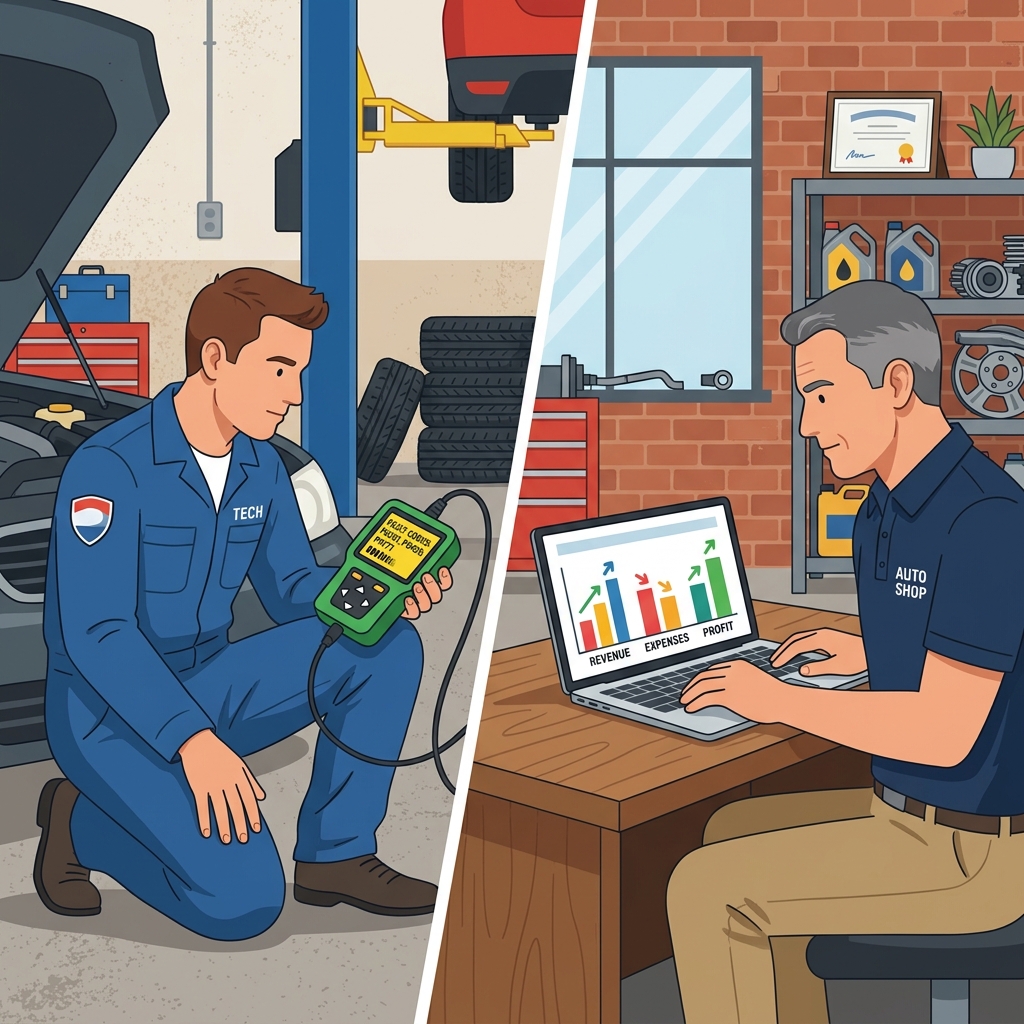
Auto repair data is any information collected, stored, or analyzed in the process of diagnosing, repairing, or running an auto repair business. It falls into two broad categories: technical repair data and business/operational data. Technical data tells you what's wrong with a vehicle and how to fix it. Business data tells you how well your shop is performing. Modern shops need both to stay competitive.
Technical repair data includes labor times, OEM specifications, Technical Service Bulletins (TSBs), wiring diagrams, diagnostic trouble codes (DTCs), and factory recall information. This is the data that helps a technician fix a 2019 Ford F-150 correctly and bill the right number of hours. Business data includes metrics like revenue, average repair order (ARO), technician productivity, customer return rates, and parts margins — the numbers that tell an owner whether the shop is actually profitable.
These two data types are more connected than most shop owners realize. A technician using accurate labor times directly affects the ARO. A higher ARO affects monthly revenue. Revenue data then informs hiring decisions. It's one continuous loop.
Major providers like ALLDATA and Mitchell 1 have built entire platforms around technical repair data. ALLDATA, which is owned by, is one of the most widely used technical data sources in the industry, with coverage for over 38,000 vehicle systems according to the company. These platforms give technicians access to factory-correct repair procedures, saving time and reducing comebacks.
On the business side, shop management software captures operational data automatically as work flows through the shop — every estimate, invoice, part ordered, and hour billed becomes a data point.
Technical vs. Business Data: What's the Difference?
The simplest way to think about it: technical data answers "How do we fix this car?" Business data answers "How is our shop doing?" Both matter, but they serve different people in the shop. Technicians rely on technical data. Owners and service advisors rely on business data. In practice, the best-run shops make both types accessible to the right people at the right time.
| Data Type | Examples | Primary User | Main Purpose |
|---|---|---|---|
| Technical | Labor times, TSBs, wiring diagrams, OEM specs, DTCs | Technicians, service advisors | Accurate diagnosis and repair |
| Business/Operational | Revenue, ARO, car count, technician efficiency, customer history | Shop owners, managers | Profitability and performance tracking |
Here's why you can't rely on just one type:
- A shop with great technical data but no business tracking might fix cars perfectly while quietly losing money on parts margins.
- A shop obsessed with revenue numbers but using outdated labor guides will underbill jobs or create angry customers with surprise charges.
- Shops that integrate both — pulling technical data into estimates and automatically tracking the business impact — tend to make faster, smarter decisions with less administrative work.
Learn how shop management platforms centralize both data types
Technical data is largely sourced externally (from OEM databases and third-party aggregators), while business data is generated internally through day-to-day operations. The challenge for most shops is that these two streams have historically lived in separate systems — a repair database over here, a spreadsheet over there. That gap is exactly what modern all-in-one platforms are designed to close.
Technical vs. Business Data: What's the Difference?
Most shop owners think about data in one bucket. But technical data and business data are fundamentally different things — and mixing them up leads to gaps in how a shop operates.
Technical data tells you what to fix and how to fix it. Business data tells you how well your shop is performing while doing that work.
Technical Data: The "What and How"
Technical repair data comes from vehicle manufacturers, engineering databases, and diagnostic systems. It answers the mechanical questions a technician needs to do the job correctly.
Common types of technical data include:
- Labor time guides — standardized hours for specific repair tasks
- Technical Service Bulletins (TSBs) — manufacturer notices about known defects or updated repair procedures
- Wiring diagrams and schematics — electrical system maps for diagnosis
- OEM specifications — torque values, fluid capacities, clearances, and tolerances
- Diagnostic trouble codes (DTCs) — fault codes pulled from a vehicle's OBD-II system
This data is largely fixed. A timing belt replacement on a 2018 Honda Accord has a defined labor time and a specific procedure — that doesn't change based on how busy your shop is.
Business Data: The "How Well"
Business data tracks shop performance over time. It's generated internally, through customer interactions, repair orders, and day-to-day operations.
Key types of business data include:
- Revenue and profit margins — total income vs. costs
- Average Repair Order (ARO) — the average dollar amount per customer visit
- Technician efficiency — how actual hours billed compare to hours on the clock
- Car count — how many vehicles move through the shop per day, week, or month
- Customer return rate — the percentage of customers who come back for future service
- Parts-to-labor ratio — how parts revenue and labor revenue are balanced
Unlike technical data, business data is unique to your shop. Two shops on the same street can have completely different AROs, return rates, and efficiency numbers.
Side-by-Side Comparison
| Technical Data | Business Data | |
|---|---|---|
| Purpose | Fix the vehicle correctly | Run the shop profitably |
| Source | OEMs, databases, diagnostic tools | Shop management software, repair orders |
| Changes over time? | Rarely (tied to vehicle specs) | Constantly (tied to shop activity) |
| Who uses it most? | Technicians, service advisors | Owners, managers, service advisors |
| Examples | TSBs, labor times, wiring diagrams | ARO, car count, efficiency rate |
Why Shops Need Both
A shop with excellent technical knowledge but no business tracking is like a mechanic who can fix any car but doesn't know if the shop is making money. The repairs are right — but the margins, efficiency, and growth trajectory are invisible.
Shops that track both types of data make faster, more confident decisions — on the floor and in the office.
In practice, the two categories intersect constantly. A labor time guide (technical data) directly affects how you price a job. That price flows into your ARO (business data). A pattern of low AROs on certain repair types might lead you back to your labor guide to check if you're billing correctly.
The shops that pull ahead are the ones treating both types of data as equally important — not choosing one over the other.
Where Auto Repair Data Comes From
Auto repair data comes from several distinct sources, and each one serves a different purpose in the shop's daily workflow. Understanding where the data originates helps shops choose the right tools and avoid gaps in their information.
OEM Databases
Original equipment manufacturers (OEMs) like Ford, GM, and Toyota publish their own technical data through subscription portals. This includes factory repair procedures, torque specs, technical service bulletins (TSBs), and wiring diagrams. In practice, this is the most accurate source for a specific make and model — but accessing dozens of OEM portals separately is impractical for most shops.
Third-Party Data Aggregators
Companies like ALLDATA, Mitchell 1, and Identifix compile OEM data and add their own layers — community repair tips, labor time guides, and diagnostic shortcuts. ALLDATA, which is owned by AutoZone, covers over 44,000 engine-specific vehicles according to their platform documentation. These aggregators make it practical for a shop to access reliable repair data across hundreds of makes and models without managing multiple OEM subscriptions.
ALLDATA does not offer a free tier. It operates on paid subscription plans, typically priced per month based on the number of users or shop size. Some libraries and vocational programs provide access, but for commercial repair use, a paid account is required.
OBD-II and Telematics Data
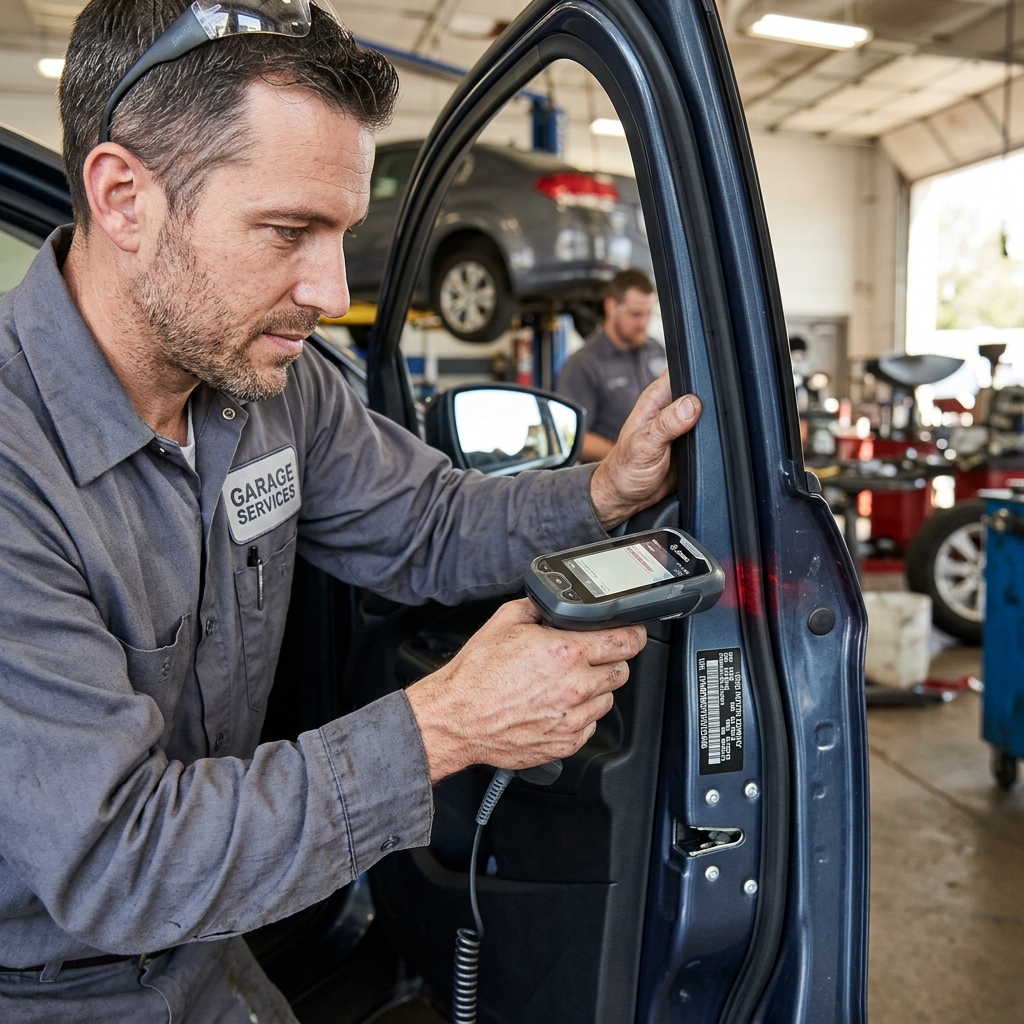
Every vehicle sold in the US since 1996 has an OBD-II port that stores diagnostic trouble codes (DTCs) and live sensor data. Shops pull this data during diagnostics using scan tools. Modern connected vehicles go further — telematics systems transmit real-time vehicle health data to manufacturers and, in some cases, directly to service platforms.
Shop Management Software
As technicians write repair orders, log parts, and complete jobs, the shop management system quietly builds its own database. Over time, this becomes one of the most valuable sources of business data a shop owns — customer records, vehicle history, revenue trends, and technician performance metrics. Unlike external databases, this data is proprietary to the shop.
These sources don't operate in isolation. A well-connected shop pulls technical data from aggregators, captures diagnostic data from scan tools, and logs everything into their management platform — creating a complete picture of each repair and each customer relationship.
How Vehicle History Data Works
Vehicle history data is a record of what has happened to a specific vehicle over its lifetime, tied to its unique 17-character. Any service shop, customer, or buyer can use a VIN to pull up a vehicle's documented past.
What a Vehicle History Report Typically Includes
- Previous owners and title transfers
- Reported accidents or damage
- Odometer readings at different points in time
- Recall and TSB history
- Emissions and safety inspection records
- In some cases, service and maintenance records
How to Look Up Vehicle Repair History
The most common consumer tool is, which aggregates data from thousands of sources including dealerships, insurance companies, and state DMVs. The is a government-run database that tracks title, theft, and salvage records — it's often the most reliable source for ownership and total-loss history.
For shops specifically, the most useful vehicle history is what's stored internally. When a customer returns for service, a shop management platform with VIN-based lookup can pull up every past repair order, parts used, mileage at each visit, and technician notes in seconds.
Internal vehicle history is often more actionable than third-party reports, because it captures the shop's own work — not just what was reported to outside databases.
How Shops Access and Use This Data
- At check-in — Search by VIN, license plate, or customer name to pull up the vehicle's full in-house history
- During inspection — Compare current findings against past services to spot patterns or flag overdue maintenance
- During the estimate — Reference prior repairs to avoid recommending duplicate work or catch warranty-eligible parts
- For customer conversations — Show customers a clear service timeline that builds trust and justifies recommendations
According to, there are over 284 million registered vehicles in the United States. Each one has a service history that grows with every visit — and shops that capture and use that history are better positioned to retain customers and deliver accurate diagnoses.
How Vehicle History Data Works
Vehicle history data is built on the VIN — the Vehicle Identification Number. Every car made after 1981 has a unique 17-character VIN that acts like a fingerprint. When a repair is recorded against that VIN, it becomes part of the vehicle's permanent data trail.
When a customer brings a car in, a shop can pull up that VIN and instantly see everything on file: past repairs, mileage at each visit, parts installed, and any diagnostic codes that were flagged. This saves time and prevents shops from recommending work that was already done.
What Records Are Typically Available
VIN-based lookups can return different types of information depending on the source:
| Data Source | What It Shows |
|---|---|
| Shop management software | In-house repair history, mileage, parts installed, technician notes |
| CarFax / AutoCheck | Accident reports, title changes, odometer readings, service records |
| Title brands, theft records, salvage and junk designations | |
| OEM dealer systems | Warranty repairs, recall completions, factory service records |
Not all service history ends up in national databases. Independent shop repairs are often only visible if that shop uses software that contributes records — or if the customer brings documentation.
is a federally mandated database that tracks title and ownership history across all 50 states. It's one of the most reliable sources for spotting salvage titles or odometer fraud.
How Shops Access Vehicle History
In practice, most shops use their shop management platform as the first stop. If a customer has been to that shop before, their vehicle's full in-house history is already linked to the VIN. For new customers, a quick CarFax or NMVTIS check fills in the gaps.
Platforms like RedAppy allow service advisors to look up a vehicle by VIN, license plate, or customer name in seconds. That lookup surfaces past repair orders, mileage records, and notes — all without digging through paper files or spreadsheets.
How Customers Can Look Up Their Own Vehicle History
Customers can access their vehicle's history through several channels:
- CarFax or AutoCheck — paid reports that compile accident, title, and some service data
- NMVTIS — free or low-cost title and brand checks through authorized providers
- Asking their shop — any reputable shop should be able to print or email a full service history from their system
- OEM owner portals — some manufacturers offer digital service records for vehicles serviced at franchised dealers
According to, vehicles with documented service history sell for measurably more on the used car market, which gives customers a direct financial reason to keep records current.
The value of vehicle history data runs in both directions. Shops use it to work faster and recommend the right services. Customers use it to make informed buying and repair decisions. When that data lives in a centralized shop management platform, both sides benefit automatically — without anyone having to chase down records manually.
Key Auto Repair Metrics Every Shop Should Track
The most important business data points for an auto repair shop are Average Repair Order (ARO), technician efficiency, car count, customer return rate, and parts-to-labor ratio. Tracking these numbers consistently is what separates shops that grow intentionally from those that guess.
Average Repair Order (ARO)
ARO is the average dollar amount collected per repair order. You calculate it by dividing total revenue by the number of repair orders completed in a given period. According to, a healthy ARO for a full-service shop typically falls between $350 and $600, though high-performing shops regularly exceed that.
A rising ARO without a rising car count often signals better inspection processes, not just higher prices.
Low ARO is one of the clearest early warning signs that a shop is undercharging, underperforming on upsells, or missing recommended services during inspections.
The "$3,000 Rule" — When Data Guides Customer Decisions
A common question customers ask is whether a repair is worth doing on an older vehicle. The informal "$3,000 rule" suggests comparing the repair cost against the vehicle's market value — if the repair costs more than the car is worth, it may not make financial sense.
This is where repair cost data becomes a customer-facing tool. When a service advisor can pull up accurate labor times, parts costs, and the vehicle's history in seconds, they can have that conversation with confidence. Shops that lack this data often lose the customer entirely because they can't justify the estimate quickly.
Technician Efficiency and Productivity Rate
Technician efficiency measures how many billable hours a technician produces compared to how many hours they were clocked in. A technician clocked in for 8 hours who produces 10 billable hours is running at 125% efficiency — meaning the shop billed more than it paid for.
Most shop management platforms calculate this automatically. Without tracking it, shop owners often don't know which technicians are carrying the workload and which are underperforming.
| Metric | Definition | Healthy Benchmark |
|---|---|---|
| Average Repair Order (ARO) | Total revenue ÷ number of repair orders | $350–$600+ |
| Technician Efficiency | Billable hours ÷ clocked hours × 100 | 100–130% |
| Car Count | Number of vehicles serviced per day/week/month | Varies by shop size |
| Customer Return Rate | % of customers who return within 12–18 months | 60–70%+ |
| Parts-to-Labor Ratio | Parts revenue ÷ labor revenue | ~1:1 for most shops |
| Gross Profit Margin | (Revenue − COGS) ÷ Revenue × 100 | 50–60% on labor |
Car Count and Customer Return Rate
Car count is the simplest metric — how many vehicles come through the door. But raw car count without context is misleading. A shop doing 60 cars a week at a low ARO may earn less than one doing 30 cars at a high ARO.
Customer return rate is the more powerful number., increasing customer retention by just 5% can increase profits by 25–95%. In an auto repair context, a customer who returns for oil changes, tire rotations, and seasonal maintenance is worth significantly more over their lifetime than a one-time visitor.
Shops that track return rate can pinpoint exactly when customers stop coming back — and act before it becomes a pattern.
Parts-to-Labor Ratio
This ratio compares how much revenue comes from parts versus labor. A healthy parts-to-labor ratio for most general repair shops is roughly 1:1, meaning for every dollar earned on labor, about a dollar is earned on parts. Shops skewing heavily toward parts may be undercharging on labor. Shops with very low parts revenue may be turning away work that requires sourcing components.
Tracking this metric over time also reveals supplier pricing trends. If parts costs creep up but retail prices don't adjust, margin compression shows up here first.
Why These Metrics Work Together
No single metric tells the full story. A shop can have a high ARO but a low car count — not enough volume to cover overhead. Or high car count but low efficiency — technicians are busy but not productive.
In practice, the shops that use data most effectively look at these metrics as a dashboard, not individual gauges. Platforms like RedAppy surface all of these numbers in real time, so a shop owner can see revenue, technician performance, and customer trends without pulling data manually from multiple sources. That visibility is what turns raw numbers into actual decisions.
Conclusion
Auto repair data falls into two clear categories, and the shops that track both have a measurable advantage over those that don't. Technical data tells you what's wrong with a vehicle and how to fix it correctly. Business data tells you whether your shop is healthy, efficient, and growing.
Throughout this guide, we've covered how these two pillars work together — from VIN-based vehicle history lookups and OEM repair specs, to ARO benchmarks, technician efficiency rates, and digital inspection workflows. Neither type of data is optional. Shops that rely only on technical data fix cars well but struggle to grow. Shops that track only business numbers know their revenue but can't diagnose why it's flat.
Shops that unify technical and business data in one place spend less time searching for information and more time turning wrenches and approving work.
The practical takeaway is straightforward: your data tools should work together, not in silos. A labor guide that doesn't connect to your estimate, a parts database that doesn't sync with your invoice, or an inspection tool that doesn't feed your vehicle history — these gaps cost you time and money every single day.
Your Next Step: Evaluate Your Current Setup
Start by asking a few honest questions about the tools you're using now:
- Do your technical data sources (labor times, TSBs, wiring diagrams) connect directly to your repair orders?
- Can you pull a customer's full vehicle history in under 30 seconds?
- Do you have a dashboard showing ARO, technician efficiency, and car count in real time?
- Are your digital inspections generating data that feeds future service recommendations?
- Does your shop management software surface insights, or just store records?
If the answer to most of these is "no" or "sort of," you're leaving both time and revenue on the table.
Platforms like RedAppy are built specifically to close these gaps. By consolidating digital inspections, real-time parts ordering, AI-assisted labor times, customer and vehicle history, and a live analytics dashboard into one system, shops can operate from a single source of truth rather than juggling multiple disconnected tools.
Auto repair is a data-intensive business — more so now than at any point in history, with vehicles generating more diagnostic information than ever before. The shops that treat data as a core business asset, not just a byproduct of doing repairs, are the ones positioned to grow, retain customers, and outperform the competition.
The right platform doesn't just store your data. It puts it to work.
Frequently Asked Questions
Can I use ALLDATA for free?
ALLDATA does not offer a completely free version, but it provides a limited free trial for new users. Paid subscriptions start at around $27/month for DIY users, with professional shop plans priced higher based on features and access level.
What is the $3000 rule for car repairs?
The $3,000 rule suggests that if a repair costs more than $3,000, you should seriously consider replacing the vehicle instead. The logic is that spending thousands on an aging car may not be worth it if the vehicle's market value is close to or less than the repair cost.
How to look up vehicle repair history?
You can look up a vehicle's repair history using its VIN (Vehicle Identification Number) through services like Carfax, AutoCheck, or the NHTSA database. Dealerships and some auto repair shops can also pull service records if the work was performed at their locations.
Is ALLDATA owned by AutoZone?
Yes, ALLDATA is a subsidiary of AutoZone, having been acquired by the company in 1996. It operates as an independent brand but benefits from AutoZone's resources, providing OEM repair data, diagnostics, and technical information to professional shops and DIY mechanics.
Ready to Transform Your Shop?
RedAppy helps auto repair shops create professional digital estimates with photos and videos, send them instantly via text or email, and get customer approvals in seconds. No credit card required to start.