
Auto Repair Invoice Forms: Types, Requirements, and Best Practices
Auto repair invoice forms are the backbone of every shop's billing process — yet many businesses treat them as an afterthought. A poorly structured invoice leads to payment disputes, missed line items, and frustrated customers. Get it right, and you build trust, speed up collections, and create a paper trail that protects your shop legally.
For auto repair businesses, invoicing isn't just about getting paid. It's a compliance document, a service record, and a communication tool all in one. According to the, repair shops must provide clear written documentation of services performed and charges. Failing to do so can expose a business to consumer protection violations.
This article covers the main types of auto repair invoice forms, what information they must include, and the best practices that separate high-performing shops from the rest. You'll also find guidance on when to use paper versus digital invoicing — and how modern shop management platforms are replacing manual forms entirely.
Table of Contents
- What Is an Auto Repair Invoice Form?
- What Every Auto Repair Invoice Must Include
- Types of Auto Repair Invoice Forms
- Conclusion
What Is an Auto Repair Invoice Form?
An auto repair invoice form is a formal billing document issued by a repair shop to a customer upon completion of service. It itemizes all work performed, parts supplied, labor charges, applicable taxes, and the total amount owed. Unlike an estimate or work order, the invoice represents the final record of a completed transaction.
How an Invoice Differs from an Estimate or Work Order
These three documents are often confused, but each serves a distinct purpose in the repair workflow.
- Estimate: A pre-authorization document that projects the expected cost of repairs. It is not a request for payment.
- Work order: An internal shop document that authorizes technicians to begin work. It tracks job progress but is not sent to the customer as a bill.
- Invoice: The final document presented to the customer after work is complete. It confirms what was done and what is owed.
Shops that treat work orders and invoices as the same document risk presenting inaccurate totals or omitting authorized changes made during the repair process.
In practice, the invoice is generated from the work order once all labor is logged and parts are confirmed. Any differences between the estimate and the final invoice typically require documented customer authorization.
The Legal Role of an Invoice
An auto repair invoice functions as a legally binding record of the transaction between the shop and the customer. It serves as proof of services rendered, supports warranty claims on parts and labor, and provides documentation in the event of a billing dispute or audit.
According to the and various state-level consumer protection statutes, repair shops are required to provide customers with written documentation of completed work and charges. California's mandates that shops provide a written invoice for any repair exceeding a defined cost threshold, and that it match the original authorized estimate unless written amendments were obtained.
Why Every Shop Needs a Proper Invoice Form
A well-structured invoice protects the shop as much as the customer. It creates a clear paper trail that supports collections, resolves disputes, and satisfies requirements from warranty administrators, insurance companies, and tax authorities.
Shops operating without a standardized invoice form are more vulnerable to chargebacks, failed warranty claims, and regulatory penalties. From experience, inconsistent invoicing is one of the most common reasons shops lose revenue they legitimately earned — not from poor work, but from poor documentation.
What Every Auto Repair Invoice Must Include
A complete auto repair invoice must contain specific fields to be legally valid, professionally credible, and useful for warranty or dispute resolution. Missing even one critical element — such as a VIN or authorization signature — can void your legal standing in a customer dispute.
| Field | Required | Optional |
|---|---|---|
| Shop name, address, phone, license number | ✓ | |
| Customer name, address, phone | ✓ | |
| Vehicle year, make, model | ✓ | |
| VIN (Vehicle Identification Number) | ✓ | |
| Odometer reading at check-in and check-out | ✓ | |
| Date of service | ✓ | |
| Invoice number | ✓ | |
| Itemized labor lines with descriptions and hours | ✓ | |
| Parts with part numbers, quantities, and unit prices | ✓ | |
| Subtotals for labor and parts | ✓ | |
| Applicable taxes (labor and/or parts) | ✓ | |
| Total amount due | ✓ | |
| Payment terms and accepted payment methods | ✓ | |
| Customer authorization signature | ✓ | |
| Technician name or ID | ✓ | |
| Warranty terms on parts and labor | ✓ | |
| Recommended future services | ✓ | |
| Shop logo and branding | ✓ | |
| QR code for digital payment | ✓ |
The VIN is non-negotiable. It ties the invoice to a specific vehicle, not just a customer, which matters during warranty claims, insurance audits, and resale history checks.
Shop and technician information establishes accountability. Most U.S. states require repair shops to display their license number on all customer-facing documents, including invoices. In California, for example, the mandates that the shop's registration number appear on every invoice.
Vehicle identification fields — year, make, model, VIN, and dual odometer readings — create a verifiable service record. The dual mileage entry (in and out) is particularly important for warranty coverage, as it documents when a service was performed relative to vehicle use.
The authorization signature confirms the customer approved the work before it was performed. Without it, a shop has little recourse if a customer disputes the charges. In practice, this signature should reference the original estimate amount and any subsequent change orders.
Payment terms must appear explicitly on the invoice — not just assumed. Terms should state the due date, any late fees, and accepted payment methods. Shops that omit payment terms often face slower collection and higher dispute rates.
Labor vs. Parts Breakdown
Separating labor and parts into distinct line items is one of the most important structural decisions on an invoice. It is not merely a formatting preference — in many states, it is a legal requirement.
Transparency builds customer trust. When a customer can see exactly what they paid for — three hours of diagnostic labor at $125/hr, plus a specific part at a stated price — they are less likely to question the total. Bundled or vague line items ("repair and parts: $600") invite suspicion and disputes.
Warranty claims depend on the separation. Parts warranties and labor warranties are handled differently. A defective part may be covered by the manufacturer, while the labor to reinstall it may be the shop's responsibility. If the original invoice does not separate these costs, calculating the correct remedy becomes difficult and often contentious.
Insurance and fleet billing require it. Insurance companies and fleet accounts routinely audit invoices. They expect discrete labor and parts lines with verifiable part numbers. An invoice that lacks this structure is often rejected or flagged for review, delaying payment.
A labor line should include the operation description, the flat-rate or actual hours charged, the labor rate, and the line total. Vague entries like "misc. labor" create liability during audits and warranty disputes.
From experience, shops that itemize every line — including shop supplies as a separate line rather than a percentage markup buried in totals — report fewer billing disputes and faster approvals from insurance adjusters.
Taxes, Fees, and Compliance Requirements
Tax treatment of auto repair invoices varies significantly by state, and applying the wrong rate — or no rate — creates compliance risk.
Labor and parts are often taxed differently. In many states, parts are subject to sales tax while labor is not. In others, both are taxable. According to the, at least 22 states tax some or all auto repair labor, while others exempt it entirely. Shops operating near state borders or with multiple locations must apply the correct rules for each jurisdiction.
Shop supply fees and hazardous waste disposal fees are common additions on auto repair invoices. These must be disclosed as separate line items in most states — they cannot be embedded in parts or labor costs. California's Bureau of Automotive Repair, for instance, requires that any fee added to an invoice be explicitly authorized by the customer in advance.
Disclosure laws govern estimate-to-invoice alignment. Many states cap how much a final invoice can exceed the written estimate without additional customer authorization — often 10% above the estimate. Shops that exceed this threshold without a signed change order can face regulatory penalties, customer refunds, or both.
| State Example | Labor Taxable | Parts Taxable | Estimate Overage Rule |
|---|---|---|---|
| California | No | Yes | Authorization required for any increase |
| Texas | Yes | Yes | No statutory cap, but disclosure required |
| New York | No | Yes | Must notify customer before exceeding estimate |
| Florida | No | Yes | No statutory cap |
Always verify current tax rules with your state's department of revenue. Tax treatment for auto repair changes more frequently than most shop owners realize, and a single audit can result in back-taxes owed on years of incorrect filings.
Shops should review their invoicing practices against state-specific requirements at least annually. A shop management platform that allows configurable tax rules by line item type reduces the risk of consistent errors across hundreds of repair orders.
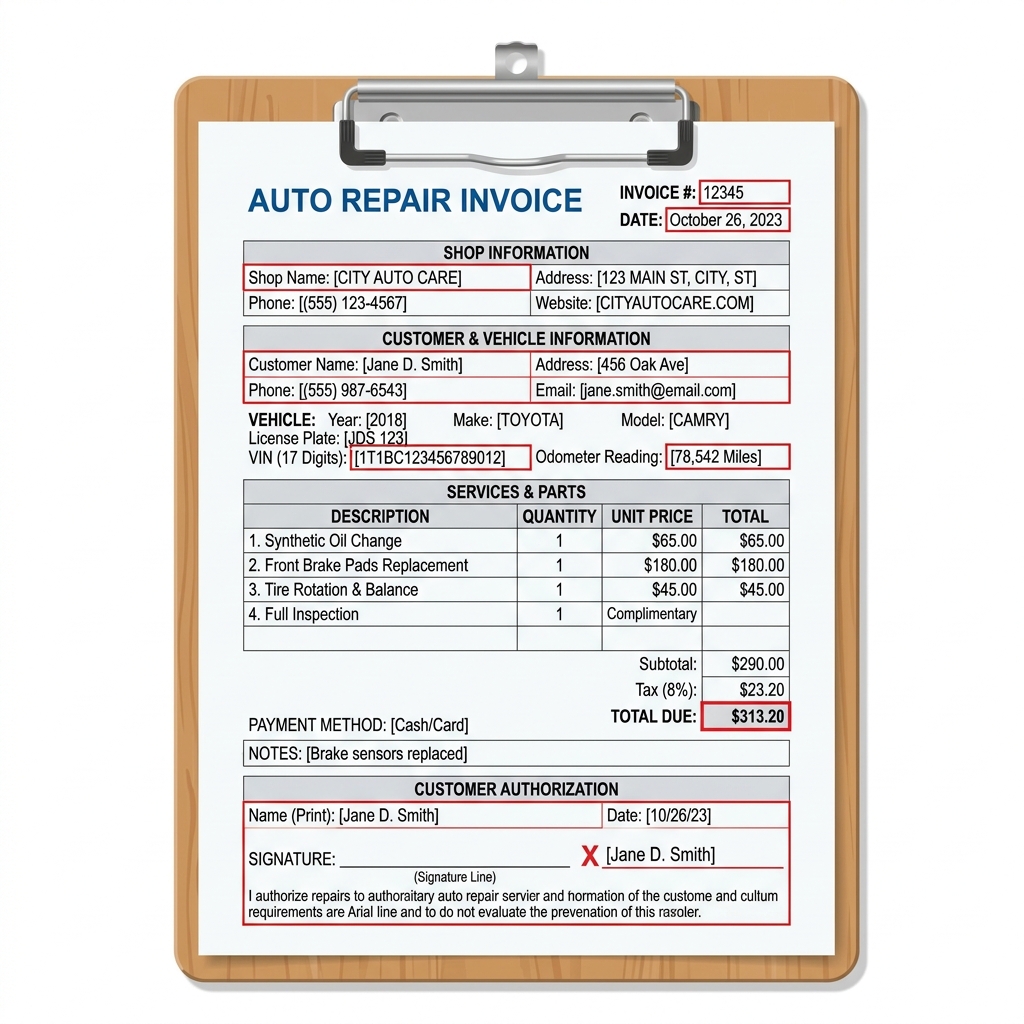
Labor vs. Parts Breakdown
Separating labor and parts into distinct line items on an auto repair invoice is not optional best practice — it is a functional requirement for transparency, legal compliance, and customer trust.
Why the Separation Matters
Labor charges reflect the technician's time and skill. Parts charges reflect the cost of physical components. These two categories carry different tax treatments, different warranty implications, and different consumer protections depending on the state. Combining them into a single "service fee" creates ambiguity that can trigger disputes, failed audits, or warranty claim denials.
Customers who can see exactly what they paid for — and why — are far less likely to dispute a charge after the fact.
Transparency and Customer Trust
An itemized breakdown allows the customer to verify that the work matches the original estimate. According to the, consumers have the right to an itemized list of parts and labor before paying. When a shop presents a single bundled total, it removes the customer's ability to cross-check that right.
In practice, shops that provide clear labor and parts breakdowns report fewer post-service complaints. The customer understands the value delivered: labor is the expertise, parts are the materials.
Warranty Claims Require Line-Item Detail
Parts warranties — whether from the supplier or passed through to the customer — apply only to the component itself, not the installation labor. If a part fails under warranty, the shop must be able to show:
- The part number and description installed
- The unit cost of that part
- The labor time charged for original installation (which may or may not be covered under re-installation)
Without a clean separation, processing a warranty claim becomes a manual reconstruction exercise. This slows the shop down and can lead to disputes with suppliers or customers over what is actually covered.
Labor Descriptions Should Be Specific
Each labor line item should include a brief description of the task performed and the number of hours billed. Vague entries like "engine work — 3 hrs" are harder to defend in a dispute than "remove and replace timing belt, water pump, and tensioner — 3.2 hrs." Many shops reference standard labor time guides, such as those published by, to establish defensible time estimates.
Parts Should Include the Part Number
Every parts line item should list the part number, description, quantity, and unit price. This serves three purposes:
- It confirms the correct part was installed
- It gives the customer a reference point for price verification
- It supports the supplier's warranty process if the part fails
Flagging Sublet and Shop Supplies Separately
Some invoices include additional categories beyond standard labor and parts. These should also appear as separate line items:
| Category | Description | Examples |
|---|---|---|
| Labor | Technician time on the vehicle | Diagnosis, installation, alignment |
| Parts | Physical components installed | Brake pads, filters, sensors |
| Sublet | Work outsourced to a third party | Alignment at another facility, glass replacement |
| Shop Supplies | Consumables used during repair | Rags, fluids, fasteners |
| Hazardous Waste Disposal | Disposal fees for regulated materials | Used oil, refrigerant, batteries |
Mixing these categories into labor or parts totals distorts the actual cost structure and can create compliance problems in states that regulate shop supply fees separately.
Taxes, Fees, and Compliance Requirements
Labor and parts are not always taxed at the same rate — and in many states, they are taxed differently by law. Understanding these distinctions is essential for invoicing accuracy and regulatory compliance.
How Labor and Parts Are Taxed
In most U.S. states, parts and materials sold to a customer are subject to sales tax, because they are treated as tangible goods. Labor charges, however, are often exempt from sales tax — but not always. According to the, roughly 20 states tax some or all repair labor, while the majority exempt it. The exact rules vary significantly by jurisdiction.
| Item Type | Commonly Taxed? | Notes |
|---|---|---|
| Parts and materials | Yes, in most states | Treated as tangible personal property |
| Shop supplies/consumables | Varies | Some states tax; others allow flat-fee disclosure |
| Labor (mechanical repair) | No, in most states | Exceptions include Hawaii, New Mexico, South Dakota, and others |
| Sublet repairs | Varies | Depends on whether the shop marks up the service |
| Hazardous waste fees | Varies | Some states require separate disclosure |
Because rates and rules change, invoices should calculate tax line items separately for parts and labor rather than applying a single blended rate to the total.
Applying a single tax rate to a combined parts-and-labor total can result in either overcharging the customer or underpaying the state — both of which create legal exposure.
State Disclosure and Compliance Laws
Several states impose specific disclosure requirements on repair invoices beyond basic tax rules. California has among the most detailed regulations in the country, administered by the. Under California Business and Professions Code Section 9884, shops must:
- Provide a written estimate before beginning any work
- List parts by type (new, used, remanufactured, or rebuilt) on both the estimate and the final invoice
- Obtain customer authorization before exceeding the estimate by a defined threshold
- Return replaced parts to the customer upon request
Other states with notable automotive repair consumer protection statutes include New York, Texas, and Florida. Each has its own thresholds for when written authorization is required and what must appear on the invoice.
Failing to disclose part condition (new vs. remanufactured) on an invoice is a common compliance gap that can expose shops to consumer protection complaints, even when the repair itself was done correctly.
Shop Supplies and Hazardous Waste Fees
Many shops charge a shop supply fee — a line item covering consumables like rags, cleaners, and small hardware that are difficult to track individually. In practice, this fee is legal in most states, but it must be disclosed on the invoice. Some states cap the maximum amount or require it to be expressed as a percentage of labor.
Hazardous waste disposal fees (for oil, coolant, brake fluid, and similar materials) are similarly regulated in states like California and Washington. These must appear as a separate, itemized line on the invoice — not buried in labor or parts totals.
Multi-State and Multi-Location Considerations
Shops operating across state lines or in multiple locations face added complexity. Tax rates, disclosure requirements, and permissible fee structures differ by state and sometimes by county or municipality. In practice, manual invoicing makes it difficult to apply the correct rules consistently across locations.
Shop management software that integrates tax tables by jurisdiction significantly reduces this risk. See how digital invoicing tools handle compliance for a detailed breakdown of what to look for in a platform.

Types of Auto Repair Invoice Forms
Auto repair invoice forms fall into three broad categories: handwritten paper forms, generic digital templates, and invoices generated by purpose-built shop management software. Each format serves the same core function but differs significantly in speed, accuracy, and professional presentation.
Handwritten and Paper Forms
Paper invoice forms are the oldest and most basic option. A technician or service writer fills out a preprinted form by hand, recording labor, parts, and totals manually.
In practice, paper forms are prone to legibility errors, math mistakes, and missing fields. They offer no automatic calculation, no integration with parts ordering, and no searchable record-keeping. Shops using paper forms typically spend more time on billing corrections and dispute resolution.
Paper forms are still used in very low-volume operations or as backup documents during system outages. For any shop processing more than a handful of repair orders per week, the limitations quickly outweigh the low setup cost.
Generic Digital Templates (Word and PDF)
Generic templates — created in Microsoft Word, Excel, or PDF editors — are a step up from handwritten forms. They can be printed or emailed, and some include basic formula fields for automatic totals.
These templates are inexpensive and widely available. However, they require manual data entry for every invoice, do not connect to parts suppliers or estimate workflows, and must be stored and retrieved manually. Version control is also a common problem: shops may use outdated templates that omit required fields.
Generic templates eliminate handwriting errors but still leave shops vulnerable to omissions, inconsistent formatting, and disconnected recordkeeping.
Purpose-Built Shop Management Software
Shop management platforms generate invoices directly from the repair workflow. When a technician completes a digital inspection and an estimate is approved, the invoice populates automatically with labor times, part numbers, prices, and customer information already entered earlier in the process.
This format eliminates redundant data entry, reduces billing errors, and maintains a complete searchable history for every vehicle. Invoices produced by software are also more consistent, since required fields are enforced by the system rather than left to individual discretion.
According to the, administrative inefficiency is one of the leading contributors to profit leakage in independent repair shops. Automated invoicing directly addresses that issue.
Comparison Table
| Format | Speed | Accuracy | Professional Appearance | Record-Keeping | Integration |
|---|---|---|---|---|---|
| Handwritten paper | Slow | Low | Low | Manual filing | None |
| Word/PDF template | Moderate | Moderate | Moderate | Manual filing | None |
| Shop management software | Fast | High | High | Automatic, searchable | Parts, estimates, payments |
Shops generating 20 or more repair orders per week will typically find that manual formats — paper or template — create a measurable administrative burden that compounds over time.
The format a shop uses directly affects how quickly invoices are issued, how often disputes arise, and how easily records can be retrieved for warranty claims or audits. That decision is worth examining carefully, which is what the next section addresses.
Conclusion
A complete, legally sound auto repair invoice is not a formality — it is the document that protects the shop, satisfies the customer, and holds up under audit or dispute. Every invoice must include shop and customer identification, full vehicle details, itemized labor and parts with separate line items, applicable taxes, total charges, payment terms, and a signed authorization.
The shift from paper to digital is no longer a matter of preference. Shops processing more than a handful of repair orders per week face real administrative costs from manual invoicing: time spent writing up tickets, transcription errors, missing fields, and documents that cannot be searched or retrieved quickly. Purpose-built shop management platforms eliminate those costs by converting inspections and estimates into invoices automatically, collecting payment digitally, and storing every record in a searchable history.
Shops that standardize their invoicing process — whether through software or a consistent paper template — experience fewer billing disputes, faster payment cycles, and stronger customer trust.
The core standards remain constant regardless of format:
- Shop and customer information must be complete and accurate
- Vehicle details including VIN, mileage, year, make, and model must appear on every invoice
- Labor and parts must be itemized separately, each with descriptions, quantities, and unit prices
- Tax treatment must comply with state law, which often differs between labor and parts
- Payment terms and due dates must be stated explicitly
- Customer authorization must be documented before work begins and referenced on the final invoice
For shops evaluating their current process, the practical next step is to compare what your invoices include today against those required fields. If fields are missing, or if your current format cannot produce an itemized breakdown quickly, that gap represents both a compliance risk and a customer experience problem.
Platforms like RedAppy address this directly by connecting every stage of the workflow — from the first customer lookup to the final payment — so that the invoice reflects the actual work performed, matches the approved estimate, and reaches the customer without additional manual entry. The result is fewer errors, less administrative time, and a professional record that supports the shop's reputation and revenue.
For further reading on invoice compliance and consumer protection standards in automotive repair, the publishes detailed regulatory guidance that serves as a practical benchmark even for shops operating outside California. The also provide a useful legal reference point.
The invoicing standard a shop sets reflects the business it intends to run. Shops that invest in accurate, complete, and professional invoicing reduce risk and build the kind of customer record that supports repeat business and long-term growth.
Ready to Transform Your Shop?
RedAppy helps auto repair shops create professional digital estimates with photos and videos, send them instantly via text or email, and get customer approvals in seconds. No credit card required to start.