
Auto Repair Trends: A Guide to Future-Proof Your Shop
The day usually starts the same way. A service advisor is on the phone explaining a quote, a technician is waiting on approval, a customer at the front desk wants an update, and someone is digging through paper notes to figure out whether the part was already ordered. That kind of chaos doesn't mean the shop is failing. It usually means the shop is busy, growing, and running into the limits of an older workflow.
That's why auto repair trends matter less as headlines and more as operating decisions. Most independent shops don't need every new tool, every EV gadget, or every software add-on. They need a tighter process that gets approvals faster, keeps bays moving, and gives customers the kind of convenience they already expect everywhere else.
The opportunity is real. The says the market is projected to grow from USD 1,033.6 billion in 2025 to nearly USD 2,065.2 billion by 2035, with a 7.2% CAGR. For shop owners, that doesn't mean chasing trends for their own sake. It means building a shop that can capture more of the work already coming.
Table of Contents
- The Changing Landscape of Auto Repair
- Meeting the Modern Customer's Expectations
- Navigating Vehicle Complexity and Electrification
- Implementing a Data-Driven Repair Workflow
- Solving the Technician Shortage with Technology
- Adapting to New Auto Repair Economics
- Your Blueprint for a Modern Repair Shop
The Changing Landscape of Auto Repair
Monday at 8:15 a.m. usually tells the truth about a shop. Three customers are waiting up front. One advisor is chasing an approval. A technician is stalled because the inspection notes are incomplete. Another car is tying up a bay while everyone waits on a parts ETA. The problem is not demand. The problem is how work moves.
That shift is reshaping the field. Shops are dealing with older vehicles, more electronics, more calibration-related work, and customers who expect the same convenience they get everywhere else. According to, the average age of vehicles on the road in the U.S. reached a record high in 2024. That creates opportunity for independent garages, but it also means more vehicles arrive with stacked maintenance needs, intermittent issues, and longer service histories to sort through.
More car count does not fix a weak process.
Your shop's workflow is like an assembly line. If the handoff between intake, inspection, estimate, approval, parts, and production is loose, every small delay turns into lost hours and blocked capacity. I see shops spend real money on new tools while the highest-return fix is still sitting in plain view. Faster estimates. Easier approvals. Clear status updates. Those three steps usually improve average repair order and reduce follow-up calls before a shop needs anything more ambitious.
Why demand can still strain a profitable shop
Older vehicles and more complicated systems increase the value of good service advisors and disciplined process. They also punish inconsistency. A shop can stay busy all month and still give away margin through slow authorizations, weak documentation, and stop-and-start production.
The strongest operators handle this as an operations issue, not a shopping list for software. They look for the points where revenue stalls:
- Vehicles waiting on estimate approval: The bay stays occupied while the customer waits to hear a voicemail.
- Technicians missing context: Poor notes and scattered history create repeat questions and wasted motion.
- Advisors buried in updates: Time goes to phone tag instead of selling needed work.
- Parts and job status out of sync: Cars sit half-finished because nobody has one clear view of what is approved, ordered, and ready.
That is the practical change happening across auto repair. The winners are not the shops buying every new platform. They are the ones fixing the few digital handoffs that directly affect throughput, ARO, and retention.
Meeting the Modern Customer's Expectations
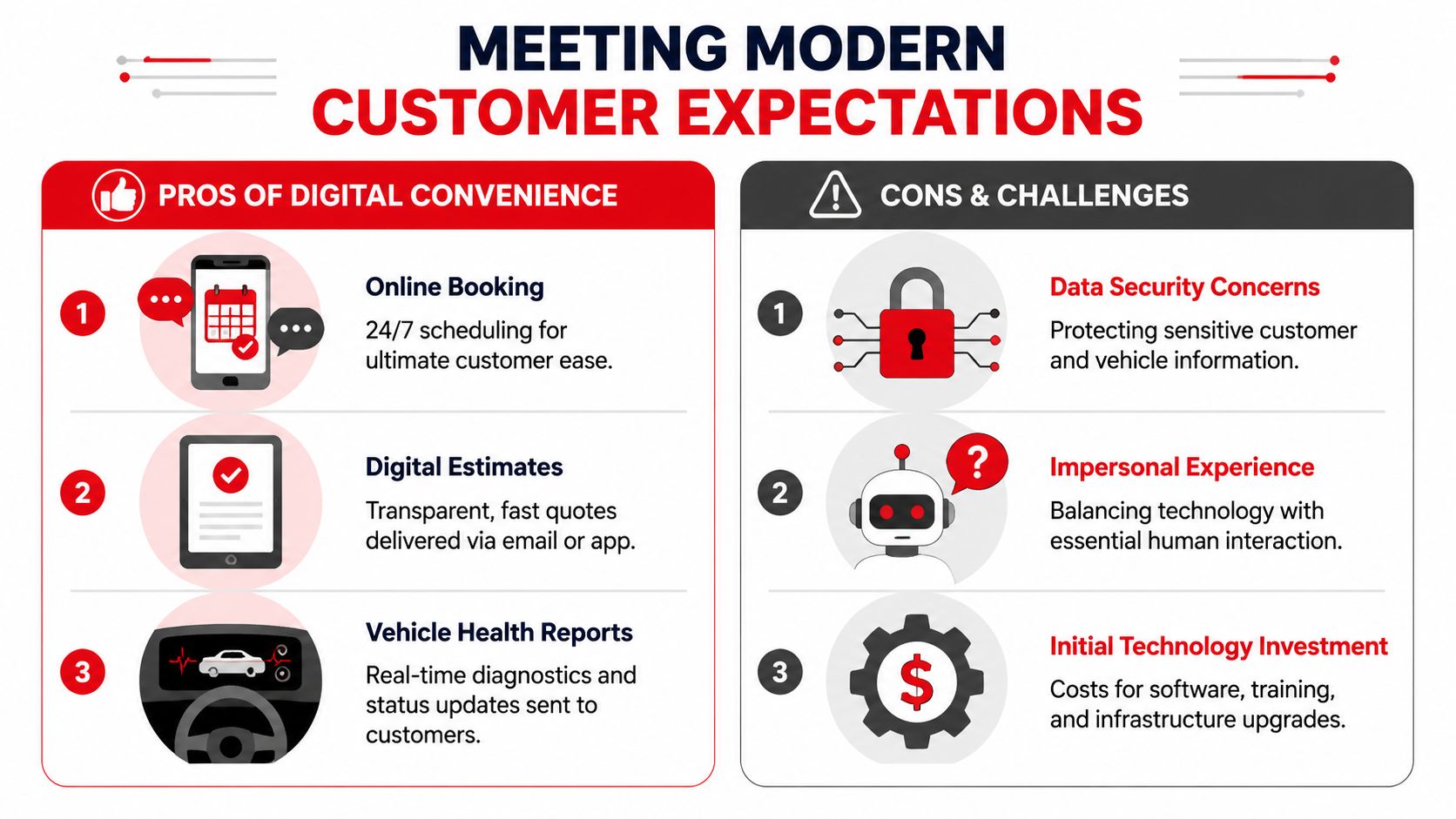
Customers don't compare a repair shop only to other repair shops anymore. They compare it to every other service experience they already use. They expect quick updates, clear approvals, and less back-and-forth. If a shop still depends on voicemail, paper estimates, and “we'll call you later,” trust starts leaking before the repair even begins.
This is one of the clearest auto repair trends because it affects both conversion and average ticket. According to, more than 70% of consumers now look for features like digital communication and transparent service updates before choosing a shop, and SMS and email approval requests average 50% higher value than shops without digital authorization.
Digital convenience that actually changes approvals
Not every digital feature produces the same return. The highest-ROI moves are the ones connected directly to a repair decision.
A practical stack usually starts here:
- Digital estimates: Customers can review the work without being tied to a live phone call.
- SMS or email approvals: Advisors stop chasing signatures and can move jobs faster.
- Status updates: Customers stay informed, which cuts down inbound calls and front-desk interruptions.
- Online payment: Pickup gets smoother, especially late in the day when the counter is slammed.
Those tools work because they solve a decision problem, not just a branding problem. When customers can see the estimate, understand the recommendation, and approve it from their phone, the shop compresses idle time. The car gets moving sooner.
Practical rule: If a digital feature doesn't speed up authorization, reduce call volume, or improve handoff clarity, it's probably not the first thing to buy.
What to skip until the basics work
A lot of owners hear “go digital” and assume they need a large software stack all at once. That's where over-investment starts. Fancy customer portals, broad marketing automation, and niche integrations can wait if the shop still struggles with the basic flow of estimate, approval, and update.
A simple decision filter helps:
| Shop need | High-ROI response | Lower-priority add-on |
|---|---|---|
| Slow customer approvals | SMS and email estimate approval | Extra app layers customers may never use |
| Too many “what's going on with my car?” calls | Automated status updates | Generic chat widgets |
| Disputes over recommended work | Photo-backed inspections and clear estimates | Cosmetic front-end tools |
| Long pickup delays | Online payment and clean invoicing | Secondary loyalty features |
The point isn't to avoid technology. It's to buy in sequence. A shop's workflow should feel like a service lane, not a gadget shelf. Start where money and time get trapped.
Navigating Vehicle Complexity and Electrification
Vehicles have become harder to service, but the main challenge isn't complexity by itself. The challenge is deciding where to invest first. Shops hear constant pressure around EV capability, ADAS calibration, scan tools, and training. All of those matter. None of them should force a rushed capital decision.
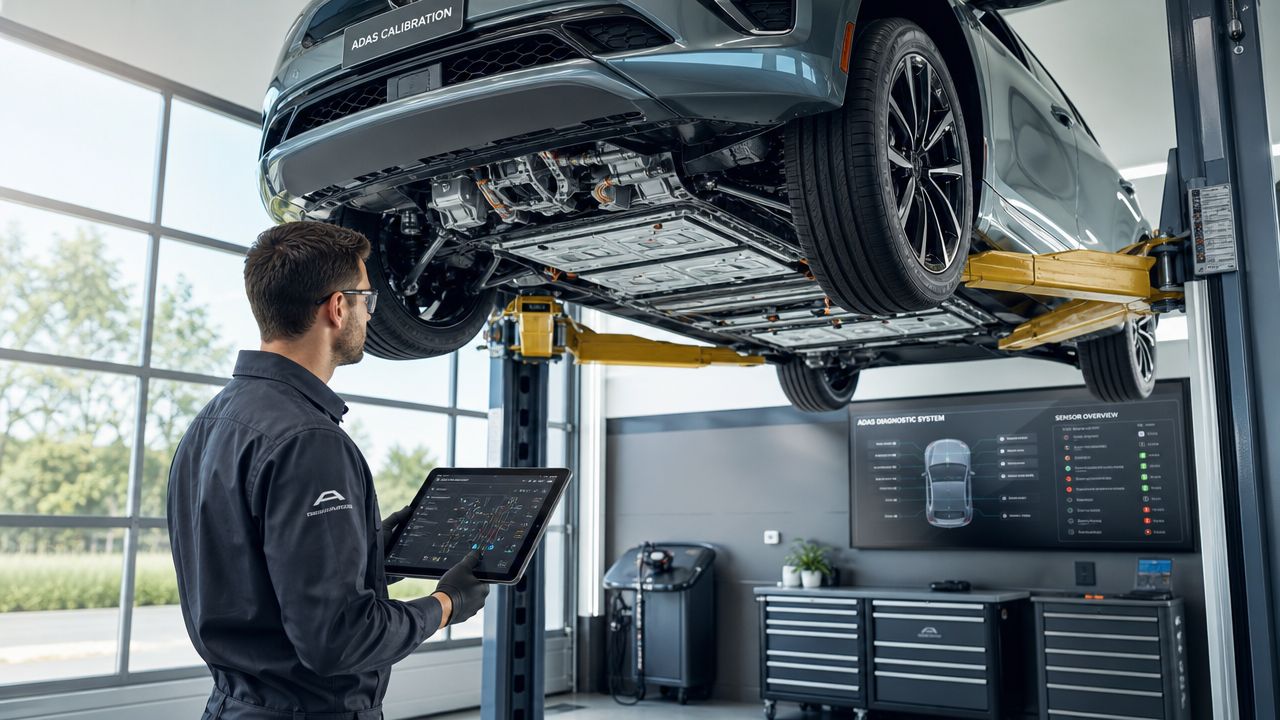
Complexity changes the service mix. It also changes the cost of being wrong. Buying equipment before the work volume exists can tie up cash in assets that sit idle. Waiting too long can leave the team unprepared for profitable work already appearing in the market. The smart move is phased adoption.
The phased investment approach
A practical shop doesn't ask, “Should every capability be added now?” It asks three narrower questions.
First, what work is already being requested locally. Second, which services fit existing technician strengths. Third, which investment opens near-term revenue without creating too much training drag.
That leads to a phased model:
- Deepen high-frequency work first. Strengthen diagnostics, maintenance, drivability, and climate-control services.
- Add training before major hardware. Train the team on newer systems before buying every specialized tool.
- Use referral partners for edge cases. Keep complex work moving without overextending the shop.
- Expand capabilities once demand is visible. Let real service mix guide the next purchase.
Where many shops can win first
One of the more useful signals comes from search behavior. The reports that “AC repair near me” and “AC repairs near me” are up 50% year over year, while broader terms like “auto repair” and “automotive repair” are down 45–55% YoY. That matters because it points to a practical near-term opportunity. Many independent shops may get better ROI by getting sharper in climate-control and maintenance work before making large EV-capability investments.
That's the contrarian part many trend pieces miss. A shop can respect electrification without trying to become everything immediately. There's still strong demand for profitable work that customers actively search for in plain language.
The shop that masters common, high-intent services usually earns the right to fund the next training phase from operating cash instead of hope.
A good shop plan might look like this:
- Near term: tighten AC diagnostics, maintenance packages, and inspection quality
- Mid term: train key technicians on hybrid and EV-adjacent systems
- Later: add heavier EV tooling when car parc, local demand, and technician readiness line up
That approach protects cash, keeps utilization healthy, and avoids the expensive trap of buying capability before the market is ready for it.
Implementing a Data-Driven Repair Workflow
A car can be diagnosed correctly, approved quickly, and still lose profit if the handoffs are sloppy. Your shop's workflow is like an assembly line. If one station pauses, every car behind it waits too. In most independent garages, the expensive delays are not the repair itself. They happen between inspection, estimate, approval, parts sourcing, and status updates.
That is why the highest-ROI digital upgrades are usually not flashy. They are the tools that shorten decision time and reduce rework. Digital estimates, customer approvals by text or email, and automatic status updates do more for ARO and retention than a long list of features your team barely uses.
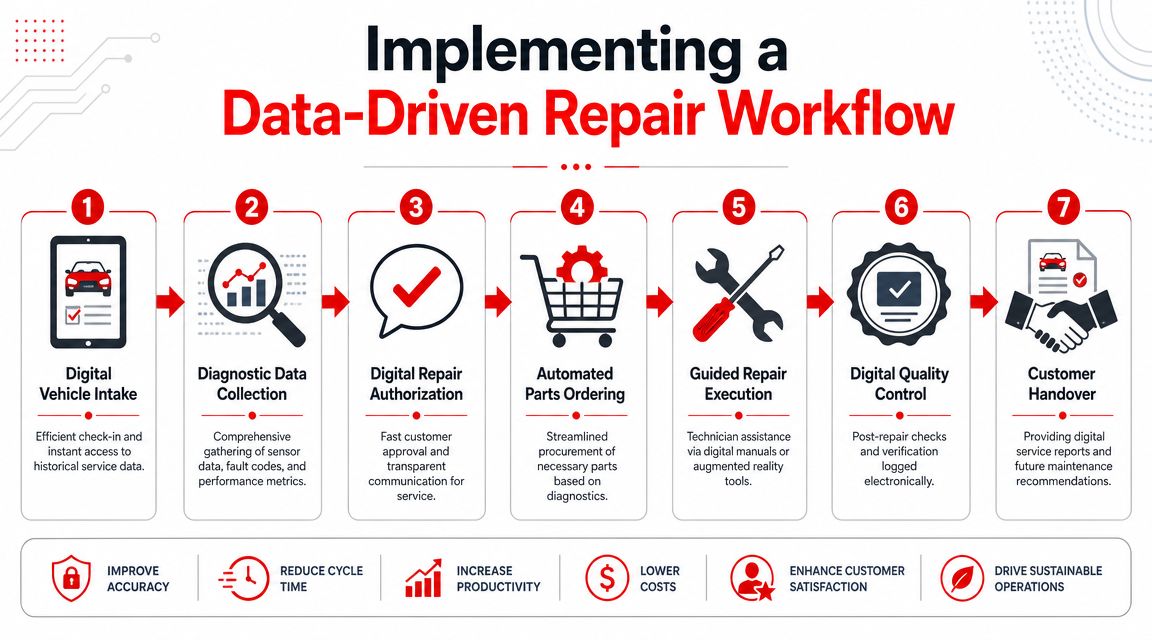
Many owners overbuy here. They pay for a full software stack before fixing the three moments that customers care about most. What is wrong with my car, what will it cost, and when will it be ready? Start there. If the system makes those answers faster and clearer, it usually earns its keep.
Turn the repair order into a live workflow
A repair order should work like a live job file, not a static document that gets rewritten at every desk. The best process captures information once, then carries it through the job without repeated phone calls, duplicate entry, or missing notes.
A practical workflow usually looks like this:
- Digital intake: Capture vehicle details, customer concerns, and prior history once.
- Inspection with photos or video: Show the customer the finding, not just the recommendation.
- Estimate tied to findings: Connect line items directly to inspection results.
- Remote approval: Let customers approve work without waiting for a callback window.
- Integrated parts ordering: Keep sourcing connected to the active job.
- Job status visibility: Give advisors and technicians a clear view of what is approved, waiting, or blocked.
- Final handoff: Send the invoice, payment link, and deferred work notes in a clear format.
That structure matters because every extra handoff creates drag. Advisors spend less time chasing answers. Technicians get fewer interruptions. Customers get faster responses, which is often the difference between partial approval and full approval.
The same logic shows up across the trades. The broader point to the value of reducing admin friction so skilled workers spend more time on billable work.
What good workflow data should reveal
Good workflow data does not exist to make reports look smarter. It should help an owner find where profit stalls.
A useful dashboard answers operational questions like these:
| Operational question | What the workflow should reveal |
|---|---|
| Where do approvals slow down? | Estimate sent time, viewed time, approved time |
| Which jobs wait too long for parts? | Parts status linked to active work orders |
| Which technicians are getting interrupted by admin tasks? | Stage delays before repair start |
| Which recommendations convert consistently? | Inspection findings tied to approved line items |
Many shops can stay disciplined on spending. If a tool does not improve estimate conversion, shorten approval time, or make status communication easier, it may be software bloat. Customers rarely reward you for buying more technology. They reward you for making the process easier.
A system such as RedAppy's shop management platform and features is an example of this model, integrating inspections, estimates, invoicing, parts ordering, analytics, and a digital shop board into a single platform. For some shops, that reduces handoffs between separate tools. For others, a lighter setup that handles estimates, approvals, and updates well may produce better ROI.
Solving the Technician Shortage with Technology
Monday morning in a busy shop usually does not break down because nobody wants to work. It breaks down because a good technician loses 20 small chunks of time before lunch. An advisor interrupts to clarify a line item. A vehicle history note is missing. A customer has not approved the job yet. Parts status lives in someone's inbox. None of that requires a better technician. It requires a better system.
As noted earlier, technician shortages and training pressure are still squeezing independent shops. The practical response is not buying every new tool that promises automation. The better move is to remove low-value admin work first, especially the handoffs that pull technicians away from diagnosis and repair.
Productivity is part of retention
Good technicians notice process fast. If dispatching is unclear, repair information is scattered, and every update depends on someone walking the floor, the job feels harder than it should. That hurts retention before compensation even enters the conversation.
The same pattern shows up across the trades. These are useful context because they point to a broader labor reality. Skilled people stay longer where work is organized, delays are reduced, and the day feels productive.
A shop that runs cleanly is easier to staff.
Start with the tools that protect billable hours
Owners can waste a lot of money here. Fancy software does not solve a shortage if it adds screens, setup work, and duplicate data entry. The highest-ROI tools are usually the ones that cut interruptions and keep the front office from bottlenecking the bays.
Focus on a short list:
- Digital estimates and approvals: Advisors get authorizations faster, and technicians are less likely to sit on hold waiting for a phone callback.
- Status updates customers can receive without a phone tag loop: Front-counter staff spend less time repeating the same answer, which frees them to sell approved work and keep jobs moving.
- A digital shop board: Everyone can see job status, bay load, and waiting work without chasing updates verbally.
- Centralized vehicle history and inspection notes: Techs and advisors can find prior recommendations and current findings in one place instead of piecing together context from paper and memory.
Your shop's workflow is like an assembly line. If one station keeps stopping to ask what is approved, what parts are in, or what the customer said, the whole line slows down. The right technology removes those stops. The wrong technology creates new ones.
That is the trade-off owners need to keep in view. If a tool helps you send estimates faster, get approvals quicker, and keep customers informed without tying up the service desk, it usually pays for itself. If it mainly gives you more dashboards, more notifications, and more training time, it is overhead dressed up as innovation.
Adapting to New Auto Repair Economics
The financial side of repair has tightened. Customers still need the work, but they notice every quote more closely. Shops still need margin, but costs have been climbing across labor, parts, and operations. In that environment, blunt price increases only solve part of the problem.
The consumer repair cost analysis reports that U.S. maintenance and repair costs rose 6.5% in one year, and cumulative repair-cost inflation increased nearly 25% from the start of 2022 through June 2024. The same source notes that basic services typically run $95-$237, annual service $157-$355, and major service $296-$474. Customers feel those numbers. Shops do too.
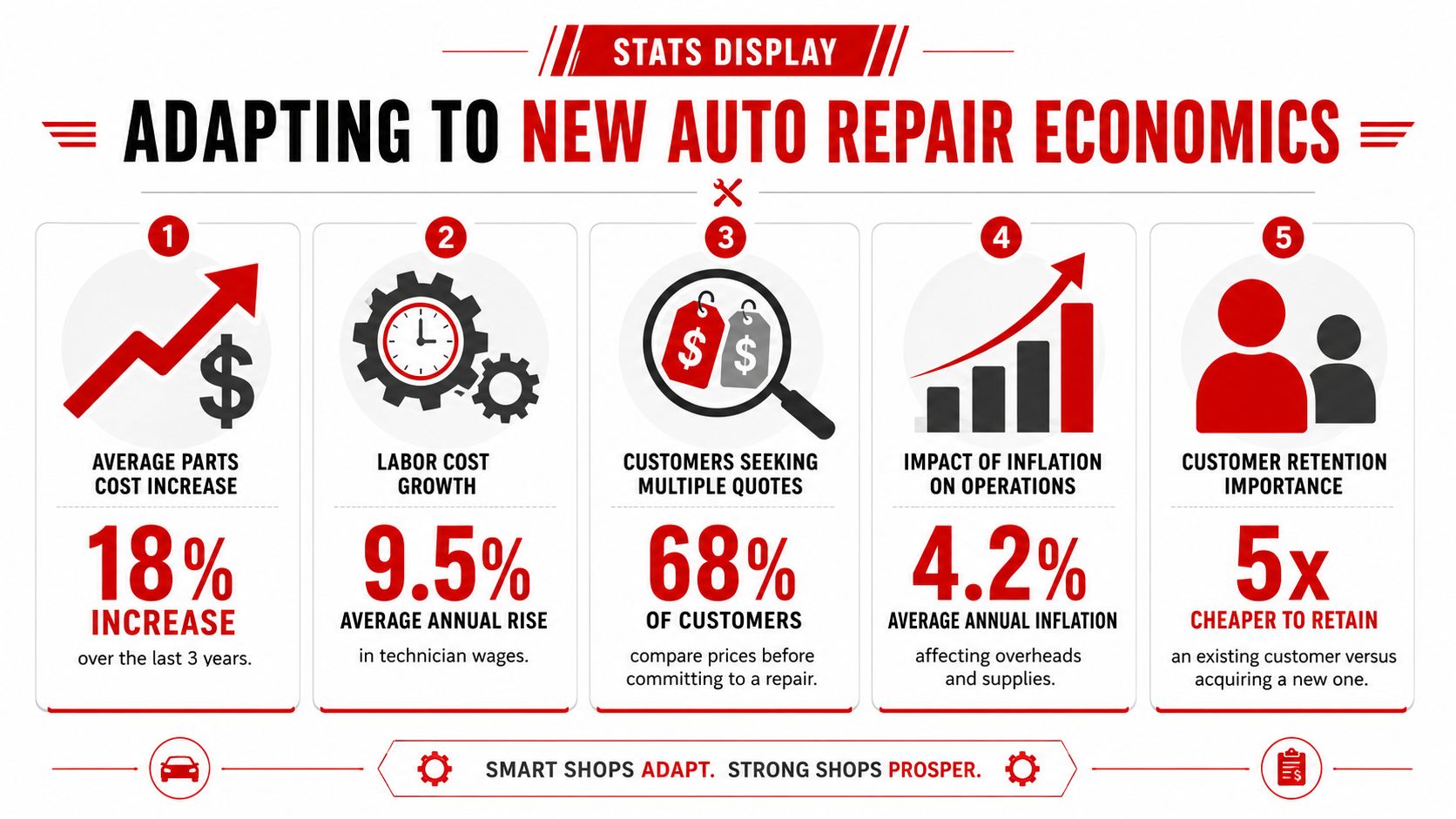
Margin gets protected in the process, not at the counter
When costs rise, owners often focus first on the labor rate. That matters, but rate alone won't protect profit if the shop still loses time on slow estimates, weak authorizations, or parts delays.
Three margin leaks show up repeatedly:
- Estimate drag: Cars sit while the team waits for customer contact.
- Under-documented work: Advisors struggle to justify needed repairs clearly.
- Administrative friction: Staff spend too much time moving information manually.
Each one reduces throughput or conversion. Efficient estimating and cleaner communication matter because they preserve productive hours the shop already has.
A better response than blanket price hikes
A stronger response usually combines a few operational moves:
| Economic pressure | Better shop response |
|---|---|
| Higher operating costs | Tighter estimating and approval flow |
| Price-sensitive customers | Clear evidence, cleaner communication, fewer surprises |
| Parts and wage pressure | Better workflow discipline and less wasted labor time |
| Margin compression | Focus on jobs that move smoothly from inspection to approval |
That's the useful part of current auto repair trends. The healthiest shops aren't trying to be cheaper. They're trying to be clearer, faster, and more consistent. Those traits protect margin better than a reactive pricing strategy alone.
Your Blueprint for a Modern Repair Shop
A modern shop doesn't need to look futuristic. It needs to run cleanly. The winning blueprint is usually simple: one system for intake, one clear inspection process, one easy way to approve work, one visible board for job status, and one reliable record for the vehicle and customer.
That's the operating model many shops are moving toward because it solves several problems at once. It helps the front counter answer customers faster. It gives technicians better context. It reduces dead time between estimate and approval. It gives owners better visibility into where profit is made or lost.
A practical operating model
For most independent garages, the blueprint looks like this:
- Start with communication: digital estimates, approvals, and status updates
- Standardize the inspection: every technician documents findings the same way
- Make the shop board visible: jobs should move through stages, not disappear into memory
- Keep history centralized: no more searching across notes, tabs, and paper files
- Add reporting that supports decisions: not vanity metrics, but workflow and profitability visibility
That kind of structure also makes marketing more effective. If a shop plans to invest in visibility, the offer and customer experience need to hold together. For owners thinking about that side of the business, the is a useful companion resource because it focuses on how repair shops can attract demand that their process can convert.
What to evaluate in a shop platform
Not every system is worth the disruption of switching. The right questions are practical.
- Does it remove duplicate entry?
- Does it speed approvals instead of just storing estimates?
- Does it help the team see job status instantly?
- Does it connect inspections, invoicing, parts, and analytics in one place?
- Can the shop adopt it without forcing a complete operational rewrite overnight?
Shops that want to see one example of that all-in-one approach can review RedAppy's contact options to discuss their current process, or compare workflows and capabilities through the platform details linked earlier. The point isn't to buy more technology. It's to choose a system that fixes the expensive handoffs the team deals with every day.
A shop doesn't future-proof itself by buying every new tool. It does it by tightening the workflow where approvals stall, communication breaks, and technician time gets wasted. If that's the problem that needs solving, RedAppy is worth a closer look.
Ready to Transform Your Shop?
RedAppy helps auto repair shops create professional digital estimates with photos and videos, send them instantly via text or email, and get customer approvals in seconds. No credit card required to start.