
Auto Scratch Repair Near Me: Local Auto Scratch Repair
A shop owner usually sees the same pattern. A driver notices a fresh scuff on a bumper, a scratch on a door, or key damage along a panel. That driver pulls out a phone, searches for Auto Scratch Repair Near Me, and wants three things fast: proof the shop does this work well, a simple way to get an estimate, and a clear path to book.
That search sounds small, but it sits inside a serious local-service category. Scratch repair can start as cosmetic work and turn into sanding, prep, refinishing, blending, and paint labor. Shops that win these jobs don't just rank. They answer quickly, quote cleanly, and move the customer from search to invoice without friction.
Table of Contents
- Dominate Local Search for Scratch Repair
- Build a Landing Page That Converts Clicks to Customers
- Streamline Your Quoting with Digital Inspections
- Leverage Reviews and Reputation to Build Trust
- Amplify Your Reach with Paid Local Ads
- Integrate Your Workflow from Search to Payment
Dominate Local Search for Scratch Repair
Shops chasing Auto Scratch Repair Near Me traffic need to start with local intent, not broad SEO theory. Google reports that searches containing “near me” have grown by more than 500% over the last several years, and 46% of all searches have local intent, which makes nearby discovery central to this category according to.
That matters because scratch repair buyers usually aren't researching for a month. They want a nearby shop that looks credible, answers fast, and makes next steps obvious.
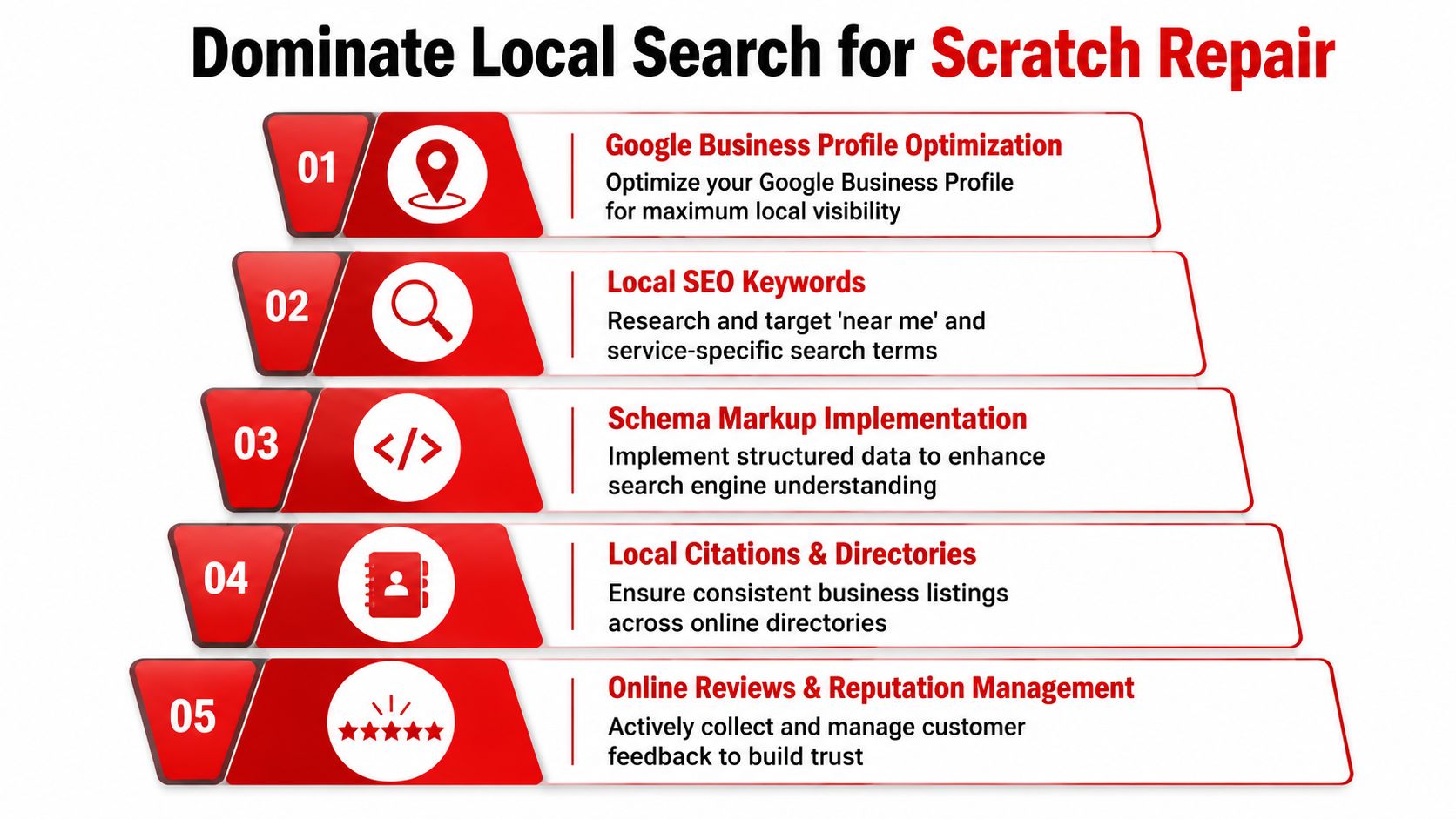
Treat Google Business Profile like a service advisor
A weak Google Business Profile costs jobs before the phone rings. Many shops set one up once, add a logo, and leave it stale. That doesn't work for cosmetic body work, where customers judge from photos, reviews, service labels, and how easy it seems to get an estimate.
Use this checklist:
- Primary category first: Pick the category that best matches body and paint work. Then add relevant service categories tied to scratch repair, bumper work, and paint correction where appropriate.
- Service descriptions that answer buying questions: Write plain descriptions around scratch depth, bumper scuffs, paint transfer, refinishing, and quote availability.
- Photos that prove capability: Upload before-and-after work, close-ups of defect areas, finished panels in daylight, and shots of the front office and bays.
- Calls to action that reduce hesitation: Turn on messaging if the team can answer quickly. Make booking and estimate requests visible.
- Q&A used on purpose: Seed common questions such as whether photos are enough for a preliminary estimate, whether bumper scratches can be repaired, and how color matching is handled.
Practical rule: If the profile doesn't help a stranger decide in under a minute, it isn't finished.
Use local signals that match buyer intent
Most shop owners think ranking comes from keywords alone. Local visibility is built from consistency and completeness. Name, address, phone number, business hours, service areas, and website links need to match everywhere a customer might verify the shop.
A quick way to spot missed basics is to run the profile through the. It helps identify profile gaps that reduce visibility or weaken conversion.
There are also a few local-search habits that consistently help body shops:
| Local element | What works | What fails |
|---|---|---|
| Business photos | Real repair photos from the shop | Stock cars and generic paint images |
| Posts | Short updates showing recent scratch work and booking options | Posts unrelated to core services |
| Directory listings | Matching NAP details across directories | Old phone numbers and duplicate listings |
| Service pages | A dedicated page for scratch repair in target markets | A broad homepage with no service detail |
The biggest mistake is treating scratch repair like a side service. If the shop wants that car count, it needs a profile and website footprint built specifically for it. Local search rewards relevance. Customers reward clarity.
Build a Landing Page That Converts Clicks to Customers
A generic services page usually underperforms for scratch repair. It forces the visitor to hunt for details, guess whether the shop handles cosmetic damage, and decide whether it's worth calling. That extra friction sends the lead back to search results.
A dedicated scratch repair landing page works better because it matches the exact job the customer has in mind. The page should feel like the shop already understands the problem.
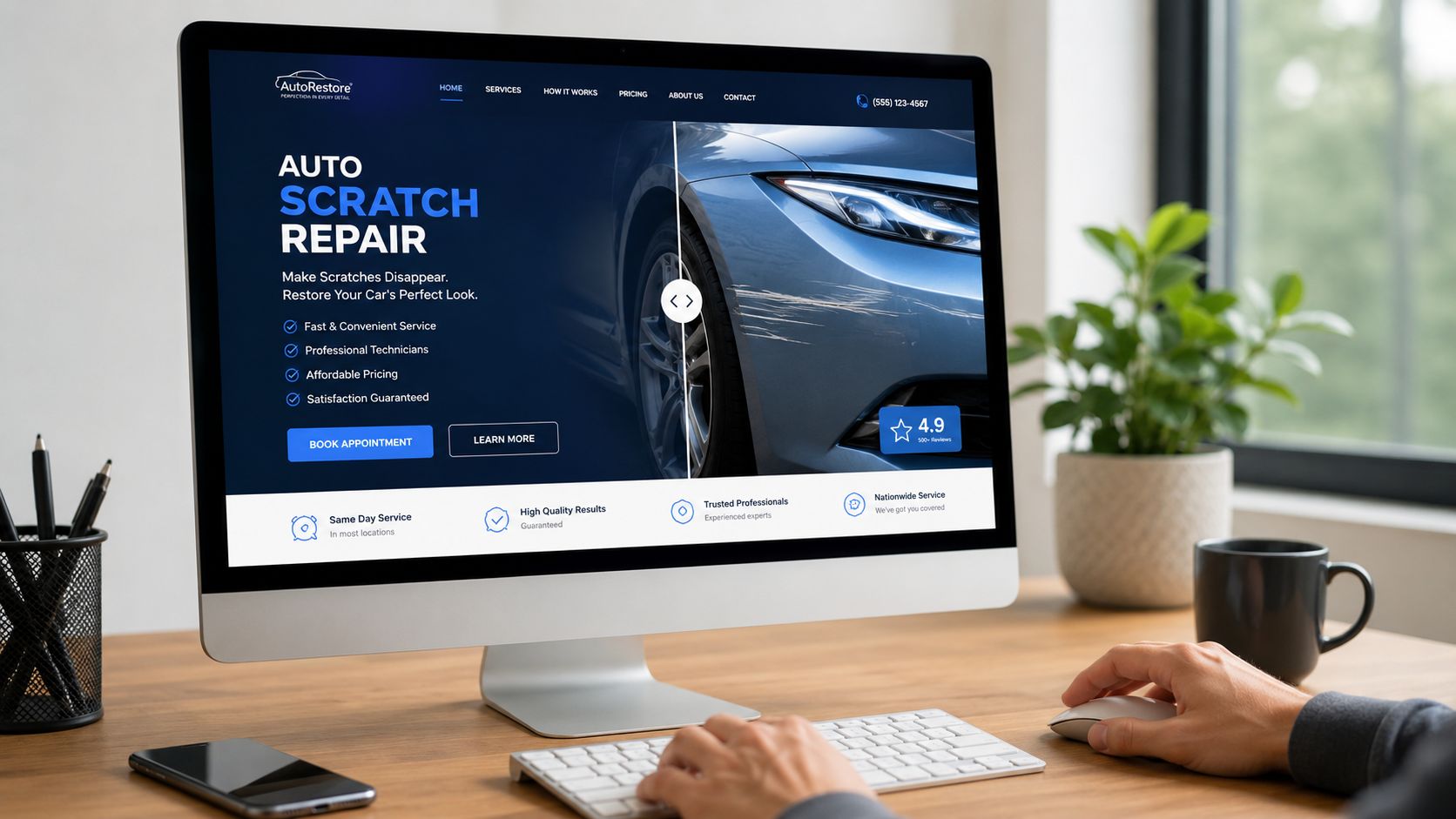
A generic services page leaks leads
The visitor searching for scratch repair isn't asking for the full history of the company. That visitor wants to know:
- Can this shop fix my kind of damage?
- Can I send photos?
- How do I get a quote?
- How soon will someone respond?
A broad page that lumps together alignments, diagnostics, major collision, oil service, and scratch repair answers none of those well. It also buries the conversion path.
A landing page should remove decisions, not add them.
Shops that want more scratch-repair bookings need one page focused on one service and one next step.
What the page needs above the fold
The strongest version is simple and direct. Start with a headline that speaks to the problem. Follow it with a tight subhead that explains the benefit. Then place the form and call button where a mobile user can act without scrolling much.
The page should include these core blocks:
- Problem-first headline: "Scratch on your door or bumper? Get a fast quote from a local shop."
- Before-and-after proof: Not gallery clutter. A few strong examples with clear defect-to-finish contrast.
- Short intake form: Name, contact info, vehicle details, photo upload, and a description field.
- Trust signals: Reviews, certifications, insurance familiarity if relevant, and real shop photos.
- Process strip: Submit photos, receive estimate review, approve work, schedule repair.
A mobile-first layout matters because this buyer is often searching from a phone. Buttons need thumb-friendly spacing. The form can't feel like paperwork. The phone number should be tap-to-call. If the page fights the device, conversion drops.
For shops refining the user experience side, this guide to is a useful reference for reducing friction and tightening page flow.
One more point matters. The copy has to sound like a shop, not an agency. Customers respond to plain language such as scuffs, keyed panels, paint transfer, bumper scratches, and color match. They don't respond to vague marketing language about premium solutions.
Streamline Your Quoting with Digital Inspections
The handoff from lead to estimate is where many shops lose easy scratch work. The search was won. The click happened. The customer filled out the form. Then the process slows down.
A front desk employee calls back late, asks for the same information again, and tells the customer to come by for someone to take a look. Some customers will. Many won't.
What the old process looks like
The old quoting workflow is familiar. Photos arrive by text. A service advisor forwards them to a painter or estimator. The images are incomplete. No one can tell whether the scratch is only in the clear coat or through the primer. The quote sits. The customer waits.
That delay creates three problems at once:
- Lead decay: The customer keeps shopping.
- Estimate inconsistency: Different staff price similar jobs differently.
- Admin drag: The team spends time chasing photos, approvals, and follow-up.
This is exactly why digital inspections matter. They create a repeatable intake path before the estimate starts.
What the faster process looks like
A tighter workflow starts with a form that tells the customer what photos to upload. Front angle. Side angle. Close-up of the damage. Wider shot showing the full panel. Vehicle details. Best contact method. That's enough to begin triage.
Then the estimator reviews the job in one place, tags the damage type, requests any missing image, and sends a professional estimate or next-step recommendation.
Fast quotes don't come from typing faster. They come from collecting the right information first.
Build a triage path before writing the estimate
Scratch repair should be triaged by depth, not by guesswork. Clear-coat-only scuffs can often be corrected with polishing or paintless methods, while scratches that reach primer or base metal require sanding, filling, color matching, and refinishing, as outlined in. That same source notes that minor repairs may run about $50–$150, while deeper or more complex damage can reach $200–$1,000+.
That doesn't mean every photo estimate should lock final price immediately. It means the shop should branch the job correctly from the start.
A practical triage model looks like this:
| Damage observation | Likely path | Quoting note |
|---|---|---|
| Surface scuff or transfer with no break visible | Polish or correction review | Quote as preliminary pending inspection |
| Scratch appears through color layer | Refinish workflow | Include prep and color-match review |
| Primer or metal visible | Full repair and paint | Flag for in-person confirmation |
The key is transparency. Customers accept estimate ranges and inspection qualifiers when the reasoning is clear. They resist vague pricing with no explanation.
A strong digital inspection also helps the shop upsell correctly. If the bumper corner is scratched and the adjacent panel has visible transfer or edge damage, the team can quote the full cosmetic scope instead of the single mark the customer mentioned. Better documentation produces better approvals.
Leverage Reviews and Reputation to Build Trust
For scratch repair, reviews matter more when they don't stand alone. A five-star rating helps, but the deciding factor is often whether the shopper can see evidence that the shop fixes the exact type of damage being discussed.
That creates a stronger trust signal than either one by itself. Reviews answer, "Were customers happy?" Visual proof answers, "Can this shop do this repair well?"
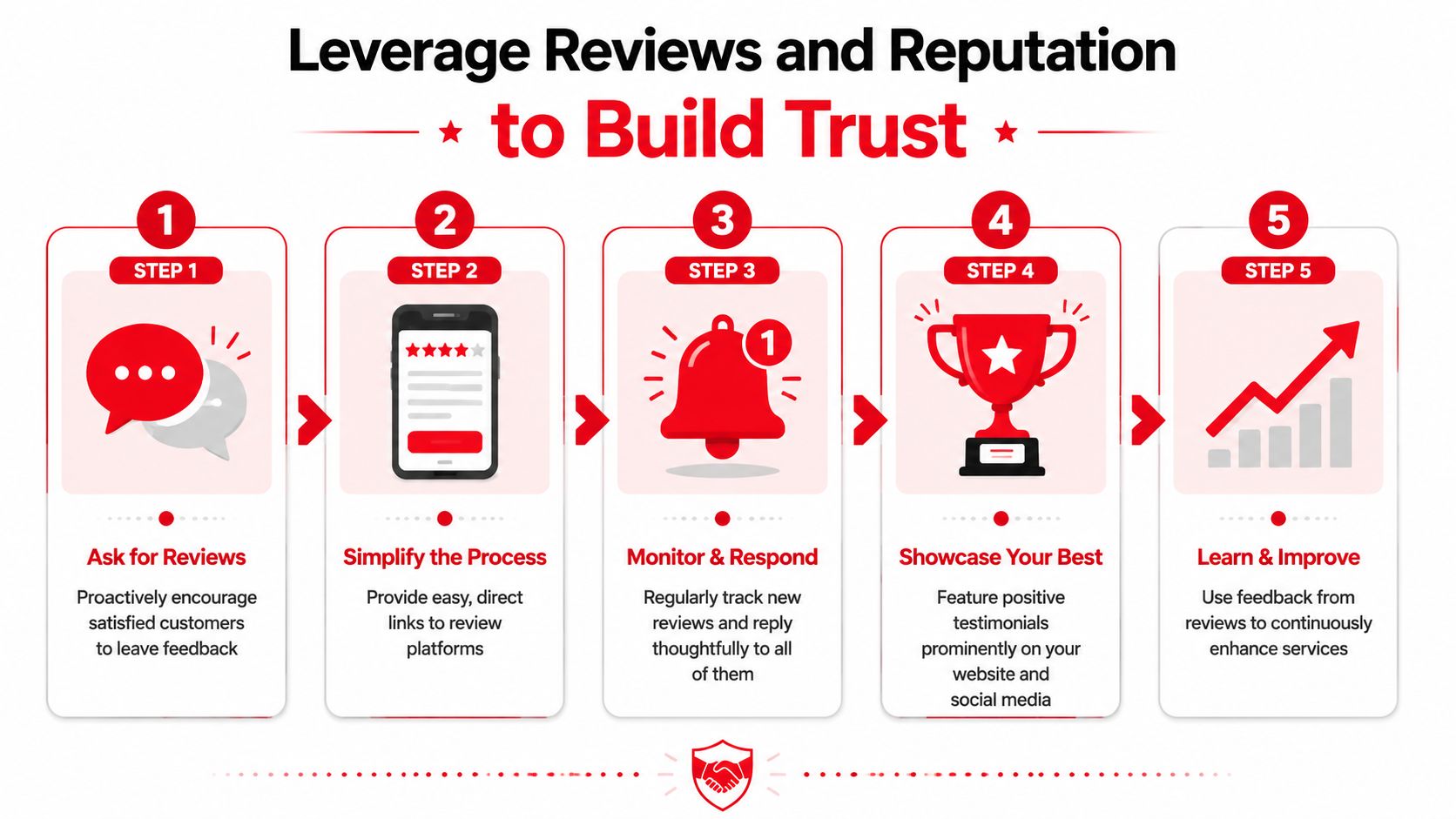
Reviews work better when paired with visual proof
A review that says the team fixed a bumper scuff is good. A review placed next to a clean before-and-after set is much better. The customer reading it doesn't have to imagine the result.
Many shops often leave value on the table. They ask for reviews, but they don't organize photos. Or they post photos, but they don't connect them to customer feedback on the website, social pages, and business profile.
Use a simple pairing system:
- Match the job type: Put scratch-repair reviews next to scratch-repair photos.
- Keep captions specific: Mention panel area, repair type, and outcome in plain language.
- Update often: Fresh examples make the shop feel active and responsive.
- Get permission: Make photo-use approval part of delivery and payment workflow.
A polished reputation isn't built from star counts alone. It's built from proof that the shop does what it says.
Build a repeatable review workflow
Review generation should happen right after the customer has seen the finished vehicle and payment is complete. That's the moment satisfaction is highest and recall is freshest.
A repeatable process usually works best:
- Ask while the job is still top of mind. The advisor or cashier makes the request part of checkout.
- Send a direct review link. Don't make customers search for the business profile.
- Respond to every review. Thank positive reviewers. Address complaints calmly and specifically.
- Reuse the best feedback. Add selected reviews to the scratch-repair page and estimate follow-ups.
Negative reviews also deserve attention. A defensive reply scares off future buyers. A professional response that acknowledges the issue and invites resolution shows control and maturity.
For local conversion, reputation isn't a separate marketing channel. It's part of the sales process. The shopper sees the review, checks the photos, reads the response style, and decides whether the shop feels dependable.
Amplify Your Reach with Paid Local Ads
Paid local ads work best when they sit on top of a clean foundation. If the business profile is weak, the landing page is vague, or lead handling is slow, paid traffic just buys more wasted opportunities.
But once the shop has those basics in place, paid local visibility can fill open capacity and capture buyers who won't scroll far.
Run paid ads only after the basics are ready
For scratch repair, the message has to qualify the lead before the call comes in. Broad messaging invites the wrong jobs. Tight messaging attracts the right ones.
A practical setup looks like this:
- Use service-specific language: Mention scratch repair, scuffs, bumper damage, paint correction, and estimate requests.
- Constrain the service area: Keep the radius close enough that the shop can respond and schedule efficiently.
- Send traffic to the dedicated page: Don't drop paid clicks onto the homepage.
- Match ad copy to the intake process: If the page asks for photos, the ad should hint at fast quote requests.
Paid local placements can also support shops during slower weeks, help newer locations gain visibility, and create a second lead source beyond organic rankings.
Keep the budget tight and the lead handling tighter
A budget-conscious campaign usually performs better than a sloppy bigger one. The point isn't to buy every click. The point is to capture high-intent buyers and respond faster than competing shops.
Lead handling discipline matters more than clever ad wording. The team needs a simple rule set:
| Lead stage | Required action |
|---|---|
| New inquiry | Respond quickly and confirm photo receipt |
| Incomplete info | Request exact missing angle or vehicle detail |
| Qualified scratch job | Send estimate or inspection next step |
| Poor-fit job | Redirect politely or decline cleanly |
Shops also need to filter for fit. Some inquiries will be too large for a quick cosmetic workflow. Some will be too vague to quote responsibly. Some will only be shopping for the lowest possible price. Paid local ads still work in those conditions, but only if the team qualifies firmly and avoids clogging the schedule with low-value noise.
The right approach is controlled growth. Add paid local demand only as fast as the shop can quote, book, and deliver well.
Integrate Your Workflow from Search to Payment
Most shops don't have a lead problem. They have a handoff problem. The website form lives in one tool. Photos arrive somewhere else. Estimates are built in another system. Approvals come by text. Scheduling sits on a whiteboard or calendar. Payment happens at the counter with no clean link back to the original job.
That fragmentation slows everything down.
Disconnected tools create avoidable friction
Scratch repair is especially sensitive to process gaps because the customer expects speed. This isn't usually a long diagnostic sale. It's a local service purchase with visible damage and a narrow decision window.
The broader market is large and competitive. The collision repair industry in the United States has been estimated at roughly $56 billion in annual revenue, with thousands of independent shops competing alongside large chains, and one major collision chain states that most repairs take about 10 business days on average, according to. That makes intake speed, communication, and operational clarity even more important for winning smaller body-and-paint jobs before they drift elsewhere.
The friction points are easy to spot:
- Lead intake isn't connected to job creation
- Estimate approvals require manual follow-up
- Scheduling lives apart from the estimate
- Invoices don't flow directly from the approved work
Each disconnect adds delay. Each delay increases the chance that the customer goes quiet.
One workflow produces better shop economics
An integrated workflow does more than make the front office look organized. It changes car count quality and admin efficiency.
When the search lead, photo intake, estimate, approval, repair order, scheduling, and payment all connect, the shop can:
- Respond faster: No copying data between systems.
- Quote more consistently: The same intake fields feed the same estimate logic.
- Reduce missed follow-up: Every job has a clear status.
- Improve customer confidence: The process feels professional from first click to final invoice.
The shops that convert more scratch-repair work usually aren't doing magic. They're removing friction between each step.
Modern shop management matters. The website shouldn't be separate from operations. The estimate tool shouldn't be separate from communication. The payment step shouldn't feel like the end of a different process than the one the customer started online.
Shops that want more profitable scratch-repair volume need a connected system, not a pile of apps.
Shops that want to turn more local scratch-repair searches into paid work should look closely at the full workflow, not just traffic. If the goal is to connect website leads, photo-based inspections, estimates, approvals, shop scheduling, invoicing, and payment in one place, RedAppy is built for that job. For a closer look at the workflow, explore the platform features or reach out through the contact page.
Ready to Transform Your Shop?
RedAppy helps auto repair shops create professional digital estimates with photos and videos, send them instantly via text or email, and get customer approvals in seconds. No credit card required to start.