
Automotive Business Cards: Boost Your Shop's Growth in 2026
Most advice about automotive business cards is stuck in the past. It treats the card like a tiny brochure that needs to hold every detail about the shop.
That approach doesn't fit how customers behave. A driver leaving after a brake job, a tow, or a roadside issue usually doesn't study a card for two minutes. The card has a simpler job. It needs to make the next step easy, credible, and immediate.
That matters because business cards still aren't a niche channel. One industry roundup says about 273 million cards are printed every day worldwide, while the digital business card market was estimated at USD 215.13 million in 2025 and projected to reach USD 680 million by 2035, which shows the category is growing across both print and digital formats according to.
Table of Contents
- Why Your Business Card Is More Important Than Ever
- Designing a Card That Builds Instant Trust
- Essential Information Every Auto Shop Card Needs
- The QR Code Your Bridge to Digital Engagement
- Smart Distribution Strategies to Maximize Reach
- From Card to Customer How to Measure Your ROI
Why Your Business Card Is More Important Than Ever
A business card isn't obsolete. A badly used business card is obsolete.
For an auto repair shop, the card still does something digital ads often can't. It gets handed over at the exact moment trust is highest. That might be after a successful diagnosis, when a service advisor explains a repair clearly, or when a customer asks, "Do you also work on my other car?" In those moments, the card becomes a physical reminder of a solved problem.
The job of the card has changed
Years ago, a card mainly stored contact details. Today, automotive business cards work better as a bridge between the front counter and the phone in the customer's hand.
A good card doesn't try to explain the whole business. It creates an easy next action:
- Book the next visit
- Find the shop on maps
- Review recommended services
- Pay an invoice
- Save the shop contact for later
Practical rule: If the card can't move a customer into a digital action within seconds, it's doing too little.
This shift matters for shop owners who care about repeat visits and larger repair orders. The card itself rarely closes the job. What it does well is reduce friction. It gives the customer a fast way back into the shop's system when they need tires, diagnostics, an estimate approval, or a follow-up repair.
Why physical still works in auto repair
Auto repair is local, practical, and relationship-driven. Customers still meet service advisors, technicians, tow operators, and owners in person. That makes a physical handoff valuable in a way that many other industries don't get anymore.
A card also travels. Customers keep one in the glove box. They pass one to a spouse. They hand one to a coworker who needs a mechanic. That kind of local referral behavior is why printed cards still belong in the toolbox.
The mistake isn't printing cards. The mistake is printing cards that don't lead anywhere useful.
Designing a Card That Builds Instant Trust
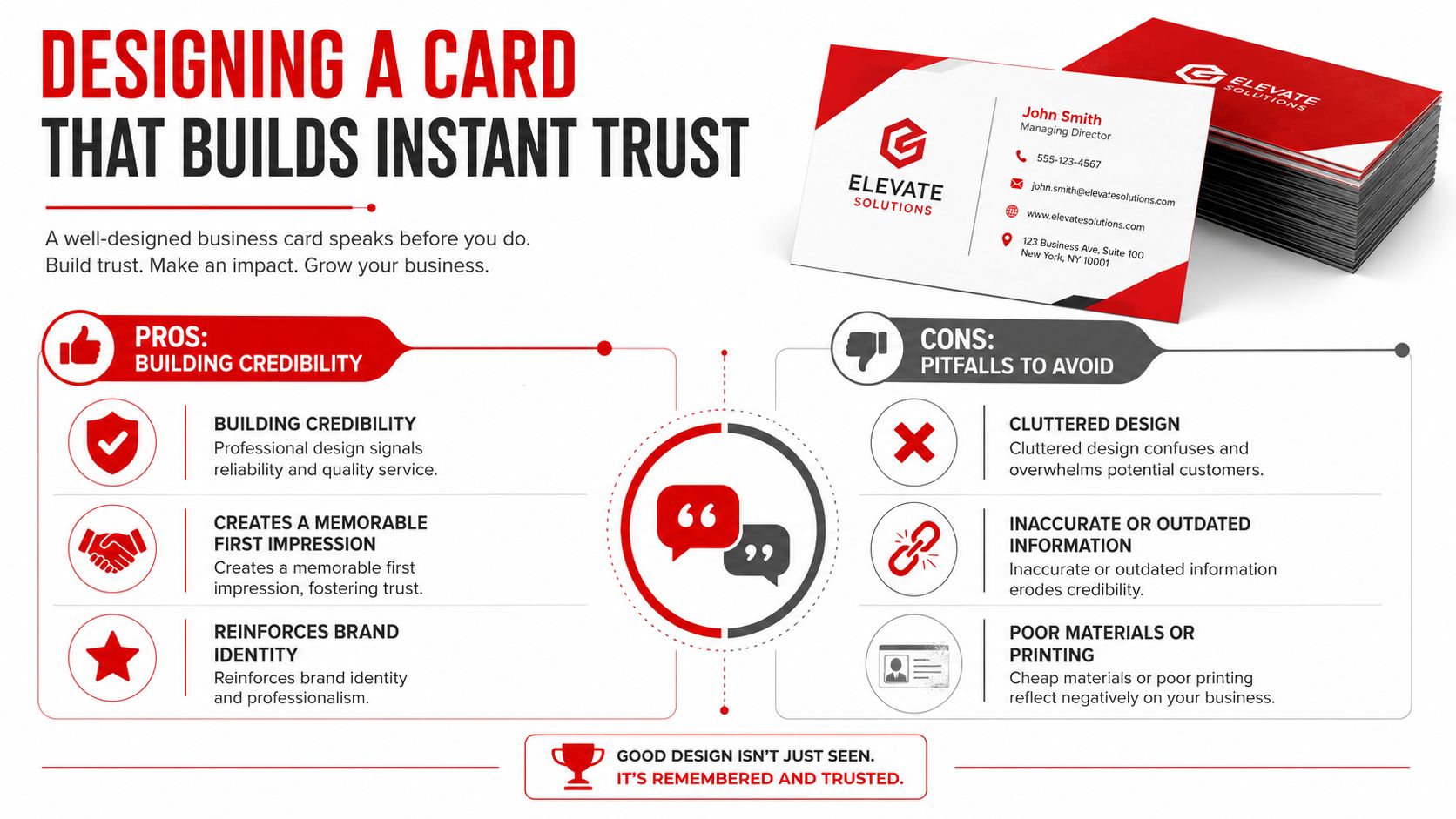
A business card can contribute to closing work, or it can erode confidence before a customer ever books. In local service businesses, visual quality sends a message about work quality.
Research summarized by Tapni says 68% of small business owners find business cards useful when meeting new contacts in person, and 39% of people say they'd avoid doing business with someone whose card looks cheap, as noted in.
What customers notice first
Customers don't judge a card like a designer. They judge it like a buyer. They look for order, clarity, and signs that the shop takes details seriously.
That usually comes down to a few basics:
- Print quality: Crisp text and sharp logo edges matter more than fancy effects.
- Stock feel: Thin, flimsy paper makes the shop feel temporary.
- Spacing: Crowded cards look rushed and harder to trust.
- Readable type: If the phone number is hard to read, the card has already failed.
A repair shop sells competence. The card should look controlled, not creative for the sake of it.
What works on an automotive card
The strongest designs are usually simple. They use one logo, one or two brand colors, and one clean font family with clear hierarchy.
A practical layout often looks like this:
| Element | Best use on the card | Common mistake |
|---|---|---|
| Logo | Top area or one strong side | Oversized logo that crowds contact details |
| Shop name | Prominent and easy to scan | Decorative lettering that's hard to read |
| Phone number | Given visual priority | Small text buried among other details |
| Service line | Short list of core work | Long paragraph of every service offered |
| QR code | Clean space around it | Tiny code squeezed into a corner |
Cheap finishes, cluttered layouts, and outdated information don't just look sloppy. They make customers wonder what else in the business is being overlooked.
Design choices that fit repair shops
Some style choices work better for auto repair than others.
- Use strong contrast: Dark text on a light background is easier to read in a parking lot, at a counter, or beside a vehicle.
- Keep colors on-brand: Red, black, blue, gray, and white are common because they feel mechanical and direct. The exact palette matters less than consistency.
- Choose durable finishes: Matte stock is often easier to read than glossy stock under shop lighting.
- Leave breathing room: Empty space makes the card feel more premium and more organized.
Shops often overdesign the back of the card. That's usually a mistake. If every inch is filled, nothing stands out. A cleaner card looks more expensive, and more expensive usually reads as more trustworthy.
Essential Information Every Auto Shop Card Needs
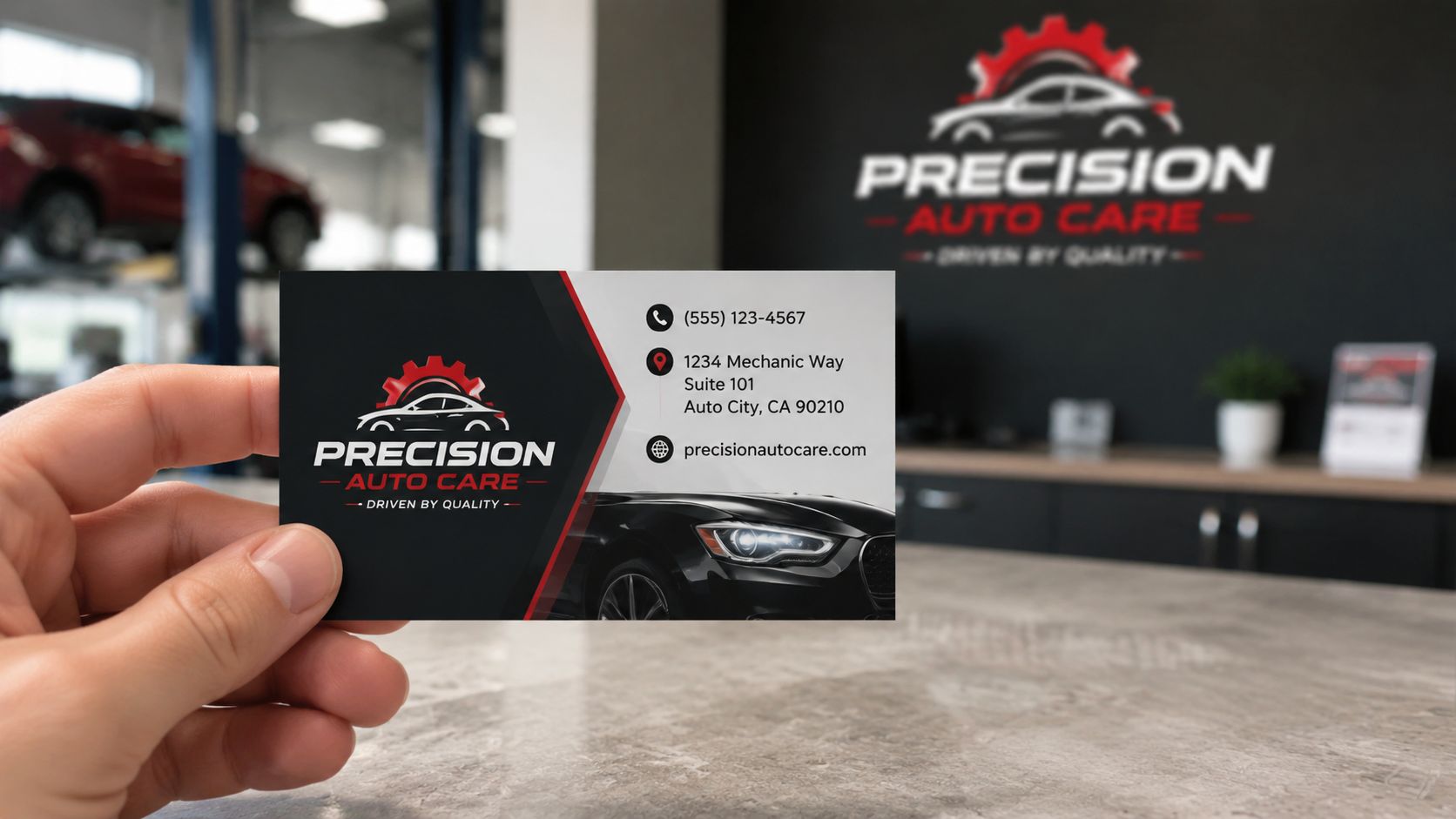
Most shop cards either say too little or far too much. The right approach is selective. Every line should help a customer take action or feel more confident handing over a vehicle.
The non-negotiables
Every auto shop card should include the basics below. These aren't optional.
- Shop name: Use the exact name customers will search for online.
- Primary phone number: Put the main number, not a line that goes unanswered.
- Website: A short, clean domain builds legitimacy and supports follow-up.
- Physical location: At minimum, include the city or address if walk-in traffic matters.
- Person's name and role: This helps when a service advisor or owner is building direct relationships.
If the shop has multiple locations, the card should reflect that clearly. A confusing card creates friction before the first call.
The high-impact extras
At this point, a card starts acting like a marketing tool instead of a contact slip.
A short service line helps pre-qualify the right customer. Instead of listing everything from oil changes to transmission work, focus on the profitable categories the shop wants more of. Examples include diagnostics, brakes, suspension, fleet service, tires, diesel work, or EV service if the shop offers it.
Certifications and credibility markers also help, but only if they're real and relevant. A simple reference to ASE certification, factory specialization, or a warranty promise can reassure a hesitant customer. The key is restraint. One or two trust cues are enough.
The best cards answer three silent questions fast. Who are you, what do you fix, and what's the next step?
What to leave off
Some details feel useful but weaken the card.
Avoid these:
- Long slogan lines: Most of them take space without adding trust.
- Too many phone numbers: One clear number is better than a maze of contacts.
- Dense service menus: Small text blocks look promotional and rarely get read.
- Personal social handles: They usually distract from the shop brand.
A card shouldn't try to replace the website, estimate page, or scheduling system. Its job is to direct attention, not absorb it.
A simple content model
A practical front-and-back structure works well for many shops.
Front side
- Shop logo
- Shop name
- Name and role
- Main phone number
- Website
Back side
- Short service list
- QR code
- Short trust cue such as certifications or specialties
That format gives the card a clear hierarchy. It also leaves room for the digital action that matters most.
The QR Code Your Bridge to Digital Engagement
The most important square inch on a modern business card is usually the QR code.
That sounds odd to owners who still think the card itself needs to carry the full message. But the stronger approach is to let the card start the interaction and let the phone complete it. Guidance for repair shops already points in this direction. The card isn't the main conversion device. It's a low-friction trigger that works best when it connects to scheduling, maps, or a branded site, as discussed in.
What the QR code should actually do
A QR code shouldn't dump people on a generic homepage if a better destination exists. It should send them to the next useful action.
Good destinations include:
- Online scheduling page: Best for routine service and repeat customers.
- Directions or maps page: Useful for first-time visitors and breakdown situations.
- Estimate approval page: Helpful when the card is handed over during an active job.
- Payment page: Smart for speeding up pickup and reducing phone friction.
- Branded landing page: Good when the shop wants one clean mobile destination.
One strong QR destination is better than a vague one. If the shop wants more booked work, the code should lead to booking. If it wants faster approvals, the code should support approvals.
Where shops get this wrong
Some cards include a QR code because it seems modern, but they don't think through the destination. That leads to weak results.
A poor QR setup usually has one of these problems:
| Problem | What happens |
|---|---|
| Code links to a generic homepage | Customer has to hunt for the next action |
| Mobile page loads slowly | Customer drops off |
| Destination isn't branded | Trust drops after the scan |
| No scheduling or payment path | Interest doesn't become revenue |
A repair shop should treat the QR destination like a service advisor script. It needs a purpose.
Connecting the card to shop software
Cards start producing real operational value if the scan leads into scheduling, digital estimates, inspection results, invoices, or payments. The card stops being passive print and starts becoming a measurable part of the workflow.
A shop that wants this kind of setup can review RedAppy features, which include digital inspections, online payments, analytics, scheduling support, and a branded website that can act as the destination after a customer scans.
For physical placement beyond cards, some shops also to add the same scan path to counters, waiting areas, loaner packets, key drop boxes, or pickup desks. That keeps the customer journey consistent across every touchpoint.
Smart Distribution Strategies to Maximize Reach
A well-designed card does nothing inside a storage drawer. Distribution is where many shops waste the asset.
The most effective shops don't hand out cards randomly. They place them where trust is already forming or where a repair need is likely to come up next.
Use moment-based distribution
The best time to hand over a card is tied to context.
A service advisor finishing a visit should attach a card to the invoice or service summary. A technician speaking with a customer during a walkaround should have cards ready. A tow partner should keep cards available when dropping off vehicles. These moments feel natural because the customer is already thinking about the vehicle.
A card given at the right moment feels helpful. A card handed out with no context feels disposable.
This also applies to vehicles leaving the shop. A card tucked into a thank-you sleeve, glove box insert, or warranty packet can stay with the car long after the visit ends.
Build local referral channels
Auto repair shops benefit from neighborhood adjacency. Good partners aren't just other automotive businesses. They're any local businesses that regularly hear, "Do you know a good mechanic?"
Useful referral points can include:
- Tire shops and parts counters: They meet drivers with immediate repair needs.
- Tow operators: They interact with stranded customers under stress.
- Gas stations and convenience stores: Still relevant in many local markets.
- Real estate agents and property managers: New residents often need a local repair shop.
- Fleet-adjacent vendors: Contractors, wrap installers, and equipment suppliers often know who manages work vehicles.
The key is simple. Don't leave a random stack and hope. Ask the partner where cards should sit, who should hand them out, and in what situation.
Equip every staff role differently
Not every card has to serve the same purpose.
A front-desk card may focus on scheduling and general service. A fleet-focused card may highlight commercial maintenance. A mobile mechanic or diagnostic specialist may need a version that emphasizes on-site work or advanced troubleshooting.
That doesn't mean creating brand confusion. The visual identity should stay consistent. The call to action can change based on who hands out the card and what kind of work the shop wants more of.
From Card to Customer How to Measure Your ROI
Most shops never learn whether their cards are working because they don't build in a tracking method. They print, distribute, reorder, and guess.
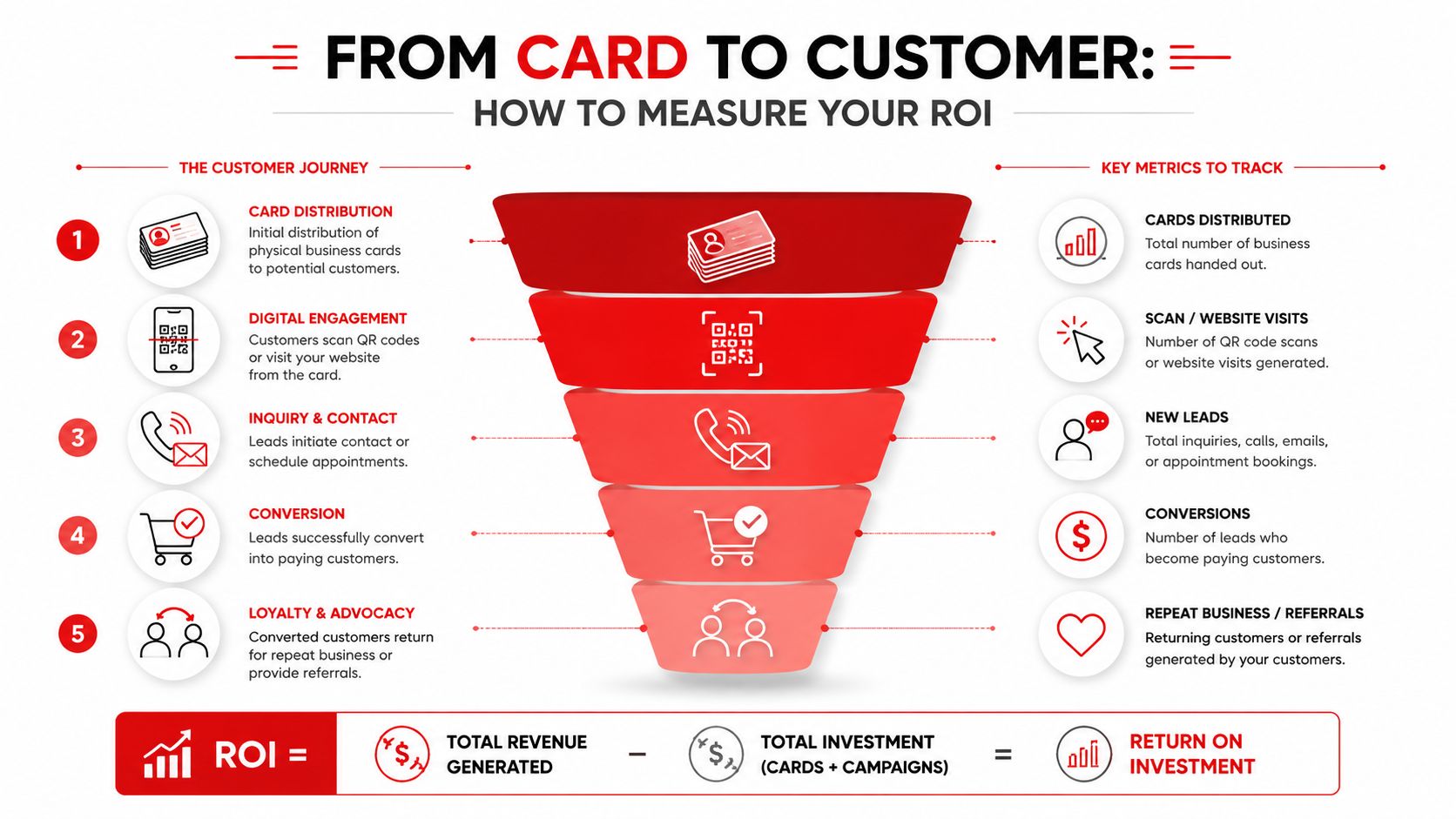
A better system follows the path from handoff to revenue. The card creates awareness. The scan or visit creates engagement. The booking creates a lead. The completed repair order shows whether that lead was worth pursuing.
Simple tracking methods that work
A shop doesn't need a complicated attribution model to get useful insight. It needs clean paths.
Consider a setup like this:
- Unique QR destination: Create a dedicated scan page tied only to the card.
- Specific booking page: Send card traffic to a separate scheduling link.
- Distinct offer or message: Use a service reminder or landing page message that only appears on the card.
- Front-desk intake note: Train staff to ask how the customer found the shop.
Those steps help a shop see whether cards produce first visits, follow-up work, or referrals. They also reveal which card versions are strongest. A general-purpose card may bring in routine maintenance, while a specialty card may attract more profitable diagnostic or suspension work.
What ROI actually means for a repair shop
The goal isn't collecting scans. The goal is understanding whether the card helps bring in the right kind of customer.
That means looking at outcomes such as:
| Stage | What to watch |
|---|---|
| Engagement | Scan, visit, or call from the card path |
| Conversion | Appointment scheduled |
| Revenue quality | Type of job booked and final ticket size |
| Retention | Whether the customer returns |
The useful question isn't "Did the card get attention?" It's "Did the card start work that fit the shop's goals?"
Once that data is visible, the shop can improve the weak points. If cards are scanned but bookings are low, the landing page may be weak. If bookings happen but ticket quality is poor, the service positioning on the card may need tightening.
A business card should do more than share a phone number. It should push customers into a clean digital path that supports scheduling, estimates, approvals, payments, and repeat visits. Shops that want tighter visibility into that journey can review RedAppy and use the contact page for a direct conversation about fitting that workflow to their service process.
Ready to Transform Your Shop?
RedAppy helps auto repair shops create professional digital estimates with photos and videos, send them instantly via text or email, and get customer approvals in seconds. No credit card required to start.