
Automotive Repair Invoices: A Complete Guide for Auto Shops
Automotive repair invoices are more than just a bill at the end of a job. They are a legal record, a communication tool, and a direct reflection of your shop's professionalism. For auto repair businesses, a poorly structured invoice leads to payment disputes, failed audits, and lost customer trust — while a well-crafted one speeds up collections and protects the shop legally.
According to the, billing disputes are among the most common sources of friction between shops and customers. The invoice is often the only document that resolves them. Getting its structure and content right is not optional — it is a core business function.
This guide covers everything auto shops need to know: what a proper automotive repair invoice must include, how to format one correctly, the legal requirements that vary by state, common errors that cost shops money, and how modern shop management software like RedAppy can automate the entire process from estimate to final payment.
Table of Contents
What Is an Automotive Repair Invoice?
An automotive repair invoice is a formal financial document issued by a repair shop to a customer upon completion of vehicle service. It itemizes all work performed, parts used, labor charges, taxes, and the total amount owed. Legally, it serves as a binding record of the transaction between the shop and the vehicle owner.
An invoice is not an estimate. An estimate is issued before work begins as a projected cost. An invoice is issued after work is completed and reflects the actual charges.
The shop issues the invoice at the point of pickup or, in the case of digital workflows, at the time of final approval. It functions simultaneously as a receipt, a service record, and in many jurisdictions, a legally required disclosure document.
Legal Role of the Invoice
An automotive repair invoice carries legal weight beyond a simple bill. Most U.S. states with automotive repair licensing laws — including California, Texas, and New York — require shops to provide customers with a written invoice that documents all charges. In California, the Bureau of Automotive Repair (BAR) mandates that invoices show every part replaced and the price charged for each, along with whether parts were new, used, or rebuilt.
Federal law also applies. The requires that warranty terms be clearly communicated to consumers, which means invoice language can directly affect a shop's warranty obligations and liability exposure.
Failure to issue a compliant invoice can result in fines, license suspension, or civil liability in the event of a dispute.
Invoice vs. Estimate: A Clear Distinction
Customers sometimes confuse estimates with invoices. The distinction matters legally and financially.
| Document | When Issued | Legal Status | Purpose |
|---|---|---|---|
| Estimate | Before work begins | Non-binding projection | Communicate expected costs |
| Authorization | Before work begins | Binding customer approval | Authorize shop to proceed |
| Invoice | After work is completed | Binding financial record | Document actual charges and collect payment |
In practice, a well-run shop maintains a clear paper trail from estimate through authorization to invoice. Gaps in this chain are a common source of customer disputes and regulatory complaints.
The invoice is the final, authoritative record of what was done to a vehicle and what was charged — it should be accurate enough to stand up in a small claims court proceeding.
Who Issues It and When
The repair shop issues the invoice. Timing depends on shop workflow, but the invoice should be finalized before or at the moment the customer takes possession of the vehicle. In digital invoicing systems, the invoice can be sent electronically before the customer arrives, allowing them to review charges and pay online in advance of pickup. This reduces time at the counter and eliminates payment delays.
What Must Be Included on an Auto Repair Invoice
A complete auto repair invoice must include specific information to be legally valid and professionally credible. Most U.S. states define minimum required fields through their motor vehicle repair licensing laws. Missing even one required element — such as a VIN or authorization signature — can expose a shop to regulatory penalties or make an invoice unenforceable in a dispute.
The core required fields across nearly all U.S. jurisdictions include:
- Shop information: Business name, address, phone number, and license number (where required by state law)
- Customer information: Full name, address, and contact number
- Vehicle identification: Year, make, model, VIN, license plate number, and odometer reading at check-in and check-out
- Invoice number and date: A unique identifier and the date of issue
- Authorization signature: Written or digital customer signature authorizing the work
- Itemized labor charges: Each job listed separately with hours and rate
- Itemized parts list: Part name, part number, quantity, unit price, and total
- Taxes and fees: Sales tax on parts, shop supply fees, hazmat disposal charges — each on its own line
- Warranty statement: Terms covering both parts and labor
- Total amount due: Clearly stated final amount with payment method options
Odometer readings at both drop-off and pickup are required in many states and serve as legal protection against mileage-related disputes.
California's Bureau of Automotive Repair (BAR) and Texas's DMV both require itemized invoices with customer authorization before any work begins. Shops operating in these states must retain invoice copies for a minimum of three years. A full breakdown of these legal obligations appears in the Legal Requirements section.
Labor Line Items
Labor charges must be itemized by individual repair operation. Each line should state the specific task performed, the number of hours charged, and the hourly labor rate or flat-rate amount.
There are two common billing methods:
| Billing Method | How It Appears on Invoice | Common Use Case |
|---|---|---|
| Flat-rate (book time) | Fixed hours per operation (e.g., 2.5 hrs) regardless of actual time | Standard repairs, warranty work |
| Time-based (actual time) | Hours clocked by technician on that specific job | Diagnostic work, custom jobs |
In practice, most shops use flat-rate billing sourced from labor time guides such as. The invoice should clearly state which method applies, especially when a flat-rate charge exceeds actual time spent — a common source of customer disputes.
Shops that separate diagnostic labor as its own line item collect it more reliably and reduce the likelihood of customers disputing the charge after the fact.
Each labor line should also reference the corresponding vehicle complaint or repair order note. For example, "Brake pad replacement — front axle — 1.5 hrs @ $125/hr" is clear and defensible. "Labor" alone is not.
If a repair involves multiple technicians or multiple visits, each should appear as a distinct line item. This protects the shop in warranty claims and gives the customer a transparent record of who performed what work.
Parts and Materials
Every part used in the repair must appear as a separate line item. The invoice should include the part name, part number, quantity, unit cost, markup (where required by state law), and total price.
Key distinctions that must be noted on the invoice:
- OEM vs. aftermarket parts: Some states require shops to disclose whether a part is original equipment manufacturer (OEM) or aftermarket. California BAR regulations, for instance, require this notation explicitly.
- Remanufactured or used parts: Must be identified as such, along with any applicable warranty terms.
- Core charges: When a part carries a refundable core deposit (common with alternators, starters, and brake calipers), the charge and the refund process must both appear on the invoice.
- Hazmat and disposal fees: Fluids, batteries, and tires carry disposal costs. These should be itemized rather than buried in a generic "shop supplies" line.
- Shop supply fees: If the shop charges a blanket supplies fee (rags, cleaners, small hardware), this must be disclosed and, in many states, capped at a percentage of the total labor charge.
Parts markups are legal and standard, but several states require disclosure of the shop's cost versus the customer's price on request. Itemizing part numbers makes this easier to verify and builds customer confidence.
A well-structured parts section also simplifies warranty claims. If a part fails within the warranty period, having the part number and supplier on record speeds up the replacement process and reduces friction with both the customer and the supplier.
Totals, Taxes, and Payment Terms
The final section of the invoice must present a clear, unambiguous summary of all charges before the customer pays.
A properly structured total section includes:
- Parts subtotal — sum of all parts and materials
- Labor subtotal — sum of all labor operations
- Fees subtotal — disposal, hazmat, shop supplies
- Tax line(s) — sales tax applied to taxable items (typically parts; labor tax rules vary by state)
- Total amount due — single, clearly labeled final figure
Tax treatment of labor varies by state. In most U.S. states, labor is not taxable, but parts are. Texas taxes both parts and labor for certain repairs. Shops operating across state lines or in states with complex tax rules should confirm their obligations with a tax professional or reference their state's department of revenue guidelines.
Payment terms should be stated explicitly on every invoice:
| Payment Term | Meaning | Common In |
|---|---|---|
| Due on pickup | Payment required before vehicle release | Most retail auto repair shops |
| Net-30 | Full payment due within 30 days | Fleet accounts, commercial clients |
| Deposit applied | Pre-paid amount deducted from total | Large jobs, parts-heavy repairs |
Accepted payment methods — credit card, cash, check, digital payment — should be listed. If a credit card surcharge applies, it must be disclosed in advance and on the invoice in most states. Failing to disclose fees at this stage is a common source of complaints filed with state consumer protection agencies.
Labor Line Items
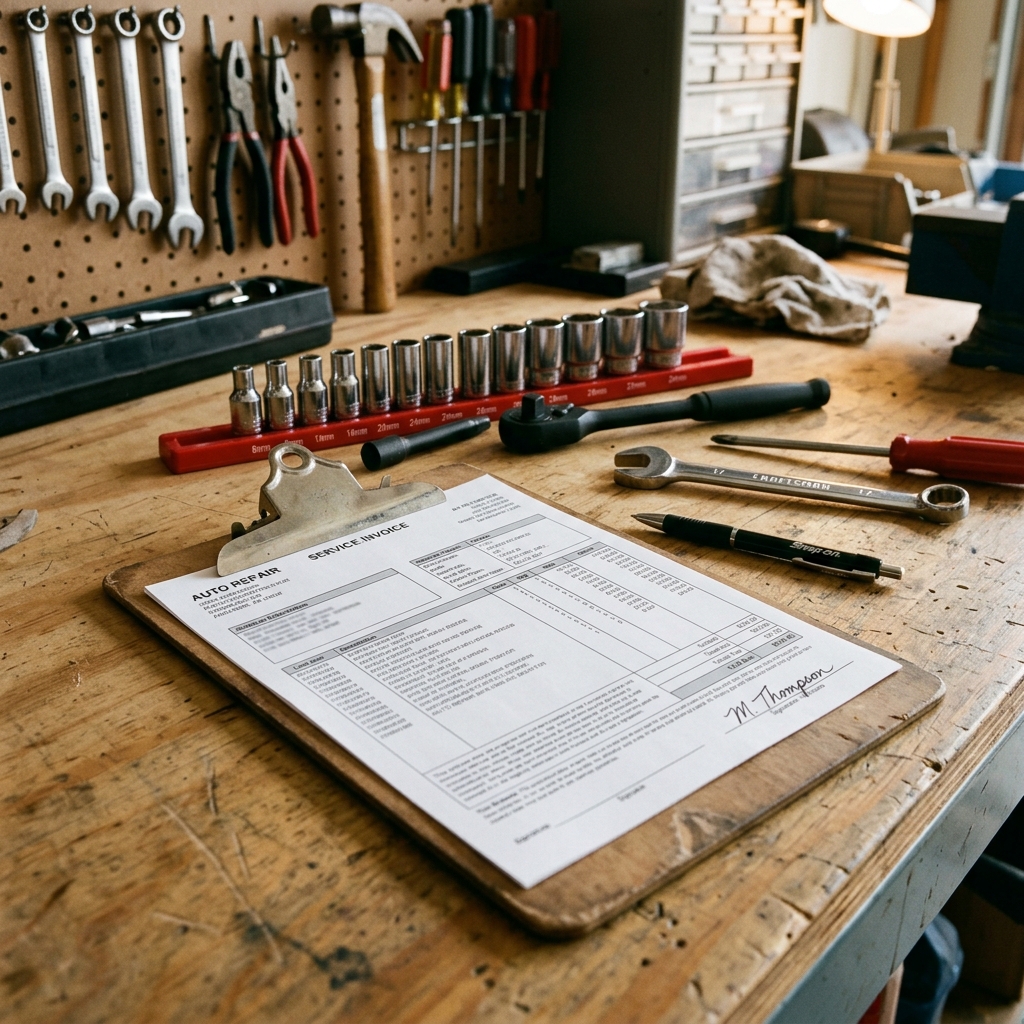
Labor line items document the work performed by technicians and translate that work into billable charges. They are one of the most scrutinized sections of any repair invoice, and how they are presented directly affects whether a customer accepts or disputes a charge.
How Labor Hours Are Documented
Each labor line item should identify the specific job performed, the number of hours billed, and the hourly labor rate. A typical labor entry looks like this:
- Operation description: e.g., "Replace front brake pads and rotors — both sides"
- Labor hours: e.g., 2.5 hours
- Labor rate: e.g., $120/hr
- Line total: e.g., $300.00
Some shops also include a job code or reference number tied to a labor guide. This adds a layer of transparency and makes the charge easier to verify.
Customers who can see exactly what was done, how long it took, and what rate applies are far less likely to dispute the invoice.
Flat-Rate vs. Time-Based Billing
Most professional auto repair shops use one of two billing methods for labor. Understanding both helps clarify how the invoice should be structured.
| Billing Method | How It Works | How It Appears on Invoice |
|---|---|---|
| Flat-rate | A fixed labor time is assigned to each job based on a published labor guide (e.g., Mitchell, Alldata, or MOTOR) | Hours listed reflect the standard guide time, not actual clock time |
| Time-based (actual time) | The technician clocks in and out; the customer is billed for real hours worked | Hours reflect actual time on the job |
Flat-rate billing is the industry standard at most independent shops and dealerships. According to, labor time guides are updated regularly to reflect real-world repair conditions across vehicle makes and models. Shops using these guides can justify their labor charges with a published, third-party reference.
In practice, flat-rate hours for a given job may be higher or lower than actual time spent. That is intentional — the system rewards technician efficiency. What matters for the invoice is that the method used is consistent and disclosed.
Why Labor Clarity Protects Both Parties
Vague labor entries create disputes. A line that reads "Repair — 3 hours — $360" gives a customer no basis for understanding what they paid for. In contrast, a broken-out entry with a clear description, hours, and rate creates an auditable record.
From a legal standpoint, many state consumer protection laws require that labor charges be itemized separately from parts. California's Bureau of Automotive Repair, for example, mandates that invoices show each labor operation as a distinct line item. Shops that bundle labor into a single lump sum may be in violation of state disclosure requirements.
When shops use shop management software that pulls labor times directly from integrated labor guides, the hours are populated automatically and tied to the specific repair operation. This removes manual entry errors and gives the invoice a defensible paper trail if a charge is ever questioned.
Parts and Materials
Parts and materials represent a distinct cost category on every auto repair invoice. Each part used in a repair must be listed individually, with enough detail for the customer to verify what was installed and to support any future warranty claim.
OEM vs. Aftermarket Notation
Every part line should identify whether the component is OEM (Original Equipment Manufacturer) or aftermarket. This distinction matters legally in many states and practically for warranty purposes. California's Bureau of Automotive Repair, for example, requires shops to used on every repair order.
A standard parts line should include:
- Part name and description
- Part number (manufacturer or supplier SKU)
- OEM, aftermarket, or remanufactured designation
- Quantity used
- Unit cost and extended price
- Any applicable core charge
Core Charges
A core charge is a refundable deposit collected when a customer receives a remanufactured part — such as an alternator, water pump, or brake caliper. The old part (the "core") is returned to the supplier for rebuilding. The core charge must appear as a separate line item on the invoice, and any refund issued after core return should be documented clearly.
Failing to itemize core charges separately can create disputes at the counter and complicate your shop's accounting reconciliation.
Hazmat and Shop Supply Fees
Shops routinely charge for supplies consumed during a repair — rags, penetrating oil, zip ties, and similar consumables. These are typically bundled into a shop supply fee, which is a percentage of the labor or parts total, capped at a set dollar amount. Many states require this fee to be disclosed rather than embedded in other line items.
Hazardous material disposal fees cover the cost of properly disposing of items like used oil, coolant, brake fluid, and refrigerants. According to the, shops that generate used oil must manage it as a regulated material — and the cost of that compliance belongs on the invoice as a transparent line, not absorbed silently.
Parts Markup Disclosure
Parts markup is standard practice in the industry. Shops typically purchase parts at wholesale cost and invoice at retail. In practice, markup rates range from 20% to 50% depending on the part type, supplier, and shop policy.
| Part Category | Typical Markup Range |
|---|---|
| OEM parts | 20–35% |
| Aftermarket parts | 25–50% |
| Remanufactured parts | 20–40% |
| Tires | 10–25% |
Some states require shops to provide the actual cost of parts upon customer request. Even where it is not mandated, clearly labeling parts as "retail price" rather than obscuring markup inside vague line items reduces disputes and builds customer trust.
Itemized parts lines with part numbers give customers a verifiable record — and give your shop a defensible paper trail if a warranty claim or dispute arises later.
From experience, shops that include supplier part numbers on invoices resolve parts-related disputes faster because both parties can reference the exact component installed. This is especially important for managing vehicle history and repair records over the life of a customer relationship.
Totals, Taxes, and Payment Terms
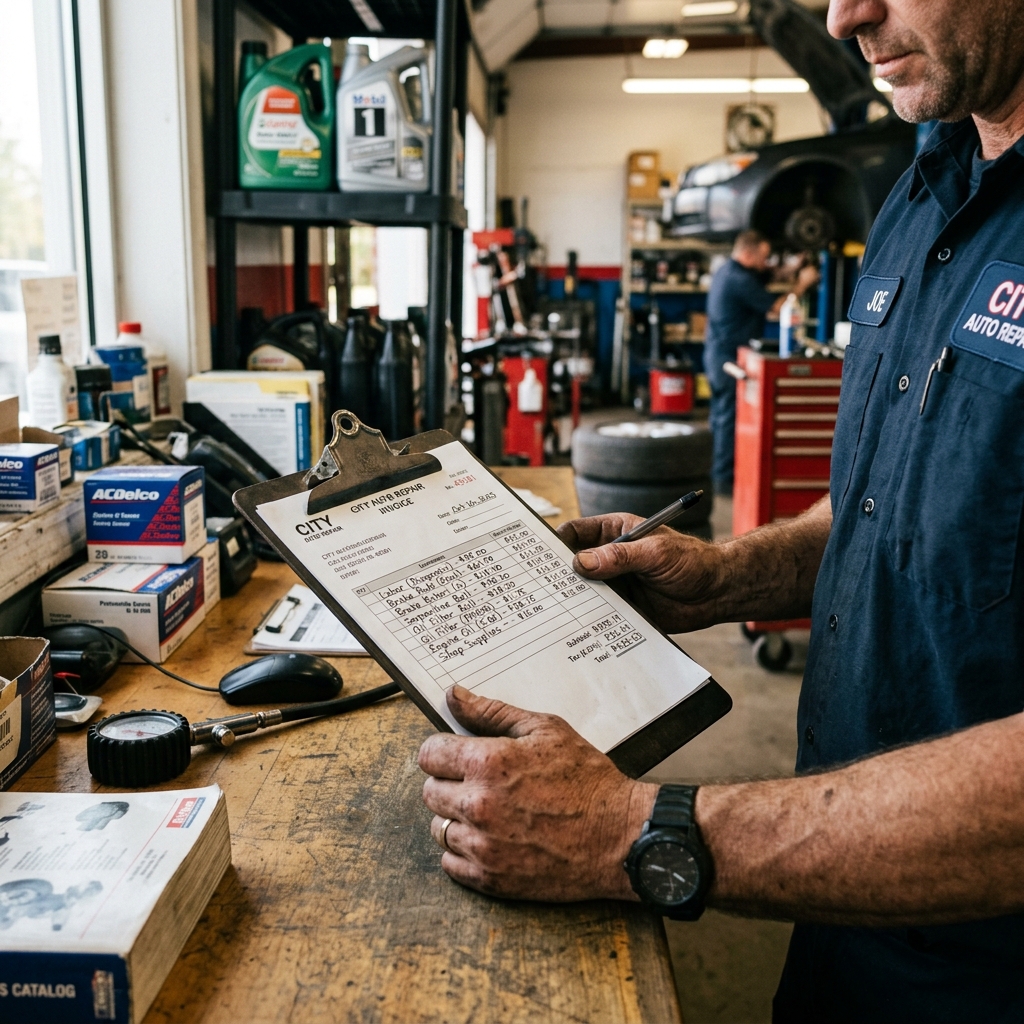
The totals section of an automotive repair invoice translates all individual charges into a clear, final summary that the customer authorizes and pays. A well-structured totals block prevents billing disputes and satisfies most state disclosure requirements.
Standard Totals Structure
Every invoice should present charges in a consistent sequence:
| Line | Description | Example |
|---|---|---|
| Parts Subtotal | Sum of all parts and materials | $312.47 |
| Labor Subtotal | Sum of all labor charges | $195.00 |
| Shop Supplies / Fees | Disposal, hazmat, or shop supply fees | $18.00 |
| Pre-Tax Subtotal | Combined total before taxes | $525.47 |
| Sales Tax (parts) | Tax applied to taxable items only | $25.75 |
| Total Due | Final amount owed | $551.22 |
In most U.S. states, labor is not subject to sales tax, but parts are. Applying tax incorrectly — or applying it to labor — creates compliance risk and customer disputes.
Shops should verify taxability rules with their state revenue authority. California, for instance, taxes parts and materials but generally exempts labor under the guidelines.
Tax Line Transparency
Tax lines should be itemized, not bundled into the subtotal. Each taxable category — parts, shop supplies, and any applicable environmental fees — should appear as a separate line with the applicable rate clearly stated (e.g., "Sales Tax 8.25%: $25.75"). This level of detail holds up in audits and gives customers a complete picture.
If the shop operates in a jurisdiction with multiple tax rates (county, state, municipality), each rate should appear on its own line rather than as a single combined figure.
Payment Terms
Payment terms define when payment is due and what methods are accepted. The most common structures in auto repair are:
- Due on pickup — Payment required before vehicle release. Standard for most retail repair shops.
- Net-15 / Net-30 — Payment due within 15 or 30 days. Typically used for fleet accounts and commercial customers.
- Partial deposit applied — Shows any pre-paid deposit and reduces the balance due.
The invoice should state the payment term explicitly (e.g., "Payment due upon vehicle pickup") rather than leaving it implied.
Shops that accept online payment collect faster. Based on industry data, digital invoices with embedded payment links are paid an average of 11 days faster than paper invoices sent by mail.
Accepted Payment Methods
Listing accepted payment methods on the invoice eliminates confusion at pickup and reduces friction. Include every method the shop accepts:
- Credit and debit cards
- Cash
- ACH / bank transfer
- Online payment link (if applicable)
- Financing options (if offered)
Shop management platforms like RedAppy embed online payment links directly into the invoice, allowing customers to pay from their phone before arriving at the shop. This reduces counter time and eliminates awkward payment conversations.
Late Fees and Returned Checks
If the shop charges late fees or returned check fees, these must appear in the payment terms section — not added at the time of collection. Most states require that fees be disclosed in advance. A standard disclosure reads: "Invoices unpaid after 30 days are subject to a 1.5% monthly finance charge."
Shops that do not disclose fees in advance typically cannot enforce them in small claims court.
Deposits and Credits
Any customer deposit, warranty credit, or prior payment should appear as a deduction line immediately above the final total due. This keeps the arithmetic transparent and prevents the customer from needing to ask why the total is lower than the subtotal.
| Line | Amount |
|---|---|
| Total Before Credits | $551.22 |
| Customer Deposit | -$100.00 |
| Balance Due | $451.22 |
Presenting credits this way also creates a clean audit trail for the shop's accounting records and integrates directly with repair order management workflows.
Conclusion
An automotive repair invoice is more than a receipt — it is a legal record, a communication tool, and a direct driver of shop revenue. The sections above have established what a complete invoice must contain, how legal requirements shape its format, and how digital systems replace error-prone manual processes.
Three principles define a strong invoicing process:
- Clarity — every line item, from labor hours to disposal fees, must be specific enough that a customer can verify what they paid for
- Compliance — invoice format and retention must satisfy state licensing laws, federal warranty obligations, and customer authorization requirements
- Digital efficiency — automated workflows eliminate transcription errors, reduce disputes, and accelerate payment collection
Shops that connect their inspection, estimate, and invoice into a single digital workflow recover time that paper-based processes permanently lose.
In practice, the gap between a compliant invoice and a profitable one comes down to integration. A well-structured invoice that includes inspection photos, approved estimate line items, and itemized parts costs gives customers the transparency they need to approve more work. According to industry data, shops using digital inspections with photo documentation report measurably higher authorization rates on recommended repairs.
Modern shop management platforms like RedAppy centralize this entire process — from customer lookup by VIN or plate, to one-click invoice generation from an approved estimate, to online payment collection. The result is fewer admin hours, fewer disputes, and a cleaner audit trail for compliance purposes.
For shops still using paper invoices or generic templates, the limitations are real: manual entry errors, missing line items, and no automatic link between the estimate and the final bill. As state regulators and customers alike expect more transparency, the invoice itself becomes a measure of how professionally a shop operates.
The automotive repair invoice sits at the intersection of legal obligation and customer trust. Shops that treat it as both — not just a billing document — are better positioned to retain customers, resolve disputes quickly, and build a business that scales.
Ready to Transform Your Shop?
RedAppy helps auto repair shops create professional digital estimates with photos and videos, send them instantly via text or email, and get customer approvals in seconds. No credit card required to start.