
Automotive Repair Shop Management: The Ultimate Guide
The day usually starts before the bay doors are fully open. A customer is waiting for a ride, a technician is asking where a part went, the phone is ringing, and someone at the front desk is trying to match handwritten notes to the right vehicle. Nothing is technically broken, but the shop still feels out of control.
That kind of chaos doesn't come from a lack of effort. It comes from running the business as separate tasks instead of one connected operating system. Check-in, inspection, estimate, parts ordering, approvals, repair, billing, and follow-up all affect each other. When those steps live in different notebooks, inboxes, whiteboards, and people's heads, the shop slows down and profit leaks out.
That matters because this isn't a small, static market. The U.S. automotive repair and maintenance service market was valued at USD 183.4 billion and is projected to reach USD 473.9 billion by 2032, according to. In a market that large, small gains in labor efficiency, estimate speed, parts control, and customer approvals matter more than most owners realize.
Table of Contents
- From Chaos to Control in Your Repair Shop
- Mapping Your Core Workflow from Check-In to Checkout
- Building and Managing Your High-Performance Team
- Mastering Customer Communication with Digital Inspections
- Pricing Parts and Profitability Strategies
- The Modern Tech Stack for Automotive Repair Shops
- Conclusion and Your Implementation Checklist
From Chaos to Control in Your Repair Shop
A struggling shop rarely has just one problem. The service advisor is buried in calls. Technicians stop mid-job to ask about approvals. Parts arrive late because nobody ordered them when the diagnosis was finished. The customer hears one price in the morning and another in the afternoon because the estimate wasn't updated cleanly. By closing time, everyone feels busy, but the day still produced less billed work than it should have.
That pattern is common because many shops grow on top of habits, not systems. One person remembers who approved what. Another person knows where the comeback parts were set aside. A third person handles scheduling based on instinct. It works until volume rises, a staff member is out, or the second location opens.
Practical rule: If the shop only works when specific people are present, the business doesn't yet have a management system. It has workarounds.
Strong automotive repair shop management starts with a different view of the business. The shop isn't a collection of separate chores. It's a chain of handoffs. Every bad handoff creates friction. Every clean handoff improves speed, trust, and billed hours.
The difference shows up in ordinary moments:
- At check-in: Vehicle concerns are captured once, clearly, and attached to the repair order.
- At inspection: Findings move straight into the estimate instead of being rewritten.
- At approval: Customers see what the shop sees, so decisions happen faster.
- At repair: Technicians work from current information instead of chasing updates.
- At checkout: Billing reflects the actual approved job, not a patched-together version of it.
The shops that get control don't usually do it through harder work. They do it by reducing re-entry, guesswork, and interruptions. That shift changes management from reactive to deliberate.
Mapping Your Core Workflow from Check-In to Checkout
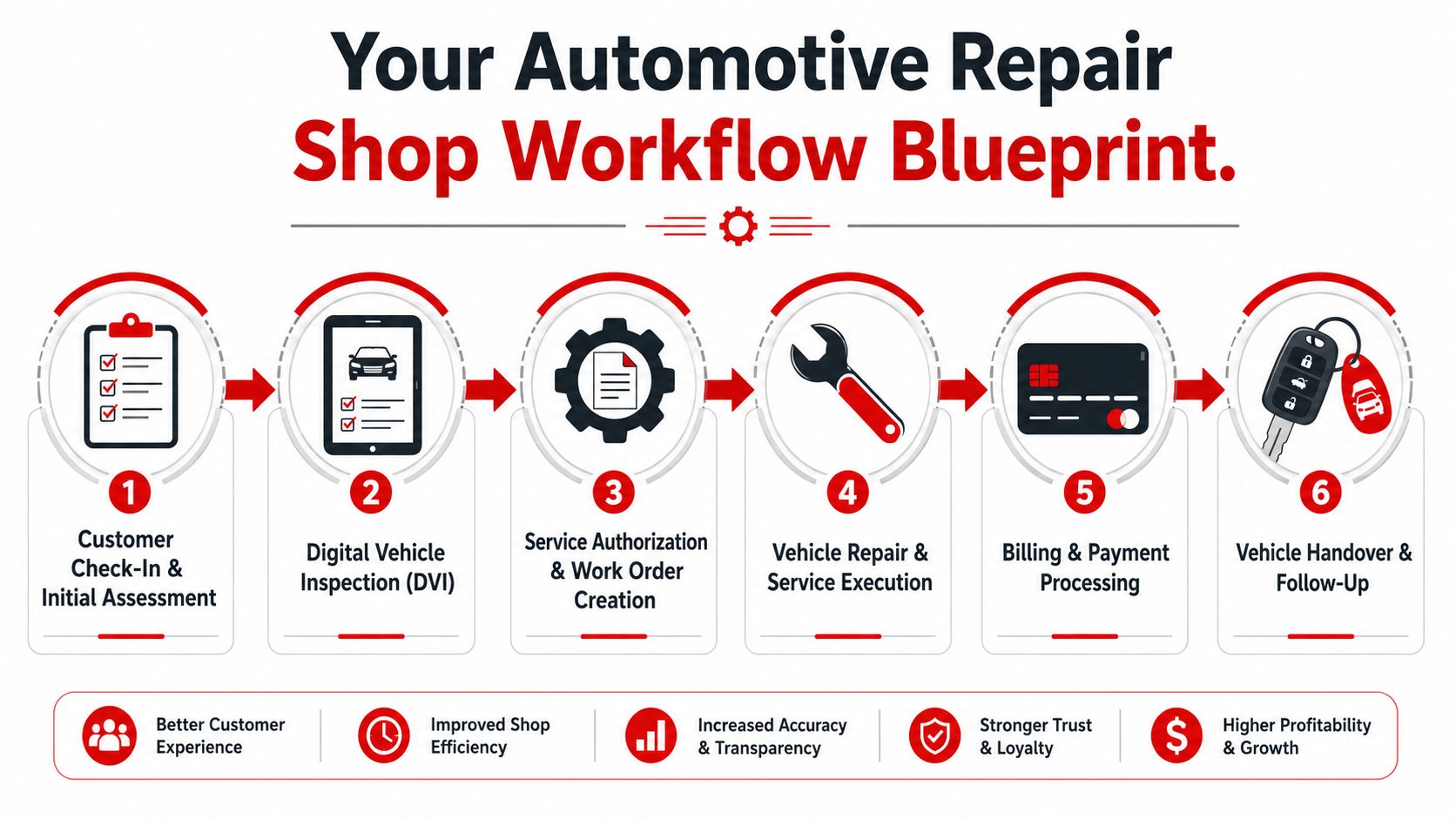
A repair shop that runs well has a visible flow. Every car is somewhere specific in the process, every employee knows what happens next, and no vehicle depends on memory to keep moving.
The simplest way to think about automotive repair shop management is to map the entire vehicle journey and remove friction at each handoff.
What a controlled workflow looks like
Appointment and check-in set the quality of the rest of the job. The front desk needs the complaint, contact details, vehicle details, requested services, promised time, and any transportation notes captured in one place. If the advisor misses context here, the technician starts with bad information.
Inspection and diagnosis should produce structured findings, not loose notes. The technician needs a repeatable inspection process that captures what was checked, what was found, and what needs immediate attention versus future attention. That creates consistency across techs and prevents estimate drift.
Estimate and approval must happen inside the same workflow as the inspection. Independent research notes that shop-management platforms create value when they link labor guides, parts inventory, and inspection findings into a single estimating workflow because that reduces rekeying errors and shortens the time from diagnosis to authorization, as explained by.
Repair and parts ordering should begin only after the authorization is clear and documented. Shops lose time when a technician diagnoses correctly but the part sourcing process lives in a different system, forcing someone to duplicate lines, verify fitment separately, and then walk back changes after parts pricing shifts.
Quality control and checkout need their own step. Too many shops treat final review as whatever happens before the customer arrives. A real QC step checks completed work, confirms notes, verifies fluids or resets when relevant, and makes sure the invoice matches the approved scope.
A smooth checkout usually starts much earlier in the day. It doesn't begin when the customer reaches the counter.
Where most shops lose time
Most bottlenecks don't come from wrench time. They come from avoidable administrative loops.
A few common failures show up again and again:
- Double entry: Advisors rewrite technician notes into estimates.
- Blind scheduling: Jobs are booked by time slot, not by labor mix, technician skill, or bay reality.
- Approval delays: Customers can't see the issue, so they postpone decisions.
- Parts confusion: The estimate says one thing, the supplier invoice says another.
- Weak status visibility: Nobody can answer a basic question like whether the car is waiting on approval, waiting on parts, or ready for delivery.
A practical workflow has to make status obvious. That's why many strong systems use a board-style view that shows vehicles moving from check-in to inspection, estimate, approved work, in progress, QC, and ready. Managers don't need more reports if they still can't see where today's jobs are stuck.
A good workflow also protects against exceptions. Walk-ins happen. Warranty questions happen. Parts returns happen. The fix isn't pretending they won't. The fix is having one system that records each change so the whole team sees the current state of the job.
Building and Managing Your High-Performance Team
At 10:30 on a Tuesday, the front counter is promising a same-day job, one technician is waiting on parts nobody ordered, another is getting interrupted for status updates, and the best A-tech in the building is doing work a lube tech could handle. That is not a people problem first. It is a system problem showing up through people.
Staffing pressure is real. As noted earlier in the article, shops across the industry are competing hard for technicians. Higher pay helps get attention, but pay alone does not fix a day that feels disorganized, unfair, and impossible to win. Good people leave shops where priorities change by the hour, documentation is incomplete, and every estimate turns into a scavenger hunt.
That is why team management has to be built into shop management. The platform, the schedule, the dispatch process, the inspection flow, the parts process, and the communication rules all shape technician output far more than motivational speeches ever will.
Build roles around flow, not personality
High-performing shops do not rely on heroic employees who cover for broken handoffs. They define who owns each step and make that ownership visible inside one operating system.
The service advisor owns customer updates, approvals, and promised times. The technician owns inspection quality, diagnosis, repair execution, and complete notes. The parts process needs an owner too, whether that is a dedicated parts person or an advisor following a strict ordering checklist. If nobody owns that handoff, the whole day gets softer around the edges. Jobs sit. Bays stay occupied. Customers wait longer than they should.
I learned this the hard way. The moment a shop starts saying, "Everybody just helps wherever needed," the best people start carrying the weakest process.
What strong shops protect
Team performance improves fast when the workday becomes predictable enough for people to focus.
- Clean dispatching: Assign work by skill, bay availability, and job stage, not by who happens to be free for five minutes.
- Ready-to-work jobs: Technicians should receive vehicles with concerns documented, approvals clear, and parts status confirmed.
- Fewer interruptions: Advisors collect questions and updates in batches instead of pulling technicians off cars all day.
- Visible accountability: Everyone can see what is waiting, what is blocked, and who owns the next action.
- Documented proof: Photos and notes help, reduce comeback arguments, and protect the team when a customer challenges prior damage or declined work.
A shop platform should support that structure directly. Shared job boards, role-based permissions, status updates, and technician notes in one place cut down on the hallway conversations that drain hours out of a week.
Manage capacity like a production line
Many owners still schedule by empty slot. That works until the board fills with the wrong labor mix and one technician becomes the bottleneck for half the day.
Capacity planning needs three inputs. Available labor hours. Technician skill mix. Bay and equipment constraints. If the system cannot show all three in one view, advisors will keep selling work the floor cannot absorb.
Here is the practical standard:
| Focus area | What works | What fails |
|---|---|---|
| Daily load | Book around real capacity and technician skill | Filling open slots first, then trying to sort it out |
| Advisor workflow | Set planned times for updates and approvals | Constant switching between the counter and the shop |
| Technician utilization | Dispatch complete jobs with clear next steps | Starting cars before parts or approvals are ready |
| Team communication | Track status in one shared system | Relying on verbal updates and memory |
The integrated-system approach demonstrates its value. Scheduling, dispatch, inspections, parts status, and customer communication should not live in separate islands. The software should act like the shop's central nervous system. One update changes the status for everyone. One source of truth cuts down on rework, missed handoffs, and wasted technician minutes.
Retention follows operating discipline
Shops keep strong technicians when the day feels fair. Fair means good work gets dispatched cleanly, labor is not lost to chaos, and documentation protects the technician from avoidable callbacks and customer disputes.
Culture matters, but culture in a repair shop is often the result of operations. If the board is clear, the handoffs are clean, and the expectations stay consistent, morale usually improves without a speech. If the process is sloppy, pizza on Friday will not save retention.
The best team strategy is simple. Hire carefully, train steadily, and build a system that lets good people do good work at a profitable pace.
Mastering Customer Communication with Digital Inspections
The old approval process still shows up in too many shops. The advisor calls the customer, explains a problem over the phone, answers questions from memory, puts the customer on hold to re-check something with the technician, and hopes the customer says yes before moving on with the day.
That method creates friction even when the diagnosis is correct. The customer can't see the issue. The advisor has to sell from notes. The technician gets pulled off the vehicle to clarify details. If the customer doesn't answer, the whole job stalls.
The old approval method breaks trust
Most customers don't resist repairs because they enjoy delaying service. They hesitate because they don't have proof, context, or a simple next step. A verbal description of a worn component is weaker than a photo, a marked inspection item, and a clear estimate sent to their phone.
That gap matters because communication quality affects both trust and speed. Industry guidance shows that digital vehicle inspections with photo and video sharing increase approval speed because customers can review evidence before authorizing work. The same guidance says SMS and email estimate approvals can produce approvals averaging 50% higher than non-digital authorization methods, according to.
Digital inspections change the conversation
A proper digital vehicle inspection does more than replace paper. It changes the approval conversation from persuasion to documentation.
Instead of this:
"Your brakes are getting bad and the belt is cracking. Do you want us to take care of that today?"
The customer receives a message with photos, notes, prioritized recommendations, and a clean approval path. The advisor can still explain the repair, but now the explanation has evidence behind it.
That gives the shop several practical advantages:
- Fewer misunderstandings: Customers can review the issue on their own time instead of trying to process everything during a rushed call.
- Better estimate acceptance: Recommended work is easier to understand when the findings are attached to the estimate.
- Stronger records: The inspection becomes part of the job history, which helps with future visits and customer questions.
- Less conflict: Photo-based documentation can also help shops when a customer questions condition, damage, or recommended work.
Digital communication also improves the front counter's workload. Advisors spend less time playing phone tag and more time answering real questions. Technicians spend less time repeating findings. Managers get cleaner data because the inspection, estimate, and approval live in the same record.
A platform like RedAppy features for shop workflow, digital inspections, parts ordering, and payments fits this model because it keeps inspections, approvals, invoicing, and job tracking connected instead of splitting them across separate tools.
Pricing Parts and Profitability Strategies
Monday looks strong. The bays are full, the phones are moving, and the sales total feels healthy. Then the month closes, and net profit says something else. In most shops, that gap comes from pricing drift, missed billable time, weak estimate construction, and parts process failures that nobody corrected early.
That is why pricing cannot live as a front-counter habit. It has to be built into the operating system of the shop.
If the shop runs on disconnected decisions, margin slips one repair order at a time. If the shop runs on a defined system, pricing rules, sourcing rules, approvals, and follow-up all stay connected. That is the difference between a busy shop and a controlled one.
Parts pricing must be built into the system
Parts gross disappears fast because parts decisions happen under time pressure. An advisor gets a different supplier quote, a core changes the cost, or a rush order lands higher than expected. If the team is choosing markups on the fly, the shop is handing margin away in small pieces all day.
The fix is simple to describe and harder to enforce. Set a documented parts matrix. Apply it every time. Define exception rules before the exception shows up.
A workable parts pricing system usually includes:
- A written matrix: Advisors should not be guessing markup by memory or mood.
- Live cost visibility: The estimate should reflect current supplier pricing before it reaches the customer.
- Defined exceptions: Warranty jobs, fleet accounts, sublet work, and hard-to-source parts need rules that protect margin.
- Estimate control inside one platform: Parts cost, selling price, approvals, and final invoice should live in the same job record so changes do not get lost between screens.
That last point matters more than many owners think. A pricing policy on paper does not fix much by itself. The shop needs software that carries the policy into the estimate, flags variance, and keeps the final invoice tied to what was approved. That is the central nervous system approach. The process does not depend on one strong advisor remembering every rule.
For owners who want a customer-facing example of how service pricing shifts based on scope, inclusions, and local market conditions, is a useful reference. It is not a universal pricing template, but it shows why package definitions and clear boundaries matter.
Profit leaks hide in ordinary habits
The expensive mistakes are rarely dramatic. They show up as routine behavior the team stopped questioning.
Unbilled diagnostic time. The technician verifies the complaint, tests the system, documents findings, and isolates the fault. Then the estimate only includes the repair. That trains customers to expect free expertise and teaches the staff that skilled diagnosis has no value.
Incomplete estimate capture. The inspection identifies related work, but the advisor presents only the urgent repair because building the estimate takes too many clicks or too much back-and-forth. The shop loses revenue on the current visit and creates a higher chance of another comeback conversation later.
Weak parts receiving. One wrong part can wipe out the profit on a job. The bay stays occupied, the car misses promised delivery, labor gets shuffled, and the advisor spends more time doing damage control than selling work.
No process for declined work. Many shops record declined recommendations and never use them. That is missed future revenue sitting in the system. A clean follow-up process turns "not today" into a real pipeline instead of dead notes.
Margin control comes from repeated execution. Every approved line gets billed. Every diagnostic step is documented. Every part follows policy. Every declined item stays attached to the customer record for follow-up.
This is also where owners need trade-off discipline. A lower markup can make sense on a price-sensitive tire package or a commercial account that sends steady volume. A blanket habit of discounting does not. Good operators know where they are choosing to be aggressive and where they are protecting gross, and the system reflects that choice.
Most shops do not need better financial theory. They need fewer manual exceptions, cleaner estimate workflows, and software that connects pricing policy to the repair order from the first quote to final payment.
The Modern Tech Stack for Automotive Repair Shops
Software choices get confused with feature shopping. Owners compare appointment tools, texting tools, invoicing tools, inspection apps, and reporting tools one by one, then end up with a stack that doesn't run the shop well.
The better question is whether the system works as the shop's central nervous system. If it doesn't connect the workflow, it adds another screen without removing any confusion.
What the core system must connect
A modern automotive repair shop management platform should join the front counter, the bays, the parts process, and the customer experience into one operating view.
That usually means the system needs to handle these connections well:
| Need | Why it matters |
|---|---|
| Workflow board | Managers need live status without chasing updates |
| Digital inspections | Findings should move directly into estimates and approvals |
| Estimating and labor data | Advisors need speed and consistency |
| Parts ordering and inventory visibility | The estimate has to match what can actually be sourced |
| Payments and invoicing | Checkout should happen without rebuilding the job |
| Reporting and analytics | Owners need to see close rates, repair order quality, technician performance, and repeat business trends |
A disconnected stack causes hidden costs. Staff re-enter data. Customers get mixed messages. Reports don't match because each tool defines the job differently. The owner spends more time reconciling than managing.
How to judge software without getting distracted
Feature lists can mislead buyers. What matters is whether the software removes handoffs and gives the team one source of truth.
Newer industry guidance says the market is shifting from basic shop software to decision support systems, with emphasis on AI use in operations, data analytics, and end-to-end digital workflows. That same guidance also points owners back to practical ROI questions like higher repair-order approval and faster estimation, as outlined in.
A useful evaluation process asks questions like these:
- Can the technician capture inspection findings once and push them into the estimate?
- Can the advisor see job status, approvals, and parts state without leaving the main screen?
- Can the owner review performance without exporting data into spreadsheets?
- Can the same system support one shop today and multiple locations later?
- Does the software fit the team's actual workflow, not just a generic template?
AI features deserve attention, but only after the basics are connected. Diagnostic guidance, labor suggestions, and operational insights can help. They won't fix a broken workflow if the shop still relies on duplicate entry and scattered communication.
Conclusion and Your Implementation Checklist
A profitable shop doesn't run on hustle alone. It runs on clean handoffs, visible workflow, disciplined pricing, strong documentation, and a team that isn't forced to improvise every hour of the day.
That's the core purpose of automotive repair shop management. It isn't about adding more tasks to the owner's plate. It's about designing one connected system so the shop can produce consistent work without constant firefighting.
A practical rollout path
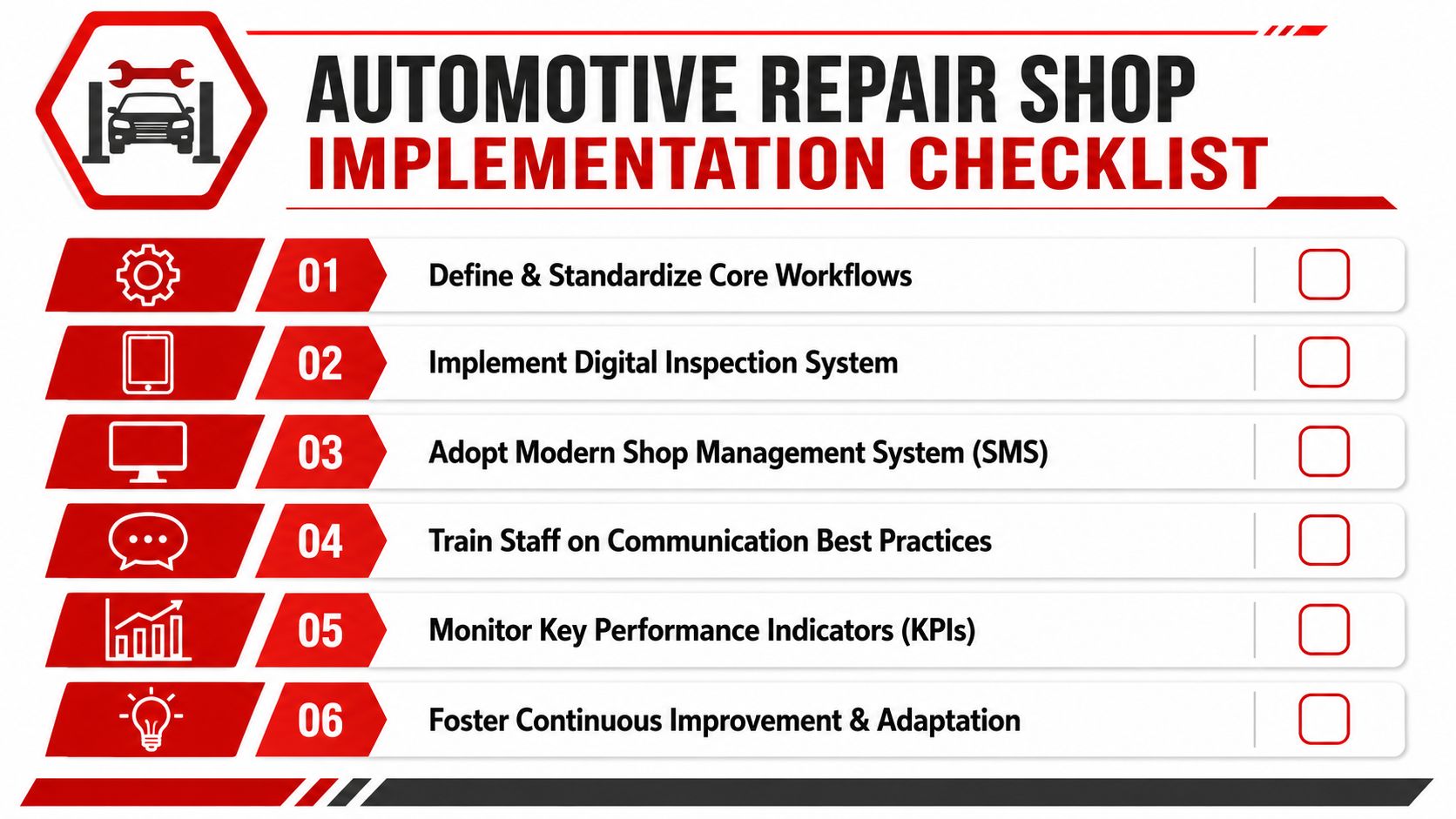
Most shops shouldn't try to change everything at once. A staged rollout usually works better.
- Document the current workflow. Write down what really happens from appointment to checkout. Include the exceptions, not just the ideal path.
- Find the repeated delays. Look for where jobs stall. Approval lag, missing parts, estimate rework, and weak status visibility are common starting points.
- Standardize inspections and estimates. If every technician and advisor handles findings differently, consistency won't hold.
- Choose one system of record. Vehicle history, approvals, notes, parts status, and invoice details should live together.
- Train by role. Advisors, technicians, and managers need different training tied to their daily actions.
- Review performance weekly. Watch for cleaner approvals, faster estimate flow, and fewer dropped details.
What to protect during implementation
New systems fail when the software gets blamed for weak rollout habits.
A few protections make the transition smoother:
- Keep the process simple first: Don't load every optional setting on day one.
- Name one owner for implementation: Someone has to own setup, accountability, and follow-up.
- Clean customer and vehicle data before migration: Bad records create immediate distrust in the system.
- Require full documentation on every repair order: Partial use creates partial results.
- Listen to frontline friction: Advisors and technicians will quickly spot where the setup doesn't match the actual workflow.
The right system should reduce decisions the team has to remake every day.
Improvement usually comes from discipline more than novelty. The shop gets stronger when check-in is consistent, inspections are documented, approvals are easy, parts pricing follows policy, and every vehicle moves through a visible workflow. Once that happens, growth becomes easier to manage because the operation isn't held together by memory.
If the shop is at the point where spreadsheets, paper notes, and disconnected tools are slowing down the team, it's worth talking through the workflow with a platform built for that environment. RedAppy is an all-in-one shop management option for auto repair businesses, and the contact team can walk through how a connected system could fit a single location or a growing multi-shop operation.
Ready to Transform Your Shop?
RedAppy helps auto repair shops create professional digital estimates with photos and videos, send them instantly via text or email, and get customer approvals in seconds. No credit card required to start.