
Automotive Shop Invoice: The Complete Guide for Auto Repair Businesses
An automotive shop invoice is more than a payment request — it's a legal record, a trust signal, and a direct reflection of your shop's professionalism. Yet many auto repair businesses still rely on handwritten tickets, generic templates, or disconnected software that creates errors, delays payment, and frustrates customers. According to the, administrative inefficiency is one of the top operational challenges facing independent repair shops today.
This guide covers everything auto repair businesses need to know about shop invoices: what they must include, how they differ from estimates, common billing mistakes that cost shops money, and how modern invoicing software closes the gap between completing a repair and getting paid.
Whether you run a single-bay garage or a multi-location operation, the way you invoice directly affects cash flow, customer retention, and shop reputation. A well-structured invoicing process can save 10 or more admin hours per week and increase the rate at which customers approve additional work. The sections below give you a practical, authoritative foundation for building that process.
Table of Contents
- 1. What Is an Automotive Shop Invoice?
- 2. What Every Automotive Shop Invoice Must Include
- Conclusion
1. What Is an Automotive Shop Invoice?
An automotive shop invoice is a formal billing document issued to a customer after vehicle repair or maintenance work has been completed. It serves as both a request for payment and a legal record of the transaction. Unlike a verbal quote or a preliminary estimate, the invoice reflects the actual work performed and the final charges owed.
In legal terms, the invoice functions as a binding commercial document. It establishes what services were rendered, what parts were used, and what the customer owes. Courts and consumer protection agencies treat it as evidence in billing disputes, warranty claims, and fraud cases.
A signed invoice protects both the shop and the customer — it documents mutual agreement on completed work and final cost.
The invoice is issued after the work is complete and the customer has approved any additions or changes to the original scope. It is the last financial document in a sequence that typically begins with an estimate.
It is important to distinguish between a repair order and a final invoice. A repair order (also called a work order) is an internal document opened when a vehicle is checked in. It tracks job progress, technician assignments, and parts used throughout the repair. The final invoice is derived from the repair order once all work is done — it is the customer-facing billing statement.
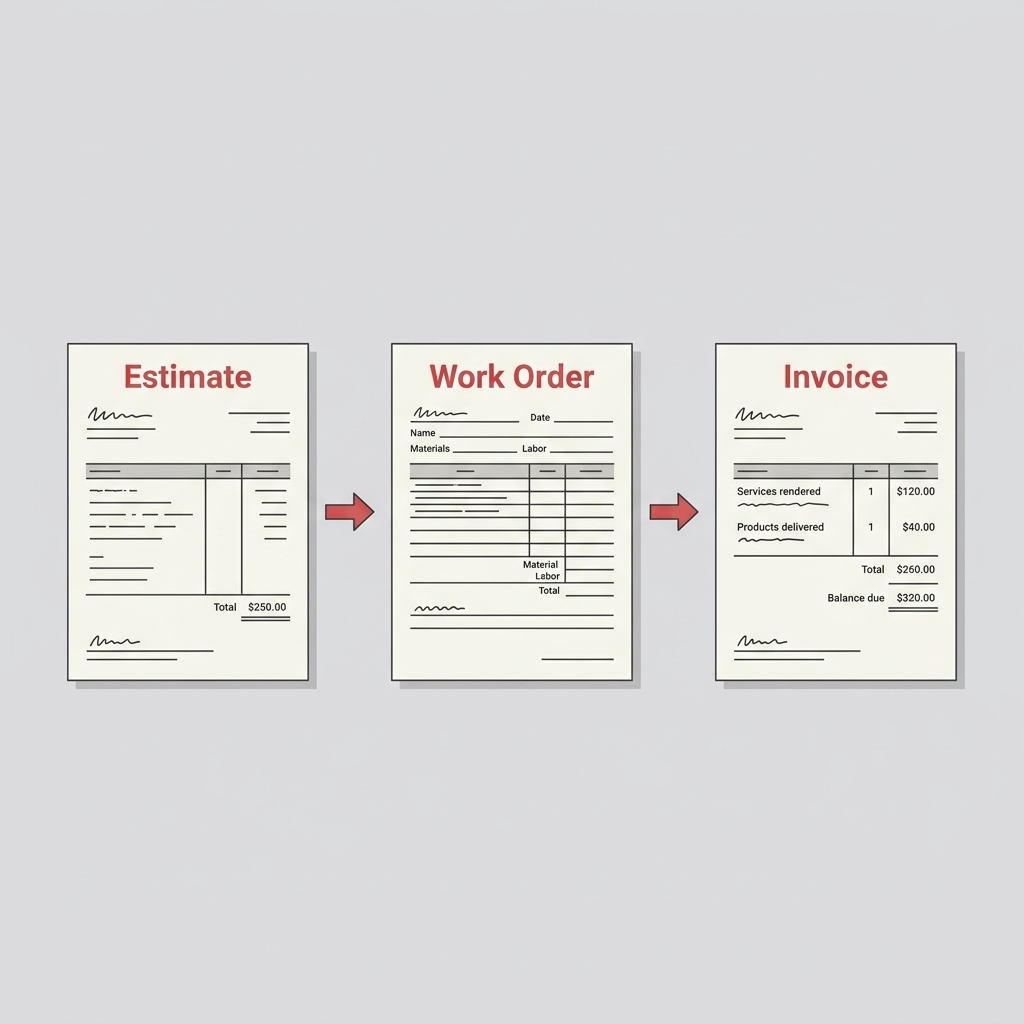
Invoice vs. Estimate vs. Work Order
These three documents appear at different stages of the repair process. They serve distinct purposes, though the information in each feeds into the next.
| Document | Stage | Purpose | Customer-Facing? |
|---|---|---|---|
| Estimate | Before work begins | Projected cost of proposed repairs | Yes |
| Work Order (Repair Order) | During repair | Internal job tracking, parts, labor logs | Partially (authorization copy) |
| Invoice | After work is complete | Final billing statement and payment request | Yes |
Estimate: This is a projected cost provided before any work starts. In many states, shops are legally required to give a written estimate and obtain customer authorization before proceeding. The estimate is not a guarantee of final cost — it reflects anticipated labor and parts based on an initial inspection.
Work Order: Once the customer approves the estimate, the shop opens a work order. This document guides the technician through the job. It records actual time spent, parts installed (with part numbers), and any additional repairs discovered during the process. The customer typically signs the work order at check-in to authorize the shop to proceed.
Invoice: After the work order is closed, the shop generates the invoice. It consolidates all charges from the work order into a final bill. In a well-run shop — or with auto repair shop management software — this conversion happens automatically, reducing manual entry and billing errors.
The estimate sets expectations, the work order documents reality, and the invoice records the final agreement between shop and customer.
In practice, shops that conflate these documents — for example, handing customers a work order as an invoice — create confusion and potential compliance issues. Each document has a specific legal and operational role that should be preserved throughout the workflow.
Invoice vs. Estimate vs. Work Order
An automotive shop invoice, a written estimate, and a repair work order are three distinct documents. Each serves a different purpose, but they follow a clear sequence in any repair transaction.
The table below outlines how these three documents differ in purpose, timing, and legal standing.
| Document | When It's Issued | Purpose | Binding? |
|---|---|---|---|
| Estimate | Before work begins | Projected cost of parts and labor | Not binding, but regulated in most states |
| Work Order | After customer authorization | Internal instruction for technicians; authorizes the shop to proceed | Yes — customer signature makes it legally binding |
| Invoice | After work is completed | Final bill reflecting actual charges | Yes — serves as proof of transaction |
The estimate is what the shop promises. The work order is what the shop does. The invoice is what the shop charges.
How the Three Documents Relate
The sequence is always the same: estimate → work order → invoice. A customer approves an estimate, which converts into a work order that guides the repair. Once the technician completes the job, the shop generates an invoice based on the actual parts used and labor performed.
In practice, the final invoice amount may differ from the original estimate. Additional repairs discovered mid-job, parts substitutions, or approved add-ons all affect the total. Most state regulations — including California's Bureau of Automotive Repair rules — require shops to contact the customer and obtain authorization before exceeding the estimated amount.
Repair Order vs. Final Invoice
These two terms are sometimes used interchangeably, but they are not the same. A repair order (RO) is an internal document that tracks job progress, assigned technician, parts pulled, and labor recorded. It acts as a living record throughout the repair process.
The final invoice is derived from the closed repair order. It presents the completed charges in a customer-facing format, with payment terms, totals, and any applicable taxes. The repair order feeds the invoice — they share the same data, but serve different audiences.
Some shop management platforms merge these functions, automatically generating the invoice from the closed repair order with no manual re-entry required.
2. What Every Automotive Shop Invoice Must Include
A complete automotive shop invoice must contain specific elements to be legally valid, professionally credible, and useful as a financial record. Missing even one key component — such as a VIN or itemized labor description — can create disputes, complicate warranty claims, or violate state consumer protection laws.
The required components fall into four categories: shop and customer identification, vehicle information, charge details, and authorization records.
Shop and Customer Information
- Shop name, address, phone number, and license number (required in most states)
- Customer full name, address, and contact number
- Invoice number and invoice date
- Payment terms (e.g., "Due upon pickup" or "Net 15")
Vehicle Information
- VIN (Vehicle Identification Number) — a 17-character code that uniquely identifies the vehicle
- License plate number and state
- Year, make, model, and trim
- Mileage at drop-off and at completion
Mileage recorded at both drop-off and pickup protects the shop against claims that a vehicle was driven excessively while in service.
Charge Details
Every charge must appear as a separate line item. Combining labor and parts into a single lump sum is a red flag for customers and may violate state disclosure laws. The charges section should include:
- Itemized labor lines (job description, hours, and rate)
- Itemized parts lines (part name, part number, quantity, unit cost, and extended price)
- Shop supply fees, if applicable
- Subtotal, applicable taxes broken out by type, and grand total
Authorization and Signatures
Most states require documented customer authorization before work begins. The final invoice should reference or include:
- Customer signature on the original repair authorization
- Technician or service advisor name associated with each job
- Any warranty terms for parts or labor performed
| Invoice Element | Why It Matters |
|---|---|
| VIN | Confirms work was performed on the correct vehicle |
| Itemized labor | Prevents disputes over time charged |
| Part numbers | Verifies OEM vs. aftermarket and supports warranty claims |
| Mileage in/out | Protects shop from liability claims |
| Tax breakdown | Required for accurate accounting and sales tax compliance |
| Authorization reference | Legal proof customer approved the work |
According to the, customers are entitled to a written explanation of all charges before payment is collected. A fully itemized invoice satisfies this requirement and reduces the likelihood of chargebacks or complaints.
In practice, shops that include all elements consistently see fewer post-repair disputes and faster payment turnaround. A complete invoice also serves as the primary document for any warranty claim made after the customer leaves.
Labor Line Items
Labor is typically the largest cost on an automotive invoice, and how it is documented directly affects customer trust and shop profitability. Each labor line should clearly state what was done, how long it took (or the flat-rate time applied), and the rate charged.
A properly structured labor line includes:
- Job description — specific and plain-language (e.g., "Replace front brake pads and rotors, both sides" rather than "brake job")
- Labor type — flat-rate time or actual time billed
- Hours charged — expressed as a decimal (e.g., 1.5 hours)
- Labor rate — the shop's hourly rate in dollars
- Extended amount — hours × rate
Flat-Rate vs. Actual Time Billing
Most professional shops use flat-rate billing, which charges based on a standardized labor time published by sources such as Mitchell 1, Chilton, or AllData — regardless of how long the technician actually takes. Actual time billing charges the customer for the real clock time spent on the job.
| Billing Method | How It Works | Common Use Case |
|---|---|---|
| Flat-rate | Standardized time from labor guide × hourly rate | Most mechanical repairs |
| Actual time | Real elapsed time × hourly rate | Diagnostics, custom fabrication |
| Hybrid | Flat-rate base + actual time for diagnosis | Complex or unknown-cause repairs |
Flat-rate billing is the industry standard for repair work because it rewards technician efficiency and gives customers a predictable charge up front.
From experience, the job description on a labor line is the most frequently disputed element. Vague entries like "miscellaneous labor" or "check engine" without further detail give customers no basis to understand what they paid for. Specific descriptions — tied to a DTC code, a complaint, or a visual inspection finding — reduce callbacks and justify the charge if questioned.
If a job involves multiple sub-tasks (such as a timing belt service that includes a water pump and idler pulleys), each task should appear on its own labor line rather than bundled into one. This transparency is especially important when some tasks are covered under warranty and others are not.
Parts and Materials Breakdown
Every part installed during a repair should appear as a separate line item on the invoice. Listing parts with full detail supports warranty processing, helps customers understand what was done, and satisfies most state disclosure requirements.
A complete parts line includes:
- Part name and description (e.g., "OEM Front Strut Assembly — Driver Side")
- Part number from the manufacturer or supplier
- Condition — new, remanufactured (reman), or used
- Quantity
- Unit cost (what the shop paid or the list price, depending on billing method)
- Markup applied
- Extended price (quantity × final price per unit)
OEM vs. Aftermarket Parts
The invoice must clearly indicate whether a part is OEM (Original Equipment Manufacturer) or aftermarket. Several states, including California under, legally require shops to disclose part type before installation. Customers who request OEM parts and receive aftermarket without disclosure have grounds for complaint.
| Part Type | Definition | Invoice Notation Example |
|---|---|---|
| OEM | Made by or for the vehicle manufacturer | "OEM — Toyota 47750-0E010" |
| Aftermarket | Made by a third-party supplier | "Aftermarket — Raybestos 780259R" |
| Remanufactured | Rebuilt to OEM spec | "Reman — Cardone 19 |
Labor Line Items
Labor line items document the human work performed on a vehicle. Each line should include a description of the job, the time charged, and the labor rate applied. Without this detail, customers cannot verify what they paid for, and shops have no paper trail if a dispute arises.
Flat-Rate vs. Actual Time Billing
Auto repair shops use one of two methods to bill labor:
- Flat-rate billing charges a predetermined time for a job, regardless of how long the technician actually takes. These times come from published labor guides such as. A brake pad replacement might be listed at 1.2 hours whether the job takes 50 minutes or 90.
- Actual time billing charges the customer for the exact hours and minutes a technician spent on the vehicle, tracked via a time clock or job timer.
Flat-rate billing is the industry standard at most independent shops and dealerships. According to the, most automotive technicians are themselves compensated on a flat-rate basis, which aligns shop revenue with technician pay.
In practice, flat-rate billing creates predictability for customers and consistent margins for the shop. Actual time billing is more common for diagnostic work, where the labor required is genuinely unknown at the start.
How to Structure a Labor Line Item
Each labor entry on an invoice should contain the following fields:
| Field | Example |
|---|---|
| Job description | Replace front brake pads and rotors |
| Labor hours | 1.5 hrs |
| Labor rate | $120.00/hr |
| Line total | $180.00 |
| Technician or op code (optional) | Tech: J. Rivera / Op: 0604 |
Operation codes, often called op codes, are standardized short codes that categorize types of repair work. They simplify record-keeping, support warranty claims, and make invoices easier to audit.
Writing Clear Job Descriptions
Vague descriptions like "repair engine" or "check vehicle" create confusion and invite disputes. Each labor line should describe:
- What was done (the action)
- What component was affected
- Where on the vehicle, if relevant (e.g., "left front," "rear axle")
A well-written description reads: Diagnose and replace failed oxygen sensor — bank 1, sensor 2. A poor one reads: O2 sensor. The first protects the shop legally and gives the customer a clear account of the work.
Shops that use detailed labor descriptions on invoices see fewer chargebacks and customer disputes, because the work is documented in plain language the customer can read and understand.
Multiple Labor Operations on One Invoice
A single vehicle visit often involves several separate jobs. Each operation should appear as its own line item — not bundled into one lump sum. Itemizing separately:
- Allows customers to approve or decline individual services
- Supports accurate tracking of which jobs generate the most revenue
- Makes warranty claims easier to process, since each repair is independently documented
Some jobs share labor time — for example, replacing a water pump and a timing belt at the same time requires less total labor than doing each separately. When applicable, note any labor overlap or combination discount directly on the invoice. This transparency builds trust and reduces the perception that the shop is padding hours.
Parts and Materials Breakdown
Parts on an invoice should be listed individually, with enough detail for the customer to verify what was installed and for the shop to maintain accurate records. Each line should include the part name, part number, quantity, unit cost, and the price charged to the customer.
OEM vs. Aftermarket Parts
The type of part used affects both cost and documentation. OEM (Original Equipment Manufacturer) parts come directly from the vehicle's manufacturer or an authorized supplier. Aftermarket parts are made by third-party manufacturers and are typically less expensive. Shops should clearly label which type was used, as this affects warranty coverage and customer expectations.
Failing to disclose aftermarket part substitutions can expose a shop to legal liability in many states, particularly where consumer protection laws require explicit customer authorization before non-OEM parts are installed.
Part Numbers
Every part listed on an invoice should carry its manufacturer or supplier part number. This creates an auditable trail — if a part fails under warranty, the number confirms exactly what was installed and when. It also reduces disputes if a customer questions whether the correct component was used.
Unit Cost and Markup
Shops purchase parts at wholesale cost and charge customers a marked-up retail price. This markup is a standard and legitimate revenue source. Common markup ranges for auto parts typically fall between 20% and 50%, though this varies by part type, supplier, and regional market. High-volume, low-cost items like filters may carry higher percentage markups, while expensive components like transmissions often carry lower ones.
| Part Detail | Example |
|---|---|
| Part Name | Front Brake Pads (Set) |
| Part Number | MKD1553 |
| Type | Aftermarket |
| Quantity | 1 |
| Unit Cost (Wholesale) | $38.00 |
| Customer Price (Retail) | $55.00 |
| Markup | ~45% |
Shop Supply Fees
Shop supply fees cover consumable materials used during a repair — items like rags, cleaning solvents, lubricants, and small fasteners that are not billed as individual parts. These are typically charged as either a flat fee or a percentage of the total labor and parts cost, often between 5% and 10%, capped at a set maximum. Some states regulate how these fees must be disclosed, so the invoice should itemize them separately rather than embedding them in other line totals.
In practice, clear parts documentation is one of the most effective ways to reduce customer disputes. When a customer can see exactly what was ordered, at what price, and from which supplier, the invoice becomes a transparent record rather than just a demand for payment.
Conclusion
A well-structured automotive shop invoice is one of the most important operational documents a repair business produces. It serves simultaneously as a legal record, a billing instrument, a compliance document, and a reflection of shop professionalism. Getting it right has direct consequences for cash flow, dispute resolution, and customer retention.
The core principles are straightforward. Every invoice should identify the parties, describe the work, itemize all charges, and state the payment terms clearly. When those elements are in place, the invoice protects both the shop and the customer.
Shops that document work thoroughly — with photo-rich inspections tied to invoice line items — experience fewer chargebacks and higher approval rates on recommended services.
Legal compliance is not optional. States including California require written estimates, customer authorization, and itemized final invoices under consumer protection statutes. Keeping signed records for the minimum required retention period — typically three to five years — shields a shop from liability long after a vehicle leaves the lot. Shops that operate without these records take on unnecessary legal and financial risk.
The choice between manual and digital invoicing has become increasingly clear. Paper-based systems introduce transcription errors, slow payment cycles, and weak record-keeping. Digital platforms that generate invoices directly from the work order — eliminating redundant data entry — reduce administrative time and improve accuracy. Auto repair shop management software like RedAppy compresses the entire workflow from estimate to final payment into a single connected system, with one-click invoicing, integrated online payments, and automatic vehicle history logging.
Invoice data is also a management tool. Tracking metrics like average repair order and revenue per technician from invoice records gives shop owners actionable visibility into business performance. Shops that review this data regularly can identify pricing gaps, underperforming service categories, and growth opportunities.
Consistent, professional invoicing builds customer trust faster than most marketing efforts — it signals that the shop is organized, transparent, and accountable.
For shops evaluating their current process, the practical starting point is an audit of existing invoices against the required elements covered in this guide. Gaps in labor documentation, missing part numbers, absent authorization signatures, or unclear payment terms all represent both compliance exposure and customer experience problems. Addressing those gaps — whether through revised templates or a purpose-built platform like RedAppy — is a direct investment in shop stability and long-term profitability.
Ready to Transform Your Shop?
RedAppy helps auto repair shops create professional digital estimates with photos and videos, send them instantly via text or email, and get customer approvals in seconds. No credit card required to start.