
The Auto Shop's Guide to Building Customer Loyalty
A shop owner knows the feeling. A car that used to come in for every oil change, brake job, and check engine light drives past the lot and stops at another bay down the street.
That loss usually gets blamed on price. Sometimes price is part of it. More often, the core problem is weaker follow-up, inconsistent communication, missing service reminders, or a front-desk process that makes the customer feel forgotten. In auto repair, loyalty rarely breaks in one dramatic moment. It leaks out through small gaps.
Building customer loyalty in a repair shop isn't about handing out random discounts and hoping people feel appreciated. It's about making it easy for customers to trust the shop, approve work, come back on schedule, and remember the experience as professional from first call to final payment. When that happens, retention improves, average ticket quality often improves with it, and the shop stops living month to month on fresh leads alone.
Table of Contents
- Why Building Customer Loyalty Is Your Shop's Best Investment
- Where Do You Stand Diagnosing Your Customer Retention
- Building Your Loyalty Engine with Key Touchpoints
- Turn Great Service into Lasting Loyalty
- Measuring the ROI of Your Loyalty Efforts
- Your Quick-Start Plan and Critical Questions Answered
Why Building Customer Loyalty Is Your Shop's Best Investment
Every shop talks about getting more cars in the door. Fewer shops give the same attention to keeping the customers they already worked hard to earn. That's a mistake, because retention changes the economics of the whole business.
A widely cited analysis found that a 5% increase in customer retention can lift profits by 25% to 95% according to. For an auto repair shop, that isn't an abstract marketing number. It shows up in recurring maintenance visits, more opportunities to catch deferred work, steadier scheduling, and less pressure to chase every new customer with coupons.
Loyalty protects future revenue
A returning customer isn't just another invoice. That customer already knows the advisor, already has a service history, and usually needs less convincing to book the next job. The trust has been built once, so the shop doesn't have to rebuild it from zero every time.
That matters even more in repair because the relationship compounds. One good first visit can lead to tire rotations, fluid services, brakes, suspension work, diagnostics, and referrals over time. One bad handoff can erase all of it.
Practical rule: A lost repeat customer is rarely just one lost ticket. It's a chain of missed future visits.
Discounts don't create real loyalty
Many shops respond to churn with a coupon. That can fill a schedule hole, but it doesn't fix the reason customers drift away. If the estimate process is slow, reminders are generic, and no one follows up after a major repair, a loyalty card won't carry much weight.
Real loyalty in auto repair usually comes from a short list of operational strengths:
- Clear communication when the vehicle is dropped off, inspected, and ready.
- Consistent reminders based on vehicle history, not guesswork.
- Easy approvals and payments so the customer doesn't hit friction.
- Visible trust signals like photos, notes, and complete service records.
A shop that handles those basics well builds customer loyalty without sounding like it's trying too hard. The customer remembers that the process felt organized, fair, and easy to repeat.
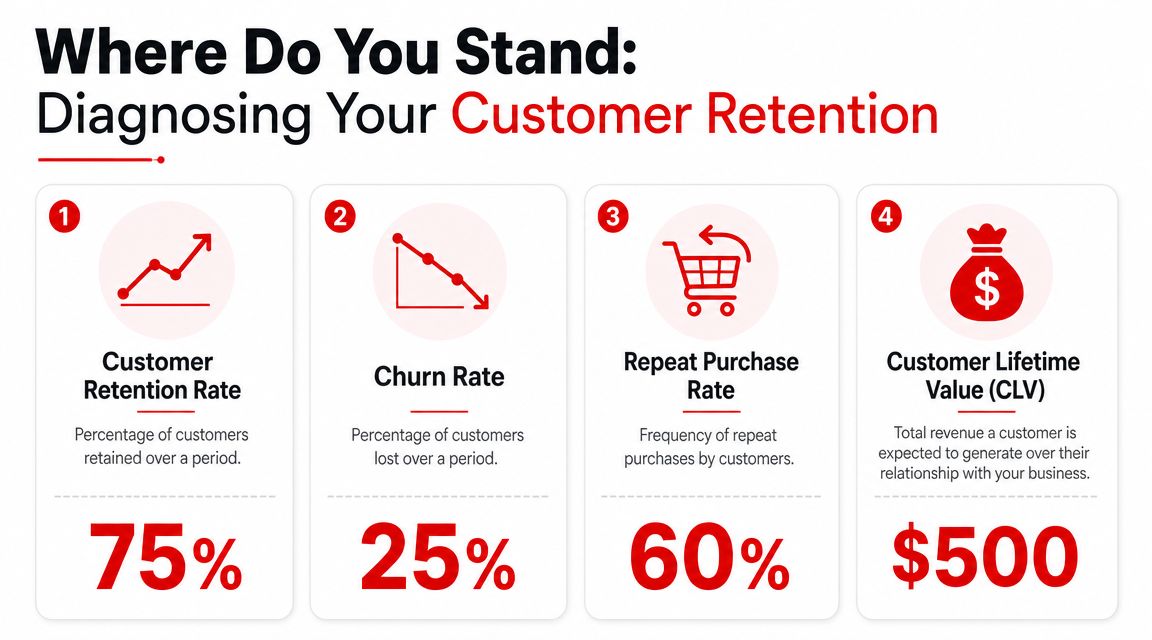
Where Do You Stand Diagnosing Your Customer Retention
Most owners have a gut feeling about retention. They know which names come back, which ones disappeared, and which fleets stay solid. Gut feel helps. It doesn't replace a baseline.
Before changing anything, a shop needs a simple read on current retention. That starts with the records already sitting in the system, on invoices, or buried in spreadsheets.
Start with the records you already have
The cleanest starting point is a customer list by service date. Pull a defined period from the shop system and sort customers into two groups: people who visited once, and people who returned.
A shop can keep the math simple:
- Count active customers in the period.
- Count returning customers in that same period.
- Review repeat purchase rate as an early signal of whether the shop is building habits or only winning one-time visits.
For benchmarking, Epsilon states that a repeat purchase rate in the 20% to 40% range can be considered successful in its guidance on. That doesn't mean every shop should stop there. It gives the owner a rough target line instead of guessing.
The second check is service interval behavior. Look at how long customers go between visits, which job types tend to bring them back, and where they drop off. A customer who comes in for an oil change and never returns after a declined brake estimate tells a different story than a customer who follows the recommended plan over several visits.
Find the leaks before you add rewards
Many retention problems don't come from weak branding. They come from broken process. Common leaks include:
- Missing vehicle history so advisors can't make informed recommendations.
- Paper inspection notes that never become usable follow-up reminders.
- Scattered customer data across phones, texts, invoices, and memory.
- Manual outreach that only happens when the front desk has spare time.
Shops usually don't have a loyalty problem first. They have a visibility problem.
This is where centralized shop software starts earning its keep. A platform that keeps customer records, VIN lookup, prior recommendations, reminders, and payment history in one place gives the shop a real retention dashboard instead of a pile of disconnected events. Shops comparing options can look at shop management system features from RedAppy to see the kind of tools that support this workflow.
If the data is messy, that's still useful. Messy records usually confirm the same point. The shop can't improve what it can't see consistently. Building customer loyalty starts with accurate history, because every later step depends on it.
Building Your Loyalty Engine with Key Touchpoints
Customers don't decide to stay loyal because of one punch card. They decide based on a series of moments. The booking call. The estimate. The inspection photos. The reminder at the right time. The text that sounds like it came from a real shop, not a robot.
A modern loyalty engine is just those moments handled properly, every time.

What the customer sees before and after modern shop processes
Consider a common first visit. A driver calls about a vibration and overdue maintenance. In a weak process, the call gets scribbled on paper, the advisor gives a rough verbal estimate, the inspection stays in the bay, and the customer receives a generic "your car is ready" message hours later. Nothing about that experience creates a reason to return.
Now compare that with a tighter process. The customer gets scheduled with complete vehicle details. The technician performs a digital inspection with photos. The estimate is sent clearly with recommended work grouped by priority. After pickup, the customer gets a follow-up tied to the actual repair and later receives a service reminder based on mileage or prior work. That feels different because it is different.
Deloitte's consumer loyalty survey, based on 5,564 U.S. adults who were loyalty-program members, emphasized that brands now compete on easy redemption, personalization, and digital engagement in. Auto repair isn't retail in the usual sense, but the lesson still applies. Customers expect simple, personal, digital interactions. Points alone won't carry the relationship.
A helpful outside reference on this is FixyFlow's, which lines up with what many shops see on the ground. Service businesses win loyalty through process discipline as much as perks.
The reminder that lands after the customer already forgot the sticker on the windshield is often worth more than the discount printed on the invoice.
A simple loyalty structure that fits an auto shop
Many repair shops overbuild loyalty programs. They create rules nobody at the counter can explain, then wonder why customers ignore them. A better setup is simple enough for staff to use fast and clear enough for the customer to understand.
| Tier | Entry Requirement | Rewards | Communication Trigger |
|---|---|---|---|
| New Customer | First completed visit | Thank-you message, next-service reminder, stored vehicle history | After first paid invoice |
| Returning Customer | Multiple completed visits | Priority reminders, occasional maintenance offer, easier recall of prior recommendations | After repeat visit or accepted follow-up work |
| VIP or Household | Multiple vehicles or consistent long-term service | Early scheduling access, personalized service tracking, loyalty credit or appreciation perk | Multi-vehicle profile or steady repeat behavior |
A structure like that works because it supports real behavior. It doesn't try to turn brake jobs into airline miles.
A few touchpoints tend to outperform everything else:
- Digital inspections with photos make trust visible.
- Post-service follow-up catches questions before they become bad reviews.
- Declined work reminders turn lost approvals into future revenue.
- Vehicle-specific maintenance reminders bring customers back when the car needs attention.
These aren't glamorous tactics. They work because they fit how repair customers make decisions.
Turn Great Service into Lasting Loyalty
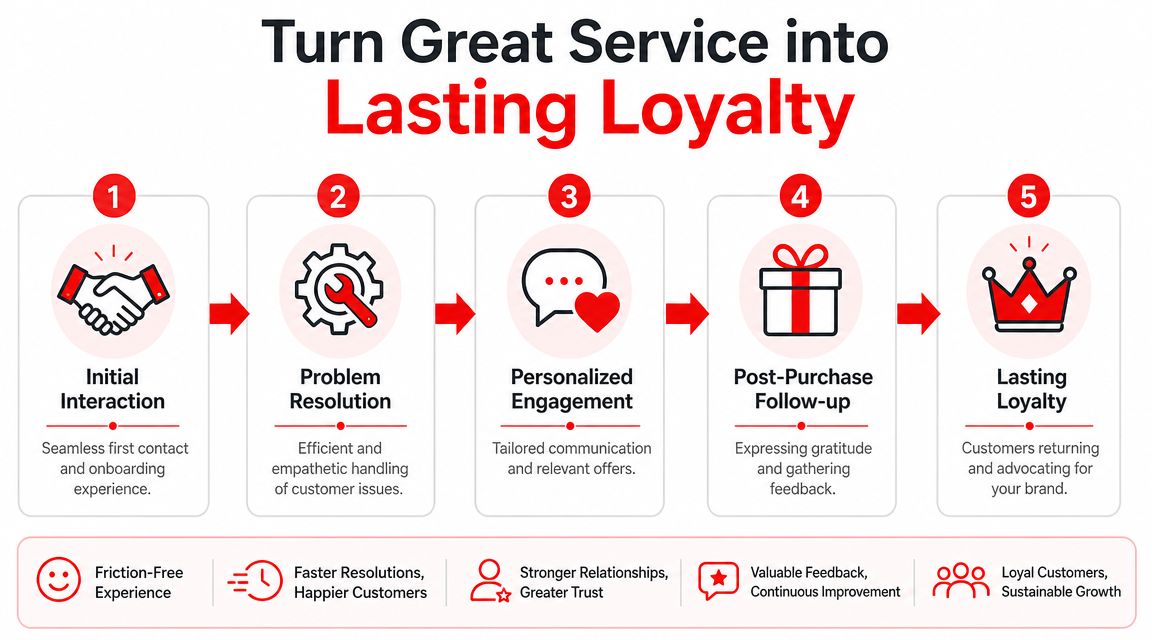
The strongest loyalty program in an auto repair shop often isn't a program at all. It's a smooth experience that lowers stress at every step. Drivers already arrive worried about cost, downtime, and whether they're being told the full story. The shop either reduces that friction or adds to it.
When a shop runs clean operations, customers read that as professionalism. When it runs disorganized operations, customers read that as risk.
Operations are part of marketing
A front desk team may spend money on ads, local SEO, and mailers to get the phone ringing. But if the estimate takes too long, if the customer has to call twice for an update, or if pickup turns into a line at the counter, operations just undid the marketing spend.
That is why process matters. Guidance on loyalty implementation from Droidsonroids notes that systematic implementations are reported to achieve 60% higher success rates than unstructured initiatives in its article on. In plain shop terms, the owner needs a repeatable system, not a collection of good intentions.
A good shop experience usually includes:
- A visible job status flow so staff knows where each vehicle sits.
- Fast, documented estimates that show what was found and why it matters.
- Approval tools that reduce back-and-forth between advisor and customer.
- Simple digital payment options so pickup doesn't stall at the end.
What friction looks like in a repair shop
Friction isn't only a big failure. It's usually a pile of small annoyances:
- The unanswered phone call from a new customer who moves on to the next shop.
- The vague inspection result that doesn't justify the estimate.
- The delayed parts update that leaves the customer guessing.
- The clumsy checkout that makes the last impression worse than the repair itself.
Even call handling affects loyalty more than many owners admit. If inbound calls get missed or delayed, the shop loses trust before the car ever enters the bay. For shops reviewing phone workflow, this breakdown on how to is useful because it focuses on the practical call bottlenecks front desks deal with every day.
A customer doesn't separate service quality from process quality. To that customer, they're the same thing.
When the shop board is clear, inspection notes are documented, and payments are easy, the experience feels controlled. That's what loyalty grows from. The customer doesn't need to love car repair. The customer just needs to feel that this shop handles it better than the alternatives.
Measuring the ROI of Your Loyalty Efforts
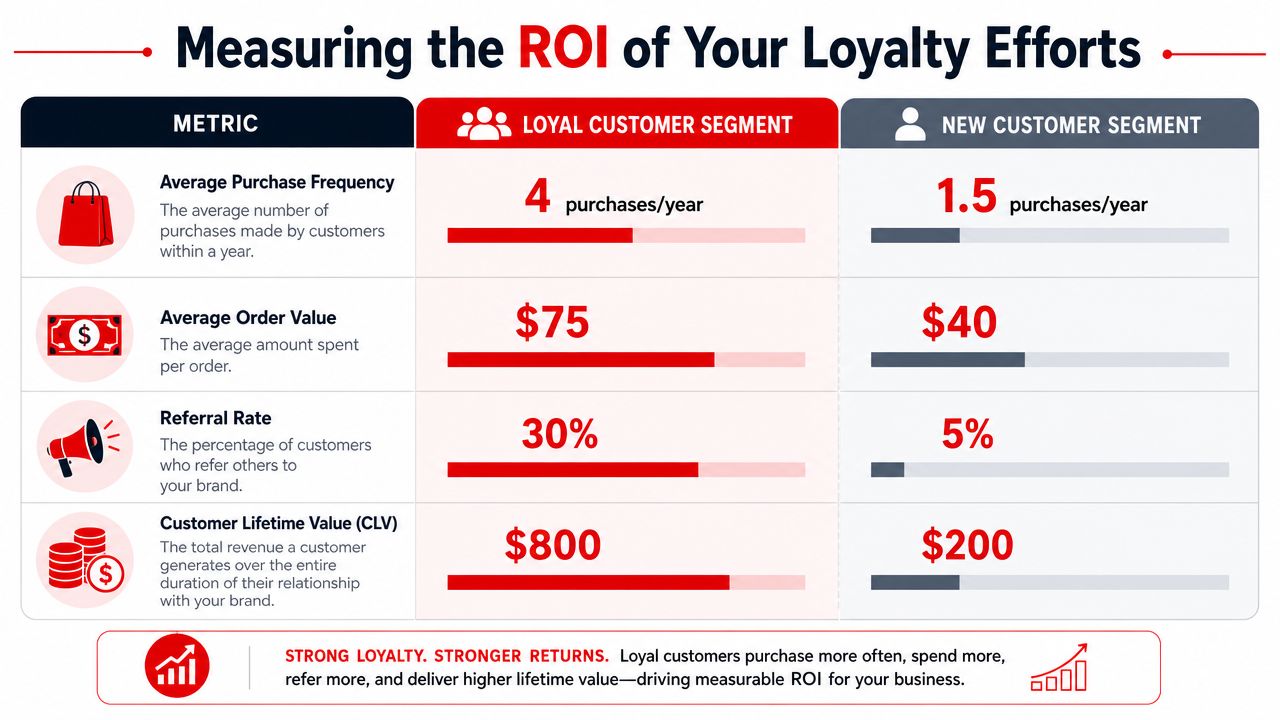
Loyalty work shouldn't get judged by signups, likes, or how many people took a free coffee mug. It should get judged the same way a technician judges a repair. Did it fix the problem, and can the shop prove it?
The cleanest way to do that is to track a small set of numbers that connect customer behavior to money.
The three numbers that tell the real story
The first is repeat purchase rate. That tells the shop whether customers are coming back at all. If that number climbs after better reminders, better follow-up, or a cleaner estimate flow, the shop is likely fixing real loyalty problems instead of just talking about them.
For a benchmark, Epsilon states that a repeat purchase rate in the 20% to 40% range can be considered successful in its guidance on loyalty measurement. The exact result will vary by shop model, car count, and service mix, but the point is simple. Repeat behavior needs a target.
The second number is customer lifetime value, often written as CLV or LTV. In a repair shop, a simple version can be estimated by looking at how much a customer spends over the full relationship with the business. A customer who returns for maintenance, tires, inspections, and larger repairs is worth far more than a one-time discount buyer.
The third is average repair order. Loyalty doesn't only show up in frequency. It also shows up in trust. Customers who trust the shop are generally more willing to approve appropriate recommended work because they understand what they're paying for and why it matters.
Read loyalty like a shop owner reads a vehicle history
One invoice doesn't tell the whole story. Vehicle history does. Loyalty metrics work the same way.
A healthy pattern might look like this:
- Repeat purchase rate rises because reminders and follow-up are consistent.
- LTV rises because customers stay with the shop longer.
- Average repair order stays stable or improves because trust supports better approvals.
A weaker pattern looks different:
| Signal | What it may mean |
|---|---|
| High signups, weak return visits | Customers joined a program but didn't feel a reason to come back |
| Good first-visit volume, low LTV | Acquisition is working, retention isn't |
| Strong repeat visits, flat approvals | Customers return for basics but don't fully trust recommendations |
Loyalty ROI is easier to see when each customer record ties together visit count, accepted work, declined work, and time between services.
That is why measurement needs complete touchpoint data. Epsilon's guidance also stresses instrumenting key steps like signup, first purchase, earn, redeem, and renewal, then judging performance by enrollment, participation, redemption, retention, average spend, and incremental margin rather than signups alone. In a shop, the equivalent is booking, check-in, inspection, estimate approval, payment, and return visit. If one step breaks, the loyalty result usually breaks with it.
Your Quick-Start Plan and Critical Questions Answered
Most shops don't need a giant loyalty launch. They need a manageable rollout that tightens daily habits and gives the owner better visibility.
A practical rollout plan
Start with the first block of work:
- Clean customer records by checking names, phone numbers, plates, VINs, and vehicle history.
- Standardize reminders for routine service, deferred work, and post-repair follow-up.
- Review the estimate process so every recommendation is explained clearly and documented.
In the next phase, focus on consistency:
- Use digital inspections on the jobs where trust matters most.
- Create customer segments such as first-time visitors, repeat maintenance customers, lapsed customers, and multi-vehicle households.
- Track return behavior by segment so the shop can see who comes back.
Then move into refinement:
- Test one loyalty offer at a time instead of stacking discounts.
- Compare behavior before and after each change using return visits, approvals, and service intervals.
- Keep the process that changes behavior and drop the one that only adds admin work.
Questions owners should ask before spending money on loyalty
The hardest question is also the most important. Is the shop creating new repeat business, or just giving rewards to people who would've returned anyway?
That issue matters because a loyalty tactic can look busy without being profitable. Yotpo highlights this gap directly in its discussion of. A shop has to identify which customer segments are persuaded to come back because of the program, and which ones were already likely to return.
A few practical questions help sort that out:
- Did lapsed customers return? If not, the offer may only be rewarding the already loyal.
- Did first-time customers book a second visit faster? If not, follow-up may still be weak.
- Did approvals improve after inspections became clearer? If yes, trust may be doing more than any reward ever could.
- Did one segment respond better than another? Households with multiple vehicles often behave differently from coupon-driven first-timers.
Another important question is whether the staff can maintain the system. If the program adds complexity at the counter, the team will abandon it when the bays get full. Loyalty should reduce guesswork, not create another binder nobody opens.
The best quick-start plan is usually boring in the right way. Better records. Better reminders. Better inspections. Better follow-up. That's how building customer loyalty becomes part of the shop's daily workflow instead of a side project that fades out after a month.
If the shop needs help turning those steps into a working process, RedAppy is worth a look. It combines tools like digital inspections, estimates, invoicing, payments, vehicle history, analytics, and a digital shop board in one system, which makes loyalty easier to execute because the operational pieces are already connected.
Ready to Transform Your Shop?
RedAppy helps auto repair shops create professional digital estimates with photos and videos, send them instantly via text or email, and get customer approvals in seconds. No credit card required to start.