
Compression Test vs Leak Down Test: Which to Use & When
A vehicle comes into the bay with low power, a rough idle, and a complaint that it “just doesn't pull like it used to.” The scan data isn't giving a clean answer. Fuel trims may be off. A misfire may be present, or maybe not. At that point, the question isn't whether the engine has a mechanical problem. The question is which test gets the shop to the answer faster.
That's where the compression test vs leak down test decision matters. Both are core engine health checks. Both belong in a real diagnostic workflow. But they do different jobs, and using the wrong one first wastes time, confuses the diagnosis, and can push a tech toward the wrong repair.
A compression test is the fast first look. A leak-down test is the precise fault finder. The mistake is treating them like interchangeable versions of the same test. They aren't. One shows how the engine builds pressure while cranking. The other shows how a cylinder holds pressure when it's static. That difference changes what each test can and can't reveal.
Table of Contents
- The First Question for Any Engine Problem
- The Compression Test A Quick Health Check
- The Leak-Down Test A Precise Fault Finder
- Key Differences Compression vs Leak Down Test
- How to Interpret Your Test Results
- The Diagnostic Blind Spot Why You Might Still Need Both
- Creating an Efficient Diagnostic Workflow
The First Question for Any Engine Problem
A vague drivability complaint usually starts the same way. The car starts, but it shakes. It runs, but it won't make power. It may have a dead miss under load, or it may just feel lazy. That's when a new apprentice often reaches straight for the “better” tool without stopping to ask what question needs answering first.
The first question is simple. Does the engine have a broad mechanical health problem, or does it have a specific sealing problem inside one or more cylinders? That's the split between a compression test and a leak-down test.
In a busy shop, speed matters. Not rushed work. Efficient work. A compression test gives a fast mechanical snapshot. It helps sort a healthy engine from a sick one without tearing anything apart. A leak-down test slows things down on purpose and gets more exact. It's for finding where the pressure is going.
Shop rule: Start with the test that narrows the field fastest, then move to the test that proves the failure.
That approach prevents common mistakes:
- Guessing from symptoms alone can lead to replacing ignition or fuel parts on an engine with a mechanical problem.
- Jumping straight to leak-down can miss problems that only show up when the engine is turning.
- Relying on one result in isolation can make a bad engine look repairable, or a repairable engine look ready for overhaul.
A skilled tech treats these tests like different lights in the same toolbox. One floods the room. The other spots the exact crack in the wall.
The Compression Test A Quick Health Check
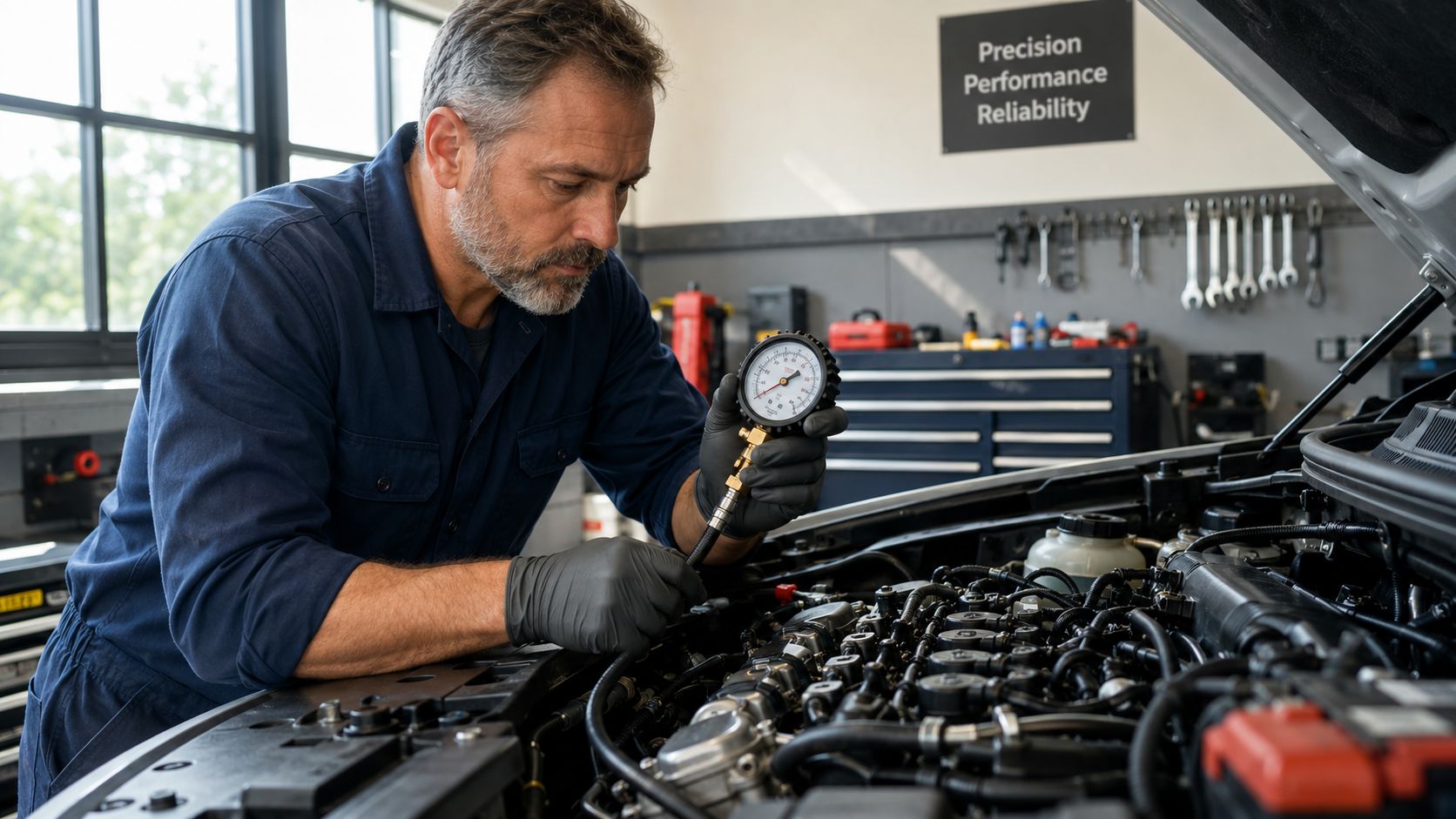
A car comes in with a shake at idle and no pull on the road. Fuel trims look reasonable. Ignition parts are not telling on themselves. Before tearing into anything, run a compression test. It is the fastest way to find out whether the engine can make cylinder pressure while it is turning, and that dynamic part matters more than many guides admit.
What the compression test is really telling you
A compression test checks how each cylinder builds pressure during cranking. The pistons are moving, the valves are opening and closing, and cranking speed affects the result. That gives it one advantage a static leak-down test does not have. It can expose problems tied to valve timing and valve motion.
That matters on engines with a jumped timing chain, a worn cam lobe, a valve that hangs up at speed, or valve timing that is late enough to kill cranking pressure. A leak-down test done at Top Dead Center can still look decent in some of those cases because the cylinder may seal once the valves are fully closed. The compression gauge catches the cylinder in motion, which is why it is such a good first filter.
Use it to answer one question fast. Can this engine build pressure evenly enough to run right?
A weak cylinder stands out. A tired engine usually shows a pattern across all cylinders. The test does not tell you the exact leak path, but it does tell you whether the problem is isolated, widespread, or tied to engine timing rather than basic sealing alone.
A practical shop procedure
Keep the setup consistent or the numbers lose value.
- Warm the engine if it will run well enough to do it safely.
- Disable fuel and ignition so the engine cannot start during the test.
- Remove all spark plugs so the starter can spin the engine evenly.
- Hold the throttle open if the engine design calls for unrestricted intake air during cranking.
- Install the gauge so the hose seals fully at the plug hole.
- Crank the engine the same number of pulses on every cylinder and record the highest reading.
- Repeat the process across the whole engine, then compare cylinders to each other before worrying about the absolute number.
The pattern matters more than one headline PSI figure. One low hole points you in a different direction than four low holes. Two adjacent low cylinders raise different suspicions than one cylinder that improves on a wet test.
Where the compression test earns its keep
In a real shop, this test saves time because it sorts the jobs that need mechanical work from the jobs that do not.
It is especially useful for:
- Low power complaints when the scan data does not fully explain the lack of output
- Misfires under load that could still be mechanical even after basic ignition and fuel checks
- Used engine evaluations where a quick baseline helps decide whether to go further
- Valve timing concerns because the test reflects what happens while the valvetrain is moving
What it does well, and where it stops
Compression testing is a screening tool. It shows whether the engine can produce pressure under cranking conditions. It can reveal a timing problem that a static sealing test may miss, and that is a big reason experienced techs still start here.
What it will not do is tell you exactly why a cylinder is low. Burned valve, worn rings, head gasket leak, cam timing error, and valvetrain damage can all show up as low compression. Once the compression pattern tells you there is a mechanical problem, then it makes sense to slow down and pinpoint the leak path with the next test.
The Leak-Down Test A Precise Fault Finder
A leak-down test answers a different question than a compression test. Instead of asking how much pressure the cylinder can make while the engine is turning, it asks how well that cylinder holds pressure when it is parked at top dead center on the compression stroke. That makes it a fault-isolation test, not a first-pass screen.
Setup matters here. The piston has to be at true TDC on the compression stroke, both valves need to be fully closed, and the crankshaft has to be held so shop air does not push the engine over. Miss that position by a little and the result gets noisy fast. On some engines, especially ones with aggressive cams or worn timing components, finding and holding the exact spot takes more time than the test itself.
That extra setup is why I do not start here on every no-power or misfire complaint. Leak-down is slower, but it pays you back once compression has already shown there is a mechanical problem and you need to know where the pressure is going.
How the test is set up
A regulated leak-down tester feeds compressed air into one cylinder at a time through the spark plug hole. One gauge shows supply pressure. The other shows how much is being retained versus lost through the cylinder. The number matters, but the true insight is what you hear and where you hear it.
A careful test also needs the engine in decent test condition. A cold engine, carbon on the valve seats, or a piston sitting slightly off TDC can skew the reading. Consistency across cylinders matters more than chasing one dramatic number from one hole.
Why the leak-down test is so useful
Leak-down earns its keep because it helps separate possible causes.
- Air at the throttle body or intake points to an intake valve that is not sealing
- Air at the tailpipe or exhaust outlet points to an exhaust valve leak
- Air from the oil fill, breather, or dipstick tube points to ring or piston leakage into the crankcase
- Air bubbling in the radiator or moving into an adjacent cylinder points toward a head gasket, cracked head, or block problem
That is the difference between saying a cylinder is weak and saying why it is weak. In the bay, that can be the difference between pulling a head with confidence and wasting time second-guessing rings, valves, and gasket sealing.
Where it shines and where it doesn't
Leak-down works best after the quick screening is done and the job has narrowed to a sealing fault. It is especially useful when the engine has one bad cylinder and the shop needs to know whether to expect top-end work, bottom-end damage, or a head gasket failure before teardown.
It still has a blind spot. The engine is static during this test. The cam is not advancing through its events, the valves are not opening and closing at speed, and the valvetrain is not being loaded the way it is during cranking. A cylinder can post an acceptable leak-down result and still have low compression from a dynamic problem such as late valve timing, a worn cam lobe, lifter trouble, or another issue that shows up only while parts are moving.
That is why leak-down is precise, but not complete by itself. It tells you where pressure escapes at rest. It does not replace the dynamic picture.
Key Differences Compression vs Leak Down Test
The easiest way to settle the compression test vs leak down test question is to compare what each test is built to do.
| Comparison point | Compression test | Leak-down test |
|---|---|---|
| Primary job | Broad cylinder health check | Specific pressure-loss diagnosis |
| Test type | Dynamic | Static |
| Engine condition | Cranking | Cylinder held at TDC |
| Main reading | PSI | Leakage percentage and leak path |
| Best use | Fast screening | Pinpointing the fault |
| Limitation | Doesn't clearly show where pressure is lost | Doesn't show dynamic timing-related problems |
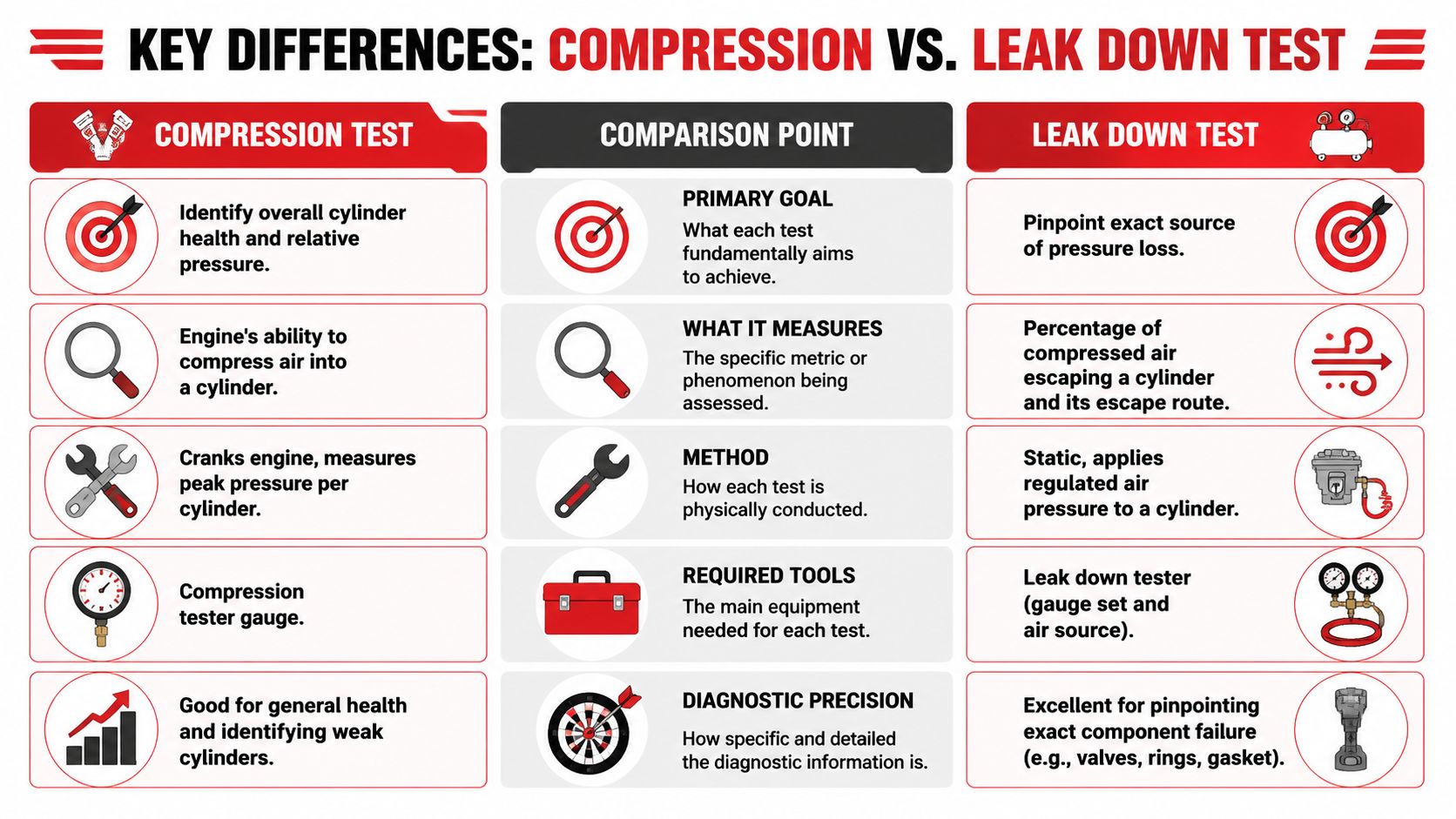
Different questions, different answers
A compression test asks, “How much pressure can this cylinder make while the engine turns?”
A leak-down test asks, “How much pressure can this cylinder keep, and where is it escaping?”
Those are related questions, but they are not the same. That's why one test shouldn't replace the other.
Tool choice in a real shop
If the shop needs a quick answer to whether the engine is mechanically healthy enough to keep chasing fuel, ignition, or control issues, the compression tester gets used first. It's simpler, faster, and easier to run as a broad check.
If the shop already knows a cylinder is weak and needs to prove whether the problem is in the rings, valves, or head gasket area, the leak-down tester is the right move.
A compression test is usually the faster decision-maker. A leak-down test is usually the stronger proof.
Practical trade-offs
The trade-offs aren't about which test is “better.” They're about efficiency.
- Compression test wins on speed when the complaint is vague and the shop needs direction.
- Leak-down wins on detail when a bad cylinder has already been identified.
- Compression helps with moving-system issues because the engine is cranking during the test.
- Leak-down helps with sealing faults because the cylinder is isolated and pressurized in a controlled way.
A lot of confusion comes from hearing that leak-down is more accurate. That's only true if the shop is trying to find a sealing leak. If the problem comes from valve timing behavior while the engine moves, the compression test can reveal something the leak-down test won't.
Which one should come first
Most of the time, the smart order is simple:
- Run compression first.
- Look for a weak cylinder or a suspicious pattern.
- Follow up with leak-down where needed.
- Confirm the failure path before quoting major internal engine work.
That sequence saves labor and reduces comeback risk. It also makes the shop's findings easier to explain to the customer.
How to Interpret Your Test Results
A gauge reading only matters if you read it in context. The job is to sort the result into one of two buckets. Is the cylinder failing to build pressure while the engine turns, or is it failing to hold pressure when the cylinder is parked?
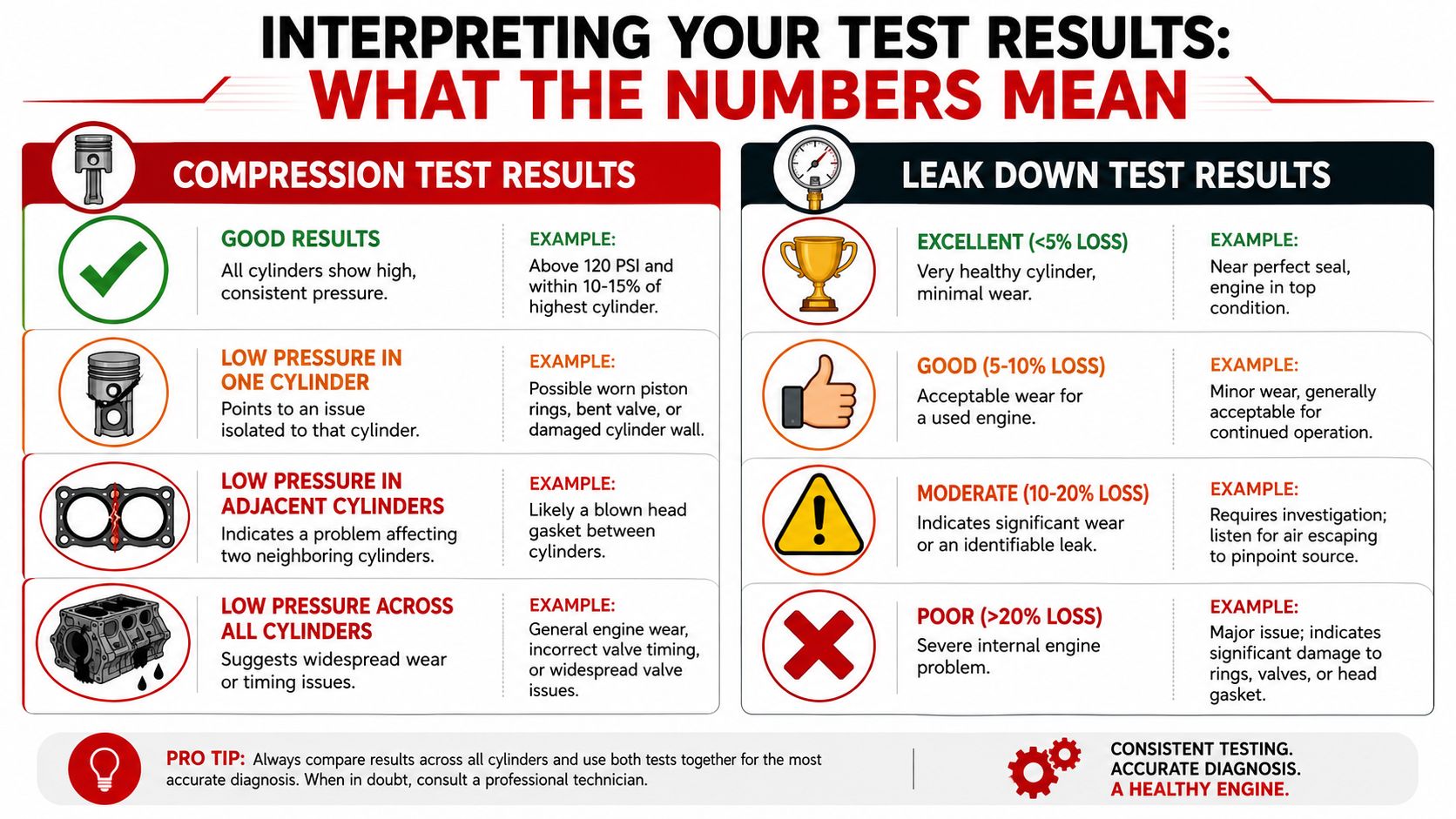
Reading compression results the right way
Read compression numbers across the whole engine first. A single cylinder matters, but the pattern matters more.
Here is the shop logic:
- Even numbers across all cylinders usually mean the engine is mechanically balanced at cranking speed
- One cylinder clearly lower than the rest points to a localized problem in that hole
- Two adjacent cylinders low raises suspicion for a shared sealing failure between them
- All cylinders low shifts attention toward an engine-wide issue such as wear, incorrect test conditions, or valve timing that is off during cranking
That last pattern gets missed a lot.
If compression is low across the board but leak-down later looks decent, do not assume the engine is healthy. That combination can point to a dynamic problem. Cam timing that has drifted, a worn lobe, or another issue that affects cylinder filling and pressure during engine rotation can pull compression down without creating a dramatic static leak at TDC.
A wet compression retest can help narrow the field. If added oil brings the number up, ring seal moves higher on the suspect list. If the number barely changes, valve sealing or valve timing stays in play.
Understanding leak-down percentages
Leak-down results answer a different question. They show how well the cylinder holds supplied air at a fixed position.
The exact percentage matters less than three things in the bay:
- how that cylinder compares with the others
- whether the leakage is minor or clearly excessive
- where the air is going
A moderate reading on one cylinder with obvious air noise at the tailpipe means more than a bare percentage written on the repair order. A higher reading into the crankcase points you in a different direction. The gauge gives the amount of loss. The leak path gives the reason.
Match the sound to the fault
During leak-down, the sound often finishes the diagnosis.
| Where the air is heard | Likely issue |
|---|---|
| Intake tract | Intake valve not sealing |
| Exhaust outlet | Exhaust valve not sealing |
| Dipstick tube or crankcase | Rings or piston leakage |
| Cooling system or adjacent area | Head gasket or related sealing problem |
Use your ears carefully. A little hiss can be normal on a used engine. Strong, obvious airflow is what matters, especially when it lines up with the weak cylinder from the compression test.
Put both results together before calling the failure
The best interpretation comes from combining the two tests instead of forcing one test to answer everything.
A low compression cylinder with heavy leak-down into the exhaust usually points to an exhaust valve sealing fault. Low compression with strong crankcase leakage usually pushes the problem toward rings or piston damage. Low compression with acceptable leak-down needs more caution. That is where experienced techs stop and ask what could be wrong only while the engine is moving.
That approach saves parts, labor, and arguments with customers.
The Diagnostic Blind Spot Why You Might Still Need Both
The common mistake is assuming the leak-down test replaces the compression test because it seems more exact. For static sealing faults, it is more exact. But that doesn't make it complete.
A compression test happens while the engine is turning, which means it can expose problems tied to valve timing behavior. A leak-down test happens with the cylinder held still at TDC. That setup is excellent for finding a leak path, but it can miss a timing problem that only shows itself during dynamic engine motion.
A technical discussion from experienced mechanics on points to that exact gap. The core issue is simple. A compression test is a dynamic evaluation capable of revealing valve timing errors, while a leak-down test is a static pressure hold that cannot. The same discussion describes the compression test as the primary filter for catastrophic dynamic issues like timing.
Why this matters in the bay
A stretched timing set, worn camshaft lobe, or bank-to-bank timing issue can lower effective cylinder pressure during cranking. The leak-down test may still look acceptable because the valves and rings seal reasonably well at the static test position.
That creates a dangerous trap:
- The engine feels weak
- Compression looks suspicious in a pattern
- Leak-down doesn't look bad enough to match the complaint
- The shop starts blaming wear when the underlying issue is timing behavior
That's how an engine can get pushed toward unnecessary internal work when the actual problem lives in the timing side of the engine.
Don't use a static test to rule out a dynamic failure.
The right way to think about the two tests
These tests are partners, not rivals. Compression catches things leak-down can miss. Leak-down clarifies things compression can't localize.
If a tech skips compression and goes straight to leak-down, the diagnosis may lose the one clue that points toward a dynamic timing fault. If a tech stops at compression, the diagnosis may never identify whether the weak cylinder is leaking through the intake valve, exhaust valve, rings, or gasket area.
That's the key lesson in the compression test vs leak down test debate. The leak-down tester is not automatically the superior tool. It's the superior tool for a narrower question.
Creating an Efficient Diagnostic Workflow
A car comes in low on power, no hard misfire, fuel trims are not screaming, and the customer is already bracing for an engine replacement quote. That is exactly when a shop needs a disciplined workflow. The right order of tests saves time, protects credibility, and keeps a timing problem from getting mistaken for bottom-end wear.
A workflow that works in a real shop
Start by confirming the complaint with a road test, scan data, and the basics. If the symptoms point toward a mechanical problem, run compression before reaching for the leak-down tester. Compression is the fast screen. It can show a cylinder issue, a bank pattern, or a dynamic timing problem that will not stand out during a static leak-down test.
From there, the sequence should stay simple:
- Verify the complaint with a drivability check and scan data review.
- Run a compression test when the symptoms fit a mechanical fault.
- Compare the pattern across all cylinders instead of fixating on one low hole.
- Use leak-down on the suspect cylinder or bank to trace the leak path.
- Inspect valve timing and related mechanical timing issues when compression is weak but leak-down does not match the complaint.
- Document the findings clearly before recommending teardown or engine replacement.
That order keeps labor focused on the next useful answer. It also prevents the shop from selling major engine work off a static test that missed the true problem.
Documentation has to support the diagnosis
Customers approve expensive repairs when the story makes sense. Compression readings, leak-down percentages, notes on where the air was heard, scan data, and a few inspection photos give the advisor something solid to present.
If you want to see a customer-facing example, shows how some shops present diagnostic services as a real paid process instead of a quick guess.
Good records also help the next tech. If the vehicle comes back a month later, nobody should have to repeat basic testing just because the first set of notes was thin.
Keep the process repeatable
The best workflow is the one every technician follows the same way on a busy day.
- Use compression as the first mechanical screen
- Use leak-down to localize the failure
- Treat a compression pattern as a clue, not just a number
- Do not let an acceptable static leak-down result override a dynamic timing warning
- Write findings so the advisor and customer can both follow the logic
Consistency matters at the shop level too. The foreman gets cleaner diagnostics. The advisor gets a repair recommendation backed by evidence. The customer gets a clear reason for the estimate.
Many shops now use management software to keep inspections, technician notes, estimates, job status, and vehicle history tied to the same repair order, which makes that consistency easier to maintain.

Shops that want a cleaner way to manage inspections, estimates, technician notes, and vehicle history can review the RedAppy features or reach out through the RedAppy contact page. It is a practical fit for teams that want tighter diagnostic control from check-in to checkout.
Ready to Transform Your Shop?
RedAppy helps auto repair shops create professional digital estimates with photos and videos, send them instantly via text or email, and get customer approvals in seconds. No credit card required to start.