
DPF Filter Repair: A Pro Shop's Guide to Profitability
A diesel comes in with the DPF light on, the customer wants it fixed fast, and the front counter has to answer the same hard question every time. Is this a quick regeneration, a real cleaning job, or a replacement conversation nobody wants to have? That's where most shops either make money or give it away.
DPF filter repair isn't one task. It's a workflow. The shops that handle it well don't just clean filters. They diagnose root cause, choose the right repair path, document the job clearly, and price the work in a way that protects margin and prevents comebacks.
Table of Contents
- Diagnosing DPF Problems Beyond the Warning Light
- The First Line of Defense On-Vehicle Regeneration
- The Deep Clean A Guide to Off-Vehicle DPF Repair
- The Big Decision When to Repair vs Replace a DPF
- Streamlining DPF Services with Smart Shop Management
- Building a Profitable DPF Repair Program
Diagnosing DPF Problems Beyond the Warning Light
A DPF warning light is a symptom. It's not a diagnosis. Treating it like a final answer is how shops clean a filter, hand the keys back, and see the same vehicle return with the same complaint.
Start with the fault, not the assumption
The first move is basic but often skipped. Read the codes, review the live data, and look at the operating context before touching the repair plan. The scan tool should help answer a simple question. Is this a soot loading problem that still has a recovery path, or is the filter reacting to something upstream?
Manufacturer guidance ties DPF performance directly to operating temperature and duty cycle. Stop-and-go driving, short trips, frequent remote starts, and aftermarket components can drive excessive regeneration and DPF damage, and unresolved issues like exhaust leaks or sensor faults commonly sit behind repeat failures, as noted in.
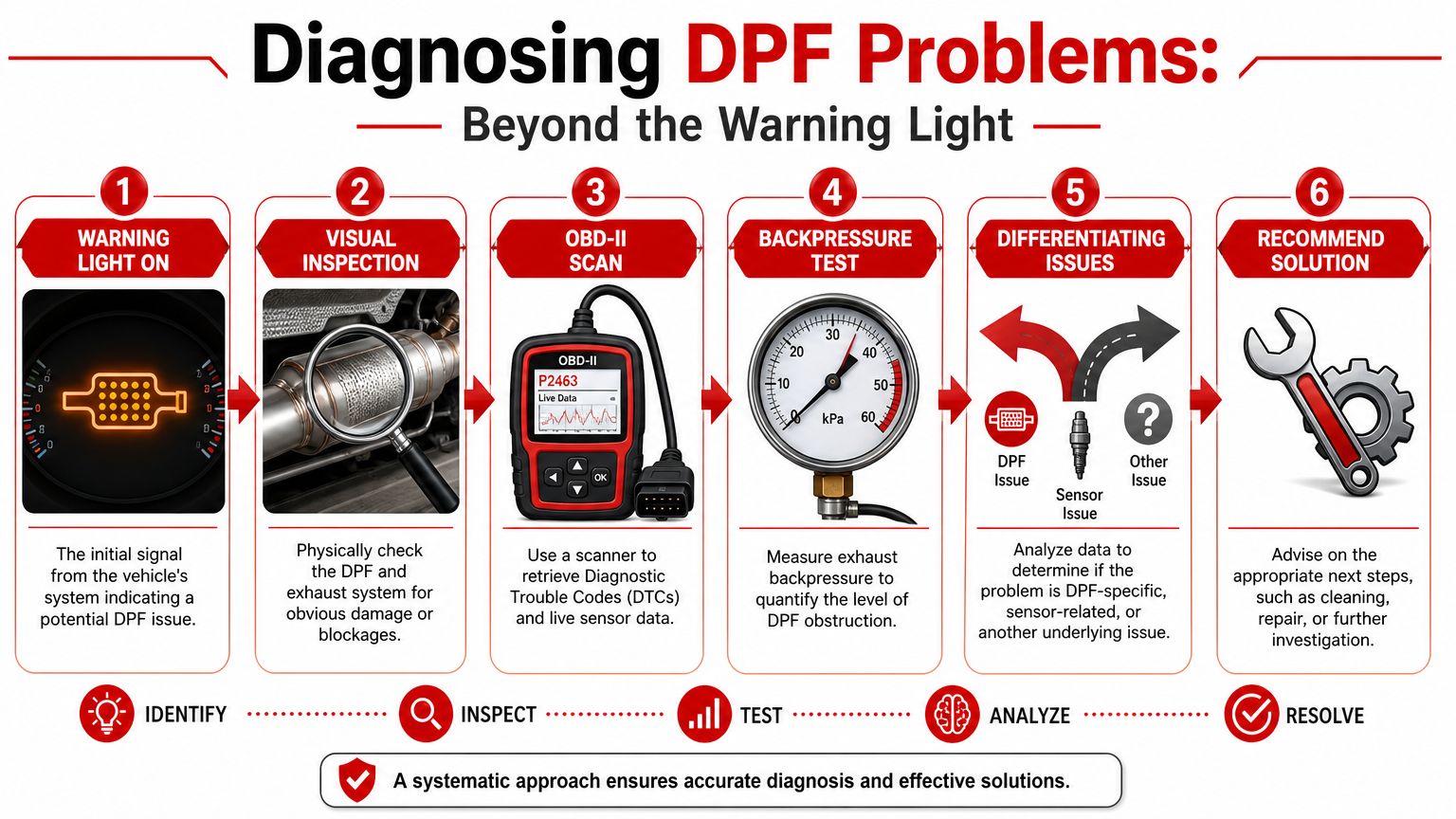
Build a diagnostic tree that rules causes in or out
A strong shop process usually follows this order:
- Confirm the complaint by checking the warning lights, customer notes, and recent drivability symptoms.
- Inspect the exhaust path for leaks, obvious damage, loose clamps, and signs of overheating.
- Scan the vehicle fully instead of looking only at one DPF code.
- Review sensor behavior so bad temperature or pressure readings don't send the shop down the wrong path.
- Check regeneration history and current loading in the scan data.
- Decide whether the filter is the cause or the victim.
That last point matters most. A DPF can clog because the vehicle never gets hot enough to complete regeneration. It can also clog because a sensor lies to the control system, an exhaust leak disrupts pressure readings, or another engine-side problem pushes too much soot into the system.
Practical rule: Never sell DPF filter repair as a cleaning-only job until the shop has looked for the reason the filter loaded up in the first place.
A service writer should also understand the difference between soot and ash. Soot can often be burned off through regeneration if the filter is still within a recoverable range. Ash is different. It accumulates over time and has to be removed through off-vehicle cleaning when the filter condition supports that path.
What the service writer needs to explain
Customers usually understand “clogged filter.” They often don't understand why the estimate includes diagnosis before cleaning. The answer is straightforward. The shop isn't charging to confirm the dashboard light. The shop is charging to avoid an incomplete repair.
A short explanation works well at the counter:
- The light points to the system, not the failed part.
- The filter may be blocked because the vehicle's use pattern prevents regeneration.
- A pressure, temperature, or exhaust issue can make a cleaned filter fail again immediately.
For the advisor, this turns a vague conversation into an informed one. For the technician, it protects bay time. For the customer, it makes the estimate feel logical instead of padded.
The First Line of Defense On-Vehicle Regeneration
Not every DPF job needs removal. A controlled, scan-tool-commanded regeneration is often the smartest first repair step when the data supports it. It saves labor, keeps the vehicle intact, and gives the shop a quick read on whether the filter can recover on the car.
When a forced regeneration makes sense
Static regeneration is typically effective when soot loading is up to about 60% capacity, while a filter approaching 90% capacity is often beyond the normal recovery window and much less likely to respond to regeneration alone, according to.
That one threshold changes the whole workflow. If the filter is still in a realistic recovery range, the shop can try to burn out the soot on-vehicle. If the loading is too high, pushing ahead with a forced regen often burns technician time, frustrates the customer, and still ends with removal.
How to run it without wasting bay time
The cleanest workflow is disciplined, not fancy.
- Verify preconditions: Engine temperature, fuel level, and fault status have to support the procedure.
- Check for blocking faults: If there are unresolved sensor or exhaust issues, the regeneration may fail or produce bad data.
- Command the regen with the scan tool: Follow the platform-specific prompts and monitor the process.
- Confirm the result on a road test: Don't stop at “procedure completed.” Make sure the warning light clears and the vehicle behaves normally.
A common mistake is treating the forced regen like a universal reset button. It isn't. It's a controlled recovery step for a filter that is loaded, but not too far gone.
If the soot load is already beyond the normal recovery window, skip the ritual and move to the next repair path.
That protects profitability in two ways. First, it avoids tying up a bay on a low-probability attempt. Second, it gives the advisor a clear reason for the next estimate. The customer hears a diagnosis tied to data, not guesswork tied to hope.
The Deep Clean A Guide to Off-Vehicle DPF Repair
When regeneration isn't enough, the work gets physical. Good shops stand apart from parts changers at this point. Off-vehicle DPF filter repair can work well, but only when the cleaning process is controlled and the reinstall is treated with the same care as the diagnosis.
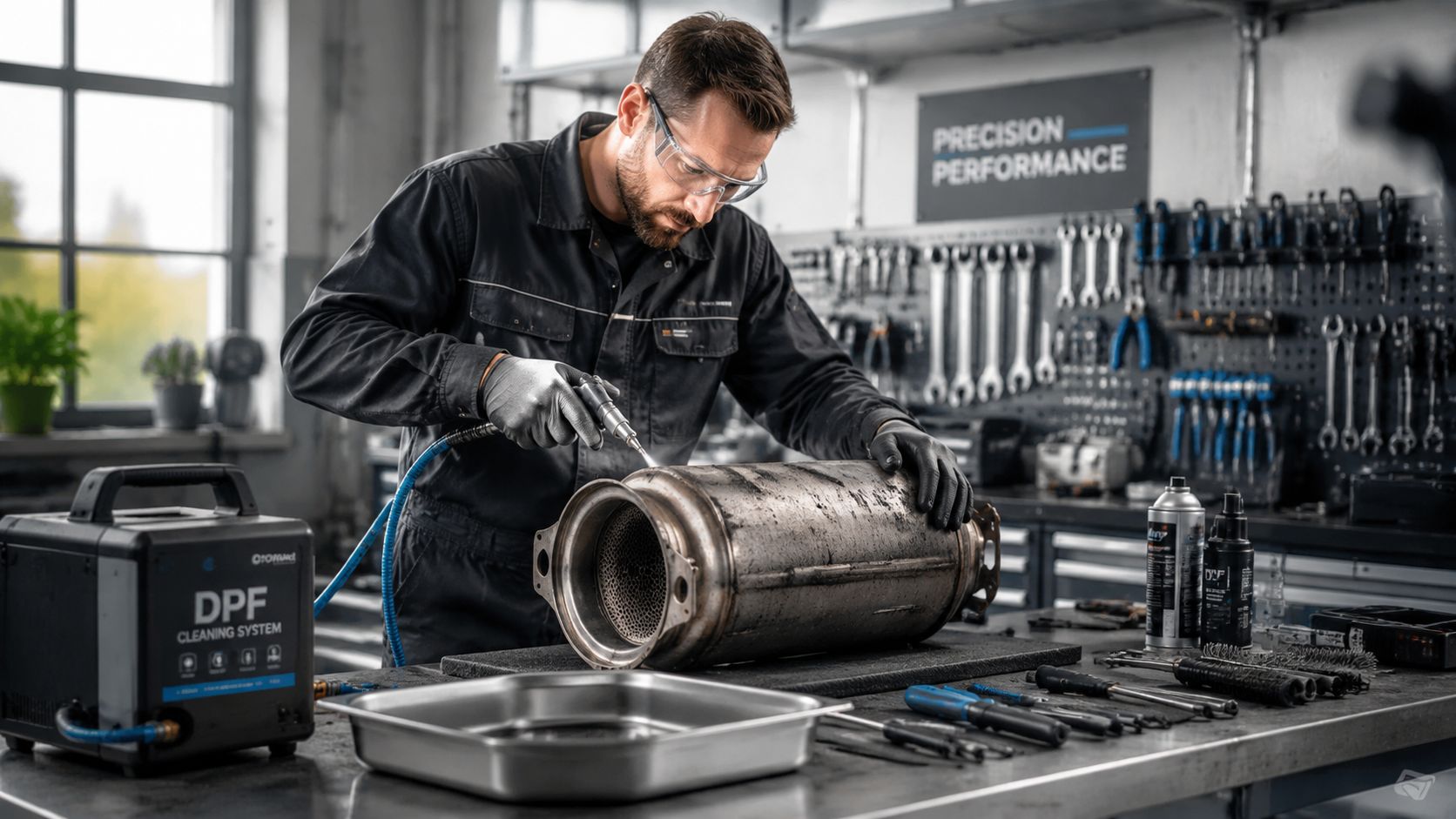
Pull the unit only after the diagnosis supports it
Removal should happen for a reason. The scan data and earlier checks should already have shown that on-vehicle recovery isn't the right move. Once the DPF is out, the first job isn't washing it. The first job is inspection.
Look for visible damage that changes the recommendation immediately:
- Cracked substrate: Cleaning won't fix structural failure.
- Melting or severe heat damage: The filter has moved past normal service.
- Sensor risk: Any attached temperature or pressure hardware needs to be protected before cleaning starts.
A proper off-vehicle process involves removing the DPF, inspecting for physical damage, using compressed air and a high-pressure water rinse from both ends until runoff is clear, disconnecting temperature and pressure sensors beforehand, and replacing all gaskets or seals during reinstallation, as outlined in.
Clean it in a controlled way or expect a comeback
The words “we cleaned it” don't mean much unless the method was sound. Shops create their own repeat failures when they rush this stage.
A dependable process looks like this:
- Remove and isolate the filter carefully so no sensor or fitting gets damaged during handling.
- Inspect before cleaning because a cracked unit should be classified, not cleaned.
- Use air and water from both ends so debris isn't pushed deeper into the substrate.
- Keep cleaning until runoff is clear instead of stopping when the outside looks better.
- Dry the unit completely before reinstall.
That final step gets ignored more than it should. Moisture left inside the assembly can trigger immediate problems after installation and can make a good cleaning job look like a failed repair.
A rushed reinstall can erase a careful cleaning in one key cycle.
Reinstall like the earlier diagnosis still matters
Reassembly isn't housekeeping. It's part of the repair. If the shop leaves old gaskets in place, pinches a seal, or damages a sensor connection, the vehicle may return with leaks or fault codes that look like DPF failure even when the filter itself is no longer the problem.
The front counter should document this part clearly on the estimate and invoice. Customers tend to notice filter cleaning. They don't always notice why new seals, careful sensor handling, and post-install checks belong on the ticket. Those details are what make the work durable.
The Big Decision When to Repair vs Replace a DPF
This is the conversation that tests both the technician and the advisor. A customer doesn't just need a technical answer. The customer needs an answer that makes economic sense for the vehicle.
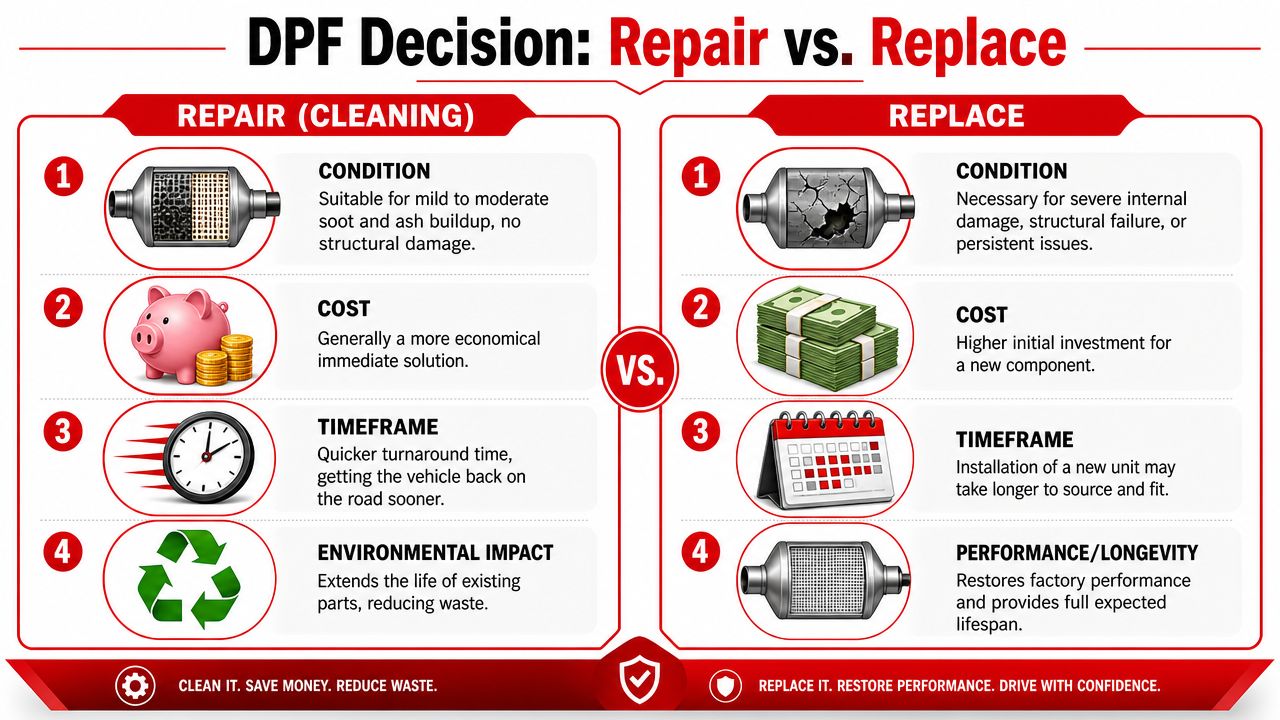
Repair is a condition decision, not a hope decision
Independent fleet guidance notes that DPFs typically need ash cleaning every 150,000 to 300,000 miles, while full replacement can cost $3,000 to $10,000, making the choice highly sensitive to diagnostic accuracy, vehicle value, and downtime risk, as explained by.
That's the heart of the repair-versus-replace call. A restricted filter doesn't automatically need replacement. But a filter with substrate damage, heat damage, or repeated failed recovery attempts can become a bad candidate for more cleaning labor.
RAC also notes that a well-maintained DPF is generally expected to last at least 100,000 miles, may only need cleaning every 20,000 to 40,000 miles under normal driving conditions, and that a sustained 30 to 50 minute motorway or A-road drive helps passive regeneration. RAC also cites replacement DPF pricing commonly at £1,000 to £3,500 for some cars, which shows why maintenance and diagnosis matter before replacement is recommended, according to.
A simple decision matrix for the front counter
| Filter condition | Typical recommendation | Why |
|---|---|---|
| Recoverable soot loading, no evidence of physical damage | Regeneration or cleaning | The filter may still be serviceable |
| Ash accumulation, no cracked or melted substrate | Off-vehicle cleaning | Ash can't be burned off through regeneration |
| Cracked, melted, or otherwise structurally damaged unit | Replacement | Cleaning won't restore substrate integrity |
| Vehicle value is low and downtime tolerance is limited | Case-by-case discussion | The repair has to fit the economics of the vehicle |
This decision should never be sold as “cheapest first.” It should be sold as most durable next step.
How to present the recommendation
A clear estimate usually works best when it gives the customer options with reasoning:
- If repair is viable: explain why the filter appears serviceable and what supporting repairs are needed around it.
- If replacement is required: point to the physical or diagnostic evidence that rules out a durable cleaning result.
- If the economics are borderline: explain the trade-off between spending money on emissions repair and the remaining value of the vehicle.
That approach protects trust. It also protects the shop. A documented recommendation tied to condition is far stronger than a generic “customer declined replacement” note after an uncertain cleaning attempt.
Streamlining DPF Services with Smart Shop Management
DPF jobs are easy to underprice and hard to manage casually. The technical side is only half the work. The other half is scheduling diagnostic time, documenting findings, building estimates that reflect real branches in the repair path, and keeping parts and labor visible before the job starts eating margin.
Where profit gets lost on DPF jobs
Most losses happen in the gaps:
- Poor scheduling: The shop books a “warning light diagnosis” and then discovers the vehicle needs longer testing, cleaning coordination, and a follow-up road test.
- Weak documentation: The technician finds a damaged sensor or heat-stressed unit, but the advisor doesn't have usable photos or notes for customer approval.
- Flat estimates on variable jobs: One quote gets written before the diagnostic tree is complete, so the final invoice becomes a negotiation.
- Parts delays: Seals, sensors, or replacement components aren't sourced early enough.
Those misses don't always show up as one big problem. They show up as slow approvals, extra phone calls, rework, and labor the shop never bills.
What a tighter workflow looks like
A stronger process starts before the vehicle hits the lift. The service writer books enough time for diagnosis, not just code reading. The technician records inspection notes and images that support the recommendation. The advisor builds separate estimate paths for regeneration, cleaning, or replacement so the customer can approve the right job without starting from zero each time.
One tool that supports that operational side is RedAppy's shop management features. It handles digital inspections, estimates, invoicing, parts lookup, scheduling, and job tracking in one system. For DPF work, that matters because these jobs often split into branches after diagnosis, and branch-based estimates are much easier to manage when the workflow stays in one place.
The cleanest DPF process in the shop still loses money if the office can't document it, price it, and move it forward quickly.
A management system also helps the shop keep records that matter later. Photos of a damaged substrate. Notes on failed regeneration attempts. Proof that gaskets and seals were replaced. That record protects the shop if the customer returns later with a separate upstream issue and assumes the DPF repair failed.
Track the job after the vehicle leaves
The last layer is reporting. Shops should know which DPF jobs are worth chasing and which ones tie up labor with poor return. That means reviewing:
- Billed diagnostic time versus actual technician time
- Parts margin on related hardware
- Comeback patterns tied to missed root cause issues
- Approval rates on tiered estimates
Without that visibility, DPF work feels difficult and inconsistent. With it, the shop can refine the process and price it correctly.
Building a Profitable DPF Repair Program
A profitable DPF program isn't built on cleaning equipment alone. It's built on a repeatable system that keeps technical decisions and business decisions connected.
The three-part system that works
First, the shop needs accurate diagnosis. That means treating the warning light as the start of the job, not the answer. The vehicle has to be checked for loading, sensor behavior, exhaust issues, and use pattern so the shop fixes the cause instead of only the symptom.
Second, the team needs a repair path that matches filter condition. Some vehicles can recover with an on-vehicle regeneration. Some need off-vehicle cleaning. Some need replacement because the substrate is damaged or the economics no longer support further repair attempts. Discipline here protects the customer from repeat expense and the shop from repeat labor.
Third, the shop needs operational control. The estimate has to match the branch in the workflow. The inspection needs usable proof. The parts process needs to be organized. The invoice needs to reflect what was done.
Why the business side matters as much as the wrench work
DPF work rewards shops that can. That idea applies directly to emissions repairs because these jobs consume technician attention, advisory time, and often more than one decision point before completion. When the shop allocates bay time, documentation effort, and follow-up properly, the repair becomes far more predictable.
Customers notice that difference. They can tell when a shop is guessing. They can also tell when a shop has a process, explains the options clearly, and documents why one path is smarter than another.
Shops that want more control over DPF filter repair need a workflow that supports the whole job from intake to final payment, not just the wrench work. Contact RedAppy to see how that process can be adapted to the way the shop already operates.
A shop that wants cleaner approvals, better documentation, and tighter control over DPF jobs can review RedAppy and see whether its workflow fits the way the team handles diagnostics, estimates, parts, and invoicing.
Ready to Transform Your Shop?
RedAppy helps auto repair shops create professional digital estimates with photos and videos, send them instantly via text or email, and get customer approvals in seconds. No credit card required to start.