
E Invoicing Regulations Explained for Auto Repair Shops
The service desk is already busy before the first coffee gets poured. A parts supplier has sent over a stack of invoices, a customer is waiting on a final bill, and the office manager is trying to match everything against the accounting system without missing a tax detail or filing a wrong document in the wrong place. For an independent garage, that daily scramble is exactly where e invoicing regulations stop being a legal buzzword and start becoming a front-desk problem.
At the simplest level, e-invoicing rules change how an invoice has to be created, sent, received, and stored. In many places, that means a structured electronic invoice, not a flat PDF, because software has to read the data directly and pass it into accounting or tax systems without human retyping. For a shop owner, the important part is straightforward, if a rule applies to an invoice, it affects the invoices sent to customers, the invoices received from parts vendors, and the records kept for tax and audit purposes.
Table of Contents
- What E Invoicing Regulations Actually Mean for Your Shop
- The Building Blocks Behind Every E Invoicing Regulation
- How E Invoicing Regulations Differ Around the World
- A Practical Compliance Checklist for Repair Shops
- How E Invoicing Changes Your Daily Shop Workflow and Software
- Common Pitfalls and Frequently Overlooked Compliance Costs
- Your Next Steps Toward E Invoicing Readiness
What E Invoicing Regulations Actually Mean for Your Shop
Monday morning in a busy garage often starts the same way. The office manager is sorting supplier bills, chasing a missing parts line, and trying to make sure the customer invoice matches the repair order before the vehicle leaves the bay. That's the practical world where e invoicing regulations show up, not as theory, but as a rule about whether a document can be accepted by software, by a tax authority, or by both.
A paper invoice is not the same thing as an e-invoice
A printed invoice, or even a PDF emailed from a laptop, may look digital enough to the eye. The problem is that many regulations care about whether the invoice is structured so a system can read fields like supplier ID, buyer ID, tax breakdown, and invoice number without someone typing them in again. The European definition for public procurement is clear on this point, an e-invoice has to be issued, transmitted, and received in a structured electronic format that allows automatic processing, and PDFs don't qualify as true e-invoices under that legal approach.
That distinction matters at the service counter. A garage can still email a customer a friendly PDF copy for convenience, but the compliance record may need the underlying structured file that tax software can validate. In other words, the invoice has to work like a parts barcode, not just like a photo of a parts label.
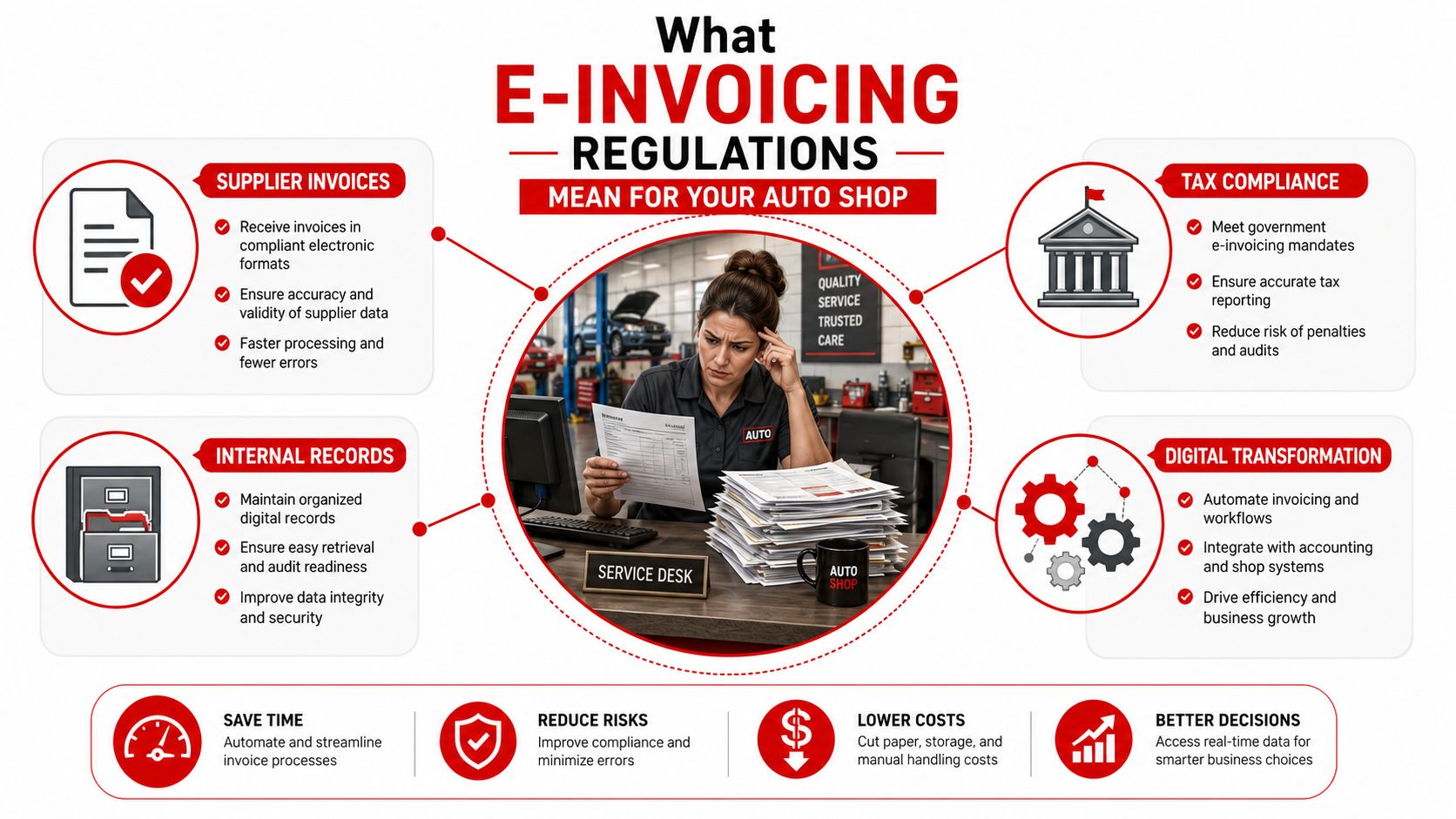
Who gets affected inside the shop
The biggest mistake is thinking this only touches the accounting team. It also affects the people who buy brake pads, order tires, approve subcontracted work, and send invoices to fleet customers or public-sector clients. Once a mandate exists, every invoice touching the shop has to be treated like a controlled document, because the way it is generated and stored can decide whether it passes compliance.
A plain way to think about it is this. A regular invoice is like a handwritten service note. A compliant e-invoice is like a completed digital repair order with every field in the right place, ready for the back office, the tax system, and the archive. That's why e invoicing regulations aren't just digitization, they're a change in how the shop's paperwork travels.
Practical rule: if a document has to be retyped, corrected by hand, or reassembled from email attachments before it can enter accounting, it probably isn't meeting the spirit of a structured e-invoice rule.
The Building Blocks Behind Every E Invoicing Regulation
Every country writes the rule in a slightly different way, but the same building blocks keep showing up. A shop owner can think of them like a service book for an engine. The book doesn't just prove that work happened, it proves who did it, what parts were used, and whether the record can be trusted later. E-invoicing rules do the same thing for invoices.
The five process checks that keep appearing
CEN's compliance guidance names five process requirements, auditability, authenticity of origin, integrity of content, continuity of the tax invoicing process, and compliance with legal requirements on invoicing and storage. In garage language, that means the invoice has to be traceable, believable, unchanged, consistently handled from creation to archive, and stored in the right way.
That sounds technical, but it maps neatly to work a shop already understands.
- Auditability means the invoice trail can be followed later, the same way a customer file can be traced from estimate to pickup.
- Authenticity of origin means the recipient can tell who issued it.
- Integrity of content means the line items haven't been altered after issue.
- Continuity of the tax invoicing process means the record moves through the workflow without gaps.
- Storage compliance means the file survives long enough, and in the right format, for tax review.
The structure behind the structure
Across Europe, EN 16931 is the technical baseline that defines the data content and syntax rules for electronic invoices so software can process them automatically. The formal release of EN 16931-1:2026 shows that the standard is still being updated as rules tighten.
For a garage, this matters because structured invoices are not just a legal wrapper. They're a checklist of fields. If the shop software can't map those fields cleanly, the invoice may look fine on screen but still fail compliance.
If a business is searching for a practical country-specific example, is a useful reference point for how rules are being translated into actual workflows.
Shop-floor translation: if a repair order can't be read by the system without a human smoothing out the details, the invoice format is probably too loose for a structured mandate.
How E Invoicing Regulations Differ Around the World
A repair shop in one country can be fine sending a PDF by email, while a shop a few borders away may need a structured file, routed through a government-approved path, before the invoice is even considered valid. That gap matters because parts sourcing, fleet work, warranty claims, and cross-border customers all pull a garage beyond its home market sooner than owners expect.
The big regimes at a glance
| Region | In Scope | Required Format | Authority | Key Date |
|---|---|---|---|---|
| European Union | Public procurement across all 27 Member States, and the broader move toward structured B2B invoicing | Structured electronic invoice under EN 16931 aligned rules | EU and Member State tax and procurement authorities | Public-sector coverage was transposed across all 27 Member States by July 2023, with ViDA pushing default e-invoicing from January 2028 (projected) and intra-Community B2B structured invoicing from 1 July 2030 (projected) |
| Germany | Domestic B2B invoicing, with structured invoicing required for suppliers and recipients in the domestic business flow | Structured electronic invoice compliant with EN 16931, not a simple PDF | German tax framework | Mandatory receipt and processing began on January 1, 2025 |
| UAE | VAT-registered businesses in B2B and B2G flows | PINT AE XML, not PDF or scanned images | UAE clearance regime | July 2026 |
| India | Businesses above the GST turnover threshold cited in the source | Invoice reporting through the Invoice Registration Portal with an IRN before issuing to the customer | GST system and Invoice Registration Portal | Mandated for businesses above Rs. 5 crores annual turnover, with a 30-day reporting rule for businesses above Rs. 10 crores |
Germany shows how quickly a major market can harden its rules. Since January 1, 2025, companies there have been required to receive and process e-invoices, and a simple PDF does not meet the legal requirement.
The UAE follows the clearance model. From July 2026, VAT-registered businesses in B2B and B2G flows must issue invoices in PINT AE XML, and invoices that do not match the rule can be rejected and may block VAT recovery.
For a shop that buys from abroad or serves cross-border customers, the EU direction on ViDA matters because it points toward mandatory electronic invoices for intra-EU transactions by 2030, along with standardized reporting. The United Kingdom has also announced mandatory e-invoicing for VAT invoices from 2029, which shows where the wider market is headed.
Useful way to read any new rule: first check who is in scope, then the format, then the authority, then the deadline. If those four pieces are clear, the rest usually falls into place.
A Practical Compliance Checklist for Repair Shops
A shop does not need to become a tax law office, but it does need a repeatable routine. The easiest way to keep e-invoicing under control is to treat it like a post-repair quality check, same steps every time, no shortcuts, no guessing.
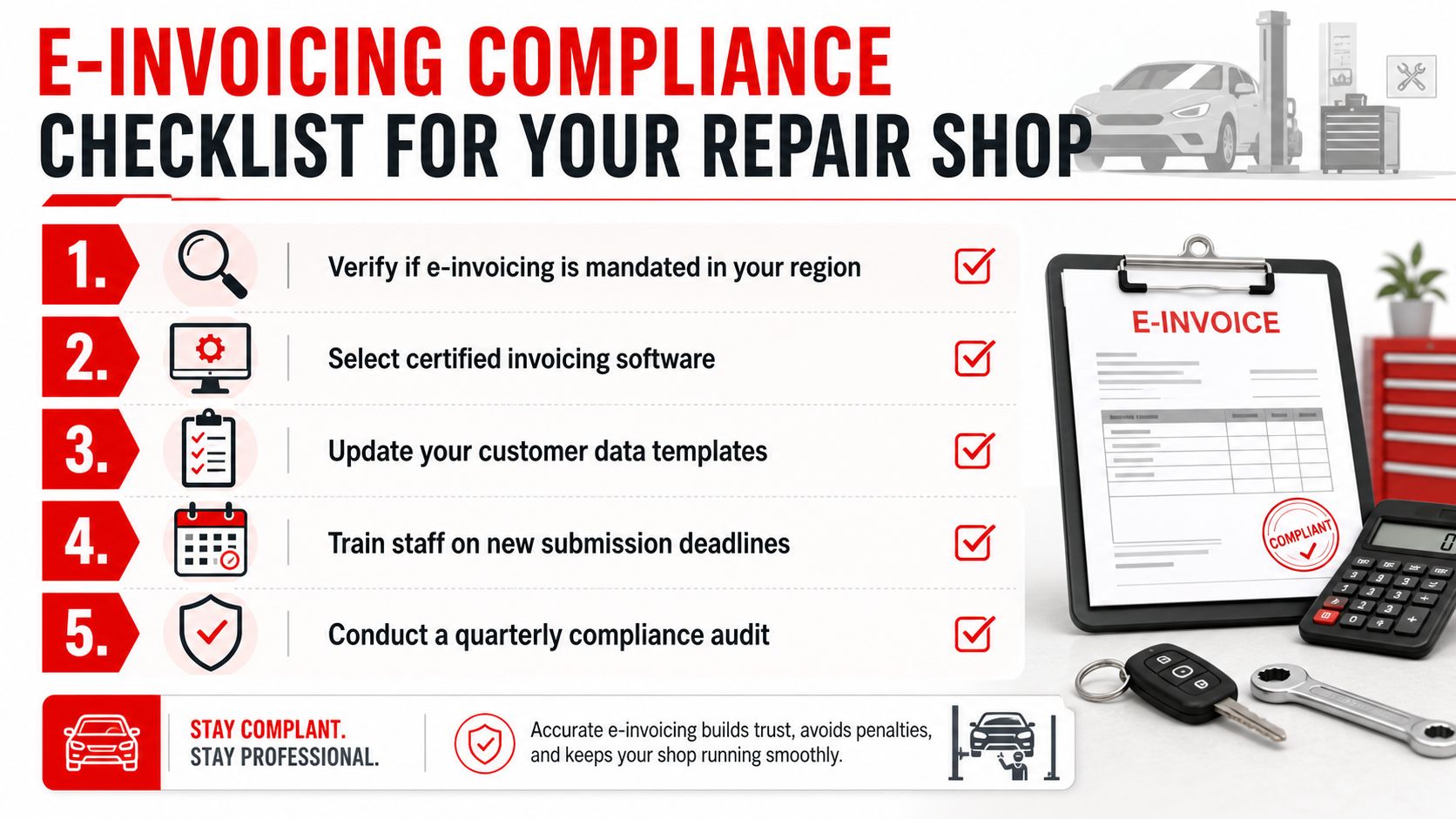
The Tuesday-afternoon self-audit
- Verify the local rule first. A shop should confirm whether its jurisdiction already requires structured e-invoicing for B2B or B2G transactions, because a customer-facing rule and a supplier-facing rule do not always begin at the same time.
- Check software in both directions. Sending an invoice is only half the job. The system also needs to receive, validate, and archive structured invoices from parts vendors and subcontractors.
- Inspect the required fields. Supplier and customer records need the tax IDs, VAT numbers, invoice numbers, issue dates, and line-level breakdowns the rule expects.
- Lock down storage. Invoices should be kept in a tamper-evident archive so the shop can show what was issued, when it was issued, and what was stored.
- Train the front desk. If staff enter the wrong customer name, vehicle data, or tax detail at checkout, the invoice can fail later even if the repair work was flawless.
The same checklist helps with supplier invoices. A parts bill that arrives without the right structured data can slow reconciliation, create a tax issue, or trigger a manual fix that eats into the morning schedule. That is why invoice compliance is as much about intake as it is about billing out.
Cross-border sourcing adds another layer. EU guidance notes that ViDA will require electronic invoices for intra-EU transactions by 2030, so a shop buying parts from multiple countries should treat mixed domestic and export workflows as a live compliance issue, not a future one.
A shop owner who wants to compare invoice financing for SMEs can use the same disciplined mindset. If cash flow is tight, the invoice process, the approval trail, and the archive all need to be clean enough that financing options stay open and disputes are easier to sort out.
A quarterly review catches the quiet failures, the wrong template, the missing field, the software update nobody tested, before they turn into rejected invoices.
How E Invoicing Changes Your Daily Shop Workflow and Software
A repair order already moves through a lot of hands. The front desk enters the vehicle and customer details, the technician adds the work, parts come in from suppliers, and the payment gets closed out at the counter. E-invoicing changes that routine by asking the shop system to turn those steps into one structured invoice that can pass compliance checks without someone retyping the same job three times.
What good software has to do
Good software has to map each invoice field into a machine-readable schema, check the invoice before it goes out, and support the format required in the market where the shop operates. In Europe, that means working with EN 16931-aligned structures. In the UAE, it means handling the clearance flow and PINT AE XML format that applies to B2B and B2G invoices from July 2026, as covered in the.
That is the split between software that helps and software that only looks modern. A polished billing screen still leaves the office team stuck if it needs manual exports, extra re-entry, or a separate tax filing step. Better software does the quiet work in the background. It builds the structured invoice from the repair order, checks the fields, and sends the file through the right channel.
What matters more than the sales pitch
A garage owner should ask a few plain questions before buying or upgrading software.
- Can it generate structured invoices automatically?
- Can it receive supplier invoices in the same format?
- Does it validate required fields before sending?
- Can it handle digital signatures, clearance steps, or portal submissions where needed?
- Does it keep the invoice trail tied to the repair order, estimate, and payment record?
Those questions matter more than the look of the screen or broad claims about automation. The workflow should feel like the last step in the job, the same way closing a repair order should feel like the final click after the work is done, not a separate admin project after the bay has already emptied.
For shops that also want to compare invoice financing for SMEs, the invoicing setup matters for cash timing too. The cleaner the receivables trail, the easier it is to understand how billing and payment flow affect the shop's day-to-day cash position.
The main goal is to keep the complexity out of the front desk's way. If the software can pull labor times, parts data, and customer details into one clean invoice, the shop spends less time fixing paperwork and more time moving cars.
Common Pitfalls and Frequently Overlooked Compliance Costs
A repair shop can get tripped up by the simplest assumption, that a PDF with an invoice number is enough. A PDF may look complete at the front desk, but many e-invoicing rules call for a structured file that tax software can read, check, and accept without someone retyping the details by hand.
The traps that catch smaller shops
Supplier invoices create another blind spot. A garage may focus on sending customer bills and still run into trouble when a parts vendor starts sending structured invoices that the shop system cannot handle. Then the office team has to key in the same part numbers, totals, and tax fields again, which adds work instead of removing it.
The quiet costs are usually the ones that surprise owners. As noted earlier, researchers and policymakers have pointed to upfront investment and insufficient IT structure as common barriers, especially for smaller firms that also have to deal with software integration, schema validation, digital signatures, and changes to staff workflow.
The costs that show up after go-live
Many shops budget for the software and stop there. The actual bill can also include staff training, cleaning up invoice templates, mapping old customer records into structured fields, and handling invoices that come back rejected because one required field was missed. Those are not side tasks, they are part of the rollout itself.
The invoice rarely fails at the printer. It usually fails at the field mapping, the missing tax code, or the wrong workflow step.
For an independent garage, the main lesson is straightforward. E-invoicing is a workflow project, not a one-time paperwork switch. It brings software, training, storage, and process control into the same job, the same way a repair order ties parts, labor, and customer approval together. Shops that plan for those moving parts usually make fewer mistakes once the requirement starts affecting daily invoicing.
Your Next Steps Toward E Invoicing Readiness
A repair shop can make progress without overcomplicating it. Start by auditing the current invoicing setup, then choose a shop management platform that supports structured formats out of the box, configure parts and labor catalogs so every invoice carries the right data, and schedule a quarterly compliance review. Keeping an eye on local tax authority updates matters too, because this is moving from optional to mandatory in more markets.
For garages that want one workflow instead of a pile of disconnected tools, RedAppy brings one-click invoicing, digital inspections, online payments, real-time analytics, and parts ordering together in one place. That makes it easier to build a compliant workflow without stitching separate systems together, and it's a practical fit for shops that want to stay focused on repairs instead of admin.
RedAppy is built to help auto repair shops keep invoicing, inspections, parts, and payments moving in one clean workflow. If the goal is to stay ready for stricter billing rules without adding more desk work, visit RedAppy and take a look at the platform's features, then contact the team for a walkthrough that fits the shop's size and country.
Ready to Transform Your Shop?
RedAppy helps auto repair shops create professional digital estimates with photos and videos, send them instantly via text or email, and get customer approvals in seconds. No credit card required to start.