
How Much Does a Car Lift Cost? a Shop Owner’s Guide
Basic two-post and four-post lifts for passenger vehicles and light trucks typically run from about $2,000 to well over $10,000, and higher-capacity or specialty models can push past $15,000 based on lift type, capacity, and installation complexity. That answer helps with budgeting, but it doesn't help much with the actual decision, because the wrong lift can tie up a bay, create downtime, and cost more to own than a better unit ever would.
Most shop owners asking how much does a car lift cost aren't shopping for steel alone. They're trying to add throughput, reduce wasted motion, and decide whether the next equipment purchase will improve the bottom line. A lift changes how quickly technicians can move, what jobs a bay can handle, and how reliably the schedule holds together on a busy week.
That's why sticker price is only the starting point. The smarter way to buy is to look at the lift as a production asset. Hardware cost matters. Site prep matters. Maintenance matters. Uptime matters more than most buyers expect.
Table of Contents
- Investing in Your Shop A Car Lift Is More Than Steel
- Decoding Car Lift Prices by Type and Capacity
- Beyond the Sticker Price Site Prep and Installation Costs
- The True Cost of Ownership Long Term Maintenance and Inspections
- Calculating Your ROI When a New Lift Pays for Itself
- Buying Smart New vs Used Lifts Brands and Warranties
- Your Final Decision Checklist for the Right Lift
Investing in Your Shop A Car Lift Is More Than Steel
A lift purchase usually happens at a pressure point. The schedule is packed, technicians are waiting on space, and too much time gets burned moving vehicles around instead of repairing them. That's when the question shifts from equipment cost to business impact.
A car lift is one of the few shop purchases that directly affects labor efficiency, bay utilization, and service mix. It can open the door to undercar work that's awkward on the floor, speed up inspections, and make routine repairs more consistent. It can also become a source of frustration if the shop buys the cheapest option without thinking through capacity, ceiling height, slab condition, or service support.
Why the cheapest lift often costs more
The purchase decision gets expensive when a shop treats the lift like a commodity. Two lifts can look similar in a product photo and still create very different day-to-day results. One may fit the shop's vehicle mix, arm reach, and workload. Another may create setup delays, poor access, or extra maintenance interruptions.
Practical rule: A lift should be judged by what it earns over time, not just what it costs on delivery day.
That's the right frame for how much does a car lift cost. The upfront number matters, but it's only one line in a larger equation.
What good buyers focus on first
Before comparing brands or models, strong buyers usually work through these questions:
- Vehicle mix: Which jobs come through most often, and which ones create the most frustration with the current bay setup?
- Bay purpose: Will the lift support general repair, storage, alignment-related work, or a mix?
- Downtime tolerance: Can the shop absorb service interruptions, or does every lost bay hour hurt the schedule immediately?
- Growth plan: Is the lift meant to solve a present bottleneck, or support a larger change in staffing and workflow?
A lift isn't just equipment. It's a throughput decision.
Decoding Car Lift Prices by Type and Capacity
Price follows use case more than marketing category. The lift that looks cheapest on a quote can become the expensive option if it slows setups, limits the vehicles you can service, or forces you into another purchase sooner than planned.
A broad overview from places basic two-post and four-post lifts for common passenger vehicles and light trucks at roughly $2,000 to more than $10,000, with higher-capacity and specialty models climbing past $15,000. That spread is wide for a reason. Capacity, access, bay layout, and duty cycle all affect what the lift will return to the shop over time.
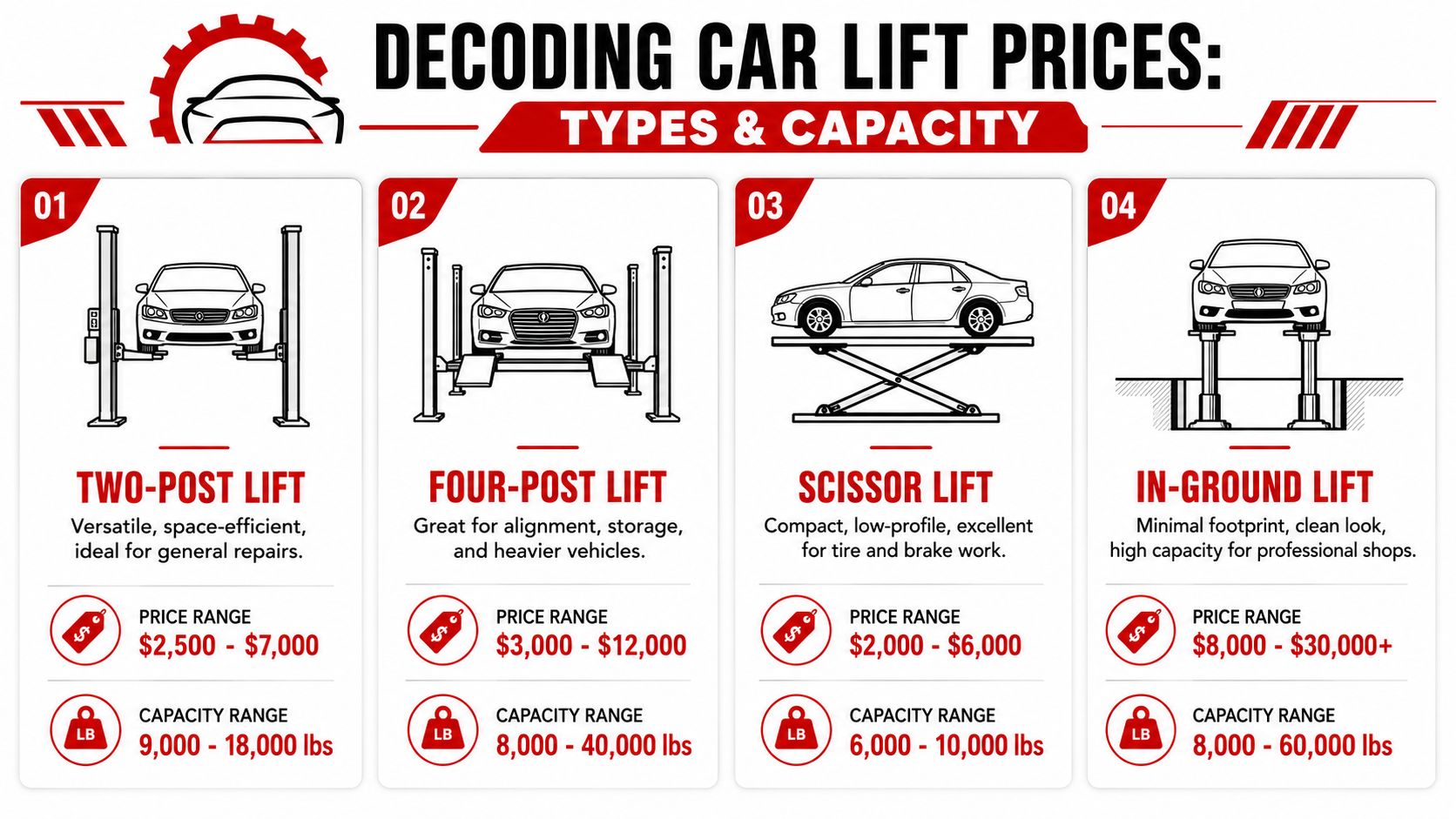
Two-post lifts for everyday production
For general repair, two-post lifts are still the standard for many independent shops because they support the work that pays the bills. Exhaust, suspension, brakes, steering, underbody inspection, drivability diagnosis. Technicians can get to the vehicle quickly and work without constantly repositioning.
As noted earlier, Identifix places a standard 10,000-lb two-post around $2,000 to $3,500. also shows a broad pricing band, with basic two-post and four-post units at $1,500 to $5,000 and commercial-grade two-post lifts with 10,000 to 12,000 lb capacity and full-rise height often running $3,000 to $8,000.
That middle range is where many shops get the best return. A properly sized commercial two-post usually costs more upfront than an entry-level unit, but it often pays back through faster bay turnover, better arm reach, and fewer daily compromises. Shops that routinely see half-ton trucks, vans, or EVs should be careful about buying right at the minimum capacity needed today.
Four-post lifts for storage, alignment, and drive-on workflow
Four-post lifts usually cost more than a comparable two-post, and that extra money only makes sense if the workflow supports it. They are strong fits for drive-on service, some alignment-related setups, vehicle storage, and situations where faster initial positioning matters more than open-wheel access.
As noted earlier, typical passenger-vehicle four-post lifts often land in the $2,500 to $5,000 range.
They make financial sense in shops that benefit from:
- Drive-on loading: Helpful for technicians who need quick vehicle placement
- Storage use: Adds vertical parking capacity in tight buildings
- Alignment-related work: Better suited to bays built around that process
- Heavier vehicle stability: Useful within the lift's rated application
The trade-off is undercar access. A four-post can be productive in the right bay and inefficient in the wrong one. Buyers should judge it by job mix, not by the fact that it feels versatile.
Scissor and in-ground lifts for narrower roles
Scissor lifts serve a different purpose. They work well for tire and brake service, detailing certain inspection tasks, and low-clearance bays where column placement is a problem. As noted earlier, Identifix places many shop-grade scissor lifts around $2,000 to $4,000, with the wider category running from $1,000 to $6,000.
Portable scissor-style units sit at the low end of that category. notes that entry-level portable scissor-style lifts start around 500 USD, while heavier portable versions usually run 1,000 to 2,500 USD. That can work for light-duty use, mobile service, or a hobby setup. A busy repair shop will usually outgrow that class once throughput and daily reliability start to matter.
In-ground hydraulic lifts belong in a separate investment tier. As noted earlier, they can exceed $10,000 to $20,000 once structural work and supporting trades are included. They offer a clean floor and a premium look, but the buyer needs to price the whole job, including site work and the if the building and equipment specs call for it.
A practical buying view is to match lift type to the work that produces the most billable hours and the least technician friction.
| Lift type | Best fit | General hardware cost pattern |
|---|---|---|
| Two-post | General repair and undercar access | Strong value for mixed repair work |
| Four-post | Storage, drive-on service, some alignment-related use | Usually costs more than comparable two-post units |
| Scissor | Tire, brake, compact bays, low-rise needs | Wide range between portable and shop-grade models |
| In-ground | Premium professional setups, clean floor footprint | Highest installation complexity and total project cost |
Beyond the Sticker Price Site Prep and Installation Costs
A lift deal can go sideways before the crate is off the truck. The purchase price looks fine on paper, then the installer walks the bay and finds thin concrete, the wrong power at the wall, poor column placement, or no practical way to unload the shipment without extra equipment. That gap between quoted price and working lift is where budgets get blown.
For a shop owner, this is not a side issue. Site prep and installation are part of the investment case. If the bay is down for extra concrete work or electrical changes, the true cost is not just the invoice. It is lost production.
Costs that show up after the quote is signed
The lift itself is only one line item. The full project usually includes several pieces that buyers underestimate:
- Concrete and anchors: Every lift has slab requirements for thickness, strength, and anchor layout. If the floor does not meet spec, the install stops until that is corrected.
- Electrical readiness: Some bays are ready. Others need a dedicated circuit, panel capacity check, conduit runs, or a review of the if the building and equipment call for it.
- Freight and unloading: A commercial lift shipment can require a forklift, liftgate service, or scheduled unloading help. Tight access adds labor fast.
- Bay layout and clearance: Column spacing, overhead obstructions, arm swing, door clearance, and technician traffic flow affect whether the lift works well day to day.
- Assembly, leveling, and testing: A lift has to be set, anchored, wired, bled, equalized, and tested under load before it earns its keep.
These are operating decisions disguised as install details.
Poor site prep hurts ROI fast
I have seen shops save a little on installation and give it back in the first year through technician frustration, awkward vehicle positioning, and preventable downtime. A lift that sits in the wrong spot or shares inadequate power slows every job that touches it. That cost repeats daily.
Professional setup pays for itself when the installer catches problems before the first vehicle goes up. Good installers look beyond the manual. They check whether your regular truck mix will fit cleanly, whether opening doors will crowd the next bay, and whether the power setup will become a service headache later. That judgment protects throughput, which is what pays for the lift.
Build the budget around the working bay
A realistic budget includes the lift, freight, unloading, slab verification, electrical work, installation labor, and time lost if the bay is tied up during prep. That number is less exciting than the catalog price, but it is the number that matters.
Buyers who price the whole project make better decisions. They choose the lift that fits the shop, the building, and the revenue plan, not just the cheapest steel in the brochure.
The True Cost of Ownership Long Term Maintenance and Inspections
The biggest pricing mistake isn't overpaying for a lift. It's buying one based only on the invoice total and ignoring what ownership looks like after the first few months.
A detailed look at ownership costs from points out that routine maintenance such as annual hydraulic fluid, cable replacement every 5 to 7 years, and optional safety inspections can add several hundred dollars annually per lift. That article also notes practical examples where an independent shop with three lifts might spend $150 to $200 per year on cables, $40 to $70 on fluid, and $125 to $250 on inspections.
The infographic below captures the bigger idea. Ownership spreads far beyond purchase day.
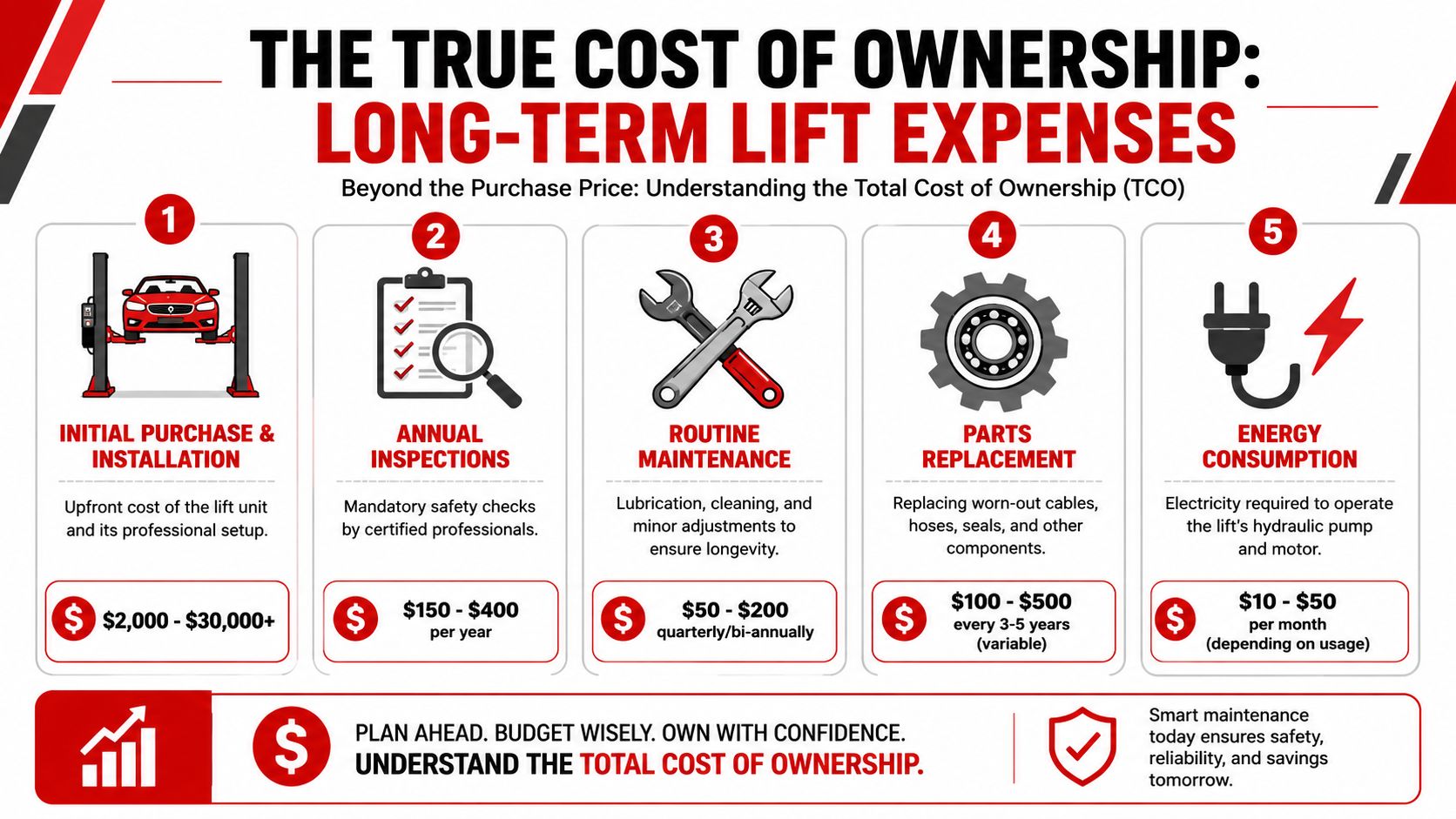
Recurring costs that buyers often ignore
Every shop tracks visible expenses well. The less visible ones are where lift ownership gets distorted.
Recurring ownership usually includes:
- Hydraulic fluid service: Small on its own, but part of regular upkeep that can't be skipped.
- Cable and wear-part replacement: Predictable over the life of the lift, especially in heavier-use bays.
- Inspections: Optional in some settings, essential in practical risk management.
- Downtime during service: The hidden cost no one likes to model.
- Technician disruption: A lift that's out of service doesn't just stop one task. It can force job reshuffling across the schedule.
For shops that want a useful framework beyond lifts, is a helpful way to think about equipment ownership through maintenance, efficiency, and service life rather than sticker price alone.
Cheap lift lower price expensive ownership
A budget lift can still be a smart purchase. The problem starts when the lower price also brings more service interruption, harder parts support, or faster wear in a busy shop. In that situation, the savings on day one can disappear into lost production.
Consider the decision this way:
| Question | Lower-priced lift | Higher-quality lift |
|---|---|---|
| Upfront cash | Easier to approve | Harder to approve |
| Parts and service support | Can be uneven | Often more dependable |
| Downtime risk | Potentially higher | Often lower |
| Long-term planning | Best if usage is light | Best if uptime matters daily |
Ownership lens: If a lift serves a busy bay, uptime is part of the purchase price.
That's the true shift in thinking. A lift isn't cheap because the invoice is low. It's cheap when it delivers reliable service at a lower total ownership cost across its working life.
Calculating Your ROI When a New Lift Pays for Itself
Monday at 8:15, three vehicles are waiting, two techs are free, and one profitable job is delayed because the right bay is tied up. That is the moment a lift either earns its keep or sits there as expensive steel. ROI starts with throughput. If the new lift lets the shop finish more billed work in the same week, it is doing its job.
Lift selection plays a big part in that return. As noted earlier, Tekmetric's analysis points out that many general repair shops land in the 10K to 12K two-post range because it covers most passenger vehicles and light trucks without pushing the buyer into a heavier, more expensive class than the work mix really needs. That matters because overbuying hurts payback just as much as underbuying hurts productivity.
The screenshot below shows the kind of shop software view that matters once new capacity is added.
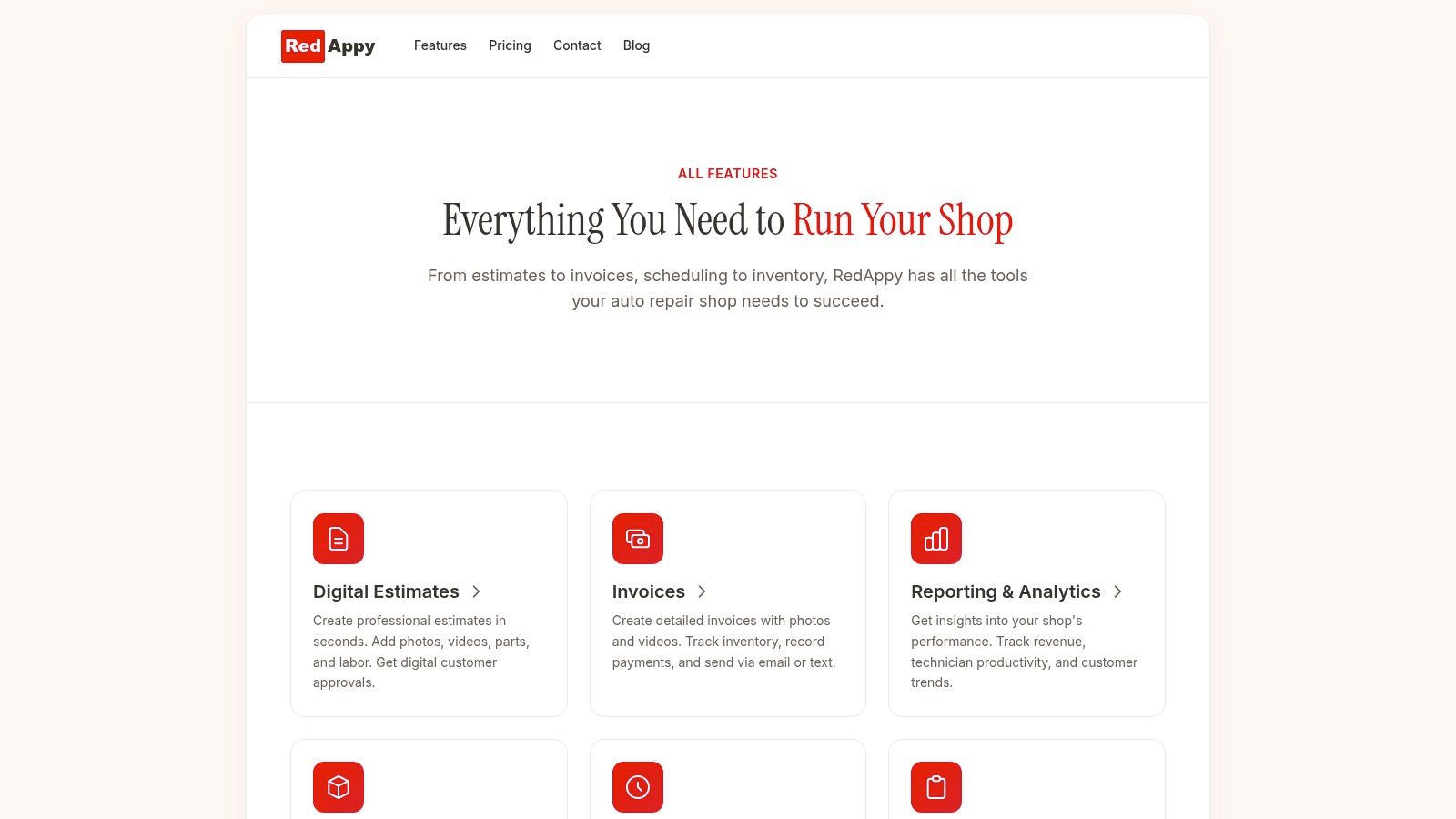
A simple ROI framework for a working shop
A useful ROI check starts with gross profit, not just labor hours.
If the lift helps the shop add one more alignment, brake job, suspension ticket, or inspection block each day, the return can be measured. If it only makes the bay look more capable while the schedule, approvals, and parts flow stay messy, the payback drags out.
Use questions like these:
- Does the lift let the shop accept work it is currently delaying or turning away? Added capability matters most when it opens profitable repair categories that already fit the customer base.
- Does it cut labor time on repeat jobs? Saving even a small amount of time on common services adds up fast across a month.
- Does it reduce unbilled handling time? Less vehicle shuffling, fewer setup compromises, and easier access under the car improve technician output.
- Will the bay stay busy enough to justify the investment? A lift that sits idle two days a week has a very different payback profile from one that carries daily production.
One of the clearest mistakes buyers make is using revenue alone as the target. A lift can increase sales while still producing a weak return if the added work is low-margin, slows other bays, or requires too much discounted labor to keep cars flowing.
The lift only pays when the bay is managed well
A new lift improves capacity. It does not fix weak shop habits.
If approvals stall at the front counter, parts arrive late, or dispatching is inconsistent, the lift will spend too much time waiting for the next step. In that case, the constraint is management, not equipment. Shops that get the best payback usually pair the purchase with tighter scheduling rules, clearer bay assignments, and better tracking after install.
The metrics worth watching are practical:
- Revenue by bay: Measure whether the lift is supporting more completed work, not just more cars on the property.
- Technician productivity: Check whether wrench time rises and non-billable movement drops.
- Repair order mix: See whether the shop is booking higher-value undercar and inspection work more consistently.
- Cycle time: Watch how long vehicles sit between check-in, diagnosis, approval, repair, and delivery.
A shop that wants to pressure-test those changes can review RedAppy's shop management features. The point is not software by itself. The point is visibility into whether the lift is producing more gross profit, better bay utilization, and steadier daily flow.
A lift pays for itself when it increases billed output, protects technician time, and stays busy enough to justify the capital tied up in the bay.
Buying Smart New vs Used Lifts Brands and Warranties
A shop owner finds a used lift at a price that looks hard to ignore. Two months later, the savings are gone in freight, missing parts, anchor replacement, a service call, and three lost days in a bay that should have been producing. That is the true comparison. New versus used is a capital decision tied to uptime, support, and how predictable the next five years will be.
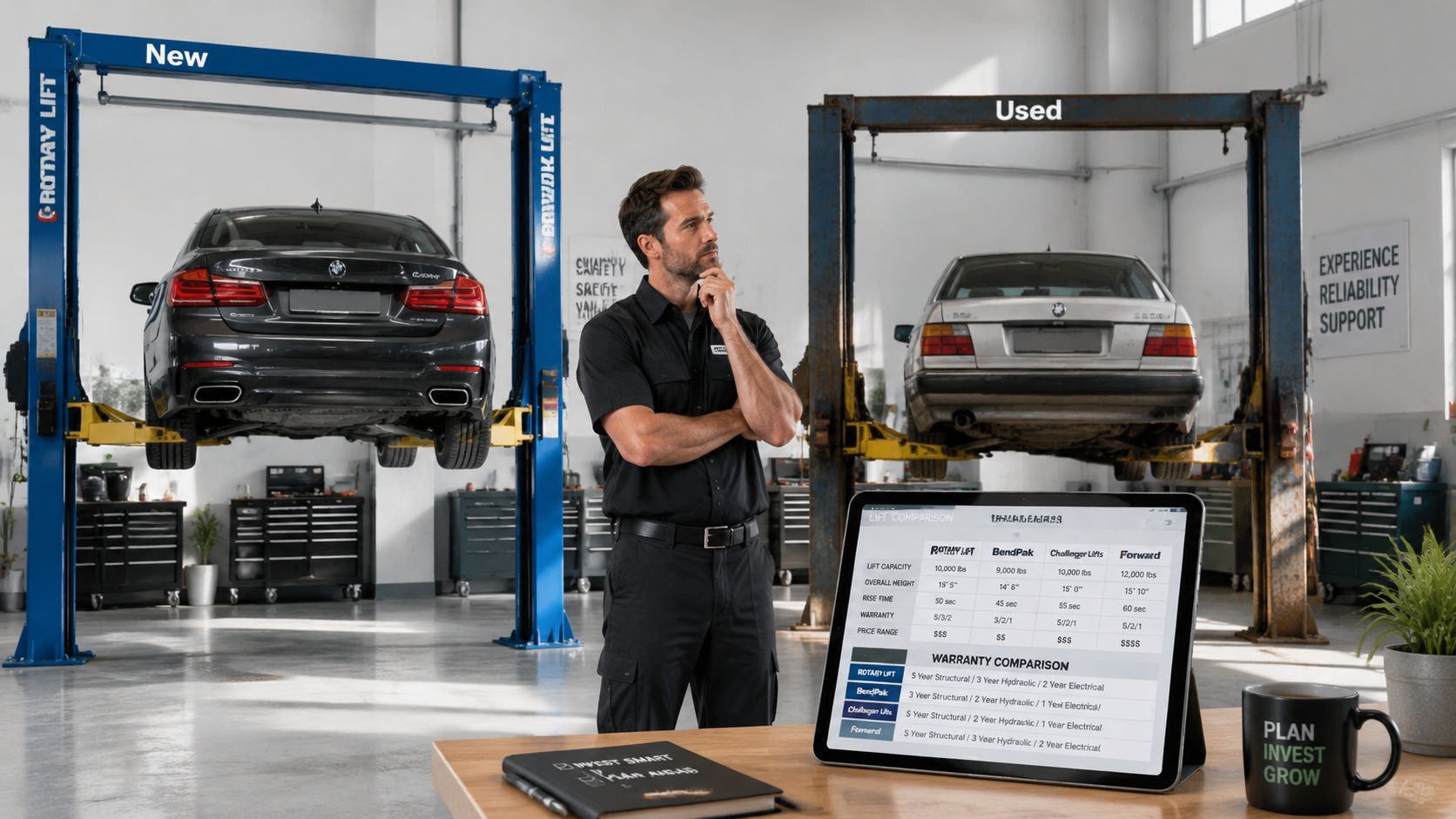
When new makes sense
New is usually the better investment for a bay that will stay in daily rotation. The reasons are practical. You know the lift's history from day one, installation is cleaner, parts support is easier to confirm, and warranty coverage still has full value.
That matters most in production work, where one disabled lift can jam scheduling across the shop. A lower purchase price does not help much if the bay sits idle waiting on a cylinder, lock part, or cable that is hard to source.
It also helps to separate homeowner-grade equipment from shop-grade equipment. Portable and low-rise units can fit light-duty use, detailing, storage, or mobile service setups. They do not replace a full-rise lift in a repair bay that needs clear undercar access, repeat cycles, and steady technician throughput.
When used can work and when it can't
Used lifts have a place. I would consider one for a lower-volume bay, a secondary service area, or a shop that has in-house maintenance capability and enough purchase discipline to walk away from a questionable deal.
The problem is uncertainty. A used lift may have been overloaded, installed poorly, relocated more than once, or maintained inconsistently. Some of those problems are visible. Some show up only after the unit is in your shop and the bay is already committed.
A sound used-lift review should cover:
- Certification and labeling: Confirm the lift still carries proper safety labeling and that nothing important has been removed, painted over, or altered.
- Service records: Ask for maintenance history, prior repairs, and any major component replacements.
- Structural condition: Inspect columns, arms, pads, locks, cables, chains, pulleys, hydraulic lines, cylinders, power unit, and anchor points.
- Model support: Verify that wear parts and technical support are still available from the manufacturer or a reliable distributor.
- Installation history: Find out where and how the lift was installed before. Improper anchoring or relocation can create hidden trouble.
- Seller credibility: A short written warranty from a reputable dealer carries more weight than verbal assurances from a liquidation sale.
Used equipment only makes financial sense when the condition can be verified well enough to limit downtime risk.
Why brand and warranty matter more than buyers admit
Brand is not about prestige. It is about parts inventory, documentation, service response, and the odds that the lift can still be repaired five or ten years from now.
A stronger warranty matters for the same reason. It lowers the cost of early failures and gives the buyer a clearer path if something arrives damaged, misaligned, or incomplete. Read the terms closely. Labor coverage, freight on replacement parts, wear-item exclusions, and required inspections can change the actual value of a warranty fast.
I usually advise buyers to treat support quality as part of the purchase price. A lift from a known manufacturer with clear documentation and responsive dealer support often delivers a better return than a cheaper unit with thin warranty terms and uncertain parts access. In a busy shop, predictability has value.
Your Final Decision Checklist for the Right Lift
The best lift purchase usually looks boring on paper. It fits the vehicle mix. It suits the bay. It has realistic installation planning behind it. It can be maintained without drama. That's what a good decision looks like.
A final buyer checklist should include:
- Capacity fit: Match the lift to the vehicles the shop sees most often.
- Bay fit: Confirm layout, access, and site readiness before ordering.
- All-in budget: Include installation, electrical work, and prep, not just hardware.
- Ownership view: Factor in maintenance, inspections, and downtime risk.
- Return logic: Tie the purchase to throughput, technician productivity, and better bay use.
- Support quality: Check certification, parts access, and warranty strength.
A lift can increase capacity fast, but equipment alone doesn't create a better operation. The shops that get the best return are the ones that pair a smart physical purchase with tighter scheduling, cleaner approvals, and better visibility into how each bay performs.
A new lift should do more than raise cars. It should raise throughput, improve technician efficiency, and make the shop easier to run every day. RedAppy helps turn that added capacity into measurable results with digital inspections, estimates, invoicing, parts workflows, analytics, and a live shop board built for real repair operations. Shops that want a closer look can contact the RedAppy team and see how the system fits their workflow.
Ready to Transform Your Shop?
RedAppy helps auto repair shops create professional digital estimates with photos and videos, send them instantly via text or email, and get customer approvals in seconds. No credit card required to start.