
How to Improve First Call Resolution for Auto Repair Shops
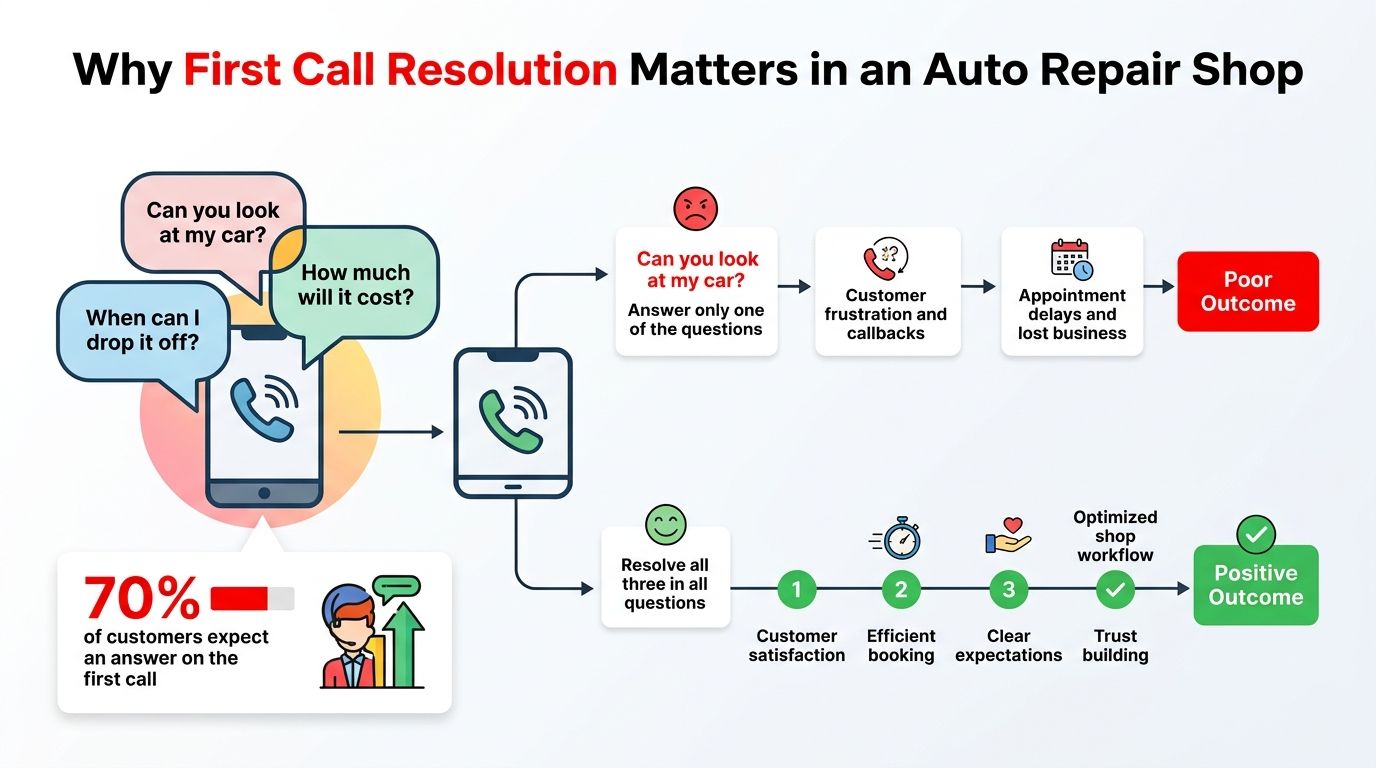
The phone rings while a tech is elbow-deep in a brake job. The caller wants three answers at once, can you look at the car, how much will it cost, and when can it be dropped off. Most front desks answer one piece, book the vehicle, then spend the rest of the day fielding the same question again because the first call never got resolved.
That pattern is why first call resolution matters in an auto repair shop. A shop doesn't lose only a phone conversation when FCR is weak, it loses booking confidence, clean handoffs, and often the customer who was ready to choose a competitor if the answer felt vague. The useful benchmark is still the same across service work, about 70% of issues resolved on the first contact, which means roughly 30% of customers are calling back about the same issue, and 70% to 75% is generally treated as a good range while 80%+ is world-class.
For a shop owner, that number isn't abstract. It shows up as fewer interrupted advisors, fewer “just checking in” calls, and fewer customers who arrive uncertain because nobody nailed down the plan on the first ring. It also shows up in the review that never gets written, because a caller who felt handled well usually doesn't feel the need to keep chasing the front desk.
Table of Contents
- Why First Call Resolution Matters in an Auto Repair Shop
- Running a Root-Cause Analysis on Repeat Calls
- Front-Desk Scripts and Triage Workflows That Actually Work
- Walking Through a Real Booking Call From Hello to Confirmed
- Using Tech Integration to Close the Loop Faster
- Training, KPIs, and the Weekly Review That Keeps FCR Climbing
- Troubleshooting and Common Questions From the Front Desk
Why First Call Resolution Matters in an Auto Repair Shop
A caller rarely phones a repair shop with a single question. Pricing, diagnostics, drop-off timing, and parts availability usually arrive in the same breath, and if the advisor only answers one of them, the customer still has unfinished business. That unfinished business turns into a callback, and callbacks are where booking friction, confusion, and lost trust usually start.
What the number actually means in a shop
The cleanest way to measure first call resolution is to define “resolved” before the team changes scripts or routing. For a shop, that means writing down what counts as resolved for the top five call types, pricing, diagnostics, status updates, complaints, and parts availability, then stating what does not count and who owns the outcome on that first contact. A booked appointment is not always the same thing as a resolved call, especially if the customer still lacks a price range, a drop-off window, or a clear next step.
A practical formula keeps the math honest, first call resolutions divided by total engagements, multiplied by 100. The denominator has to stay consistent from a quiet Tuesday to a stacked Saturday, or the team will confuse volume swings with real performance changes. That same discipline is why guidance from service operations recommends defining resolution operationally, measuring by segment, and then tracking repeat-contact reasons instead of blaming “bad customers”.
Practical rule: if the caller still needs to phone back for the same job, the first call wasn't resolved, even if the advisor sounded helpful.
The shop version of this can fit on one page. For pricing, resolved might mean the caller got a range, what affects the range, and the next step. For diagnostics, it might mean the advisor captured the symptom, the vehicle details, and whether the car should come in now or after the technician confirms something. For parts, it might mean the customer was told what's in stock, what's uncertain, and when the shop will confirm the missing piece.
That one-page definition matters because it prevents false confidence. A front desk can feel busy and productive while repeat callers expose the same gaps again and again.
Why FCR changes revenue, stress, and customer choice
When FCR improves, the front desk stops working like a relay race with dropped batons. Advisors aren't re-explaining the same brake concern, customers aren't wondering whether anyone wrote anything down, and techs aren't getting pulled out of jobs just to answer questions that should have been handled cleanly the first time. That reduction in churn matters more than it looks on paper.
There's also a measurable business case behind the habit. One benchmark summary says a 1% increase in FCR can lift CSAT by 1% and NPS by 1.4 points, while saving a midsize contact center about $286,000 per year. The exact dollar figure belongs to contact centers, not shops, but the direction is the same, fewer repeat calls free up labor, reduce friction, and make the first interaction feel finished instead of partial.
That same logic shows up on the shop floor. If the advisor can book the visit, confirm whether the car needs to be seen before a quote is final, and set a realistic expectation for parts or follow-up, the caller has a reason to stay with your shop instead of checking another place that sounds more certain.
A shop can build trust in its own number fast. Start with the top call reasons, separate first-contact resolutions from same-day callbacks, and tag every repeat contact by reason rather than by frustration. Once that happens, the front desk stops arguing about whether the number is “good” and starts seeing exactly which part of the phone path still breaks.
For shops that want a more formal benchmark, the makes the same point in a tighter process environment, define the resolution path before changing the scripts.
Running a Root-Cause Analysis on Repeat Calls
Repeat calls usually are not random. They cluster around the same few breakdowns, missing vehicle details, an unconfirmed part, an advisor waiting on a technician, a promised callback that never happened, or pricing that stayed too vague for the customer to make a decision. The fastest way to prove it is to pull a small sample and tag it instead of debating it in the office.
A simple worksheet for the last 50 repeat contacts
Start with the last 50 repeat calls and label each one in under a minute. The goal is not perfect taxonomy, it is to find the patterns that keep breaking resolution. A basic sheet can have four columns, the original call reason, the repeat reason, whether the callback was same-day or later, and the likely root cause.
- Missing information: the advisor never captured the symptom, mileage, or VIN well enough to close the loop.
- Parts unconfirmed: the customer had to call back because the advisor quoted work before verifying supply.
- Tech needed: the advisor promised an answer before checking with a technician.
- Missed follow-up: the shop said it would call back, then did not.
- Pricing unclear: the caller left with a range that was too fuzzy to use.
That list is more useful than a complaint log because it separates a true repeat contact from a same-day ping. A same-day clarification can be normal in a busy shop. A next-day repeat because nobody confirmed the part or the diagnosis usually points to a broken handoff.
A strong FCR baseline comes from separating true repeat contacts from callbacks that only look like repeats on paper.
The cleanest measurement habit is to define what counts as resolved before the team touches scripts, routing, staffing, or automation. VoiceDial's guidance stresses documenting what counts as resolved, what does not, and who owns the first contact, which is exactly the kind of clarity a shop needs before it starts chasing call center style metrics.
How to rank the key drivers
After the labels are in place, rank them by frequency, not by opinion. If pricing uncertainty shows up in a third of the sample, that is where the fix starts. If missed callbacks show up often, the problem may be process discipline rather than advisor wording.
The goal is to leave with two or three fixable patterns, not a long list of complaints. A shop that knows its top repeat drivers can rewrite the intake flow, adjust authority, or add one lookup step and see the effect in the next week's calls. A shop that skips the analysis usually ends up training the team on everything, which means nothing changes.
Front-Desk Scripts and Triage Workflows That Actually Work
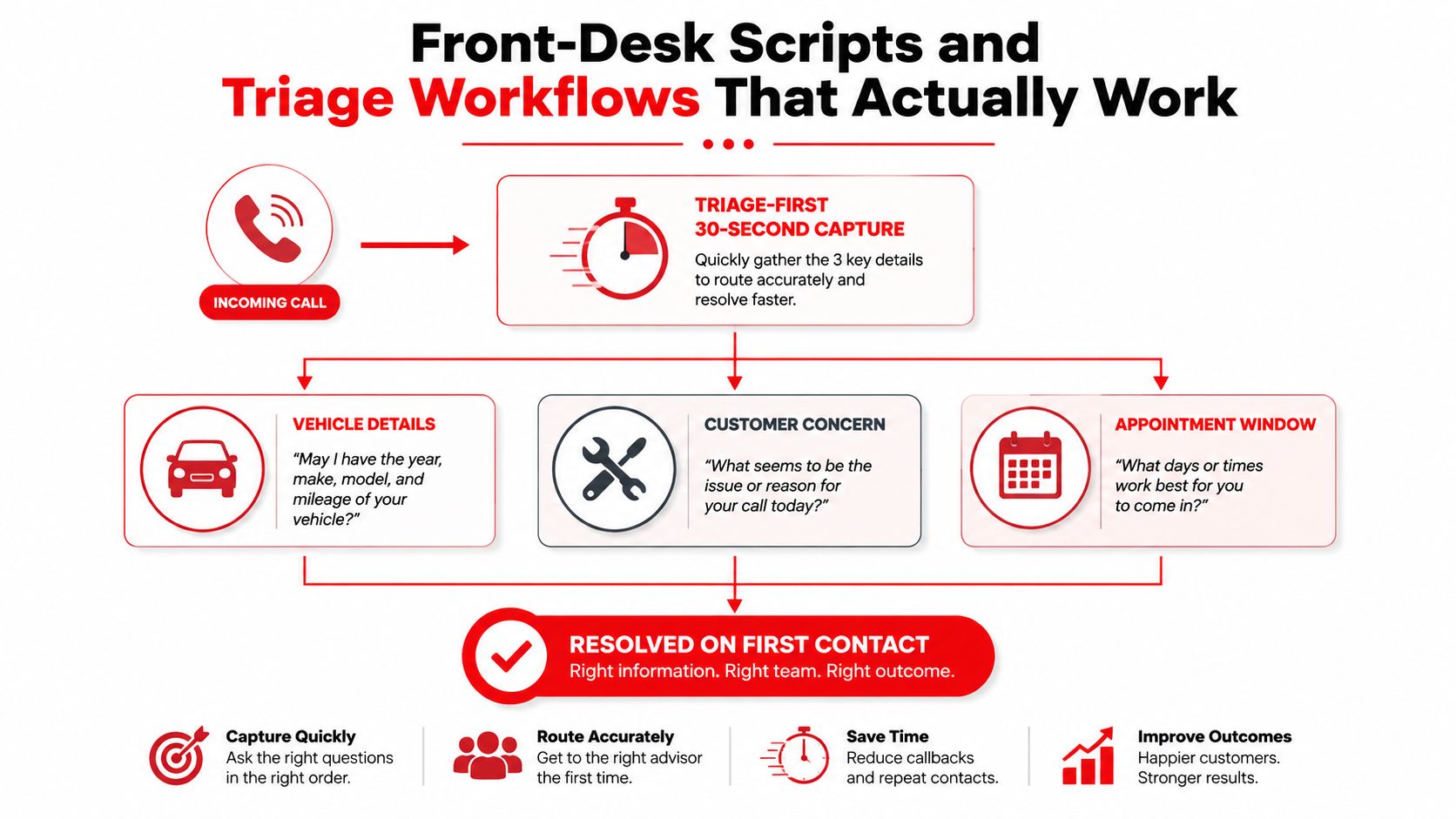
Scripts fail when they sound like scripts. They work when they feel like a structured conversation that gets the caller to a real answer fast, especially when the advisor is trying to do three jobs at once, listen, triage, and keep the phone moving. The opening 30 seconds matter most because that's where the shop either captures the vehicle, the concern, and the timing, or misses one of them and creates a callback later.
A triage-first opener
A strong opener does not start with a long explanation of policies. It starts by collecting the minimum facts that let the advisor route the call correctly without bouncing the customer around.
- Vehicle details first. Ask for year, make, model, and if needed the VIN or plate so the team can pull the right history.
- Customer concern second. Ask what the car is doing, when it started, and whether there's any warning light or safety issue.
- Timing third. Ask when the customer can drop off and whether the vehicle is drivable.
That sequence prevents the common mistake of jumping straight to price before the shop knows what it's pricing. It also avoids the equally common mistake of transferring the caller to a technician too early, before the advisor has enough context to ask a useful question.
Resolve the question behind the question, not just the question asked.
That principle matters most in auto repair because the visible question is often a proxy for a deeper one. “How much will it cost?” usually means “is this worth fixing right now?” “Can you look at it today?” usually means “am I safe to keep driving?” A good advisor hears both layers and answers both where possible.
When to book, when to confirm, and when to bring in a tech
Book on the spot when the caller has enough information to choose a time and the shop doesn't need a technician to complete the next step. Confirm later when a real quote depends on a parts check, a diagnostic, or a technician's review. Pull in the technician only when the advisor already has the facts needed to make the technician's input efficient.
The worst pattern is pretending certainty where none exists. Rigid scripts, missing context, and forcing the customer into extra off-call steps all increase repeat contact risk. That warning shows up in implementation guidance that pushes shops to review failed calls, improve access to information, and give advisors the authority to finish the conversation cleanly.
For training, the front desk should rehearse one practical line for each branch of the call. For example, “The vehicle's checked in and the technician needs to confirm the brake noise, so the advisor will call you back before lunch with a real answer,” works better than a vague promise that sounds polite but gives no timeline. Clear handoffs beat polished language.
Walking Through a Real Booking Call From Hello to Confirmed
A real call about brake noise rarely stays neat. A customer says the truck squeals, wants a rough price, and needs to know whether the shop can get it in this week. The advisor's job is to keep the call moving without guessing, because guessing is how callbacks start.
The first minute
The call opens with vehicle capture, then symptom capture, then timing. The advisor asks for the year, make, model, and VIN if needed, then asks whether the noise happens when braking, turning, or starting from a stop. That sequence matters because a brake noise can mean several things, and the advisor needs just enough detail to know whether the next step is a booking, a tech check, or a callback with a real number.
If the customer is returning, a digital inspection history changes the flow. The advisor can see the last brake service, the photos from the earlier visit, and the notes that explain what was already measured. That usually removes one layer of uncertainty and prevents the shop from asking the customer to retell the whole story.
The best move is not to overpromise. If the parts picture is unclear or the tech needs to verify something, the advisor says so. If the issue is straightforward and the shop already has the vehicle history on screen, the advisor can move closer to confirmation without putting the caller on hold twice.
The middle of the call
The middle of the call is where the front desk earns its keep. The advisor checks parts availability, confirms whether the noise sounds like a safety issue, and decides whether to book now or call back with a real estimate. If the shop can only answer after a quick technician review, the advisor gives a specific follow-up promise and owns it.
A useful line is simple, “Let me confirm with the tech and call you back before lunch.” That line works because it names the next step, names the owner, and gives the customer a time anchor. What doesn't work is “We'll look into it,” because that sentence creates a callback without a deadline.
A booking is stronger when the customer leaves knowing three things. What the shop believes the issue may be, when the vehicle can come in, and what still needs confirmation before a final number is given. That's the point where the call feels finished instead of half-finished.
What changes for a returning customer
Returning customers should not be forced back through a blank intake. Their vehicle history, prior recommendations, and inspection photos should shorten the call, not lengthen it. When the advisor can say, “We saw that right rear brake wear on the last visit, let me pull up the inspection and confirm where we left off,” the caller hears competence, not repetition.
That kind of continuity is what raises FCR in a real shop. The same workflow that handles a simple booking also handles a more complex repair question, because the advisor is looking at the customer's path, not just the immediate question on the line.
Using Tech Integration to Close the Loop Faster
Advisors can't resolve what they can't see. When customer history lives in one place, inspection photos live in another, and parts availability lives in a third, the front desk wastes time stitching together an answer while the caller waits for clarity. The right integration reduces callbacks because it gives the advisor enough context to close the conversation before it drifts.
What actually helps FCR
The most useful tools are the ones that remove uncertainty during the live call. A CRM with lookup by name, plate, or VIN helps the advisor find the vehicle fast. A digital inspection tool with photos lets the advisor explain what the technician saw without turning the call into a guessing game. A parts view across suppliers helps the shop know whether a quote is real or premature.
Those are the integrations that move FCR because they cut off the classic reason for a callback, “I need to check and get back to you.” A screen-pop with vehicle history, real-time parts inventory, and inspection photos the advisor can text or reference mid-call all help the call end with a decision instead of a promise.
What's just nice to have
Pretty dashboards don't improve resolution by themselves. If the advisor still has to ask another person, search a separate file, or wait until after the call to verify the repair path, the software hasn't changed the workflow enough. FCR improves when the tool changes what the advisor can answer while the customer is still on the line.
That is where a platform like RedAppy fits as a practical example, because its workflow brings together customer lookup, vehicle history, digital inspections, parts ordering, and scheduling in one place. For shop owners who want to see how those pieces sit together in practice, the features page is a useful next stop.
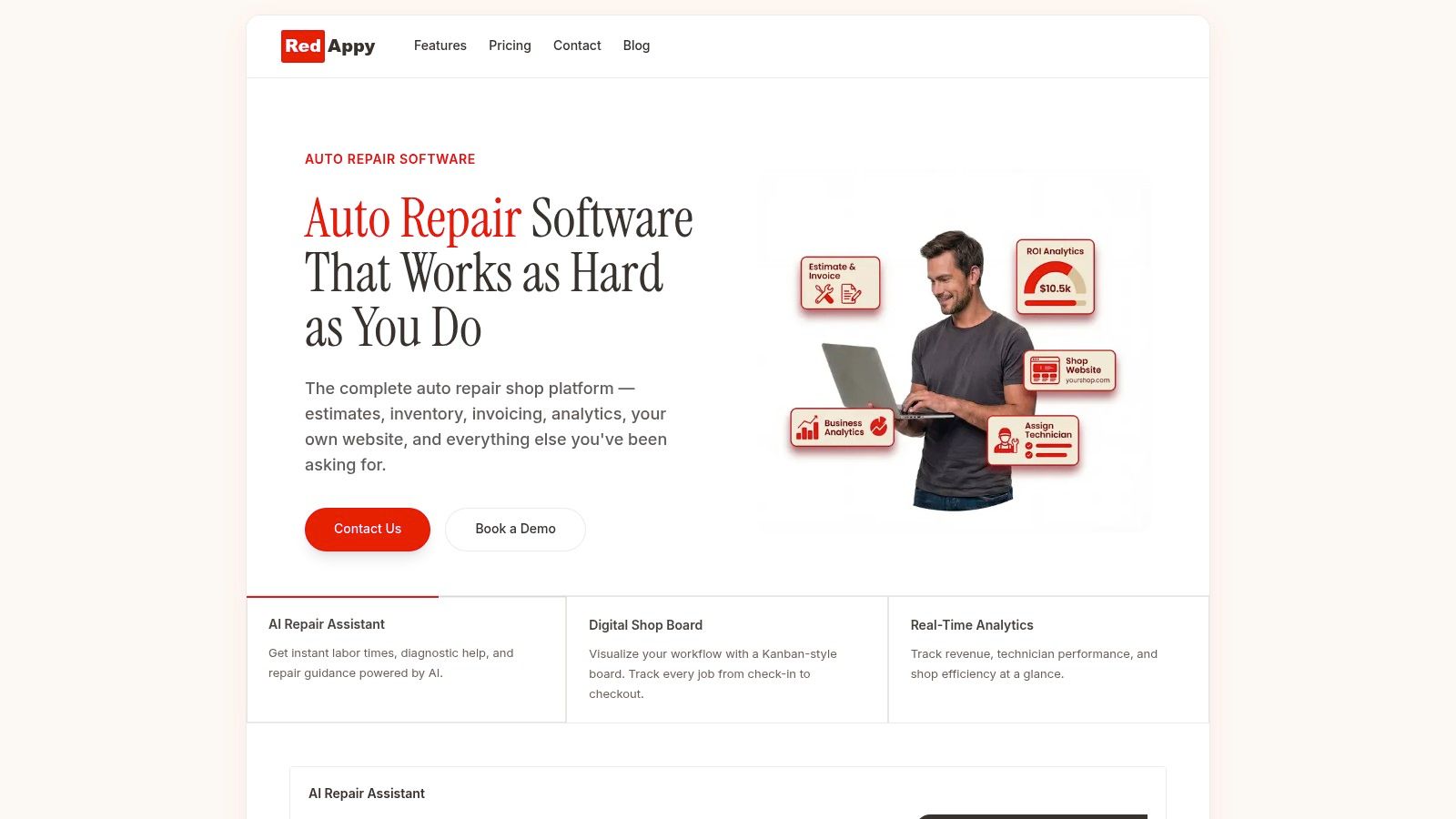
The best setup puts the answer in front of the advisor before the phone is answered. If the call runs long, the advisor should also have one clean place to confirm labor, parts, and the customer's next appointment window. That's how tech supports FCR, by shortening the path from question to ownership.
Training, KPIs, and the Weekly Review That Keeps FCR Climbing
One training session won't move FCR. A rhythm will. Advisors need a weekly review that looks at real calls, a simple scorecard that tracks the right behaviors, and coaching that fixes one issue at a time instead of turning every call into a lecture.
The weekly cadence
A 30-minute weekly review is enough if it stays focused. Pick a few calls, ideally one saved callback and one call that resolved cleanly, then ask the team what information was missing, what the advisor asked early, and where the customer could have been given a clearer next step. Keep the tone practical, not punitive.
The best reviews let advisors bring their own hard calls. That keeps the session grounded in what happens at the front desk, not what the manager wishes happened. It also makes it easier to celebrate a call that avoided a callback because someone asked one better question or checked one more detail.
For a useful outside reference on support metrics that drive better scheduling and service habits, the from Headset Army are worth comparing with the shop's own cadence. The point isn't to copy a call center scorecard, it's to borrow the discipline that keeps the right metrics in view.
FCR Scorecard Comparison
| Scorecard Element | Scorecard That Drives FCR | Scorecard That Just Fills a Spreadsheet |
|---|---|---|
| Resolution definition | Clear rules for pricing, diagnostics, status, complaints, and parts calls | “Handled the call” with no real outcome rule |
| Repeat-contact view | Tags repeat calls by reason and timing | Counts all callbacks the same way |
| Coaching focus | One fix per week from real recordings | General reminders to “be more helpful” |
| Advisor ownership | One person owns the outcome on the first contact | Handoff-heavy process with vague responsibility |
The monthly coaching loop
Monthly coaching should tie call recordings to one or two behaviors only. If the team keeps hearing that pricing calls are too vague, the coaching should focus on how to give a range, explain what changes the range, and tell the customer when a final number will be ready. If missed callbacks are the problem, the coaching should center on follow-through and ownership.
There's also a measurement point that matters. SQM recommends using both internal and external methods, including post-call surveys and repeat-contact analysis, because metrics can look better on paper without reflecting actual resolution. That idea translates cleanly to a shop, since a front desk can sound efficient while customers still return with the same unresolved issue.
The team should retire scorecard items that don't change behavior. If nobody uses a metric to make a better booking, clearer handoff, or faster follow-up, it's dead weight. The goal is a short scorecard the whole team can remember without opening a manual.
Troubleshooting and Common Questions From the Front Desk
The playbook gets tested when the shop is busy. The technician is tied up, the caller wants a number right now, and the advisor has to decide whether to guess, escalate, or call back with something real. Those moments expose whether the workflow is built for the front desk or just written for an ideal day.
What to do when the tech is busy
If the technician can't answer immediately, the advisor should not fill the silence with a made-up quote. The better move is to capture the detail needed to get the right answer later, then set a specific callback window. That keeps the customer from getting two wrong answers, one at the desk and one over the phone.
Automation helps only where the call is repetitive and low-risk. VoiceDial's guidance is useful here because it recommends AI voice handling for narrow, repeatable tasks like reminders, qualification, and straightforward booking, while keeping human ownership for ambiguous cases. In a repair shop, that means reminders and confirmations can be automated, but diagnostic ambiguity should still stay with a person who can read the situation.
When automation creates more callbacks
Automation breaks FCR when it pushes the caller down the wrong path. A self-service menu that can't handle parts questions, complaint handling, or repair status usually creates another call, not fewer. The same risk shows up if a shop uses a script that answers the question asked but ignores the question behind the question.
Small shops can still run an FCR program without a huge system. The discipline matters more than the size of the team. One advisor can track repeat reasons, one manager can review a handful of recordings each week, and one simple definition of “resolved” can keep the team honest.
When the shop needs a platform
A pen-and-paper workflow starts to fail when the advisor has to search across sticky notes, texts, and memory to answer a caller. That's usually the point where a shop management platform becomes less of a luxury and more of a way to protect the front desk from repeat work. The right system should shorten calls, not just organize them.
For shops that want a guided walkthrough of how RedAppy fits into that workflow, the contact page is the right place to start. The strongest teams don't chase software for its own sake, they choose the tool that helps the first call end with a real answer.
If the goal is fewer callbacks, cleaner bookings, and a front desk that can resolve more of the call before it leaves the customer's hand, RedAppy is built for that workflow. It brings scheduling, inspections, parts, customer history, and invoicing into one place so the advisor can keep ownership from the first ring to the final payment. Visit RedAppy to see how the system can help a repair shop tighten first call resolution without adding more desk chaos.
Ready to Transform Your Shop?
RedAppy helps auto repair shops create professional digital estimates with photos and videos, send them instantly via text or email, and get customer approvals in seconds. No credit card required to start.