
How to Start a Mechanic Shop: Your 2026 Guide
A lot of mechanics hit the same point. The technical side feels solid, customers already trust the work, and the thought keeps coming back: why keep building someone else's shop when it's possible to build one that runs the right way from day one?
That's where things get real fast. Opening a garage isn't just about getting a lift, hanging a sign, and waiting for cars to line up. A shop can be busy and still lose money. It can have talented techs and still choke on poor workflow, sloppy estimates, missed approvals, and weak follow-up. The shops that last treat operations as seriously as repairs.
Instead of just asking how to start a mechanic shop, a smarter question is this: how does a new shop open with a system that protects margins, keeps work moving, and gives customers a reason to come back?
Table of Contents
- Your Blueprint for a Profitable Auto Shop
- Building Your Foundation Legal and Financial Setup
- Your Shop Location Tools and Essential Equipment
- Modernizing Your Operations with Smart Technology
- Pricing Marketing and Finding Your First Customers
- Your Launch Checklist and 90-Day Roadmap
Your Blueprint for a Profitable Auto Shop
The repair business is large enough to support a new entrant, but only if that shop knows exactly who it serves and how it will operate. The U.S. automotive repair industry is projected to reach $129 billion, the average vehicle on the road is 12.6 years old, and the average invoice is $586, according to. That tells a new owner three useful things. Demand is real, older vehicles keep work coming in, and revenue planning starts with the average repair order, not wishful thinking.
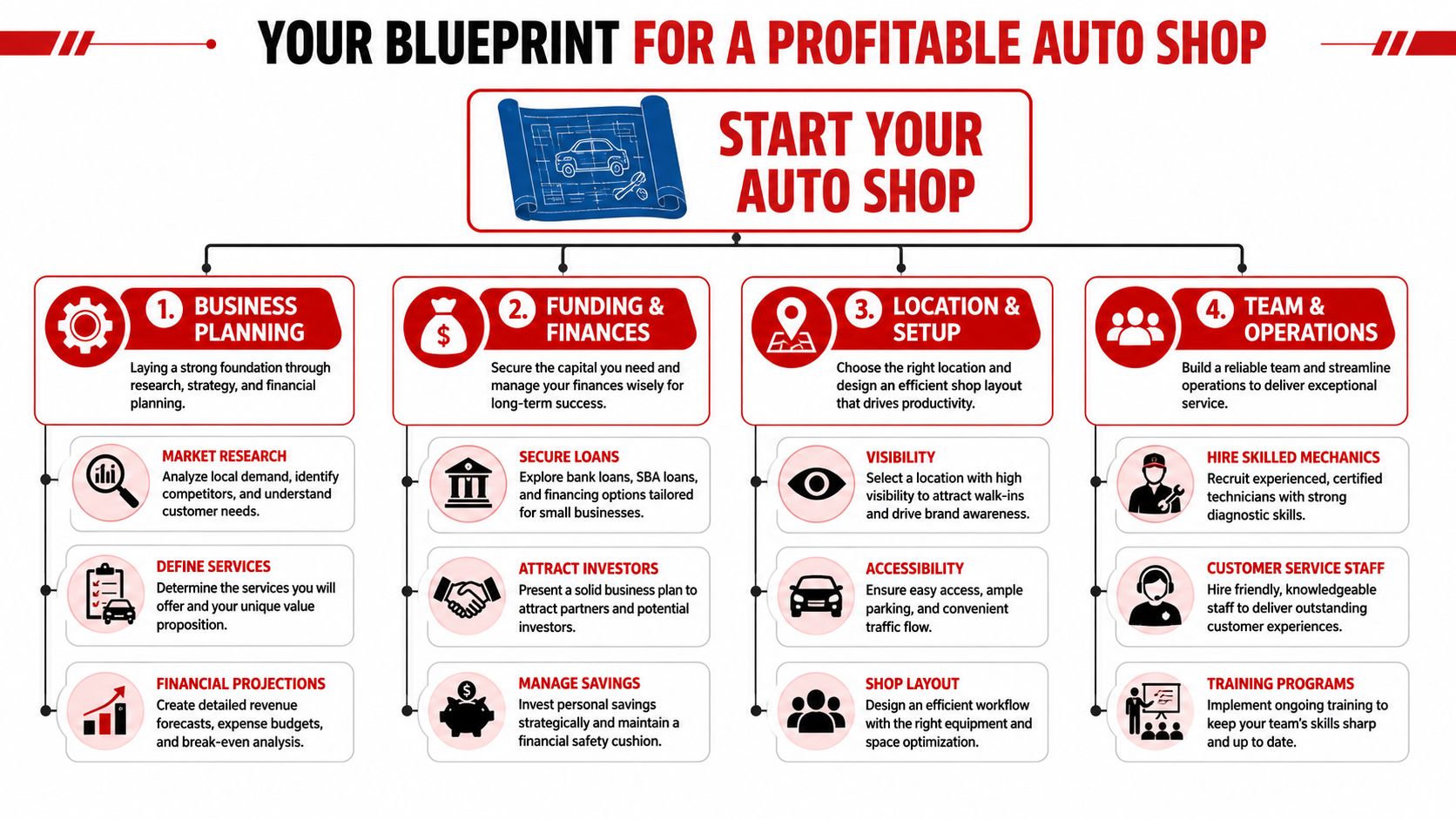
Read the market before signing a lease
A weak market study usually looks like this: count nearby shops, assume there's room for one more, and move forward. That's not enough. A smarter review looks at what neighboring shops don't handle well.
Start with a short field check:
- Service mix: Identify whether local shops lean toward general maintenance, diagnostics, tire work, fleet work, diesel, European, or drivability problems.
- Customer complaints: Read public reviews and look for patterns. Long wait times, poor communication, and vague estimates create openings.
- Vehicle fit: Watch the parking lots. The cars in the area tell a clearer story than broad demographic guesses.
- Traffic quality: A road with heavy traffic isn't automatically good if access is awkward for pickups, tow-ins, or fleet vehicles.
Practical rule: Don't choose a market just because there are cars there. Choose a market where customers are underserved in a specific way.
Choose a niche that supports good work and good margins
A new shop doesn't need to be everything to everyone. In fact, that usually creates pricing confusion, tool bloat, and technician frustration.
A good niche does three things. It matches the owner's technical strengths, fits the local vehicle population, and supports clean repeatable processes. Examples include general repair for aging commuter vehicles, diagnostics-heavy drivability work, fleet maintenance, or a specialty lane such as imports or EV-adjacent services where the shop has genuine capability.
Here's a simple way to pressure-test a niche:
| Question | Good sign | Bad sign |
|---|---|---|
| Does the shop already know the work deeply? | Fast diagnosis and confident estimates | Constant learning on customer time |
| Can the bay layout support it? | Smooth flow and predictable tooling | Frequent rearranging and delays |
| Will parts sourcing stay manageable? | Reliable vendors and common inventory | Long waits and one-off orders |
| Does it help the shop stand out? | Clear reason to choose the business | Generic message with no edge |
Build a business plan that operators can actually use
Too many business plans are written for a lender and never used again. A working plan should act more like a shop playbook.
At minimum, it should answer these questions:
- What work gets accepted? Define core services and what the shop will decline early on.
- Who is the ideal customer? Busy families, commuters, fleet managers, performance owners, or another clear segment.
- What is the promise? Fast diagnostics, transparent communication, specialty expertise, or convenience.
- What must happen daily? Car count targets, estimate turnaround, follow-up habits, and parts ordering discipline.
- Where does margin leak out? Comebacks, underquoted labor, delayed approvals, and poor parts control.
A strong plan isn't glamorous. It's blunt. It forces decisions before money gets spent.
That's the part many new owners skip, and it's usually the part that hurts them later.
Building Your Foundation Legal and Financial Setup
A lot of new shop owners hit a dangerous stretch right before opening. The bays are almost ready, tools are showing up, friends are asking for the grand opening date, and money is already going out. That is exactly when rushed legal and financial decisions create expensive problems.
Get the foundation right first. A profitable shop needs more than lifts and customers. It needs a business structure that protects the owner, insurance that matches the actual work being done, and enough cash discipline to survive the first slow month without cutting corners.
Handle compliance before you advertise or schedule work
The legal side is not glamorous, but it decides whether the doors stay open. A shop needs the right business registration, local operating approval, and environmental compliance for waste oil, chemicals, batteries, and other regulated materials. If the shop will service vehicle air conditioning systems, the required certification has to be covered too..
The order matters. Verify the property can legally support the repair work planned. Set up fluid storage and disposal correctly. Match the business name across state filings, bank accounts, insurance, tax records, and vendor applications. Small mismatches create delays that waste time when the owner should be focused on opening cleanly.
I have seen owners spend on signs, uniforms, and ad campaigns before confirming use approval. That mistake burns cash fast. Customers can forgive a modest waiting room. Regulators will not forgive operating in the wrong space or handling waste improperly.
Choose a structure and insurance policy that fit the risk
Picking an entity is not just a filing task. It affects liability exposure, taxes, banking, payroll, and how easy it is to add a partner later. Many independent shops start as LLCs because that structure often gives a practical balance of protection and simplicity, but the right choice depends on the ownership plan and tax advice for the specific business.
Insurance deserves the same level of attention. Garage liability, property coverage, workers' compensation, and garagekeepers coverage all need to be reviewed in plain language, not skimmed for the cheapest premium. If the policy excludes a loss the shop is likely to face, the low price did not save anything. For a clear breakdown of what to review, are worth reading before buying a policy.
Read the exclusions. Read the deductibles. Read how customer vehicles are covered.
That last point matters more than many first-time owners realize.
Build a startup budget around cash flow, not opening-day excitement
New owners usually underestimate two things. The money tied up before the first steady stream of cars arrives, and the drag created by slow approvals, delayed parts, and uneven car count in the first few months.
The U.S. Small Business Administration advises owners to calculate both startup costs and ongoing operating expenses before launch, including fixed costs, variable costs, one-time purchases, and a cash cushion for the early stage of the business. is a better planning reference than rough industry chatter because it forces the owner to account for what the shop has to carry month after month.
A stronger opening budget usually includes four buckets:
- Setup costs: entity formation, permits, deposits, basic office setup, and only the equipment needed for the initial service mix
- Operating reserve: payroll, rent, utilities, software, supplies, and parts float while revenue is still inconsistent
- People costs: wages, taxes, training time, uniforms, and the cost of hiring too early or too late
- Systems costs: shop management software, payment processing, accounting support, and inspection or workflow tools that help the shop produce consistently from day one
That last bucket gets skipped all the time, and it should not. Shops that add software and process control early usually quote faster, track labor better, follow up more consistently, and spot margin leaks sooner. Shops that wait often end up rebuilding their workflow after bad habits are already in place.
Spend deliberately. Protect cash. Set up the business so it can handle mistakes, slow weeks, and growth without chaos. That is what gives a new shop a real chance to become profitable instead of just busy.
Your Shop Location Tools and Essential Equipment
A shop can recover from ugly paint and a small waiting room. It won't recover easily from a bad location, poor bay flow, or cheap equipment that slows every job down.
Pick a location that fits the work
The best location isn't always the one with the highest visibility. For some shops, easy drop-off, tow access, and parking matter more than drive-by traffic. A diagnostics-focused shop might thrive in a tucked-away industrial pocket if the workflow is smooth and the customer experience is strong. A maintenance-heavy shop may benefit more from commuter visibility and simple entry and exit.
When reviewing a property, check practical friction points:
- Access: Can customers pull in and out without awkward turns or backups?
- Bay usability: Are the doors, ceiling height, and electrical setup right for current and future equipment?
- Parking logic: Is there enough room for vehicles waiting on parts, pickups, and after-hours drop-offs?
- Front-office layout: Can the advisor speak with customers without standing in the middle of shop noise?
A lease should also be read with expansion and restrictions in mind. Some properties look workable until signage rules, fluid handling limits, or repair-use restrictions show up in the fine print.
Buy core equipment in the right order
A new owner doesn't need every shiny machine on day one. The core package should match the first service mix.
A small independent shop typically needs a minimum startup investment of $50,000 to $200,000, with tool expenses around $15,000, hydraulic lifts at approximately $3,700 to $4,000 each, and diagnostic machines ranging from $5,000 to $10,000, according to. That same source notes monthly overhead, including rent, insurance, and labor, can total $10,000 to $20,000 per month.
A practical buying sequence looks like this:
- Lift and safety gear first: No bay earns well without safe lifting and dependable basics.
- Diagnostics second: A weak scanner slows the entire shop and creates guesswork.
- General hand tools and shop equipment: Enough quality to avoid breakdowns and wasted motion.
- Nice-to-have specialty tools later: Buy these once the service mix proves demand.
Open vendor accounts before the first repair order
This gets missed constantly. Parts sourcing should be built before the grand opening, not after the first estimate stalls.
Wholesale vendors often require a tax resell number and active business licensing to unlock trade pricing. According to, missing that setup can mean 15–20% higher parts costs in the first year, which cuts directly into margin and slows repair turnover.
That single issue affects more than price. It affects trust. When parts arrive late, estimates change, or the advisor can't promise a clear timeline, customers feel the chaos immediately.
Good vendor relationships don't start when the first car breaks down in Bay 1. They start when the business paperwork is still warm.
Modernizing Your Operations with Smart Technology
The biggest early mistake in a new shop often isn't technical. It's operational. Owners carry paper inspections, chase estimate approvals by phone, bounce between parts websites, and rebuild the same customer story over and over. The day feels full, but too much of that time isn't billable.
Manual workflow costs more than most owners think
A typical repair order touches more people than most owners realize. The customer calls or messages. The advisor creates the job. A technician performs the inspection. Findings go back to the front. The estimate gets built. Approval gets chased down. Parts are ordered. The invoice is assembled. Payment is collected. Follow-up gets forgotten because the team is already underwater on the next car.
That mess compounds across every bay.
Industry benchmarks target annual revenue of $250,000 to $500,000 per repair bay, based on 2.2 vehicles per day per bay and an average repair order of $500 to $749, according to. The point isn't the top end of the range. The point is that hitting healthy bay performance requires clean execution hour after hour.
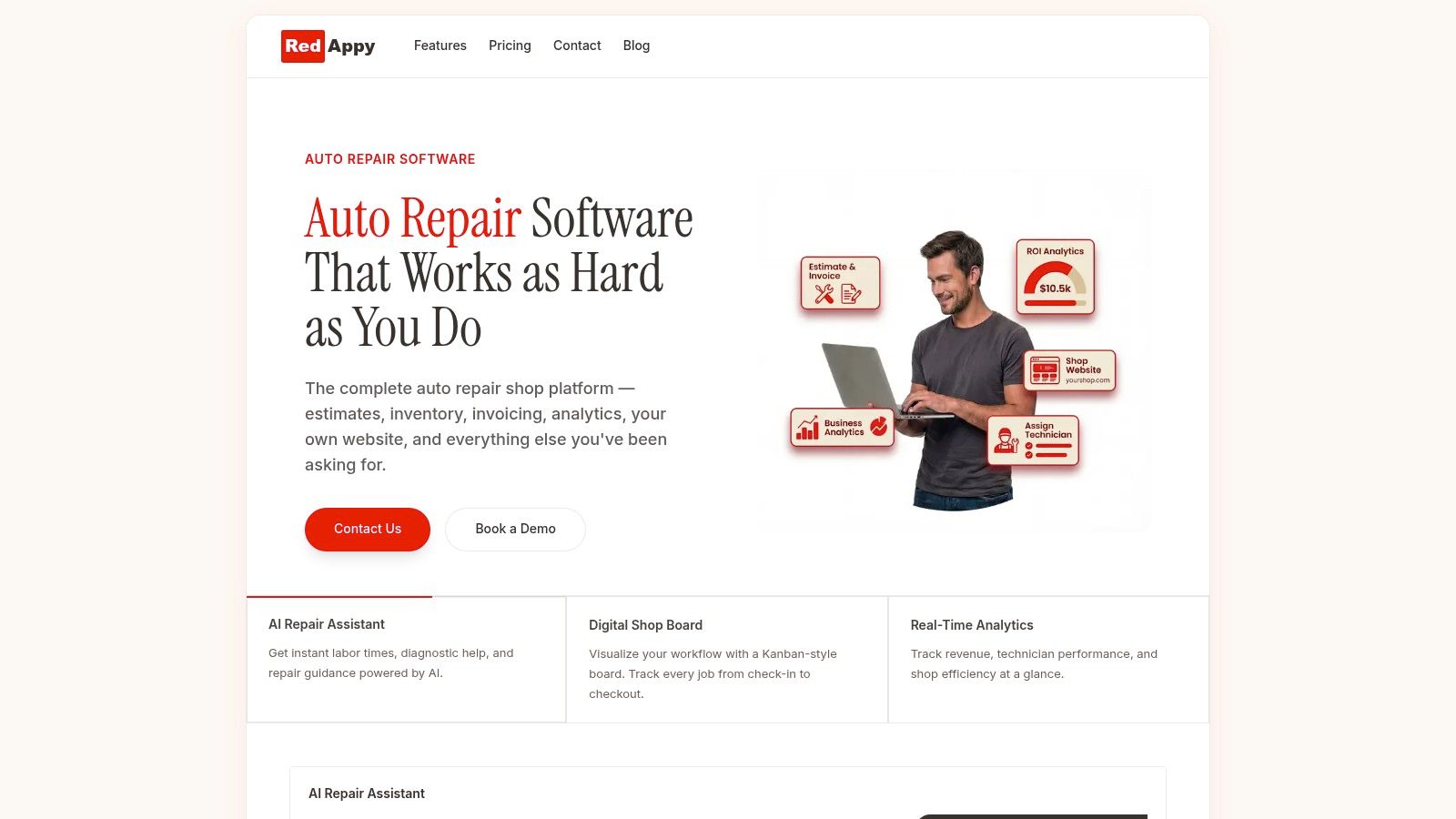
What a modern operating stack should handle
A modern shop should run from one connected workflow, not a pile of workarounds. That means digital inspections with photos, estimate approvals that customers can handle remotely, organized parts ordering, clear job status tracking, invoicing, payment collection, and reporting that shows what is happening in the bays.
Good systems also reduce avoidable communication lag. If the customer can review inspection photos, see line items clearly, and approve work without a phone tag marathon, the shop gets to the profitable part faster.
A useful stack should support these jobs well:
- Intake and scheduling: Fast check-in with accurate vehicle and customer history.
- Inspection and authorization: Photo-backed findings and clear approval steps.
- Parts coordination: Fewer tab-switching mistakes and better visibility into what's ordered.
- Job tracking: A live board that shows what's waiting, blocked, in progress, and done.
- Payment and records: Clean handoff at pickup and a future-ready service history.
For shops that still rely on printed approvals, a practical starting point is understanding digital authorization. This gives a useful overview of why electronic approvals matter for speed and accountability.
A repair order should move like a relay race. When one handoff is sloppy, the whole shop slows down.
Technology should remove friction, not add another screen
Not every software tool is worth the trouble. Some create more clicking than clarity. A good system should reduce re-entry, keep the whole team looking at the same information, and make the next action obvious.
That's especially important for a new owner learning how to start a mechanic shop with discipline instead of improvisation. Building modern workflow from the first day is far easier than trying to retrain a busy staff after months of paper habits, missing notes, and fragmented customer communication.
The right software decision isn't about looking advanced. It's about keeping bays productive, estimates moving, and customers informed without dragging the front counter into chaos.
Pricing Marketing and Finding Your First Customers
Monday opens with two empty bays, payroll coming due, and a phone that is not ringing enough. That is where a lot of new shop owners make their first bad decision. They cut prices to get cars in fast.
Cheap work fills space, but it rarely builds a healthy shop.
A new repair business usually faces high startup costs and steady monthly overhead, so pricing has to protect gross profit from the beginning. The U.S. Small Business Administration's guide to is a useful reference if you want to map those numbers before opening. If your labor rate, parts margin, and inspection process do not cover the cost of doing the job right, marketing only helps you lose money faster.
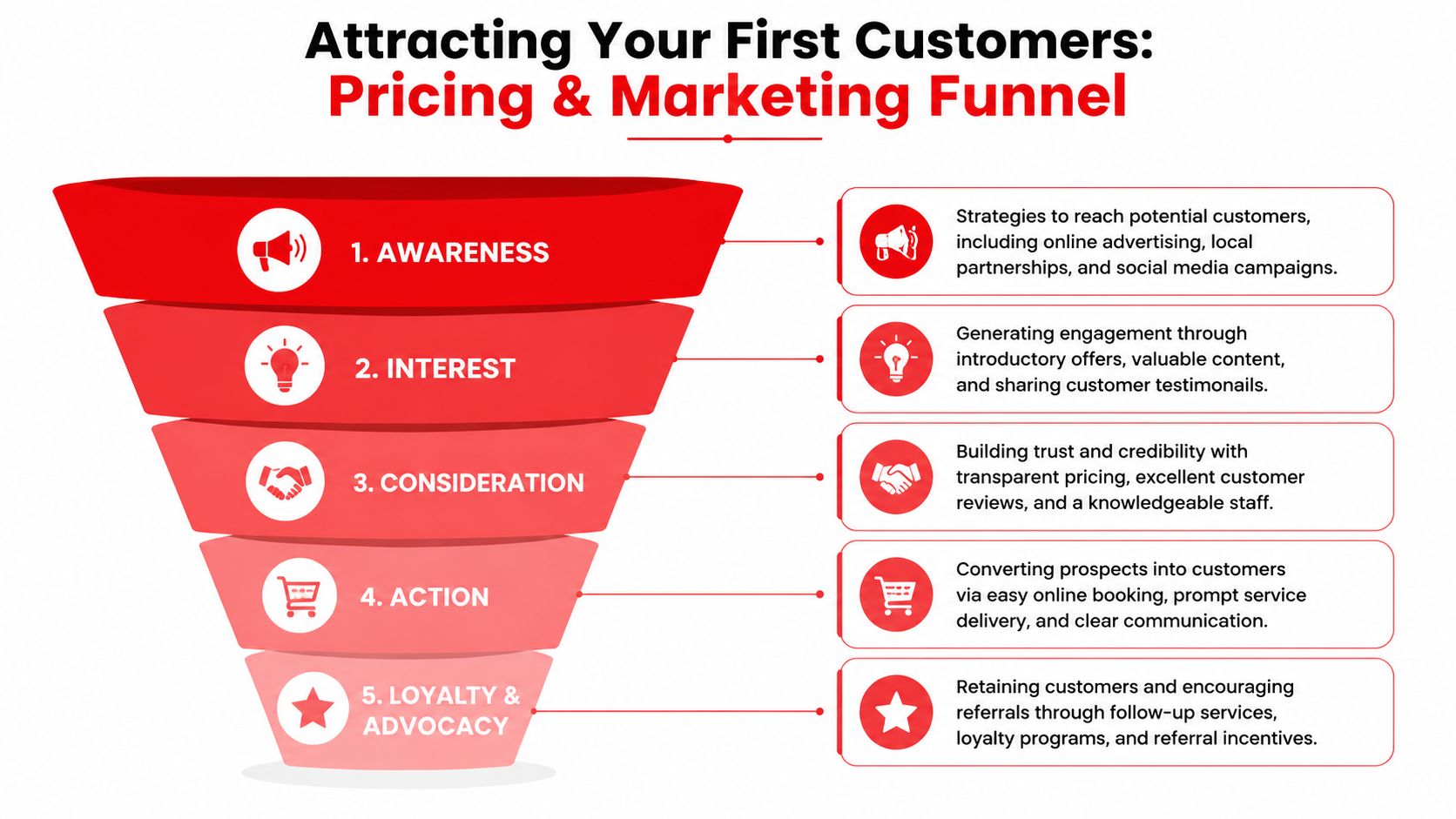
Price for the shop you want to run
Set pricing around the operating model you plan to keep, not around the fear of being new.
That means accounting for technician time, diagnostic time, service advisor effort, parts procurement, software, warranty comebacks, and the time it takes to communicate clearly with customers. Owners who skip those costs usually end up doing busy work all day and wondering why cash stays tight.
Here is the trade-off in plain terms:
| Approach | What happens |
|---|---|
| Cheapest in town | Fills bays with price shoppers, lower-margin jobs, and more pushback on needed repairs |
| Mid-range with no clear reason | Leaves customers comparing you on distance and convenience alone |
| Value-based with a documented process | Supports healthier margins, better approvals, and stronger long-term retention |
If the shop includes digital inspections, photo documentation, clear estimates, and consistent follow-up, charge like those steps matter. They do. Customers who want the lowest number on the phone were never your best customers anyway.
Market locally with proof, not noise
Early marketing works best when it answers one question fast. Why should someone trust this shop with their car?
Start with the basics that drive local discovery and conversion:
- Google Business Profile: Keep hours, categories, photos, and contact details accurate.
- Reviews: Ask satisfied customers while the visit is still fresh, not three weeks later.
- Website copy: Be specific about the work you do, the vehicles you serve, and how people book.
- Photos and inspection evidence: Show real jobs, a clean shop, and the standard of work customers can expect.
- Local relationships: Build referral ties with tow operators, body shops, used car lots, and small fleets that fit your workflow.
A lot of new owners waste money on broad ads before they have enough proof to convert attention into appointments. A tighter approach works better. Show the shop, show the process, show the communication standard, and make booking easy.
Modern shop technology helps here too. Shops that send digital inspections, store service history, and follow up on declined work have better material for reviews, reminders, and repeat visits. That is a big advantage if the goal is to build a profitable, efficient operation from day one instead of patching systems together later.
Turn first-time customers into repeat business
The first repair order is an audition.
Repeat business usually comes from consistency more than charm. Customers come back when the estimate is clear, the approval process is clean, pickup goes smoothly, and the next service is explained without pressure. They leave for the next shop when they feel surprised, rushed, or forgotten.
Use a simple retention standard from the start:
- Write estimates clearly.
- Explain findings in plain language.
- Document future work before the vehicle leaves.
- Follow up with a real reminder, not a generic blast.
- Make the second visit easier than the first.
That is the connection between pricing and marketing. Strong pricing gives the shop room to deliver a better experience. A better experience gives customers a reason to return, leave reviews, and send the next car your way.
Your Launch Checklist and 90-Day Roadmap
Opening week feels like progress. The first ninety days determine whether the shop is building discipline or just reacting.
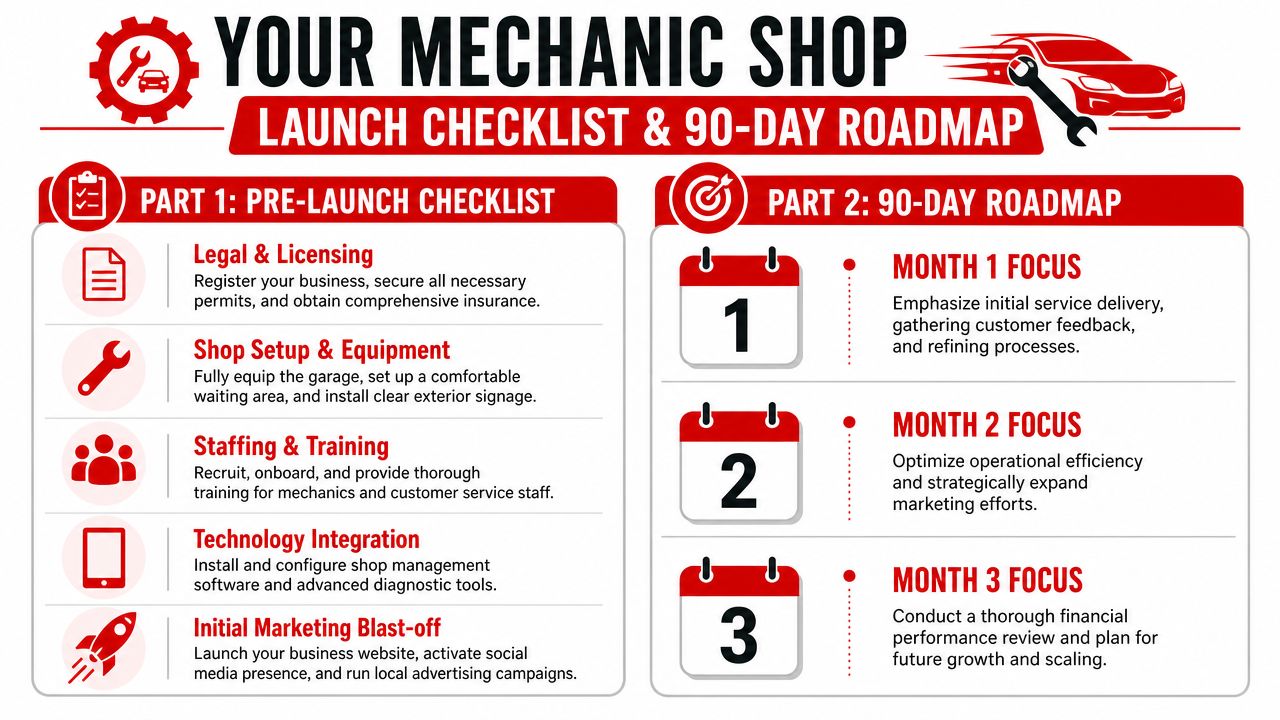
Pre-launch checklist
Before the first public booking, verify the fundamentals:
- Legal completion: Business registration, licensing, zoning, permits, and insurance all confirmed.
- Physical readiness: Bays functional, signage installed, waiting area usable, phones answered properly.
- Tool readiness: Core equipment tested, not just delivered.
- Vendor readiness: Parts accounts active and delivery expectations clear.
- System readiness: Scheduling, inspections, estimates, payment flow, and job tracking all rehearsed.
- Message readiness: Website live, business listings accurate, and a basic review request process in place.
Opening without a dry run is asking customers to discover the shop's problems before the owner does.
First 30 days
The first month is about control, not speed. Keep the car count manageable enough to spot workflow failures early.
Focus on three habits:
- Tight communication: Every customer gets clear updates and no vague promises.
- Estimate discipline: Every recommendation is documented cleanly and presented consistently.
- Daily review: End each day by checking delays, missed approvals, parts issues, and customer objections.
Days 31 through 90
Once the front counter is stable, the shop can tighten operations and start building momentum. Review which jobs are profitable, which services create friction, and where technicians or advisors lose time.
By this stage, the owner should be asking practical questions:
- Which repairs move cleanly through the shop?
- Which estimates stall or get rejected most often?
- Which customers are coming back, and why?
- Where is admin work eating productive time?
This is also when the shop's identity starts to sharpen. Some services deserve more promotion. Some should be dropped. Some process problems need training. Others need better tools.
A shop that reviews its first ninety days objectively will make better decisions than a shop that stays busy and never measures anything.
A modern shop needs more than tools and talent. It needs a system that keeps inspections, approvals, scheduling, invoicing, parts ordering, and reporting connected from the first customer onward. For shops ready to build that foundation properly, RedAppy is worth a close look. To see what that kind of workflow can do in practice, explore the RedAppy features or reach out through the contact page.
Ready to Transform Your Shop?
RedAppy helps auto repair shops create professional digital estimates with photos and videos, send them instantly via text or email, and get customer approvals in seconds. No credit card required to start.