
Boosting Auto Shop Success: Improving Team Performance
The day usually starts the same way. A customer is waiting at the counter, a tech is asking where the keys went, somebody can't tell if the brake job is approved, and a repair order is sitting under a stack of parts invoices with grease on the corner. The phone keeps ringing. The schedule looked fine an hour ago. Now the whole shop feels late.
That kind of chaos doesn't mean the team is lazy. It usually means the shop is running on memory, verbal updates, and paper that moves faster than anyone can track. Good people get forced into bad habits when the process is loose. Service advisors chase answers. Technicians stop and start. Owners spend the day solving preventable problems.
Improving team performance in an auto repair shop starts there. Not with a motivational speech. Not with a generic productivity tip. It starts by fixing the system the team works inside, then coaching people inside that system so they can win.
Table of Contents
- From Morning Chaos to a Well-Oiled Machine
- Set Clear Goals and Define What Winning Looks Like
- Redesign Your Workflow for Peak Efficiency
- Empower Your Team with Training and Feedback
- Sustain Improvements and Drive Long-Term Growth
From Morning Chaos to a Well-Oiled Machine
A lot of shops think they have a people problem when they really have a visibility problem. The front desk can't see what's really happening in the bays. The techs can't see what's approved, what's waiting on parts, or what the customer was promised. The owner can't see where the day is getting stuck until everybody is already frustrated.
One lost RO doesn't seem like much. One delayed estimate doesn't seem fatal. One parts order scribbled on the wrong notepad doesn't feel like a crisis. Stack ten of those small misses into a single day and the shop starts bleeding time, trust, and margin.
The busiest shops aren't always the most productive shops. A packed lot can hide a broken workflow.
A strong shop runs on clean handoffs. The advisor checks in the vehicle with complete notes. The technician sees the job status without asking. The estimate goes out fast. Parts are tied to the right job. The customer gets updates before calling in angry. Payment closes the loop instead of creating one more paper chase.
That shift matters because team performance in this business isn't abstract. It shows up in comebacks, stalled bays, missed calls, and advisors spending half the day hunting information. When the process gets tighter, the team doesn't have to work harder just to stay in place.
Follow one repair order all the way through
The easiest way to see the core problem is to trace one job from first call to final payment.
Start with the customer contact. Was the complaint captured clearly? Did the advisor write enough detail for the technician to diagnose the problem without walking back to the counter three times? Then move to inspection, estimate, approval, parts ordering, scheduling, status updates, invoice, and pickup.
At every step, ask four plain questions:
- Who owns this step
- Where is the information stored
- How does the next person know it's ready
- What usually causes delay or confusion
If the answers depend on memory, hallway conversations, or sticky notes, that's the bottleneck.
Look for friction, not blame
Most owners already know the names of their strongest people. That's not the point. The point is finding where the process burns their energy.
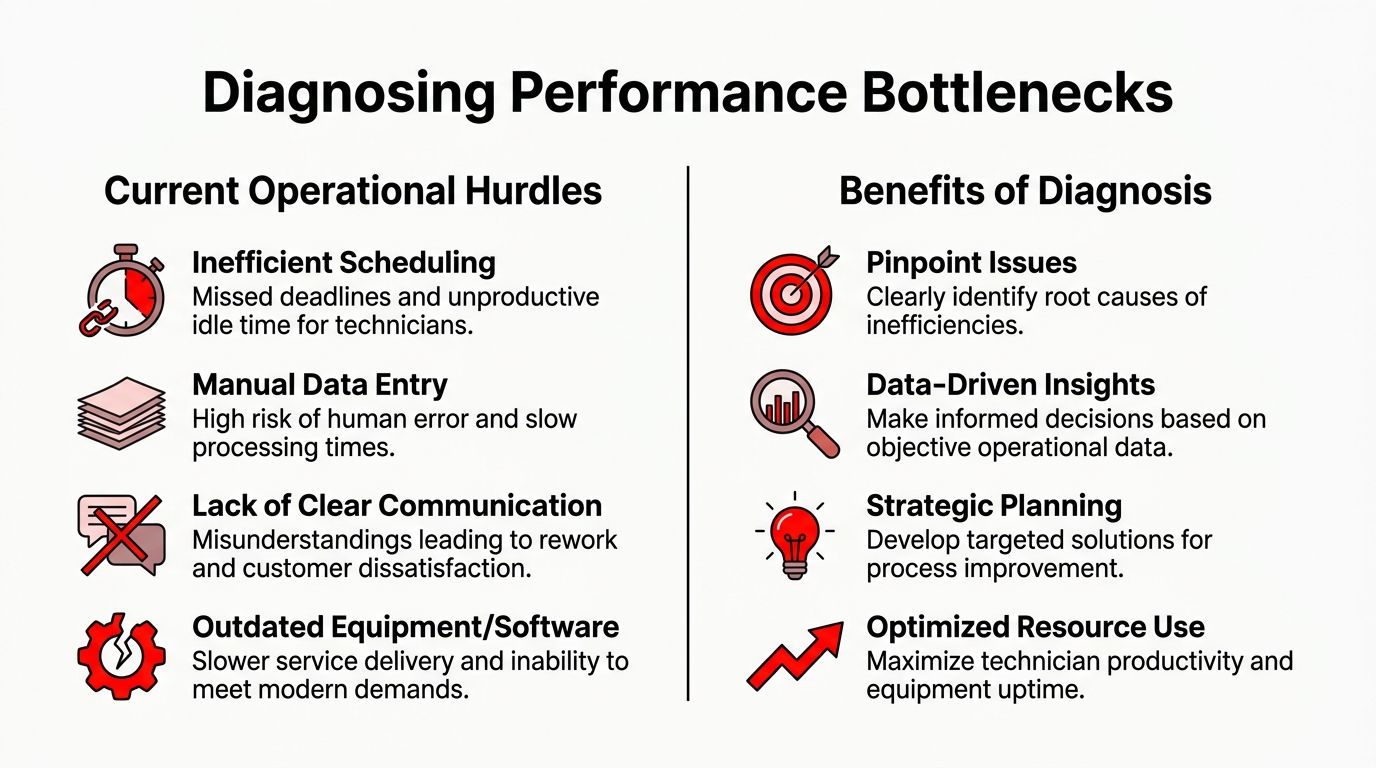
Common friction points show up fast when somebody watches the floor directly:
- Inefficient scheduling: Cars get assigned based on whoever looks free instead of who fits the work. That creates idle time in one bay and overload in another.
- Manual data entry: The same customer, vehicle, and parts details get typed or written more than once. Every duplicate entry creates another chance for error.
- Weak communication: Advisors, techs, and parts staff all know part of the story, but nobody sees the whole job in one place.
- Old software or no software: The team spends more time updating each other than moving work forward.
Trust and communication carry more weight than most owners think. Over 50% of positive changes in team communication patterns stem from social time spent together, and research summarized by Teamland also notes that trust and communication have the greatest impact on efficiency in high-precision environments like auto shops.
That doesn't mean pizza fixes operations. It means shops perform better when people know each other, talk clearly, and don't treat every status update like a scavenger hunt.
Practical rule: If a technician has to leave the bay to ask what happens next, the workflow is broken.
A useful diagnosis also includes wasted motion. Watch how often staff members do these things during a normal day:
- Chase approvals
- Search for keys
- Re-enter customer information
- Walk to ask for job status
- Stop work because parts weren't staged
- Interrupt a technician for updates that should already be visible
Write those down for a week. Patterns show up quickly. One shop may have a scheduling issue. Another may have an estimate bottleneck. Another may be losing half its momentum at the front counter because every customer update depends on finding one busy advisor.
Improving team performance gets much easier once the shop stops talking in generalities. “We need better communication” is too vague to fix. “Approved jobs aren't getting flagged clearly, so techs don't start them for twenty minutes” is a real problem with a real solution.
Set Clear Goals and Define What Winning Looks Like
“Be more productive” isn't a goal. It's a complaint dressed up as a plan.
Teams need a scoreboard. In an auto repair shop, that scoreboard has to connect daily behavior to gross profit, job flow, and completed work. If the team can't tell whether today was good, average, or bad without waiting for the owner's mood, the targets aren't clear enough.
Stop using vague shop goals
Most shops drift because they manage by feel. The owner senses that labor is soft or parts markup is inconsistent, but nobody has a shared number to anchor decisions. That's where performance slips into guesswork.
A profit-driven shop should track Labor Gross Profit with a target of 60–70% and Parts Gross Profit with a target of 50–55%, and the working method should include SMART goals and dashboards to track those KPIs.
That matters because the numbers force better questions:
- Labor Gross Profit below target: Are labor rates wrong, are hours leaking, or is the schedule loading weak jobs into prime bay time?
- Parts Gross Profit below target: Is the shop discounting too easily, missing matrix pricing, or quoting inconsistently?
- Average Repair Order trending low: Are inspections thin, approvals delayed, or advisor recommendations unclear?
The exact fix depends on the shop. The point is that clear KPIs turn opinion into management.
Build a scoreboard the team can read
A useful KPI board isn't built for accountants. It's built for action.
| KPI (Key Performance Indicator) | Target Benchmark | What It Measures |
|---|---|---|
| Labor Gross Profit | 60–70% | Whether labor pricing and billed work support healthy margin |
| Parts Gross Profit | 50–55% | Whether parts pricing and sourcing protect profit |
| Average Repair Order (ARO) | Shop-defined | How much approved work the shop completes per visit |
| Technician Efficiency | Shop-defined | How effectively available hours turn into billed work |
| Work Approval Rate | Shop-defined | How often recommended work gets approved by customers |
A shop owner doesn't need fifty metrics. A shop owner needs five numbers that make the next decision obvious.
SMART goals help because they remove wiggle room. “Raise ARO” is weak. “Improve estimate follow-up quality and inspection completeness so approved work rises over the next review cycle” gives the team something to work on. The same goes for scheduling. “Load the board better” is fuzzy. “Assign diagnostics and maintenance work by technician fit and available bay time each morning” is operational.
Shops hit targets faster when every role can answer one question: what does winning look like in my lane today?
Goals also need role clarity. The advisor owns fast estimate delivery and customer communication. The tech owns accurate inspection notes, clean documentation, and timely status changes. The manager owns workload balance, blocked jobs, and the daily board. Once those lines are clear, fewer tasks fall into the gap between “I thought somebody else had it” and “now the car is still here at five.”
Dashboards make this practical because they remove the lag between work done and work measured. A good dashboard shows what's happening now, not what happened after the month already went sideways. That's why many shops move away from paper summaries and spreadsheets patched together after hours. Real-time visibility supports improving team performance because it turns every shift into a feedback loop instead of a postmortem.
Redesign Your Workflow for Peak Efficiency
Most shop bottlenecks don't come from hard repairs. They come from clumsy handoffs. The problem usually isn't that the team can't do the work. The problem is that the work keeps disappearing into side conversations, paper piles, and status confusion.
The fix is to rebuild the flow of a job so the next step is obvious.
Replace handoffs with visibility
A smooth workflow starts before the car enters the bay. The check-in has to capture the complaint clearly, attach the right vehicle history, and place the job where the whole team can see it. After that, each stage should move the job forward without requiring three extra conversations.
A practical digital flow usually looks like this:
Check-in with complete notes
The advisor logs the concern, captures contact details, and ties the visit to the customer and vehicle record.Inspection with evidence
The technician adds findings, photos, and recommendations instead of relying on verbal explanations that get weaker every time they're repeated.Estimate built from actual findings
The advisor sends a clear estimate quickly, with labor, parts, and supporting inspection context connected to the same job.Approval and parts ordering tied to the RO
Nobody should be guessing whether a customer approved the work or whether the parts were ordered for the correct vehicle.Live job status on a shared board
Everyone can see whether the vehicle is checked in, awaiting diagnosis, waiting for approval, waiting on parts, in progress, ready for quality check, or ready for pickup.Invoice and payment without duplicate entry
The work already documented in the job should flow directly into the invoice.
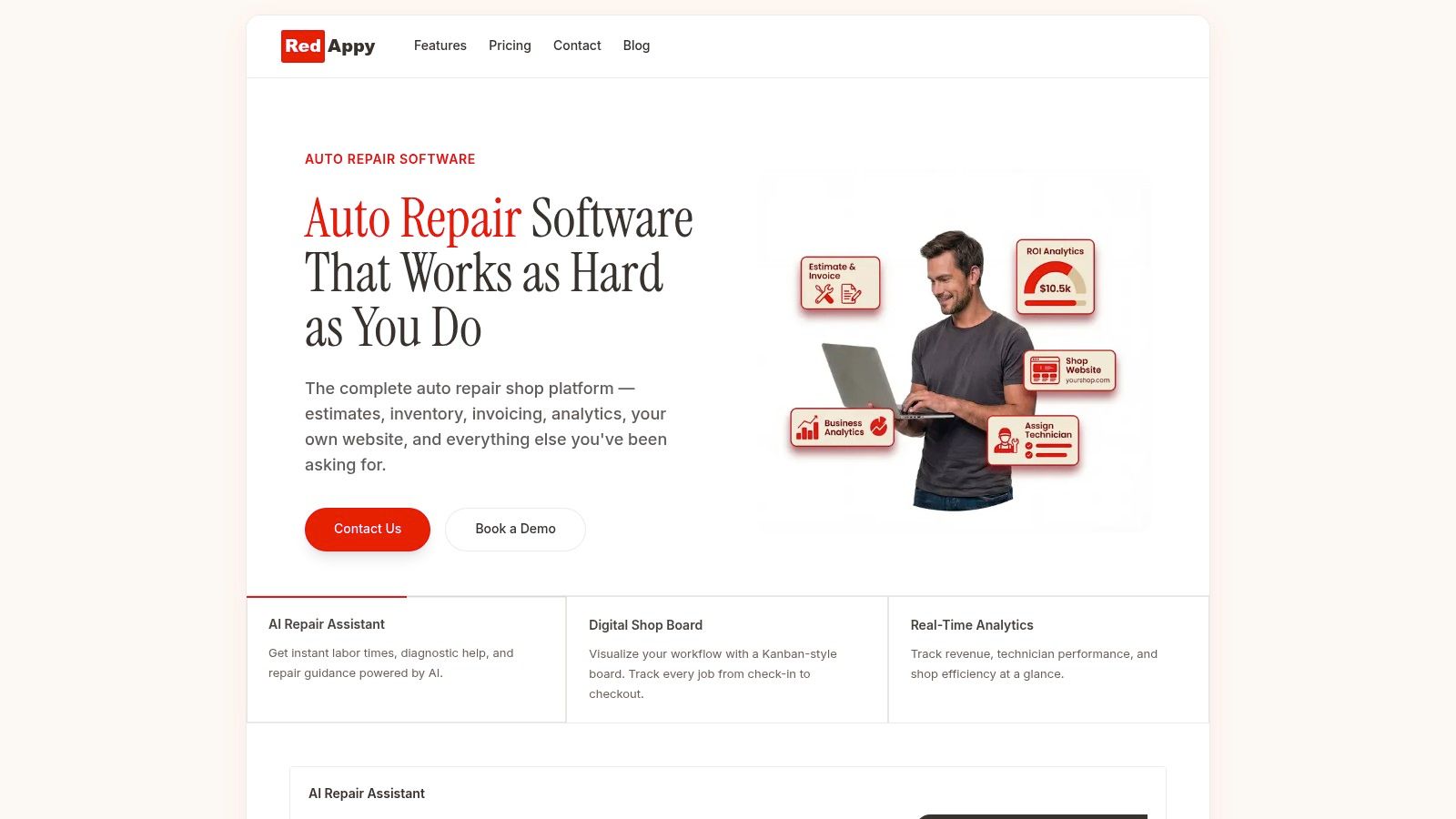
That's where a tool like RedAppy fits. It combines digital inspections, estimates, invoicing, parts ordering, analytics, and a Kanban-style Digital Shop Board so the team can track jobs from check-in to checkout in one system. For shops trying to get rid of lost paperwork, status confusion, and front-to-back miscommunication, that kind of shared visibility solves more than one problem at once. Owners who want to compare workflows can review the platform's shop management features.
Build the day around flow, not interruptions
A lot of shops organize the day around whoever shouts loudest. That creates rushes, rework, and techs bouncing between jobs.
A better pattern is simple:
- Start with board review: The manager or advisor checks the full job list, blocked items, waiting approvals, and parts delays.
- Match work to capability: Diagnostics go to the right thinker. Fast maintenance work goes where it won't jam up a skilled diagnostic bay.
- Update status at transition points: Not every five minutes. At real milestones.
- Protect technician focus: Keep bay-side interruptions down by making job notes, approvals, and priorities visible on the board.
- Close loops before the customer calls: Send updates when the status changes, not when the customer gets tired of waiting.
A digital shop board does more than display jobs. It settles arguments about what's next.
This kind of redesign also cleans up scheduling. The old paper calendar often hides real capacity. One tech may be buried in jobs that require diagnosis while another has open time but the wrong assignment mix. A visual board exposes that mismatch fast.
The same goes for parts. If the estimate is approved but the ordering step lives in someone's memory, the job will stall. If ordered parts aren't tied clearly to the right repair order, the wrong vehicle gets delayed. Workflow design should reduce dependence on memory at every stage.
Improving team performance in a shop doesn't require fancy language. It requires fewer blind spots, cleaner handoffs, and one visible source of truth.
Empower Your Team with Training and Feedback
A shop can have a clean board, better scheduling, and tighter handoffs, then still underperform because nobody was taught the standard clearly. The result shows up in the usual places. Blurry inspection photos. Thin story notes. Advisors chasing details with greasy paper in hand while the customer waits on the phone.
Training in a repair shop has to match real shop conditions. It has to be fast enough for a busy day, specific enough to fix the problem, and visible enough that everyone knows what right looks like inside the same system. RedAppy helps here because the training target is not abstract. It is the actual inspection, status update, estimate note, and customer communication the team uses every day.

Coach from facts, not frustration
The best coaching in a shop happens close to the work. By the end of the week is good. Three months later is useless.
Use the repair order, inspection, photos, timestamps, and customer updates as the record. If a technician keeps writing “needs brakes” with no measurements, coach the write-up. If an advisor lets approved work sit because the next action was never documented, coach the handoff. Facts keep the conversation clean and fair.
A simple pattern works well:
- Situation: Name the job or moment.
- Behavior: State what the person did or missed.
- Impact: Show the effect on bay time, estimate approval, customer confidence, or comeback risk.
- Next standard: Define what the job should look like next time.
For example, if the leak diagnosis on a pickup did not include the source photo, the advisor has to interrupt the tech, the estimate goes out late, and the bay can sit open longer than it should. That is a process issue you can fix. It is not a personality debate.
Build short training into the week
Formal training has its place, but most shop improvement comes from short reps tied to current work. Ten minutes before the day starts can fix a problem that has been costing hours all month.
Use that time for one topic only. Better inspection photos. Cleaner symptom, cause, correction notes. How advisors should document declined work so it is easy to revisit later. How parts delays should be logged so nobody is hunting for answers at 4:30.
A practical cadence looks like this:
- Weekly one-on-ones: Review one or two real jobs, not vague impressions.
- Monthly skill focus: Pick one shop-wide weakness and train it hard for a few weeks.
- Quarterly development talks: Discuss who is ready for diagnostics, who needs help with documentation, and who can take on more customer-facing responsibility.
- Same-day correction and praise: Fix misses fast. Call out clean work just as fast.
Managers at Gallup found employees are more engaged when they receive meaningful feedback during the week rather than once a year. In a shop, that matters because small misses pile up quickly. A weak note on Monday can turn into a delayed estimate, a follow-up call, and a customer who no longer trusts the recommendation.
A five-minute correction tied to one repair order beats a long lecture every time.
Shops that want stronger phone handling can also learn from adjacent service businesses. This guide on fits the front counter more than many owners realize. Complete notes, fewer handoffs, and a clear next action solve customer questions faster and cut repeat calls.
Training should match the trade-offs your team deals with every day:
| Common problem | Bad fix | Better fix |
|---|---|---|
| Estimates keep going out late | Tell advisors to hurry up | Train techs to write inspection findings so advisors can build estimates without chasing details |
| Techs get interrupted all day | Ask for better communication | Set a rule for when updates must be entered in RedAppy so the board answers routine questions |
| Inspections are inconsistent | Assume the tech is not trying | Show examples of strong photos, measurements, and note quality, then review live jobs |
| Reviews turn defensive | Save feedback for a formal sit-down | Use short coaching tied to one recent job and one clear correction |
Good shops do not train people by waiting for a blowup. They train by showing the standard, checking the work, and correcting it while the job is still fresh. That is how a team gets sharper without adding more chaos to the day.
Sustain Improvements and Drive Long-Term Growth
The test comes six weeks later.
The shop is busy, two techs are waiting on parts, an advisor is covering the phone, and someone says, “Just write it on the paper for now.” That is how good changes die. Shops do not slip backward because the team forgot the plan. They slip because the process still allows shortcuts when the day gets messy.
Make the better process the default process
If the workflow depends on memory, personality, or constant chasing, it will fail under pressure. In an auto repair shop, the fix is simple to describe and harder to enforce. Put inspections, estimates, approvals, parts status, invoicing, and job updates in one system that the whole team uses.
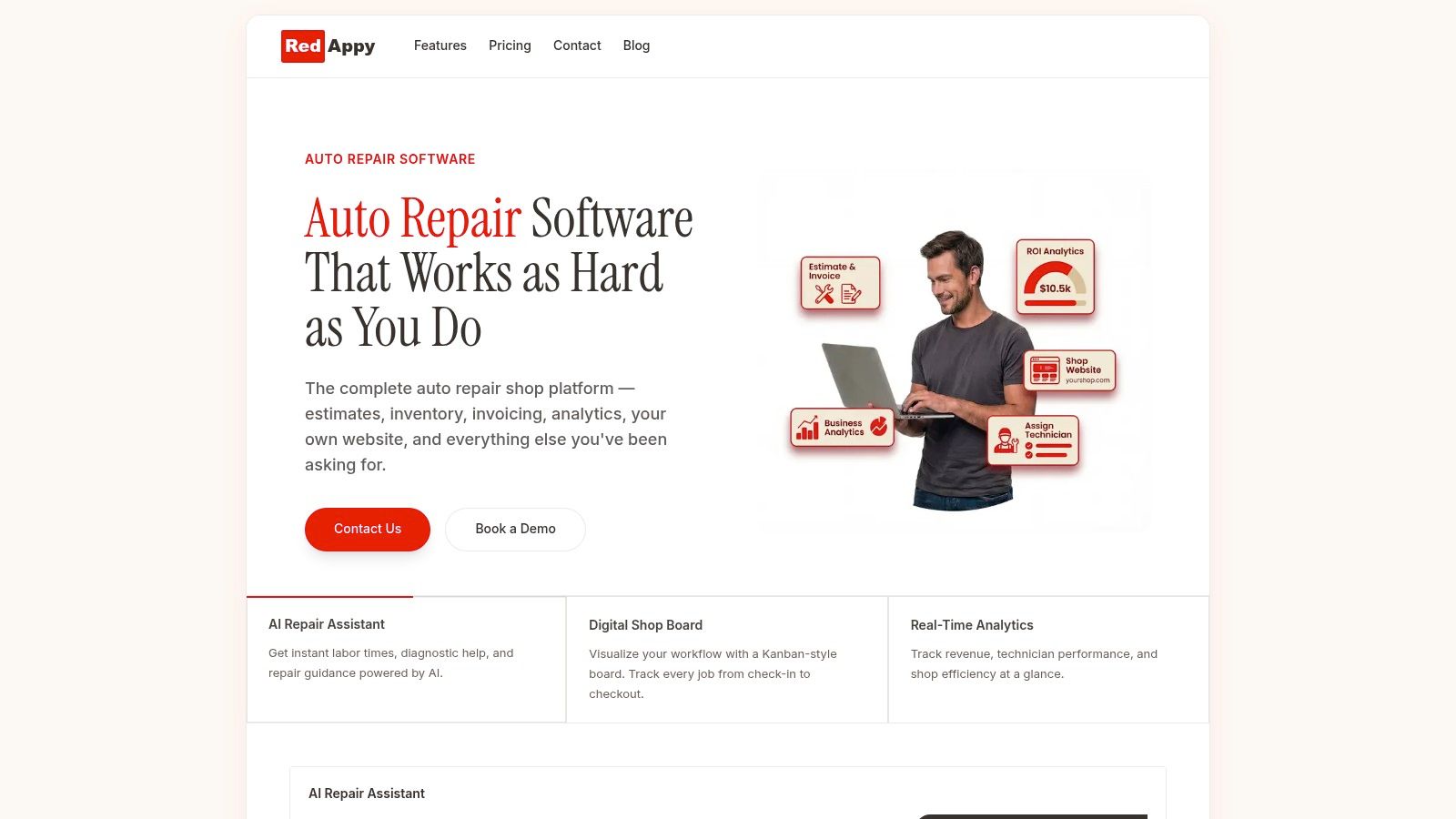
RedAppy helps by putting the next step in front of the person doing the work. The advisor can see whether the inspection is complete. The tech can see job priority without walking to the counter. The owner can spot stalled work before a lost RO turns into a late delivery and an upset customer.
That kind of structure keeps people engaged because the day feels organized instead of sloppy. Good technicians want to fix cars, not chase keys, hunt for notes, or answer the same status question three times.
Use consistency to protect profit
Long-term growth comes from weekly review, not occasional cleanup. I am not talking about a long meeting where everyone argues from memory. I mean a short look at live shop data and a clear decision about what needs to change.
Start with questions that expose friction fast:
- Where do repair orders sit too long without movement
- Which bays stay overloaded while other capacity goes unused
- Are approvals delayed because inspection notes and photos are too weak
- How often is the front counter fixing bad labor lines, parts entries, or job status at invoice time
- Which top performers are carrying broken process for the rest of the shop
These reviews matter because wasted motion eats margin. A few extra minutes here and there sounds small until it shows up every day in missed labor hours, delayed pickups, and jobs that should have been sold the first time.
Retention ties into this too. Shops that want to keep solid advisors and technicians need more than decent pay. They need a workday that feels under control. This guide on how to is useful for that reason. In repair shops, good people usually leave after months of preventable friction, unclear expectations, and workflow mess.
Stable growth comes from cleaner habits, visible work, and fewer chances for information to get lost.
The shops that hold their gains usually do a few things well. They run one clear process. They check live numbers instead of relying on opinions. They fix workflow problems while they are still small. And they stop accepting daily chaos as part of running a shop.
A shop does not need more motivation. It needs a system that holds up on the ugly days. To see how that can work in a real auto repair workflow, explore RedAppy or reach out through the contact page.
Ready to Transform Your Shop?
RedAppy helps auto repair shops create professional digital estimates with photos and videos, send them instantly via text or email, and get customer approvals in seconds. No credit card required to start.