
Car Repair Invoice: What It Is, What's On It, and How to Get Paid Faster
A car repair invoice is more than just a bill — it's the final word on every job that leaves your shop. For shop owners, it's proof of work done and the key to getting paid. For customers, it's a record they'll refer back to for warranty claims, resale paperwork, and insurance purposes. Whether you're running a busy multi-bay operation or a one-person garage, how you handle your invoice car repair process directly affects your cash flow and your reputation.
Most shops lose time — and sometimes money — because their invoicing is inconsistent, incomplete, or still done on paper. According to industry data, administrative tasks consume an average of 15–20% of a service advisor's day. That's time that could go toward customer communication, upsells, or simply getting cars out the door faster.
This guide breaks down exactly what a car repair invoice is, what it must include, how it differs from an estimate, and what modern shops are doing to get paid faster with less back-and-forth. You'll also find a comparison of invoice methods, a breakdown of common mistakes, and practical steps to tighten up your billing process today.
Table of Contents
- What Is a Car Repair Invoice?
- What Every Car Repair Invoice Should Include
- How to Create a Car Repair Invoice (Step by Step)
- Conclusion
- Frequently Asked Questions
What Is a Car Repair Invoice?
A car repair invoice is a formal billing document that a shop issues to a customer after repair work is completed. It lists every service performed, every part used, and the total amount owed. Unlike an estimate (which is a prediction of cost) or a work order (which authorizes the shop to begin work), an invoice is the final financial record of what actually happened.
Legally, a car repair invoice serves as proof of services rendered. It documents that specific work was done on a specific vehicle on a specific date. Most states require repair shops to provide written invoices under, and failure to issue one can expose a shop to liability.
A signed invoice protects the shop if a customer disputes a charge — and it protects the customer if parts or labor were warranted.
Both sides benefit from a clear, complete invoice. Shops get a paper trail that holds up in disputes. Customers get a record they can reference for warranty claims, insurance purposes, or when deciding whether to sell or keep the vehicle.
The difference between these three documents is easy to confuse, so here's a quick breakdown:
| Document | When It's Created | Purpose |
|---|---|---|
| Estimate | Before work begins | Predicts the cost of repairs |
| Work Order | When work is authorized | Instructs technicians on what to do |
| Invoice | After work is completed | Bills the customer for what was done |
In practice, a well-run shop moves through all three in sequence. The invoice is the final step — and the one that triggers payment.
What Every Car Repair Invoice Should Include
A complete car repair invoice captures every detail of the work done — who the customer is, what vehicle was serviced, what was fixed, what it cost, and what the customer owes. Missing even one field can cause payment disputes or create legal gaps.
Here are the standard elements every invoice should contain:
- Customer information — full name, address, phone number, and email
- Vehicle details — year, make, model, mileage, license plate, and VIN
- Invoice number and date — for tracking and record-keeping
- Repair order reference — ties the invoice back to the original job
- Itemized labor — description of each task, hours worked, and labor rate
- Itemized parts — part name, part number, quantity, unit cost, and markup
- Taxes and fees — broken out by type, not bundled into a single line
- Total amount due — clearly visible
- Payment terms — due date and accepted payment methods
- Technician or service advisor name — for accountability
The VIN is especially important. It ties the invoice to one specific vehicle, which matters for warranty claims, insurance reimbursements, and any future disputes about what work was done.
A missing VIN or part number is one of the most common reasons an insurance company or warranty provider rejects a repair claim.
Required vs. Optional Fields
| Field | Required | Why It Matters |
|---|---|---|
| Customer name & contact | ✅ Yes | Identifies the paying party |
| VIN | ✅ Yes | Ties work to a specific vehicle |
| License plate | ✅ Yes | Secondary vehicle identifier |
| Mileage at service | ✅ Yes | Establishes condition at time of repair |
| Labor description & hours | ✅ Yes | Justifies the labor charge |
| Part numbers | ✅ Yes | Supports warranty and returns |
| Taxes (applicable) | ✅ Yes | Legal compliance requirement |
| Invoice number | ✅ Yes | Bookkeeping and dispute resolution |
| Payment terms | ✅ Yes | Reduces late payment |
| Technician name | ⚪ Optional | Useful for quality tracking |
| Photos of completed work | ⚪ Optional | Builds customer trust |
| Authorization signature | ⚪ Optional | Strong legal protection |
In practice, shops that skip optional fields like authorization signatures often face more chargebacks and "I never approved that" disputes. Treating some of these as standard practice — not optional — reduces friction down the line.
Labor vs. Parts: How Costs Are Broken Out
Shops bill labor and parts as two separate line items, each calculated differently. Understanding how both work helps customers read their invoices — and helps shops price jobs accurately.
Labor charges are based on either actual time or flat-rate time. With flat-rate billing, a shop charges a fixed number of hours for a specific job regardless of how long it actually takes. According to industry data, the ranges from roughly $80 to $150 per hour, with dealerships often charging $130–$200.
Here's a simple example:
| Line Item | Details | Cost |
|---|---|---|
| Replace front brake pads | 1.5 flat-rate hours @ $120/hr | $180.00 |
| Brake pad set (OEM) | Part cost $45 + 40% markup | $63.00 |
| Subtotal | $243.00 |
Parts markup is how shops recover the cost of sourcing, storing, and managing inventory. A typical markup runs between 25% and 50% on standard parts, though some shops use a matrix pricing model — applying higher markups to lower-cost parts and lower markups to expensive ones., parts gross profit is one of the top revenue drivers for independent shops.
Shops that clearly label parts costs and labor separately tend to have fewer pricing complaints — customers understand what they're paying for.
Keeping labor and parts clearly separated also matters when a warranty claim comes up. If a part fails within a warranty period, the shop needs to know exactly what was installed, at what cost, and on what date. A vague single-line charge like "brake service — $243" doesn't provide that paper trail.
Understanding how costs are broken out makes it easier to build accurate estimates before the job begins — which feeds directly into faster, cleaner invoicing at the end.
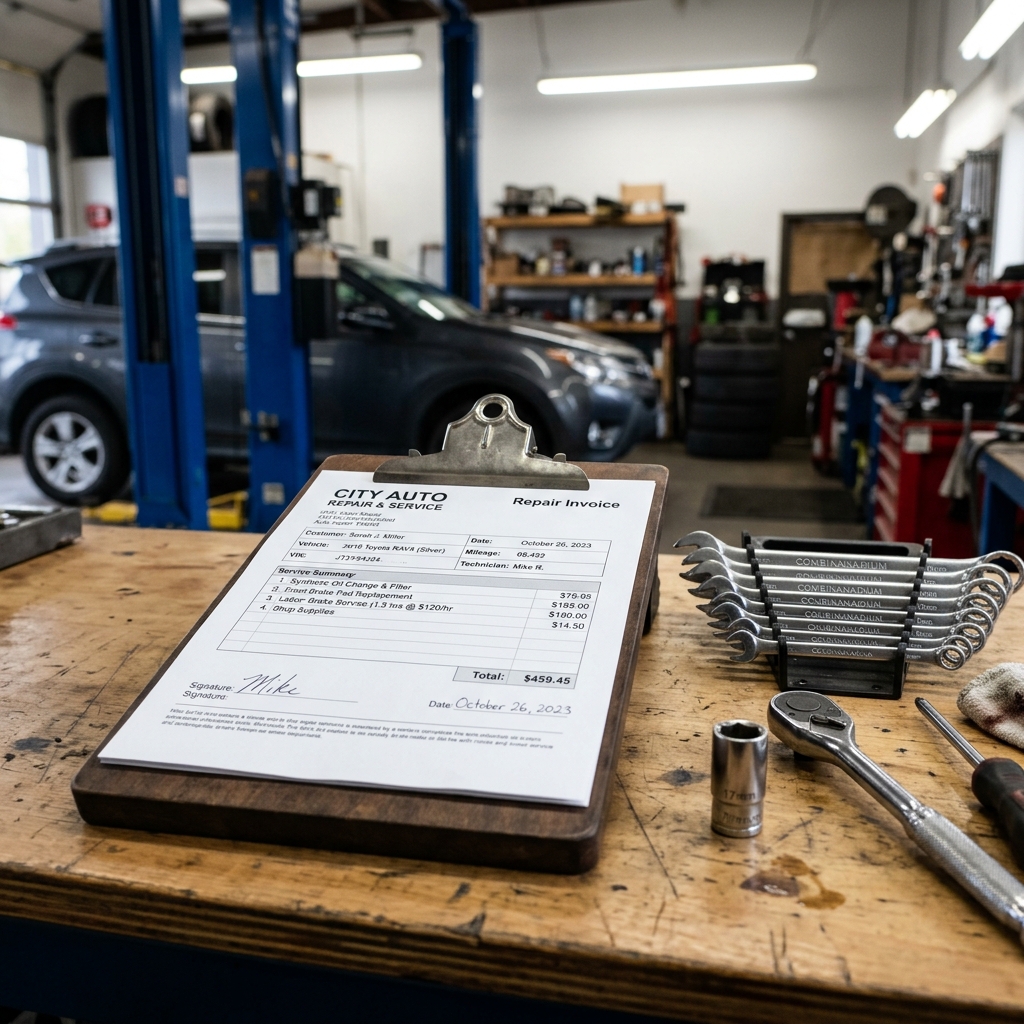
Labor vs. Parts: How Costs Are Broken Out
Labor and parts are almost always listed as separate line items on a car repair invoice. This separation exists for a reason — labor and parts are taxed differently in many states, and customers deserve to see exactly what they're paying for.
Labor charges are based on either actual time spent or a flat-rate system. Most shops use flat-rate pricing, where a labor guide (like Mitchells or AllData) assigns a standard number of hours to each job, regardless of how long it actually takes. For example, replacing a water pump might be listed at 2.5 hours in the guide. If the shop's labor rate is $120/hour, the labor charge is $300 — whether the technician finishes in 2 hours or 3.
The flat-rate system protects customers from inefficiency and rewards skilled technicians who work faster.
Parts charges reflect the shop's cost to acquire the part, plus a markup. Markup covers the shop's time to source, order, and manage inventory — it's a legitimate cost of doing business. Typical parts markup ranges from 25% to 50% on most replacement parts, though this varies by part type and shop policy.
Here's a realistic example of how a brake job might break out:
| Line Item | Detail | Cost |
|---|---|---|
| Labor – Front brake replacement | 1.5 hrs @ $120/hr | $180.00 |
| Parts – Brake pads (OEM) | Cost $45 + 40% markup | $63.00 |
| Parts – Brake rotors (x2) | Cost $90 + 40% markup | $126.00 |
| Subtotal | $369.00 |
This kind of breakdown makes pricing transparent and gives customers something concrete to review. It also helps the shop if a dispute arises later — there's a clear record of what was charged and why.
Understanding Labor Rate Ranges
Labor rates vary significantly by region, shop type, and specialization. According to, hourly labor rates at repair shops typically range from $75 to $150 per hour, with dealerships often charging at the higher end and independent shops sitting in the middle. Specialty shops — transmission, European imports, diesel — may charge above that range.
In practice, a shop's labor rate should cover technician wages, shop overhead, equipment costs, and profit margin. It's not arbitrary — it's the engine that keeps the business running.
How Parts Sourcing Affects the Invoice
Where a shop sources parts affects both cost and the time it takes to complete the job. Shops that can check multiple suppliers at once get better prices and fill orders faster. This matters for the invoice because backordered parts delay job completion, which pushes back the invoice and payment.
Platforms like RedAppy allow shops to order parts across multiple suppliers with real-time inventory visibility, so technicians aren't stuck waiting — and invoices go out sooner.
One thing to watch: invoices should always include the part number for each component. This ties the physical part to the invoice, which matters for warranties, returns, and customer questions down the road. A line that reads "brake pads – $63" is less defensible than one that includes the part number and brand.
Taxes, Fees, and Shop Supplies
Tax rules on auto repair vary significantly by state — and getting them wrong is one of the most common invoicing mistakes shops make.
Most states tax parts but not labor. A few states, like Hawaii and New Mexico, tax both. Others have carve-outs depending on whether the vehicle is commercial or personal. According to the, auto repair is one of the most inconsistently taxed service categories in the U.S., which means shops that operate near state lines or serve fleet customers need to pay close attention.
Applying the wrong tax rate — even by accident — can trigger audits, customer disputes, or refund demands.
Common Add-On Fees
Beyond tax, most invoices include one or more additional line items that customers sometimes question. Being upfront about these reduces friction at checkout.
| Fee Type | What It Covers | Typical Range |
|---|---|---|
| Shop supply fee | Rags, cleaners, small consumables | $5–$30 flat or 2–5% of labor |
| Hazmat disposal | Used oil, coolant, brake fluid | $5–$20 per service |
| Environmental fee | Recycling tires, batteries, filters | $3–$15 per item |
| Inspection fee | Diagnostic time billed separately | $50–$150 flat rate |
Shop supply fees are a common point of confusion. In practice, these cover the small items that don't get their own line — shop towels, spray lubricants, wire ties — that add up quickly across dozens of jobs per week. Charging a flat percentage of labor, usually 2–5%, is the most common approach.
Some states regulate what shops can charge for supply fees or require them to be disclosed upfront. California, for example, has consumer protection rules that govern how miscellaneous fees are presented on repair invoices.
How to Handle Fees Transparently
- List every fee as its own line item — don't bundle them into labor
- Label each fee clearly so the customer knows what they're paying for
- Post your fee schedule in your waiting area or on your website
- Include fee disclosures in the estimate before work begins, not just on the final invoice
Transparency here isn't just good customer service — it's often a legal requirement. Many states with consumer protection laws for auto repair, including California's, require that all charges be explained in writing before the shop proceeds with work.
When fees are itemized and explained from the start, customers rarely push back. The disputes almost always come from surprises.
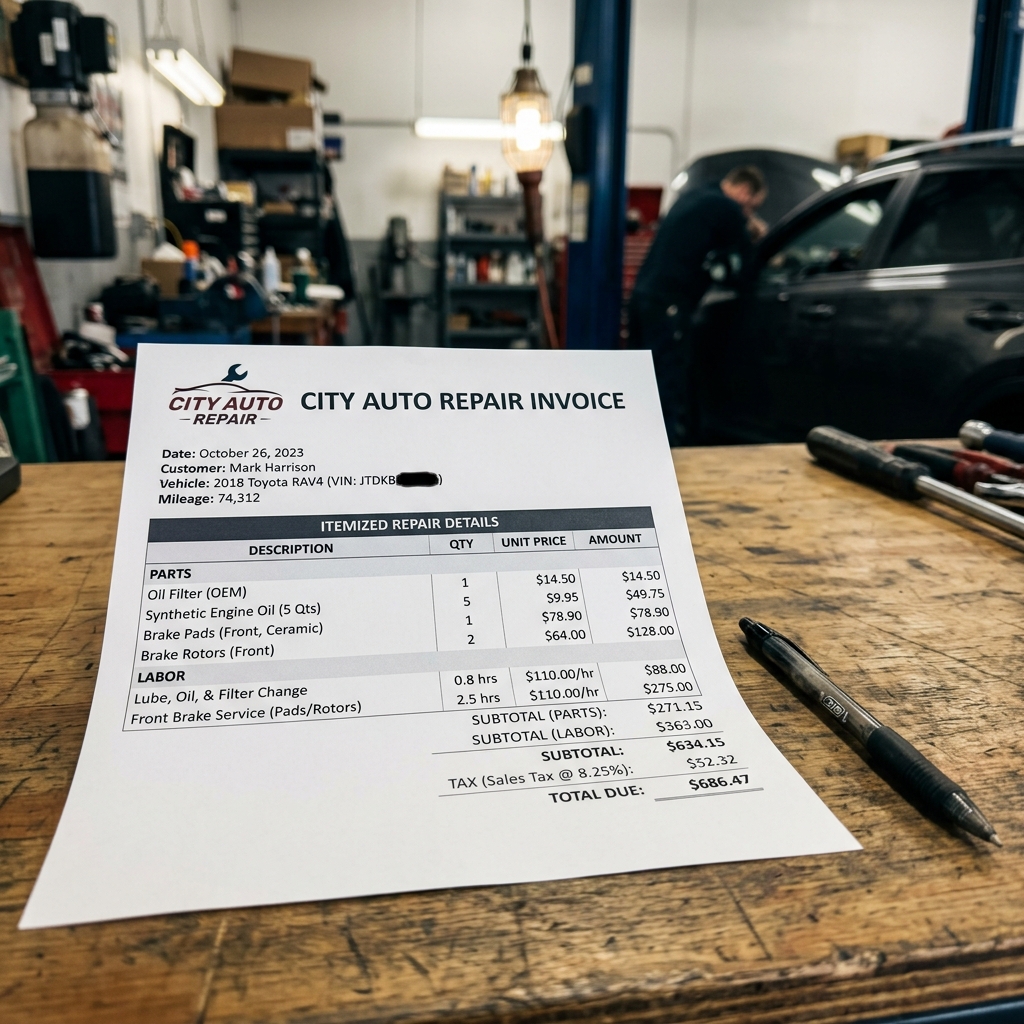
How to Create a Car Repair Invoice (Step by Step)
Creating a car repair invoice follows a clear sequence: gather job details, log parts and labor, apply taxes and fees, review the total, then send it to the customer. Each step builds on the last, and skipping one usually means going back to fix mistakes later.
Here's how the process works in practice:
- Gather job information — Pull the customer's name, contact details, and vehicle info (year, make, model, VIN, mileage, and license plate). This should be captured at check-in, not reconstructed later.
- Log labor charges — List each service performed with a description, the time spent or flat-rate hours applied, and the labor rate. Vague entries like "checked engine" create disputes. Be specific: "Diagnosed P0420 code, tested O2 sensors, confirmed catalytic converter failure."
- Add parts line items — Enter each part with its part number, quantity, unit cost, markup, and the customer-facing price. Part numbers matter for warranty claims and supplier returns.
- Apply taxes, fees, and shop supplies — Add applicable state and local taxes to the correct line items (parts, labor, or both, depending on your state). Include any shop supply fees or environmental charges.
- Review totals and payment terms — Confirm the math, check that payment terms are clearly stated (due on pickup, net 7, etc.), and verify the subtotal, tax, and grand total are accurate.
- Send the invoice and collect payment — Deliver it digitally or in print, and give the customer a clear way to pay.
Template, Spreadsheet, or Software — Which Should You Use?
Shops have three main options for creating invoices. Each comes with real tradeoffs.
| Method | Cost | Speed | Error Risk | Best For |
|---|---|---|---|---|
| Paper/Word template | Free | Slow | High | Very small, low-volume shops |
| Spreadsheet (Excel/Google Sheets) | Free | Moderate | Moderate | Shops with basic needs and time to manage manually |
| Shop management software | Monthly fee | Fast | Low | Any shop processing multiple jobs per day |
Templates and spreadsheets cost nothing upfront, but they require manual data entry at every step. A technician finishes a job, the service writer pulls up the estimate, types in the final hours and parts, checks the tax table, and then formats the document. Every one of those steps is a chance to enter the wrong number.
A single transposed digit on a parts price or an incorrect tax rate can turn a profitable repair order into a billing dispute — and disputes cost shops far more time than the software they're trying to avoid paying for.
Using Shop Management Software to Invoice Faster
Shop management software removes most of the manual steps by connecting the estimate, work order, and invoice in one continuous workflow. When a technician closes out a job, the parts and labor already logged flow directly into the invoice — no re-entry required.
RedAppy's one-click invoicing does exactly this. The repair order converts to a finalized invoice automatically, pulling in all line items, taxes, and fees already set up in the system. Customers can then pay online, which eliminates the phone-tag cycle of chasing payment after the vehicle leaves the lot.
In practice, this kind of automation is where shops recover the most time. RedAppy reports saving shops 10+ admin hours per week — a chunk of that comes directly from eliminating duplicate data entry between work orders and invoices.
According to, there are over 160,000 auto repair shops operating in the United States. The ones running on manual invoicing processes are competing against shops that close out a job, send the invoice, and collect payment before the customer even pulls out of the lot.
The method you choose for invoicing is ultimately a business decision. But the faster and more accurately you can get a correct invoice in front of a customer, the faster you get paid.
Conclusion
A good car repair invoice is accurate, detailed, and sent as soon as the work is done. Those three things — accuracy, detail, and speed — determine whether a shop gets paid quickly or chases money for weeks.
Clear invoicing does more than collect payment. It protects the shop if a customer disputes a charge, gives the customer confidence that they're being treated fairly, and creates a paper trail that matters for warranties, audits, and vehicle history. A vague or incomplete invoice creates friction at exactly the wrong moment — right when the customer is ready to pick up their car.
The invoice is the last impression a shop leaves. A clean, itemized bill communicates professionalism just as much as the repair itself.
Modern shops don't have to choose between speed and accuracy. When invoicing is connected to the rest of the workflow — estimates, digital inspections, parts orders, and customer approvals — the invoice practically builds itself. There's no re-entering data, no hunting down labor times, and no guessing what parts were used. The repair order becomes a paid invoice in one step.
That's exactly what shop management software makes possible. Platforms like RedAppy are built to move a job from first call to final payment without manual gaps. One-click invoicing, online payment options, and a connected Digital Shop Board mean the billing process is the easiest part of the day, not the most time-consuming.
If your shop is still working from templates or spreadsheets, it's worth thinking about what that costs — in admin hours, in errors, and in the customer experience. Auto repair businesses that switch to integrated software typically recover those costs quickly through faster payment cycles and fewer billing disputes.
The bottom line is simple: a car repair invoice done right gets you paid faster, keeps customers coming back, and keeps your shop out of disputes. Start with the right fields, follow a consistent process, and use tools that remove the manual steps between finishing a job and getting paid for it.
Frequently Asked Questions
How to make a car repair invoice?
Use a template or invoicing software to list your business name, contact details, invoice number, and date at the top. Below that, itemize all labor charges (with hours and hourly rate), parts used (with unit costs), taxes, and the total amount due. Free tools like Wave, FreshBooks, or even a simple spreadsheet can generate professional car repair invoices quickly.
What is the 30-60-90 rule for cars?
This rule refers to the recommended maintenance intervals at 30,000, 60,000, and 90,000 miles on a vehicle. At each milestone, specific services are due — such as air filter replacement at 30k, spark plug and coolant flush at 60k, and transmission fluid or timing belt replacement at 90k. Following this schedule helps prevent costly breakdowns and extends vehicle life.
What is a car repair invoice?
A car repair invoice is a formal billing document issued by an auto repair shop to a customer detailing all services performed on a vehicle. It typically includes a breakdown of labor costs, parts and materials used, applicable taxes, and the total amount owed. It also serves as an official record for warranty purposes, insurance claims, and vehicle history.
Should I spend $4000 to fix a car?
The general rule of thumb is to avoid repairs if the total cost exceeds the vehicle's current market value or one year's worth of car payments on a replacement. If your car is worth $5,000 and repair costs are $4,000, that's an 80% ratio — generally considered too high. However, if the repaired car would remain reliable for several more years, spending $4,000 can still be cheaper than taking on monthly payments for a new vehicle.
Ready to Transform Your Shop?
RedAppy helps auto repair shops create professional digital estimates with photos and videos, send them instantly via text or email, and get customer approvals in seconds. No credit card required to start.