
Auto Repair Invoice: Complete Guide to What's Included, How It Works, and Best Practices
An invoice for auto repair is more than a bill — it's a legal record of every service performed, part installed, and charge applied to a customer's vehicle. For shop owners, it directly affects cash flow, dispute resolution, and tax compliance. For customers, it's the document that proves what was done and what they paid. Getting it right matters on both sides of the counter.
Yet many shops still rely on handwritten tickets or basic spreadsheets that leave room for errors, missed charges, and customer confusion. According to the, billing disputes are among the most common sources of customer complaints in independent repair shops — most of which stem from unclear or incomplete documentation.
This guide covers everything you need to know: the required components of a compliant auto repair invoice, how the invoicing process works from estimate to payment, common mistakes that cost shops money, and how modern shop management software like RedAppy can automate the entire workflow.
Table of Contents
- 1. What Is an Auto Repair Invoice?
- 2. What Every Auto Repair Invoice Must Include
- 3. Auto Repair Invoice vs. Estimate vs. Repair Order
- Conclusion
1. What Is an Auto Repair Invoice?
An auto repair invoice is a formal billing document issued by a repair shop to a customer after service work has been completed. It records every charge associated with a vehicle repair — labor, parts, fees, and taxes — and serves as the official request for payment.
An invoice is not a preliminary document. It reflects actual work performed, actual parts used, and the final amount owed.
Three documents move through a typical repair transaction, and they are frequently confused with one another.
- Estimate — a pre-work cost projection given before any repairs begin
- Repair order — a customer-signed authorization that allows the shop to proceed with the work
- Invoice — the final billing statement issued after the work is complete
Each document has a distinct purpose. The estimate sets customer expectations. The repair order creates a legal agreement to perform service. The invoice closes the transaction.
Legal and Financial Role
An auto repair invoice carries real legal weight. It functions as proof of service rendered, a record for business tax purposes, and a consumer protection document. In a dispute, the invoice is often the primary evidence of what work was done, what parts were used, and what the customer agreed to pay.
Most states require auto repair shops to provide itemized invoices by law., for example, mandates written invoices that list all parts and labor separately, along with whether parts are new, used, or rebuilt. Similar statutes exist across most U.S. states, often modeled on the FTC's consumer protection framework.
Itemization is not just good practice — in most jurisdictions, it is a legal requirement.
From a financial standpoint, the invoice is the document that triggers cash flow. It records taxable revenue, supports accounts receivable tracking, and provides the data that feeds into shop performance metrics like average repair order (ARO) and monthly revenue totals.
How It Differs From an Estimate
An estimate is a projection. An invoice is a record. In practice, customers sometimes treat these as interchangeable, which creates disputes when the final bill differs from the initial quote. Shops are legally required in most states to obtain customer authorization before exceeding the original estimate by a defined threshold — commonly 10%. The invoice must reflect the final, agreed-upon figures, not the preliminary ones.
Connection to the Repair Order
The repair order (also called a work order) is the internal document that authorizes the job and tracks it through the shop. In shops using auto repair management software, the repair order and invoice are generated from the same record. When the job closes, the repair order converts to an invoice automatically — eliminating duplicate data entry and reducing billing errors.
2. What Every Auto Repair Invoice Must Include
A complete auto repair invoice documents every charge in enough detail that a customer can verify what was done, and a shop can defend every line item in a dispute or audit. Missing fields are the most common cause of invoice-related complaints and compliance violations.
| Field | What to Include | Why It Matters |
|---|---|---|
| Shop name, address, phone | Full legal business name and contact info | Required for consumer protection in most states |
| License/registration number | State-issued repair dealer number | Legal requirement in regulated states (e.g., California BAR) |
| Customer name and contact | Full name, phone, email | Links invoice to customer record and payment |
| Vehicle year, make, model | Exact vehicle identification | Confirms correct vehicle was serviced |
| VIN | Full 17-character VIN | Prevents mix-ups; required for warranty tracking |
| Odometer reading (in/out) | Mileage at check-in and completion | Protects shop from odometer dispute claims |
| Date of service | Completion date | Establishes warranty start date and tax record |
| Itemized labor | Description, hours, rate, total per line | Required for legal compliance in most states |
| Itemized parts | Part name, part number, quantity, unit price, total | Lets customers verify parts used |
| Shop supplies/consumables | Listed separately or as a percentage fee | Discloses all charges; prevents hidden fee complaints |
| Sublet repairs | Third-party work billed through the shop | Must be disclosed as sublet per many state laws |
| Taxes and fees | Tax rate and calculated amount | Required for tax filing and consumer transparency |
| Subtotal and total due | Pre-tax and final amount | Clear payment expectation |
| Payment terms | Due date, accepted methods, late fees | Reduces payment disputes |
| Warranty disclosure | Parts and labor warranty terms | Required in many states; protects shop from future claims |
Omitting even one required field — such as the VIN or odometer reading — can expose a shop to regulatory fines and make warranty disputes nearly impossible to resolve.
Labor Line Items
Labor is typically billed one of two ways: flat-rate or actual time. Flat-rate billing uses published labor guides — such as or ALLDATA — to assign a standard number of hours to a specific repair, regardless of how long the job actually takes. Actual-time billing charges by the hour based on time clocked on the job.
Most independent and dealership shops use flat-rate hours because they create predictable pricing and reward technician efficiency. In practice, a brake job might carry a flat-rate of 1.5 hours whether the technician finishes in 1.2 or 1.8 hours.
Each labor line item should include:
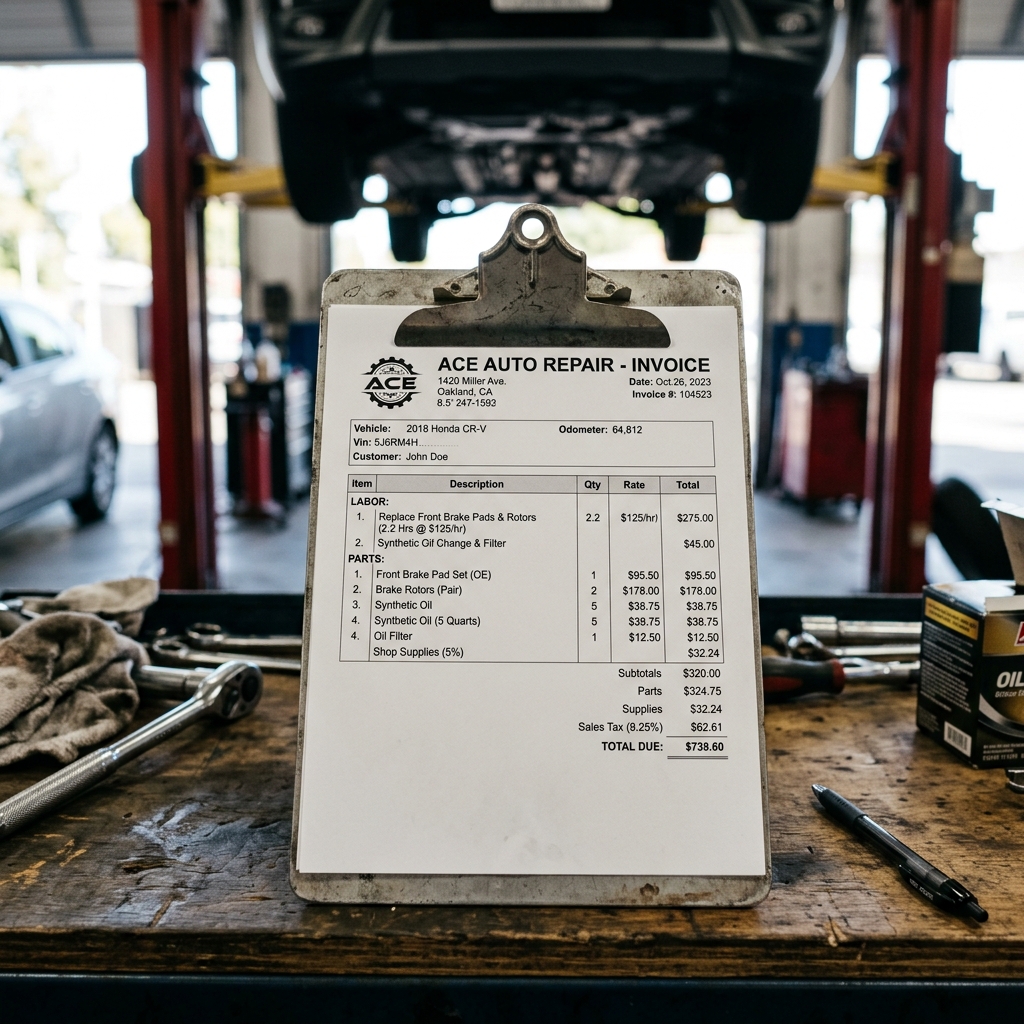
- A clear, specific description of the work performed (e.g., "Replace front brake pads and rotors — both sides" rather than "brake work")
- The number of hours charged
- The shop's labor rate per hour
- A line total
Technician time should be logged to each specific repair order — not pooled across jobs. This protects the shop during disputes and feeds accurate efficiency data into shop analytics. Some shop management platforms capture clock-in and clock-out times per job automatically, linking technician time directly to the invoice line item.
Parts and Materials
Every part installed should be listed with its part number, a description, quantity, unit price, and extended total. This level of detail lets customers verify the parts used and gives the shop a clear audit trail.
Shops typically apply a markup to parts cost — industry averages range from 25% to 50% depending on part category and shop pricing strategy. The invoice shows the customer price, not the shop's cost, but the part number allows independent verification of what was installed.
Parts should be clearly identified as OEM (original equipment manufacturer), aftermarket, or remanufactured. Several states require this disclosure by law. Customers have different expectations and warranty rights depending on part type, so transparency here prevents disputes after the fact.
Shop supplies and consumables — items like rags, brake cleaner, thread locker, or waste disposal fees — are commonly listed as either individual line items or a single percentage-based shop supply fee (often 5–10% of parts). Either method is acceptable, but the charge must appear on the invoice and cannot be hidden within labor or parts totals.
Sublet repairs — work sent to a specialty shop, such as transmission rebuilding or alignment — must be listed as a separate line item. Many state regulations require shops to disclose when work was performed by a third party rather than in-house.
Warranty terms should appear directly on the invoice, not just in fine print on a separate form. Specifying the warranty period for both parts and labor — by line item where coverage differs — creates a clear record that benefits both the customer and the shop.
Labor Line Items
Labor is billed in one of two ways: flat-rate hours or actual time. Understanding the difference matters because it directly affects what a customer pays and how a shop manages its technicians.
Flat-rate billing is the industry standard. A labor guide assigns a fixed number of hours to each repair task — for example, 2.5 hours to replace a water pump on a specific vehicle. The customer pays for that fixed time regardless of whether the technician finished in two hours or three. This method is predictable and widely accepted.
Actual time billing charges the customer for the exact hours a technician spent on the job. Smaller shops or diagnostic work sometimes use this method, especially when the repair scope is unclear at the start.
Flat-rate hours protect customers from paying for technician inefficiency, but they also mean a skilled tech can earn more by working faster — which is why most production-based shops prefer it.
Industry Labor Guides
Shops do not set flat-rate times arbitrarily. They reference standardized labor guides that specify times for nearly every repair on every make and model. The two most widely used are:
| Labor Guide | Coverage | Common Use |
|---|---|---|
| Mitchell 1 | Domestic and import vehicles, updated continuously | Independent shops, MSOs |
| ALLDATA | OEM-sourced data, factory times | Dealerships and independents |
| Chilton | Broad coverage, often used in training | Smaller independent shops |
is considered one of the most accurate sources for factory-specified labor times because it pulls directly from manufacturer data. Using a recognized guide also gives shops a defensible basis if a customer questions the hours billed.
How Labor Lines Should Appear on the Invoice
Each labor line item should include:
- A specific description of the task — "Replace front brake pads and rotors, both sides" rather than "brake work"
- The flat-rate hours assigned to that operation
- The labor rate applied (e.g., $125/hr)
- The extended charge (hours × rate)
In practice, vague labor descriptions are one of the most common sources of customer disputes. A line that reads "misc. labor — 1.5 hrs" gives a customer nothing to verify and a shop nothing to defend.
Technician Time Logging
Beyond billing, logging technician time against each job serves a second purpose: it feeds into efficiency tracking. In shop management platforms, technicians clock in and out of each repair order. This creates a record of actual time versus flat-rate time, which managers use to measure productivity.
For shops using a platform like RedAppy, labor times can be pulled directly from the AI Repair Assistant, reducing the manual step of cross-referencing a separate labor guide. That time stamps directly onto the repair order, which then carries forward into the invoice without re-entry.
Parts and Materials
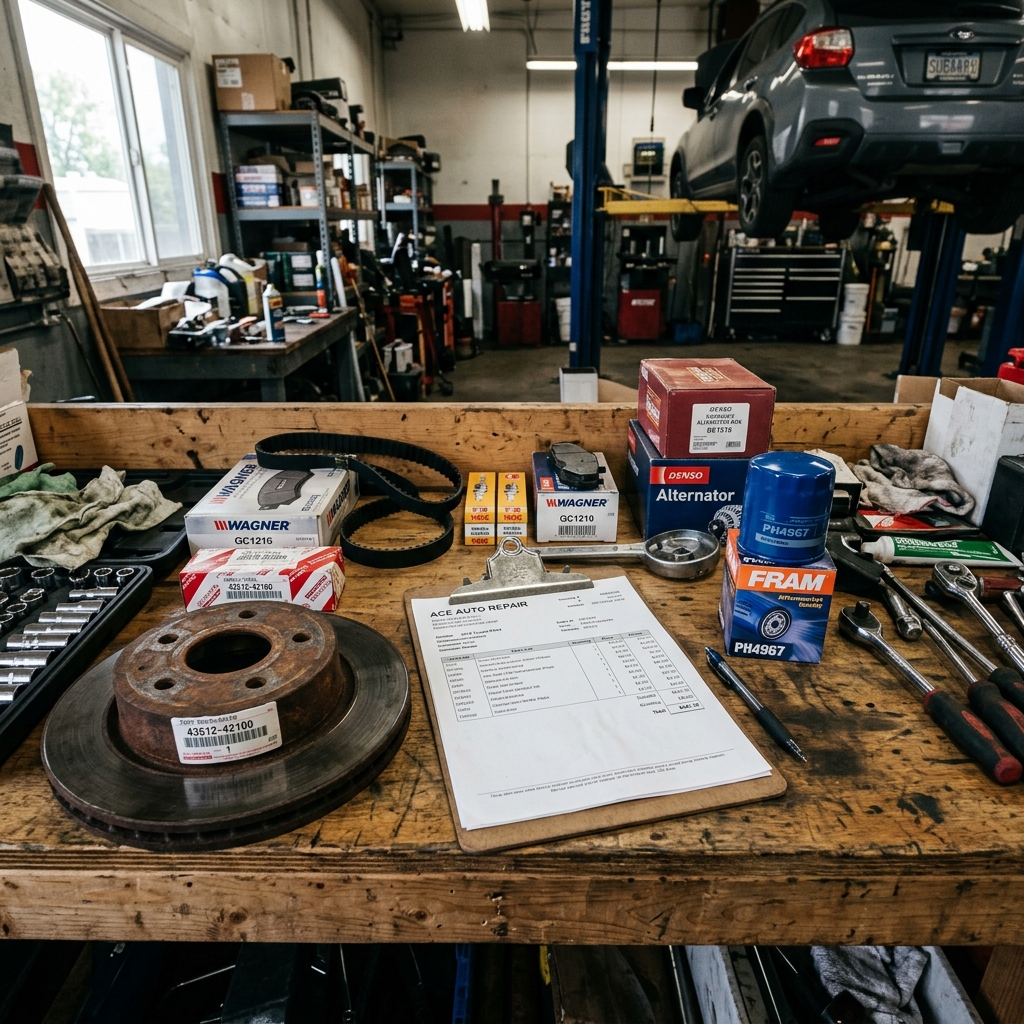
Parts listed on an invoice should identify exactly what was installed — including the part number, description, quantity, unit cost, and the price charged to the customer. This level of detail lets the customer verify the work and gives the shop documentation if a warranty claim arises later.
OEM vs. aftermarket notation is an important distinction. OEM (Original Equipment Manufacturer) parts come directly from the vehicle manufacturer or an authorized supplier. Aftermarket parts are made by third-party manufacturers and are generally less expensive. Most state automotive repair regulations — including California's Bureau of Automotive Repair rules — require shops to disclose whether a part is OEM, aftermarket, remanufactured, or used. Omitting this distinction can create legal exposure.
Customers have the right to request their old parts back in most U.S. states. The invoice or repair order should note whether returned parts were requested before work began.
Part Markup
Shops rarely sell parts at cost. A markup is applied to cover procurement time, warranty liability, and overhead. Typical markup rates range from 20% to 50% above dealer or jobber cost, though high-volume shops may apply tiered pricing. The invoice should show the customer price, not the shop's cost — but the markup itself does not need to be disclosed unless state law requires it.
Shop Supplies and Consumables
Shop supplies — sometimes called "miscellaneous materials" or "shop consumables" — cover items like rags, solvent, wire ties, fasteners, and fluids used in small quantities that aren't practical to itemize individually. These are commonly billed as either:
- A flat fee (e.g., $10–$25 per repair order)
- A percentage of the total labor charge (typically 5%–10%, often capped)
Some states regulate how this charge is disclosed. In California, for example, shops must list shop supply charges as a separate line item rather than embedding them in labor or parts totals.
Core Charges and Hazardous Waste Fees
Certain parts — alternators, starters, brake calipers — carry a core charge: a refundable deposit returned when the old part is exchanged. This should appear as its own line item, with a corresponding credit if the core was returned at the time of service.
Disposal fees for hazardous materials such as used oil, tires, or refrigerant must also be listed separately. These are regulated at the state level and cannot be absorbed into a general labor or parts line without disclosure.
3. Auto Repair Invoice vs. Estimate vs. Repair Order
An auto repair estimate, repair order, and invoice are three distinct documents that serve different purposes at different stages of the repair process. They are frequently confused — and sometimes mislabeled — but each carries its own legal and operational weight.
Using the wrong document at the wrong stage creates liability for the shop and confusion for the customer.
The workflow moves in one direction: estimate → repair order → invoice. Each document builds on the one before it.
The Three Documents Compared
| Document | When It's Created | Signed by Customer? | Purpose |
|---|---|---|---|
| Estimate | Before work begins | No (in most states) | Communicates anticipated cost of parts and labor |
| Repair Order | When customer authorizes work | Yes | Legal authorization for the shop to perform specific repairs |
| Invoice | After work is completed | No | Final billing statement; proof of service rendered |
Estimate
An estimate is a pre-work projection of what a repair will cost. It is not a binding contract in most jurisdictions, but many states require shops to honor estimates within a defined variance — commonly 10% above the written figure. An estimate can be verbal or written, though written estimates offer legal protection for both parties.
According to the, shops in California must provide a written estimate before beginning work if the total cost will exceed $100 and the customer is present or can be reached.
Repair Order
The repair order (RO) is the authorization document. When a customer signs a repair order, they are legally permitting the shop to perform specific work at an agreed price range. The RO typically captures the same vehicle and customer data as the estimate, plus a detailed description of authorized repairs.
In practice, the repair order also functions as an internal job ticket — technicians reference it during the repair, and parts are ordered against it. Any change to the scope of work should trigger a revised or supplemental authorization before additional work proceeds.
Invoice
The invoice is the final document issued once repairs are complete. It reflects what was actually done, what was actually installed, and the final price owed. A complete invoice will match the repair order in most line items, with documented additions or reductions where scope changed.
If the final invoice total exceeds the authorized estimate by more than the state-permitted threshold, the shop may be legally required to absorb the difference.
Common Points of Confusion
Shops sometimes use these terms interchangeably, which causes problems. The most frequent errors are:
- Calling a repair order an "invoice" before work is complete
- Issuing an invoice without a signed repair order on file
- Treating a verbal estimate as equivalent to written authorization
Some shops also issue a pro forma invoice — a draft invoice used before final payment is confirmed. This is common when a vehicle is held pending insurance approval, but it should be clearly labeled as a draft, not a final billing document.
How Shop Management Systems Handle All Three
Modern auto repair shop management software generates all three documents from a single vehicle record. When a job is created, the system builds an estimate. Upon customer approval — often captured digitally via a text or email link — it converts to a repair order. Once the technician marks the job complete, one click produces the final invoice.
This single-record approach eliminates re-entry errors, maintains a clean audit trail, and ensures the estimate, repair order, and invoice are always linked and retrievable. RedAppy, for example, handles this entire sequence within one platform — from digital inspections tied to line items through to online payment collection — so no document exists in isolation from the job record it belongs to.
Conclusion
An auto repair invoice serves two purposes at once: it protects the shop legally and gives the customer a transparent record of every charge. When these two interests are met in a single, well-structured document, disputes are rare and payment is faster.
Throughout this guide, the key elements of a professional invoice have been established — from itemized labor and parts to legally required disclosures and the proper relationship between estimates, repair orders, and final billing. Each component exists for a reason, whether that is state compliance, warranty documentation, or accurate tax reporting.
Manual invoicing introduces risk at every step — data re-entry errors, missing line items, and delayed delivery all slow cash flow and create openings for customer disputes.
Modern shop management software eliminates those risks by generating invoices directly from the repair order, with labor times sourced from industry guides, parts pulled from live supplier catalogs, and payment links delivered to the customer the moment work is complete. Platforms like RedAppy handle this entire chain — from digital inspection photos attached to line items, to one-click invoice generation, to online payment collection — without requiring any information to be entered twice.
The shift toward digital invoicing is no longer a competitive advantage. It is a baseline expectation. Customers in every other service industry receive itemized digital receipts instantly. Auto repair shops that still rely on handwritten invoices or disconnected spreadsheets face slower approvals, more payment delays, and greater exposure to compliance risk.
Shops that treat the invoice as a living part of their workflow and analytics — not just a billing formality — gain something additional: every completed invoice feeds revenue data, average repair order calculations, and technician efficiency metrics that inform smarter business decisions over time.
A well-executed invoice process reflects directly on shop professionalism. Customers who receive clear, detailed, and timely invoices are more likely to return and more likely to approve future work. That connection between documentation quality and customer retention is one of the clearest returns on investing in a modern invoicing system.
Ready to Transform Your Shop?
RedAppy helps auto repair shops create professional digital estimates with photos and videos, send them instantly via text or email, and get customer approvals in seconds. No credit card required to start.