
Mechanic Hourly Rate: Calculate Your 2026 Profit
Mechanic hourly rates in many U.S. markets sit around $120 to $159 per hour, with a national benchmark near $140 per hour for independent shops. But the right rate for any single shop isn't the national average. It's the number that covers that shop's costs, fits its market, and leaves enough margin to stay healthy.
A lot of owners hit the same wall. The bays are full, the phones are busy, technicians are turning wrenches all day, and the month still ends with less cash than expected. That usually isn't a workload problem. It's a pricing problem.
The mechanic hourly rate drives almost everything in a repair business. It affects gross profit, technician compensation, estimate approval, cash flow, and how much room the shop has to invest in tools, training, and better systems. Shops that guess at labor rate usually stay busy and underpaid. Shops that calculate it properly know what each sold hour needs to produce.
This guide focuses on the math behind a profitable labor rate. Not a generic average. Not the number a nearby competitor posts on the wall. A practical framework a shop can use to work out its own rate and apply it with confidence.
Table of Contents
- Your Labor Rate Is Your Shop's Engine
- Decoding The National Average Mechanic Rate
- Key Factors That Drive Your Labor Rate
- Calculate Your Shop's Profitable Labor Rate Step-by-Step
- Billing Models and Advanced Pricing Strategies
- Manage and Maximize Your Labor Profitability with RedAppy
Your Labor Rate Is Your Shop's Engine
A shop can be slammed every day and still struggle financially. That happens when labor sales look strong on the surface but the posted rate doesn't support the business underneath it.
One common pattern shows up again and again. An owner picks a mechanic hourly rate by checking the shop down the street, rounds a little lower to stay “competitive,” and keeps the bays moving. Customers come in. Cars leave fixed. The owner works hard. Profit stays thin because the rate was built on comparison, not math.
Busy doesn't always mean profitable
Labor rate is the lever that carries the weight of the whole operation. If it's too low, the shop ends up funding rent, service advisors, software, utilities, comeback time, and diagnostic dead ends out of its own pocket.
That problem gets worse in shops that are proud of being fair. Fair pricing matters. But too many owners confuse “fair” with “cheap enough to avoid pushback.” Customers don't buy labor because the number is low. They buy because the estimate is clear, the repair is trusted, and the shop communicates value.
Practical rule: If the schedule is full and the bank balance still feels tight, the first place to inspect is labor pricing.
What works and what doesn't
What works:
- Using a calculated rate: Start with actual costs, not local gossip.
- Reviewing the rate regularly: Expenses change, technician capability changes, and the shop has to keep up.
- Charging for skill appropriately: Diagnostics, electrical work, and specialized repairs shouldn't be treated like basic maintenance.
What doesn't:
- Copying a competitor blindly: That shop may own its building, run leaner, or be underpricing too.
- Using one flat number for every job: Some work consumes more expertise, interruptions, and equipment than others.
- Waiting for the accountant to flag the issue: By then, months of margin may already be gone.
The labor rate isn't just another setting in the management system. It's the number that decides whether the business can pay people properly, replace equipment without stress, and grow without constant cash pressure.
Decoding The National Average Mechanic Rate
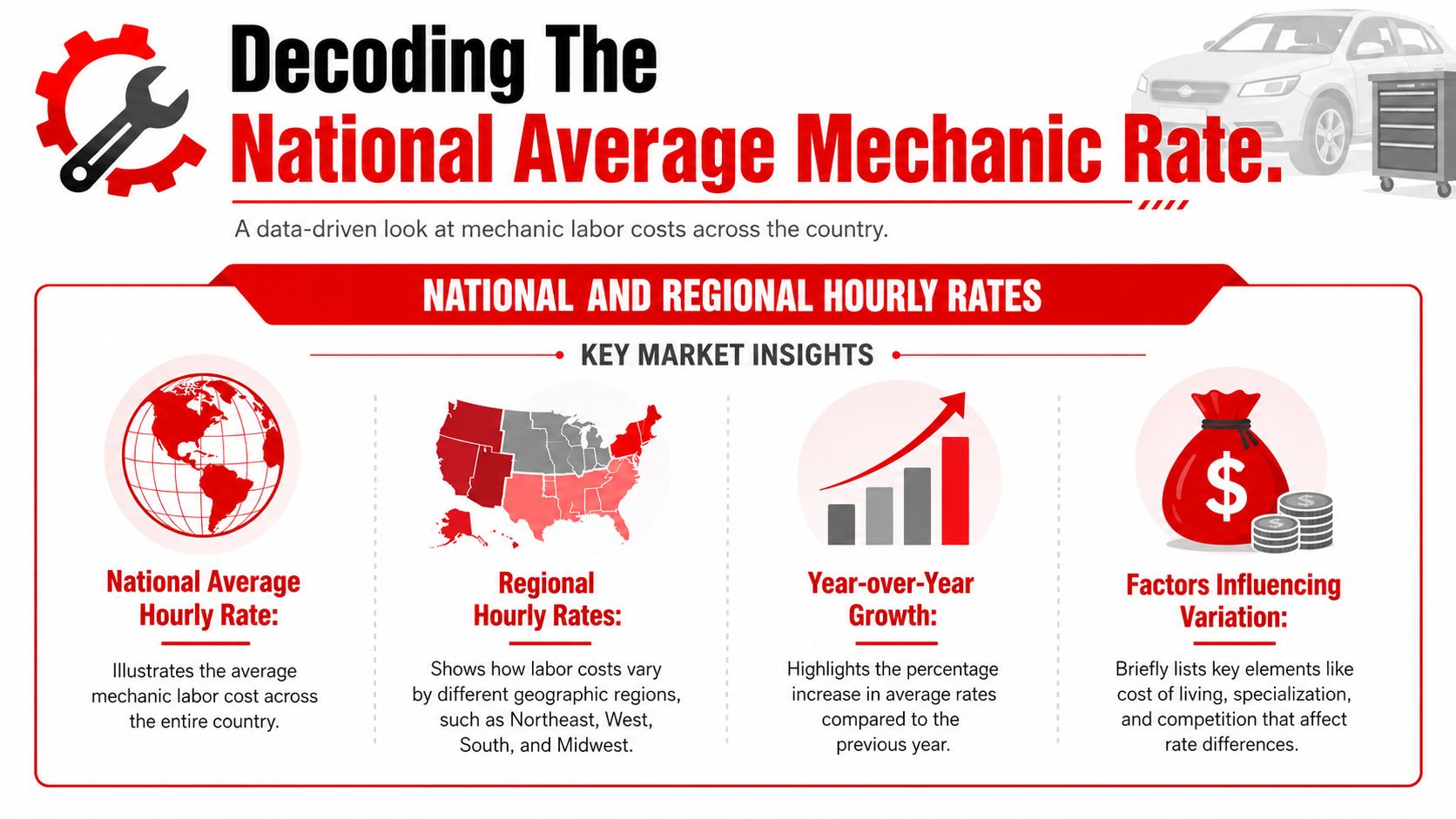
The national market gives useful context, but it doesn't give any shop its final answer. Posted mechanic labor rates in the U.S. have moved into the $120 to $159 per hour range in many markets, with a national benchmark near $140 per hour for independent shops. The same market view notes that high-cost states such as California and New York often exceed $160 per hour, lower-cost markets can be closer to $120 per hour or less, and dealerships typically charge $20 to $40 per hour more than nearby independent shops, according to.
The average is only a benchmark
That range matters because it resets expectations. Many owners still think in old numbers, especially if they haven't reviewed pricing aggressively. A posted rate that feels “high” to the owner may be normal for the market.
At the same time, the national average can mislead when it's treated like a rule. A neighborhood shop serving price-sensitive commuters won't always apply the same labor strategy as a specialty European or drivability shop. A dealer also prices from a different structure than an independent.
Here's a practical way to read the market:
| Shop context | What the benchmark helps with | What it can't decide |
|---|---|---|
| Independent general repair | Whether the posted rate is broadly in line with the area | Whether the shop is actually profitable |
| Dealership | Whether the premium over independents is expected | Whether internal efficiency supports the price |
| Specialty shop | Whether the market accepts premium pricing | How much specialization the shop can really justify |
Why the spread is so wide
The market doesn't hand out one universal mechanic hourly rate because the cost base varies shop to shop. Rent, payroll burden, insurance, technician level, inspection process, diagnostic capability, and customer mix all change the number.
A low posted rate can attract calls and still damage the business if each sold hour carries too much hidden cost.
That's why average-rate articles often leave owners frustrated. They answer what many shops charge. They don't answer what one specific shop needs to charge. For that, the internal cost structure matters more than the headline average.
Key Factors That Drive Your Labor Rate
The biggest mistake in labor pricing is treating the technician wage like the labor rate. They are not the same thing.
A foundational benchmark for automotive service technicians shows a median annual wage of $49,670, which equals $23.88 per hour. The occupation employed 805,600 workers and is projected to grow 4% from 2024 to 2034, with about 70,000 openings per year on average, according to the. That wage matters as a starting point, but consumer-facing labor rates are far higher because a shop has to cover far more than base pay.

The first layer is labor cost
The hourly wage on payroll is only the visible part. Labor cost includes the burden wrapped around that employee. Shops pay taxes, benefits, workers' comp, training, uniforms, and paid non-billable time. That means the actual cost of having a technician on staff is always higher than the wage line suggests.
Owners who price from raw wage alone usually undercharge without realizing it. They think, “The technician earns this much, so billing a bit above it should work.” It doesn't.
Overhead changes the number fast
After loaded labor cost comes overhead. This includes the bills that don't disappear when the bay is empty.
A shop's posted mechanic hourly rate has to help carry things like:
- Facility costs: Rent, mortgage, utilities, shop supplies, and maintenance.
- Operating systems: Software, phones, payment processing, and admin tools.
- Risk and compliance: Insurance, licensing, and required business coverage.
- Technical support costs: Scan tools, subscriptions, calibration access, and ongoing training.
Some of those costs rise gradually. Tool subscriptions renew. Insurance jumps. The front office adds another process. If the labor rate doesn't move with those expenses, the margin shrinks even while sales look stable.
Profit isn't what's left over
Many owners still price labor by hoping profit appears at month end. That approach almost always fails. Profit has to be built into the rate from the start.
Shops don't stay healthy by charging enough to survive the week. They stay healthy by charging enough to replace equipment, invest in people, and absorb bad surprises without panic.
That's why labor pricing should be treated like a formula, not a feeling. Wage matters. Overhead matters. But neither one tells the full story until the shop adds the margin it needs to operate with control.
Calculate Your Shop's Profitable Labor Rate Step-by-Step
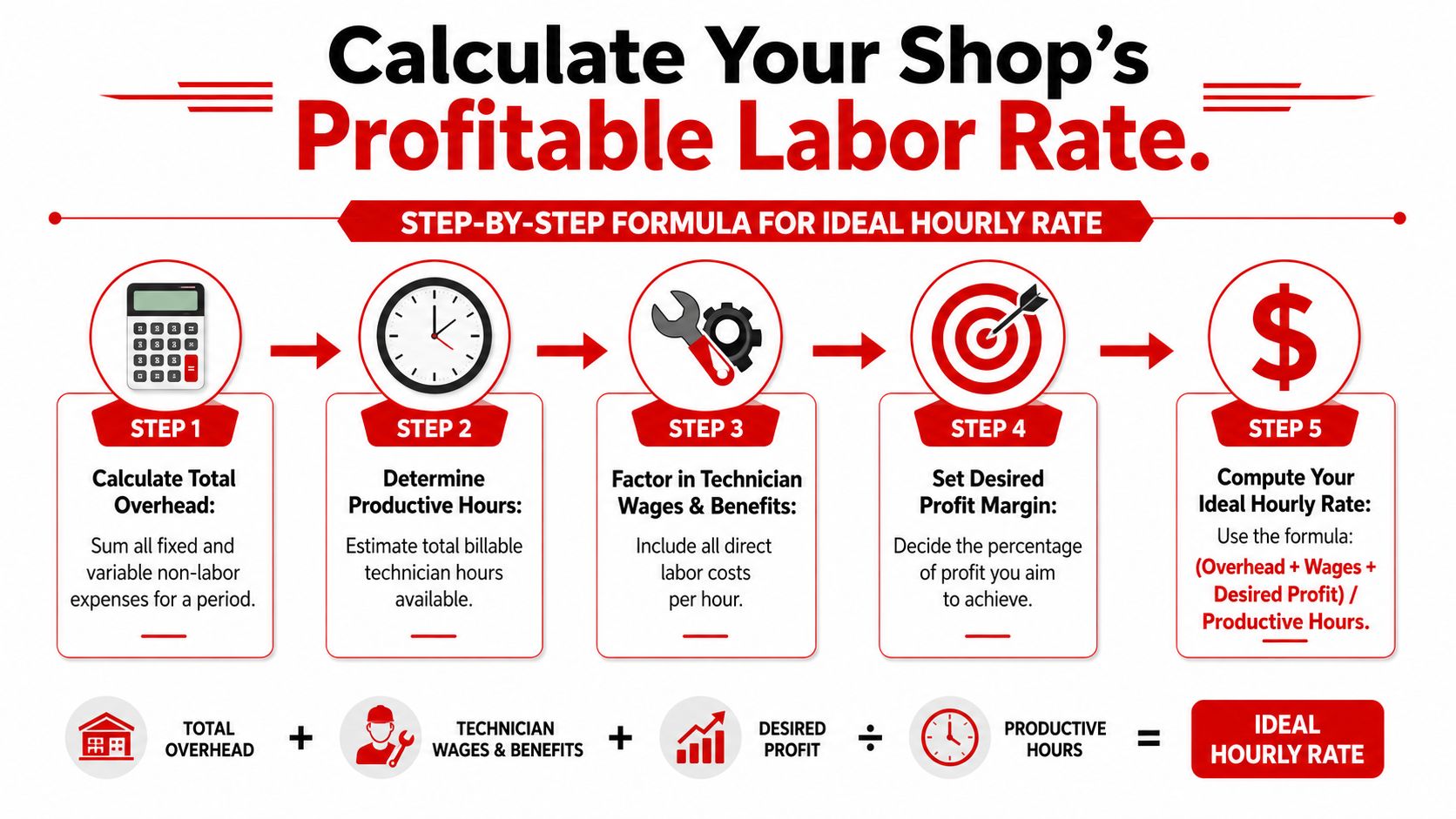
The cleanest way to set a mechanic hourly rate is to build it backward from cost and margin. Industry guidance says labor pricing should cover a technician's loaded labor cost and overhead, then include a target profit margin of roughly 40% to 70%. One example shows that if a technician's loaded cost is $45 per hour and the shop targets a 65% margin, a labor rate of about $128 per hour is needed to stay profitable, according to.
Use this calculator logic
A practical shop formula looks like this:
Start with loaded technician cost per hour
Don't use wage alone. Use the fully loaded labor number.Add overhead cost per billable hour
Take the shop's operating expenses for the period and divide them by realistic billable hours, not theoretical hours.Apply the target margin
The final posted rate has to leave room after labor and overhead are covered.
That sounds simple, but the detail that breaks most calculations is billable hours. Owners often estimate based on scheduled hours instead of sold hours. A technician can be present and still not produce fully billable time due to diagnostics, parts delays, shop movement, rechecks, cleanup, meetings, and interruptions.
A simple worksheet
Use this worksheet with a calculator or spreadsheet:
| Step | What to enter | Why it matters |
|---|---|---|
| 1 | Loaded labor cost per technician hour | This is the true direct labor cost |
| 2 | Total overhead for the period | These expenses must be recovered through sold time |
| 3 | Total realistic billable hours | This converts monthly cost into hourly cost |
| 4 | Overhead per billable hour | This shows how much each sold hour must carry |
| 5 | Desired margin | This turns break-even pricing into profitable pricing |
The math path is straightforward:
- Loaded labor cost per hour
- plus overhead per billable hour
- then adjusted upward for the margin target
Where owners usually go wrong
The most common errors are operational, not mathematical:
- Using optimistic billable hours: The shop plans around perfect productivity that rarely happens.
- Ignoring non-productive technician time: Someone still pays for those hours.
- Leaving out small recurring overhead: Individually minor costs add up quickly.
- Setting a posted rate first and forcing the math later: That reverses the process.
A separate discipline helps here. Shops that track time tightly tend to see where labor leakage happens. For a useful outside reference on time tracking habits and how teams, the same basic lesson applies in a repair environment. If billable hours are overstated, pricing decisions start from a false base.
Field note: The right labor rate often feels uncomfortable the first time an owner calculates it honestly. That discomfort usually comes from outdated assumptions, not bad math.
How to use the result
Once the calculation produces a number, compare it with the market reality around the shop. If the result lands near local expectations, the next move is implementation. If it lands above what the shop has been charging, the answer usually isn't to ignore it. The answer is to tighten workflow, improve estimate presentation, sharpen customer communication, and decide where premium work should carry higher pricing.
A profitable rate isn't a vanity number. It's the minimum needed for a sustainable business.
Billing Models and Advanced Pricing Strategies
Once the shop knows its target mechanic hourly rate, the next question is how to apply it on real repair orders. Most shops don't use one method for every situation, and they shouldn't.
Two models dominate the conversation. One is straight hourly billing, where the customer pays for actual time spent. The other is flat-rate or book-time billing, where the job is sold at a preset labor amount based on standard times.
Hourly versus flat rate
The choice depends on the kind of work the shop sells most often.
| Model | Best use | Main upside | Main risk |
|---|---|---|---|
| Hourly billing | Diagnostics, electrical faults, unusual drivability work | It matches time spent more closely | Customers may worry about open-ended time |
| Flat-rate billing | Repeat repairs, common services, menu work | It gives cleaner quoting and easier approvals | Bad labor guides or missed steps can hurt margin |
Hourly billing fits jobs where the path is uncertain. Complex diagnosis can't always be boxed into a neat book time without exposing the shop to lost hours. Flat rate fits repeatable work where the process is known and the team can execute consistently.
Neither method is automatically better. The wrong method on the wrong job is what causes trouble.
One shop rate doesn't have to cover every skill level
A lot of shops leave money on the table by using one posted labor rate across all categories. That might feel simple, but it blurs the difference between basic maintenance and specialized technical work.
According to, rates can range from under $100 to over $200 per hour, and high-skill segments such as EV, hybrid, and luxury work often command 20% to 30% higher labor rates because they require specialized tools, certifications, and diagnostic capability.
That gives shops a clear pricing signal. If the shop invests in advanced tooling, training, and faster diagnostic capability, it should price that expertise differently.
Smart tiering in practice
A practical structure often looks like this:
- General service labor: Routine mechanical work with predictable workflow.
- Diagnostic labor: Electrical, intermittent faults, drivability, and testing-heavy jobs.
- Specialty labor: EV, hybrid, luxury, or other advanced systems work.
Customers usually accept higher rates when the shop clearly documents why the work is different and what expertise supports the charge.
What doesn't work is hiding the difference. If the estimate shows a higher number with no explanation, the customer sees price. If the estimate explains the process, required tooling, and specialized workflow, the customer sees value.
The posted labor rate is the foundation. The billing model and service mix determine how much of that value the shop captures.
Manage and Maximize Your Labor Profitability with RedAppy
Calculating a profitable labor rate is one job. Maintaining that rate in practice is another.
Most shops lose margin in the gap between pricing policy and daily execution. Hours don't get tracked cleanly. Diagnostics get blended into general labor. Service advisors estimate from memory. Technicians complete work that never gets billed properly. The shop has a good posted rate on paper and a weaker effective rate in practice.
Why manual tracking breaks down
Whiteboards, spreadsheets, handwritten notes, and disconnected systems make it hard to answer basic questions:
- Which technician categories produce the strongest labor gross
- Which job types consume time without enough billed hours
- Where approvals slow down and labor sales stall
- Whether the posted rate is translating into actual recovered labor
That's why software matters here. A shop management platform can connect estimate creation, labor times, technician workflow, digital inspections, invoicing, and reporting so the owner sees whether labor strategy is working on live jobs instead of guessing at month end.
What to look for in a system
The useful features aren't flashy. They're the ones that protect labor margin day after day.
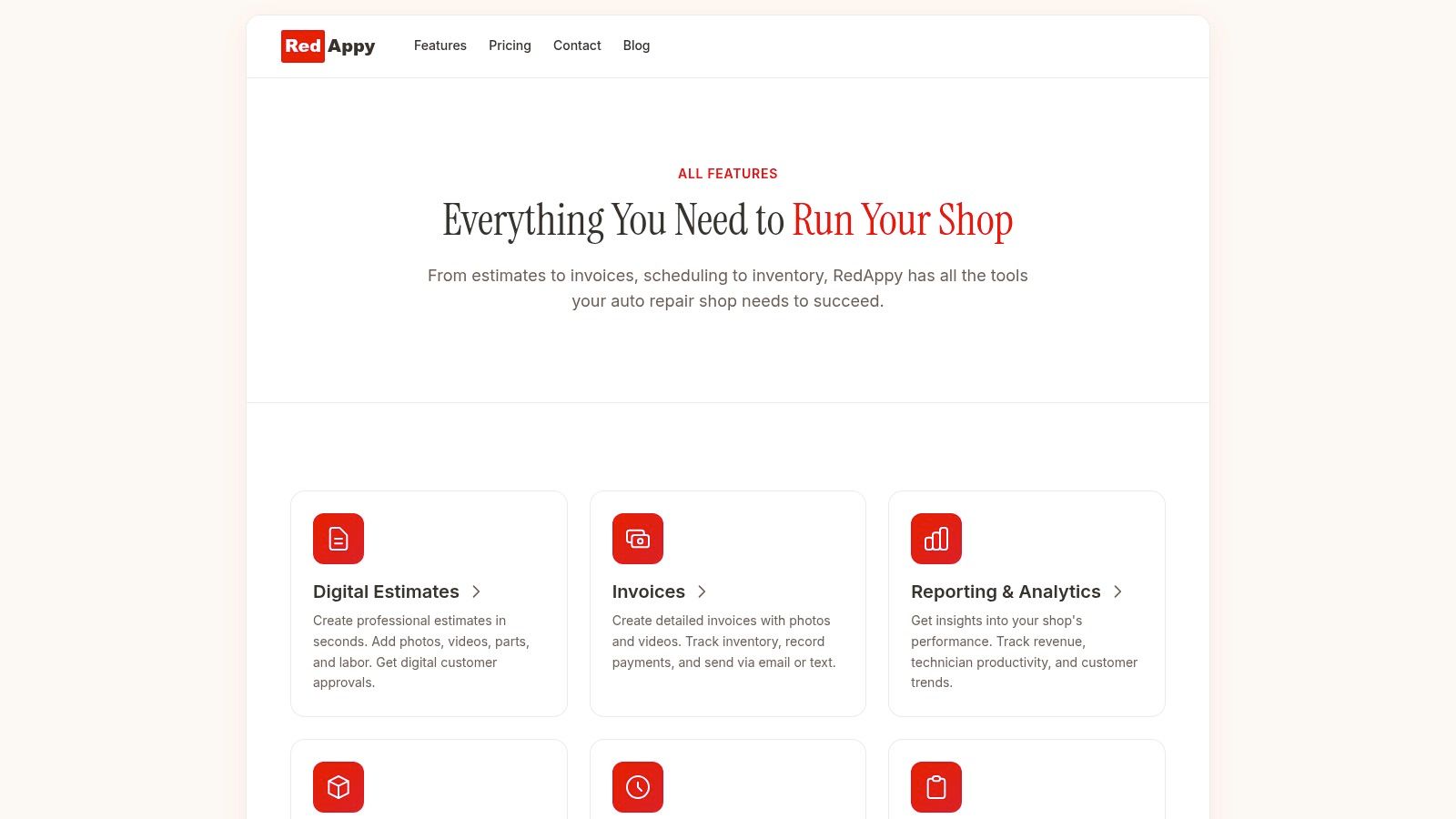
A platform such as RedAppy's shop management features can support that work with instant labor times, digital inspections, estimates, invoicing, parts workflows, a digital shop board, and real-time analytics tied to revenue and technician efficiency. Those functions matter because they reduce underbilled time, make estimates more consistent, and help advisors justify labor with documented inspection findings.
Shops also need better customer communication around value. That matters before the customer ever walks in. Owners looking to improve lead quality and local demand generation may also find it useful to review approaches to, especially when the goal is to attract customers who care about expertise and convenience, not only the cheapest posted rate.
Better visibility changes pricing decisions
Once labor data is visible, the pricing conversation gets easier. Owners can see whether diagnostics are priced correctly, whether specialty categories deserve their own rate, and whether technician efficiency supports the current menu.
A profitable mechanic hourly rate isn't just a number on the wall. It's a number the shop can defend, track, and recover consistently.
The shops that improve labor profit usually don't do it with one dramatic change. They tighten estimating, clean up time tracking, present repairs better, and use reporting to spot where sold hours leak out of the process.
If the current labor rate feels more like a guess than a decision, it's worth taking a closer look at the systems behind it. Contact RedAppy to see how a connected workflow can help a shop calculate, apply, and protect a profitable labor rate with less manual effort.
Ready to Transform Your Shop?
RedAppy helps auto repair shops create professional digital estimates with photos and videos, send them instantly via text or email, and get customer approvals in seconds. No credit card required to start.