
OEM Parts vs Aftermarket: Profitable Choices for Shop Owners
A service advisor has a customer on hold, a technician waiting for approval, and two parts prices open on the screen. One is OEM. One is aftermarket. The price gap looks big enough to sway the job, but the wrong choice can burn an hour in the bay, trigger a comeback, or make the customer think the shop cut corners.
That decision happens all day long. Water pumps, wheel bearings, control arms, sensors, trim pieces, cooling fans. The debate around OEM parts vs aftermarket usually gets reduced to one lazy question: which is cheaper? Shops that run profitably know that isn't the main question.
The core question is this: which part gives the shop the best result after labor time, fitment risk, warranty exposure, customer approval, and reputation are all factored in. A cheap part that creates friction at install isn't cheap. An expensive part that drops straight in and prevents a redo can be the better business decision.
Before getting into the framework, this side-by-side view helps clarify the basics.
| Factor | OEM Parts | Aftermarket Parts |
|---|---|---|
| Manufacturer | Built by the vehicle maker or approved supplier | Built by third-party manufacturers |
| Fitment | Consistent, exact-match fit | Can range from excellent to inconsistent |
| Quality control | Predictable and standardized | Varies by brand and product line |
| Warranty support | Usually clearer and easier to defend | Depends on brand, seller, and documentation |
| Cost | Higher upfront cost | Often lower upfront cost |
| Selection | Usually one direct replacement path | Wide range from budget replacement to performance upgrade |
| Best use case | Critical systems, warranty-sensitive repairs, high-labor jobs | Non-critical items, price-sensitive jobs, specialty upgrades when brand quality is known |
Table of Contents
- The Daily Dilemma for Every Auto Repair Shop
- OEM vs Aftermarket Core Differences Explained
- The Financial Equation of Cost and Profitability
- Streamlining Sourcing and Inventory Management
- Installation and Shop Floor Realities
- A Practical Decision Matrix for Your Shop
- Building Trust Through Transparent Communication
The Daily Dilemma for Every Auto Repair Shop
A common shop-floor moment starts the same way. A customer calls for a quote on a water pump. The advisor has two options ready. The OEM part costs more. The aftermarket option helps the estimate land easier. The choice has to happen fast because the customer wants an answer now, the bay is tied up, and the technician already has the vehicle apart.
That single choice affects three things at once. It changes the gross profit on the ticket. It changes the odds of the technician fighting fitment. It changes how the customer judges the shop if something feels off after delivery.
What makes the decision harder
Most new owners look at part price first because it's visible and immediate. The hidden costs show up later. An O-ring that's slightly off. A bracket hole that doesn't line up cleanly. A sensor that installs fine but creates a new diagnostic path.
Those issues don't just frustrate technicians. They slow down the whole operation. The front counter has to explain delays, the schedule gets squeezed, and the original estimate starts to look weak.
Practical rule: The part decision isn't a purchasing decision alone. It's an operations decision.
The jobs where this matters most
The pressure gets stronger when the repair sits in one of these categories:
- High-approval jobs: Brake work, suspension, cooling, and drivability repairs where the customer compares quotes quickly.
- High-labor jobs: Repairs where doing the job twice would erase the savings from a cheaper part.
- Trust-sensitive jobs: Any repair where the customer already sounds nervous about cost, safety, or warranty.
Shops don't need a slogan about OEM parts vs aftermarket. They need a repeatable way to decide which part protects margin, keeps technicians productive, and gives advisors a clean explanation the customer can understand.
OEM vs Aftermarket Core Differences Explained
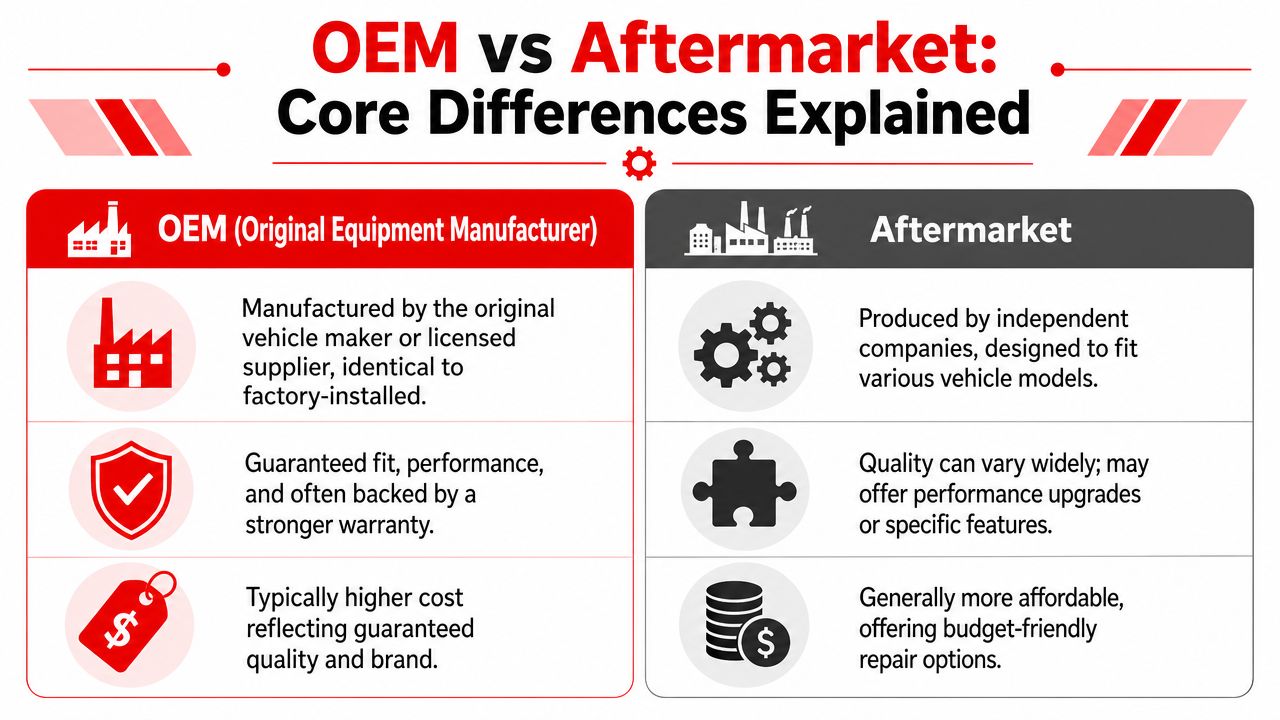
OEM and aftermarket parts solve different business problems. OEM parts prioritize consistency. Aftermarket parts prioritize choice. That's the cleanest way to think about it.
How OEM parts earn their premium
OEM means the part comes from the vehicle manufacturer or an approved supplier tied to that original specification. The selling point isn't mystery. It's predictability. Fitment is known, dimensions are consistent, and warranty conversations are usually simpler because the part matches the original design intent.
For a busy shop, that predictability has value beyond quality alone. It reduces install surprises and gives the advisor a more defensible recommendation on sensitive repairs.
Why aftermarket isn't one category
Aftermarket gets discussed as if it's all one thing, but it isn't. It includes economy lines, OE-style replacement lines, and specialty performance products. Quality ranges from excellent to risky depending on the brand, supplier, and part type.
One of the most important distinctions is that aftermarket can go beyond factory replacement. As noted by, high-performance aftermarket components can surpass OEM benchmarks by using materials like forged aluminum or carbon fiber. That matters less for a commuter car getting routine service, but it matters a lot when a shop handles enthusiast work or specialty builds.
A useful outside perspective comes from this guide on, which helps frame the differences in fitment, sourcing, and buyer priorities.
Core comparison points that matter in the bay
- Fitment certainty: OEM usually wins. Less guesswork means faster installs.
- Range of options: Aftermarket wins. Shops can choose economy, OE-replacement, or upgraded versions.
- Quality consistency: OEM is more uniform. Aftermarket quality depends heavily on brand discipline.
- Warranty clarity: OEM is usually easier to explain. Aftermarket warranty handling varies by manufacturer and seller.
A shop shouldn't ask whether aftermarket is good or bad. The better question is whether this specific aftermarket brand is right for this specific repair.
That distinction saves a lot of bad decisions.
The Financial Equation of Cost and Profitability
The part price on the estimate is only the first line of the financial story. Profitability lives in the total job outcome, not in the lowest purchase cost.
According to, OEM parts cost approximately 60% more than aftermarket alternatives, while also providing guaranteed fitment and factory-consistent performance. That number gets attention fast, especially when a customer is shopping quotes.
Where the cheaper part helps
Lower-cost aftermarket parts can create room in the estimate. That matters when the customer is deciding whether to approve the repair at all. In many common repair categories, an affordable but reputable aftermarket line can keep the ticket alive and protect labor sales that would otherwise walk out the door.
Shops also benefit from flexibility in markup strategy. A shop can sometimes maintain a healthy gross profit on a lower-cost part while still presenting a customer-friendly final number.
Where the cheaper part hurts
The savings disappear quickly when the part creates friction. One extra install attempt, one re-order, one missing gasket, or one alignment issue can wipe out the cost advantage. This damage gets worse on jobs with heavy labor because the bay time is already expensive.
A new owner should look at the full financial chain:
| Cost Area | OEM Tendency | Aftermarket Tendency |
|---|---|---|
| Upfront part spend | Higher | Lower |
| Install time risk | Lower | More variable |
| Comeback exposure | Lower on fitment-sensitive repairs | Higher if brand quality is inconsistent |
| Advisor selling difficulty | Harder on price | Easier on price |
| Margin protection on redo risk | Better | Depends on part quality and job type |
The hidden profit leak
A comeback doesn't just cost labor. It hits the schedule, annoys the customer, ties up the advisor, and crowds out a fresh paying job. That's why owners get into trouble when they evaluate OEM parts vs aftermarket as a line-item purchase instead of a capacity decision.
Shop-floor reality: The cheapest part on paper can become the most expensive part in the building once a technician loses productive time.
A better way to calculate the choice
Before approving the lower-cost option, the shop should ask four things:
- Is the labor expensive to repeat
- Is the part likely to affect safety, drivability, or a warning light
- Does the supplier stand behind the part without friction
- Will the customer blame the shop if the repair feels anything less than perfect
If the answer turns risky on more than one of those, the OEM option often protects profit better, even with the higher invoice cost.
Streamlining Sourcing and Inventory Management
The part decision gets more complicated when sourcing enters the picture. OEM usually comes through a controlled channel. Aftermarket moves through a broader network of warehouses, local jobbers, online sellers, and specialty distributors.
That wider market is massive. The states that the global automotive aftermarket industry was valued at approximately USD 533.87 billion, and it flows through independent repair shops, online marketplaces, and auto parts retailers rather than the tightly controlled OEM distribution network. For shop owners, that means opportunity and complexity show up together.
Why sourcing gets messy fast
A simple estimate can require checking multiple vendors for these variables:
- Availability: One supplier has it today, another has it tomorrow.
- Version differences: Economy, premium, coated, bare, remanufactured, direct-fit.
- Warranty terms: Clear replacement support versus fine-print headaches.
- Core handling: Some categories create extra administrative drag.
That work chews up front-counter time. It also creates inconsistency when each advisor has a different favorite vendor or ordering habit.
A separate challenge shows up with imported or less common applications. Shops dealing with non-standard sourcing can benefit from practical market guides like this, especially when local supply is thin and lead time affects scheduling.
Inventory discipline beats shelf volume
New owners often think better parts management means stocking more. Usually it means stocking less, but stocking smarter. Fast-moving maintenance items may justify shelf space. Slow-moving vehicle-specific items usually don't.
A clean process looks more like this:
- Standardize preferred brands by category. Choose a default path for filters, brake hardware, cooling parts, electrical items, and suspension.
- Separate critical from non-critical sourcing rules. Safety and comeback-prone categories should have tighter vendor standards.
- Track supplier reliability. The best vendor isn't always the cheapest one. It's often the one that delivers the right part with the fewest interruptions.
This kind of workflow is easier to run when the parts view is centralized instead of scattered across tabs, calls, and handwritten notes.
What operational efficiency looks like
A strong parts workflow gives the advisor a quick answer to three questions: Can the part be sourced now, can the job stay on schedule, and can the shop defend the choice if the customer asks why this brand was selected.
When those answers are slow, the whole estimate slows down. When they're clear, approvals get easier and the day stays organized.
Installation and Shop Floor Realities
The technician often tells the truth about a part before anyone else does. The estimate may look fine at the counter, but the bay reveals whether the choice was smart.
A guaranteed-fit OEM part usually drops stress out of the install. The technician doesn't have to compare castings, chase threads, swap old hardware, or stop and ask whether a variation is acceptable. That matters when the schedule is full and every stalled bay affects the next job.
What goes wrong with weak part selection
The common problems aren't dramatic. They're small and irritating.
A bracket sits slightly off. A connector clips in but doesn't lock confidently. A gasket profile looks close enough until torque goes on. A sensor reads, but the vehicle still behaves differently than expected. None of that shows up on the invoice line where the part looked cheaper.
Why technicians remember these jobs
Technicians don't judge a part by catalog language. They judge it by what happens under load, under time pressure, and at reinstall. If a brand causes repeat friction, the whole shop starts paying for it through slower confidence and more second-guessing.
A part that fits after extra persuasion still didn't fit right.
Practical examples from the floor
- Cooling system repairs: Water pumps, thermostats, and housings can look straightforward until sealing surfaces or included hardware differ.
- Suspension and steering: Bushings, ball joints, and links may install, but dimensional variation can affect noise, alignment feel, or longevity.
- Electronic components: Some non-OEM sensors physically fit yet create diagnostic noise that burns additional time.
The biggest mistake a new owner makes here is assuming the labor guide covers real-world variance between part brands. It doesn't. The labor guide assumes the technician isn't fighting the part.
What shops should capture after the job
Shops get better at OEM parts vs aftermarket decisions when they document install outcomes. Every shop should have a simple internal habit:
- note parts that required modification
- flag brands that arrived incomplete
- record repeated fitment complaints
- feed that information back to advisors before the next estimate
That creates a practical memory system. Without it, the same bad part gets ordered again by a different person next month.
A Practical Decision Matrix for Your Shop
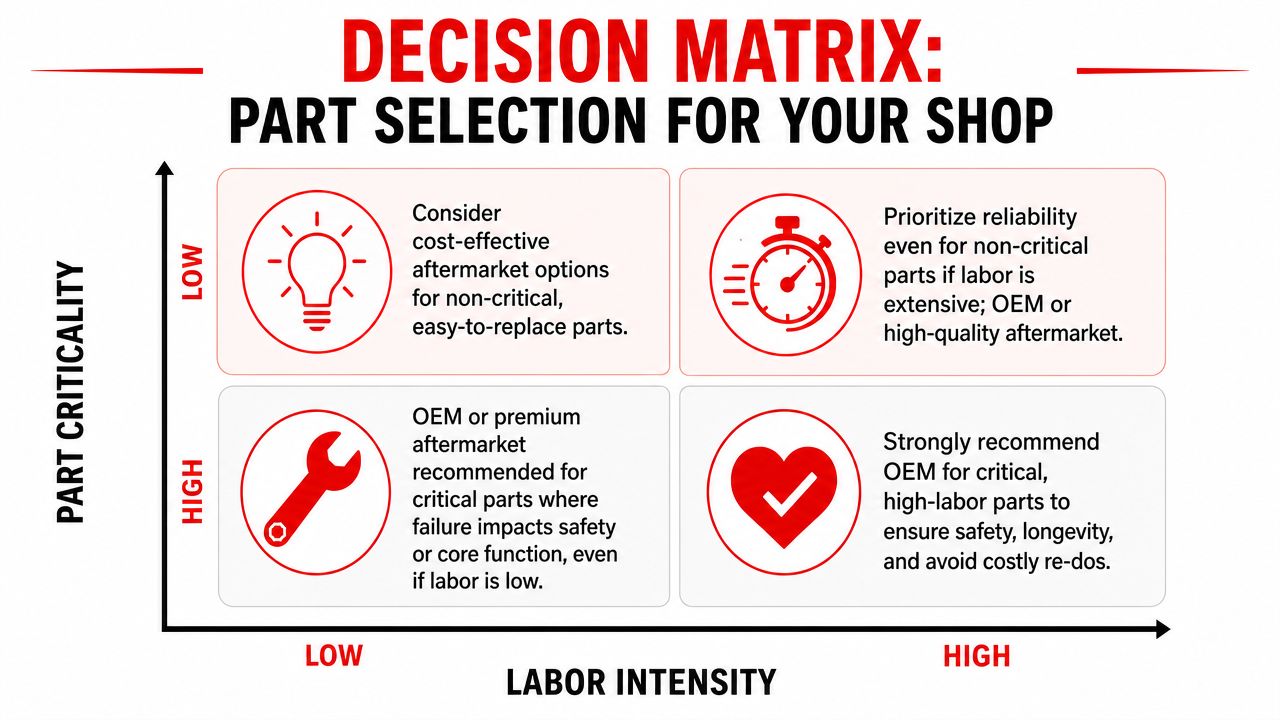
The cleanest framework is part criticality versus labor intensity. This moves the decision away from personal opinion and toward repeatable shop policy.
The core rule is straightforward. For critical parts where labor is expensive to repeat, the safer choice often protects profit. That aligns with the point made in this, which argues that comebacks from aftermarket parts can erase the original savings when labor is high.
How to read the matrix
The two variables are simple:
- Part criticality means how much failure affects safety, core vehicle function, or customer confidence.
- Labor intensity means how painful it is to redo the job if the part causes trouble.
When both are high, the shop should lean heavily toward OEM. When both are low, vetted aftermarket options usually make sense.
OEM vs Aftermarket Decision Matrix
| Scenario | Recommended Part | Rationale |
|---|---|---|
| Low criticality, low labor | Aftermarket | Best place to control estimate price with limited downside if a change is needed |
| Low criticality, high labor | OEM or premium aftermarket | Labor exposure matters more than the part price alone |
| High criticality, low labor | OEM or premium aftermarket | Safety and function matter, even if replacement time is manageable |
| High criticality, high labor | OEM | Best protection against comebacks, repeat labor, and customer distrust |
Applying it to common shop categories
High criticality and high labor
Timing components, internal engine sealing, major cooling assemblies, advanced sensors tied to drivability, and some suspension categories fit here. If a comeback would consume serious labor and damage trust, OEM is usually the stronger business choice.
Low criticality and low labor
Trim clips, non-critical covers, cabin accessories, simple cosmetic items, and straightforward bolt-on pieces often fit here. These are the easiest places to use quality aftermarket alternatives without inviting major downside.
The middle ground
Many shops lose money. Brake and steering jobs, mounts, wheel-end components, or electrical items can vary by vehicle and by brand. These aren't automatic OEM calls, but they aren't bargain-bin decisions either. Premium aftermarket from a known supplier may be the right answer.
Decision shortcut: If the shop would hate doing the job twice, the part choice should reflect that before the estimate is sent.
Turn the framework into policy
A good shop doesn't leave this to improvisation. It gives advisors rules they can use consistently.
- Create approved brand lists by category. Not every aftermarket line belongs in every repair.
- Require escalation on high-labor jobs. Advisors should get a second review before selecting the cheaper option.
- Write the reason into the estimate notes. That makes handoff cleaner between advisor, technician, and customer.
This is also the point where software and AI can shorten decision time. Shops that want help making these calls faster can contact the RedAppy team to learn how the AI Repair Assistant supports estimate quality and repair decisions.
Building Trust Through Transparent Communication
Customers rarely argue about parts because they understand parts. They argue because they don't understand the reasoning behind the recommendation.
That trust gap is real. The highlights a sharp disconnect: 82% of insurers state non-OEM parts are equal, yet 65% of customers reject them because they perceive them as lower quality. That leaves the shop in the middle.

What customers need to hear
The strongest explanation is specific to the repair, not generic. The advisor should explain why this job got this part.
Examples work better than theory:
- For an OEM recommendation: the labor is significant, the system is critical, and the shop wants the most predictable fit and performance.
- For an aftermarket recommendation: the part isn't highly sensitive, the brand is trusted, and the option keeps the repair cost under control without cutting corners.
What builds confidence faster
A verbal explanation helps, but visuals close the gap. Photos of the failed part, estimate notes, and a plain-language comparison make the customer feel the shop made a thoughtful call instead of a random one.
Shops earn trust when they explain the trade-off clearly before the repair, not after a problem appears.
That communication style improves approvals and reduces price-only objections. It also protects the shop when the customer compares the estimate against one from another facility that chose the cheapest visible option.
Shops that want tighter parts decisions, faster estimates, cleaner inspections, and a better front-counter workflow can explore RedAppy features or reach out through RedAppy to see how an all-in-one shop management platform can support sourcing, communication, and daily operations.
Ready to Transform Your Shop?
RedAppy helps auto repair shops create professional digital estimates with photos and videos, send them instantly via text or email, and get customer approvals in seconds. No credit card required to start.