
Overhead Calculation for Auto Repair Shops
A repair order can look profitable while the shop loses money. Parts and technician labor get entered correctly, the invoice goes out, and the gross margin appears acceptable. Yet the rent, insurance, utilities, software, front-desk wages, scheduling work, customer follow-up, and idle bay time still have to be paid. Without a disciplined overhead calculation, an owner may price every repair below its true operating cost.
That problem is especially common when administrative work happens in small pieces throughout the day. A service advisor answers calls between estimates, sends inspection photos, chases approvals, orders parts, updates customers, and processes payments. Each task feels minor, but together they consume capacity that the shop must recover through its pricing and workflow.
Table of Contents
- What Overhead Really Means for Your Shop
- How to Calculate Total Monthly Overhead
- Turning Total Overhead into Per-Hour and Per-Job Rates
- Choosing the Right Allocation Method for Your Shop
- Why Software and Admin Time Change the Overhead Equation
- Practical Steps to Reduce Overhead and Track It Ongoing
What Overhead Really Means for Your Shop
A shop owner may look at a busy week and assume the business is healthy. The bays are occupied, technicians are working, and customers are collecting vehicles. Then the owner separates direct costs from indirect costs and sees the gap.
Direct costs attach to a specific repair. Parts installed on a vehicle are direct costs. Labor performed on that vehicle is also direct. These costs generally rise with the work sold because each repair order consumes particular materials and technician time.
Overhead supports the shop as a whole but can't be traced cleanly to one repair order. Rent keeps the building available. Insurance protects the operation. Utilities power the lifts, lights, compressors, and office. Software supports scheduling, inspections, estimates, communication, inventory, and payments. Administrative salaries cover work that enables revenue without being part of the physical repair.
A practical accounting reference describes overhead as ongoing business expenses that don't directly produce revenue, with examples such as rent and utilities. Its discussion of direct costs also distinguishes expenses tied directly to producing a product or service from the indirect costs required to keep the business operating, as explained in.
The shop overhead pool
For an auto repair business, the overhead pool can include:
- Facility costs: Rent, property-related charges, cleaning, security, and routine building services.
- Protection and compliance: Liability insurance, workers' compensation-related costs, licenses, and professional services.
- Operating utilities: Electricity, water, gas, waste removal, internet, and phone service.
- Administrative labor: Service advisors, reception, bookkeeping support, scheduling, invoicing, follow-up, and customer communication.
- Technology: Shop management software, inspection tools, payment systems, accounting subscriptions, computers, and communication platforms.
- Indirect shop supplies: Cleaning materials, general consumables, office supplies, and items used across many jobs rather than one identifiable repair.
The classification needs judgment. A part installed on one vehicle usually belongs with that repair's direct cost. A general supply used around the shop may belong in overhead. The important point is consistency, because changing the treatment from month to month makes the rate unreliable.
Practical rule: If an expense keeps the shop ready to serve customers but can't be assigned fairly to one repair order, start by placing it in the overhead pool.
Owners should also separate fixed, variable, and semi-variable behavior. Rent may remain stable while utilities, maintenance, supplies, and payment-related costs move with activity. That distinction helps explain why a quiet month can produce a painful overhead rate even when the bills themselves haven't changed.
How to Calculate Total Monthly Overhead
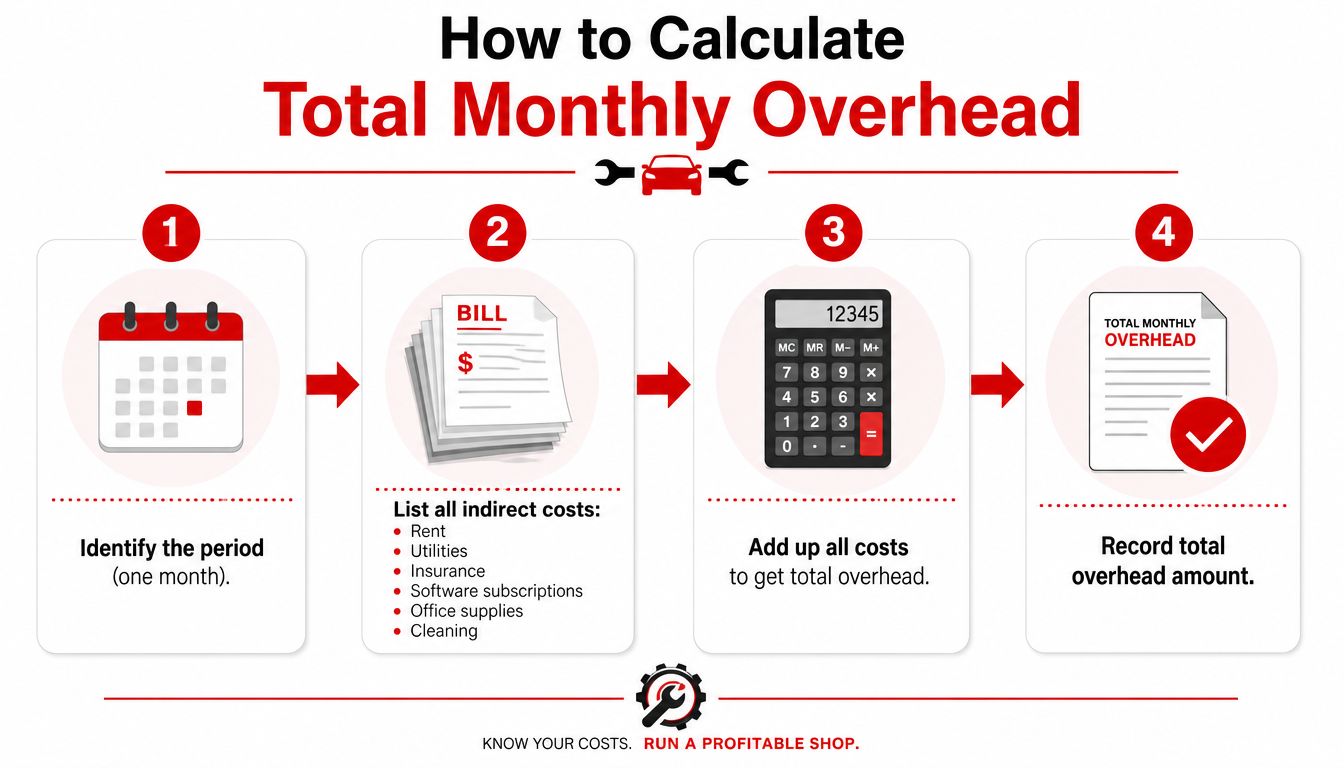
The core workflow is straightforward. Choose the period, list indirect costs, remove direct costs, add the remaining overhead, and document the result. This follows the standard process outlined in.
Start with one consistent period
A monthly period usually works well for an independent shop because rent, payroll, utilities, software, and insurance can be reviewed together. Use the same accounting treatment each month. If annual insurance is paid in one transaction, the shop should decide whether to record the full payment in the payment month or spread it across the periods it covers, then apply that policy consistently.
Build the indirect-cost list
A realistic monthly example might look like this:
| Indirect cost | Monthly amount |
|---|---|
| Building rent | $6,000 |
| Liability and business insurance | $1,200 |
| Shop management software | $450 |
| Utilities and waste services | $1,100 |
| Administrative salaries | $8,000 |
| Internet and phone | $350 |
| Cleaning and office supplies | $500 |
| Equipment maintenance not assigned to one repair | $900 |
| Total monthly overhead | $18,500 |
The figures above are an illustrative shop example, not an industry benchmark. They show the mechanics of the calculation, not a recommended budget.
Exclude direct repair costs
Parts bought for a particular vehicle and technician labor recorded against that repair order shouldn't be mixed into this overhead total. Including them would inflate the pool and make the shop charge indirect costs twice, once through the repair's direct pricing and again through its overhead rate.
Front-desk labor needs closer attention. It isn't direct repair labor, but it is still a real operating cost. Scheduling, estimate preparation, approval calls, invoicing, and payment collection support the whole shop, so administrative compensation generally belongs in the indirect pool.
Record the result and use it
The example produces $18,500 in monthly overhead. That figure becomes an operating input for rate setting, break-even analysis, capacity planning, and expense review. It shouldn't sit alone in a spreadsheet. The owner should compare it with realistic billable capacity and the revenue the shop expects to produce.
For a broader explanation of how fixed costs, variable costs, revenue, and capacity interact, the provides useful context without replacing the shop's own records.
Turning Total Overhead into Per-Hour and Per-Job Rates
A monthly overhead total becomes useful when the shop attaches it to the capacity that generates revenue. The most common starting point is a labor-hour allocation base, calculated as:
Overhead rate per billable hour = Total monthly overhead ÷ Realistic billable labor hours
The word realistic matters. Scheduled technician hours aren't automatically billable hours. Training, inspections, diagnosis, waiting for approvals, parts delays, cleanup, comebacks, meetings, and vehicle movement can consume time without appearing as billed labor.
A worked shop example
Assume the monthly overhead from the previous example is $18,500. The shop has two technicians, and management estimates a combined 240 realistic billable hours for the month. The calculation is:
$18,500 ÷ 240 billable hours = $77.08 overhead per billable hour
That amount isn't the technician's wage and isn't the labor price by itself. It's the indirect operating burden that each billable hour must help recover. The labor rate must still cover direct technician compensation, payroll-related costs treated as direct labor, profit, and any other pricing requirements.
| Metric | Value | Calculation |
|---|---|---|
| Monthly overhead | $18,500 | Sum of indirect monthly costs |
| Realistic billable hours | 240 | Combined capacity used as the allocation base |
| Overhead rate per billable hour | $77.08 | $18,500 ÷ 240 |
| Two-hour repair overhead burden | $154.16 | $77.08 × 2 |
| Three-hour repair overhead burden | $231.24 | $77.08 × 3 |
A two-hour repair therefore carries $154.16 of overhead burden under this model. That burden doesn't mean the customer sees a separate line item. The shop can recover it through labor pricing, a properly designed shop-supply policy, parts margin where appropriate, or a combination that remains clear and compliant with local requirements.
Per-job allocation requires discipline
A job with one billed labor hour and a job with four billed labor hours shouldn't automatically carry the same overhead burden if labor hours are the chosen driver. The longer job consumes more technician capacity and therefore receives more of the shared cost under the model.
Annual planning can use the same logic. Add the expected overhead for the chosen planning period, then divide by the realistic billable hours expected during that period. Seasonal changes still matter. If demand falls while fixed costs remain, the overhead burden per billable hour rises. If capacity expands without corresponding overhead growth, the burden may fall, but only if the additional hours are billable.
A rate based on theoretical capacity makes estimates look cheaper than the shop can actually deliver.
The owner should review applied overhead against actual overhead at the end of each period. A persistent gap indicates that the cost pool, allocation base, or pricing structure needs adjustment.
Choosing the Right Allocation Method for Your Shop
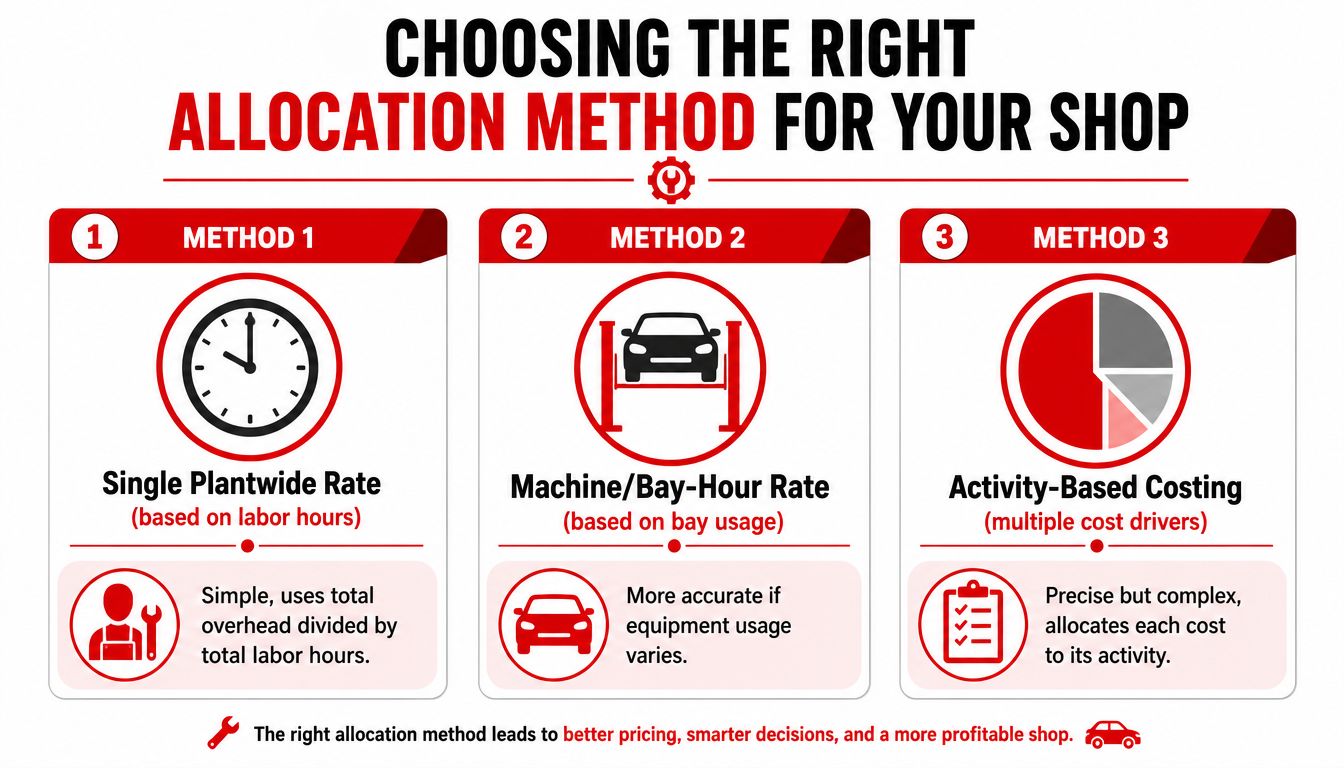
A single overhead rate is easy to maintain, but easy isn't always accurate. The right method depends on how the shop consumes space, equipment, technician time, diagnostic capability, and administrative support.
The historical progression supports that trade-off. Industrial accounting moved from lump-sum overhead toward systematic allocation, with manufacturing firms using single plantwide rates by the 1920s. Activity-based costing emerged by the 1980s, linking overhead to the activities that drive it, as described in this.
Single plantwide rate
This method divides total overhead by one broad activity base, often labor hours. It works well for a smaller shop where most services use similar bays, tools, staff, and workflows.
Strengths:
- Simple to calculate and explain.
- Easy to maintain in a spreadsheet or accounting system.
- Useful when service types consume resources in broadly similar ways.
Weaknesses:
- A quick maintenance job may receive too much burden.
- A complex diagnostic or engine repair may receive too little.
- The method can hide expensive equipment or workflow bottlenecks.
Machine or bay-hour rate
A bay-hour method allocates overhead according to the time a vehicle occupies a bay or uses particular equipment. This can make more sense where lifts, alignment equipment, diagnostic tools, or specialized service areas drive facility costs.
It offers more visibility than a single labor-hour rate, especially when technician labor and bay occupancy don't move together. The trade-off is measurement. The shop needs reliable records for bay usage, equipment time, and idle capacity.
Activity-based costing
Activity-based costing assigns costs through multiple drivers. Scheduling activity, diagnostic equipment use, alignment work, vehicle storage, parts handling, and customer communication can each receive separate treatment.
This approach fits a larger or more complex operation with materially different service lines. It can also become administrative work of its own. If the shop can't maintain dependable activity records, a model creates false precision rather than better decisions.
A useful enterprise workflow collects cost elements into baselines, defines the surcharge against the selected base, calculates overhead for the relevant baselines, and posts the result to a cost center, internal order, or process. That technical structure is described in.
Why Software and Admin Time Change the Overhead Equation
Rent is visible because a landlord sends an invoice. Administrative time is harder to see because it appears as interruptions. A service advisor moves between the phone, appointment calendar, inspection report, parts order, customer text, estimate, and payment screen. The shop pays for that time even when it doesn't appear as a separate expense line.
Recent small-business research reports that owners spend about 23 hours per week on administrative tasks, including scheduling, invoicing, follow-up, and customer communication, as reported by. For a repair shop, those hours can affect both overhead and revenue capacity. They consume payroll time, owner time, or technician time, and they can delay approvals that would otherwise turn available bays into billed work.

Software is a cost and a possible offset
A software subscription belongs in the overhead pool if the shop treats it as an indirect operating expense. That classification alone doesn't answer whether the purchase makes financial sense.
The better question is whether the tool changes the rest of the equation. A platform that reduces duplicate entry, sends inspection information digitally, supports faster approvals, coordinates parts ordering, or makes payment collection easier may reduce administrative load and improve the use of available technician hours. The subscription adds a cost, but the workflow change may offset part of that cost through lower labor waste or better billed utilization.
RedAppy is one example of a shop management platform that combines digital inspections, estimates, invoicing, online payments, supplier-connected parts ordering, inventory, analytics, scheduling, and a visual digital shop board. It also includes an AI Repair Assistant, vehicle history lookup, and a branded website with contact forms. Those features should be evaluated against the shop's own administrative workload, adoption quality, and measurable operating results.
Recalculate after adoption
The calculation shouldn't stop at the subscription invoice. Before adopting a tool, record the current overhead pool, administrative workload, approval process, billable capacity, and payment workflow. After implementation, review the same categories and ask:
- Did administrative labor move to more valuable customer or production work?
- Did realistic billable hours change?
- Did fewer approval delays leave technicians waiting?
- Did faster invoicing improve cash collection?
- Did the shop eliminate other subscriptions or duplicate processes?
- Did the team use the system consistently?
If the software only adds another screen and the team keeps the old manual process, it has increased overhead without changing capacity. If it replaces scattered work with a reliable workflow, the owner should update both the overhead pool and the realistic allocation base.
Practical Steps to Reduce Overhead and Track It Ongoing
Overhead reduction works best when the owner attacks the largest leaks first, not when the team cuts small expenses randomly. A cheaper office supply doesn't solve a recurring approval delay, underused bay, duplicate software subscription, or poorly scheduled technician capacity.
Use a short operating review
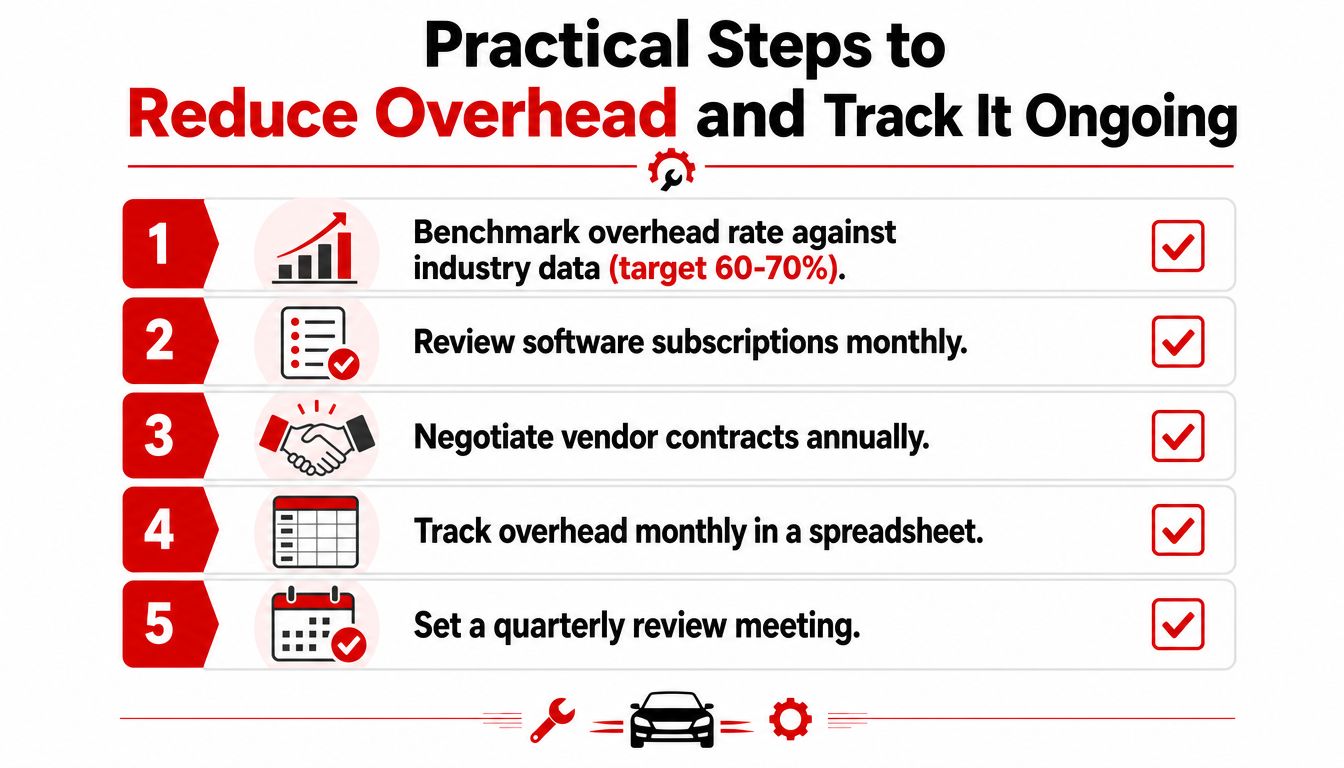
A practical weekly or monthly review can focus on five questions:
- What changed in the overhead pool? Flag new subscriptions, insurance changes, utility movement, maintenance, and staffing costs.
- Which costs lack an owner? Assign someone to review each recurring expense instead of allowing automatic renewals to pass unnoticed.
- Where does capacity disappear? Look for no-shows, parts delays, waiting approvals, rework, and excessive administrative interruptions.
- Which vendors deserve negotiation? Review supplier terms, payment conditions, service contracts, and recurring fees before renewal.
- Does the allocation base still match the work? A labor-hour method may need review if equipment-heavy work, diagnostics, or bay usage changes substantially.
A commercial benchmark reference reports more than 500,000 benchmark data records across areas including materials, manufacturing, sales, administration, development, logistics, and maintenance. A newer reference version reports around 70,000 benchmark data points across several cost categories for 180 countries and regions. These figures come from, and they illustrate the breadth of external data available for validating assumptions. The figures aren't a target for an individual repair shop, but they show why internal history shouldn't be the only reference point.
Make the numbers operational
A spreadsheet can track monthly overhead, but the team needs operating data beside it. Monitor technician efficiency, realistic billable hours, average repair order value, approval delays, no-shows, and bay utilization. These measures help explain why the overhead rate moved instead of merely showing that it moved.
Supplier negotiations, better scheduling, and digital customer updates can reduce waste without lowering service quality. The owner should test each change, record what happened, and keep the change only if it improves the shop's actual economics.
The next useful step is simple: pull the latest month of expenses, separate direct from indirect costs, total the overhead pool, and divide it by realistic billable hours. Then review the result with the service advisor and shop foreman, identify one capacity leak, and assign a specific fix.
RedAppy brings digital inspections, estimates, invoicing, payments, parts ordering, scheduling, shop-board visibility, and analytics into one workflow, giving repair shops practical data for their overhead calculation. Visit RedAppy to review the platform, compare its features, and decide whether it fits the shop's current front-desk and bay operations.
Ready to Transform Your Shop?
RedAppy helps auto repair shops create professional digital estimates with photos and videos, send them instantly via text or email, and get customer approvals in seconds. No credit card required to start.