
Parts Ordering Software Guide for Auto Shops
A vehicle is on a lift, the repair has been approved, and the customer has been promised a collection time. Then the parts search begins. One supplier shows no stock, another has an uncertain delivery window, and a third offers a cheaper component that may not arrive until the vehicle has occupied a bay for another day. By the time the order is placed, the service advisor has made several calls, the technician is waiting, and the customer needs a new update.
That routine makes the actual cost of parts ordering easy to miss. The expense isn't only the part itself. It includes staff time, repeated data entry, incorrect fitment, emergency freight, returns, idle bays, and promises the front desk can no longer keep. Parts ordering software earns its place when it controls those operational costs, not merely when it displays a long supplier list.
Table of Contents
- The Auto Shop Parts Puzzle
- What Parts Ordering Software Actually Does
- Why Multi-Supplier Ordering Changes Everything
- Selecting the Right Software for Your Shop
- RedAppy, An All-in-One Solution for Modern Shops
- Taking the Next Step in Shop Efficiency
The Auto Shop Parts Puzzle
Every busy garage knows how quickly a straightforward repair can become a procurement problem. A technician identifies the required component, the service advisor checks a distributor, and the first answer is often incomplete. Stock may be shown at another branch, a superseded part number may need checking, or the supplier may confirm availability without giving a dependable arrival time.
The team then repeats the process with another supplier. Someone writes a price on a notepad, someone else enters it into the repair order, and a customer receives an estimate based on information that may already be out of date. If the part doesn't fit, arrives late, or needs returning, the repair order becomes a chain of corrections rather than a controlled workflow.

The cost hiding behind a cheap part
A low listed price can look attractive until the part arrives late and keeps a vehicle in a bay. A return can consume front-desk time, create a new delivery charge, and delay the technician from completing the repair. The cheapest offer is often the wrong operational choice when delivery reliability, fitment confidence, warranty terms, and return risk point in another direction.
Parts availability matters because the aftermarket handles enormous purchasing volume. U.S. light-duty aftermarket sales reached approximately $392 billion in 2023, while parts accounted for an estimated $218.8 billion, according to. That scale explains why a small shop's ordering friction can repeat across a large number of repair orders.
Practical rule: A part isn't commercially available until the shop can match fitment, price, delivery timing, and return conditions to the repair deadline.
Digital ordering doesn't remove the need for experienced staff. It gives them a dependable place to compare offers, record decisions, and keep the order attached to the vehicle's job. Teams that also handle key programming or security-related work may find a practical reference in this, especially when a repair involves more than mechanical parts.
The result is less calling, less re-keying, and fewer customer updates based on guesswork. The software becomes useful when it helps the shop make a better purchasing decision before the vehicle sits idle.
What Parts Ordering Software Actually Does
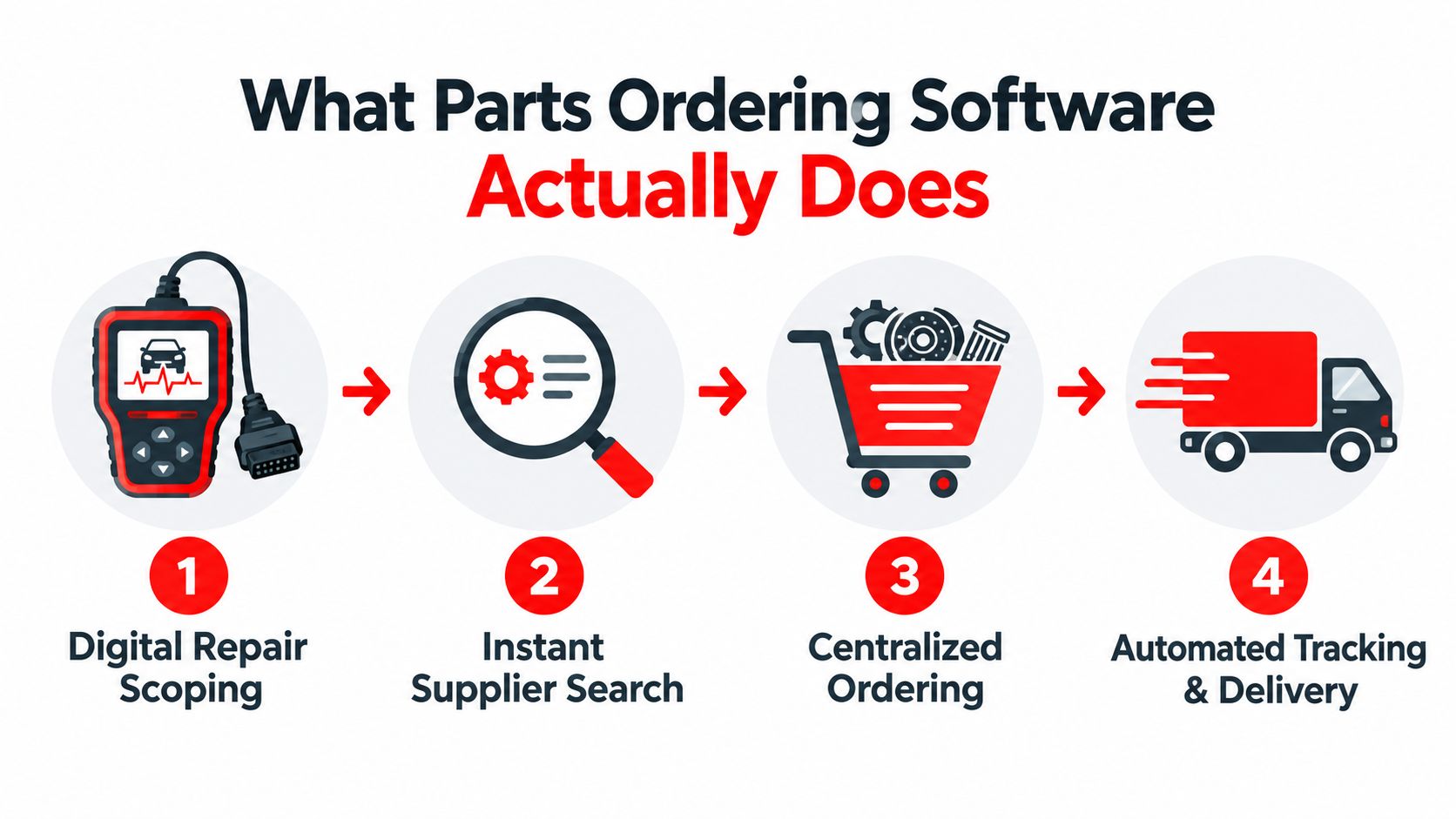
Parts ordering software acts as a working connection between the repair order and the supplier network. It shouldn't behave like a separate online catalogue that forces staff to copy information back into the shop system. The useful model is a connected sequence, from vehicle identification and repair scoping to supplier comparison, approval, ordering, receiving, and invoicing.
A strong system typically supports these functions:
- Repair-order connection: Required parts stay attached to the correct vehicle, customer, and job rather than living in emails or handwritten notes.
- Supplier search: Staff can check several connected suppliers without opening separate portals or making repeated calls.
- Live commercial detail: The screen should show current price and availability, while clearly identifying when a response was received.
- Order control: The shop can see whether an order is submitted, acknowledged, dispatched, delayed, or ready to receive.
- Financial reconciliation: The received part and supplier invoice can be checked against what the repair order expected.
The data underneath the screen
The visible search box is only as reliable as the catalogue behind it. A supplier connection should handle part identifiers, supersessions, quantities, prices, availability, order acknowledgments, shipping updates, and invoices in structured form. Electronic Data Interchange has long been used to move procurement documents between systems, and describes electronic workflows as a way to speed information exchange, reduce transaction costs, and expose supplier-inventory information.
That doesn't mean every stock response is correct. A stale quantity, incorrect product mapping, or missing supersession can create an order that looks successful but delivers the wrong component. The shop should therefore look for timestamped inventory responses, supplier-specific acknowledgments, catalogue validation, and exception flags that send uncertain orders to a human.
A delivery dashboard follows the same principle. Businesses comparing delivery tools can learn from the broader discussion in this guide to, but automotive ordering has an extra requirement: the delivery event must remain tied to the repair deadline and customer promise.
Good software gives the service advisor a defensible answer. It can show what was found, which supplier was selected, when arrival is expected, and whether the order has moved. It can't guarantee that every supplier will keep its promise, but it can expose uncertainty early enough for the shop to act.
Why Multi-Supplier Ordering Changes Everything
A larger supplier list isn't automatically better. A shop can connect to many vendors and still make poor decisions if the system doesn't compare the details that affect the repair. The useful shift is from supplier aggregation to immediately fulfillable demand, meaning the proportion of requested parts the shop can secure for the job.
A 2025 survey of nearly 700 repair shops found that parts availability was the most important ordering factor for 34% of respondents, and shops used an average of 5.8 suppliers or dealers. The figures appear in the OEC U.S. General Auto Repair Shop Survey Report/Reports%20Mockups/The%20OEC%20US%20General%20Auto%20Repair%20Shop%20Survey%20Report.pdf?hsLang=en). Managing that many relationships manually creates a decision problem every time a vehicle needs more than one component.
Compare the job, not just the SKU
Suppose Supplier A offers the lowest price but can't confirm delivery until later. Supplier B costs more but has the part ready for a scheduled route. Supplier C has a suitable alternative with different return terms. A practical ranking should consider:
- Delivered cost: Include the part price, freight, core charges, and likely handling costs.
- Arrival confidence: Compare the promised window with the customer's required collection time.
- Fitment confidence: Check the VIN, catalogue mapping, supersession, and any vehicle-specific notes.
- Supplier reliability: Use the shop's own history of late deliveries, substitutions, returns, and invoice discrepancies.
- Return exposure: A saving disappears quickly if the part is difficult or expensive to send back.
This is why a fill-rate dashboard deserves more attention than a supplier-count dashboard. Fill rate should be measured by fulfilled demand divided by total requested demand, then segmented by part line, vehicle, supplier, urgency, and repair order. An aggregate result can look healthy while safety-critical or vehicle-down repairs continue to fail.
A supplier connection creates options. A useful ranking turns those options into a controlled repair decision.
Availability and price can also conflict by part type. A federal replacement-parts study found OEM parts were available nearly 100% of the time, compared with approximately 80% for aftermarket parts and 50% for used parts. For an OEM part priced at $100, the comparable aftermarket part cost about $65, while the used part cost about $52, according to NHTSA replacement-parts research. The point isn't to select OEM parts automatically. It is to compare price with the probability and consequences of waiting.
The software should also handle split orders without hiding the operational impact. If one supplier has the brake components and another has the sensor, the repair order needs a clear view of both arrivals, outstanding lines, and customer communication. A cheap order that leaves one essential item missing isn't a completed procurement decision.
Selecting the Right Software for Your Shop
A useful evaluation starts with the shop's actual bottleneck. A small garage may need fast supplier search and a clean repair-order connection. A multi-location operation may need shared visibility, approval rules, transfer controls, and reporting by site. The right system isn't the one with the longest feature list. It's the one that removes friction from the work people already perform.
Test the workflow before buying
Ask the vendor to demonstrate a real repair, not a polished catalogue search. The team should be able to identify the vehicle, add required parts, compare suppliers, approve an offer, submit the order, receive a status update, and close the purchasing record without re-entering the same information.
Check these points during the demonstration:
- Integration: Can parts move directly from the repair order into purchasing, and do order changes return to the job automatically?
- Inventory freshness: Does the system show when a supplier response was received, or does it present old stock as certain?
- Fitment control: Can staff review identifiers, supersessions, quantities, and vehicle-specific information before ordering?
- Exception handling: What happens when no supplier confirms stock, a price changes, or an order needs human approval?
- Usability: Can a service advisor learn the core flow quickly while handling calls, estimates, and customer updates?
- Audit trail: Can the manager see who selected the supplier, what was approved, and what arrived?
A shop should also test the receiving process. Staff need to scan or confirm what arrived, identify shortages or substitutions, and connect the invoice to the correct repair order. If receiving happens in a separate system, the same data silo that caused ordering errors may return at the end of the process.
Match automation to risk
Automation should be selective. Routine replenishment for known, high-use items can follow clear reorder rules. A vehicle-specific electronic component, safety-critical item, or part with uncertain fitment may require approval before the system commits the purchase.
The need for that distinction varies by operation. In an April 2025 survey of 500 U.S. general repair shops, 38.6% reported some tariff impact, while 87.8% of one-to-three-bay shops reported no supply-chain impact. Larger shops faced greater exposure, including reported cost increases and higher shipping costs, as described in. That variation argues for configurable approval thresholds rather than identical automation everywhere.
RedAppy, An All-in-One Solution for Modern Shops
A standalone ordering portal can solve supplier search while leaving the repair order, shop board, invoice, and customer communication in separate places. That arrangement may work for a shop with a simple process, but every handoff creates another opportunity for a missed update or duplicate entry.
An integrated platform takes a different approach. Parts ordering, vehicle records, job status, estimates, invoicing, and payment remain connected to the same repair workflow. When the supplier changes an availability response or the advisor chooses another part, the front desk can work from the current job record instead of checking several systems.
Standalone portal versus connected workflow
| Operating need | Separate ordering tool | Connected shop platform |
|---|---|---|
| Part selection | Search happens outside the repair order | Parts remain associated with the vehicle and job |
| Supplier comparison | Staff may copy prices and availability manually | Offers can be reviewed within the repair workflow |
| Order changes | Advisors may need to update several records | Job information can reflect the purchasing change |
| Customer updates | Status depends on messages or manual checks | Staff can use the order record as the operational reference |
| Invoicing | Parts information may require re-entry | Purchasing and billing can share the same job context |
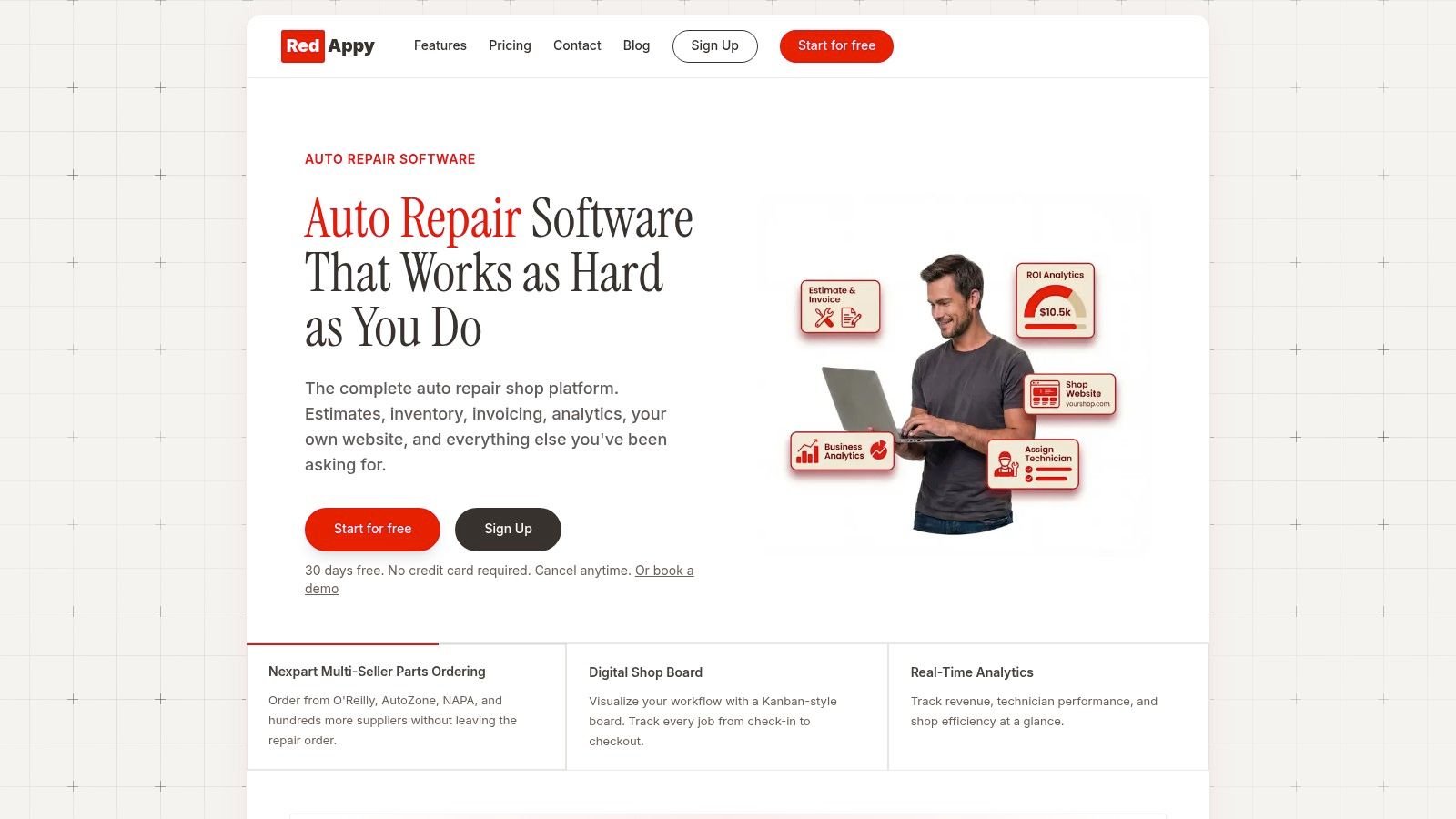
RedAppy provides parts ordering across multiple suppliers with live pricing and availability, while also connecting parts to the repair order. Its broader shop-management functions include a digital shop board, estimates, invoicing, online payments, inspections, vehicle history, scheduling, and analytics. That combination is relevant when the main problem isn't finding a part, but keeping purchasing aligned with what the workshop has promised and completed.
Where integration pays off
The strongest benefit of an all-in-one setup is reduced administrative repetition. A part selected for a repair order can remain visible to the front desk, workshop team, and billing process without creating a second record. That makes it easier to identify an incomplete order, explain a delay, and reconcile what the customer approved with what the shop finally installed.
The platform also includes a Kanban-style Digital Shop Board, analytics, and an AI Repair Assistant for labour times, diagnostic guidance, and shop insights. RedAppy reports that its workflows can save 10+ admin hours per week, a product claim available through RedAppy's platform information. Shops should validate any time-saving claim against their own current process, particularly the number of supplier calls, duplicate entries, returns, and status checks handled each week.
Integration doesn't eliminate judgement. A service advisor still needs to decide whether a lower-cost alternative meets the repair requirements, whether a split order is sensible, and whether a supplier's delivery promise is credible. The system's job is to present the decision with the correct vehicle, price, availability, status, and customer context in one place.
Taking the Next Step in Shop Efficiency
Parts ordering becomes a business issue when it controls how long a vehicle occupies a bay and how confidently the shop can promise completion. Collision-repair research found that nearly 44% of surveyed drivers experienced prolonged repair delays because of parts shortages, and 78% said affordable repair options were extremely or very important, according to the. The figures connect procurement with customer mobility and trust, not just purchasing administration.
A disciplined shop should measure more than order speed. Managers should watch fill rate by repair order, backorder age, emergency-freight frequency, first-time-fix performance, return reasons, and on-time delivery. Supplier-side control targets such as inventory-location accuracy above 99%, on-hand accuracy above 98% for high-priority items, and pick accuracy near 99.7% can be used as operational goals, provided the shop treats them as control targets rather than universal norms, as discussed in.

Start with one difficult workflow
The safest adoption plan begins with a recurring problem, such as brake repairs with uncertain aftermarket availability, special orders that need frequent follow-up, or jobs where the front desk repeatedly re-enters supplier information. The team can then compare the old process with a connected workflow and identify whether the software improves availability decisions, reduces handling, and gives customers clearer updates.
Online ordering is already part of professional purchasing for many shops, but adoption remains uneven. One industry survey found that 31% of respondents used online ordering for 90% of their parts purchases, while 68% said obtaining parts from their distributor was somewhat or very easy, according to. That combination shows why software should support established distributor relationships instead of assuming digital tools will replace them.
The right system gives technicians better information, advisors fewer status calls, and managers a clearer view of where procurement is failing. Before choosing, the shop should test live supplier responses, fitment controls, receiving, approvals, returns, and reporting against real repair orders. Then it should select the system the team can use consistently during the busiest part of the day.
RedAppy connects multi-supplier parts ordering with repair orders, shop-board tracking, estimates, invoicing, and customer payments, so purchasing doesn't sit apart from the repair workflow. Visit RedAppy to review the platform and see how its parts-ordering features can help the shop control availability, delivery risk, and administrative friction.
Ready to Transform Your Shop?
RedAppy helps auto repair shops create professional digital estimates with photos and videos, send them instantly via text or email, and get customer approvals in seconds. No credit card required to start.