
Real Time Inventory Management
A technician has the car in the bay, the job is approved, and the system says the part is on the shelf. Then the search starts. The box is empty, the part was billed to another repair order, or someone borrowed it for a rush job and never logged it. The vehicle sits. The technician waits. The service advisor calls the customer with a delay nobody wanted to explain.
That's the true cost of poor inventory control in an auto repair shop. It isn't just messy shelves or a parts person staying late. It's lost labor production, slower turnaround, inaccurate estimates, and cash tied up in parts that aren't moving. Shops often think inventory is an accounting task. In practice, it's a workflow problem that touches every repair order.
Real time inventory management fixes that by making every part movement visible as it happens. For repair shops, that means less guesswork, fewer parts surprises, and tighter control over margin.
Table of Contents
- Why Your Parts Room Is Costing You Money
- Understanding Your Inventory in Real Time
- How Real-Time Inventory Boosts Shop Profitability
- Putting Real-Time Inventory into Practice
- A Step-by-Step Implementation Guide
- Avoiding Common Inventory Management Mistakes
- Stop Counting Parts and Start Driving Profit
Why Your Parts Room Is Costing You Money
Most parts rooms don't look expensive. They look crowded, disorganized, and a little behind. But the true loss shows up in labor time and missed work flow.
A common shop failure goes like this. The advisor builds the estimate using a part that appears available. The customer approves. The technician starts teardown and reaches the point where the new part is needed. Then someone discovers the count was wrong. Now the shop is paying for a stalled bay, a delayed schedule, and a customer update that weakens trust.
That single bad inventory record creates a chain reaction:
- Technician downtime: A productive tech can't finish the job without the right part.
- Schedule disruption: The shop has to reshuffle work, move vehicles, and reassign labor.
- Estimate errors: Advisors quote from stock that doesn't exist or miss stock that does.
- Rush ordering: The shop pays more to solve a problem that better control would have prevented.
- Shelf creep: Extra parts get ordered “just in case,” then sit for months.
Practical rule: If a part can leave the shelf without touching the repair order, the shop doesn't have inventory control. It has inventory hope.
This is why spreadsheets, handwritten labels, and memory-based systems break down in busy garages. They can survive low volume for a while. They can't survive interruptions, comebacks, split jobs, special orders, returns, and multiple techs pulling the same category of parts all day.
The issue isn't that shop teams don't work hard. It's that the process depends on people remembering to update inventory later. Later usually means never, or only when someone notices a shortage.
Real time inventory management changes the timing. Instead of discovering errors after the day is over, the shop sees stock changes when they happen. That's what protects labor efficiency and gross profit.
Understanding Your Inventory in Real Time
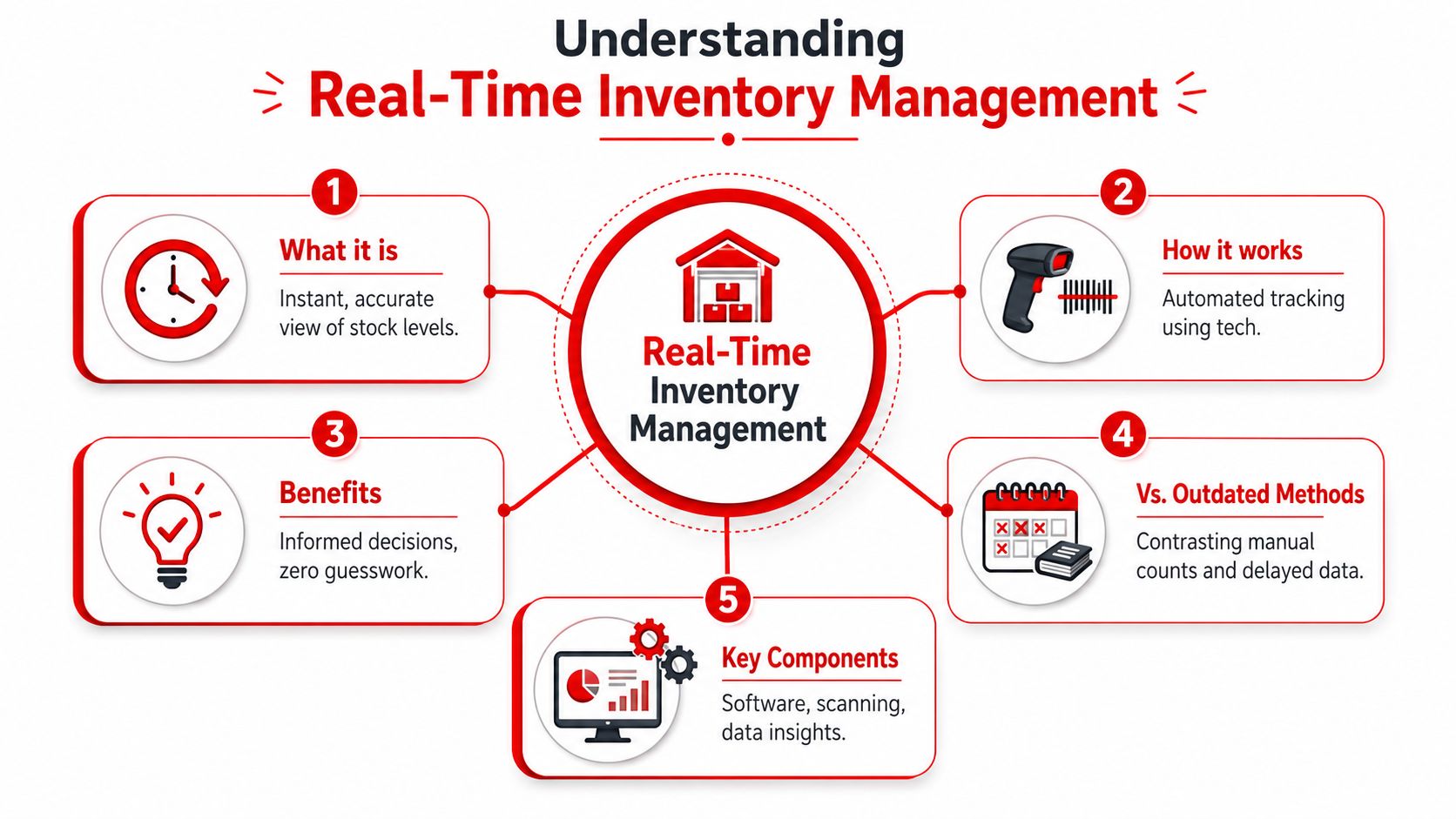
The easiest way to explain real time inventory management is this. It's a live GPS for parts, not a paper map. A paper map can still show roads, but it won't tell anyone what changed five minutes ago. Real time systems do.
Live data beats end of day cleanup
In a repair shop, parts move constantly. Deliveries arrive. Fluids get used. Filters are billed. A transfer goes to another location. A core is pulled aside. A return gets staged for pickup. If those movements are only updated later, the inventory file is already wrong.
Industry guidance describes real time inventory management as updating inventory as changes happen, not in batches. It became practical as barcode scanners, RFID, cloud software, ERP integration, and automated reorder points matured. In one published example, RFID-based tracking was associated with inventory accuracy rising from 63% to 95%, and real-time shipment tracking can cut delays by as much as 58% and reduce delivery times by 25%, according to.
That matters in a garage because delayed information creates bad decisions fast. A wrong quantity on brake pads or ignition coils doesn't stay a small clerical issue for long. It becomes a service problem.
What changes inside a repair shop
A proper real time setup usually includes three working pieces:
Capture at the point of movement
Barcode scanning is the most practical option for most shops. The part gets scanned when it's received, moved, billed, returned, or adjusted.A system tied to repair orders
Inventory shouldn't live in a separate universe from the job. When a part is assigned to a repair order, the quantity on hand should change with it.Visibility across suppliers and locations
Shops that source from several vendors or move parts between branches need one current view, not several partial ones. Teams evaluating that problem can look at for a useful example of how synchronized inventory data works across connected systems.
Real time inventory management only works when the update happens at the moment of action, not when someone has time to clean up the records later.
For auto repair, that means a tech can't grab a part, a service advisor can't post it, and a parts manager can't transfer it without the system reflecting that move. Once that discipline is in place, the parts room stops being a blind spot and starts acting like an operational control point.
How Real-Time Inventory Boosts Shop Profitability
Inventory accuracy isn't a back-office metric. In an auto repair shop, it shapes bay utilization, estimate quality, and buying behavior. When the counts are wrong, the shop loses money in places that don't show up as “inventory problems” on the surface.
Downtime drops when parts data is reliable
The biggest gain usually comes from protecting labor. Technicians need the right part at the right time. If the system says a water pump, sensor, or filter kit is available, that information has to be true. Otherwise the bay stops producing.
One industry summary reports average inventory accuracy at 83%, while world-class organizations reach 95%. That 12-point gap is linked to $1 trillion in missed global sales annually from stockouts. The same source says real-time tracking can improve stock accuracy by 35% and reduce excess inventory carrying costs by 20%, according to.
A repair shop doesn't experience stockouts the same way a retailer does, but the damage is just as real. The lost sale may be a delayed repair, an unproductive technician hour, or a customer who declines additional work because trust dropped after the first promised part wasn't there.
Less money gets trapped on the shelf
Many shop owners respond to bad data by buying extra. That feels safe. It usually isn't.
Over-ordering creates slow-moving inventory, duplicate stock, and shelves full of “backup” parts that were only needed because nobody trusted the counts. Real time inventory management gives the shop enough confidence to tighten reorder logic. That frees up cash without increasing risk.
A practical way to understand this:
- Bad visibility inflates safety stock: Teams stock deeper because they don't trust the file.
- Live visibility supports leaner ordering: The shop can reorder from actual usage, not fear.
- Fewer surprises improve margins: Rush orders, duplicate buys, and write-offs become less common.
For shops looking at the broader operational logic behind automation, this breakdown of is useful because it connects inventory control to labor efficiency and carrying cost, not just convenience.
Multi-location visibility changes buying decisions
A multi-shop operator runs into a different problem. One location has the part, another location orders it anyway, and a third location is about to return the same item to a vendor. That isn't a purchasing issue. It's a visibility issue.
When all locations share one live view, teams can transfer before buying, standardize preferred stock by branch, and stop hoarding parts “just in case.” Advisors also quote with more confidence because they can see what's available across the business.
A shelf full of parts doesn't improve profit. The right part, visible at the right moment, does.
That's the financial case in plain terms. Better inventory data keeps technicians productive, reduces unnecessary stock, and helps the shop convert approved work into completed work faster.
Putting Real-Time Inventory into Practice
The theory matters less than the daily behavior. In a working shop, real time inventory management has to fit the pace of receiving, estimating, repairing, and closing jobs. If it adds friction, the team will bypass it. If it matches the workflow, accuracy improves quickly.
What a normal day should look like
A delivery arrives in the morning. The parts person checks the packing slip, scans the part labels, and the quantities update immediately. If a part is for a specific repair order, it gets tagged to that job right then, not later from memory.
A service advisor builds an estimate and can see whether the part is already on hand, allocated to another job, or needs to be ordered. That prevents double-selling the same stock item. It also cuts the usual front-counter scramble where someone runs to the shelf to “make sure” before promising a completion time.
When the technician starts the job, the part is assigned to the repair order and deducted from inventory as it's used. Fluids, clips, sensors, filters, and shop supplies shouldn't be handled differently just because they're smaller or more common. Those are often the items that drift out of control first.
Independent industry reporting says real-time tracking with barcode scanning can push inventory accuracy to about 99% while lowering inventory carrying costs by up to 30%. The same source notes that this also supports faster fulfillment because the system can identify available stock instantly, reducing technician delays and vehicle cycle time, as explained in.
That's the operational model most shops need. Not fancy. Just immediate.
Scan it when it arrives. Tie it to the job when it's committed. Remove it from stock when it's used.
A good process also handles the awkward situations that usually break inventory accuracy:
- Returns: The item should go back into available stock only after someone confirms it's physically back and saleable.
- Cores: Cores need their own status so they don't disappear between the shelf, the return pile, and the vendor pickup.
- Special orders: These should stay linked to the customer job so they don't get mixed into general stock by mistake.
- Transfers: If one branch sends a part to another, both sides need the same event recorded.
Key Inventory KPIs for Your Auto Shop
The right KPIs should help the shop manage behavior, not create extra admin work.
| KPI | What It Measures | Why It Matters |
|---|---|---|
| Inventory accuracy | How closely system counts match physical stock | Tells the shop whether teams can trust what the screen says |
| Stockout rate | How often needed parts aren't available when required | Shows how often jobs get delayed by missing inventory |
| Parts usage by repair order | Which items were consumed on specific jobs | Protects billing accuracy and job costing |
| Inventory turnover | How quickly stocked parts are used and replaced | Helps identify dead stock and overbuying |
| Return rate | How often parts are sent back to vendors | Can reveal estimate errors, ordering mistakes, or poor fitment control |
| Supplier fill performance | Whether preferred vendors deliver the right parts consistently | Helps the shop decide who deserves more purchase volume |
| Transfer frequency between locations | How often branches borrow from each other | Highlights stocking imbalance across the business |
These KPIs work best when the data is captured automatically. Manual KPI tracking often turns into another lagging report that nobody fully trusts.
A Step-by-Step Implementation Guide
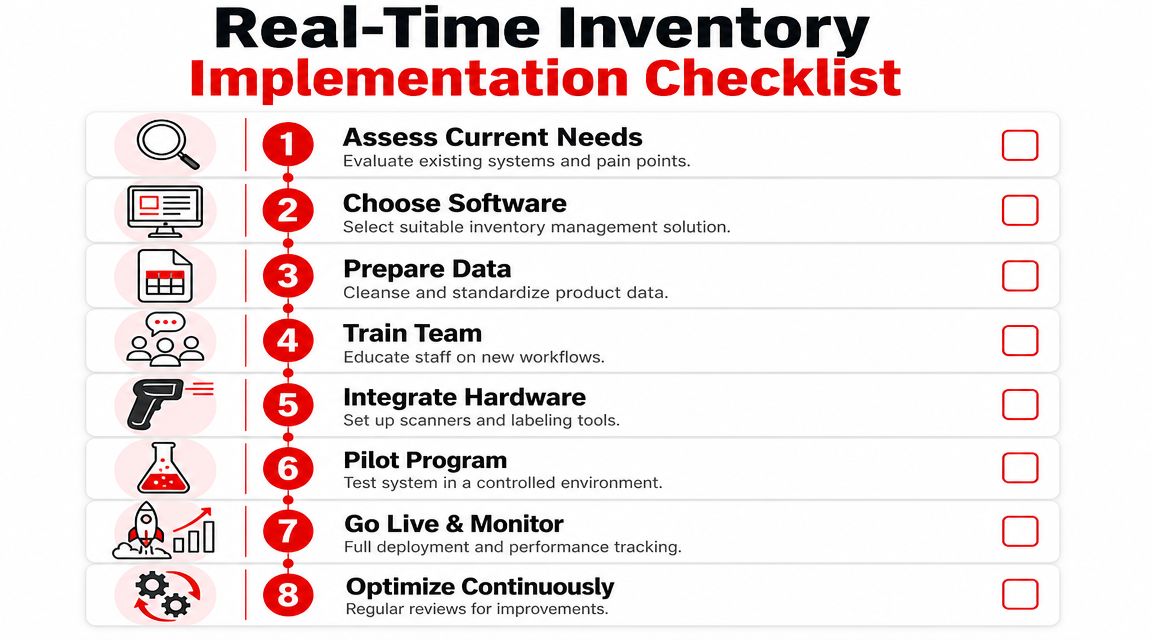
Most shops don't fail because the software is weak. They fail because they try to digitize a loose process. The better approach is to tighten the workflow first, then configure the system around it.
Start with process before software setup
Begin with a hard look at what's happening now. Where do counts go wrong. Who receives parts. Who can pull stock. How are returns handled. Which items get used without being billed. Those gaps matter more than feature lists.
Then choose software that connects inventory directly to the rest of the shop workflow. For example, RedAppy's features include parts ordering across multiple suppliers, real-time inventory, repair-order-based deductions, analytics, and a digital shop board. That type of connected workflow is what matters. Not whether the inventory screen looks impressive in a demo.
A practical rollout sequence looks like this:
Run a clean opening count
The first inventory file has to be credible. Remove obsolete items, separate returns and cores, and standardize part names and units.Label the physical room
Bins, shelves, and fast-moving categories need fixed locations. A scanner can't save a parts room that changes shape every week.Set user rules
Decide who receives, who adjusts, who returns, and who can move stock between jobs or locations.
Build the system around daily shop behavior
Once the basics are clean, configure the details that drive day-to-day accuracy.
- Add suppliers carefully: Use consistent naming and account setup so purchase history stays clean.
- Set reorder points by usage pattern: Fast-moving maintenance items should behave differently from uncommon special-order components.
- Train around actual tasks: Receiving, allocating, billing, returning, and transferring should each have a simple standard process.
- Pilot one area first: Start with stocked parts and fluids before trying to perfect every supply item in the building.
- Review exceptions weekly: Negative stock, frequent adjustments, and unbilled usage are process failures that need correction.
A shop should also expect some resistance at first. Teams often say scanning slows them down. In reality, bad inventory slows them down far more. The solution isn't more reminders. It's making the correct action the easiest action.
The fastest inventory process is the one the team will actually follow during a busy day.
When the setup is right, the shop stops relying on memory, side notes, and end-of-day cleanup. That's when the system starts producing useful purchasing and profit data instead of just recording mistakes faster.
Avoiding Common Inventory Management Mistakes
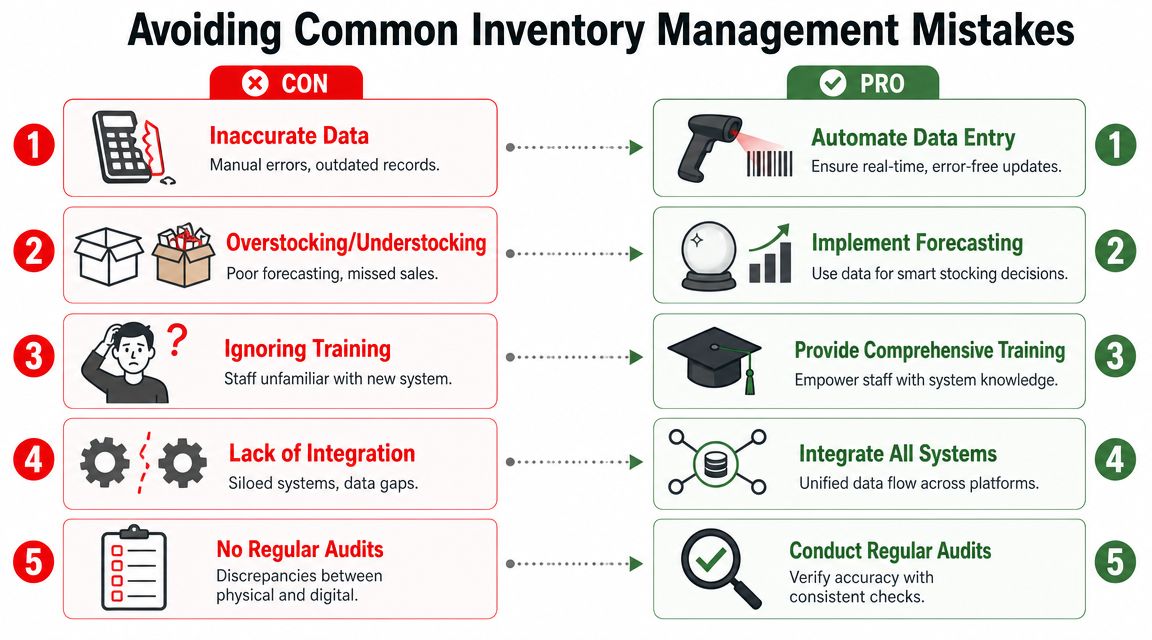
The biggest mistake shops make is assuming software alone fixes inventory. It doesn't. Software records behavior. If the behavior is sloppy, the system will produce sloppy data at high speed.
The failures that break accuracy fastest
The first failure is inconsistent data entry. One person scans receiving. Another just puts the part on the shelf. A technician grabs supplies without assigning them to a job. An advisor closes an invoice before the final parts change is entered. The system can't stay accurate under that kind of mixed discipline.
The second failure is poor exception handling. Returns, warranty swaps, cores, special orders, and branch transfers are where good intentions usually collapse. Neutral enterprise guidance notes that true real-time inventory depends on continuous data exchange, standardized formats across locations, reliable connectivity, and automated exception handling. Those are the operational hurdles many teams underestimate, as outlined in.
The third failure is treating multi-supplier purchasing as a manual chore. If each vendor has different naming, packaging, or workflow habits inside the shop, inventory becomes difficult to trust.
What disciplined shops do differently
Strong shops keep the rules simple and visible:
- One receiving method: Every delivered item follows the same check-in process.
- One source of truth: The repair order and inventory system stay connected. Side lists and handwritten backups don't control stock.
- Clear status handling: Available, allocated, returned, core, and transfer items should never be mixed together.
- Routine cycle checks: Small, regular audits catch drift before it becomes a month-end surprise.
If the team needs exceptions every day, the process wasn't designed for the way the shop actually works.
Another common mistake is trying to track everything with the same intensity. A shop doesn't need identical handling for a high-value module, a shop towel, and a bottle of brake cleaner. It does need a clear rule for what gets scanned, what gets billed automatically, and what gets reviewed through periodic controls.
Accuracy usually improves when the process gets simpler, not more complicated. Shops that win at inventory remove ambiguity. They don't write longer policy documents.
Stop Counting Parts and Start Driving Profit
A parts room should support production, not fight it. When inventory is delayed, inaccurate, or disconnected from repair orders, the shop pays for it through idle labor, extra ordering, messy scheduling, and missed billing.
Real time inventory management solves a problem that auto repair shops feel every day. It keeps parts tied to live jobs, gives advisors current information, helps managers control stock across suppliers and locations, and reduces the expensive habit of ordering extra just because nobody trusts the numbers.
This isn't an admin upgrade. It's an operations upgrade. A shop with accurate live inventory can plan better, quote better, buy better, and finish work faster. That's what turns the parts room from a cost center into a profit tool.
For owners and managers who are tired of chasing missing parts, correcting invoices, and carrying stock that shouldn't be there, the next move is simple. Put the process in place, connect it to the repair order, and make every part movement visible at the moment it happens.
RedAppy gives auto repair shops one system for parts ordering, repair orders, invoicing, shop workflow, and real-time inventory. Shops that want to see how that fits their operation can review RedAppy or reach out through the contact page to discuss their workflow.
Ready to Transform Your Shop?
RedAppy helps auto repair shops create professional digital estimates with photos and videos, send them instantly via text or email, and get customer approvals in seconds. No credit card required to start.