
Reducing No-Show Rates: A Guide for Auto Repair Shops
A technician is standing by. The lift is open. The parts were ordered yesterday. The front counter built the morning around a vehicle that never arrived. That missed appointment doesn't just leave one gap on the calendar. It throws off technician flow, slows parts decisions, and forces the team to scramble for the next profitable job.
Reducing no-show rates works best when a shop stops treating the problem as a reminder problem alone. The better frame is an appointment workflow. Booking has to be clear. The customer has to make a real commitment. Communication has to be timely and easy to act on. The shop has to protect capacity when someone cancels late or disappears. Then the team has to measure what improved.
Across healthcare settings, missed-appointment rates commonly fall between 5% and 30%, with an average of about 23% across appointments, according to. Auto repair works differently, but the operational lesson is the same. Shops need a system, not a slogan.
The nine strategies below work best when they're tested against show rates, reschedules, cancellations, technician utilization, and customer experience. RedAppy can support that workflow with online booking, customer and vehicle records, scheduling visibility, payments, and analytics. Shops that want to map the process in software can review the RedAppy features or contact the team to discuss fit.
Table of Contents
- 1. Automated Appointment Reminders and Confirmations
- 2. Clear Cancellation and Rescheduling Policies
- 3. Requiring Upfront Deposits or Payment Authorization
- 4. Strategic Double-Booking and Buffer Time Management
- 5. Personalized Customer Outreach and Relationship Building
- 6. Immediate Confirmation Callbacks or SMS Verification
- 7. Online Booking With Real-Time Availability and Appointment Types
- 8. Segmented Scheduling Based on Customer Reliability History
- 9. Incentive Programs and Loyalty Rewards for Attendance
- 9-Strategy Comparison: Reducing No-Shows
- Build a No-Show System You Can Measure and Improve
1. Automated Appointment Reminders and Confirmations
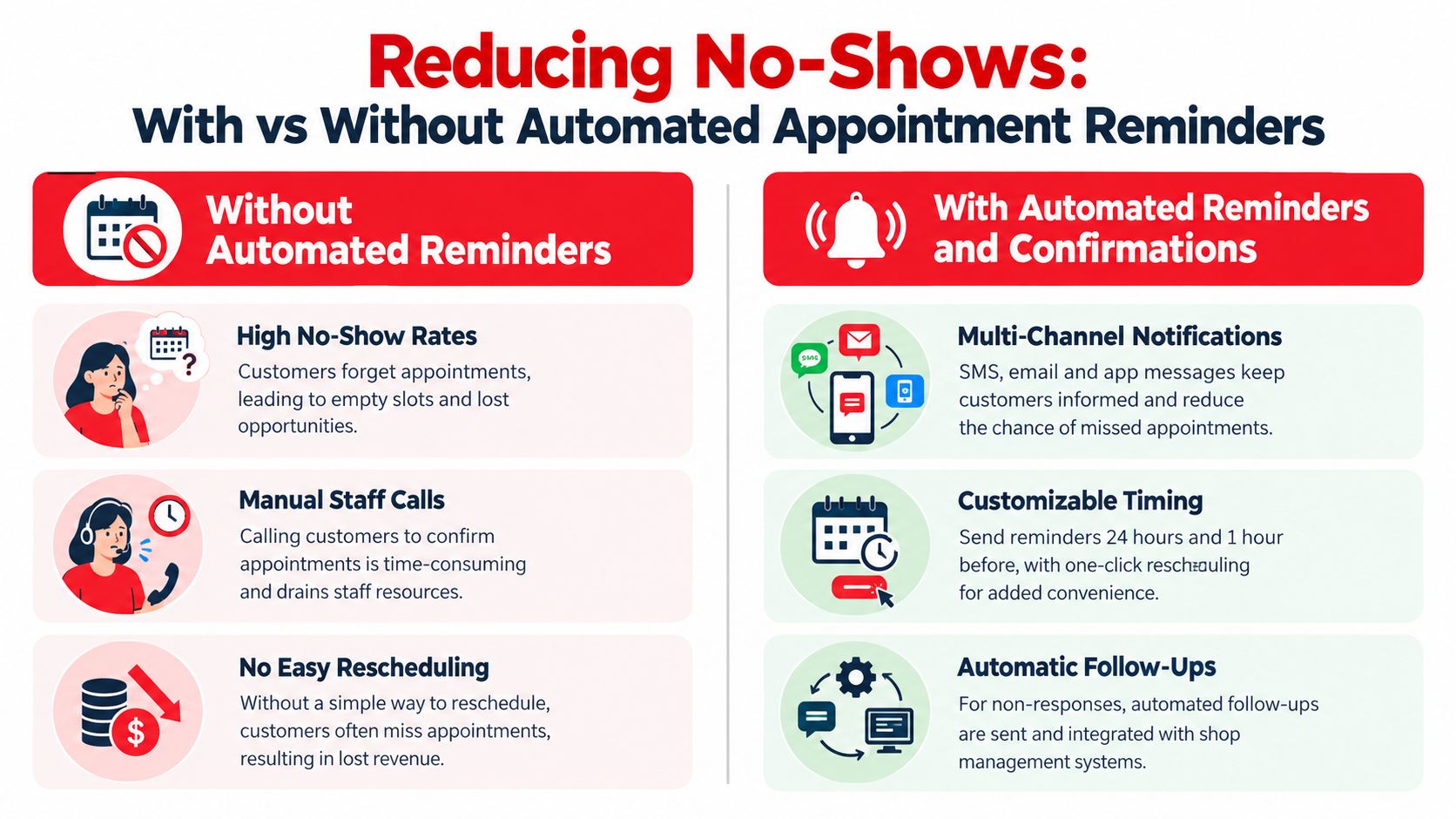
Automated reminders earn their place because forgetting is still a common reason people miss appointments. A repair shop that sends nothing is relying on the customer to remember a service slot while work, school pickup, and daily errands compete for attention. That usually isn't a winning bet.
A good reminder doesn't just repeat the date and time. It restates the service, expected drop-off time, and a simple path to confirm or reschedule. If the customer has to call, wait, and explain the whole situation again, the reminder creates friction instead of removing it.
Use reminders to trigger action
A randomized primary care study found that reminder systems reduced no-shows from 24% in the no-reminder group to 14% with either computer-generated letters or telephone reminders, according to. That matters for repair shops because the core behavior is similar. Pre-visit contact changes attendance.
The trade-off is that more reminders aren't automatically better. Too many messages can feel spammy, and a vague reminder sent at the wrong time gets ignored. Most shops do better with a small sequence that gives the customer time to react.
- Send the first reminder early enough: Give customers enough notice to move work or family plans without turning the appointment into background noise.
- Include the job summary: “Brake inspection” or “oil change and tire rotation” is more concrete than “service appointment.”
- Offer one-step rescheduling: If the customer can't make it, the slot should become reusable as fast as possible.
Practical rule: A reminder should either secure a yes or free the slot early enough to refill it.
For a shop using software like RedAppy, reminders work best when they're tied to the actual appointment record, vehicle, and advisor notes. That keeps the message accurate and makes confirmed appointments visible to the whole team.
2. Clear Cancellation and Rescheduling Policies
Many no-shows are really unmanaged cancellations. The customer knew there was a conflict, but the shop didn't make it easy or important enough to say so in advance. A clear policy fixes part of that problem by setting expectations before the booking is complete.
That policy should be visible on the website, mentioned during phone booking, and repeated in confirmation messages. Shops don't need legalistic language. They need plain language customers can understand in a few seconds.
Make rescheduling easier than disappearing
The strongest policy isn't the harshest one. It's the one customers can follow. If someone can click to move an appointment instead of calling during business hours, the shop gets the slot back sooner and keeps the relationship intact.
A useful message sounds like this: if plans change, let the shop know early so the team can reassign technician time and offer the opening to another customer. That explanation helps customers see the operational reason, not just the rule.
Shops can also reinforce the process with outside reading when training advisors on message style. offers practical examples of reminder and follow-up language.
Shops usually lose more money from silent no-shows than from reasonable flexibility on the first late change.
The trade-off is consistency versus discretion. A rigid rule protects the calendar, but front-desk teams still need room to handle emergencies, repeat customers, and legitimate problems without turning every missed visit into an argument.
3. Requiring Upfront Deposits or Payment Authorization
Deposits and card authorization change the tone of the appointment. The booking becomes a commitment, not a placeholder. That matters most for longer diagnostic slots, specialty work, mobile services, or appointments that block a bay for a meaningful part of the day.
This approach isn't right for every service. Requiring a deposit for a quick oil change may create more friction than value. Requiring one for an extended diagnostic appointment, pre-ordered parts job, or performance install often makes more sense.
Apply deposits selectively
The mistake is using deposits as a blunt instrument. Better shops apply them where the risk and cost of a no-show are highest. A first-time customer booking a half-day electrical diagnostic isn't the same as a regular customer coming in for routine maintenance.
A solid policy includes three points:
- Explain what the payment does: Tell the customer whether it holds the slot, applies to the invoice, or covers late cancellation risk.
- State refund terms clearly: Customers should know what happens if they reschedule with enough notice.
- Match the rule to the job size: Bigger commitment from the shop should mean bigger commitment from the customer.
A shop management system helps here because the authorization, appointment notes, and customer history should live in the same place. If the advisor has to bounce between separate tools, collection gets messy and enforcement gets inconsistent.
Deposits don't reduce no-shows by magic. They work because they force a clearer agreement. The customer knows the time is reserved, the shop knows the card is on file, and both sides understand what happens if the plan changes.
4. Strategic Double-Booking and Buffer Time Management
Some no-shows will still happen even in a well-run process. That means the schedule itself has to absorb some risk. Strategic double-booking and buffer time can protect technician productivity, but this is one of the easiest tactics to misuse.
Blind overbooking creates a different problem. Instead of one empty bay, the shop ends up with too many cars arriving at once, backed-up estimates, and angry customers waiting for updates. The answer isn't aggression. It's pattern-based scheduling.
Protect labor without wrecking the front counter
A shop should review which appointment types reliably start on time, which jobs often turn into larger work, and which time slots produce the most flakes. Then it can decide where a small overlap is safe.
For example, two light-intake appointments might fit the same early window if one usually becomes a waiter estimate and the other is a simple drop-off. Two heavy diagnostic jobs probably shouldn't.
- Use buffers around uncertain work: Diagnostics, electrical issues, and used-car inspections often need breathing room.
- Keep a short-notice list: Customers waiting for an opening can help fill space without overloading the schedule.
- Review advisor capacity too: A shop can have enough technician hours and still fail because write-ups pile up at the counter.
A practical scheduling board matters here. When the team can see drop-offs, waiting jobs, in-progress work, and pickup timing in one view, capacity decisions get better. That's one reason a visual workflow board inside the shop system is more useful than a basic calendar alone.
5. Personalized Customer Outreach and Relationship Building
Automation handles volume. Personal outreach handles uncertainty. When a customer sounds hesitant, has missed before, or is booking expensive work, a real conversation often beats another generic text.
This isn't about being overly casual. It's about reducing ambiguity. The advisor confirms the reason for the visit, expected drop-off process, likely timing, and any concerns that could turn into a last-minute no-show.
Human outreach works better for the risky appointments
A randomized outpatient study found that staff-delivered appointment reminders reduced no-shows to 13.6%, compared with 17.3% for automated reminders and 23.1% with no reminder, according to The American Journal of Medicine study on staff versus automated reminders00108-7/fulltext). For repair shops, the lesson is straightforward. Human contact is more expensive, so it should be saved for the appointments where it can change the outcome.
That usually includes first-time customers, large repair authorizations, customers with a prior no-show, and jobs that require ordered parts or dedicated diagnostic time.
A live call isn't just a reminder. It's a screening step for confusion, hesitation, and hidden objections.
Strong outreach sounds specific. The advisor mentions the vehicle, last conversation, and what the shop is preparing for. That tells the customer the appointment is real and gives them an easy opening to say, “That time won't work anymore.”
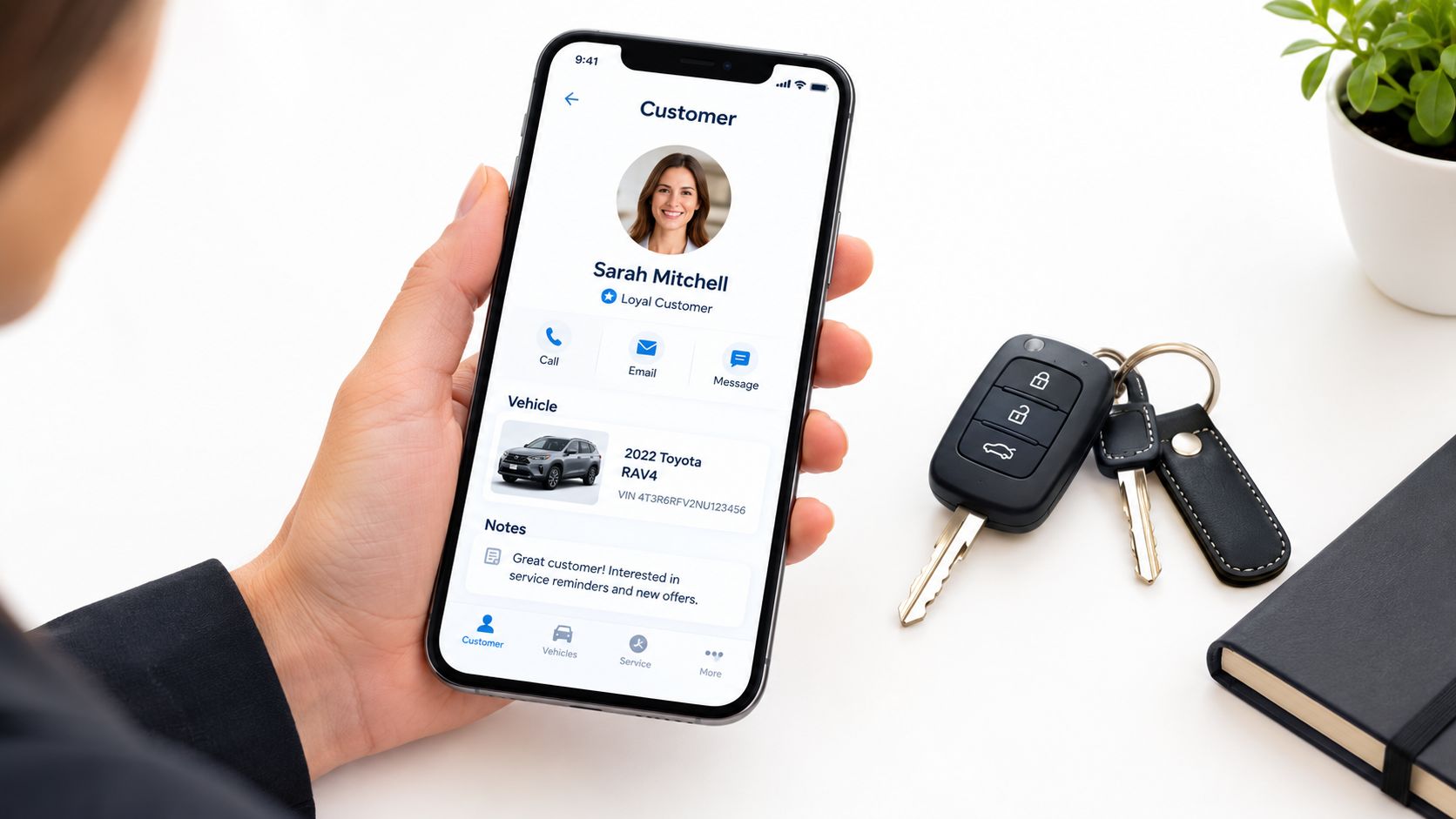
Relationship notes matter. If a customer prefers text, works night shift, needs early drop-off, or usually approves work through a spouse, that should sit in the customer record for the next visit. Personalized service isn't about memory alone. It's about storing useful context where the next staff member can use it.
6. Immediate Confirmation Callbacks or SMS Verification
The fastest way to catch a weak appointment is right after it's booked. If the number is wrong, the customer misunderstood the service, or the timing doesn't really work, the problem is easiest to fix while the booking is still fresh.
A quick confirmation callback or SMS verification turns a soft hold into an active yes. This is especially useful when appointments come in through a website form, after-hours inquiry, or a rushed phone call during a busy front-counter stretch.
Verify before the reminder window
A randomized trial of high-risk targeting showed that a patient care coordinator's phone call seven days before the visit reduced no-shows from 29.2% in the control arm to 22.8% in the intervention arm, according to. The repair-shop equivalent is simple. The earlier a questionable appointment is confirmed, the more time the shop has to repair the schedule.
This doesn't need to be a long conversation. It can be a short message asking the customer to confirm the vehicle, service concern, and arrival time.
- Verify contact details: Bad phone numbers and mistyped emails ruin the whole reminder chain.
- Confirm the actual concern: “Check engine light diagnosis” and “quick oil change” require different slot planning.
- Set the arrival expectation: Customers who know whether they're waiting, dropping off, or authorizing inspection by phone are less likely to disappear.
Teams that want to automate this kind of early outreach can study ideas from. The important part isn't the channel. It's getting a deliberate confirmation soon after booking.
7. Online Booking With Real-Time Availability and Appointment Types
A customer books online at 10:30 p.m. for “service,” shows up expecting to wait, and the job is a drivability diagnosis that needs more time, a different technician, and a call for authorization. That appointment was always at risk.
Online booking helps reduce no-shows when it removes that kind of mismatch at the start. The goal is not just convenience. The goal is a booking flow that asks for the right information, shows appointment options the shop can support, and gives the customer a clear commitment the moment they reserve a slot.
Analysts at NextPatient found lower no-show rates with online self-scheduling than phone booking in healthcare settings, according to. For repair shops, the useful lesson is operational: customers are more likely to keep an appointment when they pick a real time, choose a defined service category, and receive a confirmation that matches what will happen on arrival.
The setup matters more than the widget on the website.
Shops get better attendance from online booking when the schedule is structured around actual capacity:
- Show real-time availability: Open only the slots the shop is prepared to honor, based on bays, technician mix, and advisor coverage.
- Use specific appointment types: Oil service, brake inspection, warning light diagnosis, tire work, and pre-purchase inspections need different time assumptions.
- Collect working intake details: Vehicle year, make, model, plate or VIN, primary concern, and whether the customer plans to wait or drop off.
- Confirm the next step immediately: Send a clean summary with date, time, service request, and arrival instructions as soon as the appointment is booked.
There is a trade-off. A shorter booking form gets more completions, but a vague form creates bad appointments that either no-show, arrive unprepared, or clog the front counter while staff sort out basics. I usually favor a slightly stricter form if it saves advisor time and protects technician hours later.
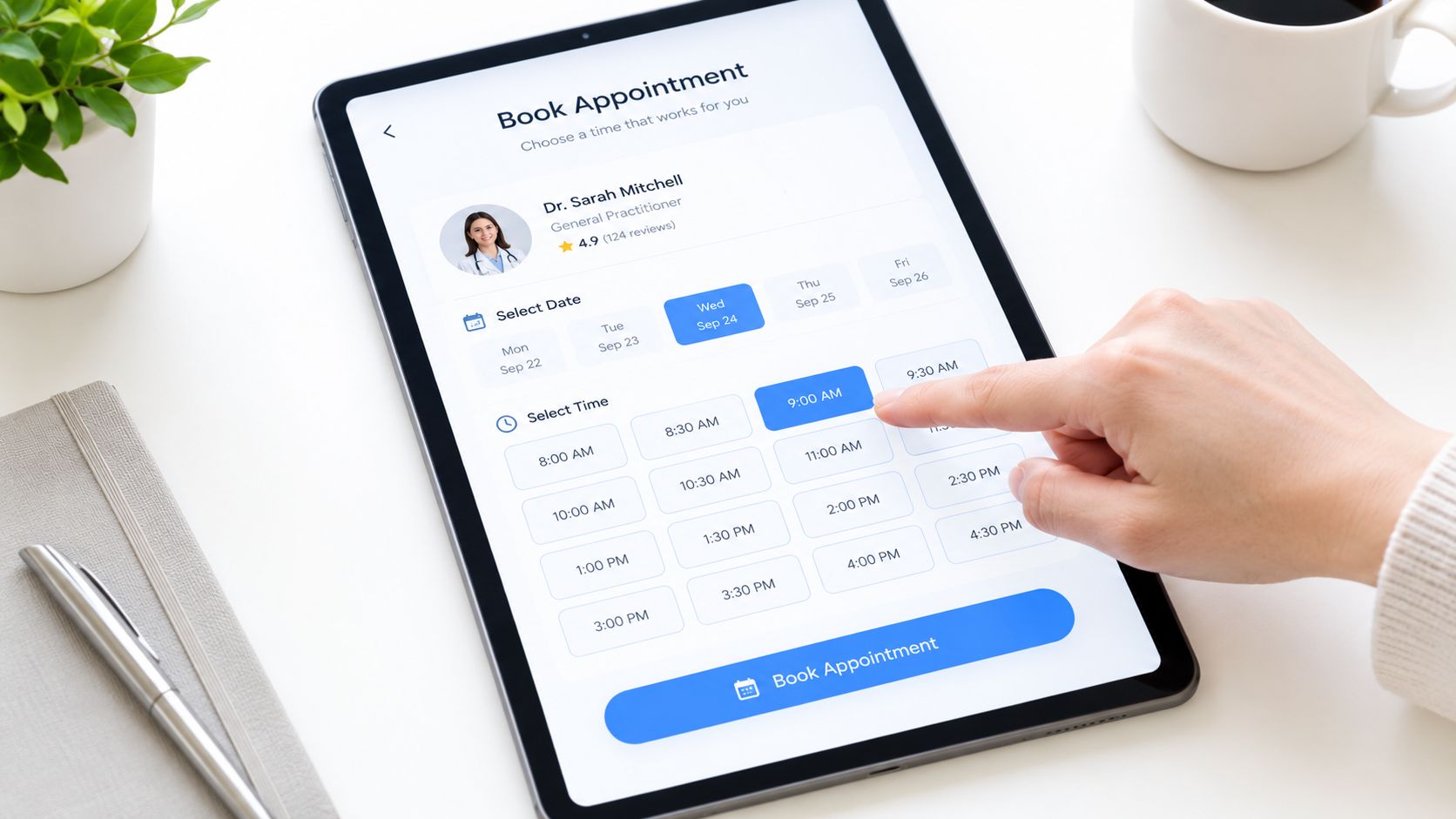
A system like RedAppy is useful when online booking feeds the same customer and vehicle record used for scheduling, estimates, and payments. That cuts double entry and keeps the front desk from rebuilding appointments by hand.
8. Segmented Scheduling Based on Customer Reliability History
Monday at 8:00 looks full on the calendar. By 8:20, one regular is already in the waiting area, one first-time customer has not confirmed, and another customer has missed two past appointments. Those three jobs should not sit in the schedule with the same assumptions behind them.
Reliability history is scheduling data. Shops that use it well stop treating no-show prevention like a reminder problem and start handling it as appointment control.
A pragmatic randomized study using a high-risk no-show prediction model found that adding a second text reminder reduced missed visits versus one text reminder. In primary care, no-shows fell from 9.1% to 8.4%, and in mental health visits the chance of no-show fell by 11%, according to. The useful takeaway for a repair shop is straightforward. Extra follow-up works better when it is aimed at higher-risk appointments instead of sent to every customer on the board.
In practice, I would sort customers into simple operating groups inside the scheduler, not build a complicated scoring model the staff will ignore.
Reliable repeat customers can book farther out and usually fit standard reminder timing.
Unproven customers need a little more control. Confirm earlier, avoid giving away the tightest peak-hour slots, and make sure the service type is clear before the job locks into the day.
Higher-risk customers need protection around the appointment. That can mean a deposit, a shorter booking window, a same-day confirmation requirement, or placing them in slots that will hurt less if they disappear.
The trade-off is real. If the shop gets too strict, good customers feel friction and the front desk spends time defending rules. If the shop stays too loose, technicians lose billable hours and advisors scramble to refill empty time. The goal is not to punish people with a spotty history. The goal is to match the amount of commitment and follow-up to the amount of scheduling risk.
This works best when the customer record shows missed appointments, late cancellations, and preferred contact method in one place. Then the service advisor can decide, at the time of booking, whether the job gets standard handling or added controls. That is how no-show reduction becomes part of the workflow instead of a last-minute reminder blast.
9. Incentive Programs and Loyalty Rewards for Attendance
A full Tuesday schedule looks solid on Monday night. By noon the next day, two customers have not shown up, one canceled late, and the front desk is trying to patch open time with waiters and deferred work. A simple attendance reward will not fix weak scheduling on its own, but it can reinforce the behavior that keeps the calendar usable.
The shops that get value from incentives treat them as part of the appointment workflow. The reward comes after the customer keeps the commitment. That matters because pre-appointment perks are easy to abuse, while post-visit benefits support the habits the shop wants, such as confirming promptly, arriving on time, and following through on approved work.
One study reported a 2.43% no-show rate across 1,193 appointments and found no statistically significant difference between phone, email, and SMS reminders in that sample, according to. For a repair shop, the useful takeaway is operational. Preference and convenience affect follow-through. If the customer record already stores contact method, visit history, and appointment outcomes, the shop can attach attendance rewards to the same record instead of running a separate promotion no one tracks.
What works best is usually boring, which is good.
Priority access to strong time slots, faster check-in, a small loyalty credit after completed visits, or waived minor convenience fees tend to outperform broad discounts because they protect margin and support how the schedule runs day to day. A free-for-all coupon program can fill the board with low-commitment appointments. A reliability-based perk does the opposite. It gives the best scheduling access to the customers who are least likely to waste it.
A workable setup usually follows three rules:
- Reward completed appointments, not bookings
- Offer perks the advisor can apply in seconds
- Set a clear threshold, such as a streak of kept visits or a defined number of completed services
There is a trade-off here. If the reward is too small, customers will not notice it. If it is too generous, the shop gives away margin for behavior that reliable customers would have delivered anyway. In my experience, scheduling perks are the cleanest option because they cost less than discounts and directly improve capacity use.
The benefit is cumulative. Over time, the program helps the shop separate dependable customers from customers who need tighter controls, while giving the front desk one more reason to ask for confirmation and one more data point to track inside the shop management system.
9-Strategy Comparison: Reducing No-Shows
| Solution | Implementation 🔄 | Resources ⚡ | Expected Outcomes ⭐ | Ideal Use Cases 📊 | Key Advantages 💡 |
|---|---|---|---|---|---|
| Automated Appointment Reminders and Confirmations | Medium, multi‑channel setup & integration 🔄 | Low–Medium, software + contact data ⚡ | Reduces no-shows 15–40%; improves confirmations ⭐⭐⭐⭐ | Dental, healthcare, auto shops with customer contact info 📊 | Scalable automation; low staff effort; measurable engagement 💡 |
| Clear Cancellation and Rescheduling Policies | Low, policy creation & communication 🔄 | Low, staff training and documentation ⚡ | Discourages last‑minute cancellations; moderate fee revenue ⭐⭐⭐ | Any appointment business needing clear expectations 📊 | Sets expectations; reduces disputes; fair revenue from fees 💡 |
| Requiring Upfront Deposits or Payment Authorization | Medium–High, payment integration & policy design 🔄 | Medium, payment processors, refund handling, compliance ⚡ | Large no‑show reduction (often 50%+); predictable revenue ⭐⭐⭐⭐⭐ | High‑value services, specialists, aesthetics 📊 | Strong financial commitment; compensates lost revenue; filters no‑shows 💡 |
| Strategic Double-Booking and Buffer Time Management | High, data analysis & dynamic scheduling 🔄 | Medium, advanced scheduling tools and monitoring ⚡ | Improves utilization; reduces idle time but risk of conflicts ⭐⭐⭐ | High‑volume shops with historical no‑show data 📊 | Maximizes technician use; smooths revenue fluctuations 💡 |
| Personalized Customer Outreach and Relationship Building | Medium, CRM use and staff processes 🔄 | High, time‑intensive staff effort and training ⚡ | Increases loyalty and attendance; higher LTV ⭐⭐⭐⭐ | Luxury services, repeat customers, relationship‑based shops 📊 | Builds loyalty; long‑term retention; fewer repeat no‑shows 💡 |
| Immediate Confirmation Callbacks or SMS Verification | Medium, callback workflows and scripts 🔄 | Medium, staff time or automated SMS tools ⚡ | Catches bad contacts; reduces no‑shows 15–25%; clarifies expectations ⭐⭐⭐ | High‑value or complex appointments where details matter 📊 | Verifies contact info; prevents misbookings; personal touch 💡 |
| Online Booking with Real‑Time Availability and Appointment Types | Medium, platform setup and sync with schedule 🔄 | Medium, booking system + maintenance ⚡ | Reduces booking errors; 20–30% fewer no‑shows; 24/7 access ⭐⭐⭐⭐ | Businesses wanting self‑service bookings and fewer staff bookings 📊 | Captures detailed info upfront; lowers staff workload; searchable records 💡 |
| Segmented Scheduling Based on Customer Reliability History | High, analytics, segmentation & rules engine 🔄 | Medium–High, CRM/analytics and ongoing analysis ⚡ | Targeted no‑show reduction; efficient resource allocation ⭐⭐⭐⭐ | Shops with sufficient historical data and CRM capability 📊 | Focuses resources on high‑risk bookings; tailors interventions 💡 |
| Incentive Programs and Loyalty Rewards for Attendance | Medium, program design, tracking & communications 🔄 | Medium, reward costs and program administration ⚡ | Boosts repeat visits and punctuality; measurable retention gains ⭐⭐⭐ | Retail/service businesses focused on long‑term customer value 📊 | Positive reinforcement; increases repeat business and referrals 💡 |
Build a No-Show System You Can Measure and Improve
Reducing no-show rates gets easier when the shop stops chasing isolated fixes and starts building a sequence. First, tighten the booking itself. Make sure the appointment type is clear, the vehicle details are complete, the cancellation policy is visible, and the customer understands what happens next. Weak bookings create weak attendance.
Next, add immediate confirmation and timed reminders. Immediate verification catches wrong numbers, vague concerns, and low-commitment bookings while there's still time to adjust. Timed reminders then reinforce the plan and give customers a low-friction way to confirm, cancel, or reschedule before the slot is wasted.
After that, use stronger controls only where they make sense. Deposits, card authorization, and live advisor outreach work best on higher-risk or higher-cost appointments. Shops usually get better results from targeted escalation than from putting every customer through the same rigid process. The same logic applies to schedule protection. A careful mix of buffers, waitlists, and selective overlap can keep technicians productive without overloading the front counter.
The measurement side matters just as much as the tactics. Shops should track booked appointments, confirmed appointments, cancellations, no-shows, reschedules, and channel engagement. They should also review technician utilization, especially by service type, time slot, and customer segment. If brake inspections almost always show up but diagnostic appointments drift, the follow-up process shouldn't be the same for both.
A simple scorecard can reveal which changes are real improvements and which ones just create more admin work. If a second reminder increases confirmations but doesn't improve actual arrivals, that workflow may need to change. If a deposit policy reduces missed diagnostics but also hurts booking volume for routine services, it may need tighter targeting.
Testing one change at a time keeps the signal clear. Adjust reminder timing. Then review. Add card authorization for selected jobs. Then review. Shorten the online booking window for high-risk appointments. Then review. Shops that change everything at once usually can't tell which step helped.
For teams that want one system to support that workflow, RedAppy is one relevant option. Its scheduling visibility, customer and vehicle records, online payments, analytics, and workflow tools fit the operational side of reducing missed appointments. Shops can review the platform on the RedAppy features page or contact the RedAppy team to discuss how it may fit their process.
RedAppy gives repair shops a connected way to manage the appointment flow behind reducing no-show rates, from online booking and customer records to scheduling visibility, payments, and analytics. That makes it easier to confirm the right jobs, catch weak appointments early, and see what's improving. Visit RedAppy to see how the platform fits day-to-day shop operations.
Ready to Transform Your Shop?
RedAppy helps auto repair shops create professional digital estimates with photos and videos, send them instantly via text or email, and get customer approvals in seconds. No credit card required to start.