
Service Writer Duties: Drive Shop Efficiency & Trust
The front counter gets messy fast. The phone rings while a customer wants a price, a technician needs approval, a parts delay changes the whole schedule, and another customer is already asking why the car isn't ready yet. In that moment, the shop doesn't run on tools alone. It runs on the person controlling the information.
That's why service writer duties matter so much. A strong service writer isn't just checking customers in and out. That person is the communication hub, the workflow controller, and in many shops, the difference between a profitable day and a chaotic one. When the role is handled well, technicians stay productive, customers stay informed, estimates get approved, and the front desk stops creating bottlenecks.
Table of Contents
- The Service Writer Is Your Shop's Quarterback
- The Core Service Writer Duties Explained
- A Day in the Life A Typical Workflow
- Skills That Separate Great Service Writers from Good Ones
- Measuring Success KPIs for Service Writers
- Streamlining Duties with Shop Management Software
- Sample Job Description and SOP Checklist
The Service Writer Is Your Shop's Quarterback
At 8:10 a.m., two cars are waiting, a technician is asking about parts on yesterday's job, the phone is ringing, and a customer wants to know why their vehicle is not ready. In that moment, the service writer is setting the pace for the whole shop. This role sits at the center of communication, timing, and money flow.
Shops that treat the service writer like a cashier usually stay stuck in rework, delays, and avoidable comebacks. Shops that treat the role like an operating seat get cleaner repair orders, faster approvals, better bay utilization, and fewer surprises at the counter. The service writer connects the customer, technician, parts process, schedule, warranty questions, and final invoice into one system that has to hold together under pressure.
When that seat is weak, the losses show up fast. Technicians lose time chasing unclear write-ups. Parts decisions happen late. Promised times slip because nobody reset expectations early. Owners and managers get pulled into problems the front counter should have contained.
A strong service writer changes the economics of the day. Better notes cut wasted diagnostic time. Better updates improve approval rates. Better scheduling keeps work moving through the bays instead of stacking up in the parking lot. This is one of the few positions in the shop that affects gross profit, technician productivity, and customer retention at the same time.
Practical rule: If the service writer is only taking messages, the shop is already giving up profit.
The role is closer to dispatch and operations than reception. The service writer's primary function is to control the flow of information, authorizations, and timing from check-in to pickup. That includes documenting concerns clearly, setting realistic next steps, filtering noise before it reaches the technician, and keeping the customer confident while the shop works through the job.
That same front-line coordination shows up in other support roles too. Anyone building process-driven desk positions can learn something from, especially the point that the person managing inputs often has outsized influence on final output quality.
What the role actually controls
Three areas decide whether the day stays on track:
- Information quality. Clear write-ups help technicians diagnose faster and avoid preventable miscommunication.
- Customer confidence. Clear explanations and timely updates reduce stalled approvals and friction at pickup.
- Operational pace. Early parts checks, realistic scheduling, and disciplined follow-up keep bays producing.
Treat the position like a profit center with operational responsibility, and the rest of the shop usually tightens up with it.
The Core Service Writer Duties Explained
The core of service writer duties isn't paperwork. It's moving a repair order from concern to completion without losing accuracy, time, or trust.
Customer intake and first impressions
The job starts the second the customer arrives or calls. A good service writer listens for symptoms, not just requests. Customers often report the effect, not the cause. “It shakes on the highway” isn't a diagnosis. It's a starting point.
The service writer's first duty is to gather usable detail, then turn it into something the shop can act on. That includes confirming symptoms, checking visible conditions when appropriate, discussing maintenance history, and making sure the concern is documented clearly enough that the technician isn't guessing later.
A weak intake sounds like this:
- Bad write-up: “Check brakes”
- Better write-up: “Grinding noise during braking, stronger from left front, customer notices it most during low-speed stops”
That difference matters because a service writer's ability to translate a customer's symptom description into an actionable work order can reduce technician diagnostic time by 20–30% by eliminating ambiguity, according to.
Writing repair orders technicians can actually use
A repair order should answer the technician's first questions before the hood is even up. What is the complaint? When does it happen? Under what conditions? Has anyone worked on it before? Is the symptom constant or intermittent?
The service writer is doing diagnostic triage here. Not full diagnosis. Triage. That means separating vague customer language from shop-ready language.
A vague repair order forces the technician to restart the conversation that should've happened at the counter.
Useful repair orders usually include:
- Customer-stated concern in plain language
- Observed condition from intake, if verified
- Vehicle context such as mileage or relevant history
- Specific authorization status so the tech knows what can be done now
- Any timing promises already made to the customer
Estimates approvals and warranty control
A service writer also owns the financial side of the job before work begins. That means building estimates that reflect labor, parts, and materials accurately enough that the customer isn't surprised later. It also means verifying warranty and service contract coverage before the repair gets too far down the line.
The role isn't only customer-facing. It's risk control. Industry guidance for the position makes clear that service writers verify coverage, prepare repair orders, obtain customer approval signatures, and enter the repair order into the service database as part of the standard workflow in.
Done well, this prevents two expensive problems. First, unapproved work. Second, warranty denials caused by bad documentation or missing process steps.
Parts coordination and workflow follow-through
Parts coordination is one of the most overlooked service writer duties. The desk often writes the estimate, but the actual job isn't done until the needed parts are matched to the job and the timing still makes sense.
That means checking what's available, adjusting promised completion times when something changes, and keeping the technician from sitting idle because the front counter assumed a part would arrive.
A good service writer asks practical questions early:
- Is the part available now
- Is there a vendor alternative if the first option fails
- Does the promised delivery still support the labor schedule
- Should the job be split into diagnosis now and repair later
Billing records and clean handoff at pickup
The last duty is often treated like cleanup. It shouldn't be. Pickup is where the customer decides whether the shop looked organized and trustworthy.
The service writer handles billing transactions, records the corrective actions taken, explains what was done, answers final questions, and closes the repair order correctly. A sloppy closeout creates confusion that follows the shop into the next visit.
A clean pickup conversation should cover:
| Item | What the service writer should confirm |
|---|---|
| Completed work | What was approved and what was performed |
| Remaining issues | What still needs attention later |
| Warranty notes | Any applicable coverage or limits |
| Payment clarity | Final amount and line-item understanding |
| Next step | Recommended follow-up or maintenance |
Good service writer duties don't happen in isolated steps. They build one continuous chain. If the first note is weak, the estimate gets shaky. If the estimate gets shaky, approval slows down. If approval slows down, the whole shop loses pace.
A Day in the Life A Typical Workflow
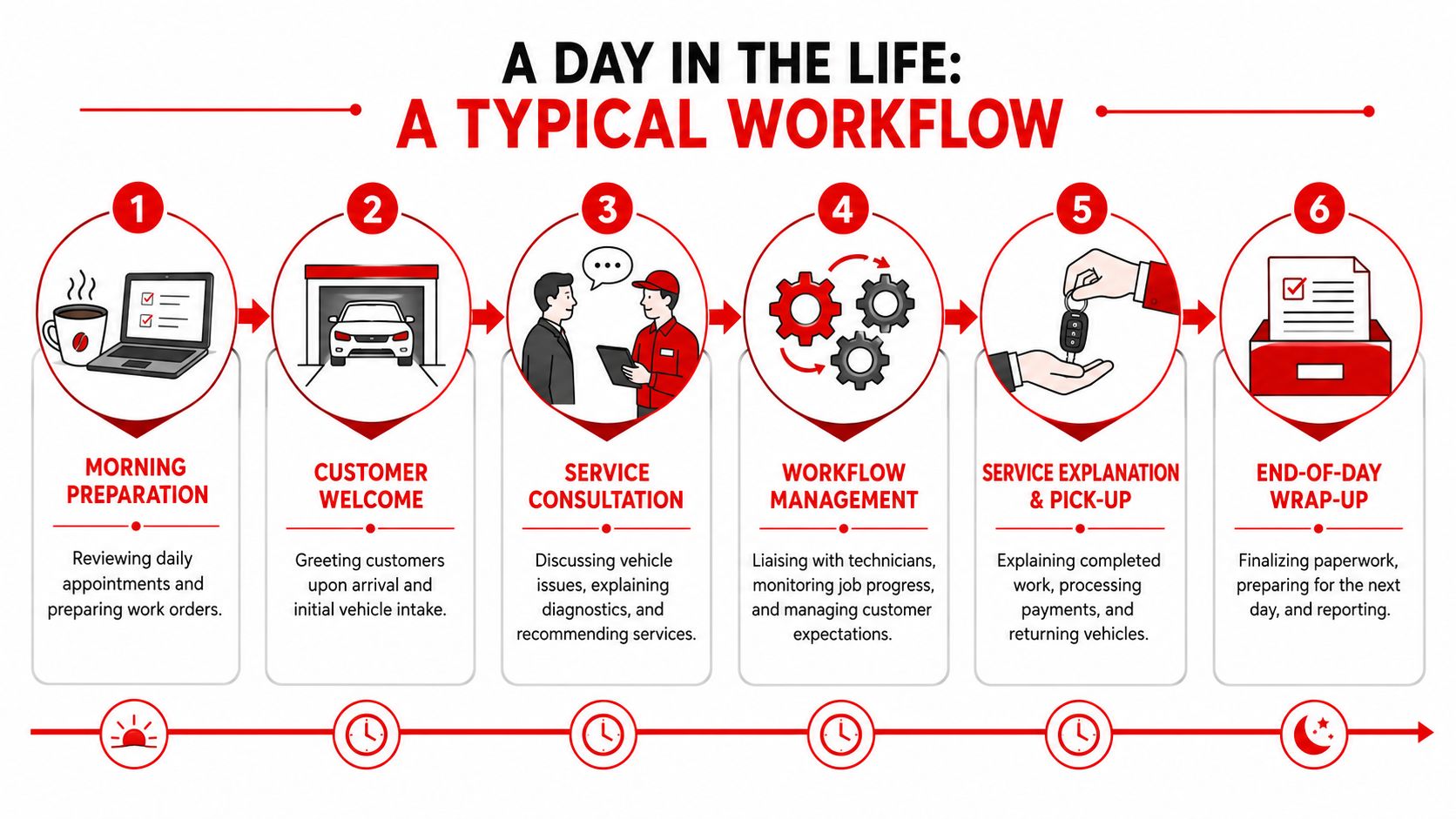
The job looks different every hour, but the strongest service writers run the day in a sequence instead of reacting to noise.
Before the doors open
The day usually starts before the customer sees it. The service writer reviews the appointment list, checks carryover work, flags vehicles waiting on parts, and makes sure open repair orders are ready for the morning rush.
A disciplined start changes the whole tone of the day. If the writer already knows which jobs are maintenance, which are diagnostics, and which may become scheduling problems, the front counter doesn't have to improvise every decision live.
The first wave of customers usually tests the system. One is early. One forgot the exact symptom. One needs a shuttle. One assumes the car will be done by lunch. The service writer keeps those conversations from turning into promises the shop can't keep.
Midday pressure and promised times
By midday, the desk turns into a control tower. Technician findings come in. Additional work needs approval. A parts ETA changes. A waiting customer asks for an update while another customer is checking in.
Timing discipline is essential. A critical part of the workflow is establishing a specific promised time for vehicle return, and that promised time has to match labor capacity, parts availability, and the actual schedule, as outlined in.
The promised time isn't a courtesy phrase. It's an operational commitment tied to the whole shop.
A weak service writer guesses. A strong one checks with dispatch, looks at workload, confirms parts, and then gives the customer a time the shop can defend.
Midday also reveals whether the writer can keep updates clean. Good updates are short, specific, and tied to a decision. The customer should know what was found, what it takes to fix it, what it costs, and how that changes completion timing.
Closing the loop before the day ends
The last stretch of the day isn't quiet. It's where loose ends either get tied up or roll into tomorrow as avoidable friction. Vehicles get picked up. Unfinished jobs need status notes. Tomorrow's appointments need a quick review.
The best service writers don't leave open questions in the system. They finalize paperwork, document what happened, note any deferred work, and prepare the next day so the morning starts from a plan instead of from memory.
A solid end-of-day routine usually includes:
- Closing open communication loops with customers still waiting on parts or approvals
- Reviewing carryover jobs so no vehicle gets lost between shifts
- Preparing next-day repair orders for known appointments
- Checking financial completeness so invoices, approvals, and records match
That rhythm is what separates a controlled front desk from a desk that survives on urgency.
Skills That Separate Great Service Writers from Good Ones
At 4:30 p.m., the phones are stacked up, two customers are waiting at the counter, one technician wants authorization, and a promised pickup is about to slip. In that moment, the service writer is not just taking messages. The writer is controlling labor flow, customer confidence, and the odds that the day closes profitably.
A good service writer keeps the front desk moving. A great one acts as the hub between customer, technician, parts, and schedule. That role has measurable impact. Better write-ups reduce lost technician time. Better updates improve approvals. Better judgment protects gross profit and keeps tomorrow from starting with today's mistakes.
Hard skills that keep the desk accurate
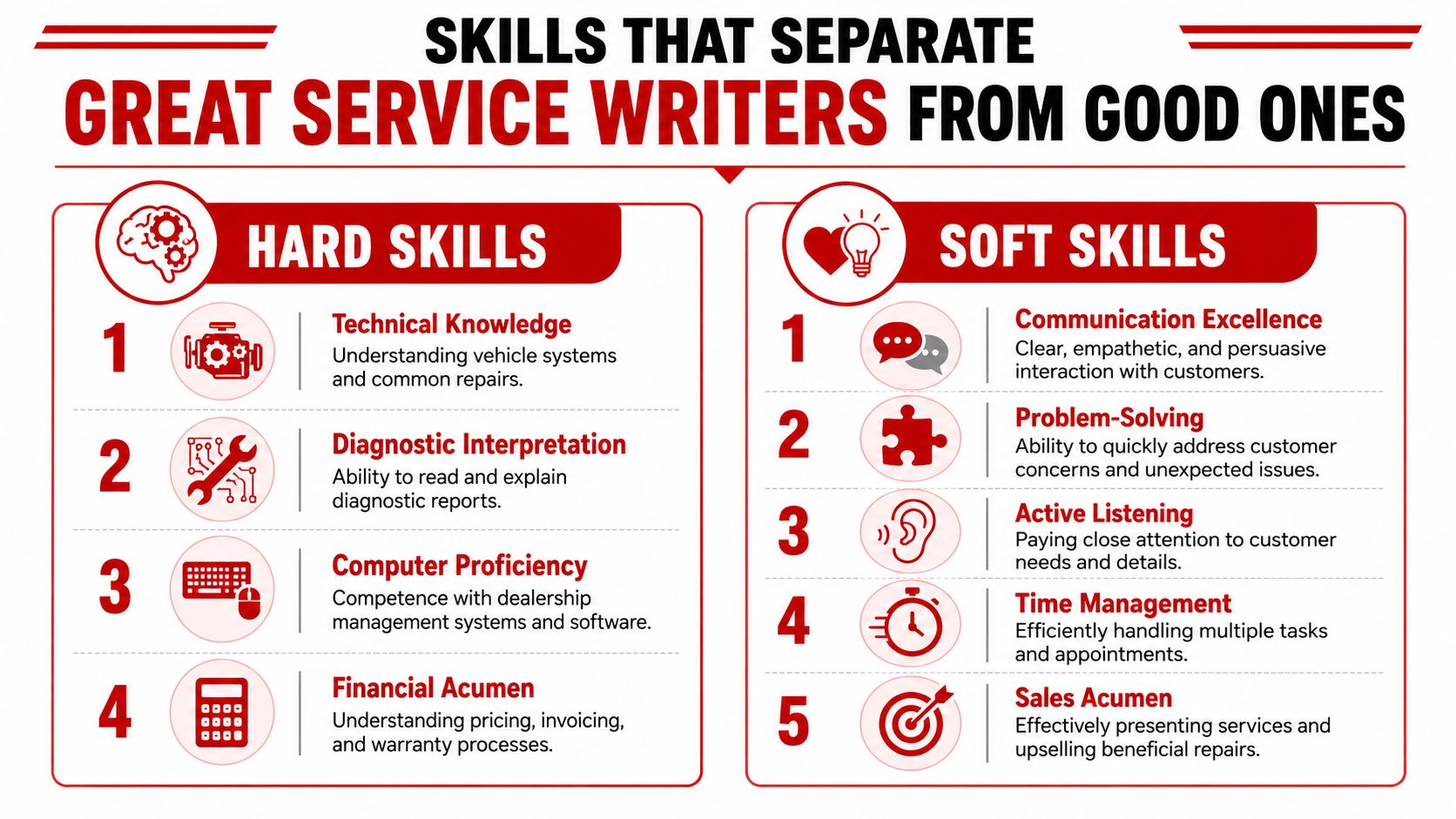
The technical side of the job matters because every weak note or sloppy estimate costs somebody time. Usually it costs the technician first, then the customer, then the shop.
Key hard skills include:
- Repair order accuracy. The complaint, conditions, and customer priorities need to be written so the technician can start diagnosis without chasing the story.
- Estimate construction. Labor, parts, sublet, shop supplies, approvals, and warranty details have to match the actual plan for the job.
- Software proficiency. A writer who moves slowly through the shop management system creates bottlenecks all day at check-in, estimate approval, and final invoicing.
- Record discipline. Declined work, promised times, authorization notes, and status changes need to be documented cleanly so the whole shop can trust the file.
Shops also tend to hire for the basics already covered earlier, such as computer literacy, front-desk experience, and the ability to handle transaction flow. Those are table stakes. The difference-maker is whether the writer can turn that knowledge into clean handoffs that keep billed hours up and confusion down.
Hard skills protect efficiency. They also protect profit.
A vague concern line can add ten wasted minutes to diagnosis. A sloppy estimate can trigger a price dispute at pickup. Multiplied across a week, those are not small errors. They drag on technician output, delay approvals, and shrink the number of cars the shop can move through the bays.
Soft skills that keep customers from walking
Average writers are often exposed here.
A service writer can know the system, know the parts process, and still lose the customer by handling tension badly. Delays, changed findings, and higher-than-expected estimates are normal shop events. The writer's job is to explain them early, calmly, and in a way the customer can act on.
That matters because 52% of customer churn in auto repair is tied to perceived lack of empathy during service delays, not technical errors, according to.
Managers should read that as an operations issue, not just a people issue. If customers stop trusting the front desk, approvals slow down, pickup conversations get harder, and future appointments disappear.
The soft skills that carry real weight on the desk are specific:
- Active listening. Good writers listen for symptoms, timing, and customer priorities instead of rushing to name the repair.
- Emotional regulation. Customers often match the writer's tone. Calm language lowers friction and keeps the conversation productive.
- Conflict handling. Price changes and delays need a steady explanation, not defensiveness.
- Clear explanation. Customers say yes more often when they understand what failed, what happens next, and what can wait.
- Time judgment. Strong writers know when to call, when to hold for one more technician update, and when a delay needs to be disclosed immediately.
Shops usually do not lose trust because the repair got more complicated. They lose trust because the communication got worse as the repair got more complicated.
There is also a sales skill here, but it has to be disciplined. Ethical upselling is prioritization. The writer separates safety items, maintenance, and future work, then explains each one in plain language. That approach gets better decisions and fewer buyer's-remorse complaints than throwing every recommendation at the customer at once.
What hiring managers should watch for
Resumes do not tell you much about desk control under pressure. Interviews should test how a candidate thinks, listens, and sets expectations when the answer is not clean.
Better signs include:
| Skill area | What to look for |
|---|---|
| Intake quality | Asks follow-up questions that narrow the complaint and identify usable symptoms |
| Composure | Stays steady when a customer pushes back on timing, cost, or prior work |
| Technical grasp | Explains common repairs simply and knows where to stop instead of guessing |
| Systems use | Moves through estimates, approvals, and notes without losing accuracy |
| Judgment | Gives realistic timelines and protects the shop from promises it cannot keep |
In training, I look for one trait above the rest. Ownership.
Strong service writers do not dump problems on technicians, blame parts delays on the system, or wait for customers to call back angry. They close loops, document decisions, and keep the whole shop aligned. That is why the best writer at the front desk often improves more than customer service. They improve billed hours, approval speed, and the consistency of the entire operation.
Measuring Success KPIs for Service Writers
If a shop owner wants better front-desk performance, “doing a good job” isn't enough. The role needs measurement tied to actions the service writer controls.

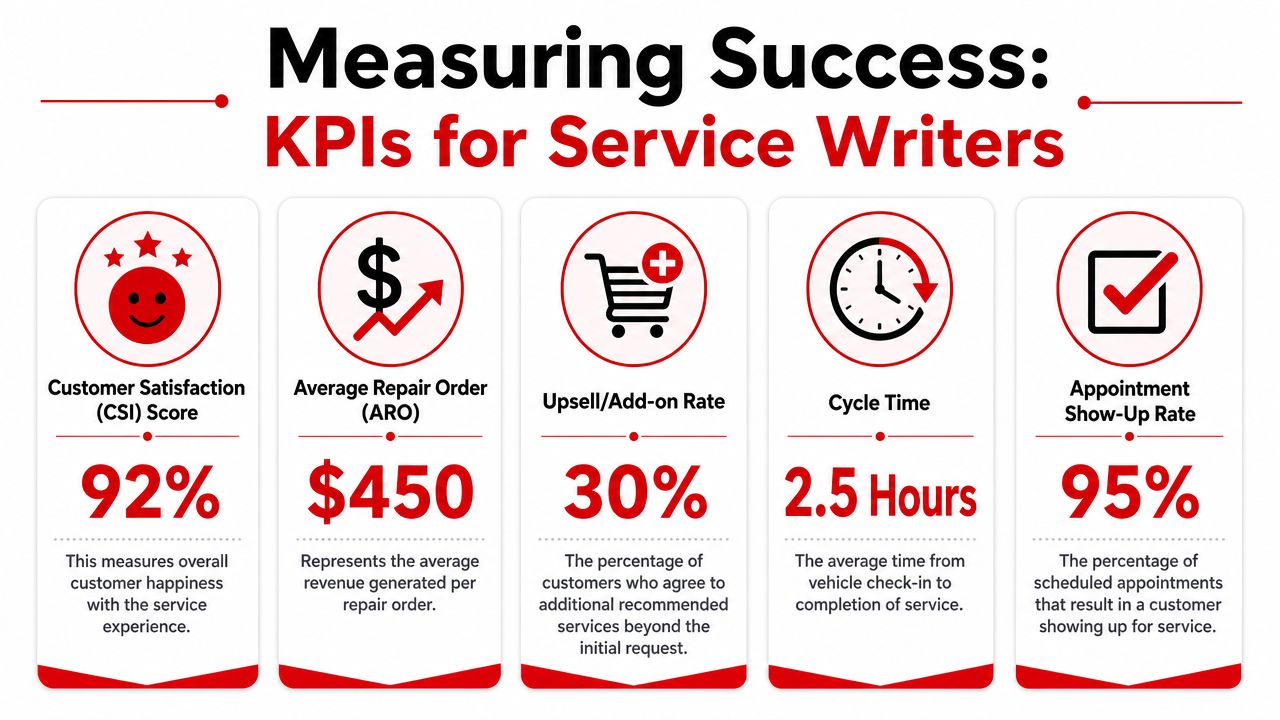
What to track weekly
Not every useful KPI needs a public scoreboard, but every manager should know whether the desk is supporting growth or slowing it down.
Good measures include:
- Average repair order
- Approval rate on recommended work
- Customer satisfaction trends
- Comeback patterns tied to poor write-up quality
- Cycle time from intake to pickup
- Estimate-to-approval lag
One KPI has a direct documented connection to communication quality. Service writers who proactively communicate cost breakdowns and time estimates achieve a 30% higher customer approval rate for additional recommended repairs, which directly lifts average repair order, according to.
That's not a script issue. It's a clarity issue. When the customer understands the work, approval gets easier.
How duties connect to profit
A service writer's performance affects revenue in a few predictable ways.
First, clean communication improves approvals. Second, strong intake reduces wasted technician time and cuts friction in the bay. Third, realistic scheduling lowers the number of customer conflicts tied to missed deadlines. Fourth, accurate documentation protects billing and warranty recovery.
A manager can use a simple review table like this:
| KPI | Strong result usually reflects |
|---|---|
| ARO | Clear estimate explanation and customer trust |
| Approval rate | Good communication of findings and urgency |
| CSI trend | Strong follow-up and calm handling of delays |
| Rework or repeat complaint pattern | Better intake notes and cleaner handoff |
| Vehicle cycle flow | Better coordination with parts and labor availability |
The point isn't to drown the desk in reports. The point is to connect service writer duties to business outcomes that can be coached.
Streamlining Duties with Shop Management Software
Most front-desk breakdowns don't happen because the staff doesn't care. They happen because the process lives in too many places at once. Notes are in one system, parts checks are on the phone, approvals are in text messages, and status updates are in someone's memory.
Where manual systems break down
Manual workflows usually fail in the same spots:
- Status visibility disappears when advisors have to chase technicians for updates
- Estimate consistency slips when pricing and labor details are pulled from scattered sources
- Approval tracking gets messy when photos, notes, and customer responses aren't attached to the repair order
- Parts coordination creates delays when supplier stock changes after the estimate was already given
That last point is especially expensive. Industry analysis shows that 65% of service delays result from inventory mismatches across multiple suppliers, a problem modern software with real-time inventory matching is designed to solve, according to.
A service writer can't set a realistic timeline if the parts picture is unreliable. That isn't a training flaw. It's a systems flaw.
What software should take off the service writer's plate
Good shop management software should remove repetitive admin work and tighten the handoff between front counter and bay. That means connected estimates, digital inspections, supplier visibility, invoicing, customer history, scheduling, and job status tracking in one workflow.
For example, RedAppy's features combine digital inspections, parts ordering across suppliers with real-time inventory, a Digital Shop Board, invoicing, analytics, and repair-order workflow tools that map directly to common service writer duties. That kind of setup helps the service writer spend less time hunting for information and more time controlling the repair process.
Good software should help with practical problems, not just reporting:
- Digital inspections support cleaner approval conversations because the writer can explain what the technician found with attached visuals.
- Shared shop boards reduce constant interruptions because job status is visible without a hallway search.
- Integrated parts ordering lowers the risk of quoting a timeline that falls apart once inventory changes.
- Customer history and VIN lookup make repeat visits faster and more accurate.
- Connected invoicing and payment tools reduce closeout friction at pickup.
Technology doesn't replace strong service writer duties. It removes the drag that keeps a capable person from doing the role well. Shops that want a cleaner front desk should review their current process and then decide whether the software supports the way the desk works. If the workflow still depends on memory, callbacks, and sticky notes, it's time to contact the RedAppy team and compare that setup against a connected system.
Sample Job Description and SOP Checklist
A weak job description hires a clerk. A strong one hires the person who controls the flow of work, protects gross profit, and keeps bad communication from turning into lost hours at the counter and in the bays.
That difference matters. If the writer misses details at intake, the technician loses time on diagnosis, the estimator has to revise the quote, parts gets rushed, and the customer starts doubting the shop. The service writer sits in the middle of all of it.
Sample job description
Position title: Service Writer
Role summary:
The service writer is the communication and workflow hub of the shop. This role owns the handoff between the customer, technician, parts process, and final invoice. Daily duties include greeting customers, documenting concerns in clear repair-order language, checking service history, confirming warranty or service contract coverage when applicable, building estimates, getting approvals, updating customers, coordinating job status with the shop floor, and closing out the visit with accurate billing and documentation.
A good role summary also sets the standard for judgment. The writer is expected to balance customer service with production reality, which means quoting honest timelines, preventing unauthorized work, and keeping the repair order clean enough that a technician can start without chasing missing information.
Key responsibilities
- Customer intake that turns a loose complaint into usable notes for diagnosis
- Repair order creation with accurate symptoms, authorization status, and contact details
- Estimate presentation that explains parts, labor, diagnostic charges, and likely next steps
- Warranty and coverage review before promising what the shop can bill
- Workflow coordination with technicians, dispatch, and parts so jobs keep moving
- Status communication during diagnosis, added work, delays, and completion
- Invoice review at pickup so the customer understands what was done and why it cost what it cost
- Recordkeeping for approvals, declined work, recommended future service, and internal notes
Preferred skills
- Working automotive knowledge strong enough to translate between customer language and technician language
- Clear communication in person, on the phone, and by text or email if the shop uses those channels
- Comfort with shop software, POS systems, and digital inspections
- Time control and organization during heavy call volume and stacked arrivals
- Conflict handling when price, time, or diagnosis changes mid-repair
Vehicle Check-In SOP Checklist
Use this checklist to train new writers and to audit experienced ones. If a shop wants more billed hours, fewer comebacks at the front desk, and cleaner technician handoffs, the check-in process has to be repeatable.
| Step | Action | Objective |
|---|---|---|
| 1 | Greet the customer and confirm vehicle, contact, and preferred update method | Start with accurate information and reduce missed approvals |
| 2 | Ask targeted questions about the concern, including when it happens and under what conditions | Turn a vague complaint into notes the technician can test |
| 3 | Review visible vehicle condition and relevant service history | Catch context that affects the estimate, diagnosis, or upsell opportunity |
| 4 | Verify warranty, service contract, or prior related repair if applicable | Prevent billing disputes and avoid promising covered work too early |
| 5 | Create the repair order in the shop system with clear customer-stated concerns | Give the technician a clean starting point and protect documentation quality |
| 6 | Explain the diagnostic charge, estimate process, and likely decision points | Set expectations before cost or timeline questions turn into friction |
| 7 | Obtain approval signature or digital authorization | Confirm permission to proceed and protect the shop |
| 8 | Set a realistic promised time based on bay capacity, technician load, and parts availability | Keep the schedule honest and reduce preventable callback pressure |
| 9 | Dispatch the job with complete notes and any relevant history | Reduce wasted technician time and repeated questions |
| 10 | Confirm the next communication point with the customer | Keep control of the repair process and lower inbound status calls |
A written SOP gives the counter a standard that can be coached, measured, and improved. It also makes hiring easier because candidates know the job is tied to process, accountability, and shop performance, not just answering phones.
A connected front desk is easier to manage when estimates, inspections, parts, status updates, and invoicing live in one workflow. Shops that want to tighten service writer duties without adding more manual admin can review RedAppy and see whether the platform fits the way their counter, bays, and customer communication already work.
Ready to Transform Your Shop?
RedAppy helps auto repair shops create professional digital estimates with photos and videos, send them instantly via text or email, and get customer approvals in seconds. No credit card required to start.