
Team Accountability in Auto Repair Shops: A Practical Guide
A busy shop rarely loses control because the team lacks skill. It loses control when work moves faster than ownership. A vehicle waits for a diagnosis, an estimate sits without a follow-up, or a completed repair reaches quality control with no clear person responsible for the next decision. By the time the problem becomes visible, the customer is already calling for an update.
Team accountability fixes that gap with shop-floor mechanics, not motivational posters. Each repair order needs one visible owner, a defined next action, measurable results, and a safe way to surface blockers. The system should work on a whiteboard in a single-bay garage and remain useful across multiple locations.
Table of Contents
- When Ownership Disappears on the Bay Floor
- What Team Accountability Actually Means in a Shop
- The Metrics That Reveal Who Owns the Job
- Why One Clear Owner Beats Shared Responsibility
- A Practical Framework for Shop Accountability
- How RedAppy Operationalizes Accountability Daily
- Balancing Accountability and Psychological Safety
- Your First Seven Days of Stronger Accountability
When Ownership Disappears on the Bay Floor
Monday morning starts with three vehicles still in the queue from Friday. One needs a brake repair, but the diagnostic notes are missing. Another arrived with a transmission complaint and is still waiting for a test-drive. The third came in for an oil change, then revealed a coolant leak, yet the estimate hasn't been updated.
The advisor is on the phone with a customer. The technician who originally inspected one vehicle has already been pulled into another bay. A parts question sits unanswered, and nobody can say who owns the next step on any of the three repair orders.
That pattern feels like a staffing problem because everyone is busy. Often, it's an accountability problem instead. The team may have enough technical ability and enough people, but no operating rule identifies who must move each vehicle forward.
Practical rule: Every vehicle should have one person responsible for progress, even when several people support the repair.
A named owner doesn't need to perform every task. The owner coordinates the diagnostic update, parts request, customer communication, quality check, and delivery path. Without that role, each handoff creates a gap. The technician assumes the advisor will call. The advisor assumes the technician is still working. The manager discovers the stalled vehicle only when the customer asks for an update.
A shop with clear ownership looks different. Each vehicle has a visible name beside it, the current stage is easy to read, and a blocked job gets a next action rather than a vague note. The same technicians can produce calmer, more predictable work because the process removes uncertainty.
The difference isn't pressure. It's structure. Team accountability turns “someone should handle it” into “this person owns the next move.”
What Team Accountability Actually Means in a Shop
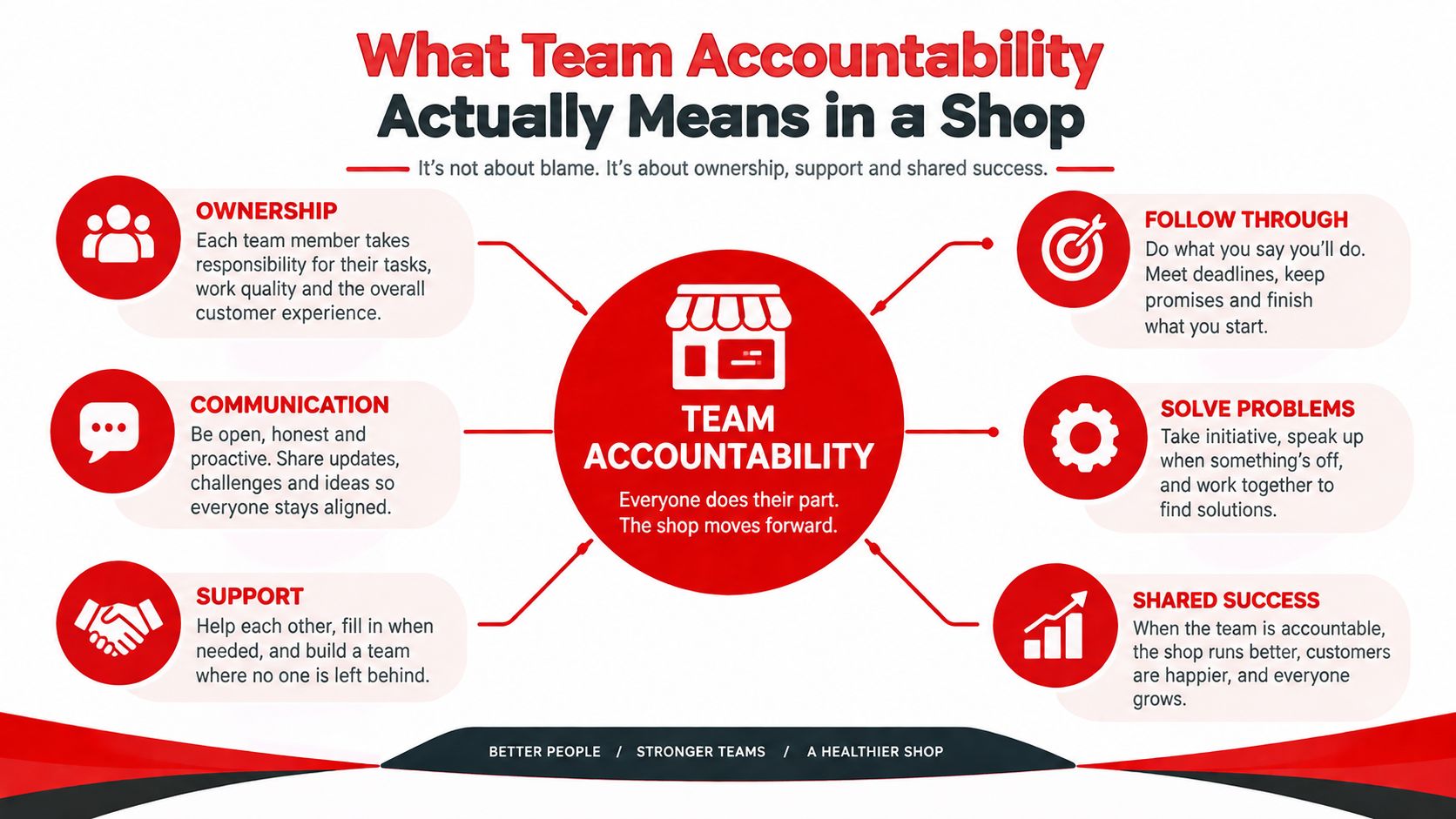
In an auto repair shop, team accountability means that every repair order has a named owner who is visible, trackable, and answerable for progress. The owner can receive support from advisors, parts staff, technicians, and managers, but responsibility for forward movement never disappears into the group.
Accountability isn't the same as blame. Blame looks backward for a person to punish. Accountability looks at what was expected, what happened, what blocked the work, and what needs to change. A comeback review, for example, should identify the repair-order owner, document the failure, and improve the process without discouraging people from reporting problems.
A useful accountability system contains five connected elements. The describes accountability through attributability, observability, evaluability, answerability, and consequentiality. Those terms translate cleanly to shop operations:
- Attributability: The repair order identifies one owner. A technician's initials or an advisor's name shows who is responsible for the next stage.
- Observability: The vehicle's status appears on a board. Anyone can see whether it's waiting for diagnosis, approval, parts, repair, quality control, or pickup.
- Evaluability: Completion is compared with a standard, such as on-time delivery, a complete inspection, an approved estimate, or a repair without a comeback.
- Answerability: The owner can explain the current condition of the job, the blocker, and the next action when a manager asks.
- Consequentiality: Results lead to recognition, coaching, workflow changes, or further review. A technician who closes a flagged job promptly should receive useful recognition. A recurring handoff failure should trigger process correction.
A 2021 peer-reviewed study of 46 teams found that average accountability remained stable across three measurement points, with means of 5.83, 5.83, and 5.88, while perceptions differed substantially between teams. The practical lesson is important for shop owners: accountability is shaped by the team environment, not just by individual attitude.
The Metrics That Reveal Who Owns the Job
Metrics become useful when they answer an operational question. A shop shouldn't track numbers merely to create a dashboard. Each measure should reveal whether a person or team is carrying a repair order from intake to delivery.
Job completion rate shows whether work finishes on the repair order where it started. A falling rate may indicate incomplete estimates, weak parts coordination, or technicians being reassigned without a controlled handoff. The direction matters more than a universal target, because the owner should first establish a baseline for the shop's current workflow.
Estimate approval rate reflects how well the advisor owns the customer conversation. If recommendations are documented clearly but approvals remain weak, the problem may be follow-up timing, explanation quality, or a missing connection between inspection evidence and customer need.
Comeback rate shows whether the shop owns repair quality after delivery. The chosen review window, such as 30 or 90 days, must remain consistent so managers can identify patterns. A comeback should connect to the original repair order, the assigned technician, the inspection record, and the corrective action.
Average repair order, or ARO, shows whether the shop is serving the customer's complete maintenance and repair needs rather than processing a narrow ticket. ARO should never be used to pressure advisors into selling unnecessary work. It becomes an accountability measure when managers review whether documented findings receive clear communication and appropriate follow-up.
Technician utilization reveals whether bay capacity is coordinated. Patchy utilization can signal poor scheduling, parts delays, unclear dispatching, or too many unfinished jobs competing for attention.
Accountability Metrics at a Glance
| Metric | What It Reveals | Typical Healthy Range | Accountability Signal |
|---|---|---|---|
| Job completion rate | Follow-through from intake to delivery | Set a baseline, then improve consistently | Falling results suggest stalled ownership or weak handoffs |
| Estimate approval rate | Advisor communication and follow-up | Set by vehicle mix and service strategy | Movement shows whether recommendations are explained and pursued |
| Comeback rate | Repair quality and post-service ownership | Track consistently by repair type and period | A rising result calls for root-cause review |
| ARO | Completeness of customer care | Compare against the shop's own history | Changes may reveal missed findings or stronger communication |
| Technician utilization | Coordination of bay capacity | Compare by technician, schedule, and workload | Uneven results can expose dispatch and blocker problems |
In survey research across 45 teams in five knowledge-based organizations, mutual accountability was positively associated with team performance, with team structure and shared beliefs acting as facilitators (research on mutual accountability and team performance). A practical reporting process can help managers connect these measures to named owners, and the offers useful context for organizing recurring performance reporting.
Why One Clear Owner Beats Shared Responsibility
Two technicians share a brake job. One performs the inspection, the other orders parts, and both expect the other person to start the installation when the shipment arrives. The vehicle remains untouched until a manager asks for an update.
Shared responsibility sounds collaborative, but it often weakens urgency. A single named owner creates a direct line from intake through delivery. Supporting staff can still complete parts, advising, diagnostics, or final quality control, but one person remains responsible for coordinating the whole vehicle.
A 2026 benchmark found that teams assigning one accountable owner per key result completed 26% more goals, while only 46% of teams reported that all OKRs had a clear owner. The same source found that tasks assigned to two people finished on time at a lower rate than tasks assigned to one person, 40.3% versus 67.3%.
The shop-floor trade-off is real. Making one technician perform every stage can create a bottleneck, particularly when a vehicle needs specialist support. The stronger rule is one owner per vehicle, not one person per task.
| Factor | Single Named Owner | Shared Responsibility |
|---|---|---|
| Status | One person maintains the current position | Several people may hold different versions |
| Handoffs | Support roles report back to a clear coordinator | Responsibility can disappear between roles |
| Customer updates | Advisor knows who must provide technical detail | Advisor may chase multiple people |
| Comebacks | The original repair path is traceable | Cause can become difficult to isolate |
| Scheduling | Manager sees the owner's active workload | Workload can look lighter or heavier than reality |
| Risk | One owner can become overloaded | Diffused ownership can delay action |
The goal isn't to reduce teamwork. It's to make teamwork answerable. One person owns the vehicle's progress, while the rest of the team makes that progress possible.
A Practical Framework for Shop Accountability
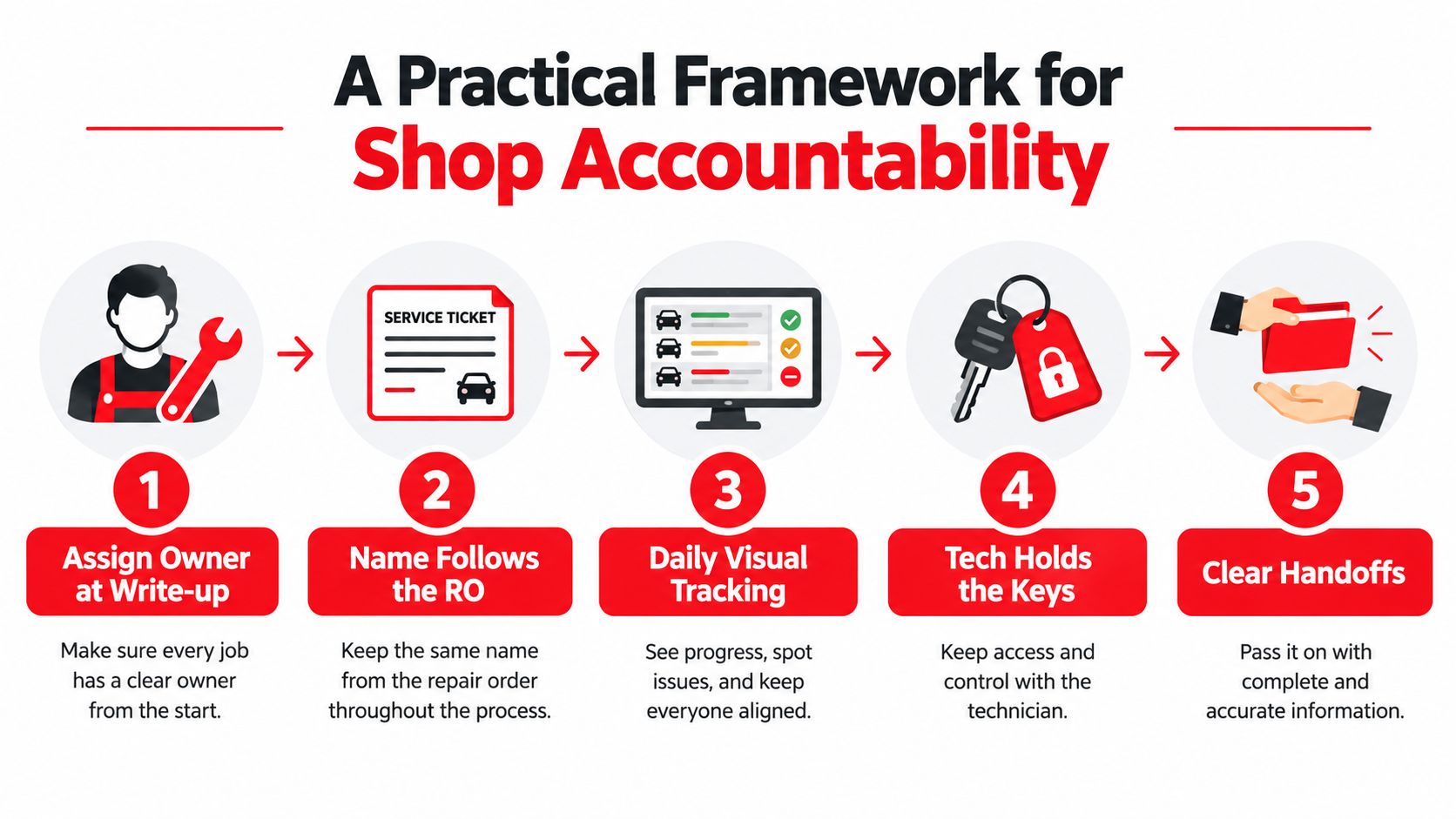
A workable system should be simple enough to start with a whiteboard and disciplined enough to move into software later. The following five actions create a repeatable operating rhythm.
Assign the owner at write-up
The service advisor assigns one owner when the repair order is opened. The name goes into the management system and onto the physical or digital board. If the vehicle changes bays, the ownership record stays attached to the repair order.
The related measure is assignment rate. An unassigned vehicle is an accountability gap before any technical work begins.
Make every meaningful step visible
The board should show inspection findings, parts ordered, estimate status, advisor updates, quality control, and delivery readiness. A status such as “waiting” isn't enough. It should state what the job is waiting for and who must act next.
The measure is board update frequency, but the purpose is not constant data entry. The purpose is to let a manager identify stalled work without interrupting every technician.
Run a short daily review
A daily standup can stay under ten minutes when each owner answers three questions:
- What moved yesterday?
- What is blocked today?
- Who owns the next action, and when will it happen?
Blocked vehicles need a named action and a time, such as “advisor calls for approval before the morning customer-update window” or “parts coordinator confirms delivery before the next dispatch review.” Track blocker resolution time to identify recurring causes.
Review outcomes, not busyness
The previous day's completed repair orders should be reviewed against ARO, estimate approval rate, and comeback rate. The purpose isn't to rank people by raw activity. It's to connect outcomes to the process that produced them.
A technician may work quickly but leave incomplete notes. An advisor may communicate frequently but fail to obtain approval. The numbers help managers coach the actual gap.
Recognize the behavior the shop needs
Public recognition should be specific. A technician who closes a flagged job the same day can be acknowledged in the morning meeting. An advisor who rescues a stalled approval through clear documentation should receive the same treatment.
Track a recognized-close count so recognition doesn't depend on whoever happens to be noticed. Guidance on how to can help managers connect clear standards with consistent follow-through.
How RedAppy Operationalizes Accountability Daily
A shop management platform turns accountability from a policy into a routine. The important test isn't whether the software contains many features. It's whether the system makes ownership visible at the exact moment a job stalls.
A Digital Vehicle Inspection can create timestamped, photo-backed evidence for recommendations and declined work. When an advisor follows up on an unapproved repair, the conversation can refer to the actual inspection record rather than relying on memory or a handwritten note. That supports better evaluation because the customer, advisor, and technician can see what was identified and what remains open.
A Digital Shop Board gives the service drive and front counter a shared view of repair-order status. The board can show the assigned technician, current stage, and blocker, reducing the repeated question of who has a particular vehicle. A physical whiteboard can provide the same basic visibility, but digital status can follow the repair order and support reporting across locations.
Surfacing stalled work before delivery pressure
The AI Repair Assistant can scan open jobs for stalled stages, missing advisor notes, or estimates waiting for approval. That kind of prompt helps a manager intervene while the repair order is still recoverable, rather than discovering the gap during a customer complaint.
Analytics should connect the workflow to the owner. Completion rate, approval rate, comeback rate, ARO, and technician utilization become more useful when managers can filter them by named person, vehicle, stage, or location. Reviews then rely on recorded activity and outcomes instead of the loudest explanation in the morning meeting.

RedAppy provides digital inspections, estimates, invoicing, online payments, parts ordering, analytics, a Kanban-style Digital Shop Board, technician time tracking, and an AI Repair Assistant in one shop-management platform. Its value for accountability is operational: ownership can be assigned once, status can remain visible, and performance information can be reviewed against the repair order rather than reconstructed later.
Balancing Accountability and Psychological Safety
Accountability and psychological safety operate at different layers. Accountability assigns responsibility for the repair order. Psychological safety makes it safe to report a mistake, ask a question, or flag a blocked job before the customer feels the impact.
A punitive shop often creates hidden problems. Technicians may avoid reporting a near miss, advisors may delay documenting a comeback, and managers may see cleaner numbers while losing the information needed to prevent repeat failures.
A blame-free comeback review follows a different sequence:
- Name the owner: Identify who coordinated the repair order.
- Trace the facts: Review inspection notes, parts, diagnostic steps, communication, and quality control.
- Find the cause: Separate a technical error from a missing process, unclear instruction, or rushed handoff.
- Change the system: Update the inspection template, checklist, training, or board rule.
- Close the loop: Confirm who owns the corrective action and when it will be checked.
Research on healthy accountability reports that team accountability was 72% higher when people felt safe asking questions and giving feedback without fear of judgment or negative consequences. The same source found that clear roles and responsibilities doubled the likelihood of healthy accountability.
Standups should begin with one blocker, not one blame statement. Daily reviews should end with a process fix, not a warning. Near-miss reporting should be treated as useful information because early visibility gives the team a chance to correct the system before a comeback.
Your First Seven Days of Stronger Accountability
A rollout works best when it starts inside one operating lane rather than across the entire shop at once.
- Day 1: Choose one lane or service area as the pilot. Assign a single owner to every active repair order.
- Day 2: Build a visible board with columns for intake, diagnostics, waiting on approval, in repair, quality control, and ready.
- Day 3: Train advisors to place the owner's name on every estimate and route updates through the repair-order record.
- Day 4: Establish baseline measures for job completion rate, estimate approval rate, comeback rate, ARO, and technician utilization.
- Day 5: Run the first daily review against the board. Keep it to 15 minutes or less, record blockers, and assign each next action.
- Day 6: Recognize the fastest owner publicly, then adjust one template or board rule based on a real bottleneck.
- Day 7: Review the week's results, identify the largest accountability gap, and assign the next improvement owner.
The first week shouldn't attempt to perfect every metric. It should prove that each vehicle has an owner, every stalled job becomes visible, and the team can discuss problems without hiding them.
For a detailed walkthrough of a specific shop layout, service mix, or multi-location workflow, the team can use the RedAppy contact page to discuss the first practical setup.
RedAppy brings digital inspections, visible repair-order tracking, estimates, payments, parts coordination, technician time records, and accountability-focused analytics into one shop workflow. Visit RedAppy to review the platform and see how a clearer owner, a live board, and measurable follow-through can fit the way the shop already operates.
Ready to Transform Your Shop?
RedAppy helps auto repair shops create professional digital estimates with photos and videos, send them instantly via text or email, and get customer approvals in seconds. No credit card required to start.