
Truck Parts in Miami: A Shop Owner's Sourcing Guide
A truck is on the lift. The technician is waiting. The service advisor has already called the customer once. Now the part that was supposed to be “in stock” turns out to be somewhere between another warehouse, another vendor, and another callback.
That's how parts problems hit a Miami shop. Not as a theory. As a stalled bay, a delayed invoice, and a customer who starts wondering whether the repair will slip again tomorrow.
For shops that handle medium-duty and heavy-duty work, truck parts in Miami aren't just a purchasing task. They're an operations problem. The shops that treat sourcing as a system usually protect their schedule better, keep bays moving, and avoid the chaos that comes from chasing parts one phone call at a time.
Table of Contents
- The High Cost of Inefficient Parts Sourcing
- Understanding Miami's Truck Part Suppliers
- OEM vs Aftermarket vs Salvage Parts A Strategic Choice
- How to Vet and Partner with Local Vendors
- Troubleshooting Common Parts Availability Crises
- Stop Calling Stop Waiting Unify Your Parts Ordering
- Build a Resilient and Profitable Parts Strategy
The High Cost of Inefficient Parts Sourcing
A common shop scenario starts with a straightforward repair. A fleet unit comes in, diagnosis is done, approval is in hand, and the team orders what looks like the right part from a local supplier. Then the timeline breaks. The warehouse count is wrong. The branch doesn't have it. The replacement option needs another call, then another quote, then another wait.
That problem isn't isolated. A documented issue in the Miami market is the lack of real-time local inventory visibility across multiple suppliers. 99% of shops report delays due to inventory mismatches, which forces teams to call vendors one by one or sit through backorders instead of working from a unified inventory view, as noted on.
Where the money is really lost
Most owners look first at part cost. That matters, but the hidden expense is usually bigger:
- Bay blockage: A truck ties up productive space while the shop waits for confirmation, delivery, or a corrected order.
- Labor interruption: Technicians lose rhythm when they stop a job midway and move to another ticket.
- Front desk drag: Service advisors spend time chasing suppliers instead of updating customers and closing work.
- Customer confidence: A commercial client can tolerate price pressure better than uncertainty. Missed timelines damage trust fast.
Practical rule: The expensive part isn't always the one with the highest invoice cost. It's often the one that keeps a completed job from becoming a closed ticket.
Preventive maintenance helps reduce emergency sourcing pressure in the first place. Shops that want a tighter process can also borrow ideas from, especially around scheduling work before a truck turns into a same-day parts scramble.
Why Miami makes this harder
Miami has strong supplier access, but that doesn't automatically mean easy procurement. The market includes dealer networks, independent aftermarket sellers, export-oriented distributors, and specialty vendors. That variety is useful, but it also creates more phone calls, more catalog differences, and more room for mismatch.
The shops that win here don't just “know a guy” at a counter. They build a sourcing process that handles delays, substitutions, and verification before the truck gets stuck waiting.
Understanding Miami's Truck Part Suppliers
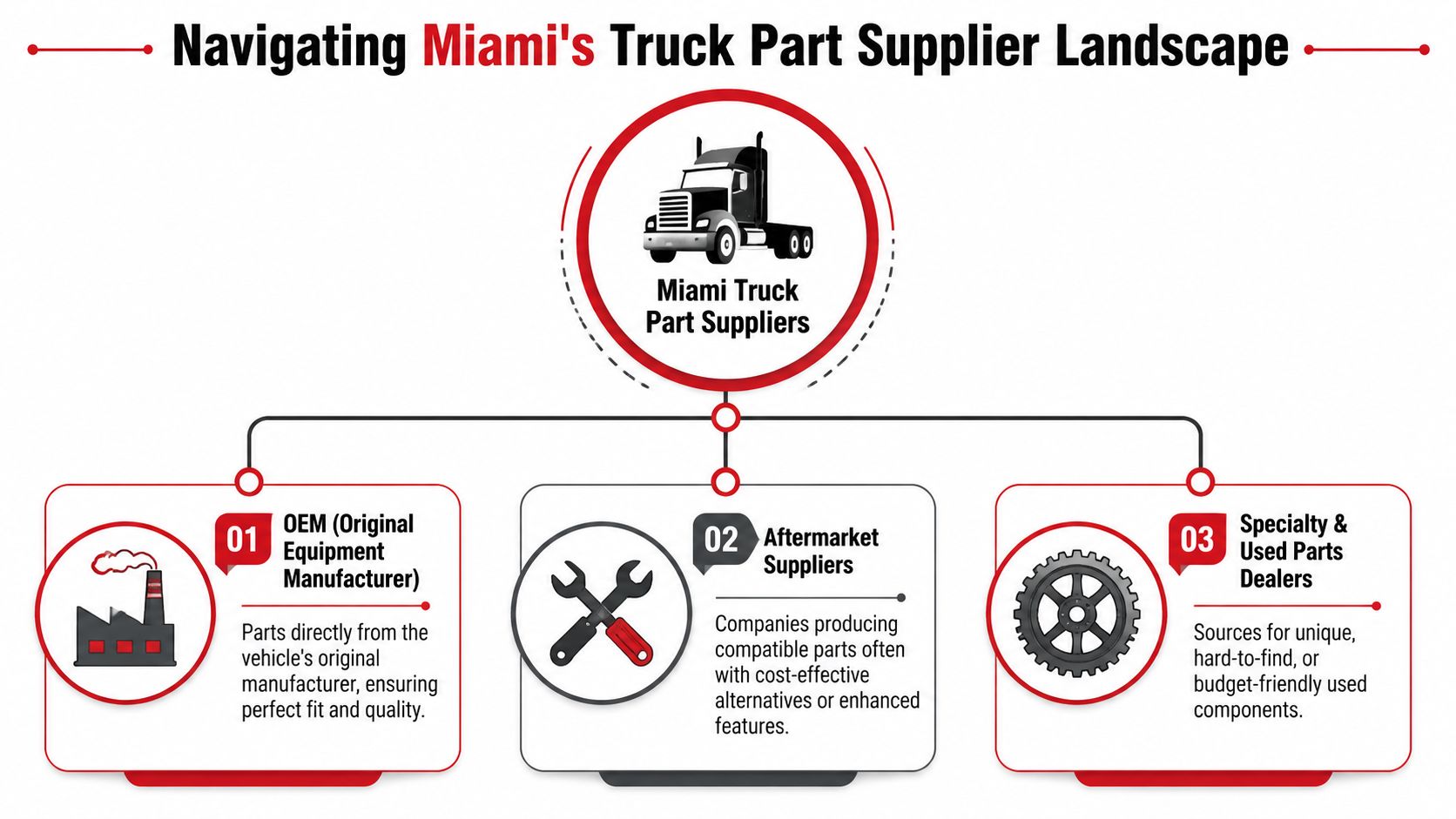
Miami gives shops plenty of buying options, but too many shops still treat sourcing like a string of phone calls. That costs time. A better approach is to sort suppliers by role, then plug each one into a repeatable process inside your shop management system so the right vendor gets checked first, the part gets verified faster, and the job keeps moving.
OEM dealerships
OEM dealers are the cleanest source when exact fit, current spec, and documentation matter more than invoice price. I usually put them at the top of the list for newer trucks, emissions parts, warranty-sensitive repairs, and anything that can create a comeback if the calibration or part revision is wrong.
What OEM dealers do well:
- Cleaner fitment verification: Part numbers usually match VIN and build data with less back-and-forth.
- Better paperwork: Quotes, supersessions, and warranty support are usually easier to document.
- Lower risk on sensitive repairs: That matters on jobs where one wrong component can stall the truck again.
Where shops get burned:
- Higher cost: Harder to sell on older units or price-sensitive approvals.
- Shelf-stock limits: Dealer access is not the same as same-day availability.
- Less flexibility: Some counters offer fewer practical alternatives when the exact part is delayed.
Aftermarket suppliers
Aftermarket vendors carry a lot of daily shop volume in Miami because they offer range. One counter may have multiple brands, better pricing, and faster local delivery than a dealer on common maintenance and wear items. That flexibility matters if your advisors are quoting against a deadline.
The catch is brand variance. Two boxes can fit the same application and produce very different results in service life, warranty handling, and repeat failure risk. Good shops track that by line, not by memory. If your software can store preferred brands, failed brands, cross-references, and vendor-specific notes, the next quote gets faster and more accurate instead of starting from zero.
A strong aftermarket vendor saves real time only when the counter team understands heavy-duty truck applications and can verify more than a catalog match.
Salvage and used parts dealers
Used parts solve availability and budget problems, not quality problems. They make sense on older trucks, discontinued items, body components, housings, brackets, and selected assemblies where condition can be checked before installation. In Miami, these vendors can also help when a new part is tied up in freight, backorder, or manufacturer delay.
This channel needs tighter controls than the others. The shop has to confirm interchange, condition, completeness, return terms, and whether the part includes the small pieces that usually go missing. If you buy used parts often, build a checklist into your workflow. Include photos, tag numbers, mileage if relevant, and who approved the risk. That turns a gamble into a managed decision.
The shops that source parts well in Miami do not rely on one favorite supplier. They assign each supplier type a job, rank vendors by speed and accuracy, and keep that information in one system the service writer and parts staff can use. That is how procurement stops being a daily disruption and starts helping margin, cycle time, and customer trust.
OEM vs Aftermarket vs Salvage Parts A Strategic Choice
Supplier type is one decision. Part type is another. Good shops don't default to one answer for every job. They match the part source to the repair risk.
For heavy-duty work, the line gets very clear around driveline and powertrain components. These parts operate under high thermal and mechanical stress, and critical components must meet the same specifications as new Cummins parts or engines to maintain compatibility and avoid premature failure in freight use, according to. That means bargain hunting in the wrong category can become a comeback, a tow bill, or a lost fleet account.
Parts Source Comparison
| Factor | OEM (Original Equipment Manufacturer) | Aftermarket | Salvage (Used) |
|---|---|---|---|
| Upfront cost | Usually highest | Usually more flexible | Usually lowest initial outlay |
| Fit and spec confidence | Best choice when exact manufacturer spec matters | Varies by brand and application | Must be verified carefully |
| Warranty support | Often clearer and easier to document | Depends heavily on vendor and brand | Usually limited and narrower |
| Immediate availability | Can be good, but not guaranteed locally | Often strongest when multiple lines are available | Depends entirely on yard inventory |
| Best use case | Critical systems, newer units, spec-sensitive repairs | Maintenance parts, common repairs, value-driven jobs | Older trucks, hard-to-find items, budget repairs |
| Primary risk | Cost | Uneven quality between brands | Unknown wear, hidden damage, missing pieces |
When paying more is the smart move
Some repairs punish shortcuts. A water pump on a lightly used local unit isn't the same decision as a driveline component on a truck that runs under constant load. If failure can damage adjacent systems, create downtime for a paying fleet, or trigger a second teardown, the cheapest line often becomes the most expensive choice.
That doesn't mean OEM is always right. It means the shop should ask a tougher question: if this part fails, what else does it disrupt?
Where aftermarket wins
Aftermarket can be the strongest option when the application is well understood and the supplier stands behind the line. Filters, brakes, common chassis items, lighting, and other frequent replacements often fit here. A strong aftermarket strategy gives the shop pricing flexibility without automatically sacrificing reliability.
Where salvage makes sense
Salvage works best when the repair has a narrow purpose. A bracket, trim piece, housing, door component, or hard-to-source assembly may be completely reasonable as a used part if it's inspected properly.
The wrong move isn't using a used part. The wrong move is using a used part where failure would force the same labor twice.
The profitable decision isn't “always OEM” or “always cheaper.” It's choosing the source that fits the consequence of failure.
How to Vet and Partner with Local Vendors
A vendor list by itself won't fix a sourcing problem. Shops need a standard for who earns regular business and who only gets occasional orders.
A reliable Miami parts partner does more than answer the phone. The vendor confirms fitment, handles returns cleanly, communicates stock accurately, and doesn't disappear when the wrong box lands at the shop.
Questions that expose weak vendors fast
Before leaning on any new supplier, a shop should ask direct questions:
- Warranty terms: What exactly is covered, and what documentation is required if the part fails?
- Return rules: Can installed-but-defective parts be processed smoothly, or does the shop get stuck in dispute?
- Delivery cutoff: What's realistic for same-day runs, and what misses the truck?
- Credit structure: Is the account designed for a working repair shop, or does every issue turn into a cash-flow headache?
Those answers matter more than friendly sales language. If a counterperson gets vague on returns or dodges stock questions, the shop should expect friction later.
Build relationships at the counter, not just transactions
The best local supplier relationships are operational, not social. The shop gives clean information. The vendor gives clear answers. Over time, that creates trust on rush orders, substitutions, and problem resolution.
Useful habits include:
- Send complete data upfront. VIN, engine details, build info, measurements, and old part numbers reduce guesswork.
- Track vendor accuracy. A shop should know who regularly gets it right and who burns time.
- Escalate professionally. When a mistake happens, calm documentation gets better results than anger.
- Consolidate volume where it makes sense. Spreading every order everywhere can weaken accountability.
A simple vendor scorecard
A practical shop doesn't need a fancy procurement department. It needs a short scorecard.
| Vendor check | What to look for |
|---|---|
| Fitment accuracy | Correct part arrives consistently |
| Stock honesty | “In stock” actually means available |
| Return handling | Credits and exchanges move quickly |
| Delivery reliability | Driver runs match promised windows |
| Counter knowledge | Staff understands truck applications |
Shop-floor advice: The best vendor for a shop isn't always the cheapest one. It's the one that protects labor hours.
When a vendor repeatedly creates confusion, the answer isn't more patience. It's less volume.
Troubleshooting Common Parts Availability Crises
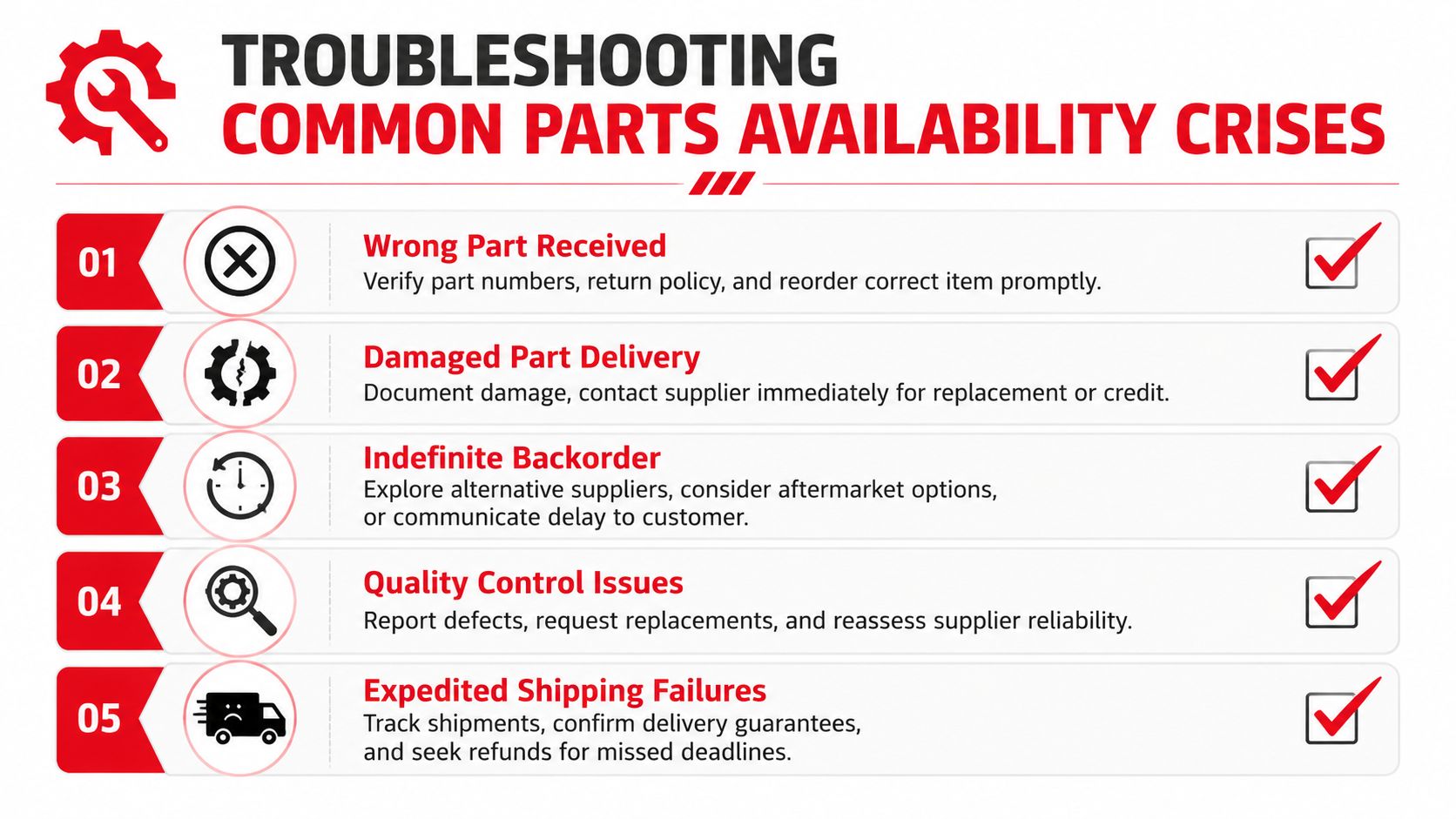
Every shop eventually hits the same set of failures. The wrong part arrives. The box is damaged. The catalog result looked right but wasn't. A customer-approved job stalls because the replacement is suddenly on backorder.
The biggest preventable issue is bad specification matching. In Miami-area online buying, incorrect specs cause about 30% of failed deliveries, and many local dealer sites still don't offer strong spec-validation tools or VIN-based filters, according to.
Start with verification, not hope
When a part matters, the shop shouldn't rely on a broad description like “fits most” or a rushed catalog match. Verification should happen before the order is placed.
A practical process looks like this:
- Match the exact application: Use VIN when available, then confirm engine, transmission, axle, and build details.
- Compare old and new identifiers: Cast numbers, stamped tags, connector style, dimensions, and revisions all matter.
- Request a photo if needed: A quick image from the vendor can stop a bad order before dispatch.
- Document who confirmed fitment: That helps if the part still arrives wrong.
How to respond when the order goes bad
When the failure already happened, speed matters less than control.
Wrong part received
Pause installation. Confirm where the mismatch occurred. Then reorder only after verifying the original application data again.
Damaged delivery
Photograph the packaging and the part before moving anything around. Contact the supplier immediately while the evidence is clear.
Indefinite backorder
Open alternate channels fast. That may mean another aftermarket line, an OEM route, or a used option if the repair can support it.
Quality problem out of the box
Don't keep forcing a suspect component into the job because the schedule is tight. That usually creates a comeback.
Missed expedited shipment Check the order timestamp, promised delivery method, and proof of dispatch. Then decide whether the need is a refund, a runner, or a different vendor entirely.
A rushed reorder without better verification usually creates the same problem twice.
Customer communication during a parts crisis
Commercial clients usually handle bad news better than vague updates. The service advisor should explain what failed, what options exist, and which path protects uptime best. That keeps the conversation about decisions, not excuses.
Stop Calling Stop Waiting Unify Your Parts Ordering
The old method still runs in too many shops. The advisor calls one supplier, gets a price, puts that on hold, calls the next one for a better option, waits for a callback on availability, writes notes on paper or in a separate screen, then tries to remember which vendor promised what.
That process isn't lean. It's fragmented. It creates mistakes because every handoff depends on memory, call timing, and manual follow-up.
A better approach is to centralize parts ordering inside the same system that manages the repair order. When pricing, availability, and order flow live together, the shop doesn't need to rebuild the same information every time someone picks up the phone.
What unified ordering fixes
Shops using management software with real-time inventory data and multi-supplier parts ordering report a 20% reduction in admin hours per week, which frees service advisors and front-desk staff to spend more time on customer communication and sales activity, according to.
That matters because manual procurement wastes time in three places at once:
- the front counter,
- the bay schedule,
- and the customer update cycle.
The operational advantage
A unified ordering setup changes the day-to-day workflow in practical ways:
- One screen instead of scattered tabs: Advisors can compare vendor options without bouncing between calls and websites.
- Cleaner documentation: The estimate, ordered part, and repair order stay connected.
- Fewer missed updates: Everyone can see what was ordered and what's still pending.
- Better dispatch decisions: The shop knows whether to keep the truck in the bay or move it until the part lands.
This is especially valuable for shops handling truck parts in Miami, where supplier variety is a strength but also a source of confusion. The market has options. The problem is that the options are usually disconnected.
Workflow shift: The shop that sees price and availability in one place usually moves faster than the shop that relies on call-backs and handwritten notes.
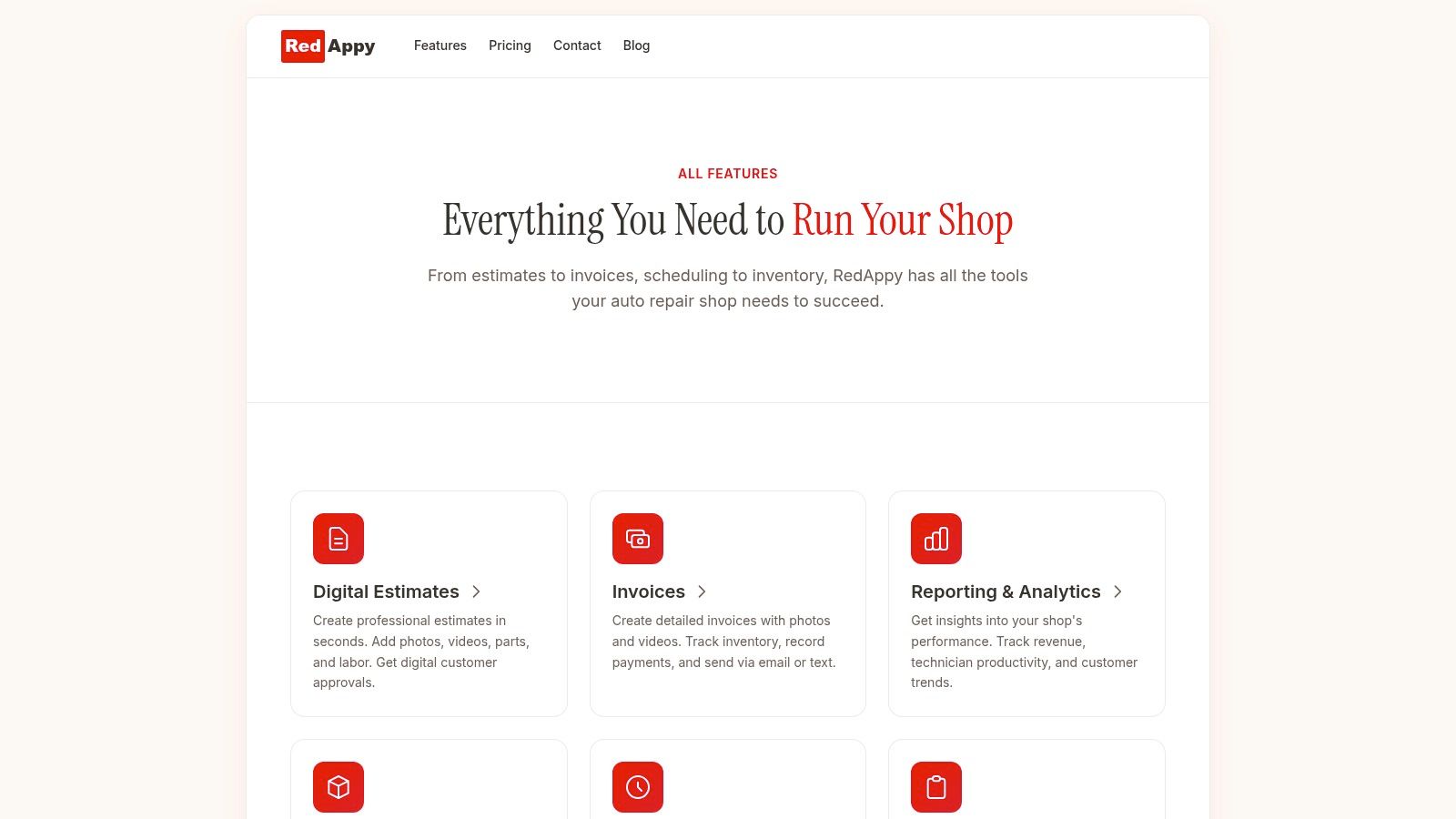
For teams comparing tools that support this kind of process, the RedAppy features overview shows what modern shop software can do when parts ordering, shop workflow, digital inspections, invoicing, and visibility are tied together instead of split across separate habits and systems.
Build a Resilient and Profitable Parts Strategy
A strong parts strategy isn't built on one good vendor or one lucky week of deliveries. It comes from discipline. The shop knows which supplier type fits which repair, which vendors earn trust, and which verification steps happen before the order goes out.
That approach helps at every level. Bays move better. Labor gets used more efficiently. Customers get clearer updates. The team spends less time fixing purchasing mistakes and more time completing approved work.
The shops that protect margin do these things well
- They choose parts by repair risk. Critical systems get tighter standards. Lower-risk jobs get more price flexibility.
- They vet vendors continuously. A supplier is only as good as recent accuracy, delivery reliability, and return support.
- They treat spec verification as mandatory. Especially on trucks, close enough often isn't close enough.
- They standardize procurement. Good process beats heroic phone work.
Digital workflow matters here because better sourcing doesn't live in isolation. Shops that use cloud-based systems with integrated estimate builders and digital inspection tools approve 30% more work from customers through photo-rich documentation that supports repair recommendations, according to. When the shop documents findings well and sources parts efficiently, approvals and execution stop fighting each other.
Stability matters beyond the parts counter
A resilient shop also looks beyond procurement. Coverage, liability, and operational protection matter when commercial vehicles, expensive components, and delivery commitments are on the line. For owners reviewing that side of the business, the is a useful resource for thinking through commercial insurance decisions in Florida.
The shops that get ahead in truck parts in Miami usually don't have fewer problems. They solve recurring problems with better systems.
Shops that want a cleaner way to manage sourcing, estimates, inspections, invoicing, and daily workflow can explore RedAppy or reach out through the RedAppy contact page to see how a more organized parts process can save time and protect profit.
Ready to Transform Your Shop?
RedAppy helps auto repair shops create professional digital estimates with photos and videos, send them instantly via text or email, and get customer approvals in seconds. No credit card required to start.