
What Is Labor Productivity? a Shop Owner's Guide
Labor productivity is output per hour worked. In an auto repair shop, the practical version is simple: it's the billed labor hours a technician produces for each hour that technician is paid.
That number matters because a shop can stay busy all day and still lose money. Bays can be full, phones can ring, advisors can hustle, and technicians can stay in motion, but if paid hours aren't turning into enough billed hours, profit stays thin. That's usually the moment a new shop owner starts asking what is labor productivity, not as an economics term, but as a survival question.
A repair shop feels productive when cars are moving through the lot. Real productivity is tighter than that. It asks whether the shop is converting labor time into sellable work at a healthy rate, without sacrificing quality, comebacks, or customer trust.
That's why labor productivity belongs near the top of the scorecard. It helps explain why one shop owner feels buried while another runs a calmer operation with better margins. The difference usually isn't effort. It's systems, workflow, communication, parts coordination, and how clearly the shop measures output against labor input.
Table of Contents
- Why Labor Productivity Is Your Shop's Most Important Metric
- The Basic Labor Productivity Formula Explained
- How to Accurately Measure Performance in Your Auto Shop
- Sample Calculations and Industry Benchmarks
- Five Actionable Strategies to Improve Technician Productivity
- Start Building a More Productive and Profitable Shop Today
Why Labor Productivity Is Your Shop's Most Important Metric
One of the most common shop problems looks healthy from the outside. The schedule is packed. The parking lot is full. Everyone seems busy. Then payroll hits, parts bills pile up, and the owner wonders why the checking account doesn't reflect all that activity.
That gap is exactly why labor productivity matters so much. It separates motion from output.

A technician can spend half the morning waiting on approvals, hunting for parts, walking back and forth for information, rechecking incomplete write-ups, or dealing with a car that was dispatched badly. Those are paid hours. But they don't become billed hours unless the system around that technician supports clean execution. The owner sees effort. The financials show leakage.
Busy doesn't always mean productive
A useful way to think about what is labor productivity is this. The shop pays for time, but customers pay for completed value. If the shop can't reliably turn labor time into sold work, the business gets squeezed from both sides.
Practical rule: If a shop always feels slammed but cash stays tight, labor productivity is usually one of the first numbers worth checking.
That's also why this metric matters beyond one shop. In the broader economy, labor productivity is commonly defined as output per hour worked, and the U.S. nonfarm business sector reached an index level of 119.58 in Q1 2026, the highest value in the Trading Economics series using U.S. Bureau of Labor Statistics data, compared with a record low of 22.07 in Q3 1947. The shop-level lesson is straightforward. Over time, better systems produce more output from the same labor input.
Profit problems often hide in operations
In repair shops, productivity problems usually don't start with lazy technicians. They start with weak dispatching, poor estimate quality, delayed parts decisions, unclear status visibility, missed approvals, and phones that ring too long at the front desk. Shops that want to understand how much revenue slips away before a vehicle even gets written up can learn a lot from this breakdown of.
When this metric improves, the shop doesn't just get faster. It gets more controllable. The owner can spot bottlenecks earlier, coach more precisely, schedule better, and protect margin without turning the workplace into a pressure cooker.
The Basic Labor Productivity Formula Explained
Labor productivity uses one formula:
Output ÷ Input = Productivity
That sounds abstract until it gets translated into shop language. In an auto repair business, output usually means the value the shop can bill from labor. Input means the technician labor hours the shop pays for.
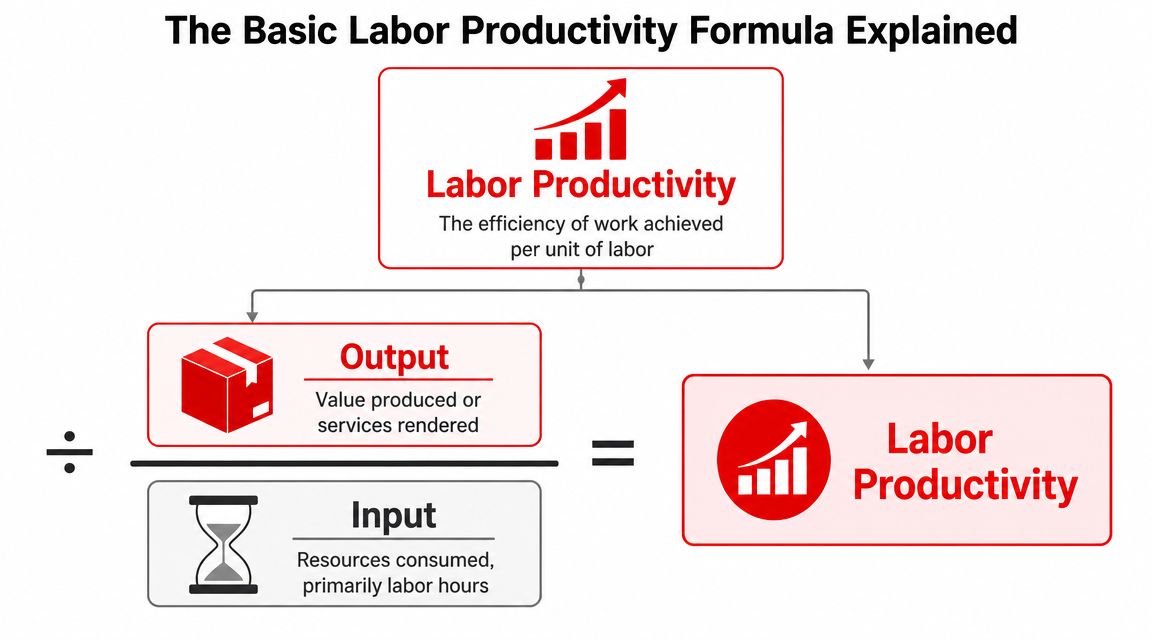
A simple version looks like this:
- Output: billed labor hours produced
- Input: technician hours clocked in or paid
- Productivity: billed hours per paid hour
If a technician is paid for a full day and produces a strong number of billed hours, productivity rises. If that same technician loses time to poor scheduling, bad handoffs, or incomplete inspections, productivity falls. The formula is simple. The management challenge is making sure the shop records both sides accurately.
What counts as output in a repair shop
Most owners should start with billed labor hours because that's easy to understand and directly tied to the work sold. Revenue can also be useful, but it gets distorted by parts mix, pricing policy, sublet work, and job type. Labor hours are cleaner when the goal is to understand technician output.
The input side matters just as much. Paid hours should include the actual time the shop is buying. If a technician is on the clock, that labor cost exists whether the shop has a car ready or not. Owners who want a clearer handle on labor expense alongside productivity can use a straightforward to separate direct labor cost from the output those hours are supposed to produce.
Even modest gains in output per hour can matter because the business is improving the return on time it already pays for.
That broader point shows up in national productivity data too. U.S. labor productivity grew 2.7% in 2023, compared with a 1.5% annual average since 2004, and that pace was close to the 2.9% rate seen during the 1990s productivity surge. For a shop owner, the practical takeaway isn't macroeconomics. It's that small gains in output per hour can compound into stronger wages, healthier margins, and more breathing room.
Keep the formula simple before making it fancy
Many shops overcomplicate this too early. They add too many custom categories, too many exceptions, and too many side calculations. That usually creates confusion instead of clarity.
Start with one clean question. For every paid technician hour, how many billed labor hours did the shop produce?
Once that number is trustworthy, deeper metrics become useful.
How to Accurately Measure Performance in Your Auto Shop
A lot of owners use efficiency, productivity, and proficiency as if they mean the same thing. They don't. Each number answers a different question, and confusion here leads to bad decisions.
A fast technician isn't automatically productive. A productive technician isn't automatically profitable if quality suffers. And a shop with strong billed hours can still have dispatching problems if the work mix changes.
The caution from labor statistics applies directly to repair shops. For service businesses, simple output-per-hour measures can miss job complexity and quality. A shop may appear less productive if it takes on more difficult diagnostics or more thorough inspections, even when profitability improves. The key is measuring value, not just speed.
Three numbers that answer different questions
Efficiency asks how fast a technician completes assigned work compared with the labor time sold or expected.
If a repair order carries a certain labor time and the technician finishes in less clock time, efficiency goes up. Flat-rate technicians understand this instinctively. They can complete billed work faster than the time allowed and create more available capacity.
Productivity asks how much of the technician's paid time turned into billed labor hours.
This is the metric most owners should watch first because it captures the effect of everything around the technician, not just wrench speed. Bad scheduling, missing parts, weak inspections, poor estimates, and delayed approvals all hurt productivity.
Proficiency combines both ideas. It gives a broader view of whether the technician is both efficient on jobs and productive across the day.
A technician can be highly efficient on brake jobs and still show weak daily productivity if the shop keeps starving that technician of ready work.
Key Technician Performance Metrics
| Metric | What It Measures | Formula |
|---|---|---|
| Efficiency | Speed on assigned work | Billed labor hours on completed jobs ÷ actual hours spent turning wrenches on those jobs |
| Productivity | Output from paid time | Billed labor hours produced ÷ total paid hours |
| Proficiency | Combined speed and utilization | Efficiency × Productivity |
A few practical cautions help keep these numbers honest:
- Track clean billed hours: Count the labor the shop sold, not what someone hoped to sell.
- Separate wrench time from total paid time: Efficiency and productivity answer different questions because they use different time bases.
- Flag heavy diagnostic work: Complex electrical or drivability jobs can distort simple comparisons.
- Watch quality alongside volume: A comeback can erase the gain from a fast repair.
- Measure by technician type: General service, diagnostics, and heavy line work shouldn't be judged by identical expectations.
What owners usually get wrong
The most common mistake is rewarding speed in isolation. That creates rushed inspections, poor notes, skipped test drives, and weak documentation. The second mistake is blaming technicians for low productivity when the actual issue sits at the service advisor desk or in the parts process.
Another mistake is reading one slow week as a people problem. Sometimes the mix of work shifts. A shop taking on more diagnostics, warranty issues, or difficult intermittent concerns may produce fewer billed hours per paid hour while still doing more valuable work.
That's why the best managers read these numbers together. Efficiency shows individual execution. Productivity shows system flow. Proficiency helps identify who's converting opportunity into output consistently.
Sample Calculations and Industry Benchmarks
A simple example makes these numbers easier to use.
Take a fictional technician named Alex. Alex is paid for a full day in the shop. During that day, Alex completes sold work on several vehicles, including one straightforward maintenance job, one brake job, and one diagnostic-heavy vehicle that takes more thinking and documentation than wrench time.
A simple day in the shop
Start with productivity.
If Alex is paid for a full day and produces nearly a full day of billed labor, productivity is solid. If Alex produces more billed labor than paid time, productivity is very strong. If billed labor falls well short of paid time, the owner should look for drag in dispatching, approvals, parts delays, or time lost between jobs.
Then look at efficiency.
Suppose the sold labor on completed jobs is strong, but Alex spent extra hands-on time on one difficult issue. Efficiency may soften even though the day still helped the shop. That doesn't automatically mean poor performance. It may mean the technician handled more complex work.
What the numbers actually mean
Many owners often ask for hard benchmark ranges. The safer answer is that shop benchmarks vary too much by labor model, car count, technician mix, diagnostic load, and advisor quality to pretend one universal number tells the truth. A European specialist shop, a general repair shop, and a high-volume maintenance operation won't look the same.
Don't judge a technician by a single ratio without checking the job mix, parts flow, and comeback record from the same period.
That caution lines up with how economists define labor productivity. The OECD notes that labor productivity is output per hour worked, but also that it's a partial productivity metric. Changes can reflect capital deepening, technical change, and organizational practices, not just individual worker effort.
In shop terms, a technician's numbers improve when the shop installs better diagnostic equipment, tightens dispatching, shortens estimate turnaround, and gives advisors cleaner inspection data to sell from. The technician may not be “working harder” at all. The operation is removing waste.
That's why benchmarks should be used as prompts, not verdicts. If a number looks weak, ask why. If a number looks great, make sure it isn't being inflated by easy work, cherry-picked jobs, or quality shortcuts.
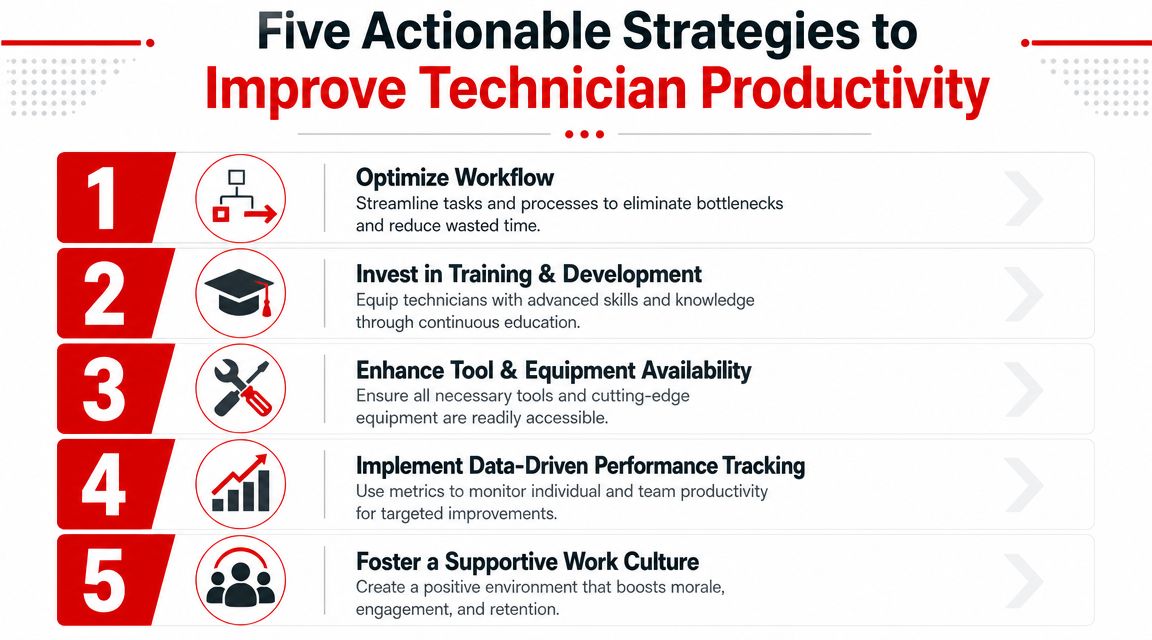
Five Actionable Strategies to Improve Technician Productivity
Most productivity gains don't come from telling technicians to move faster. They come from removing the delays, guesswork, and rework that block billed hours from happening in the first place.
The broader productivity lesson is clear. Output per hour can rise through better technology, stronger tools, and better management practices, not just more effort. That's the practical reading of how McKinsey explains productivity drivers in business settings (McKinsey on productivity drivers).
Remove friction before asking for speed
Tighten dispatching
Don't assign work based only on who looks free. Match jobs to skill level, tool access, and bay availability. A strong dispatcher protects technician flow by keeping the next vehicle ready before the current one closes.
Clean up the estimate handoff
Technicians lose time when repair orders are vague. Complaint, cause, correction notes should be usable. Parts assumptions should be checked. Authorization status should be visible. Every unclear handoff creates stop-start work.
Reduce parts interruption
A technician standing at the counter waiting for parts isn't productive. Pre-stage common items when possible. Confirm availability before dispatch on larger jobs. Build a process for fast substitutes when a supplier falls short.
Shops usually don't have a labor problem first. They have a waiting problem.
Build a shop that supports output
Use live workflow visibility
Managers need to see which cars are waiting for diagnosis, estimate approval, parts, quality control, or pickup. A digital board makes bottlenecks visible sooner than hallway conversations do. Tools such as shop management platforms with a Kanban-style workflow view, digital inspections, labor-time lookup, and analytics can help teams spot where paid hours are getting stuck. One example is RedAppy, which includes a Digital Shop Board, technician performance analytics, parts ordering tools, and an AI Repair Assistant for labor times and diagnostic support.
Coach with data, not pressure
If one technician shows strong efficiency but weak productivity, the issue may be feed rate, not skill. If another shows high productivity with recurring comebacks, quality control needs work. Use the numbers to diagnose process issues, not to shame the team.
A few habits usually produce the biggest lift:
- Prepare tomorrow today: Confirm appointments, likely parts needs, and bay assignments before closing.
- Shorten approval lag: Advisors should present inspection results quickly and clearly so cars don't sit half-sold.
- Protect diagnostic time: Complex jobs need uninterrupted thinking time, not constant pull-offs for quick tasks.
- Standardize QC: A repeatable final check prevents rework that destroys output.
- Keep information searchable: Vehicle history, prior recommendations, and customer notes should be easy to pull up fast.
Owners often ask what moves the needle. It's rarely a motivational speech. It's cleaner scheduling, better visibility, faster decisions, and fewer interruptions.
Start Building a More Productive and Profitable Shop Today
What is labor productivity in a repair shop? It's the value of billed labor hours produced for each hour the shop pays for. Once that idea becomes operational, a lot of confusion clears up.
A shop no longer has to guess why it feels busy but underperforms. The owner can look at whether technicians are being fed the right work, whether advisors are converting inspections quickly, whether parts delays are stalling bays, and whether difficult jobs are distorting simple comparisons. That changes the conversation from blame to diagnosis.
The most useful part of this metric is that it's manageable. Shops can improve it without pushing technicians into rushed work. Better dispatching, better estimates, better parts coordination, stronger inspections, and cleaner workflow visibility all raise output per paid hour in a healthier way.
The next step isn't to chase one perfect number. It's to build a system that measures the right work, shows where time is getting lost, and helps the team act on problems while the day is still in motion.
If the goal is to turn labor productivity into something the team can manage, take a look at RedAppy and reach out through the contact page to discuss how the workflow, analytics, inspections, and shop board can fit an auto repair operation.
Ready to Transform Your Shop?
RedAppy helps auto repair shops create professional digital estimates with photos and videos, send them instantly via text or email, and get customer approvals in seconds. No credit card required to start.