
Asymmetric Lifts vs Symmetric Lifts for Shops
Most buying advice on Asymmetric Lifts vs Symmetric Lifts gets the question wrong. "Cars go asymmetric, trucks go symmetric" sounds tidy, and it fails the first week a rear-loaded work truck, a long crossover, and a lowered coupe all need the same bay. Shops don't lose money because a column is square or rotated. Shops lose money when a tech has to re-spot a vehicle, work around a blocked door, or wait for an adapter that should never have been needed.
The better question is blunt. What share of the vehicles already on the schedule lift cleanly, on approved points, without special positioning, extra adapters, or a workaround? Answer that from recent repair orders, not from a sales brochure. For a mixed shop, a hybrid bay often beats the theoretically best single geometry.
Table of Contents
- Symmetric vs Asymmetric Lifts
- Access Capacity and Daily Setup Tradeoffs
- Shop and Vehicle Mix That Fits Each Lift
- Safe Positioning Rules for Both Designs
- Price Concrete and Ceiling Before You Buy
- Pick the Lift for Your Actual Bay Mix
Symmetric vs Asymmetric Lifts
Neither geometry wins for every shop. A symmetric Auto Lift AL2-9K-FX and an asymmetric AL2-9K-ACX were listed with identical 9,000-pound capacities and prices of approximately $2,420 to $2,500 by. That is roughly an $80 spread before freight. At that capacity, geometry is often close to free. Fit is not.
Equal capacity doesn't mean equal fit. A 9,000 lb rating only says the lift can carry that total load when the vehicle is spotted correctly, the arms share the load as designed, and the pads sit on approved lift points. It says nothing about whether the doors open, whether a long wheelbase stays inside the arm pattern, or whether a loaded bed pushes mass outside the footprint the manufacturer intended.
What changes between the columns
A symmetric lift puts the columns square to the vehicle. The load sits approximately 50/50 between the columns, a layout described in the as the balanced, centered setup. Arms are matched in reach front to rear, spotting is forgiving, and the vehicle center of gravity lands near the column line. That suits trucks, long-wheelbase SUVs, vans, and vehicles carrying weight in a bed, utility body, or rear cargo area.
An asymmetric lift uses shorter front arms and longer rear arms. On true asymmetric models, the columns are also rotated a few degrees. That shifts the vehicle rearward between the posts, moves the columns away from the front doors, and gives the tech room to get into the cabin while the vehicle is up. On sedans, coupes, and many crossovers, that means wider door swing, easier access to the parking brake and pedals, and a cleaner reach for under-dash electrical work.
"Asymmetric" is not one universal setup. Some models only change arm lengths. True asymmetric models also rotate the columns. Buyers need the manufacturer's drawing, not the label on the quote.
Hybrid designs, sometimes sold as super-symmetric or dual-geometry lifts, let one bay do both jobs. Three-stage front arms or an adjustable arm layout allow an asymmetric spot for a smaller car and a symmetric spot for a truck. That flexibility carries a premium and one hard condition. Every tech has to pick the right mode before the arms go under the vehicle, every time.
| Criterion | Symmetric | Asymmetric | Hybrid |
|---|---|---|---|
| Load between columns | About 50/50 | Shifted rearward | Select either split |
| Columns and arms | Columns square to the car | Shorter front arms, longer rear arms, often rotated columns | Adjustable or dual geometry |
| Best vehicle fit | Trucks, long wheelbases, rear-heavy loads | Many cars and crossovers | Mixed car and truck work |
| Door and interior access | Doors can hit columns on smaller cars | Wider door swing and easier under-dash reach | Wide swing in asymmetric mode, tighter in symmetric mode |
| Typical capacity class | Often 9,000 to 10,000 lb | Same class is common, not automatically lower | Same bay covers both classes |
| Setup risk | Easier centering on long vehicles | Wrong arms or a forward center of gravity | Tech must pick the correct mode |
| List price band | About $2,420 to $2,500 at 9,000 lb | Often the same list price at the same capacity | Usually a premium over one geometry |
Use that table as a scoring sheet against real tickets. Pull a representative run of repair orders. Mark each vehicle against the rows that decide the purchase, load split, arm reach, door access, and setup risk. The row that matches most tickets points to the default. The exceptions point to adapters, a second bay, or a hybrid.
Run a fit check, not a label check
Five facts about each common vehicle matter more than the badge on the lift.
- Wheelbase: Long vehicles need arm reach that still lands on factory lift points without the pads creeping onto rocker panels or floor pans.
- Curb weight: Total weight has to sit under the nameplate rating with margin, and each arm has to stay under its own limit.
- Where the mass sits: A front-heavy crossover, a mid-engine sports car, and a pickup with a loaded bed put the center of gravity in three different places.
- Body style: Pinch welds, frame rails, battery trays on EVs, and running boards each demand different pads and adapter heights.
- Trunk or bed load: Tools, parts, a camper shell, or cargo left in the vehicle move the balance point rearward and can turn a routine spot into a bad one.
Map those five facts to three things on the lift. Check arm reach at both full extension and full retraction, because short cars fail at retraction and long trucks fail at extension. Check column placement against door swing and the drive-through lane. Check the manufacturer's approved arm and adapter chart for the exact vehicles on the schedule. If a vehicle isn't on that chart, the lift isn't a fit for that vehicle, whatever the salesperson says.
Say a shop runs mostly compact and midsize cars, with a half-ton pickup most afternoons. The cars want door clearance for inspections and interior work. The pickup wants a centered load and full arm reach. A pure asymmetric lift serves the morning and fights the afternoon. A pure symmetric lift does the opposite. That shop should price a hybrid first, then decide if the premium is smaller than the cost of daily resets.
Say a different shop services fleet vans and three-quarter-ton trucks, with an employee's sedan once in a while. The hybrid premium buys a feature that shop uses a few times a month. Symmetric is the right buy, and the sedan gets spotted with care on the rare day it shows up.
The recommendation at this stage
Circle the geometry that matches the majority of repair orders. Then stop shopping for a winner and start checking constraints. Access and setup time decide whether a compatible lift is also a fast lift. Concrete, ceiling height, and power decide whether the chosen lift can go in the bay at all. A buyer who settles the vehicle mix first, then verifies the building, rarely ends up with the wrong posts bolted to the floor.
Access Capacity and Daily Setup Tradeoffs
Capacity is the weakest tie-breaker in this decision. Both geometries are commonly sold at 9,000 lb and 10,000 lb, and matched models can carry the same rating at nearly the same price. The work that happens after the arms lock is where the money moves.
A true asymmetric layout usually lets doors clear the posts on compact and midsize cars. That speeds up brake inspections, under-dash electrical diagnosis, parking brake checks, and the photo inspections advisors send to customers. A symmetric layout keeps a truck or long SUV centered and stable, but the same posts can block a car door. The tech then works through a half-open door, leans across a seat, or lowers the vehicle and re-spots it.
The supports hybrid systems that handle symmetric truck lifting and asymmetric passenger-car lifting from the same bay, a sign that manufacturers see access as a workflow feature rather than a comfort feature. Lift instructions in that material also stress the basics that get skipped under time pressure, centering the vehicle's center of gravity, observing per-arm load limits, and using all required arms.
A bad spot costs more than a small rating gap
A missed pad or a reversed arm can crease a rocker panel, unload one post, or burn ten to twenty minutes while the bay gets reset. That lost time hits inspections, diagnostics, electrical repairs, and customer-facing photo documentation. Shops that sell work from inspection photos feel blocked doors on the estimate, not only on the floor.
A lift can be rated for the vehicle and still be the slow bay.
One shop owner put the photo point plainly. "The inspection photos sell the work for us. Customers don't argue when they can see the problem themselves." That's Ahmed S. of Auto Boost, and the logic is simple. Clear door access means clear interior and underbody photos, faster approvals, and fewer callbacks to explain a blurry shot. Readers who want to see how photo inspections and job tracking sit next to the bay can review the RedAppy feature examples.
Measure one representative day
Don't guess at throughput. Time it.
- Minutes to spot each vehicle class: Record cars, crossovers, trucks, and vans separately, because an average hides the problem vehicle.
- Door-blocked events: Count every job where a door won't open far enough for normal entry.
- Reset count: Count vehicles lowered and re-spotted before work starts.
- Photo failures: Count inspections where the tech can't get a clear shot without moving the vehicle.
Body mechanics belong in that tally too. Under the Revised NIOSH Lifting Equation described in the, the Asymmetric Multiplier falls from 1.00 for a symmetric task to approximately 0.57 at 135 degrees, and the Recommended Weight Limit drops to zero above 135 degrees. Repeated twisting to drag arms, pads, wheels, or parts around a poorly spotted vehicle lowers the load a tech can handle safely by hand. A geometry that forces that twist all day is an ergonomic cost, not a minor annoyance.
Shop and Vehicle Mix That Fits Each Lift
Market share shows what buyers choose most often, not what fits a given bay. places symmetrical two-post lifts at 42.5% of the global two-post market and asymmetric lifts at 28.3%. Useful context. The vehicle mix in the bay still decides the purchase.
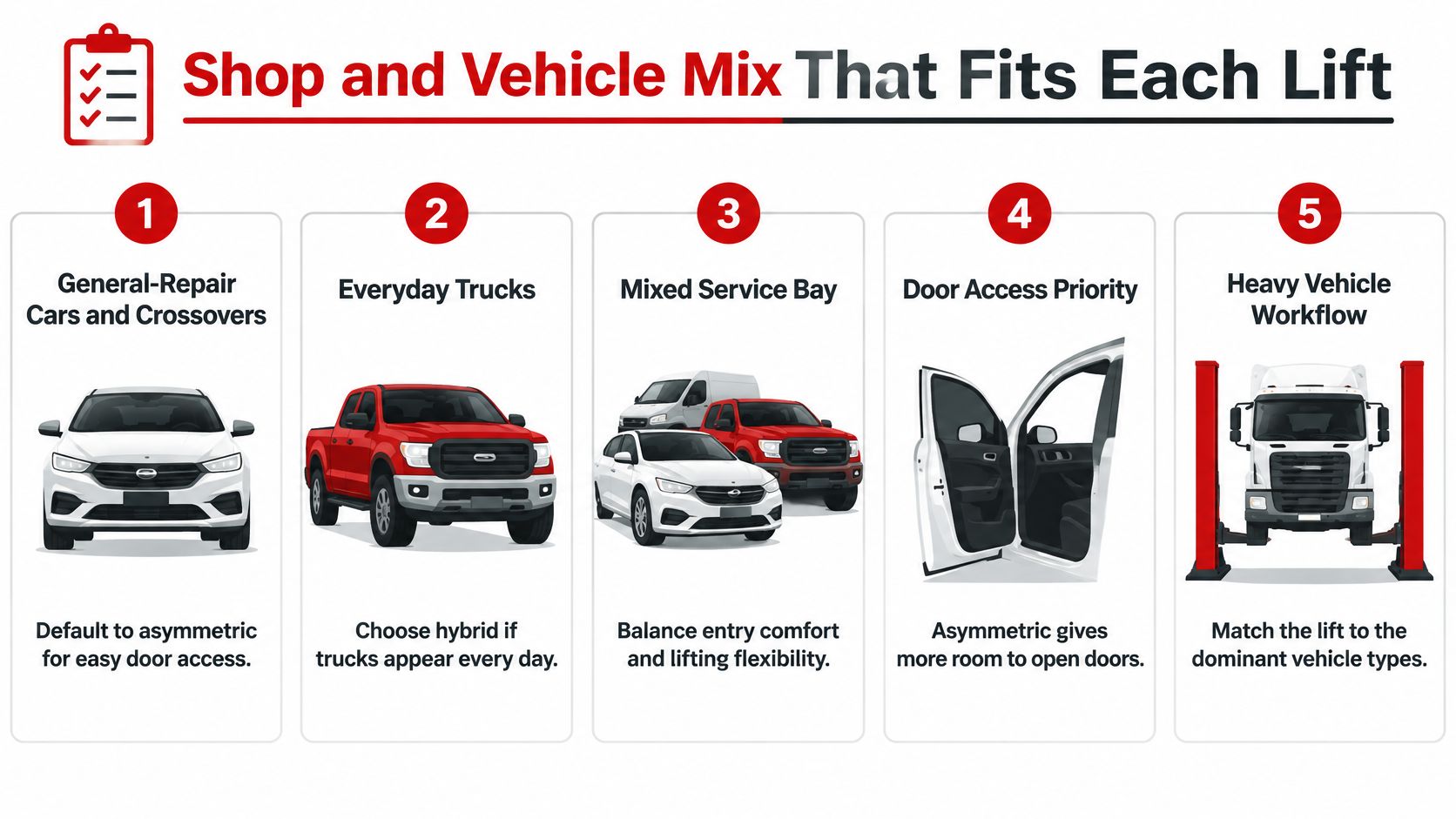
| Shop or mix | Default choice | Why it fits |
|---|---|---|
| Mostly cars and crossovers | Asymmetric, or hybrid if trucks are daily | Door and interior access on the majority of tickets |
| Trucks, vans, and fleet | Symmetric | Long wheelbase and rear load stay in the arm pattern |
| Mixed independent bay | Hybrid if the premium fits, else the majority geometry | Avoid special positioning on most repair orders |
| First permanent bay | The vehicles already on the schedule | One mismatched lift slows every job |
| Several locations | One hybrid specification | Same training, pads, and adapters at every site |
A general-repair shop built on cars and crossovers should default to asymmetric. Brakes, inspections, and electrical work all reward door swing and cabin access. If a truck or van lands in that bay every single day, the default changes to hybrid, because a daily exception isn't an exception anymore.
A fleet or truck shop should default to symmetric. Long wheelbases and rear-loaded beds stay inside the arm pattern without a custom spot, and techs get forgiving centering on the vehicles that pay the rent. Door access on the occasional sedan is a small price in that bay.
A mobile mechanic opening a first permanent bay should count vehicles already booked, not vehicles hoped for. One wrong geometry in a one-bay shop slows every ticket, with no second lift to absorb the mismatch. A multi-location operator should standardize one hybrid specification across sites. Training, pads, adapters, and spotting habits then stay identical at every address, and a tech transferred between stores doesn't relearn the bay.
Two exceptions that override any default
A lowered car needs low-profile pads and careful arm height on either geometry. Side skirts and low pinch welds don't care which way the columns face. Budget the pads and, where needed, drive-on ramps before the first sports car arrives.
A utility body, camper, or heavily loaded bed can make an asymmetric spot unsafe even when total weight sits under the nameplate. Rear mass outside the designed footprint can unload a front arm. That vehicle belongs on a symmetric lift, in hybrid symmetric mode, or in a different bay.
Close the decision with a one-week tally. Record the percent of cars, the percent of trucks and vans, and the percent needing a special position. If special positions exceed a small minority, the default in the table is wrong for that shop.
Safe Positioning Rules for Both Designs
Geometry doesn't relax the lift manual. Both designs require the vehicle center of gravity inside the column footprint, all required arms in place, pads on approved lift points, and each arm under its own capacity. A 9,000 lb lift isn't a license to put 4,500 lb on one arm. Per-arm limits exist because real vehicles don't split weight evenly across four pads.
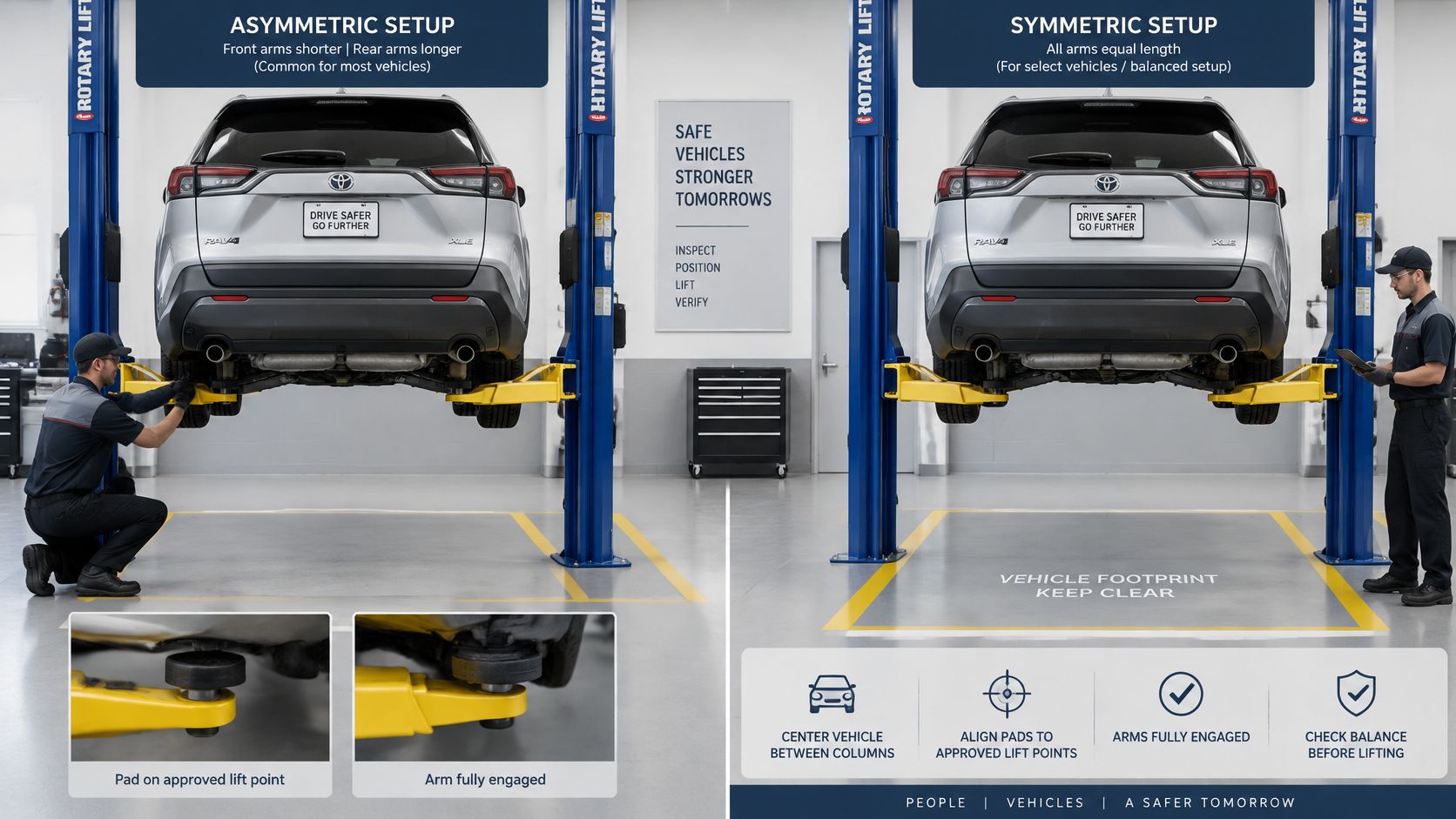
Each design invites one signature mistake. On an asymmetric lift, the error is long arms fitted at the front, or a rear-heavy truck spotted as if it were a sedan. Mass moves outside the designed footprint and a front arm can unload. On a symmetric lift, the error runs the other way. A tech forces a small car forward so the doors clear the posts, and the center of gravity walks toward the columns and off the intended balance point.
Run every lift in the same order
- Position and confirm: Place the vehicle so the center of gravity sits inside the column footprint, per the manufacturer's chart for that vehicle.
- Set arms and pads: Put all required arms and pads on factory lift points, never on rocker panels, floor pans, or improvised contact points.
- Raise and shake-test: Lift to the first lock, then shake-test the vehicle before anyone goes under it.
- Stay on the locks: Keep locks engaged the entire time the bay is occupied. Hydraulics hold pressure, locks hold vehicles.
- Clear before lowering: Lower only after arms, tools, creepers, and parts are clear of the footprint.
Stop rule: If any arm is at its limit, any pad is off a factory lift point, or the chart doesn't list the vehicle, the vehicle doesn't go up. Wait for an approved adapter or use a different bay.
Two planning items belong on the same checklist. Measure ceiling height and overhead hazards such as lights, door openers, and mezzanines before installation, not after the first tall van goes up. Treat ALI certification and the manufacturer's vehicle-specific chart as the authority. Both outrank any salesperson's cars-versus-trucks rule, and both outrank habit from a previous shop.
Price Concrete and Ceiling Before You Buy
The lift is rarely the expensive part of the bay. Equipment price gets the attention because it's printed on the quote. Freight, installation, electrical work, adapters, and concrete decide what the finished bay costs.
At the 9,000 lb class, the two geometries often list within a narrow band of each other, so arm shape alone seldom moves the budget. Extra height, three-stage arms, and a hybrid mechanism are what push a purchase upward. Options should be priced against a daily problem they remove, not against a newer name on the column.
| Cost item | Notes |
|---|---|
| Two-post lift at 9,000 lb | Listed price, before freight |
| Extra height, three-stage arms, or hybrid mechanism | Premium quoted per model and option package |
| Freight | Quote required |
| ALI-certified installation | Quote required |
| Dedicated 220-volt circuit | Amperage comes from the motor plate |
| Low-profile pads or truck adapters | Vehicle-specific |
| Slab repair or new pour | Needed if the slab is thin or cracked; many manufacturers call for 4 to 6 inches at about 3,000 psi |
The slab decides more than the arms do
Many manufacturers call for concrete on the order of 4 to 6 inches thick at about 3,000 psi, with no seams under the base plates. A thin, cracked, or residential-grade slab can cost more to cut out and replace than the lift itself. Core-drill or get the slab verified before signing a purchase order. Anchors only hold what the concrete holds.
Ceiling height needs the same discipline. Plan from the tallest vehicle plus full rise, with hood and hatch open, not from the average sedan. A standard two-post commonly needs about 12 feet clear, and routine truck work needs more. Confirm the overhead beam or cable path, lights, and door opener all clear that envelope.
Floor plan matters after the posts are down. Leave aisle width so a door can open without hitting the next bay, a toolbox, or a parts cart. An asymmetric lift that frees the door from the column and swings it into the neighboring vehicle hasn't solved anything.
Budget in three lines
- Equipment: Lift, arms, and the hybrid mechanism if selected.
- Building work: Concrete, anchors, installation, and the dedicated 220-volt circuit run from the panel.
- Adapters: Low-profile pads, truck adapters, and EV or frame adapters matched to the vehicle mix.
If building work exceeds the lift price, fix the slab and ceiling first. Arguing about arm shape over a slab that can't hold anchors is wasted effort. A hybrid premium is justified when it removes a daily reset or a daily blocked door. It's not justified as insurance against a vehicle class the shop sees twice a year.
Pick the Lift for Your Actual Bay Mix
Decide in order, and don't let capacity substitute for geometry. A bigger rating doesn't fix a wrong spot. A 10,000 lb symmetric lift still blocks car doors, and a 10,000 lb asymmetric lift still fights a long, rear-heavy truck.
- Mostly passenger cars: If more than about 70 percent of repair orders are cars and crossovers, and door access is part of the work, buy asymmetric.
- Trucks and loaded beds as the core: If trucks, vans, and rear-loaded vehicles pay the bills, buy symmetric.
- Both in the same bay most days: Buy hybrid, and train every tech to select the mode before the arms go in.
Before the purchase order, require three things in writing. Get the manufacturer's vehicle-specific chart for the five vehicles the shop sees most. Get the concrete specification the installer will certify against. Get a ceiling measurement taken with the tallest hood and hatch open. A quote without those three items is a price, not a plan.
After installation, put every bay on the same job board as the rest of the shop. The service advisor should see which vehicle sits on which lift without calling the floor. One owner described the value directly. "I can check on the shop from my phone now. I know what's on every lift without calling in. That alone was worth switching." That's John A. of IMS Auto and Body. A well-chosen lift only pays off when the front counter knows which bay is free, which job is waiting on approval, and which vehicle can move next. Shops ready to talk through bay setup, estimates, and inspections together can use the RedAppy contact page.
RedAppy gives a shop one place to run digital inspections with photos, estimates, invoicing, payments, and a Kanban-style shop board that shows every job from check-in to checkout, so the lift a shop just chose stays loaded with approved work instead of waiting on phone calls. Owners who want that bay visibility on any phone or counter screen can start at RedAppy and map the first bay, the first inspection template, and the first week of jobs before adding a second lift.
Ready to Transform Your Shop?
RedAppy helps auto repair shops create professional digital estimates with photos and videos, send them instantly via text or email, and get customer approvals in seconds. No credit card required to start.