
8 Auto Detail Names for a Business: Styles and Tips
A driver leaves work after rain, sees a windshield smeared with road film, and opens a phone to find help nearby. The map shows several listings, most with similar stars and photos, and the decision often comes down to one line of text. Strong auto detail names for a business tell that driver what happens, who it's for, and whether the work sounds worth a call.
That's why a name list alone isn't enough. A clever name that nobody can spell, register, or fit on a van creates work later. The eight styles below pair each idea with a practical check and a realistic downside, so shortlisting starts with names that can survive search results, signage, and growth.
Start by, then match the name to that buyer. A fleet manager, a luxury car owner, and a parent booking a driveway cleanup don't respond to the same words. The right name also leaves room for services that may be added later, including ceramic coating, paint correction, and interior restoration.
Table of Contents
- 1. Descriptive Service-Based Names
- 2. Shine and Gloss Wordplay Names
- 3. Mobile Detailing Names
- 4. Founder or Family Name Brands
- 5. Premium and Luxury Names
- 6. Alliterative and Memorable Names
- 7. Location-Based Names
- 8. Short Abbreviation and Tagline Names
- How the eight auto detail name styles compare
- Choose a Name You Can Register, Sign, and Grow Into
1. Descriptive Service-Based Names
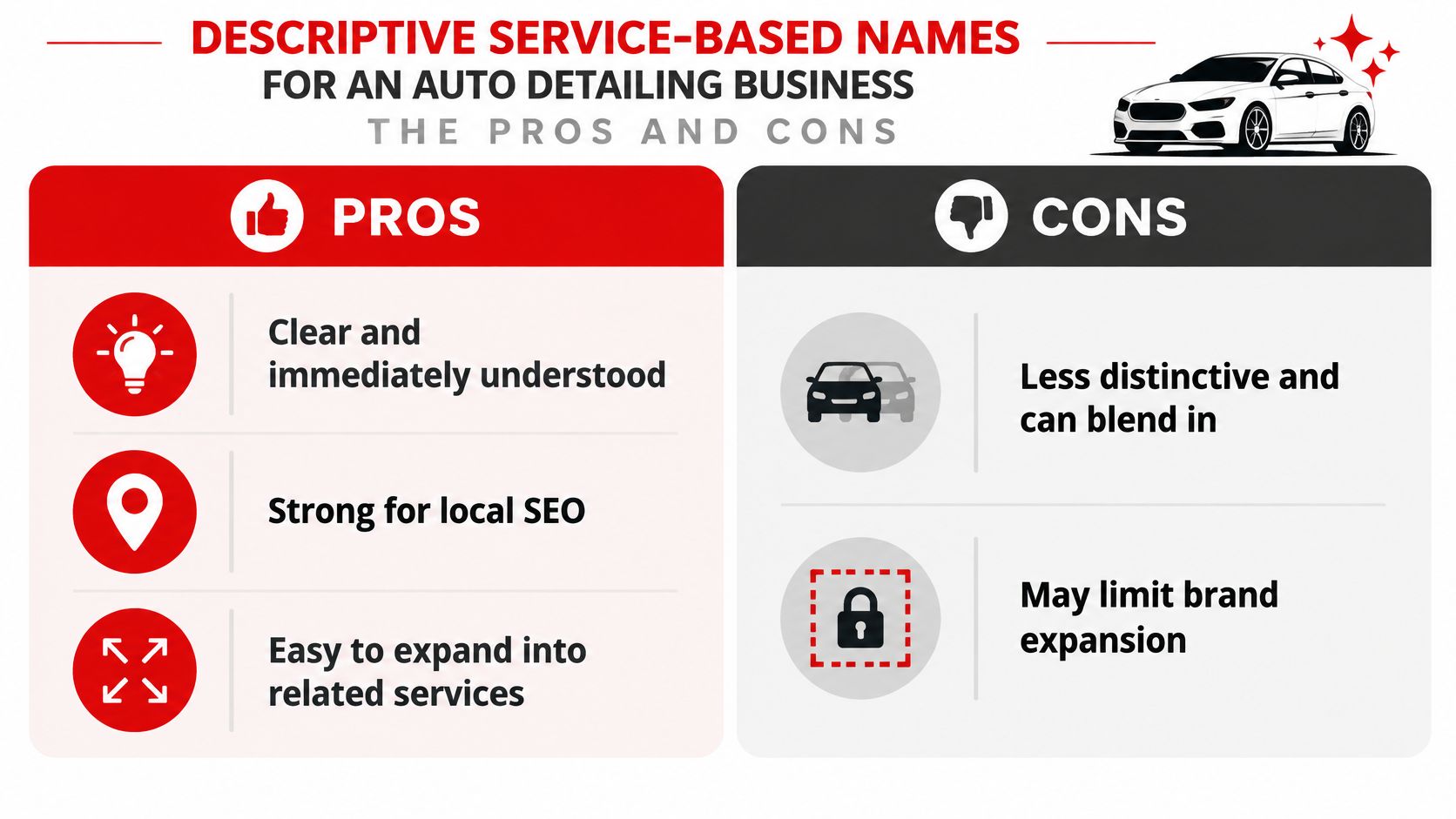
Descriptive names state the job in plain terms. Precision Auto Detail Co. and Complete Car Detailing Studio need no explanation, which helps a first-time customer understand the offer in a search result or referral. For a shop that also handles repairs, that clarity can signal detailing as a defined service rather than an afterthought.
The downside is sameness. Words such as Precision, Complete, and Pro show up everywhere, so the name may be clear without being memorable. Say a customer hears the name in conversation, searches later, and finds three similar listings in the same metro. The wrong shop gets the call.
The Pre-Launch Check
- Search the local pattern first: Search Google Maps for the city plus "auto detailing" to see which descriptive patterns are already crowded.
- Lock the digital basics: Register a matching domain and social handles before printing anything.
- Run a five-person recall test: Ask five customers to describe the business after hearing the name once.
A descriptive name works best when the distinctive part comes first and the service words do the supporting work. A branded website with contact forms and booking then turns that searchable clarity into appointments, and owners comparing online reach can also once the name is settled. An example of features shows how that website and booking layer can sit behind the name.
2. Shine and Gloss Wordplay Names
Finish words sell a picture. Gleam Garage and Sheen & Co. Detailing point straight to the moment a finished car rolls into daylight. They read well on a vehicle wrap, a uniform, and a social post, and they give photographers a clear brief. If the name promises gloss, the gallery has to prove it.
That's also the risk. A shine name raises a visual standard that weak photos immediately undermine. Dim bay photos, dusty wheels in the background, or inconsistent editing make the promise look borrowed. Say a shop sells paint correction under a gloss name. Customers will expect swirl-free panels, not a quick wash with glossy tire dressing.
Practical rule: If the name describes the finish, the first nine photos on the website need to show that finish on dark paint, light paint, and an interior.
The Pre-Launch Check
Trademark risk matters early here because finish words overlap with product brands and other shops. Run a search through before ordering signs or wraps, checking appearance, sound, meaning, and commercial impression rather than exact spelling alone. Pair the cleared name with one consistent color scheme across the website and social profiles, then post before-and-after photos that match the words on the door.

3. Mobile Detailing Names
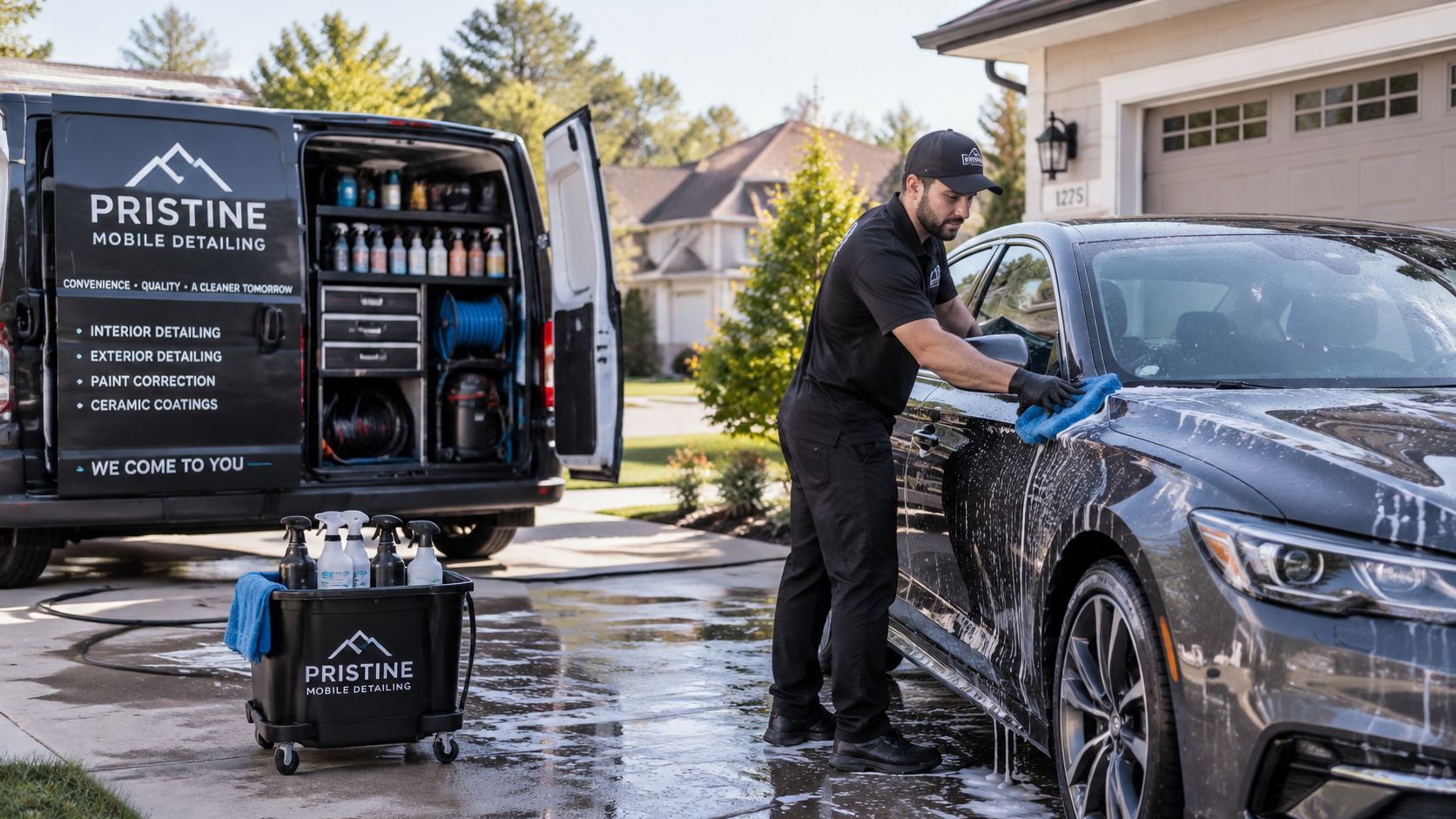
A mobile customer isn't buying a bay. That customer is buying time back. Driveway Detail Co. and On-Site Auto Spa make the delivery model obvious for solo operators and small teams working at homes, offices, and job sites. The name answers the first practical question before a call happens. Where does the work take place?
The trade-off is growth and compliance. A strongly mobile name can feel limiting after adding a fixed shop, and it can also attract jobs outside a profitable service area. Say a two-person crew covers one county but the name sounds regional. Every week brings inquiries that burn drive time and water, power, and setup costs.
The Pre-Launch Check
- State the service radius clearly: Put the radius on the website and listing so the name doesn't promise more territory than routes can support.
- Reduce phone tag: Offer scheduling windows and text reminders, because the operator is usually driving or working on a car.
- Keep routes visible: Use a simple job board or calendar so appointments cluster by area instead of scattering across town.
Mobile operators also need the listing to match reality. A business that travels to customers should use its profile as a service-area business rather than inventing locations it doesn't occupy.
4. Founder or Family Name Brands
Some customers don't want a brand. They want a person who'll answer for the work. Martinez Auto Spa and Keller's Detail Works put a surname on the invoice, which can build trust faster than an abstract finish word. That trust matters when a customer hands over keys to an expensive vehicle.
This style fits referral-driven shops well. A satisfied customer can say a surname in conversation and the listener remembers a person, not another shine claim. It's also easier to distinguish in a local market where several competitors already use similar descriptive phrases.
The downside shows up later. A personal name can complicate resale, partnership changes, or expansion if the founder steps back. Say the owner hires three technicians and stops touching cars. Customers may still expect the named person on every job, and disappointment turns into reviews that mention absence more than quality.
The Pre-Launch Check
- Put a face to the name: Use the founder's photo and story on the About page, with a clear explanation of who performs the work now.
- Ask for name-specific proof: Request reviews and referrals that mention the owner or family, because that reinforces the reason for choosing this style.
- Plan the transition early: Decide how the brand works if a partner joins, a family member takes over, or the shop is sold.
5. Premium and Luxury Names
Obsidian Auto Spa and Platinum Signature Detailing don't compete on convenience. They sell protection, patience, and higher standards. Words such as Obsidian, Onyx, Platinum, and Signature suit shops focused on ceramic coatings, paint correction, and luxury or exotic vehicles, where the ticket needs confidence before the estimate.
Premium language is easy to borrow and hard to support. If the name sounds expensive but the website has blurry photos, vague packages, and no explanation of correction stages, buyers hesitate. Say a coating customer compares two shops. The one that explains preparation, curing, maintenance, and warranty limits in plain language sounds premium. The one selling mystery sounds inflated.
The Pre-Launch Check
- Publish tiered packages: Show what's included at each level so premium pricing has visible value.
- Use photography that matches the claim: Shoot finished panels under inspection lighting, not only showroom glamour shots.
- Train the explanation: Staff should explain the difference between a maintenance detail, correction, and coating without leaning on hype.
RedAppy's transparent pricing and branded website approach can help a premium shop present that clarity, and owners who want to talk through presentation can contact us before committing the name to signage.

6. Alliterative and Memorable Names
Say Shine & Sheen once and many listeners can repeat it. Detail Dynamics works the same way. Repeated sounds make a name stick in conversation, which is useful when referrals happen away from a phone or business card.
Memorability can still fail at the keyboard. A name that's fun to say but hard to spell sends searchers to a competitor or a dead result. Forced alliteration can also sound discounted when the shop wants coating work. Say a name gets a laugh at a cars and coffee event but sounds less serious on a four-figure correction estimate. That mismatch costs trust.
A name that survives a phone call, with road noise in the background and no chance to spell it, is stronger than a name that only looks clever in a logo.
The Pre-Launch Check
- Run the aloud test: Say the name to ten people and note how many spell it correctly without help.
- Check handles before printing: Confirm social handles and the domain before ordering cards, wraps, or uniforms.
- Keep it short: Two or three words are easier to recall, sign, and fit into a Google listing without crowding out the service.
Local discovery raises the stakes for that spell test. report that 80% of U.S. consumers search for local businesses online weekly, including 32% who search daily. If searchers can't reproduce the name, memorability hasn't done its job.
7. Location-Based Names
Place names tell nearby customers that the shop belongs to their area. Harbor City Detail Works and Westside Auto Spa can strengthen local relevance for a single-location shop, and they can help a multi-location operator make each branch feel local under one shared system. They also read naturally on a map pin and a storefront sign.
The risk is drawing the map too tightly. A neighborhood name can confuse customers after a move across town, and a city name can look wrong when a second location opens elsewhere. Say a shop built around one suburb wins fleet work in the next county. The name may make that fleet buyer assume the crew won't travel or doesn't serve commercial accounts.
The Pre-Launch Check
Consistency matters as much as geography. require the profile name to match the actual name used on signage and branding, so adding a city or keywords only for search can create compliance problems. Use the same location name across the profile, website, invoices, and directories.
- Choose the right geographic width: Pick a broader regional term if expansion is likely.
- Support each site properly: Build location pages when more than one location operates, rather than stretching one page to cover everything.
- Test the move scenario: Ask whether the name still works after relocating five miles.
8. Short Abbreviation and Tagline Names
Short names earn space. ProShine Detail Lab and ADL Auto Detail fit cleanly on signage, app icons, invoices, and social handles, and a compact brand is easier to repeat on a uniform or door graphic. A short tagline can carry the explanation the name leaves out, as long as it stays concrete and brief.
Abbreviations have a discovery problem. Customers who hear initials may not know what the letters stand for, which letters they heard, or how to search them in a crowded market. Say a referral says only three letters in a parking lot. By the time that driver searches at home, a national company with the same initials may own the results.
The Pre-Launch Check
- Search the abbreviation alone: Check whether the short form is already used in the area or dominated by an unrelated business.
- Show the full name beside it: Place the complete business name next to the abbreviation on the website, listings, and vehicle graphics.
- Keep the tagline under six words: Short taglines stay readable on a van, invoice header, and profile image.
Short forms work best as a compression of an already clear identity. They shouldn't be a puzzle customers must solve before booking.
How the eight auto detail name styles compare
| Item | Best for | Main advantage | Main risk |
|---|---|---|---|
| Descriptive Service-Based Names | Shops emphasizing specific detailing services | Clear to customers and supports local search | Can blend in or limit future brand expansion |
| Shine and Gloss Wordplay Names | Brands focused on polished visual results | Memorable and suited to visual marketing | Similar names may create trademark conflicts |
| Mobile Detailing Names | Operators who travel to customers | Clearly communicates convenience and on-site service | May limit perceptions if the business opens a shop |
| Founder or Family Name Brands | Referral-driven, relationship-focused businesses | Builds personal trust and accountability | Can complicate a sale or transition |
| Premium and Luxury Names | High-end detailing and specialty services | Supports a distinctive, premium position | Requires a consistently high-end customer experience |
| Alliterative and Memorable Names | Businesses seeking easy-to-repeat branding | Easy to recall and share by word of mouth | Can sound gimmicky if overdone |
| Location-Based Names | Local shops and community-focused brands | Strengthens local relevance and search visibility | May restrict perceived reach during expansion |
| Short Abbreviation and Tagline Names | Digital-first brands needing compact names | Fits well on small graphics and social handles | Initials may be difficult to search or distinguish |
Choose a Name You Can Register, Sign, and Grow Into
Shortlist two or three candidates from different styles, not three versions of the same idea. Pair one descriptive option with one founder, place, or premium option, then run identical checks so the comparison is fair. A name that wins only because it sounds fresh in a quiet room may lose badly on a map listing.
Start with local distinctiveness. Search each exact name with the target city, then search close variants with "auto spa," "detailing," and "auto detail." A twin in the same metro matters more than a similar shop far away, because reviews, calls, and directions can cross wires fast.
Next, check whether the name can be claimed and kept consistent. separates an entity name, a trademark, a domain name, and a DBA, and those are not interchangeable. Confirm the legal registration path, search federal marks, and secure the web address before signage money goes out.
Trademark clearance needs more than an exact-match search. explains that the database includes registered and applied-for marks, so candidates should be checked in multiple forms before uniforms and wraps are printed. Similar sound or commercial impression can matter even when spelling differs.
Domain ownership deserves the same care. explains that privacy services can keep personal contact details out of the public Registration Data Directory Service, commonly known as WHOIS. Register through an accredited provider, understand who's listed, and keep contact details current.
Then test the name with people who resemble buyers. Ask five customers what service they expect, what price level they expect, and whether the shop sounds mobile or fixed. Their answers reveal positioning problems faster than another brainstorming session.
Finally, picture the name on the work itself. It should look credible on a coating estimate, fit on a van door, read clearly in a text message, and still make sense after adding fleet work or paint protection. Choose the candidate that passes registration, search, pronunciation, and growth checks, then build the website and booking tools to match that identity from day one.
Once the name is chosen, a branded website with contact forms, appointment requests, estimates, invoices, inspections, and customer records helps turn recognition into booked work. RedAppy brings those tools together for auto service shops that want one consistent system behind the name customers see. Visit the site to explore how the setup can support a detailing brand from first inquiry to final payment.
Ready to Transform Your Shop?
RedAppy helps auto repair shops create professional digital estimates with photos and videos, send them instantly via text or email, and get customer approvals in seconds. No credit card required to start.