
Auto Repair Estimate App: A Practical Guide for Shop Owners
Wednesday morning at a two-bay shop is already behind schedule. A customer is waiting in the lobby, the phone keeps ringing, and a technician has just left a handwritten inspection on the counter. The advisor still has to decipher the notes, price the work, call the customer, and record what gets approved.
Paper estimates don't just take longer to write. They make it harder to show what the technician found, harder for customers to review recommendations after they leave, and harder for the shop to prove what the customer authorized. An auto repair estimate app can bring inspection details, pricing, and customer approval into one record, turning the estimate into a decision document rather than a number on a page.
Table of Contents
- Why Your Shop Is Losing Time Before the Estimate Even Goes Out
- What an Auto Repair Estimate App Actually Does
- How Digital Inspections Flow Into Estimates and Approvals
- Core Features That Separate a Real App From a Price Spreadsheet
- Comparing Standalone Estimate Tools and All-in-One Shop Platforms
- The Real ROI of Switching From Paper to a Digital Estimate Workflow
- A Shop Owner's Checklist for Buying and Rolling Out an Estimate App
Why Your Shop Is Losing Time Before the Estimate Even Goes Out
The handwritten inspection might say “front brakes soon” without identifying what the technician saw or attaching a photo. The advisor has to find the technician for clarification, then explain the recommendation without the evidence the customer would need to judge it. Meanwhile, the customer heads back to work, and the shop starts a round of missed calls and voicemails.
That delay has a cost beyond the time spent dialing. A customer who can't see the inspection or understand which work is urgent may postpone everything, including repairs the shop considers important. The advisor may also struggle to answer a later question about whether a particular job was approved, especially if notes and signatures live on different scraps of paper.
The work itself has substantial economic context. Federal Reserve data sourced from the Bureau of Economic Analysis puts U.S. personal spending on motor-vehicle maintenance and repair at $208.628 billion in 2021 and $261.015 billion in 2024, an increase of approximately $52.4 billion, or 25.1%. That's a national spending measure, not proof that any particular app increases approvals. It does show that estimates sit at the center of a large, recurring consumer-service market.
A digital workflow doesn't fix every bottleneck. It won't make a difficult repair simple or turn an unclear recommendation into a convincing one. It can give the advisor a faster way to connect the technician's findings to line items, share evidence with the customer, and keep a record of the decision.
The practical win isn't simply sending an estimate faster. It's sending one the customer can understand, approve, and revisit later.
That's the job an estimate app should take off the counter: less hunting for information, fewer follow-up calls to reconstruct a conversation, and a more reliable record of what was proposed.
What an Auto Repair Estimate App Actually Does
A useful auto repair estimate app connects vehicle details, repair scope, pricing, and customer authorization in one decision record. The advisor can use it to explain what the shop proposes, why the work is recommended, and what the customer has approved. It differs from invoicing software, which focuses on completed work, and from a full shop platform, which may also handle scheduling, parts, work orders, and payments.
The estimate should reflect the specific vehicle and inspection, not just a generic list of prices. VIN and configuration details help the advisor select relevant repair operations. Technician notes, photos, and condition details give the recommendation context, while a clear approval record shows who authorized the work and which estimate they reviewed.
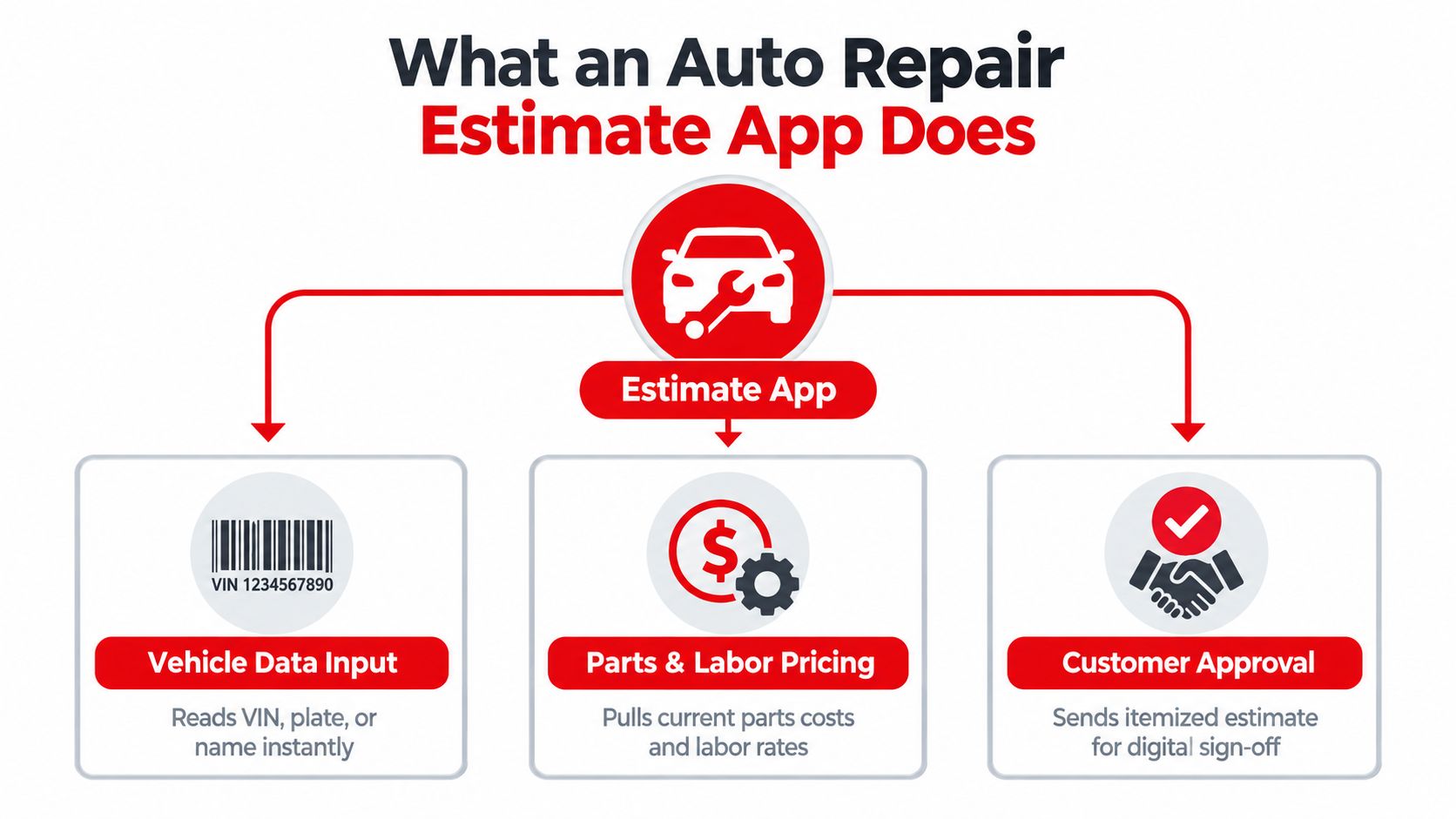
Pricing still needs human review. Labor rates, parts choices, and repair procedures all affect the total. MOTOR describes its estimated work times as researched against OEM procedures and validated by experts using technician experience and average repair durations. A useful app should show the basis for quoted labor time and let the advisor check each operation before sending the estimate. The total is a starting point for a clear conversation, not an unexplained answer.
A signed estimate also needs to preserve relevant inspection findings and any vehicle-specific considerations, including ADAS or EV procedures and applicable local requirements. That makes the record useful for a customer deciding from their phone and for the shop referring back to the approved scope later. The same need for clear documentation applies in other repair settings, including.
Standalone tools may focus on estimates and approvals, while broader platforms can carry approved work into other shop operations. Which setup fits depends on how the rest of the shop's workflow runs.
How Digital Inspections Flow Into Estimates and Approvals
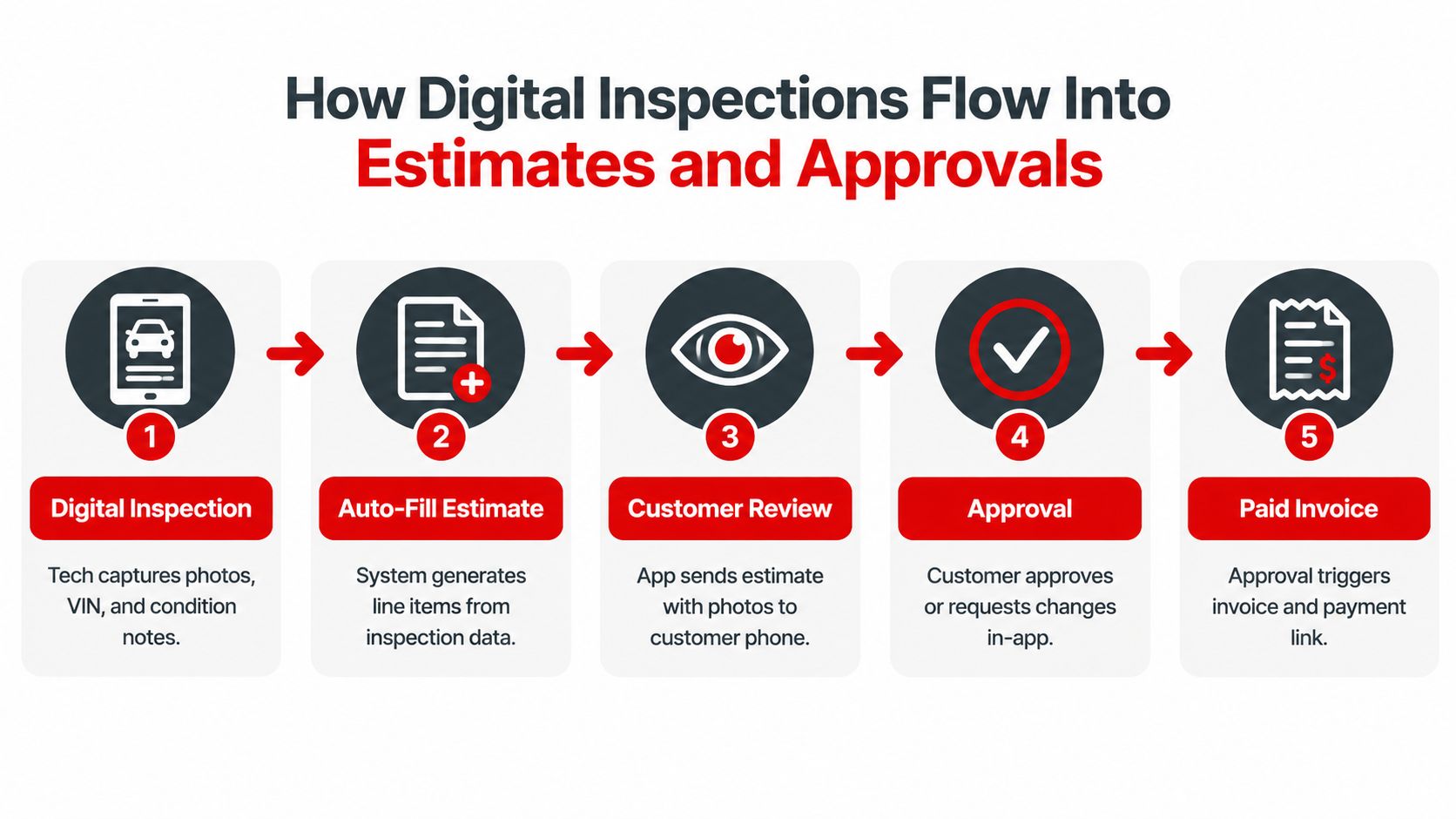
A digital workflow starts in the bay, not at the front counter. The technician identifies the vehicle, records the concern and condition, and attaches photos or notes to the inspection. Those details give the advisor something concrete to work from instead of a handwritten summary that needs interpretation.
Capture findings once
The technician should record the VIN or other vehicle identifier, the affected component, what was observed, and the evidence needed to explain it. Severity tags can help the advisor distinguish work that needs prompt attention from maintenance that can be discussed for a later visit. The important thing is that the tag supports a clear explanation, rather than substituting for one.
A note like “leak at hose” is less useful than a photo showing where the leak appears and a note identifying the recommended next step. Diagnostic findings should be treated as work with its own scope, not buried in a generic repair line. Where diagnosis is part of the recommendation, the estimate should make clear what the shop proposes to inspect and what the customer is authorizing.
Build the quote and send it
The advisor reviews the inspection, chooses the appropriate labor operations, adds parts, and includes any relevant shop supplies, sublet work, or calibration operations. Each price should be visible in the estimate, so the customer can see how the total is formed. Once the quote is ready, the app can send it for review on a phone, with the evidence attached and a digital approval record.
Repair expenses are meaningful decisions for customers. A 2019 Harris Poll for Ally Financial surveyed 2,012 U.S. adults and found average vehicle repair and maintenance spending of $1,986 over the previous five years. Adults aged 18 to 34 averaged $2,334, compared with $1,654 for adults aged 55 and older. The survey is a historical U.S. benchmark, not a measure of app performance. It helps explain why a clear scope, price, and approval record matter.
Carry approval through to completion
After approval, the shop can move the job to parts ordering and technician assignment without re-entering the estimate. A visual job board makes it easier to see what's waiting for approval, parts, or bay time. At pickup, the approved work can flow into the invoice, helping the advisor compare the completed job with the authorized scope.
The weak point in many paper systems is the handoff. A photo sits on one phone, the customer's approval is in a text message, and the parts order lives in another system. A connected record reduces the need to reconcile those pieces later.
Core Features That Separate a Real App From a Price Spreadsheet
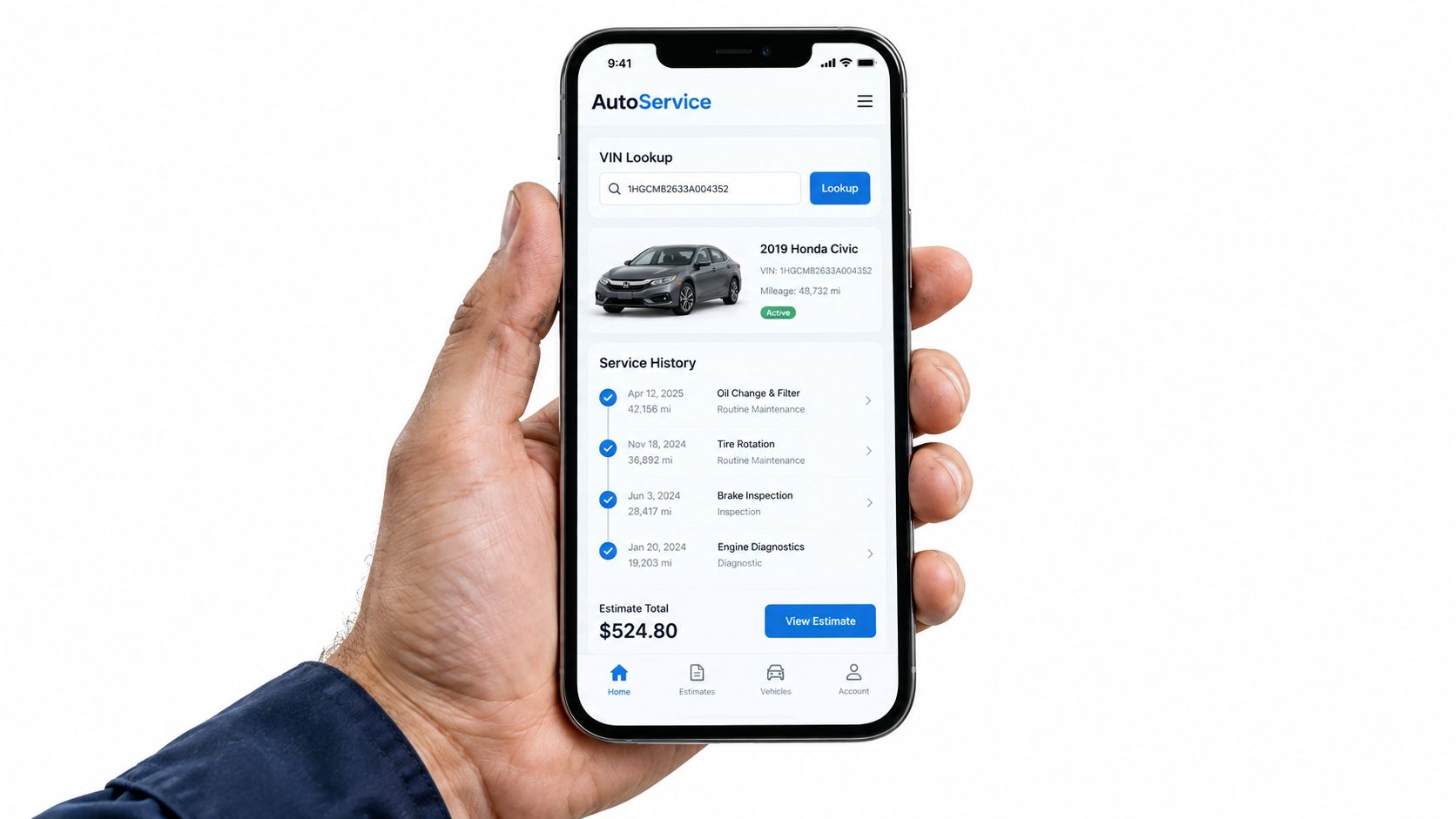
A customer is reviewing a repair estimate on a phone and needs to decide whether to approve the work. The record should connect the vehicle, inspection evidence, repair operations, and authorization in one clear document. When evaluating software, ask which parts of that process it handles and where staff still need to fill gaps by hand.
Vehicle and inspection records
Vehicle lookup and history should let staff find the right customer and vehicle by VIN, plate, or name. A service history tied to the vehicle reduces repeated entry and helps advisors check prior work before preparing a new estimate. Accurate identification also matters when equipment or repair procedures vary by vehicle.
Digital inspections should let technicians add photos, videos, notes, and condition ratings from a phone or tablet. A checklist can record that an item was inspected, but photos and notes show the customer what the technician found. Check that each piece of evidence stays attached to the correct inspection and estimate.
Labor, parts, and conditional operations
Vehicle-aware labor information should match the selected vehicle and repair operation, with separate customer-facing lines for diagnostic time, repair time, programming, calibration, and verification when applicable. That distinction helps the customer understand what the work covers and gives the shop a clearer record of the approved scope. A generic labor total can hide the difference between finding a fault and confirming that the repair fixed it.
Parts pricing and ordering should reflect the shop's suppliers and let staff compare relevant options. Each line item should identify what the shop intends to install and show how parts contribute to the total. Confirm that the estimate distinguishes parts from labor, so customers can see what they are approving.
ADAS triggers need conditional logic. A windshield replacement, suspension repair, wheel alignment, or sensor replacement may involve additional diagnostic or calibration work. The app should prompt the advisor to assess related operations and record whether the work will be done in-house or sent to a qualified provider. This is more useful than applying a generic calibration charge to every estimate, particularly when vehicle-specific requirements differ.
Authorization and visibility
Approval records should preserve the estimate the customer saw and the authorization they gave. The FTC says a written auto repair estimate should identify the vehicle condition being repaired, needed parts, and anticipated labor charge, and should be signed with an authorization threshold for additional work where state law requires it. A signature button alone does not make an incomplete estimate adequate or replace a process that follows local rules.
Reporting should help owners answer practical questions: which recommendations are approved, where jobs are waiting, and how technician time compares with quoted work. Dashboards are only useful when staff enter information consistently. A new shop can defer advanced analytics, but it needs accurate vehicle records, itemized estimates, and documented approvals from the start.
Comparing Standalone Estimate Tools and All-in-One Shop Platforms
The choice comes down to how much of the job needs to live in one system. A standalone tool may fit a shop that already has dependable processes for inspections, scheduling, parts, and invoicing. An all-in-one platform can reduce duplicate entry by connecting those tasks, but it may require more setup and a closer look at what features the shop will use.
| Dimension | Standalone Estimate Tool | All-in-One Shop Platform |
|---|---|---|
| Setup | Often focused on quote templates and approval settings. | Requires configuring connected workflows such as inspections, jobs, and payments. |
| Cost | May suit a shop that needs estimating only. | Can consolidate tools, but the owner should compare the subscription with the functions used. |
| Data flow | Inspection, estimate, and invoice records may need separate entry. | Can keep job details connected from inspection through invoice. |
| Technician workflow | May rely on a separate inspection process. | May provide a mobile workflow for inspections and job updates. |
| Growth | Can work for a simpler operation. | May support more connected processes as bays, teams, or locations expand. |
The format of the price matters as much as the software category. AAA reports that mechanic labor rates can range from below $100 to above $200 per hour across the United States (AAA's mechanic labor-rate overview). That spread is a reason to set shop-specific rates and show parts and labor separately, not to rely on a single generic national figure.
During a demo, ask the vendor to run a real repair through the complete process. Can the technician attach inspection photos? Can the advisor set the shop's rates and itemize the work? Does the customer see and approve the quote on a phone? What happens to the approved work afterward?
A calculator plus clipboard is a reasonable setup when the shop's other handoffs already work. If staff keep copying the same information between tools, a broader platform may be worth evaluating.
The Real ROI of Switching From Paper to a Digital Estimate Workflow
The financial case should be built from the shop's own workload, not a vendor's promise. Three measures are useful: administrative time spent preparing and chasing estimates, the share of estimates customers approve, and the value of work customers accept when they can compare clear options.
Start with the desk. Track the time advisors spend transcribing inspection notes, calling customers to explain recommendations, and searching for approvals. Then estimate what that time costs using the shop's actual wage and payroll burden. A system may recover time by reducing repetitive entry and phone tag, but the amount will depend on how the shop uses it. A promised weekly saving shouldn't be treated as guaranteed without measuring the current process and the result.
Next, track approval behavior by advisor and estimate type. Photo-rich estimates can help customers understand the recommendation, but the app can't make a necessary repair affordable or guarantee a higher approval rate. The useful comparison is whether customers respond differently when they receive itemized options and evidence instead of a verbal description.
Affordability matters to that decision. An AAA survey of 1,009 U.S. adults found that one in four drivers couldn't pay a $2,000 repair bill immediately, while one in eight couldn't pay a $1,000 bill. A prompt estimate with a clear total and understandable priorities gives the customer a better basis for deciding what to authorize. It doesn't guarantee the customer can pay or that every recommendation will be approved.
To evaluate payback, compare the app's recurring cost and setup effort with the shop's measured changes in admin time, approvals, and accepted work. Use the shop's own labor cost and actual repair-order data, not assumed savings or an unverified lift. If the owner can't identify which numbers will be tracked before the switch, the ROI claim is too vague to guide a purchase.
A Shop Owner's Checklist for Buying and Rolling Out an Estimate App
A vendor demo should answer operating questions, not just show polished screens. The following checklist helps separate everyday fit from features that look impressive but don't solve the shop's current bottlenecks.
- Pricing and terms: Confirm what the subscription includes, how pricing changes as staff or locations are added, and whether terms are flexible.
- Data migration: Ask how customer, vehicle, and service-history records move into the new system, and who checks that the imported records are usable.
- Mobile use: Test the technician's workflow beside a vehicle, including VIN entry, photos, notes, and estimate review.
- Integrations: Check which parts suppliers and payment processors connect to the platform, and whether staff still need to re-enter order or payment details.
- Growth: Confirm that the job board, reporting, and permissions can support the shop's current setup and any planned expansion.
- Local compliance: Ask how the app handles state-specific estimate fields and customer approvals. Florida requires written estimates for repairs over $150, including fields such as odometer reading, license tag, labor basis, and warranty terms. It also requires approval before costs exceed the estimate by more than $10 or 10%, whichever is greater.
A controlled rollout is safer than changing every bay's routine at once. Start with digital inspections and estimates on one bay, then check whether technicians attach useful evidence, advisors can build and send the quote, and approvals stay connected to the job. Adjust templates and roles before expanding to the rest of the shop.
RedAppy's feature set includes digital inspections, estimates, invoicing, online payments, parts ordering, analytics, and a visual shop board. Shop owners can review RedAppy's workflow features and discuss fit for their operation through RedAppy's contact page.
RedAppy connects digital inspections, estimates, approvals, invoicing, and parts workflows in one shop-management platform. Visit RedAppy to explore whether its tools fit the way your shop documents recommendations and gets customer authorization.
Ready to Transform Your Shop?
RedAppy helps auto repair shops create professional digital estimates with photos and videos, send them instantly via text or email, and get customer approvals in seconds. No credit card required to start.