
Auto Repair Estimate Disclaimer: What to Include
The popular advice says a longer disclaimer protects a shop better. It doesn't. A dense paragraph that warns prices may change can sound like the shop has already given itself permission to spend more, and customers still don't know when they'll get a call, what counts as a yes, or what they'll owe if they stop the job. That's where arguments start.
A better auto repair estimate disclaimer is shorter and more operational. It draws a clear line around the quoted work, promises no extra work or charges without recorded approval, and answers the question most forms skip: if the customer says no after diagnosis or teardown, what exactly is owed and how does the vehicle come back? Length isn't protection. A precise approval process, stated plainly and then followed every time, is what protects the customer and the shop.
Table of Contents
- What an Auto Repair Estimate Disclaimer Does
- Clauses Worth Putting on the Estimate
- State Rules That Change the Wording
- Sample Disclaimers for Three Situations
- Why Approval Still Has to Be Recorded
- Placing and Automating the Disclaimer
What an Auto Repair Estimate Disclaimer Does
An auto repair estimate disclaimer is the short note on an estimate that explains what the quoted price covers, what it doesn't cover, and what must happen before the price can change. A customer hears a brake price at the counter and often treats that number as a promise. The disclaimer stops that mix-up before the wheels come off.
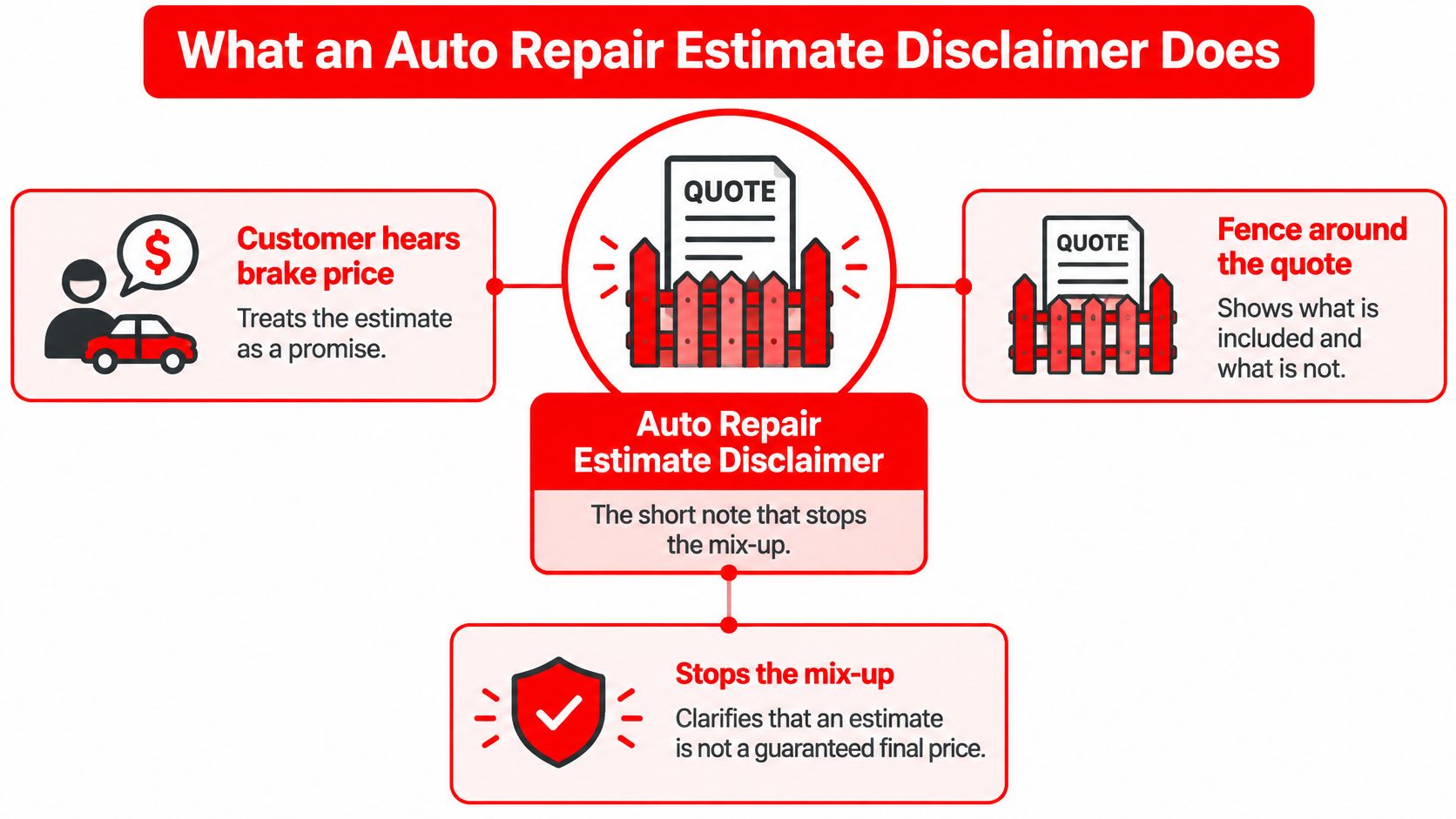
A fence around the quote
The disclaimer works like a fence around the quote. Inside the fence sit the named problem, the parts already listed, and the labor expected for that specific job. Outside the fence sit hidden rust, a seized caliper bracket bolt, extra programming, and any job that hasn't been priced yet.
- Inside the fence: The condition described, listed parts, listed labor, and charges shown on the estimate.
- Outside the fence: Hidden damage, unlisted parts, teardown findings, and work the customer hasn't approved.
The points to the same structure. A written estimate should identify the condition to be repaired, the parts needed, the anticipated labor charges, and the threshold above which the shop must get approval before doing additional work.
Three documents that aren't the same thing
Confusion grows when customers treat three different documents as one. The estimate is the price quoted before work starts. Authorization is the customer's permission to perform that scope. The invoice records what was performed and charged.
The disclaimer isn't any of those three. It can't authorize work by itself, and it isn't the final bill. Its job is to say three things in everyday words: the figure isn't a guaranteed final price, it rests on stated assumptions such as visible damage and obtainable parts, and extra work needs new approval before it happens.
A disclaimer explains the rules of the quote. It doesn't replace the customer's yes.
Shops that want broader context on how consumer protection rules frame these duties can review from LA Law Group, APLC. For shops serving more than one jurisdiction, the note should also make clear that a stricter state or federal rule controls over shop wording.
Clauses Worth Putting on the Estimate
One line does more work than a page of legal tone: "No additional work or charges will be incurred without your approval." A paragraph that only says prices may change is weaker because it can be read as advance permission for overruns. The stronger version explains the approval workflow, names how approval is recorded, and separates the estimate from a diagnostic authorization, a revised estimate, and a customer-set spending limit.
The reflects that distinction. Customers must be told about changes and must authorize additional repairs, and authorization can be documented in written, oral, or electronic form. Broad wording such as "additional repairs may be necessary" doesn't satisfy that operational need on its own.
Required lines first, recommended lines when the job can grow
| Clause | Strength | Why it belongs | Sample line |
|---|---|---|---|
| Not a guaranteed final price | Required | Stops the quote being read as the invoice | This is an estimate, not a guaranteed final price. |
| No work or charges before authorization | Required | Separates the quote from a repair order | No repairs or charges begin until you authorize them. |
| Approval ceiling | Required where a state sets a limit | Names when the shop must stop and call | We will contact you before the job exceeds the amount you approved. |
| Parts quality | Required when the customer gets a written estimate under rules like New York | Discloses used or non-original parts | Each part is identified as new, used, or not of original quality. |
| Diagnostic or teardown scope | Recommended | Prices only the inspection, not the repair found later | Diagnosis or teardown may be required before a firm repair price. |
| Taxes, shop supplies, programming, and sublet | Recommended | Keeps predictable extras from looking like surprises | Taxes, shop supplies, programming, and sublet work are listed when they apply. |
| Assumptions and how long the quote lasts | Recommended | Ties the price to visible damage and parts on hand | This price assumes the condition described and parts we can obtain, and it is valid for the period stated on the estimate. |
| How approval is recorded | Recommended | Names text, email, phone, or a designated person | We record your yes by the text, email, phone number, or person you name. |
| If the customer declines after diagnosis | Recommended | Answers what is owed and how the car comes back | If you decline further work, you owe the agreed diagnostic or teardown fee, and we return the vehicle in the condition we can lawfully leave it. |
| Stricter consumer rule controls | Recommended for multi-state shops | Prevents a shop form from overriding local law | If a state or federal rule is stricter, that rule controls. |
Shops should paste every Required line onto every estimate. Recommended lines get added when the job can grow, and the decline line belongs on the estimate whenever diagnosis or teardown carries its own fee. The stricter-law line matters most for businesses working across state lines.
Readers comparing estimate wording with broader contract structure may find from LiveDocument useful background. The lesson for an estimate is narrower and more practical. Each clause should tell the advisor and the customer what happens next, not just limit liability in the abstract.
- Use on every estimate: Final-price warning, no-work-before-authorization line, approval ceiling, parts-quality disclosure where it applies.
- Add for uncertain jobs: Diagnostic scope, likely extras, validity period, approval channel, and the decline outcome.
- Add for multi-state work: The stricter-rule line, with local wording checked location by location.
State Rules That Change the Wording
One national paragraph isn't enough because thresholds and approval limits change by jurisdiction. A disclaimer that works in one state can omit a required choice, a parts disclosure, or an overrun ceiling in another. The comparison below gives writers the differences that need to show up in actual wording.
| Jurisdiction | When a written estimate applies | Overrun rule | Details to show |
|---|---|---|---|
| California | Written estimated price for labor and parts of a specific job before work | No extra work, parts, or charges without consent after the shortfall is known | Specific job, labor, parts, and a recorded written, oral, or electronic authorization |
| Customer choice when the repair will cost more than $150: written estimate, a customer-set notify limit, or a waiver | Approval before exceeding the cost by more than $10 or 10 percent, whichever is greater | Year, make, model, odometer, tag, contact, problem, labor basis, charges, shop supplies or waste fees, estimate fee, payment method, alternate contact, warranty | |
| New York | When the customer requests one | Cannot charge more than the estimate without permission | Each part and its cost, used or not original quality, labor charges and how they are calculated |
| FTC consumer guidance | Advises a signed written estimate before repair | Contact the customer before a stated time or money limit | Condition, parts needed, and anticipated labor |
What the differences mean at the counter
California treats the written estimate as the start of fair dealing. Business and Professions Code §9884.9 expects a written estimated price for the labor and parts of a specific job, and no work or charges before the customer authorizes the repair. If that price proves insufficient, consent for the extra work or unlisted parts generally must come after the shortfall is known and before the shop proceeds.
Florida puts more of the choice in the customer's hands at intake, including the option to set a notification amount or waive a written estimate where the rule applies. Its estimate also carries a longer checklist of vehicle, contact, charge, and warranty details, so a short one-line form leaves gaps a Florida advisor can't afford. New York focuses on itemization when a customer requests a written estimate, with each part, its cost, parts quality, and the labor calculation made visible.
Federal consumer advice sits underneath those state rules as practical guidance for drivers. It tells customers to request a signed written estimate and to require contact before work exceeds a specified time or money limit. Shops that mirror that expectation in their own wording meet customers where their questions already are.
Writing rule: Quote the strictest ceiling the shop actually operates under, and state that local law controls if it's stricter.
- California wording needs: A specific job scope and recorded consent before added work.
- Florida wording needs: The customer choice, the approval ceiling, and the full estimate details.
- New York wording needs: Part-by-part costs, parts quality, and the labor basis.
Sample Disclaimers for Three Situations
Good templates separate estimated from not-to-exceed. Predictable items such as taxes, shop supplies, programming, and sublet work should be disclosed as cost components, while unknown findings should trigger a stop and a call. The supports that split by advising that an estimate identify the condition, parts, and anticipated labor charge, and require approval before work exceeds a specified amount of time or money.
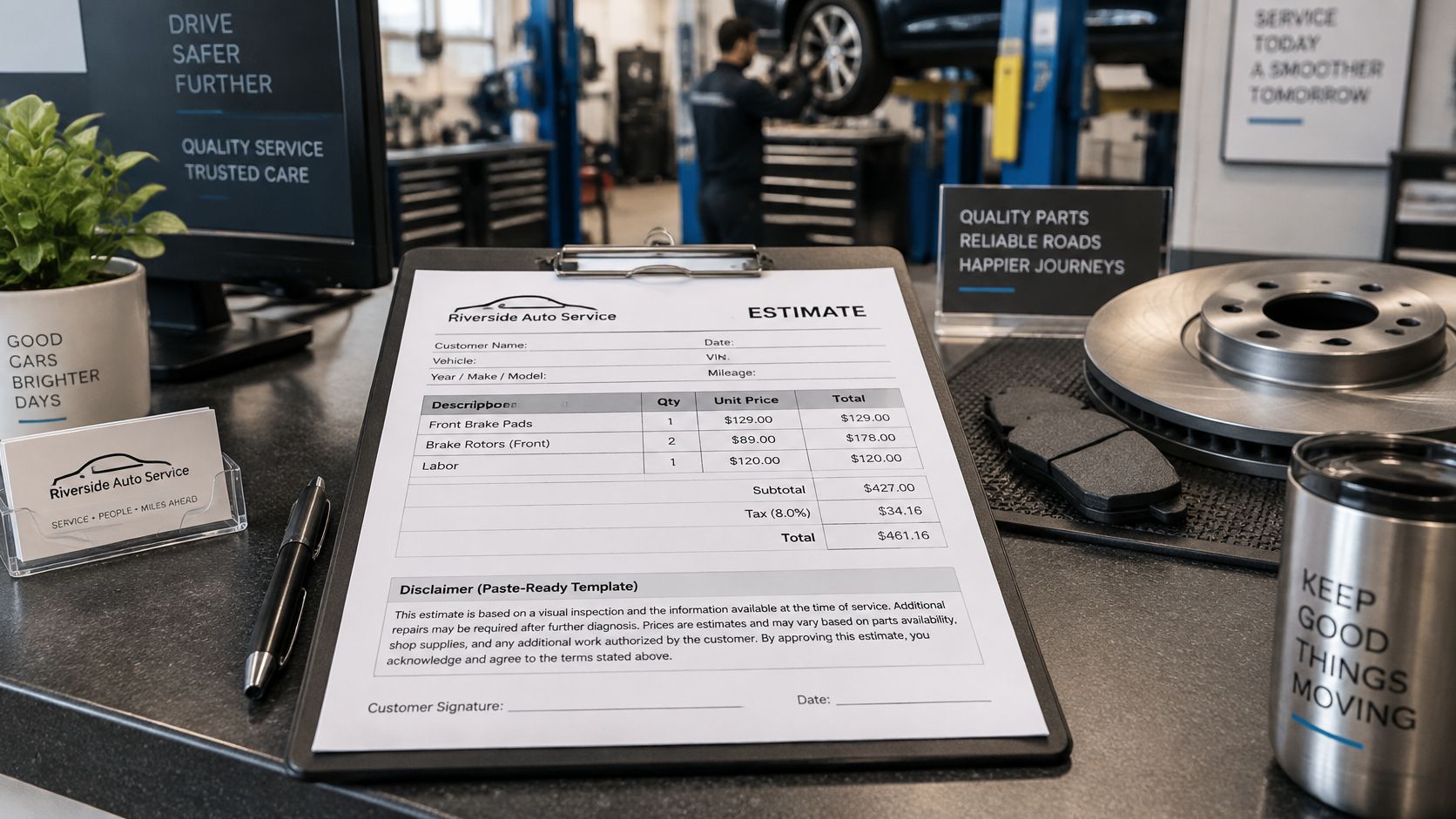
Short version for a straightforward job
Use this version when the parts are identified and the scope is stable, such as pads and rotors already inspected and measured.
"This is an estimate for the job, parts, and labor listed above, not a guaranteed final price and not permission to do other work. No additional repairs or charges will be made without your approval by the phone, text, or email you give us. If a stricter consumer rule applies, that rule controls."
Detailed version for teardown or an unknown noise
Unknown noises, intermittent faults, and teardown jobs need the decline answer in writing. Customers deserve to know what diagnosis costs, what reassembly or storage may cost where lawful, how removed parts are handled, and whether the vehicle is safe to drive if they stop.
"This estimate covers only the condition described and the diagnostic or teardown steps listed. It assumes damage we can see and parts we can obtain. Taxes, shop supplies, programming, and sublet work are extra when listed. Hidden damage can change the price. We will stop and contact you before exceeding the amount you approved, and where a state rule sets a limit, such as Florida's $10 or 10 percent, whichever is greater, we will obtain approval before going over it. If you decline further work, you owe the agreed diagnostic or teardown charge and any reassembly or storage charge stated in advance, and we will tell you whether the vehicle is safe to drive and how removed parts are handled."
Digital inspection version for photos and video
Photos and video explain a recommendation, but they don't approve it. Digital estimates in RedAppy can include photos, videos, parts, and labor, and customers can approve them digitally, which makes line-by-line wording especially important.
"Photos and video show what we found on this visit. They explain the recommended work but are not approval. Each line shows parts and labor. Tap approve only for the lines you want. Unapproved lines will not be done or charged. A revised total needs new approval, and the time, method, and person who approved it are saved with this estimate."
Before any template goes live, counsel should check it against the shop's state rules. Shop name, approval method, diagnostic fee, storage terms, and validity period should stay as blanks or structured fields, not buried edits inside a paragraph. Advisors then fill the same fields the same way on every job, and customers see consistent language whether the estimate arrives on paper or on a phone.
Why Approval Still Has to Be Recorded
A sentence saying additional repairs may be required doesn't authorize those repairs. That limit needs to be plain on the estimate and plain in shop practice. The disclaimer announces the process, but only a recorded yes lets the technician pick up the tools for the added work.
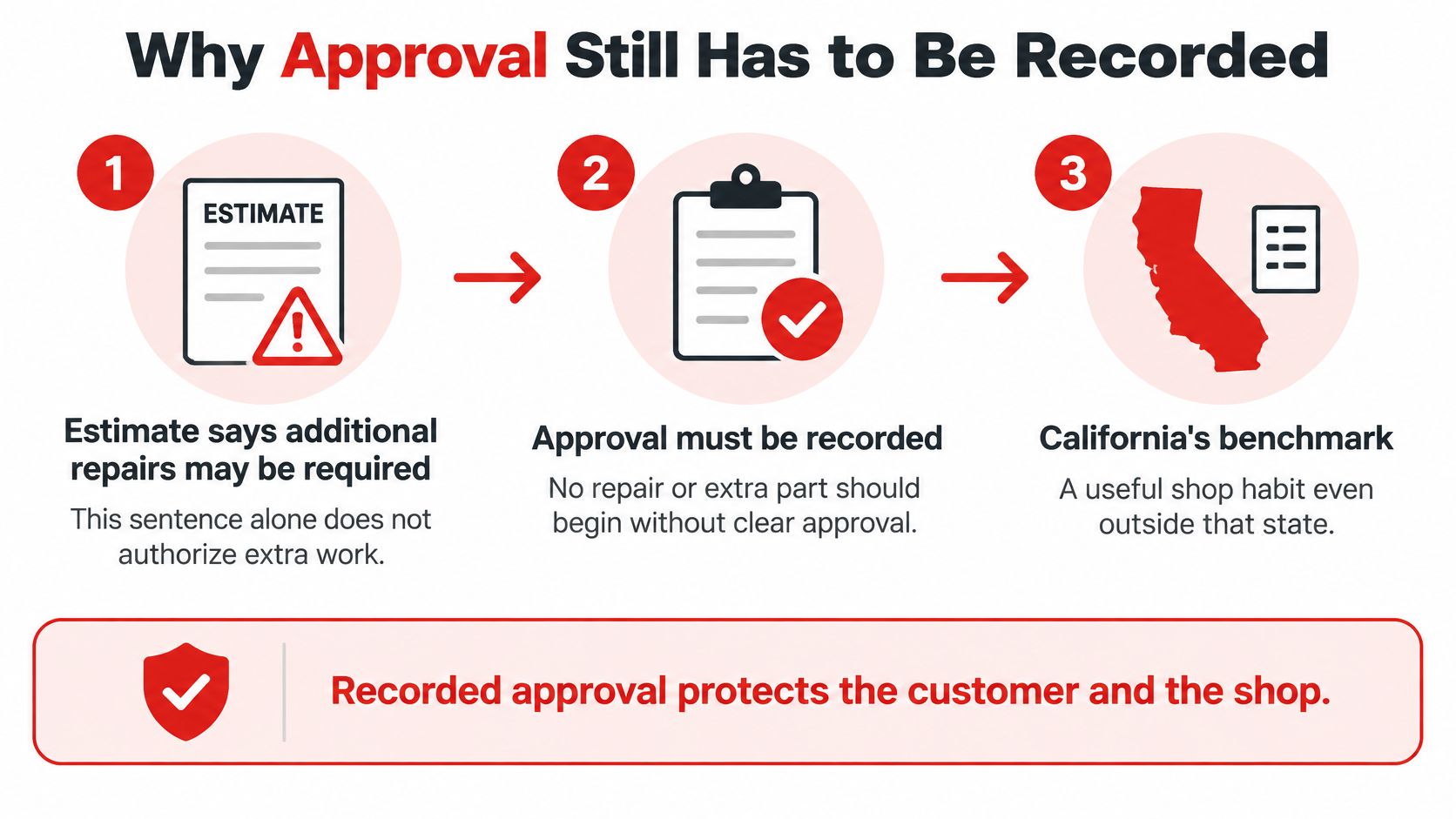
The California benchmark as a shop habit
Under, no repair or charge may begin without authorization, and a price increase requires oral or written customer consent after the shortfall is identified but before the additional work or parts are supplied. Electronic records should capture the date, time, authorizing person, and contacted phone number or email address, with messages uniquely tied to the same transaction.
That standard is a useful habit even outside California. It prevents the common dispute where a customer remembers approving "checking it out" and the shop remembers approval for the full repair. A tied, timestamped record replaces two memories with one file.
The revision sequence
- Save the original: Preserve the first estimate and don't overwrite it.
- Write the new finding separately: List the added job, added parts and labor, and the dollar difference.
- Send the revision by the chosen method: Use the phone, text, or email the customer already named.
- Wait for a yes on the new total: Approval should name the revised scope, not just acknowledge the message.
- Store the proof with the invoice: Keep the channel, timestamp, authorizing person, and supporting photos together.
If the customer says no, the shop stops at the authorized diagnostic or teardown work. Only fees already agreed are charged, and the file notes whether the vehicle is safe to drive. A customer-set spending limit is also its own document, distinct from the first estimate and from any later revision.
Multi-location businesses benefit from using identical revision steps everywhere. Different state ceilings can then sit inside one consistent workflow, and advisors don't improvise when a customer can't be reached. The disclaimer tells the customer this process will happen. The saved approval proves it did.
Placing and Automating the Disclaimer
A disclaimer buried in a footer won't change a counter conversation. Placement should follow the job, and the approval limit and contact method should read identically everywhere the customer sees them. Mismatched wording between a printed estimate and a text message is an easy way to start a dispute neither side intended.
Four places the note should travel
- Printed or PDF estimate: Directly under the total, in readable type, not in a footer.
- Text or email carrying the link: One sentence stating that it's an estimate and added work won't proceed without approval.
- Approval screen: Beside the approve button, so the yes covers only the listed lines.
- Invoice: A record of what was authorized, not a place to introduce new terms after the work.
At the counter, the advisor reads the approval limit and the decline rule out loud in plain language. The advisor also asks which phone number or email to use if the car is apart and the owner is at work. Fleet and family vehicles need a designated approver named in advance, because "someone from the office said yes" isn't a clean record.
Advisors should never call a price locked when the disclaimer allows change with approval. The spoken promise and the printed note have to match.
Building the wording into the system
For digital setup, shops do better with two master blocks than with free-typed paragraphs. One block carries the short template for straightforward jobs. A second block carries the diagnostic and teardown language, including the decline outcome, removed-part handling, and safe-to-drive note.
Approval method, approval ceiling, diagnostic fee, and validity period should be fields the advisor confirms, not sentences retyped from memory. Inspection photos and video carry the inspection-specific wording beside the findings they explain. If software suggests labor times or pricing, staff must review and verify that output before relying on it or sharing it with customers, because the shop remains responsible for the number the customer sees.
In RedAppy, a customer receives an estimate by SMS or email, opens a link, reviews the labor, parts, and total, and approves it from a phone. Estimates include parts and labor and can be converted into invoices, so the approved scope doesn't need to be retyped under new wording at checkout. Counsel can still advise whether a customer signature adds anything beyond recorded digital approval under local rules.
Shops reviewing estimate, inspection, and approval workflows can compare options on the RedAppy features page and ask for help matching disclaimer placement to shop workflow through the RedAppy contact page. The immediate step costs nothing and shouldn't wait for a software change. The short no-extra-work line belongs on every estimate before the next job is written, placed where the customer reads the total.
RedAppy gives shops digital estimates with itemized parts and labor, inspection photos and video, phone-based customer approval, and one-click conversion from approved estimate to invoice, so the disclaimer, the approved scope, and the final bill stay connected. Shops ready to replace retyped wording and scattered approvals with a recorded process can visit RedAppy to see how the platform fits daily service writing.
Ready to Transform Your Shop?
RedAppy helps auto repair shops create professional digital estimates with photos and videos, send them instantly via text or email, and get customer approvals in seconds. No credit card required to start.