
Auto Repair Shop Management Training: A Practical Guide
It's 7:40 on a Tuesday. Three cars sit in the lot, one lift is empty because the only technician who can chase an intermittent no-start called in sick, and the advisor is on the phone explaining a repair the customer insists she never approved.
None of those problems is mechanical. Each one comes from how the shop is run, and each one has a fix that can be taught, practiced and checked. That's the case for auto repair shop management training: not a motivational seminar, but a set of operating habits that move work from the lot to the invoice without losing hours or trust along the way.
Most owners learned to fix cars. Very few were taught to run a job board, price a repair, log an approval or read a comeback rate. The space between those two skill sets is where profit leaks out, a little at a time, on jobs nobody flags as a loss.
Table of Contents
- Core Training Areas and What Each One Improves
- How to Measure Whether Technician Training Pays Off
- Technician Skill Tiers and Sign-Off Rules
- Repair Order Workflow and Authorization Rules
- Staffing Limits and ADAS Decisions When Technicians Are Scarce
- Confirm Your First Training Priority This Month
Core Training Areas and What Each One Improves
A repair shop runs on two kinds of skill at once. One is technical: diagnosis, repair, calibration. The other is operational: estimating, dispatching, ordering parts, collecting approvals, getting paid. Training that covers only the first leaves the business exposed, because the operating layer is where jobs stall.
The scale explains why it matters. The counted 676,570 automotive service technicians and mechanics in the United States at a mean annual wage of $51,940, with 236,770 employed specifically in automotive repair and maintenance at a mean annual wage of $49,220. Technician time is the largest controllable cost in most shops, so every hour lost to a missing approval or an unordered part is real money walking out the door.
Here is how the six areas break down and what each one moves.
| Training area | Daily tool or document | Measure it moves | Who needs it first |
|---|---|---|---|
| Estimating and approvals | Written estimate and approval log | Disputes over unapproved work | Service advisors and owner |
| Technician productivity | Skills matrix and time records | Billed hours divided by clocked hours | Technicians and foremen |
| Workflow and job-status tracking | Job board with stages from check-in to checkout | Idle time between job stages | Front desk and shop foreman |
| Parts coordination | Supplier orders and inventory counts | Parts delays and low-stock stoppages | Parts manager and service advisors |
| Customer communication and scheduling | Appointment log and status updates | Approval rate and no-shows | Front desk team |
| Financial control | Repair order reports | Average repair order and gross profit per repair order | Owner and managers |
How to Pick the First Area
Don't train all six at once. Choose the row where the shop loses the most money right now: unapproved work that turns into a write-off, lifts sitting empty between stages, or the same parts delay every week. A shop that can't name its biggest loss will usually train the area it enjoys most, which is rarely the one costing the most.
Owners who came up through the bay often need the people side first, before they can coach anyone else. Spark's guide to covers that ground well.
Practical rule: if a loss can't be measured on one page of a report, it isn't the starting point yet.
Training also isn't a single event that ends at hire. The ASE Education Foundation reports relationships with more than 2,300 automotive technology training programs and over 50,000 students nationally, which tells you the industry treats learning as a continuing system rather than a one-time certificate. Write down the two biggest losses from last quarter and match each one to a row in the table above. That's your training plan, not a wish list.
How to Measure Whether Technician Training Pays Off
Training feels expensive because nobody invoices it. The way to make the case is to treat it as a productivity program with a before and after. An ASE-referenced study reported that certified technicians achieved 40% higher productivity, and an Automotive Training Managers Council benchmark reported 38% greater parts-and-labor revenue from trained and certified technicians, as sets out. Those numbers don't arrive by themselves. They show up when the shop measures the right things.
- Build a skills matrix. List every technician down the side and the competencies the shop sells across the top: scan-tool diagnosis, electrical testing, brake and chassis work, HVAC service, ADAS calibration routing, hybrid isolation. Leave nothing vague on the list, because a competency you can't name is one you can't assign.
- Mark each cell as none, supervised or independent. Three states are enough. This tells you who can be handed a job without a second pair of eyes, and it stops the shop from discovering a gap on the day the expert is off sick.
- Record a baseline over several weeks. Use billed hours divided by clocked hours, comeback rate, diagnostic accuracy and average repair order. Several weeks matters, because one good Friday is not a trend.
- Train one competency only, aimed at the largest money gap. One course, one skill, one group. Change too many variables and you'll never know which one worked.
- Compare the same measures afterwards, adjusted for job mix. A week of straightforward brake jobs will flatter anyone's numbers. Note the mix, then compare like with like.
- Check the parts and dispatch side before crediting the technician. Late parts, missing tooling and constant interruptions can hide a real improvement, or invent one that isn't there.
A Worked Example
Say a technician runs at 70% billed-to-clocked before a diagnostic course and 82% after it, with the comeback rate unchanged. The extra 12 points came from faster diagnosis, not from cutting corners, because comebacks would have risen if the work had been rushed. If comebacks had climbed instead, the "gain" would be borrowed time the shop would pay back later.
Measure the same way every time. Consistency beats frequency, because a number you collect differently each month can't be compared to anything.
By the end of this, the shop should have two things on paper: a one-page skills matrix and a written baseline with the dates, the job mix and the measures. Everything after that is a comparison, not a debate.
Technician Skill Tiers and Sign-Off Rules
Most shops need three levels, and every level needs a written sign-off rule based on evidence rather than attendance. Sitting through a course proves nothing. Completing a job under supervision, with a test result to show for it, proves something.
| Tier | Typical work | Sign-off proof | Record to keep |
|---|---|---|---|
| Foundational | Inspection, measurement, torque control, scan-tool use, safety | Supervised jobs and tool proficiency check | Tool log and supervised job list |
| Intermediate | Electrical diagnosis, drivability, HVAC, brake and chassis | Documented test results and comeback-free jobs | Test results and comeback record |
| Senior specialist | Intermittent faults, ADAS calibration, hybrid and EV high-voltage work, final technical review | Independent completion and review of others' work | Certification expiry dates and manufacturer bulletins read |
What Each Sign-Off Column Actually Means
Supervised jobs and tool proficiency means a foreman watched the technician perform the task and signed a list. It isn't a conversation in the bay. Documented test results means the voltage drop, the fuel trim reading, the scan data or the alignment printout is attached to the job. Independent completion and review of others' work is the senior bar: the specialist can finish the hard job alone and can catch someone else's mistake before it reaches the customer.
These structures are common, not exotic. In the U.S. General Auto Repair Shop Survey/Reports%20Mockups/The%20OEC%20US%20General%20Auto%20Repair%20Shop%20Survey%20Report.pdf?hsLang=en), 61% of shops reported providing advanced training and certification, while 57% encouraged specialization in particular diagnostic or repair areas.
The record for each person should carry certification expiry dates, completed procedures, manufacturer bulletins read, observed defects and time to proficiency. That last one matters more than people expect. A technician who needs three attempts at a job type is not yet independent, whatever the certificate says.
Cross-training test: name the second person who can do the job if the specialist is on holiday. If there isn't one, the shop has a single point of failure, not a skill tier.
Money is the constraint. WrenchWay's survey of roughly 2,600 technicians and 300 students found that 46% of diesel technicians said their shops provided adequate paid training, a 22-percentage-point decline from the year before, as. Budget the paid hours into each tier's plan before setting sign-off targets. An unpaid training promise is a target nobody hits.
Managers then use the record for two jobs: routing complex work to verified specialists, and showing each employee a visible next step. A technician who can see the path from general service to diagnostic responsibility tends to stay long enough to walk it.
Repair Order Workflow and Authorization Rules
Every repair order is a relay race. The car passes from the advisor to the technician, to the parts counter, back to the technician, to the quality check, then to the customer. A dropped baton in a relay costs a second. A dropped baton in a shop costs a day and sometimes a customer.
The workflow below works in any shop size, and each stage gets one status and one owner. If a job doesn't have both, it's the job that gets forgotten.
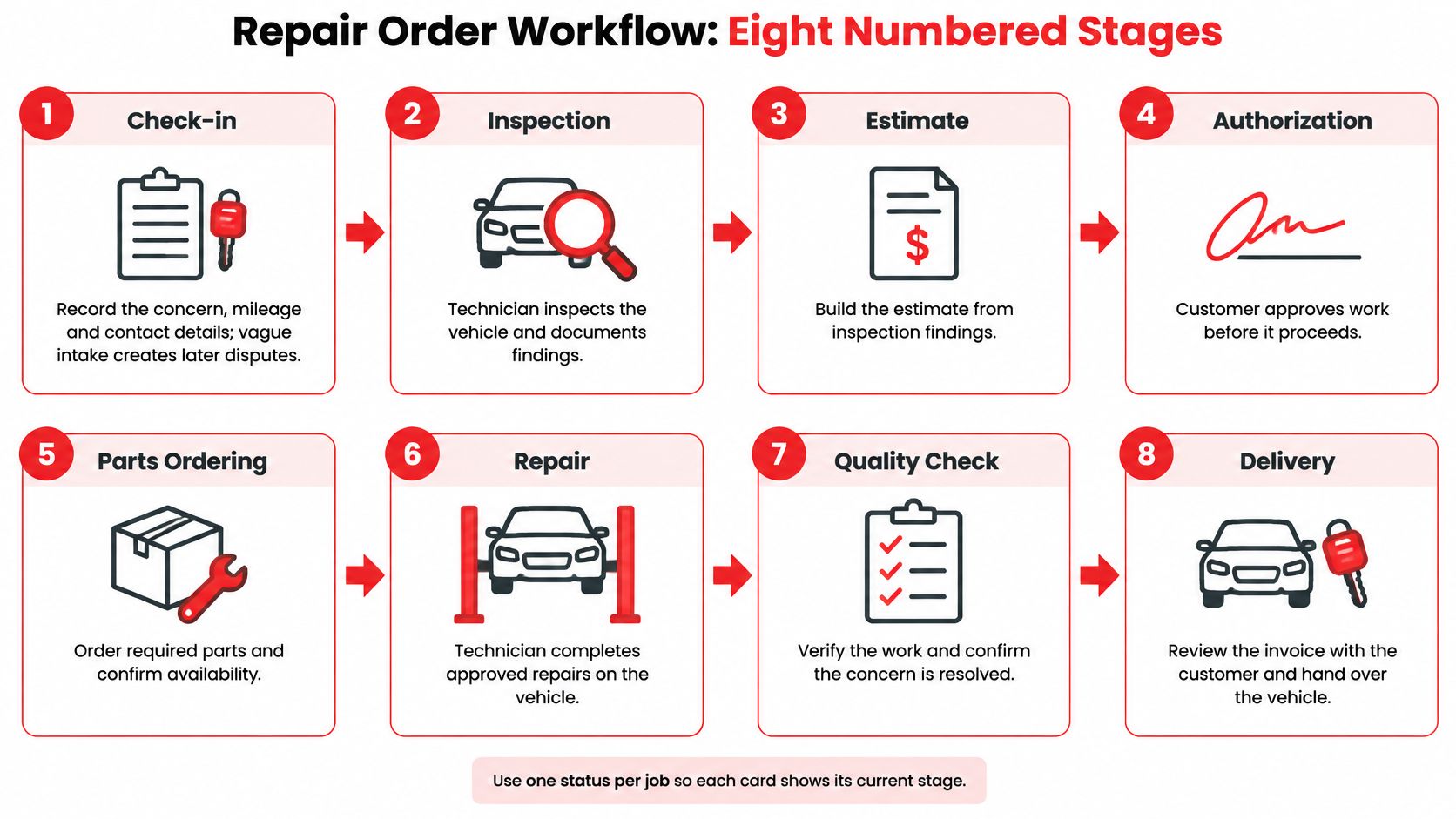
The Eight Stages
- Check-in. Record the concern in the customer's own words, plus mileage and contact details. Vague intake is the root of most later disputes, because nobody can prove what the car came in for.
- Inspection. Use a standard checklist and photograph worn parts. A photo settles arguments that a description can't.
- Estimate. List each part and each labor charge separately, and flag safety or ADAS items so the customer knows which lines can't wait.
- Approval. Log the method, the time and the name of the person who approved. Stop work above the approved limit, every time, without exceptions for regulars.
- Parts. Order against the approved job and mark each part as ordered, received or fitted. Most "the car will be ready at four" promises fall apart here.
- Repair. Assign a named technician, track clock time and note any defects found along the way.
- Quality check. Road test, confirm the original complaint is solved, and record who signed off.
- Invoice. Match every line to the approved estimate, take payment and close the job.
Where Jobs Slip
Each stage has a signature failure. Check-in loses the actual complaint. Inspection produces an estimate with no photos. Approval happens verbally and never reaches the log. Parts get ordered before approval, so the shop owns inventory for work that was declined. Repair starts without a named owner. Quality check becomes a quick look in the car park. Invoice lines drift away from the approved estimate and the customer notices.
None of these is a technical problem. All of them are trainable habits, and all of them show up as lost hours long before they show up as a complaint.
The Rules That Set Your Approval Step
The U.S. Federal Trade Commission advises that a written estimate identify the vehicle condition being repaired, the required parts and the anticipated labor charge, and that the customer receive a signed copy. It also advises that the estimate specify that the shop will contact the customer before performing work that exceeds a stated time or monetary limit, per the. Recording the estimate, the threshold, the approval method and the customer's authorization turns that advice into an auditable process.
State rules can be tighter. Florida consumer guidance states that when a repair exceeds $150, the customer must be offered a written estimate, notice if the repair exceeds a specified amount, or the option to decline a written estimate, and that the shop must obtain approval before exceeding the repair cost by more than $10 or 10%, whichever is greater, according to the. Do the arithmetic on a real job: a $400 estimate needs approval above $440.
| Source | Written estimate | Approval before extra work | Verbal approval record |
|---|---|---|---|
| U.S. Federal Trade Commission guidance | Identifies condition, parts and labor; customer gets a signed copy | Shop contacts customer before work exceeds a stated time or money limit | Not specified |
| Florida consumer guidance | Required when a repair exceeds $150, or customer is offered notice or the option to decline | Approval needed before cost exceeds estimate by more than $10 or 10%, whichever is greater | Not set by the guidance; the shop keeps its own log |
| New York DMV guidance | No work without customer permission | Permission required before work is performed | Invoice shows date, time and name of person who authorized the work |
New York shows why a simple approved-or-declined box isn't enough. The state Department of Motor Vehicles says a repair shop may not perform services without customer permission, and when authorization is given verbally or by telephone, the invoice must show the date, time and name of the person who authorized the work, per the. That is a good model for every shop, whatever its local rules, because it links the inspection finding, the revised estimate, the technician's instruction and the final invoice into one chain.
Set the approval step to the strictest rule the shop must follow. Meeting a higher standard everywhere is simpler to train than remembering which rule applies to which job.
The Morning Check
Open the board and look at every live job. Each one should show exactly one status and one named owner. A job with two statuses is a job two people think someone else is handling, and a job with no owner is the one the customer calls about at four o'clock.
Staffing Limits and ADAS Decisions When Technicians Are Scarce
Chasing maximum vehicle intake is the most common strategic mistake in a shop with a full lot. If qualified labor is the binding constraint, taking on more work doesn't produce more profit. It produces longer cycle times, more comebacks, a tired team and customers who stop believing the promised time.
The gap is structural. Projected annual automotive-technician demand of 70,865 against average annual supply of 50,085 leaves a shortfall of 20,780 technicians a year, about 29% of demand, according to. The pipeline isn't closing it fast. TechForce Foundation's Supply & Demand report notes that more than 37,000 students completed post-secondary automotive technician education in the United States while automotive-technician employment reached 794,600, as. Hiring alone won't fix a shop's capacity problem this quarter.
Manage Capacity by Skill, Not Headcount
Count who can do which category of work, not how many bodies are on the schedule. Reserve calibration and high-voltage jobs for qualified staff, train advisors to triage at intake, and keep a transparent waitlist or a referral partner for the overflow. Saying no to work the shop can't do well protects the reputation that brings the next job in.
The ADAS Decision Framework
Advanced driver-assistance systems are where this decision gets sharpest. A study of UK independent garages found two-thirds lacked a technician qualified for ADAS calibration or repair, with outsourcing costs reaching £300 per vehicle, according to. That doesn't mean every shop should buy equipment. It means every shop needs a decision rule.
- Flag ADAS triggers at intake. Ask about windshield replacement, bumper work, suspension changes, wheel alignment and battery disconnection.
- Verify the required procedure. Check the manufacturer's position on calibration for that model before quoting.
- Cost the capability properly. Equipment, floor space, training hours and realistic utilization, not just the purchase price.
- Compare with the outsource price and turnaround. Include the days the car sits waiting for a subcontractor.
- Explain the limits in writing. Tell the customer what was and wasn't calibrated, and why it matters.
Say a shop sees three calibration jobs a month. Outsourcing at a few hundred pounds a job is cheaper than buying equipment that idles for the rest of the month, so the shop keeps a referral partner and documents the handoff. At three a week, the arithmetic changes.
Confirm Your First Training Priority This Month
One decision this month: pick the row from the first table where the shop loses the most money, then build the skills matrix and baseline for it using the measurement procedure. Don't start a second area until the first has a before and after on paper.
Next, write the approval rules for the jurisdiction the shop operates in and set the approval log to the strictest rule it must follow. Then handle the people side before the team touches the system. RedAppy is an all-in-one shop management platform that carries the repair order workflow and job board from check-in to checkout, and setup can be adjusted to how each shop works.
That setup covers shop details, hours, tax and labor rates, and the first staff accounts. Give every team member their own login, so the shop can assign a technician to a job, see who wrote each estimate, and decide who can open the numbers. Do that work before the first baseline run, or the records will be too muddy to compare. A labor rate entered wrong on day one skews every after measurement that follows, the same way a miszeroed torque wrench throws off every bolt it touches.
Training a shop team works the same way as fixing a car. You find the fault, you fix one thing, and you verify the repair before moving on. RedAppy brings the job board, digital inspections, estimates, parts ordering and reporting into one place, so the habits described here have somewhere to live and something to measure. Start with one area, one baseline and one written approval rule, then visit RedAppy to see how the workflow fits the way your shop already runs.
Ready to Transform Your Shop?
RedAppy helps auto repair shops create professional digital estimates with photos and videos, send them instantly via text or email, and get customer approvals in seconds. No credit card required to start.