
The Best Auto Repair Shop Software in 2025: Tools That Actually Run Your Shop
Running a shop without the right auto repair shop software is like diagnosing an engine without a scanner — you're guessing, and it costs you time and money. According to the Auto Care Association, the average independent repair shop leaves significant revenue on the table through inefficient scheduling, missed follow-ups, and paper-based workflows that slow everything down.
The good news is that 2025 has brought a new generation of shop management tools that handle everything from digital inspections and parts ordering to online payments and customer communication — all in one place. Some are built for large dealership networks. Others are designed specifically for independent shops that need simplicity without sacrificing power.
This article breaks down the best options available right now, what each one does well, where each falls short, and which type of shop each one fits best. Whether you're running a single bay or managing multiple locations, you'll find a clear, honest comparison to help you choose the right platform.
Table of Contents
- How to Choose Auto Repair Shop Software: Key Features That Matter
- Top Auto Repair Shop Software at a Glance
- RedAppy: Best All-in-One Shop Management Platform
- Mitchell 1 Manager SE: Best for Large Independent Shops
- Shop-Ware: Best for Paperless, Transparency-Focused Shops
- Conclusion
How to Choose Auto Repair Shop Software: Key Features That Matter
Picking the wrong software can cost your shop more than the subscription fee — it costs time, staff frustration, and missed revenue. Before you compare platforms, know what features actually move the needle for a working shop.
The Core Features to Evaluate
Digital Inspections
Digital inspections let technicians document vehicle condition with photos, videos, and notes directly from a tablet or phone. Shops that send photo-rich inspection reports see significantly higher work approval rates because customers can see the problem themselves rather than taking a technician's word for it.
- Look for mobile-friendly interfaces technicians will actually use
- Photo and video attachment capability is non-negotiable
- Customer-facing reports with approval links save back-and-forth phone calls
Estimating and Invoicing
Slow estimates lose jobs. The best platforms pull labor times and parts pricing automatically so your service writers can build an estimate in minutes, not half an hour. One-click invoicing converts an approved estimate without re-entering data.
Shops that convert estimates to invoices in one step eliminate a major source of billing errors and double entry.
- Check whether labor times come from integrated data or manual entry
- Confirm invoices carry over all parts, labor, and tax without manual input
- Look for digital payment links so customers can pay online or at the counter
Parts Ordering
Ordering parts from multiple suppliers without leaving your shop management system saves a significant amount of time each week. Real-time inventory visibility means you're not calling suppliers to check availability.
- Multi-supplier ordering from one screen matters more as your parts volume grows
- Real-time pricing comparison helps protect your margins
- Automatic purchase order creation reduces manual paperwork
Customer Management and Vehicle History
A good customer lookup — by name, plate number, or VIN — means your service writers have context before the phone call ends. Vehicle history tied to the customer record makes upselling and follow-up far more effective.
- VIN decoding should populate vehicle details automatically
- Service history should be visible without digging through separate reports
- Customer communication tools (SMS, email reminders) drive return visits
Analytics and Reporting
According to industry research, shops that actively track key performance indicators grow revenue faster than those managing by feel. The metrics that matter most are average repair order (ARO), technician efficiency, and repeat customer rate.
- Real-time dashboards beat monthly reports you never read
- Technician-level productivity data helps you identify training gaps
- Revenue tracking by time period lets you spot seasonal trends early
Workflow Visibility
A visual shop board — often Kanban-style — shows every job's status from check-in to checkout at a glance. This reduces the "where is that car?" question that interrupts service writers and technicians throughout the day.
- Look for drag-and-drop job status updates
- Technician assignments should be visible on the same board
- Integration with your calendar prevents scheduling conflicts
Pricing and Contract Terms
Month-to-month pricing protects you if the software doesn't fit. Long-term contracts lock you in before you know whether the platform works for your team. In practice, platforms with transparent, flat-rate pricing are easier to budget than those with per-user or per-location add-ons that stack up quickly.
- Confirm what's included in the base price versus add-ons
- Ask whether training and onboarding are included or billed separately
- Check whether pricing scales by location, user count, or feature tier
Use this framework as your filter for every platform covered below. The right software depends on your shop size, how you manage workflow today, and where you want to be in two years. A single-bay shop has different needs than a growing multi-location operation — and the best platforms are built with that range in mind.
Top Auto Repair Shop Software at a Glance
A quick comparison helps you spot which platform fits your shop before reading the full breakdowns below.
| Software | Best For | Key Features | Pricing Model | Free Trial |
|---|---|---|---|---|
| RedAppy | All-in-one shop management | Digital inspections, AI Repair Assistant, Kanban board, parts ordering, built-in website, analytics | Transparent monthly subscription | Yes |
| Mitchell 1 Manager SE | Large independent shops | OEM repair data, deep estimating, customer history, parts ordering | Annual subscription | No |
| Shop-Ware | Paperless, transparency-focused shops | Cloud workflow, digital customer approvals, real-time communication | Tiered monthly pricing | Yes |
| Tekmetric | Multi-location, data-driven shops | Multi-shop dashboard, labor tracking, reporting, integrations | Monthly per-location pricing | Yes |
Shops that outgrow their software mid-year face costly migrations and workflow disruptions — choosing a platform that scales with you from the start saves more than money.
A few things worth noting before diving deeper:
- Pricing models vary significantly. Annual contracts lock you in; month-to-month terms give you flexibility as your shop evolves.
- "All-in-one" means different things. Some platforms combine estimating and invoicing but still require separate tools for customer communication or parts ordering.
- Free trials matter. Based on experience, a hands-on trial with your actual jobs and vehicles reveals usability issues that no demo video will show.
- Integrations add up. Each bolt-on tool — texting platforms, payment processors, parts catalogs — adds cost and complexity.
The tools above represent different philosophies. Some prioritize data depth, others prioritize simplicity, and one covers the full shop workflow end to end. The right fit depends on your shop size, staff, and where your biggest time drains are right now. The sections below break each one down so you can match the tool to your situation.
RedAppy: Best All-in-One Shop Management Platform
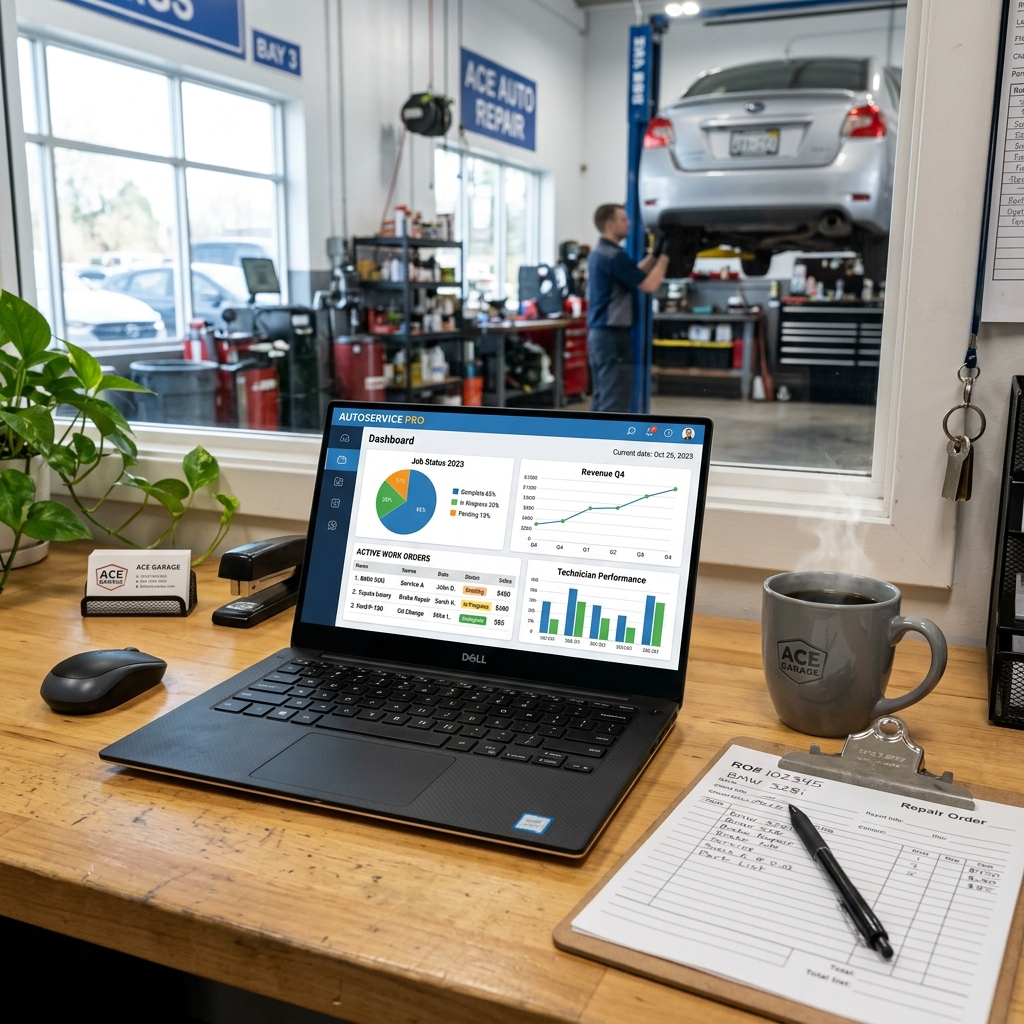
RedAppy is built for shops that want one platform to handle everything — from the moment a customer calls to the moment they drive away. Instead of juggling separate tools for estimates, inspections, invoicing, and parts, RedAppy connects all of it in a single workflow.
What RedAppy Does
RedAppy covers the full repair order lifecycle with tools designed specifically for auto repair shops:
- Digital Shop Board — A Kanban-style board that shows every job's status in real time, from check-in to checkout. Technicians and service writers see the same view, so nothing falls through the cracks.
- Digital Inspections — Photo-rich inspection reports that give customers visual proof of what needs fixing. In practice, this kind of documentation consistently increases repair approval rates.
- Instant Estimates and One-Click Invoicing — Build estimates fast and convert them to invoices without re-entering data. Online payment collection is built in.
- Parts Ordering — Search and order parts across multiple suppliers with real-time inventory, all from inside the platform. No switching between browser tabs or calling around for availability.
- AI Repair Assistant — Delivers labor times, diagnostic guidance, and shop performance insights on demand. This is particularly useful for technicians working on unfamiliar vehicles.
- Real-Time Analytics — Track revenue, technician efficiency, average repair order value, and repeat customer rates from a single dashboard.
- Vehicle and Customer Lookup — Search by name, license plate, or VIN. Full vehicle history is stored and accessible in seconds.
- Team Calendar — Centralized scheduling for service appointments and technician assignments.
- Built-In Website — Every subscription includes a professionally branded website with contact forms and optional used-car listings — no third-party web builder needed.
Who It's For
RedAppy scales from single-bay independent garages to multi-location operations. The month-to-month pricing and transparent terms make it a low-risk entry point for smaller shops, while the analytics and multi-location support give larger operations what they need to grow.
Shops that consolidate their tools into one platform eliminate the data gaps that come from using disconnected software — and that's where most admin time gets lost.
Typical Results
According to RedAppy, shops using the platform report:
- 10+ admin hours saved per week from streamlined workflows
- Higher work approval rates driven by photo-rich digital inspections
- Strong first-year ROI relative to subscription cost
Pricing and Flexibility
RedAppy operates on month-to-month terms with no long-term contracts required. Pricing is transparent, and the platform includes customization options so shops can configure it to match their existing workflow rather than rebuilding their process around the software.
| Feature | Included |
|---|---|
| Digital Shop Board | ✅ |
| AI Repair Assistant | ✅ |
| Digital Inspections | ✅ |
| Multi-Supplier Parts Ordering | ✅ |
| Real-Time Analytics | ✅ |
| Built-In Branded Website | ✅ |
| Online Payments | ✅ |
| Month-to-Month Pricing | ✅ |
Use Case
A shop owner managing four bays and two technicians can use RedAppy to replace their estimate software, inspection app, invoicing tool, and parts lookup — all while gaining a branded online presence without hiring a web developer. For shops focused on growing repeat business, the customer lookup, vehicle history, and analytics features give a clear picture of who's coming back and why.
From experience, the biggest practical advantage is the reduction in double-entry. When an estimate, inspection, and invoice all live in the same system, service writers spend less time on admin and more time with customers.
Mitchell 1 Manager SE: Best for Large Independent Shops
is one of the most established names in shop management software. It's been around for decades and is built for independent shops that handle high volume and need deep access to OEM repair data alongside their daily workflow tools.
What Mitchell 1 Manager SE Does
Manager SE combines repair order management, estimating, parts ordering, and customer history in one desktop-based platform. Its biggest differentiator is the integration with Mitchell 1's ProDemand repair information database, which gives technicians access to OEM wiring diagrams, labor times, and diagnostic procedures without switching tools.
- Estimating depth: Pulls labor times and parts data directly from Mitchell's database, reducing the need to cross-reference external guides
- Parts ordering: Connects with major suppliers and allows ordering from within the repair order
- Customer history: Stores full vehicle service records, making it easy to pull up prior work and recommend maintenance
- Workflow tracking: Moves jobs through stages from estimate to invoice with status visibility for advisors
Who It's Built For
Manager SE works best for established independent shops doing significant daily volume — typically shops with three or more bays and a dedicated service advisor. According to Mitchell 1, the platform is used by tens of thousands of independent repair shops across North America.
Shops that already pay for ProDemand get the most value from Manager SE because the integration eliminates double-entry and speeds up the estimating process considerably.
In practice, shops that run a high number of complex diagnostics benefit most. The OEM data access alone can save a technician 15–20 minutes per diagnostic job compared to looking up information manually.
Pricing and Learning Curve
Mitchell 1 uses a quote-based pricing model, so you'll need to contact their sales team for exact costs. Bundling Manager SE with ProDemand adds to the monthly cost, and from experience, the total can run higher than newer cloud-based competitors.
The platform is desktop-based, which means it's not as accessible remotely as cloud tools. Setup and training take real time — smaller shops without a dedicated office manager may find the learning curve steeper than expected.
Where It Falls Short for Smaller Shops
| Factor | Mitchell 1 Manager SE | Newer Cloud Platforms |
|---|---|---|
| Remote access | Limited (desktop-based) | Full browser/mobile access |
| Setup complexity | High | Low to moderate |
| OEM data integration | Excellent | Varies |
| Pricing transparency | Quote-based | Published monthly rates |
| Ideal shop size | 3+ bays, high volume | Flexible, scales from 1 bay |
Single-bay shops or newer operations without an existing tech stack may find the setup investment and cost hard to justify. The platform rewards shops that already have established processes — it's less suited to shops still building their workflow from scratch.
Shop-Ware: Best for Paperless, Transparency-Focused Shops
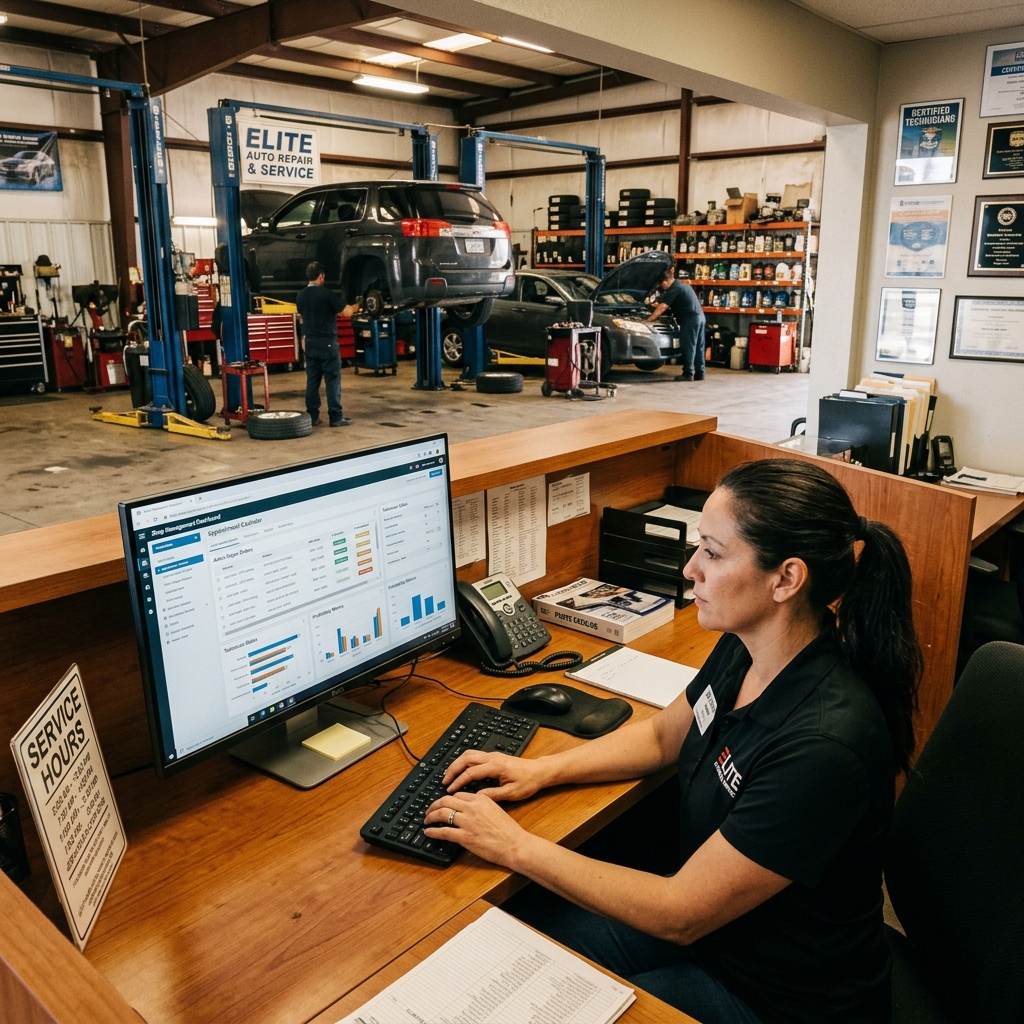
is a cloud-based shop management platform built around one idea: give customers full visibility into their repair process. Every job flows through a digital workflow where technicians add notes, photos, and recommendations that customers can review and approve in real time — no phone tag required.
Shops that switch to digital approvals typically see higher average repair orders because customers can see the evidence before they say yes.
What Shop-Ware Does Well
The platform is genuinely paperless. Technicians work from tablets or phones, adding inspection notes and images directly to the job ticket. Customers receive a link to review everything and approve or decline individual items from their phone. This transparency builds trust and speeds up the approval process.
Key features include:
- Customer-facing digital approvals with line-item accept/decline
- Technician notes and photo documentation attached to each job
- Real-time communication between service advisors and customers
- Cloud-based access — no server to maintain or update
- Parts ordering integrated into the workflow
Who It's For
Shop-Ware fits independent shops and small multi-location groups that prioritize customer communication and a clean, modern workflow. It works especially well for shops competing on trust and transparency — think European specialists or high-end independent garages where customers are skeptical of upsells.
In practice, shops with a strong service advisor culture get the most out of it. The customer-facing approval system is only as effective as the documentation technicians put in.
Where It Falls Short
Reporting depth is a common criticism. Compared to full-suite platforms, Shop-Ware's analytics are relatively basic. Shops that rely heavily on revenue trend analysis, technician efficiency tracking, or multi-location dashboards may find the data tools underwhelming. According to user reviews on, some owners note they rely on external tools to fill reporting gaps.
Pricing sits in the mid-to-upper range for independent shops, and the feature set is narrower than all-in-one platforms that bundle in websites, AI assistance, and deeper analytics out of the box.
| Feature | Shop-Ware |
|---|---|
| Digital Inspections | ✅ Photo + notes |
| Customer Approvals | ✅ Real-time, line-item |
| Reporting Depth | ⚠️ Basic |
| Cloud-Based | ✅ |
| Built-in Website | ❌ |
| Multi-Location Dashboard | ⚠️ Limited |
Shop-Ware is a strong choice if customer transparency is your top priority and you don't need deep analytics or an all-in-one marketing and operations platform in a single subscription.
Conclusion
Choosing the right auto repair shop software comes down to three things: your shop size, how you want to run your workflow, and where you plan to be in two years.
If you manage a large independent shop with complex estimating needs and deep OEM data requirements, Mitchell 1 Manager SE gives you the repair information depth few platforms can match. If customer transparency is your top priority and you want a fully paperless operation, Shop-Ware delivers a clean, approval-first workflow your customers will notice. If you're running multiple locations and live inside reporting dashboards, Tekmetric gives you the cross-shop visibility to make smarter staffing and inventory decisions.
For most modern shops — especially those growing from a single bay toward multiple locations — the real question isn't which feature to prioritize. It's which platform removes the most friction across the whole operation.
That's where RedAppy stands apart. It's the only platform on this list that combines digital inspections, AI-assisted repair guidance, real-time parts ordering across suppliers, one-click invoicing, a Kanban shop board, built-in analytics, and a branded website under one subscription — with no long-term contracts.
Most platforms do two or three of those things well. RedAppy is built to do all of them together, so your team isn't bouncing between systems to get a job from check-in to payment.
Match your decision to your actual situation:
- Single-bay or growing shop → RedAppy gives you enterprise-level tools without the enterprise-level complexity or commitment
- Large shop with deep OEM data needs → Mitchell 1 Manager SE is worth the learning curve
- Transparency-first shop culture → Shop-Ware's customer-facing approvals are best in class
- Multi-location operator focused on reporting → Tekmetric's dashboard visibility is hard to beat
The shops that get the most from their software are the ones that pick a platform matching how they already think about their workflow — then let the tools reinforce that, not fight against it. Start with a free trial or demo, run one real job through the system, and see where it saves you time and where it slows you down.
That hands-on test tells you more than any comparison table.
Ready to Transform Your Shop?
RedAppy helps auto repair shops create professional digital estimates with photos and videos, send them instantly via text or email, and get customer approvals in seconds. No credit card required to start.