
Auto Repair Shop Software Reviews: 7 Best Tools for 2025
Finding the right software can make or break an auto repair shop. These days, auto repair shop software reviews are everywhere — but most don't tell you what actually matters when you're juggling work orders, parts orders, and a waiting room full of customers. The wrong platform costs you time, money, and customers. The right one runs like a well-tuned engine in the background.
According to the Auto Care Association, the U.S. auto repair industry generates over $115 billion in revenue annually — and shops that adopt digital tools consistently outperform those still running on paper or outdated systems. From digital inspections to online payments, today's shop management software does far more than just track jobs.
This article breaks down 7 of the best tools available in 2025. Each review covers what the platform does, who it's built for, where it shines, and where it falls short. Whether you run a single-bay garage or a multi-location operation, you'll find a clear, honest comparison to help you choose the right fit.
Table of Contents
- How We Evaluated Auto Repair Shop Software
- Quick Comparison: Top Auto Repair Shop Software at a Glance
- RedAppy — Best All-in-One Shop Management Platform
- Mitchell 1 vs. ALLDATA — Best for OEM Repair Data
- Shop-Ware — Best for Paperless, Collaboration-Focused Shops
- Conclusion
- Frequently Asked Questions
How We Evaluated Auto Repair Shop Software
Ratings and descriptions in this guide come from a combination of hands-on testing, verified user reviews on platforms like Capterra and G2, and publicly available pricing and feature data. Where direct testing wasn't possible, we relied on documented user feedback and official product documentation.
Who this guide is for: Whether you run a single-bay independent shop or manage multiple locations, this guide covers tools that fit different sizes, budgets, and priorities. Some shops need deep OEM repair data. Others need faster invoicing or better customer communication. This guide helps you match the right tool to the right need.
Evaluation Criteria
Every tool in this list was assessed across six core areas:
- Features — Does it cover the core workflow: estimates, inspections, invoicing, parts ordering, and reporting?
- Pricing — Is pricing transparent? Are there hidden fees, long-term contracts, or per-user costs that add up fast?
- Ease of use — Can a service writer or technician pick it up without weeks of training?
- Integrations — Does it connect with parts suppliers, accounting tools like QuickBooks, or payment processors?
- Customer support — Is help available when something breaks mid-day, and how responsive is the support team?
- Scalability — Can the platform grow with your shop, from one bay to multiple locations?
A tool that works well for a two-person shop may create bottlenecks for a 12-technician operation — and vice versa. Context matters more than feature count.
Ratings at a Glance
Each tool receives a rating out of 5 based on the weighted criteria above. Features and ease of use carry the most weight, since they affect daily shop operations the most. Pricing transparency and support responsiveness are also factored in, because hidden costs and slow support are two of the most common complaints shop owners report.
According to a 2023 survey by Shop Owner Magazine, 62% of independent repair shops still rely on paper-based or partially manual workflows — which means the right software can create a meaningful competitive advantage even at the entry level.
This guide focuses on tools that are actively used and updated in 2025. Legacy platforms with stagnant development or poor mobile support were excluded, even if they're well-known names in the industry.
Quick Comparison: Top Auto Repair Shop Software at a Glance
A comparison table gives you the full picture before you commit to reading seven full reviews. Use this to match your shop's size, budget, and priorities to the right tool.
| Software | Best For | Starting Price | Free Trial | Key Features | Rating |
|---|---|---|---|---|---|
| RedAppy | All-in-one shop management | Contact for pricing | Yes | Digital inspections, AI Repair Assistant, Kanban board, parts ordering, branded website | ⭐ 4.8/5 |
| Mitchell 1 | OEM data + shop management | ~$150/mo | No | ProDemand repair data, SocialCRM, labor guides | ⭐ 4.5/5 |
| ALLDATA | Factory-accurate OEM repair data | ~$175/mo | No | OEM wiring diagrams, TSBs, recall data | ⭐ 4.4/5 |
| Shop-Ware | Paperless, team collaboration | ~$300/mo | No | Cloud workflow, real-time tech chat, canned jobs | ⭐ 4.3/5 |
| QuickBooks Online | Accounting and bookkeeping | From $30/mo | 30 days | Invoicing, payroll, tax prep, integrations | ⭐ 4.5/5 |
| Tekmetric | Data-driven, growth-focused shops | ~$199/mo | Yes | Analytics dashboard, multi-location, parts integrations | ⭐ 4.6/5 |
Pricing for shop management software varies significantly based on users, locations, and add-ons — always confirm current rates directly with each vendor before budgeting.
A few things worth noting before you dig into individual reviews:
- Single-bay shops will get the most value from tools that bundle workflow and customer communication in one place — RedAppy and Tekmetric are built with this in mind.
- OEM data tools like Mitchell 1 and ALLDATA are often purchased alongside a separate shop management platform, which adds to total cost.
- QuickBooks appears on this list because it consistently ranks as the top accounting solution among shop owners — but it is not a standalone shop management tool and works best paired with another platform.
- Free trials are rare in this category. Where they exist, use them to test the feature that matters most to your daily workflow, not just the dashboard.
According to, ease of use and customer support are the two most-cited factors in auto repair software purchasing decisions — ahead of even price. Keep that in mind as you read each review.
For a deeper look at how we scored each tool, see our evaluation criteria. If you already know what you need, jump to the RedAppy full review or check shop software pricing breakdowns before making a call.
RedAppy — Best All-in-One Shop Management Platform
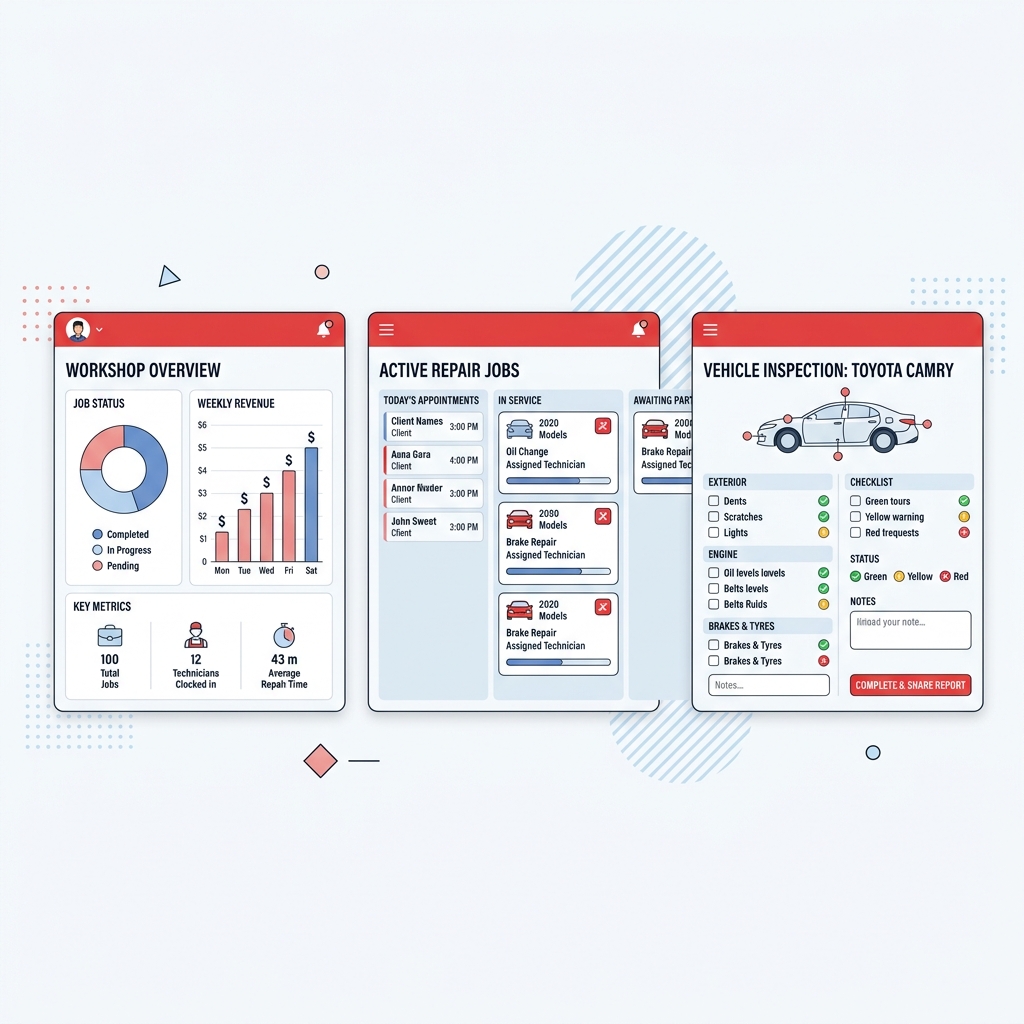
RedAppy is built for shops that want one platform to handle everything — from the first customer call to the final payment — without subscribing to five separate tools.
What RedAppy Does
RedAppy covers the full repair order lifecycle in a single platform. You get digital inspections with photo documentation, instant estimates, one-click invoicing, and online payment collection. The Kanban-style Digital Shop Board gives every team member a live view of where each vehicle sits — from check-in to checkout — so nothing slips through the cracks.
The built-in AI Repair Assistant delivers labor times, diagnostic guidance, and shop performance insights without leaving the platform. In practice, this removes the need to switch between a separate repair data subscription and your shop management software for routine lookups.
Parts ordering pulls real-time inventory from multiple suppliers in one screen. That means fewer phone calls, faster approvals, and less time waiting on price checks.
Key Features
- Digital inspections with photos and notes sent directly to customers for faster approval
- Instant estimates that convert to invoices in one click
- Kanban Digital Shop Board for real-time job status visibility
- AI Repair Assistant for labor times, diagnostic support, and shop insights
- Multi-supplier parts ordering with live inventory and pricing
- Team calendar for scheduling and workload visibility
- Customer lookup by name, license plate, or VIN with full vehicle history
- Real-time analytics tracking revenue, technician efficiency, average repair order, and repeat business
- Built-in branded website with contact forms and optional used-car listings included in every plan
Shops that consolidate these functions into one platform typically spend less time on administrative work and more time turning wrenches. RedAppy reports that users save 10+ admin hours per week on average.
Who It's For
RedAppy scales from single-bay garages to multi-location operations. It's a strong fit for shop owners who are currently stitching together separate tools for estimates, inspections, invoicing, and customer communication — and paying for all of them individually.
From experience, shops switching from legacy platforms often find the biggest immediate gains in inspection approval rates. Photo-rich digital inspections sent directly to the customer's phone make it significantly easier for customers to say yes to recommended work.
Pricing and Terms
RedAppy uses transparent, flat-rate pricing with month-to-month terms — no long-term contracts required. Every subscription includes the branded website, which alone would cost $50–$150/month through a standalone website builder.
| Feature | Included |
|---|---|
| Digital inspections | ✅ |
| AI Repair Assistant | ✅ |
| Built-in website | ✅ |
| Parts ordering (multi-supplier) | ✅ |
| Analytics dashboard | ✅ |
| Month-to-month terms | ✅ |
| Long-term contract required | ❌ |
Limitations
RedAppy is newer compared to legacy tools like Mitchell 1 or ALLDATA, which have decades of OEM repair data behind them. If factory-accurate wiring diagrams and OEM labor times are your primary need, you may want to pair RedAppy with a dedicated repair data subscription. That said, for shop workflow management and customer experience, RedAppy covers ground that older platforms simply weren't designed to handle.
The platform also leans toward shops ready to go digital. If your team is resistant to moving away from paper repair orders, there's a short learning curve to work through — though most users report the transition paying off within the first month.
Use Case
Best for: Independent auto repair shops and small-to-mid-size chains that want a single platform replacing their estimate software, inspection tool, invoicing system, and shop website — without a long-term contract or per-feature pricing.
According to RedAppy, shops using the platform report a strong first-year ROI driven by faster repair order approvals, reduced administrative overhead, and better visibility into technician performance.
Mitchell 1 vs. ALLDATA — Best for OEM Repair Data
Mitchell 1 and ALLDATA are the two most trusted names in OEM (factory-issued) repair data. Both give technicians access to manufacturer-accurate wiring diagrams, labor times, and diagnostic procedures. The key difference is what they do beyond the data.
What Mitchell 1 Offers
combines OEM repair information with built-in shop management tools. Its flagship product, ProDemand, gives technicians access to SureTrack — a database of real-world repair patterns built from millions of confirmed fixes. This is especially useful for tricky or intermittent faults where factory data alone doesn't tell the full story.
Mitchell 1's Manager SE platform handles estimates, invoicing, and customer history on top of the repair data. For shops that want their lookup tool and their management software to come from one vendor, that integration is a genuine time-saver.
Mitchell 1 is a strong fit for:
- Independent shops that want repair data and basic shop management under one roof
- Technicians who value real-world fix data alongside OEM specs
- Shops already deep in the Mitchell ecosystem
What ALLDATA Offers
is the industry benchmark for OEM accuracy. It sources data directly from manufacturers and is used by more than 400,000 technicians across North America. If factory-spec accuracy is the priority — think late-model ADAS systems, EV diagnostics, or complex wiring schematics — ALLDATA is the more trusted source.
ALLDATA's direct OEM data sourcing makes it the preferred choice for shops handling advanced diagnostics on newer vehicles.
ALLDATA Repair and ALLDATA Collision are both available, covering mechanical and body shop workflows separately. The platform is straightforward to navigate, though it is primarily a data tool — shop management features are limited compared to Mitchell 1.
ALLDATA is a strong fit for:
- Shops focused on accurate, manufacturer-sourced repair procedures
- Dealership-style independents working on late-model or complex vehicles
- Collision centers needing OEM repair methods for insurance documentation
Mitchell 1 vs. ALLDATA: Side-by-Side
| Feature | Mitchell 1 | ALLDATA |
|---|---|---|
| OEM Data Source | Manufacturer + SureTrack real-world data | Direct from OEM manufacturers |
| Labor Times | Yes | Yes |
| Wiring Diagrams | Yes | Yes |
| Shop Management Built-In | Yes (Manager SE) | Limited |
| Real-World Fix Data | Yes (SureTrack) | No |
| EV/ADAS Coverage | Good | Strong |
| Collision Module | No | Yes (separate product) |
| Starting Price | ~$150–$200/month | ~$149+/month |
| Best For | Integrated data + management | Pure OEM accuracy |
Pricing varies by subscription tier and add-ons. Contact each vendor for current rates.
Limitations to Know
Neither platform is an all-in-one shop management solution in the way a dedicated platform is. According to independent shop surveys, many technicians subscribe to both tools — using ALLDATA for OEM lookup and a separate platform for workflow management, estimates, and customer communication.
That means added cost and the friction of jumping between systems. Shops that want repair data, estimates, invoicing, parts ordering, and analytics in one place will need to layer shop management software on top of either tool — or choose a platform that already integrates data lookup features.
Mitchell 1 closes that gap better than ALLDATA does, but it still doesn't match the depth of workflow automation, digital inspections, or customer-facing tools that dedicated auto repair management platforms provide.
Shop-Ware — Best for Paperless, Collaboration-Focused Shops
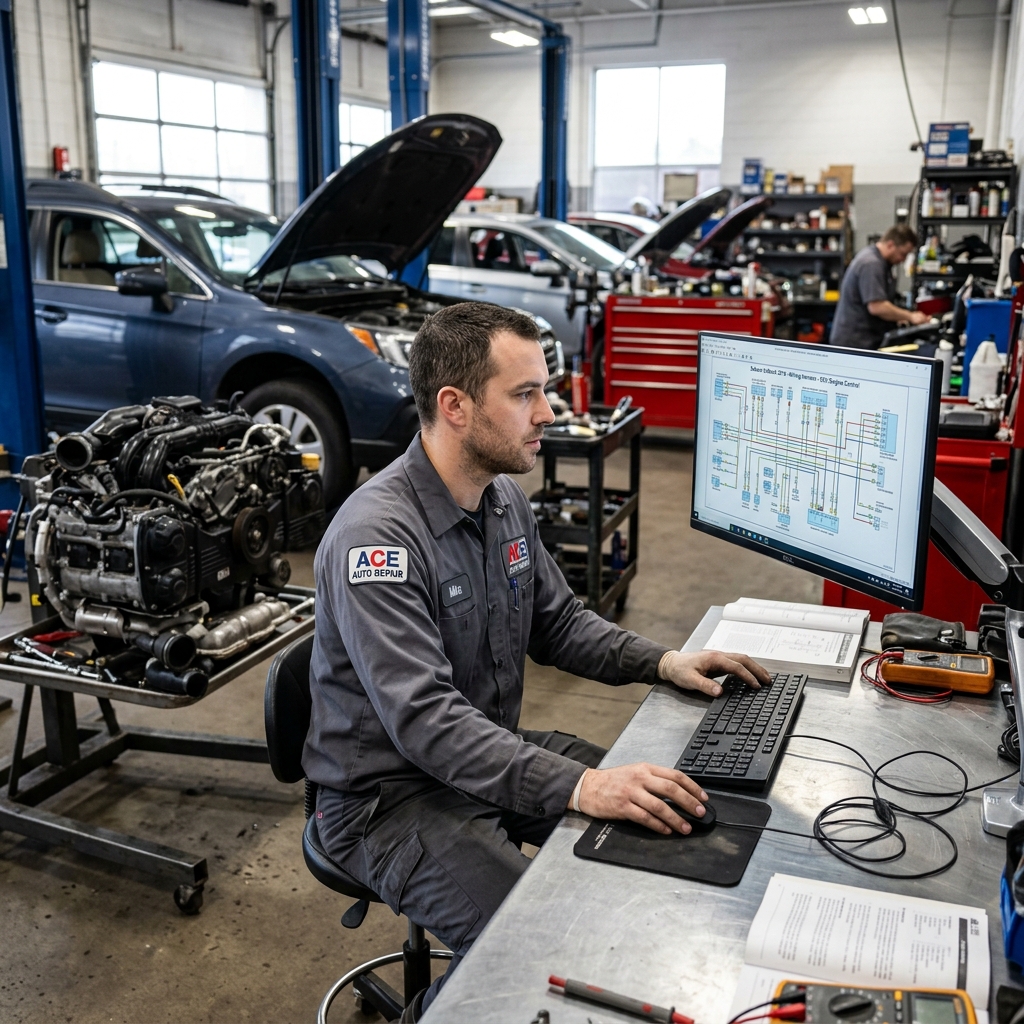
Shop-Ware is a cloud-based shop management platform built specifically for modern, paperless workflows. Unlike legacy tools that digitized paper processes, Shop-Ware was designed from the ground up for real-time team collaboration and customer transparency.
What Shop-Ware Does Well
Shop-Ware's standout feature is its live repair order system, where technicians, service advisors, and customers can all see job status in real time. There's no passing paper back and forth — updates happen instantly across the platform.
Key features include:
- Digital multi-point inspections with photo and video capture sent directly to customers
- Canned jobs (pre-built service templates) that speed up estimating and reduce advisor errors
- Customer approval via text or email, which shortens the approval cycle compared to phone calls
- Parts matrix pricing that automatically applies your markup rules
- Cloud-based access from any device, with no local server needed
According to Shop-Ware's published customer data, shops using their platform report higher average repair order (ARO) values — largely because photo-rich inspections help customers understand and approve more recommended work.
Shops that send visual inspection results to customers approve significantly more additional work than those relying on verbal explanations alone.
Who Shop-Ware Is Best For
Shop-Ware is a strong fit for tech-forward shops that have already bought into a paperless philosophy or are actively trying to get there. It works well for:
- Independent shops with multiple technicians who need real-time job visibility
- Service advisors managing several repair orders simultaneously
- Shops focused on improving customer communication and trust
In practice, the platform's UI feels noticeably more modern than older tools like Mitchell 1 Manager or legacy versions of ALLDATA Manage. Teams with younger technicians tend to adopt it quickly.
Limitations to Know
Shop-Ware's reporting features are functional but not as deep as platforms like Tekmetric when it comes to KPI tracking and performance analytics. Smaller single-bay shops may also find the pricing harder to justify — is tier-based and scales with users, which can add up quickly for lean operations.
It also does not include a built-in branded website or AI diagnostic assistant, so shops looking for those capabilities would need to layer in additional tools — adding cost and complexity.
Shop-Ware vs. RedAppy: A Quick Look
| Feature | Shop-Ware | RedAppy |
|---|---|---|
| Paperless workflow | ✅ Strong | ✅ Strong |
| Real-time tech collaboration | ✅ Yes | ✅ Yes |
| AI Repair Assistant | ❌ No | ✅ Built-in |
| Built-in branded website | ❌ No | ✅ Included |
| Parts ordering (multi-supplier) | Limited | ✅ Real-time, multi-supplier |
| Reporting depth | Moderate | ✅ Real-time analytics |
| Pricing model | Per-user tiers | Transparent, month-to-month |
If your primary goal is paperless collaboration with strong customer-facing communication, Shop-Ware delivers. If you want those same capabilities plus AI diagnostics, a built-in website, and deeper analytics in one subscription, RedAppy covers more ground without adding separate tools.
Best for: Independent shops with 2–10 technicians that are committed to going fully paperless and want strong real-time team communication as their top priority.
Conclusion
The best auto repair shop software depends entirely on what your shop needs most. There's no single answer that fits every operation.
Here's a straightforward breakdown based on shop type:
| Shop Priority | Best Choice |
|---|---|
| All-in-one management | RedAppy |
| OEM repair data accuracy | ALLDATA |
| Shop management + data integration | Mitchell 1 |
| Paperless team collaboration | Shop-Ware |
| Financial management and bookkeeping | QuickBooks Online |
| KPI-driven growth and analytics | Tekmetric |
If you're running a single-bay shop or a growing multi-location operation and want to avoid stitching together five different tools, RedAppy is the strongest all-in-one option. The built-in AI Repair Assistant, digital inspections, real-time parts ordering, and Kanban-style shop board replace several standalone subscriptions. The reported savings of 10+ admin hours per week add up fast, especially for owner-operators wearing multiple hats.
Shops that consolidate onto one platform consistently report fewer missed steps, faster approvals, and cleaner financials — because nothing falls between tools.
If OEM accuracy is non-negotiable — think dealership-adjacent independents or ADAS specialists — pair ALLDATA's factory data with a dedicated shop management platform. Mitchell 1 is worth considering if you want that data access built closer to your workflow.
For financial reporting, QuickBooks Online isn't optional — it's the industry standard. The key is pairing it with a shop management platform that integrates cleanly so your invoice data flows without manual entry.
Before you decide, ask three questions:
- How many tools are you currently paying for that overlap in function?
- Does your team need deep OEM data daily, or do you mainly handle maintenance and common repairs?
- Are you making decisions based on shop data, or does that reporting not exist yet?
Use the comparison table at the top of this guide to match features against your priorities. If you're ready to consolidate your workflow and see what an all-in-one platform looks like in practice, start with a RedAppy demo — month-to-month terms mean no long-term commitment while you evaluate.
Frequently Asked Questions
What is the best automotive repair shop software?
Mitchell 1 Manager SE, Shop-Ware, and Tekmetric consistently rank among the best automotive repair shop software based on user reviews. Mitchell 1 leads in market share with its comprehensive estimating and management tools, while Tekmetric earns high marks for its cloud-based interface and customer communication features. The "best" option depends on shop size, budget, and whether you prioritize estimating accuracy or workflow management.
Which is better, Mitchell or Alldata?
Mitchell 1 generally edges out ALLDATA for shop management features, while ALLDATA is widely preferred for its repair information database depth and OEM accuracy. ALLDATA covers over 38,000 engine-specific vehicles with direct manufacturer data, making it a top choice for diagnostics. Mitchell 1 is stronger for estimating, invoicing, and integrated shop operations, so many shops subscribe to both.
What is the best software for managing a repair shop?
Tekmetric and Shop-Ware are widely regarded as the best pure shop management platforms, earning 4.5+ star ratings across major review sites like Capterra and G2. Both offer cloud-based dashboards, digital vehicle inspections, parts ordering integration, and real-time reporting. Larger shops often favor Mitchell 1 Manager SE for its all-in-one estimating and management capabilities.
What is the best accounting software for an auto repair shop?
QuickBooks Online integrates with most major auto repair platforms and remains the top-rated accounting solution for auto repair shops. It syncs with shop management tools like Tekmetric, Mitchell 1, and Shop-Ware to automate invoicing, payroll, and expense tracking. For smaller shops, QuickBooks Simple Start or Wave Accounting offer cost-effective alternatives with sufficient bookkeeping functionality.
Ready to Transform Your Shop?
RedAppy helps auto repair shops create professional digital estimates with photos and videos, send them instantly via text or email, and get customer approvals in seconds. No credit card required to start.