
Auto Shop Programs: Best Tools to Run, Grow, and Manage Your Repair Business
Running an auto repair shop without the right auto shop programs is like trying to diagnose an engine without a scan tool — you can do it, but you're making things harder than they need to be. According to the Auto Care Association, the U.S. auto repair industry generates over $115 billion in annual revenue, yet many shops still rely on paper estimates, whiteboard job tracking, and manual invoicing. That gap between what's possible and what's practiced costs shops real money, time, and customers.
The right software changes that. Modern shop management platforms handle everything from digital vehicle inspections and parts ordering to online payments and customer follow-ups — all in one place. Shops that make the switch report saving hours of admin work every week and approving more repair orders because customers can see photo evidence of what needs fixing.
This article covers the best tools available for auto repair businesses in 2025, from full-featured shop management systems to specialized tools for scheduling, parts, and customer communication. Whether you run a single-bay garage or a multi-location operation, you'll find options here that match your size, budget, and workflow.
Table of Contents
- The Best Auto Shop Programs at a Glance
- Best All-in-One Shop Management Software: RedAppy
- Best for Automotive Training Programs: What to Know Before You Enroll
- Best for Parts Lookup and Diagnostic Support
- Best for Customer Communication and Reviews
- Conclusion
- Frequently Asked Questions
The Best Auto Shop Programs at a Glance
A quick-reference table helps you compare the major categories of auto shop programs before committing to a deep dive on any one tool. The programs below span software platforms, training paths, diagnostic tools, and customer communication — covering the full range of what a modern shop needs.
| Program / Tool | Category | Key Features | Best For | Pricing Tier |
|---|---|---|---|---|
| RedAppy | Shop Management Software | Digital inspections, AI Repair Assistant, Kanban board, parts ordering, invoicing, built-in website | All-in-one shop ops, single bay to multi-location | Paid (month-to-month, transparent pricing) |
| ALLDATA | Repair Data & Diagnostics | OEM repair data, labor times, wiring diagrams, TSBs | Shops needing factory-accurate repair info | Subscription-based |
| Mitchell 1 | Repair Data & Shop Management | ProDemand repair data + Manager SE shop software | Shops wanting data and management in one brand | Subscription-based |
| UTI (Universal Technical Institute) | Automotive Training | Hands-on tech training, manufacturer partnerships | New techs and career changers | Program tuition varies |
| ASE Certification | Industry Certification | Standardized skills testing across 50+ specialties | Technicians proving competency to employers | Per-test fees (~$36–$98) |
| Podium | Customer Communication | Review generation, two-way texting, webchat | Shops focused on reputation and retention | Paid plans |
| Kukui | Customer Communication & Marketing | Website, CRM, review tools, reporting | Shops wanting marketing plus customer management | Paid plans |
| Identifix | Diagnostic Support | Confirmed fixes database, real-world repair data | Techs diagnosing hard-to-find faults quickly | Subscription-based |
Not every shop needs every category. A two-bay independent shop has different priorities than a 12-bay fleet service center — use this table to spot which gaps are costing you the most time or money right now.
A few notes on how to read this table:
- Pricing tier reflects general structure, not exact costs — most vendors require a quote or demo call for current rates
- Some tools overlap categories (Mitchell 1 covers both data and management; RedAppy covers management, diagnostics guidance, and customer-facing website)
- Training programs like UTI are one-time investments; software tools are ongoing operational costs
- According to the, the median annual wage for automotive service techs was $46,970 in 2023 — making staff efficiency tools a direct lever on profitability
The sections below go deeper on each category, starting with the platform that handles the most ground under one roof.
Best All-in-One Shop Management Software: RedAppy
RedAppy is built for auto repair shops that want to replace a stack of disconnected tools with one platform that handles everything from the first customer call to the final payment.
What RedAppy Does
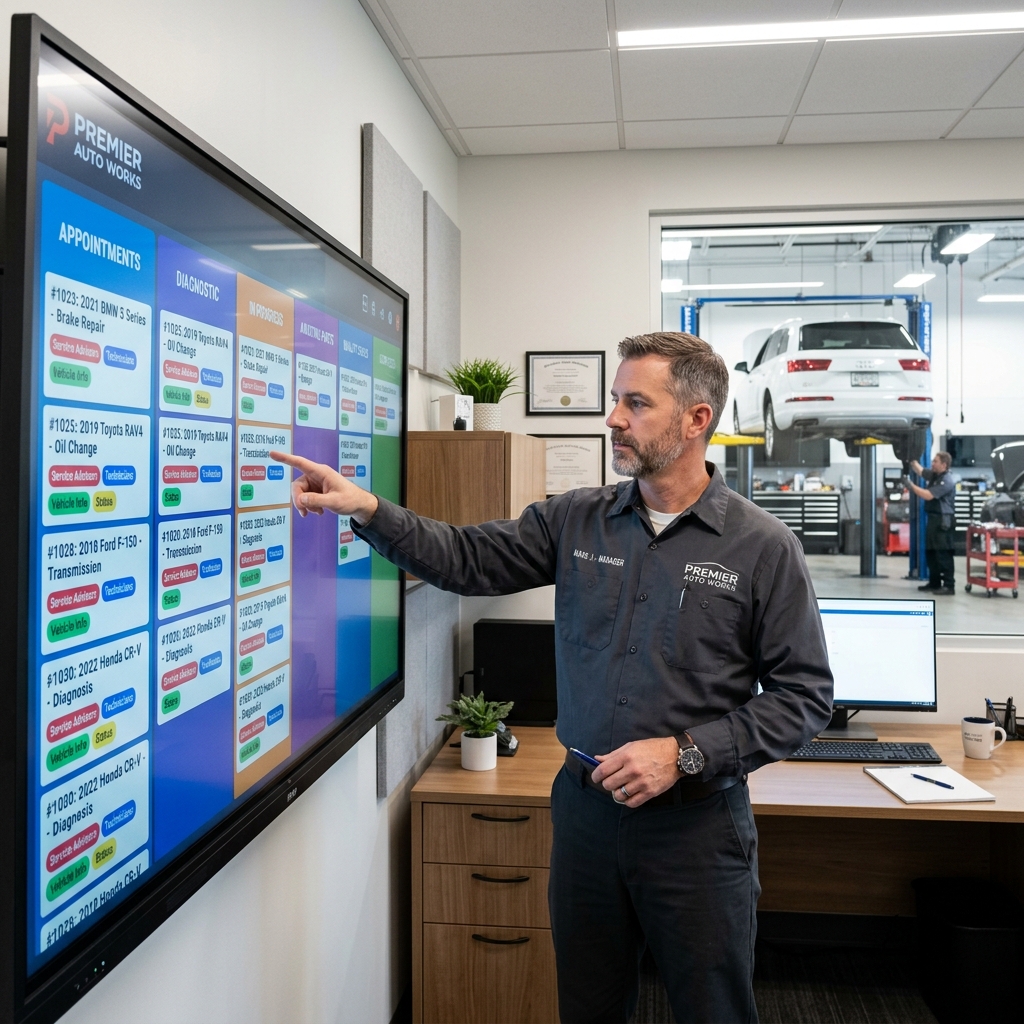
At its core, RedAppy gives shop owners a real-time view of every job in the building. The Digital Shop Board uses a Kanban-style layout — think of it as a visual pipeline where each repair order moves through stages like check-in, inspection, estimate, approval, in-progress, and checkout. At a glance, any team member knows what's happening, what's waiting, and what's done.
From there, the workflow stays in one place:
- Digital inspections with photo and video attachments so customers can see the problem, not just read about it
- Instant estimates generated from inspection findings, sent directly to the customer for approval
- One-click invoicing that converts an approved estimate without re-entering data
- Online payments so customers can pay before they pick up the car
- Parts ordering across multiple suppliers with real-time inventory, all from the same screen
Shops that send photo-rich digital inspections consistently approve more work — customers trust what they can see.
The AI Repair Assistant
RedAppy includes a built-in AI Repair Assistant that gives technicians and service advisors access to labor time estimates, diagnostic guidance, and shop performance insights without leaving the platform. In practice, this reduces the need for a separate subscription to a stand-alone labor guide or diagnostic database.
It's not a replacement for an experienced tech, but it speeds up the research process significantly — especially for shops handling a high volume of varied makes and models.
Built-In Website and Customer Tools
Every RedAppy subscription includes a professional, branded website with contact forms and optional used-car listings. This matters because most shop management platforms make you pay extra or integrate a third-party tool to have any web presence at all.
Customer lookup works by name, license plate, or VIN. Vehicle history is stored automatically, so returning customers don't have to re-explain their car's background.
Real Results
RedAppy reports that shops using the platform typically save 10+ admin hours per week and see a strong first-year ROI. The time savings come from eliminating duplicate data entry, reducing phone tag on approvals, and cutting the back-and-forth that slows down service advisors.
The real-time analytics dashboard tracks:
- Revenue by day, week, or month
- Technician efficiency and productivity
- Average repair order value
- Repeat customer rate
These numbers help owners make decisions based on data instead of gut feel.
Pricing and Flexibility
RedAppy uses transparent pricing with month-to-month terms — no long-term contracts. The platform scales from single-bay shops to multi-location operations, and customization options let owners adapt the workflow to how their shop actually runs rather than forcing a rigid process.
| Feature | Included |
|---|---|
| Digital Shop Board | ✅ |
| Digital Inspections | ✅ |
| AI Repair Assistant | ✅ |
| Parts Ordering (multi-supplier) | ✅ |
| Online Payments | ✅ |
| Branded Website | ✅ |
| Real-Time Analytics | ✅ |
| Month-to-Month Terms | ✅ |
Who It's Best For
RedAppy is the right fit for shops that are ready to move away from paper estimates, whiteboard scheduling, and spreadsheet tracking. If your shop is already running on a digital system and just needs a specific upgrade — say, better customer communication or a standalone parts tool — a more focused solution might serve you better.
Use case: A six-bay independent shop struggling with slow estimate approvals and no clear picture of technician workload. RedAppy replaces the whiteboard, the paper RO system, and the separate website, and gives the service advisor real-time status on every job.
The setup process takes real time — shops that commit to onboarding fully see the best results. Treat the first few weeks as an investment, not a disruption.
Learn how digital inspections increase approval rates — it's one of the fastest ways to grow revenue without adding a single new customer.
Best for Automotive Training Programs: What to Know Before You Enroll
Mechanic school questions come up constantly — "Who has the best automotive program?" and "How long does it take?" The honest answer depends on what you want out of it. A 6-month certificate gets you working fast. A 2-year associate degree opens more doors long-term.
Who the Top Programs Are
UTI is one of the largest trade school networks in the U.S., with campuses in over a dozen states. Programs run roughly 51 weeks for the core automotive curriculum, with manufacturer-specific training available on top of that through partners like Ford, BMW, and Porsche.
- Best for: High school graduates or career changers who want structured, hands-on training with brand-specific pathways
- Cost: Typically $33,000–$45,000 depending on program and location
- Outcome: UTI reports that over 87% of graduates who seek employment in the field find jobs within one year
The manufacturer elective programs (MSAT, BIMC, etc.) are genuinely valuable. In practice, these partnerships give students a foot in the door with dealerships that actively recruit from UTI campuses.
Lincoln Tech offers automotive programs at campuses across the eastern U.S. Their automotive technology programs range from about 9 months to 18 months, depending on the depth of the track chosen.
- Best for: Students who want regional campus options and flexible program lengths
- Cost: Ranges from roughly $20,000–$40,000
- Outcome: Graduates are eligible to sit for ASE certification exams immediately after completing their program
Lincoln Tech also offers hybrid/EV coursework, which is increasingly important as electric vehicles make up a growing share of service appointments.
ASE (Automotive Service Excellence) certifications are the industry standard for working technicians. They are not a school program — they are exams that validate what you already know. There are 58 total ASE certifications across categories including engine repair, brakes, electrical, and more.
- Best for: Working technicians who want to prove their skills, attract higher pay, or meet shop hiring requirements
- Cost: Each exam costs roughly $36–$98, depending on the test
- Outcome: ASE-certified technicians earn measurably more. According to industry data, shops with certified techs can also charge higher labor rates and build stronger customer trust
Shops that require ASE certification during hiring screen for commitment, not just experience. It signals that a technician takes the trade seriously.
Online vs. In-Person: What Actually Works
Most reputable automotive programs require hands-on time. You cannot learn to diagnose a misfire from a video alone. That said, online options exist for the theory side — things like engine fundamentals, electrical systems, and service writing.
| Format | Best For | Limitation |
|---|---|---|
| In-person trade school | Hands-on skills, manufacturer partnerships | Higher cost, location-dependent |
| Community college | Lower cost, associate degree path | Slower timeline (1–2 years) |
| Online courses | Theory, supplemental learning | No substitute for shop time |
| ASE self-study + exam | Working techs building credentials | Requires prior experience |
Community college automotive programs are worth mentioning here. They typically run 1–2 years and cost significantly less — sometimes under $10,000 — making them a strong option for students who can afford a longer timeline.
How Long Does Mechanic School Actually Take?
The range is wide, and it matters which path you pick:
- Certificate programs: 6–12 months
- Diploma programs: 12–18 months
- Associate degree: 18–24 months
- ASE certification (individual exams): Self-paced, but most techs prepare for 2–4 months per exam
According to the U.S. Bureau of Labor Statistics, the median pay for automotive service technicians was $46,970 in 2023, with the top 10% earning over $75,000. Specialized training and ASE certifications are the clearest paths to the higher end of that range.
Enrolling in a program is just the start. The technicians who earn the most are the ones who keep learning after graduation — new vehicle tech, EVs, advanced diagnostics.
From here, it's worth looking at the tools that support technicians on the shop floor every day — starting with parts lookup and diagnostic software.
Best for Parts Lookup and Diagnostic Support
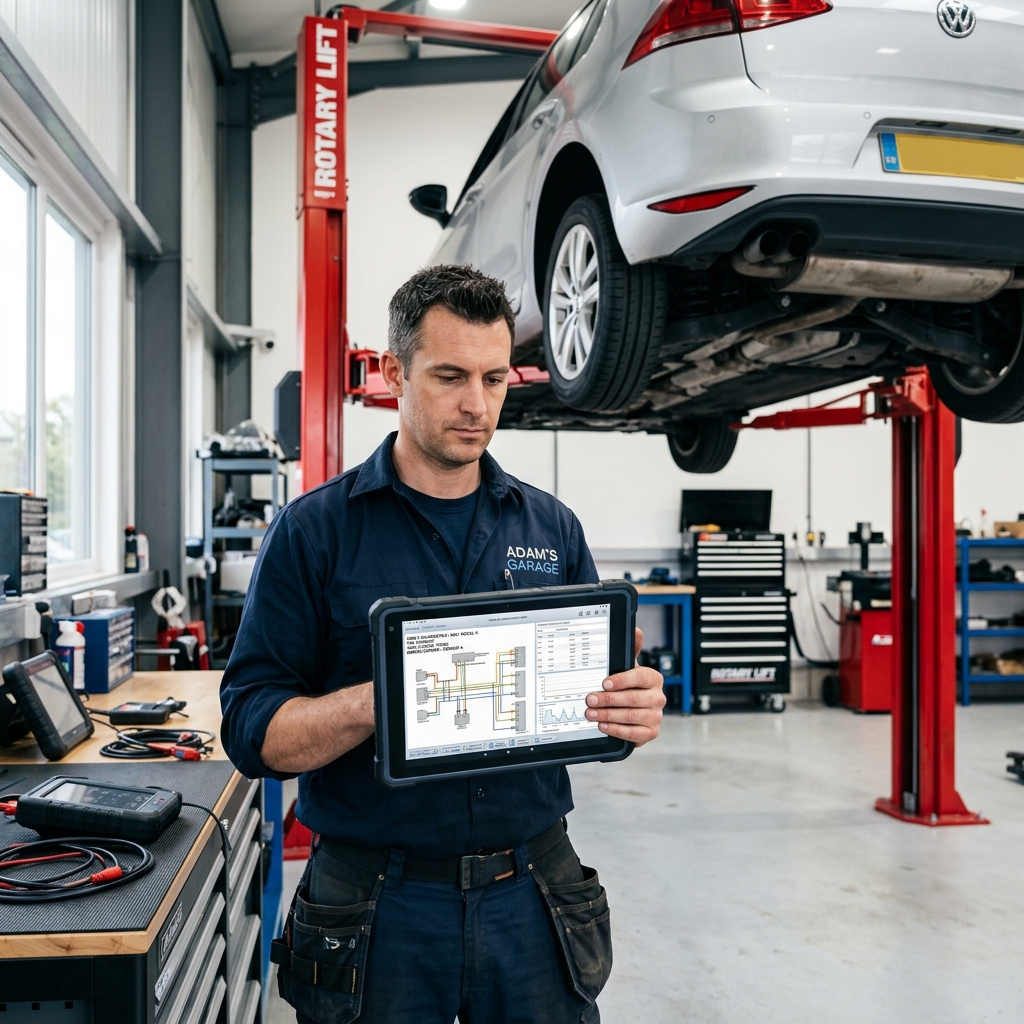
Parts lookup and diagnostic data are the backbone of accurate estimates. Without reliable labor times and repair procedures, technicians guess — and guessing leads to undercharging, comebacks, and frustrated customers. These tools exist specifically to solve that problem.
ALLDATA
is one of the most widely used repair information platforms in the industry. It provides OEM (original equipment manufacturer) repair procedures, wiring diagrams, labor times, and technical service bulletins (TSBs) for a massive range of vehicles. According to ALLDATA, the platform covers over 44,000 engine-specific vehicles.
Best for: Shops that want factory-accurate repair data and are working on a wide variety of makes and models. It's particularly strong for technicians who need to pull exact OEM procedures rather than estimated guides.
Limitation: ALLDATA is a data tool, not a shop management platform. You'll still need separate software to write estimates, manage jobs, and track payments.
Mitchell 1
offers repair information through its ProDemand platform and pairs it with Manager SE, a shop management system. ProDemand pulls together OEM data, labor times, and real-world repair records from a large database of actual technician fixes — called SureTrack.
Best for: Shops that want diagnostic guidance informed by real-world repair outcomes, not just manufacturer specs. The SureTrack component is especially useful for diagnosing intermittent or unusual faults.
- Labor time guides integrated with repair procedures
- Wiring diagrams and component locations
- Real repair records from millions of completed jobs
- Optional pairing with Mitchell 1's shop management tools
Limitation: The full suite can get expensive when you stack ProDemand and Manager SE together. Smaller shops may find the cost hard to justify.
Identifix
focuses heavily on diagnostic shortcuts — specifically, "confirmed fixes" from ASE-certified technicians who've already solved common problems on specific vehicles. It's less about comprehensive OEM data and more about speed: what's the most likely fix for this symptom on this vehicle?
Best for: Experienced technicians who want to cut diagnostic time on common problems. In practice, Identifix works well for shops with high volume where spending two hours chasing a code isn't viable.
Shops that handle high car counts benefit most from tools that compress diagnostic time — even saving 20 minutes per job adds up to hours across a week.
RedAppy's Built-In AI Repair Assistant
Rather than subscribing to a separate diagnostic tool, some shops are moving toward all-in-one platforms with AI guidance built in. RedAppy's AI Repair Assistant delivers labor times, diagnostic guidance, and shop insights directly inside the platform — without switching tabs or paying for an additional subscription.
Best for: Shops already using RedAppy for estimates, inspections, and invoicing who want diagnostic support without managing another vendor relationship.
Limitation: If your shop needs deep OEM wiring diagrams or highly specific factory procedures for complex repairs, a dedicated tool like ALLDATA may still be worth the cost alongside your shop management platform.
Quick Comparison
| Tool | Primary Strength | Best For | Standalone or Integrated |
|---|---|---|---|
| ALLDATA | OEM procedures + diagrams | Wide vehicle variety | Standalone |
| Mitchell 1 ProDemand | OEM data + real-world fixes | Complex diagnostics | Standalone or paired |
| Identifix | Confirmed fixes, fast lookup | High-volume shops | Standalone |
| RedAppy AI Assistant | Labor times + shop insights | Shops on RedAppy platform | Integrated |
According to a 2023 TechForce Foundation report, diagnostic time is one of the leading contributors to technician inefficiency — making the right lookup tool a direct impact on shop profitability, not just a convenience.
The tools above solve the data problem. But getting cars in the door and keeping customers coming back is a different challenge — and that's where customer communication tools take over.
Best for Customer Communication and Reviews
Customer communication is one of the biggest gaps in most auto repair shops. A customer who doesn't hear back quickly books elsewhere. According to, 98% of consumers read online reviews for local businesses — and shops with more recent, positive reviews consistently win more first-time bookings.
Shops that automate review requests after a repair see significantly higher review volume than those that ask manually.
The tools below focus on review generation, appointment reminders, and two-way texting. Some shops need a dedicated tool. Others can get these features from their shop management platform.
Podium
is a business messaging platform built around online reputation and customer conversations. It centralizes Google reviews, Facebook messages, and text conversations into one inbox.
What it does:
- Sends automated review requests via text after a job is closed
- Enables two-way SMS with customers from a single dashboard
- Handles appointment reminders and follow-ups
- Integrates with some shop management platforms
Best for: Shops that already have a management system but want to sharpen their review volume and text communication. Podium works across many industries, so it's not auto-specific — but in practice, its review automation is among the most effective available.
Limitation: Pricing starts around $399/month, which is a significant add-on cost if you're already paying for shop management software. It also doesn't integrate natively with every platform.
Kukui
is built specifically for auto repair shops. It combines a shop website, digital marketing tools, and customer retention features in one platform.
What it does:
- Tracks which marketing channels (Google ads, social, direct) drive phone calls and bookings
- Sends automated service reminders and follow-up messages
- Provides reputation management with review monitoring
- Offers call tracking and recording
Best for: Shops investing in digital marketing who want to know exactly which spend is generating revenue. Kukui's call tracking feature is especially useful — it ties a booked appointment back to a specific ad or campaign.
Limitation: It's a marketing-focused platform, not a shop management tool. You'll still need separate software to run estimates, invoices, and inspections.
Broadly
focuses on automated review requests and customer messaging for small service businesses, including auto shops. It's simpler than Podium and aimed at owner-operated shops.
What it does:
- Sends Google and Facebook review requests automatically after service
- Offers a web chat widget that routes to text
- Provides a shared team inbox for customer messages
Best for: Small shops that want a straightforward, low-maintenance way to collect reviews and respond to customer messages without a complex setup.
Limitation: Fewer integrations and less robust analytics compared to Podium or Kukui. It's a good entry-level tool, but high-volume shops may outgrow it.
When Your Shop Management Platform Covers This
Standalone communication tools make sense when your shop management software doesn't include customer messaging. But many modern platforms are closing this gap.
RedAppy, for example, includes customer-facing features as part of its all-in-one platform — digital inspections with photos that customers can approve remotely, online payments, and a branded shop website with contact forms. Shops using RedAppy report approving more work because customers can see the inspection photos and authorize repairs without a phone call.
If your shop management platform already handles communication and estimates in one place, adding a separate review tool may be the only gap worth filling.
Quick Comparison
| Tool | Best For | Auto-Specific | Avg. Starting Price |
|---|---|---|---|
| Podium | High-volume review generation + messaging | No | ~$399/month |
| Kukui | Marketing ROI tracking + retention | Yes | Custom pricing |
| Broadly | Small shops, simple review automation | No | ~$200/month |
| RedAppy | All-in-one including customer workflows | Yes | Transparent, month-to-month |
The right choice depends on what your current platform already handles. If you're paying for shop management software that doesn't include customer communication, a tool like Podium or Kukui fills that gap. If you're starting fresh, look for a platform that bundles these features — it reduces cost and keeps customer data in one place.
Conclusion
The auto repair industry has more tools available than ever — but no single program is right for every shop. Your best setup depends on where your biggest gaps are right now.
If you're losing hours to manual invoicing and phone tag, an all-in-one shop management platform like RedAppy closes those gaps fast. If you're hiring and developing technicians, a structured training program through UTI or Lincoln Tech builds the team underneath the software. If your estimates are slow because you're guessing at labor times, a dedicated tool like ALLDATA or Mitchell 1 pays for itself quickly.
Most shops don't have one problem — they have several running at the same time. Prioritize the gap that's costing you the most money or time first, then layer in other tools.
Here's a simple way to think about it:
- Operational chaos (scheduling, estimates, invoicing, payments) → Start with shop management software
- Technician skill gaps → Invest in ASE prep or a trade school pipeline
- Slow diagnostics → Add a repair data subscription or use a platform with AI diagnostic support built in
- Poor retention and reviews → Add a customer communication tool or choose a platform that includes it
In practice, shops that combine strong operations software with consistent customer follow-up see the highest repeat business rates. According to the, customer retention is one of the top drivers of long-term shop revenue — and it's almost entirely driven by communication and trust.
The next step is straightforward: audit your current workflow for the one or two points where time or money is slipping through the cracks. Then match a tool to that specific problem. If you want to cover the most ground with the least complexity, explore RedAppy's features or book a demo to see how an all-in-one platform handles the operational side from end to end.
The right auto shop program doesn't just save time — it creates the headroom to grow.
Frequently Asked Questions
What is the best software for an auto repair shop?
Mitchell 1 Manager SE, Shop-Ware, and Tekmetric are consistently ranked among the best auto repair shop software options. These platforms offer integrated features like work order management, parts ordering, customer communication, and accounting tools. The best choice depends on shop size, with Tekmetric favored by growing shops and Mitchell 1 preferred for its extensive OEM repair data.
Is $100 an hour fair for mechanic labor?
$100 per hour is generally considered fair and even below average in many U.S. markets, where labor rates typically range from $75 to $150+ per hour. Dealerships and specialty shops in high cost-of-living areas often charge $150–$200 per hour. Independent shops tend to be more competitive, averaging around $80–$120 per hour nationally.
Who has the best automotive program?
Universal Technical Institute (UTI) and Lincoln Tech are widely recognized as having the top automotive programs in the U.S., offering manufacturer-specific training partnerships with Ford, BMW, Toyota, and others. Community colleges also offer strong programs at lower costs, with many graduates earning ASE certifications. UTI in particular ranks highly for job placement rates and industry partnerships.
How long does mechanic school take?
Mechanic school typically takes between 6 months and 2 years to complete, depending on the program type. Certificate programs can be finished in as little as 6–12 months, while an associate degree in automotive technology takes about two years. Additional time may be needed to complete ASE certification requirements, which include hands-on work experience hours.
Ready to Transform Your Shop?
RedAppy helps auto repair shops create professional digital estimates with photos and videos, send them instantly via text or email, and get customer approvals in seconds. No credit card required to start.