
Auto Shop Websites: 10 Real Examples That Win More Customers (And What They Do Right)
Your auto shop websites are often the first thing a potential customer sees before they ever call or walk through your door. According to a, 98% of consumers used the internet to find local businesses in 2023. If your website looks outdated, loads slowly, or buries your phone number, that customer is already clicking over to your competitor.
But a great auto shop website isn't just about looking good. It builds trust, answers questions before they're asked, and turns casual browsers into booked appointments. The difference between a site that wins customers and one that loses them often comes down to a handful of specific design and content choices.
In this article, we break down 10 real-world examples of auto shop websites that do it right — and more importantly, why they work. You'll see what top shops are doing with their homepages, service pages, reviews, and calls to action, so you can steal the best ideas for your own shop.
Table of Contents
- The Anatomy of a High-Performing Auto Shop Website
- How These 10 Auto Shop Websites Compare
- Example 1–3: The Local Heroes (Small Shops That Punch Above Their Weight)
- Example 4–6: The Multi-Location Players (How Bigger Shops Manage Complexity Online)
- Example 7–9: The Specialists (Niche Auto Shops With Laser-Focused Websites)
- Conclusion
- Frequently Asked Questions
The Anatomy of a High-Performing Auto Shop Website
A high-performing auto shop website does one job above everything else: it turns a casual browser into a booked customer. According to Google, 76% of people who search for a local business on a mobile device visit that business within 24 hours. Your website is often the only thing standing between that search and that visit.
Here are the five elements that separate sites that convert from sites that just exist.
Clear, Dedicated Service Pages
Every service you offer — oil changes, brake repairs, transmission work — deserves its own page. Not a bullet point on a long list. A full page with a description, what's included, and a call to action.
Search engines use individual service pages to match your site to specific searches. A customer searching "brake pad replacement near me" won't find you if all your services are buried in a single paragraph. In practice, shops with dedicated service pages rank for more search terms and attract visitors who already know what they need.
Mobile-First Design
More than 60% of all web traffic now comes from mobile devices (Statista, 2024). A site that looks great on a desktop but breaks on a phone is actively losing customers.
Mobile-first means more than just "it fits on a small screen." It means buttons large enough to tap, phone numbers that dial with one click, and load times under three seconds. If a visitor has to pinch and zoom to read your menu, they're already gone.
Trust Signals That Do the Talking
Reviews, certifications, and real photos of your team and shop floor build trust before a customer ever calls. Shops with at least 10 Google reviews are significantly more likely to appear in the local pack — the map results that dominate mobile search.
Trust signals to include:
- Star ratings and review counts (Google, Yelp)
- ASE certification badges
- Years in business prominently displayed
- Photos of technicians at work (not stock images)
- A short "About Us" that names real people
Customers don't buy services. They buy confidence. Every review, badge, and real photo is a small proof that you're the safer choice.
Visible, Specific Calls to Action
"Contact us" is not a call to action. "Book Your Free Brake Inspection" is. The best auto shop websites place a specific CTA above the fold — meaning visible before the visitor scrolls — and repeat it at the bottom of every page.
Online scheduling is now table stakes. According to a BrightLocal survey, 67% of consumers prefer to book appointments online rather than by phone. A site without online booking is sending those customers to a competitor who has it.
Fast Load Times
directly influence your search ranking. Pages that load in under 2.5 seconds score well. Pages that take 5+ seconds lose both rankings and visitors — 53% of mobile users abandon a site that takes more than three seconds to load (Google).
Practical speed killers to fix:
- Uncompressed images
- Cheap shared hosting
- Excessive plugins or scripts
- No content delivery network (CDN)
These five elements form the framework you'll see in action — or missing — across every example in this article. A shop doesn't need a big budget to get them right. It needs a platform and a plan.
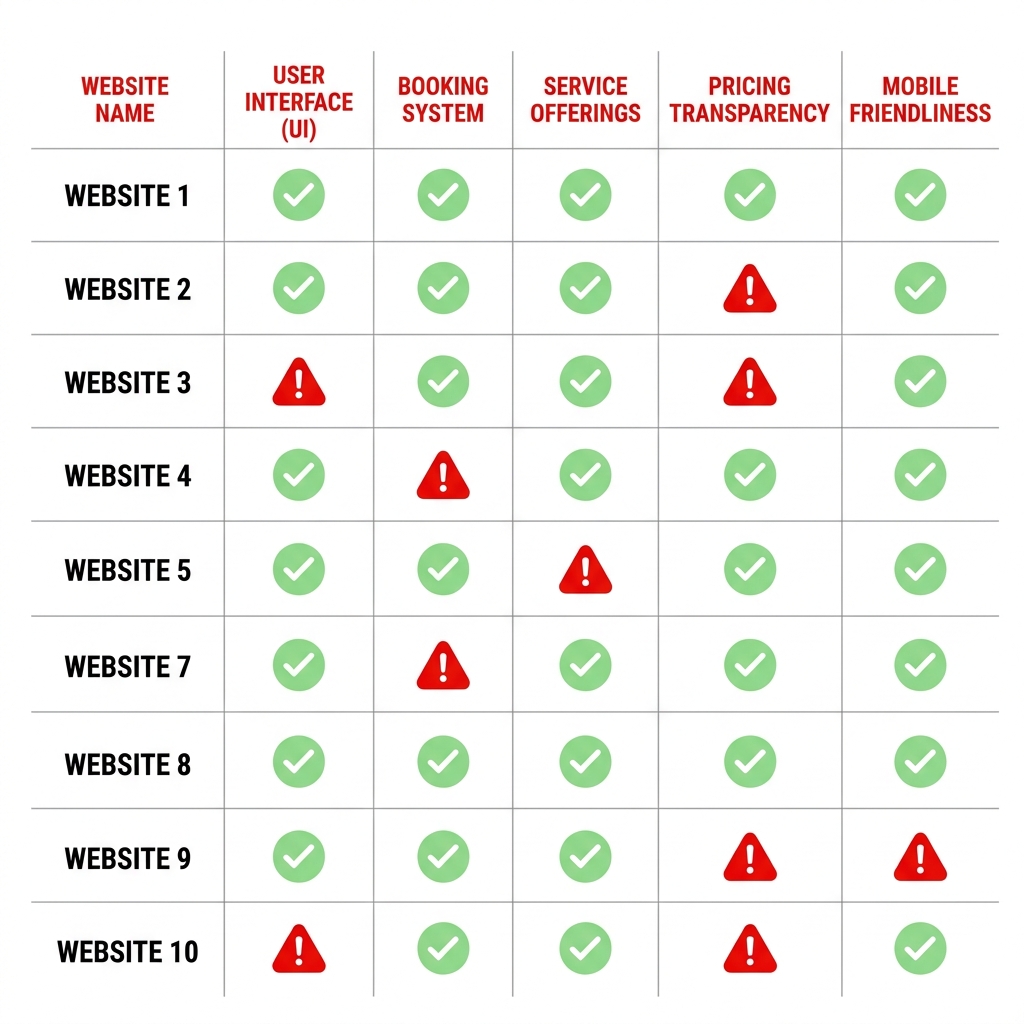
How These 10 Auto Shop Websites Compare
A comparison table helps you see the full picture before diving into any single example. Here's how all 10 sites stack up across the criteria that actually move the needle for auto shops.
| Shop Example | Mobile-Friendly | Online Booking | Digital Inspections | Trust Signals | SEO Structure | Branded Design |
|---|---|---|---|---|---|---|
| Example 1: Local Hero A | ✅ | ✅ | ❌ | ✅ Strong reviews | ⚠️ Basic | ✅ |
| Example 2: Local Hero B | ✅ | ❌ | ❌ | ✅ About Us page | ✅ | ⚠️ Template |
| Example 3: Local Hero C | ✅ | ✅ | ❌ | ⚠️ Limited | ✅ | ✅ |
| Example 4: Multi-Location A | ✅ | ✅ | ⚠️ Partial | ✅ Certs + reviews | ✅ | ✅ |
| Example 5: Multi-Location B | ✅ | ✅ | ❌ | ✅ | ✅ | ⚠️ Inconsistent |
| Example 6: Multi-Location C | ✅ | ✅ | ✅ | ✅ | ✅ | ✅ |
| Example 7: Transmission Specialist | ✅ | ⚠️ Form only | ❌ | ✅ Niche authority | ✅ | ✅ |
| Example 8: European Import | ✅ | ✅ | ❌ | ✅ Brand logos | ✅ | ✅ |
| Example 9: EV Repair | ✅ | ✅ | ❌ | ⚠️ Growing | ✅ | ✅ |
| Example 10: All-In-One Integrated | ✅ | ✅ | ✅ | ✅ Full suite | ✅ | ✅ |
A site can look polished and still lose customers if it's missing booking, trust signals, or a clear service structure — any one gap costs real appointments.
A few patterns jump out immediately. Every high-performing site in this group is mobile-friendly — that's now the floor, not a differentiator. According to Google, 76% of people who search for a local business on mobile visit that business within 24 hours, so a site that breaks on a phone is actively losing same-day customers.
Online booking and digital inspections are where the biggest gaps appear. Smaller shops often rely on a phone call as the conversion point, which creates friction. Specialist shops tend to compensate with strong SEO structure and niche trust signals instead. The integrated example at the end is the only one that scores across every column — and that gap explains a lot about where the industry is heading.
Use this table as your reference as you read through each example below. The ratings aren't about judging any shop — they're a framework for spotting what you can borrow for your own site.
Example 1–3: The Local Heroes (Small Shops That Punch Above Their Weight)
Three small shops. Three completely different approaches. But all of them figured out the same secret — your website can make you look like the biggest shop in town, even if you have two lifts and a parking lot the size of a postage stamp.
Example 1: Christian Brothers Automotive (Franchise-Level Polish at the Local Level)
Christian Brothers Automotive operates as individual franchise locations, but each local shop gets a website that feels genuinely personal. The Springfield, Missouri location is a good example. The homepage leads with a friendly photo of the actual team — not stock imagery — alongside a prominent "Schedule an Appointment" button visible before you scroll an inch.
What makes it work is trust, stacked carefully. You see Google star ratings, an A+ BBB badge, and ASE certifications all in the first screen. According to, 98% of consumers read online reviews for local businesses — and this site treats reviews like a sales tool, not an afterthought.
The "About Our Location" page reads like a neighbor wrote it. It mentions the owners by name, talks about the local community, and explains their "Courtesy Inspection" process in plain language.
A real team photo on the homepage converts better than a stock wrench image every single time.
What to steal:
- Put your actual team front and center — names, faces, a sentence about who they are
- Stack trust signals (reviews, certifications, BBB rating) above the fold
- Write your About page like you're talking to a neighbor, not a search engine
Example 2: Honest-1 Auto Care (Transparency as a Conversion Strategy)
The name says it all, and the website delivers on the promise. Honest-1 Auto Care locations use their websites to demystify auto repair — a smart move when most customers walk in feeling anxious about being overcharged.
Their service pages don't just list what they do. They explain how a brake inspection works, what a technician checks during an oil change, and why that service matters. This kind of educational content does two things: it builds trust before a customer ever calls, and it captures Google searches from people asking questions like "what does a transmission flush include."
The site also features a "Price Promise" section directly on the homepage. No buried disclaimers. In practice, transparency-led websites like this tend to attract customers who are less price-sensitive because the shop has already answered their biggest fear.
Customers who feel informed before they arrive are easier to work with and more likely to approve additional services.
What to steal:
- Add plain-language explanations to every major service page
- Feature any pricing guarantees or transparency pledges prominently — not in the footer
- Answer the top 3 questions your customers ask at the front desk, right on your homepage
Example 3: Doug's Foreign Car Service — The Power of a Hyper-Local About Page
Doug's Foreign Car Service (Eugene, Oregon) is the kind of shop that could easily disappear online behind bigger national competitors. Instead, their website leans hard into something the chains can never replicate: authenticity.
The About page opens with the shop's founding story, mentions Doug by name, and includes a photo of the original building alongside the current one. It reads like local history. The services page focuses specifically on European and Japanese imports — which tells exactly the right customer they've found the right place.
Google's local search algorithm rewards relevance and authority. A shop with specific, location-rich content ("Eugene's trusted Volvo specialist since 1987") signals both. According to, on-page signals — including NAP consistency and locally relevant content — remain among the top factors for local pack rankings.
The site isn't flashy. It doesn't need to be. It answers three questions immediately: Who are you? What do you fix? Why should I trust you?
You don't need a $10,000 website. You need one that answers the three questions every customer asks the moment they land on your page.
What to steal:
- Tell your real story — when the shop started, who built it, what you stand for
- Use local language naturally (neighborhood names, city, landmarks)
- Narrow your service focus on the homepage so the right customer self-selects immediately
What These Three Have in Common
These shops operate in different cities, serve different customers, and have different specialties. But their websites share the same bones.
| Element | Christian Brothers | Honest-1 | Doug's Foreign Car |
|---|---|---|---|
| Real team photos | ✅ | ✅ | ✅ |
| Trust signals above fold | ✅ | ✅ | ⚠️ Partial |
| Educational service content | ⚠️ Partial | ✅ | ✅ |
| Local story / About page | ✅ | ⚠️ Partial | ✅ |
| Clear primary CTA | ✅ | ✅ | ✅ |
The pattern is clear. Small shops win online when they build trust before the first phone call — through real photos, honest language, and content that treats customers like intelligent adults. No shop in this group is outspending a national chain. They're just outthinking one.
Example 4–6: The Multi-Location Players (How Bigger Shops Manage Complexity Online)
Three regional or multi-location shops show how to manage complexity without losing the customer. Their websites solve a problem small shops rarely face: how do you keep branding consistent when you have five locations, different service menus, and a dozen staff members updating content?
Example 4: Christian Brothers Automotive (Franchise Scale, Local Feel)
Christian Brothers Automotive operates — and their website strategy is built around one insight: people don't search for a chain, they search for a shop near them.
Each franchise location gets its own dedicated page with a local phone number, address, staff photos, and Google Reviews pulled from that specific location. The national brand provides the trust foundation (certifications, warranty guarantees, brand colors), but the local page does the conversion work.
Their "Schedule an Appointment" CTA appears above the fold on every location page. There's no hunting for it.
What they do right:
- Localized URLs (e.g.,
/locations/houston-memorial) that help each page rank in local search - Consistent service menu across all locations, with location-specific availability noted where relevant
- A "Why Christian Brothers?" trust section that answers the question before a visitor thinks to ask it
Each location page functions as a standalone local website — it just happens to share a brand.
Takeaway: Even if you only have two locations, give each its own page with unique content, local reviews, and a specific phone number. Google treats them as separate local entities, which multiplies your search visibility.
Example 5: Midas (Standardized Services, Scalable Trust)
Midas runs thousands of locations and faces a different challenge: keeping service pricing and descriptions consistent without confusing customers or contradicting local franchise operators.
Their solution is a tiered page structure. The national site handles service education — explaining what a brake job involves, what signs mean you need an alignment, what a full synthetic oil change includes. Then the location page handles the booking. Customers learn on the brand site and convert on the local page.
According to, 87% of consumers read online reviews for local businesses. Midas addresses this by surfacing location-specific star ratings prominently on every local page rather than relying on a generic brand score.
What they do right:
- Service content lives at the brand level, so it never goes stale at the local level
- Coupon and promotion pages that are location-aware — showing relevant deals based on the user's detected city
- Mobile-first design with a tap-to-call button that appears within the first scroll on any location page
Takeaway: Separate your educational content from your conversion content. Let the service pages build trust. Let the location pages close the appointment.
Example 6: Firestone Complete Auto Care (Live Data Integration Done at Scale)
Firestone's website demonstrates what happens when a shop management system connects directly to the customer-facing website. Visitors can check estimated wait times, see technician availability, and book specific service bays at their local store — all in real time.
This isn't just convenience. It's a conversion lever. When a customer can see "3 openings tomorrow morning" on the booking screen, the decision to book becomes immediate. Vague availability kills appointments.
Firestone also uses vehicle history lookup — enter your license plate and your car's service history at any Firestone location surfaces automatically. This creates a sticky customer experience that independent shops often struggle to match without the right platform.
What they do right:
- Real-time inventory and appointment data feeding directly into the website experience
- Cross-location vehicle history, so customers feel recognized regardless of which store they visit
- Branded consistency across thousands of pages without sacrificing local relevance
The website isn't a brochure. It's a live window into how the shop operates.
Takeaway for smaller shops: You don't need Firestone's budget to replicate the core idea. Platforms like RedAppy connect your shop's scheduling, vehicle history, and customer records directly to your website — so a two-bay shop can offer the same seamless booking experience that customers now expect from the big chains.
The Scalability Lessons Any Shop Can Apply
You don't need 300 locations to steal from these playbooks.
| Lesson | What Big Shops Do | What Your Shop Can Do |
|---|---|---|
| Location pages | Dedicated URL per location | Separate page even for a second location |
| Live data | Real-time availability shown online | Connect booking tool to your website |
| Vehicle history | Cross-location lookup | Use a CRM that ties history to customer profiles |
| Trust signals | Location-specific reviews | Embed Google Reviews filtered to your location |
| Service content | National pages, local conversion | Write service pages once, link from your homepage |
The pattern across all three examples is the same: structure handles complexity. When your website has a clear architecture — brand-level content, location-level conversion, live shop data — scaling stops feeling like chaos and starts feeling like a system.
Example 7–9: The Specialists (Niche Auto Shops With Laser-Focused Websites)
Three specialist shops show what happens when a website speaks directly to one audience instead of trying to please everyone. The result is less traffic — but far higher intent, and far better conversion.
Example 7: Advanced Transmission Center (Transmission Specialist)
Advanced Transmission Center focuses entirely on transmission repair, rebuild, and replacement. Their website reflects that singular focus from the first headline down to the footer. Every service page targets a specific problem — slipping gears, delayed shifting, transmission fluid leaks — using language that matches exactly what customers type into Google.
What makes it work is specificity. Instead of a generic "Services" page, they have individual pages for automatic transmission repair, manual transmission rebuild, and transfer case service. Each page explains the symptom, the diagnosis process, and the typical repair path. That structure earns them rankings for high-intent searches that a general shop would never compete for.
Their trust signals are equally targeted. Technician certifications from ATRA (Automatic Transmission Rebuilders Association) are displayed prominently — the kind of credential that means nothing to a general audience but everything to someone whose transmission just failed.
Niche credentials only matter if you display them where the right customer will see them. A specialist shop that hides its certifications is leaving conversion on the table.
What to steal:
- Build individual service pages around specific symptoms, not just service names
- Display trade-specific certifications (ATRA, ASE specialist ratings) above the fold
- Use technical language accurately — it signals expertise to high-intent visitors
Example 8: Bavarian Auto (European Import Specialist)
Bavarian Auto serves BMW, Mercedes, Audi, and Volkswagen owners — and their website makes that clear within two seconds of landing on the homepage. The hero image shows a BMW in a clean, modern bay. The headline reads something like: "European car care from technicians who specialize in nothing else."
This kind of positioning works because European car owners are often skeptical of general repair shops. They worry about misdiagnosis and incorrect parts. A website that speaks their language — referencing factory diagnostic tools, OEM parts sourcing, and brand-specific service intervals — immediately lowers that skepticism.
According to, 76% of consumers who use an independent repair shop say trust in the technician is their top selection factor. For European car owners specifically, that trust has to be established before they ever call.
Bavarian Auto's site also uses vehicle-specific imagery throughout. Service pages for BMW oil service look different from Audi brake service pages. That extra effort signals genuine specialization rather than a generic shop that added "European" to its name.
What to steal:
- Use brand-specific imagery — photos of the actual makes you service, not stock car photos
- Reference the diagnostic tools and parts standards your target audience cares about
- Write directly to the anxiety your ideal customer already has before they visit your site
Example 9: EV Fix (Electric Vehicle Repair Specialist)
EV Fix is a newer category of specialist, and their website reflects the educational challenge that comes with it. Many EV owners don't know what "maintenance" even means for their vehicle. The EV Fix homepage leads with education: a clear explainer on what EVs actually need serviced, followed by a CTA to book a battery health check.
This approach works because the audience is in the early awareness stage. They're not searching "EV brake repair" — they might not know EV brakes last longer due to regenerative braking. EV Fix's blog and FAQ sections capture that educational traffic and convert it into customers who now trust the shop before they've spoken to anyone.
Their service pages are structured around EV-specific components: battery diagnostics, charging system repair, thermal management, and software updates. Each page ranks for long-tail searches that zero general repair shops are targeting yet — which means lower competition and faster SEO gains.
From experience, niche shops that publish genuinely useful educational content in an underserved category can build domain authority quickly. EV Fix's blog posts on topics like "how to check your EV battery health at home" attract early-funnel visitors who convert later.
What to steal:
- If your niche is new or unfamiliar, lead with education before you lead with services
- Target long-tail keywords your competition isn't ranking for yet
- Use FAQ sections to capture question-based searches — these are high-intent and often overlooked
What Specialist Shops Prove
| Shop Type | Primary Differentiator | Key Website Tactic |
|---|---|---|
| Transmission specialist | Technical depth | Symptom-based service pages |
| European import | Brand trust | Vehicle-specific imagery + credentials |
| EV repair | Category education | Blog + FAQ content for early-funnel visitors |
The pattern across all three: they stopped trying to attract everyone and started speaking directly to someone. That focus shows up in every headline, every image, and every service page.
A niche website doesn't shrink your customer base — it filters out bad fits and pulls in better leads. Fewer tire-kickers, more booked jobs.
This is exactly why building your shop's website around a clear positioning strategy matters more than having the most features. Specialist shops often outperform larger general shops in local search because their content is coherent, specific, and trusted by the exact people searching for it.
Conclusion
The single biggest pattern across all 10 examples is this: the best auto shop websites are not brochures. They are the front door to the entire shop operation.
Every shop that stood out — from the small independent with strong Google Reviews to the multi-location chain with clean location pages to the EV specialist with laser-focused service content — treated their website as a working part of the business. Not a marketing afterthought updated once a year.
A shop website that can't book appointments, share inspection photos, or take online payments is leaving money on the table every single day.
You don't need a massive budget to compete. What the best sites share is actually pretty simple:
- Clarity — visitors know exactly what the shop does and how to book within seconds
- Mobile-readiness — since, a slow or clunky mobile experience is a direct revenue leak
- Trust signals — real reviews, certifications, and team photos do more than any tagline
- Connected workflow — the site feeds into estimates, inspections, invoicing, and customer history without anyone re-entering data
The shops that have figured this out are pulling ahead. And the gap is widening.
Platforms like RedAppy are raising the bar for what customers now expect when they find an auto shop online. A branded website that connects directly to digital inspections, instant estimates, parts ordering, and online payments isn't a luxury feature anymore — it's becoming the standard customers assume exists. When a competitor offers seamless online booking and photo-rich inspection reports sent straight to a customer's phone, a static "call us" page starts to look like a reason to go elsewhere.
The good news is that any shop — single-bay garage or multi-location operation — can build this. The examples in this article prove it. Start with the basics: a mobile-first design, clear service pages, visible CTAs, and real reviews. Then connect your website to the tools your team already uses to run the shop.
That's not a website. That's a growth engine.
Frequently Asked Questions
What is the $3000 rule for car repairs?
If a repair costs more than $3,000, you should seriously consider whether it's worth fixing versus replacing the vehicle. The rule suggests comparing the repair cost against the car's current market value — if the repair exceeds that threshold (or roughly 50% of the car's worth), buying a newer vehicle is often the smarter financial decision.
What are the top online auto parts websites?
The most popular online auto parts retailers include AutoZone, RockAuto, Advance Auto Parts, O'Reilly Auto Parts, and Amazon Automotive. RockAuto is widely regarded as the best for low prices and extensive inventory, while AutoZone and O'Reilly are preferred for same-day availability and in-store support.
Is $100 an hour fair for mechanic labor?
$100 per hour is considered reasonable and even below average in many U.S. markets, where shop labor rates typically range from $80 to $150+ per hour. Dealerships and specialty shops in urban areas often charge $150–$200/hour, so independent shops pricing at $100 reflect competitive, fair market rates.
What are the best website platforms for automotive websites?
WordPress (with automotive themes), Squarespace, and Wix are popular general platforms for auto shop websites, offering ease of use and customizable design. However, industry-specific platforms like Broadly, Shop-Ware, and DemandHub are often better suited for auto shops, as they integrate appointment scheduling, reviews, and customer communication tools built specifically for automotive businesses.
Ready to Transform Your Shop?
RedAppy helps auto repair shops create professional digital estimates with photos and videos, send them instantly via text or email, and get customer approvals in seconds. No credit card required to start.