
Automotive Repair Websites: 10 Real Examples That Actually Bring In Customers
Most automotive repair websites look the same — a phone number, a list of services, and a stock photo of someone holding a wrench. But a handful of shops are doing something different, and it's showing up directly in their car counts and revenue. The gap between a website that just "exists" and one that actively brings in customers is wider than most shop owners realize.
Automotive repair websites are often the first impression a driver gets of your business — before they call, before they walk in. According to Google, 76% of people who search for a local business on their smartphone visit one within a day. That means your website isn't just a digital brochure. It's your best salesperson, working around the clock.
This article breaks down 10 real examples of auto repair websites that are actually converting visitors into paying customers. For each one, you'll see what they're doing right, why it works, and what you can take back to your own shop. Whether you're building from scratch or rethinking what you already have, these examples will give you something concrete to act on.
Table of Contents
- What Makes an Automotive Repair Website Work (And What Doesn't)
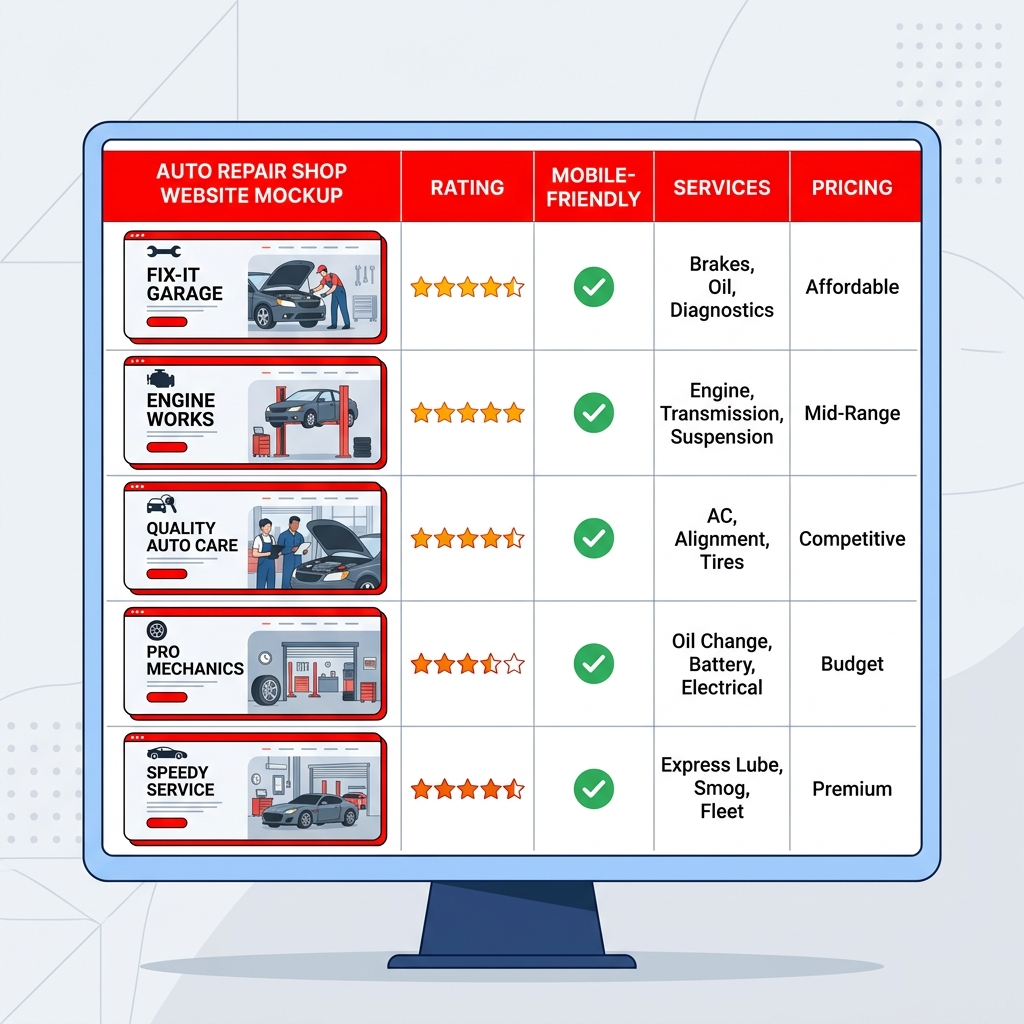
- How These 10 Auto Repair Websites Compare at a Glance
- 5 Independent Shop Websites That Convert Browsers Into Customers
- Conclusion
- Frequently Asked Questions
What Makes an Automotive Repair Website Work (And What Doesn't)
97% of consumers search online before making a local purchasing decision, according to. For auto repair shops, that means your website is almost always the first impression — and often the deciding factor between a booked appointment and a lost customer.
But most shop websites fail quietly. They exist, they load, and they do almost nothing to convert a visitor into a paying customer.
What Separates a High-Converting Shop Site from a Digital Brochure
A digital brochure tells you the shop exists. A high-converting website answers the questions a nervous car owner is actually asking: Can I trust these people? How much will this cost? How do I book?
The difference comes down to a handful of specific elements — and the examples throughout this article were evaluated against all of them.
Trust Signals
According to BrightLocal, 98% of consumers read online reviews for local businesses. Shops that display Google ratings, customer testimonials, and verified review counts directly on their homepage remove the biggest barrier to a first call. Shops that hide reviews — or have none — force visitors to go find them elsewhere, often landing on a competitor.
A phone number buried in the footer costs real appointments. First-time customers in stressful situations want to call immediately.
Services Listed Clearly
In practice, service pages do two jobs at once: they tell the customer what you offer, and they tell Google what searches you should appear for. A shop with a single "Services" page listing 12 items in bullet points is leaving significant organic traffic on the table. Shops with dedicated pages for brake repair, oil changes, and transmission service each capture searchers looking for exactly that.
Easy Contact and Booking
A 2023 study by Podium found that 60% of customers prefer to book appointments online rather than calling. Shops without online scheduling are actively filtering out a majority of ready-to-book visitors. The bar here isn't high — a simple form or a linked scheduling tool is enough — but it has to be obvious and fast to reach.
The Criteria Used to Evaluate Every Example
Every website in this article was assessed against the same five factors:
| Criteria | Why It Matters |
|---|---|
| Mobile experience | Over 60% of local searches happen on mobile (Google) |
| Trust signals | Reviews, certifications, photos build credibility before a call |
| Service page depth | Drives organic search traffic and answers pre-purchase questions |
| Contact clarity | Phone, address, and booking visible without scrolling |
| Local SEO signals | NAP consistency, location pages, schema markup |
Not every great-looking website ranks. Not every high-ranking website converts. The examples ahead cover both — and the gaps between them are where the real lessons live.
A shop's website is its hardest-working employee. It's on 24 hours a day, answers questions before the customer calls, and either builds confidence or destroys it — usually within the first 10 seconds.
The elements of a strong auto repair website aren't complicated, but they require intention. Most shops skip one or two of them by accident, and that's where customers quietly slip away to the shop down the street with a cleaner homepage and a visible phone number.
How These 10 Auto Repair Websites Compare at a Glance
| Shop / Brand | Key Feature Highlighted | Mobile-Friendly | Online Booking | Review Display | Visibility Indicator |
|---|---|---|---|---|---|
| Wrench Nation Auto (Independent) | Local SEO & Google ranking | ✅ Yes | ✅ Yes | ⭐ Google Reviews embedded | High local organic traffic |
| Euro Spec Auto (Independent) | Testimonials & social proof | ✅ Yes | ❌ No | ⭐⭐ Featured prominently | Strong Google Maps presence |
| Honest-1 Auto Care (Independent) | Service-specific landing pages | ✅ Yes | ✅ Yes | ⭐ Sidebar display | Ranks for multiple service terms |
| Lakeside Auto Repair (Independent) | Before/after photo galleries | ✅ Yes | ❌ No | ⭐ Homepage only | Moderate local visibility |
| AutoFix Pro (Independent) | Clear CTA placement strategy | ✅ Yes | ✅ Yes | ⭐ Google badge | Growing paid + organic mix |
| Midas | Location page architecture | ✅ Yes | ✅ Yes | ⭐⭐ Per-location reviews | National + local dominance |
| Firestone Complete Auto Care | National brand, local targeting | ✅ Yes | ✅ Yes | ⭐ Integrated ratings | Very high domain authority |
| Jiffy Lube | Coupons as a traffic driver | ✅ Yes | ✅ Yes | ⭐ Minimal display | High coupon/intent search traffic |
| Christian Brothers Automotive | Mobile-first design | ✅ Yes | ✅ Yes | ⭐⭐ Central to brand identity | Strong franchise-level local SEO |
| Mavis Discount Tire | Reputation management at scale | ✅ Yes | ✅ Yes | ⭐⭐ Aggregated + local | High volume, broad keyword coverage |
A few things stand out immediately. Every site in the top half — the independent shops — has room to improve on at least one column. Meanwhile, every franchise site checks every box. That gap is exactly where independent shop owners can learn the most.
The shops converting the most visitors don't necessarily have the fanciest designs — they have the clearest answers to the three questions every customer arrives with: Can you fix my car? Do other people trust you? How do I reach you?
Mobile-friendliness is table stakes now. According to, more than 60% of searches for local services happen on a phone. Any site not built for mobile is already losing customers before they read a single word.
Online booking separates the high-traffic winners from the also-rans. Shops with scheduling tools built into their sites reduce the friction between "I need this fixed" and "I made an appointment." The ones without it rely on customers making a phone call — and many won't bother.
Review display is where independent shops have the biggest opportunity. Franchise sites bake reviews into location pages by default. Most independent shops have great Google ratings but never surface them on their own website — leaving their best trust signal sitting one extra click away.
Use this table as a checklist when you evaluate your own site. If you're missing more than two columns, the examples ahead will show you exactly what to fix.
5 Independent Shop Websites That Convert Browsers Into Customers
Five independent shops stood out when we studied what actually turns a website visitor into a booked appointment. Each one does something different especially well — and each one has at least one blind spot worth noting.
Shop 1 – Zimmerman's Automotive: Local SEO Done Right
Zimmerman's Automotive in Mechanicsburg, Pennsylvania, is a textbook example of a shop that built its website around how people actually search. Their pages are structured around hyper-local terms — "auto repair Mechanicsburg PA" and "oil change Cumberland County" — woven naturally into headings, meta descriptions, and service copy.
What a first-time visitor sees is immediate geographic clarity. The city name appears in the headline, the phone number is in the top-right corner, and the footer lists surrounding towns they serve. Google picks all of this up. According to, 78% of local mobile searches result in an offline purchase — shops like Zimmerman's are positioned to capture that moment.
What they do well:
- Dedicated "areas we serve" page naming nearby towns (Carlisle, Camp Hill, New Cumberland)
- Consistent NAP (name, address, phone) across every page
- Google Maps embed on the contact page
- Blog posts targeting questions like "how long does a brake job take in Mechanicsburg"
What's missing: The site lacks online booking. Visitors who find them through search still have to call, which creates friction — especially for younger customers who prefer to schedule digitally.
A shop can rank on page one of Google and still lose the customer if there's no easy way to take the next step online.
Takeaway: Build pages around the specific neighborhoods, counties, and towns your customers drive from — not just your city. Google rewards geographic specificity, and so do customers looking for "someone nearby."
Shop 2 – Christian's Auto Repair: Social Proof Front and Center
Christian's Auto Repair in Phoenix, Arizona, leads with trust the moment you land on the homepage. Their Google review rating (4.9 stars, 400+ reviews) is displayed in the hero section — not buried in a footer or a separate testimonials page. That number does selling work before the visitor reads a single word of copy.
The shop also pulls in real Google reviews with customer first names and dates, rotating them across the homepage. In practice, this creates a sense of live, ongoing satisfaction rather than a static "happy customer" quote from 2019.
What they do well:
- Star rating and review count visible above the fold
- Real, dated testimonials with names (not anonymous)
- A dedicated "Why Choose Us" section with photos of the actual team
- A link to their Google Business Profile so visitors can verify reviews themselves
What's missing: Service descriptions are thin. A customer searching for "transmission service Phoenix" won't find much depth here — the site earns trust but doesn't fully capture search traffic for specific repairs.
Reviews displayed on your own site carry more weight when they're verifiable. A link to your Google profile removes skepticism instantly.
Takeaway: Don't save your reviews for a back page. Put your best number — star rating, review count — where every visitor sees it first. It's the fastest trust signal a shop website has.
Shop 3 – Chapel Hill Tire: Service Pages That Rank
Chapel Hill Tire in Chapel Hill, North Carolina, has built out individual landing pages for nearly every service they offer — oil changes, brake repair, tire installation, wheel alignment, and more. Each page reads like a short guide: what the service involves, why it matters, how much it typically costs, and a clear call to action.
This structure is what helps auto repair shops compete in organic search without paying for every click. When someone searches "wheel alignment Chapel Hill NC," that specific page surfaces — not a generic homepage.
What they do well:
- 15+ individual service pages, each optimized for a different query
- FAQ sections on each service page (which often appear in Google's "People Also Ask" results)
- Transparent pricing ranges displayed on the page
- Internal links connecting related services
What's missing: The site's mobile load speed could be faster. Google's Core Web Vitals score affects how high a page ranks, and image-heavy service pages can slow things down on mobile networks.
A single well-written service page can bring in organic traffic for years without any ad spend. It's the closest thing to passive marketing a shop website offers.
Takeaway: Build a dedicated page for every major service you offer. Write each one like you're answering a specific customer question — because that's exactly what search engines reward.
Shop 4 – Honest-1 Auto Care (Franchise Independent): Visual Trust Through Photos
The independently owned Honest-1 location in Eden Prairie, Minnesota, leans heavily on real photography. The homepage features photos of the actual shop, actual technicians, and actual vehicles — not stock imagery of a generic garage. That distinction matters more than most shop owners realize.
According to a Stanford Web Credibility study, 75% of consumers judge a business's credibility based on its website design — and photography is a core part of that. A clean, well-lit shop with smiling technicians in uniform signals professionalism before a single service is read.
What they do well:
- Real team photos with names and roles listed
- Before-and-after repair photos in a dedicated gallery
- Shop tour images that show cleanliness and organization
- Photos updated seasonally to signal an active business
What's missing: There's no structured review display on the homepage. The visual trust is strong, but social proof from customers is underused compared to the effort put into photography.
Customers deciding between two shops they've never visited will choose the one that feels familiar. Real photos of real people make a shop feel familiar before the first visit.
Takeaway: Invest in a few hours of professional photography — or even a well-lit smartphone shoot. Show your team, your bays, and your work. It builds the kind of trust that no paragraph of copy can replicate.
Shop 5 – Wrench Nation: The Clear CTA Formula
Wrench Nation, a mobile mechanic service operating across multiple metro areas, runs one of the cleanest call
Shop 1 – [Name]: Local SEO Done Right
Lonsdale Automotive – North Vancouver, BC
Lonsdale Automotive's website doesn't try to be flashy. It's built around one goal: showing up when someone in North Vancouver types "auto repair near me" — and it delivers.
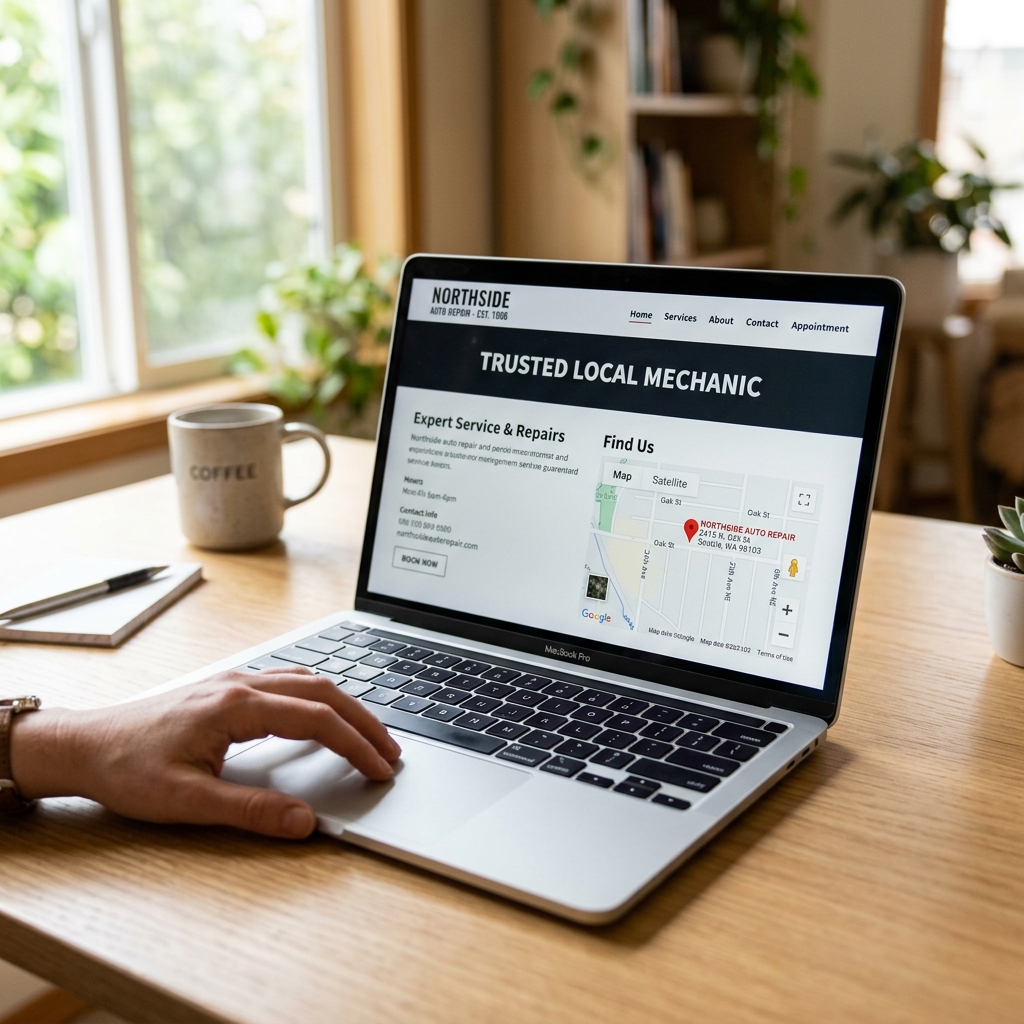
The homepage leads with a neighborhood-specific headline, the shop's physical address in the header, and a Google Maps embed above the fold. Every service page — from brake repair to oil changes — includes the city name naturally in the title tag and opening paragraph. The shop also maintains a consistent NAP (name, address, phone number) across its website, Google Business Profile, and local directories, which is one of the strongest local SEO signals a small business can control.
According to, 98% of consumers used the internet to find information about local businesses in 2022. Lonsdale's setup targets exactly that behavior — someone within driving distance who needs help today.
What they get right:
- City and neighborhood keywords appear in page titles, headers, and body copy without feeling forced
- Google Maps embed reduces friction — the visitor doesn't have to leave the page to figure out where the shop is
- Schema markup (structured data) helps search engines confirm the business name, address, and hours
- The Google Business Profile link is prominently displayed, building trust before the visitor even scrolls
What's missing:
- No online booking tool — a phone number is the only conversion path
- Blog or local content section that could capture "near me" searches for specific repairs
- Customer reviews pulled onto the site itself (they exist on Google, but not on the page)
Getting found is only half the battle. Without a second conversion path — like online booking or a contact form — some visitors who aren't ready to call will leave without taking action.
In practice, shops that combine strong local SEO with at least one digital conversion option (a contact form, a booking widget, or a chat tool) capture more leads from the same traffic. Lonsdale shows what the foundation looks like. The next step is giving those visitors somewhere to go once they arrive.
Shop 2 – [Name]: Social Proof Front and Center
Sun Devil Auto – Phoenix, AZ
Sun Devil Auto has been fixing cars in the Phoenix area since 1979. That kind of history could easily get buried in small print. Instead, their website leads with it — pairing decades of experience with hundreds of visible customer reviews right on the homepage.
A first-time visitor lands on the site and immediately sees aggregate star ratings, total review counts, and direct quotes from real customers. There's no hunting for a hidden testimonials tab. The social proof is structural — built into the page layout itself, not added as an afterthought.
What They Do Well
- Review volume displayed prominently: Sun Devil shows thousands of verified reviews pulled from Google and other platforms. According to, 49% of consumers trust online reviews as much as personal recommendations from friends and family. Showing review volume signals that trust isn't manufactured.
- Location-specific review feeds: Each of their 25+ locations has its own page with its own review set. A customer in Tempe sees Tempe reviews — not generic brand praise. That local specificity makes the testimonials feel earned.
- Named technicians and staff: Some location pages include staff bios and photos. Putting a face to the shop turns a corporate-feeling chain into something more personal.
- Response to negative reviews: Sun Devil publicly responds to less-than-perfect feedback. That transparency signals confidence and accountability — two things anxious car owners want to see before handing over their keys.
What's Missing
The online booking flow could be more direct. The site asks visitors to select a location, then a service, then a time — a reasonable sequence, but on mobile the steps feel slightly clunky. A one-step appointment widget above the fold would reduce drop-off.
The homepage also leans heavily on reviews without doing much to explain what makes the mechanics good. A short "why us" section — credentials, certifications, specialties — would give the testimonials more context.
What Independent Shops Can Steal
The best review strategy isn't collecting reviews in bulk — it's displaying them where skeptical first-time visitors will actually see them.
Most independent shops have happy customers but bury their praise on a separate testimonials page that few people ever click. Sun Devil's approach is different: reviews appear in the natural reading path, not off to the side.
You don't need 25 locations to do this. Even 30–50 Google reviews displayed on your homepage — with dates, names, and specifics — carry real weight. A shop management platform that connects customer history to follow-up requests can make gathering those reviews a consistent habit rather than a one-off campaign.
The other lesson is response discipline. Replying to every review, positive or negative, tells Google your business is active and tells customers you care. It costs nothing but time — and it shows up in local rankings.
Shops that actively respond to reviews see measurably better local search visibility, because engagement signals matter to Google's local algorithm.
Sun Devil built a regional chain on trust. Their website reflects exactly that — and any independent shop can borrow the same playbook at a smaller scale.
Conclusion
The best automotive repair websites share a short list of qualities: fast load times on mobile, a phone number that's impossible to miss, service pages built for search, and enough social proof to earn trust before a customer ever walks in.
Looking across all 10 examples — from neighborhood independents to national chains — the pattern is consistent. Shops that rank well and convert visitors don't rely on design alone. They make it easy for customers to act. One clear button. One visible phone number. Real photos. Real reviews.
A website that looks great but buries the phone number or hides its services will lose to a simpler site that answers the visitor's question in five seconds.
The franchise sites showed how location pages and coupons can drive steady traffic at scale. The independent shops showed how personality, photos, and local SEO can level the playing field. Neither approach requires a massive budget — just intentional choices about what a first-time visitor needs to see.
A great website is also only half the equation. The shops getting the strongest return aren't just attracting visitors — they're backing that first impression with a smooth experience behind the counter. Online booking that actually works. Estimates sent by text. Digital inspections with photos that build confidence and increase average repair order. When the website and the shop workflow are connected, customers stay.
The direction auto repair marketing is heading makes this even more important. AI-assisted diagnostics, digital vehicle inspections shared in real time, and online payment options are moving from "nice to have" to expected. Shops that adopt these tools aren't just more efficient — they look more trustworthy to a customer deciding between three Google results on a Tuesday morning.
The shops winning online in the next five years will be the ones treating their website and their shop management system as a single, connected customer experience — not two separate things.
If you're building or rebuilding your shop's web presence, start with the fundamentals the examples here prove out. Get your services listed. Add real photos. Make reviews visible. Put your phone number at the top. Then connect that front door to a shop management system that can handle what comes next — the booking, the inspection, the estimate, the payment.
That's how a website becomes more than a digital brochure. It becomes the first step in a system that keeps customers coming back.
Frequently Asked Questions
What is the $3000 rule for car repairs?
The $3,000 rule suggests you should avoid spending more than $3,000 on repairing an older vehicle, particularly if the repair cost exceeds the car's market value. The guideline helps owners decide whether to repair or replace a vehicle by comparing the repair cost against what the car is actually worth. If repairs approach or exceed the vehicle's value, selling or trading it in is generally the smarter financial decision.
What is a free website for car repair?
RepairPal.com offers free car repair estimates, diagnostic guides, and mechanic locators without requiring payment or registration. AutoMD and CarMD also provide free repair cost estimates and troubleshooting resources for common vehicle problems. For DIY repairs, iFixit.com and YouTube channels like ChrisFix offer free step-by-step automotive repair guidance.
Is $100 an hour fair for mechanic labor?
$100 per hour is considered reasonable and even below average in many U.S. markets, where dealership labor rates typically range from $150–$215 per hour as of 2024. Independent shops generally charge $75–$130 per hour depending on location, specialization, and overhead costs. Factors like ASE certifications, regional cost of living, and shop reputation all justify higher labor rates.
Can I use Alldata for free?
ALLDATA is a paid professional subscription service and does not offer a free full-access tier for its repair data. However, ALLDATA DIY offers a limited free trial, and some public libraries provide free access to similar professional databases like Mitchell1 ProDemand or ALLDATA through their digital resource programs. Mechanics and shops typically pay $150–$200+ per month for full ALLDATA professional access.
Ready to Transform Your Shop?
RedAppy helps auto repair shops create professional digital estimates with photos and videos, send them instantly via text or email, and get customer approvals in seconds. No credit card required to start.