
Automotive Service Managers: Duties, Skills and Workflows
It's Tuesday morning at a six-bay shop. Three cars are waiting, a customer is on the phone asking about pickup, and a technician needs a part that hasn't arrived. The service manager has to decide whether to hold the lift, move the vehicle, or change the next assignment without breaking another promise.
That's the work of automotive service managers. Customer service matters, but the harder responsibility is allocating scarce technician and bay time so the shop completes the right work safely, profitably, and when promised.
Table of Contents
- What an Automotive Service Manager Actually Does
- The Skills That Set Strong Service Managers Apart
- Estimate Approval Rules Managers Cannot Skip
- Running the Daily Workflow and Reading Capacity Numbers
- Deciding Which EV Jobs the Shop Should Accept
- Pay and Career Benchmarks for the Role
- Choose One Bottleneck to Fix This Month
What an Automotive Service Manager Actually Does
The service manager sits between customers, service advisors, technicians, and the owner. That person decides what gets worked on, in what order, by whom, and at what price. When capacity runs short, those decisions matter more than how full the appointment book looks.
The role resembles an air traffic controller. The controller doesn't fly the planes, but keeps the runway moving safely and prevents conflicting movements. A service manager does the same with repair orders, lifts, diagnostic equipment, and technician availability.

Core Responsibilities of a Service Manager
| Responsibility area | What it involves | Sign it is working |
|---|---|---|
| Workflow and scheduling | Keep every vehicle moving from check-in to pickup | Promised dates met most days |
| Estimates and approvals | Get written customer approval before extra work starts | Few surprise charges at pickup |
| Technician management | Assign jobs by skill and monitor workload | Balanced queues and low idle time |
| Customer communication | Explain findings, options and status clearly | Fewer calls asking for updates |
| Financial control | Track sold hours, parts margin and comebacks | Average repair order rising over time |
Those responsibilities overlap. A missing part becomes a scheduling problem, then a customer communication problem, and eventually a financial problem if the technician can't move onto ready work.
Public complaints also require judgment. Genuine service failures need investigation and a response; suspected fabricated feedback needs a separate approach. RepErase's guide to offers a useful resource for distinguishing reputation abuse from an operational complaint.
A strong senior technician can solve a difficult fault personally. A strong manager creates the conditions for the whole shop to produce, without becoming the person every repair must wait for.
The Skills That Set Strong Service Managers Apart
Technical knowledge earns credibility, but it doesn't automatically prepare someone to manage a repair business. Newly promoted technicians can be excellent at fixing vehicles while struggling with sales conversations, conflicting promises, and schedule pressure.
The strongest managers combine technical judgment with commercial and people skills. They know when to ask another question, when to stop a job, and when an attractive booking will create more disruption than useful work.
Judgment Under Shop Pressure
- Diagnostic judgment. An intermittent starting fault needs a test plan, not another guessed component. The manager asks what the technician confirmed, what remains uncertain, and what further testing would establish before requesting additional authorization.
- Capacity planning. A complex electrical diagnosis belongs with the technician equipped to handle it, but that technician shouldn't also carry every urgent interruption. Like a kitchen expediter, the manager identifies slow orders and redirects suitable work before everyone else waits.
- Customer communication. In a hypothetical estimate, a $600 brake repair sits beside a $90 maintenance item. The advisor needs to explain the brake findings with inspection photos, separate necessary repairs from optional maintenance, and describe the consequence of deferral without pressure.
Commercial and People Discipline
Financial literacy means understanding what each measure tells the shop. Labor rate is a selling price, parts markup isn't the same as parts margin, and a larger repair order isn't automatically a better result if the work returns.
People management means distributing opportunity as well as workload. If a developing technician receives only basic services, that person won't build diagnostic capability. Planned mentoring assignments work better than handing over an unfamiliar repair during a delivery crisis.
Process discipline protects everyone when the job changes. If teardown reveals additional damage, the manager updates the scope and records the customer's decision rather than relying on a conversation someone vaguely remembers.
Management self-check: A manager should be able to explain the causes of the last three comebacks, including whether each came from diagnosis, workmanship, parts, or communication.
That answer reveals whether the manager understands shop performance or merely knows which vehicles returned.
Estimate Approval Rules Managers Cannot Skip
In Florida, repairs exceeding $150 trigger a requirement to offer a written estimate, notification if costs exceed a specified amount, or the option to waive a written estimate, according to the. When a written estimate applies, customer approval is required before exceeding it by more than $10 or 10%, whichever is greater.
Approval isn't paperwork to finish at pickup. It controls what the technician can do next, which parts can be committed, and whether the shop has permission to expand the repair.
Illinois generally prohibits charges more than 10% above a written estimate for labor and parts without oral or written customer consent, under the. Its estimate requirements include diagnostic or estimate fees and an estimated completion time when work is expected to take more than one working day.
Estimate and Approval Rules in Florida and Illinois
| Requirement | Florida | Illinois |
|---|---|---|
| When a written estimate applies | Repairs over $150 require an estimate choice, cost-notification option, or customer waiver | Written estimates are governed by the state's repair-estimate rules; no dollar trigger is stated here |
| Approval needed before going over estimate | More than $10 or 10% above the estimate, whichever is greater | More than 10% above the written estimate for labor and parts |
| Required estimate contents | Vehicle, labor basis, repair charges, parts-and-service guarantee | Total repair cost and all charges, including diagnostic or estimate fees |
| Completion time | Not specified in the cited consumer guide | Required when the repair is expected to take more than one working day |
Turn Authorization Into a Release Gate
The manager should keep diagnostic charges, parts, labor, expected completion, and authorization status together. A separate text message without the corresponding estimate can leave the technician unsure which version the customer accepted.
A workable release process has clear checks:
- Before diagnosis: Record the approved diagnostic scope and the stopping point for further authorization.
- Before additional work: Describe the new finding, revised cost, and effect on completion.
- After consent: Record who approved, how consent arrived, and the work covered by that approval.
Auto repair estimates in RedAppy include parts and labor. Each service history record also includes the date, mileage, technician, and a summary of the work, helping staff distinguish earlier repairs from the current authorized scope.
Managers still need to check their own state's requirements rather than treating these examples as national rules. Customer contact details deserve the same attention as the vehicle identification: an unreachable customer can leave a fully diagnosed job stopped on a lift.
Running the Daily Workflow and Reading Capacity Numbers
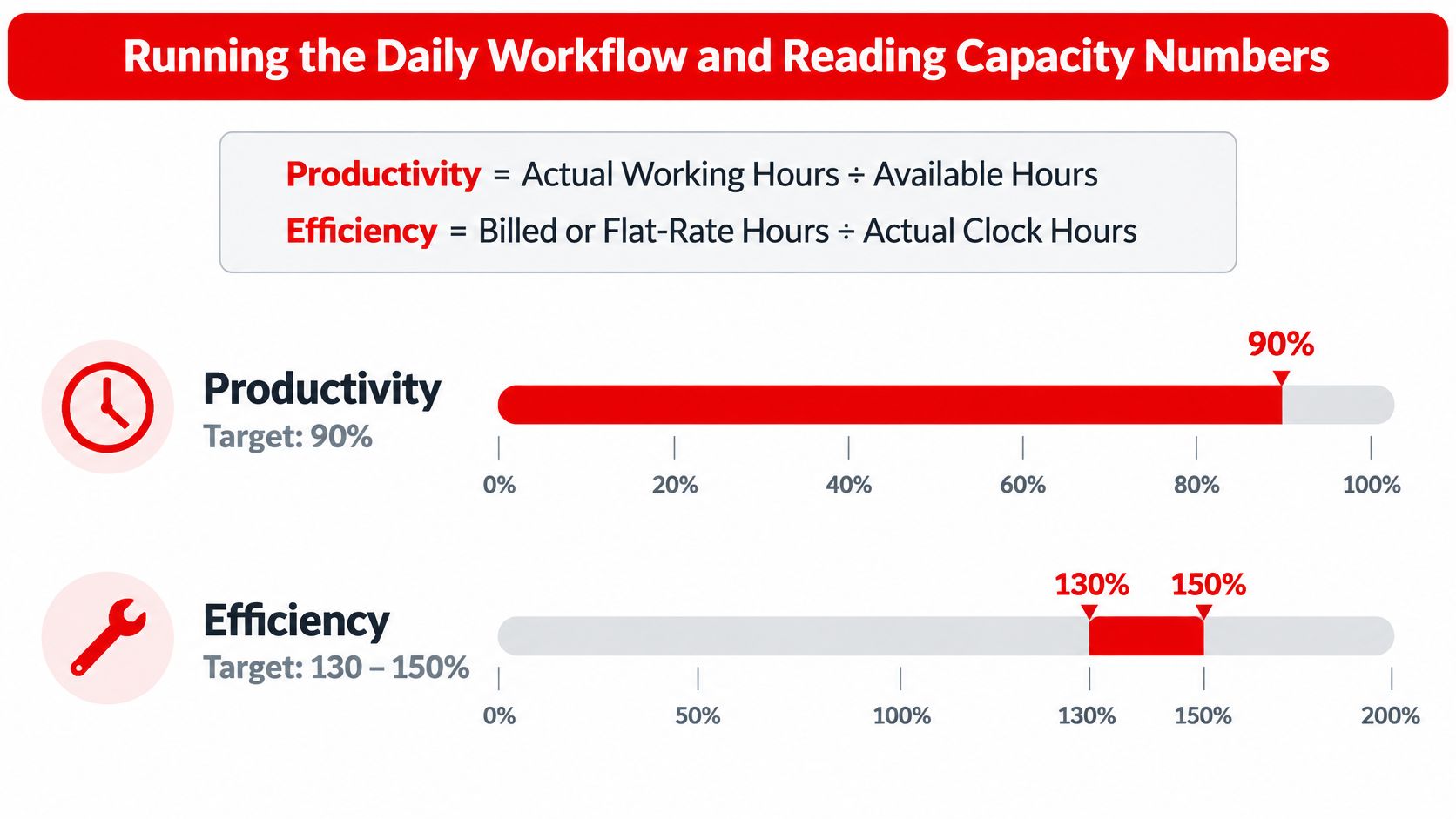
Productivity measures actual income-producing working hours divided by available hours. Efficiency measures billed or flat-rate hours divided by actual clock hours worked; identifies approximately 90% productivity and 130 to 150% efficiency as practical starting benchmarks.
These measures answer different questions. Productivity asks whether available time reaches repair work; efficiency asks how much billed output results from the time worked. Mixing them makes it easy to blame a capable technician for a poorly prepared queue.
Run the Day Through Clear Handoffs
- Review the board before dispatch. Check promised pickup times, appointments, parts arrival estimates, and carryover repairs. A booking isn't ready work because it appears on the calendar.
- Check the vehicle in properly. Capture the concern in the customer's words, mileage, condition photos, and relevant service history. Repeated symptoms deserve attention before another estimate goes out.
- Agree on diagnostic limits. Establish the authorized testing scope before teardown. The technician needs a clear stop point when the next step requires more time or dismantling.
- Issue the written estimate. Include parts and labor, then record the approval time and approving person. Any unresolved option should remain visibly separate from authorized work.
- Dispatch by skill and current load. Stage the necessary parts first. A familiar repair with a complete parts kit can be a better immediate assignment than a larger job that can't progress.
- Check stuck work at midday. Review pending approvals, missing deliveries, unexpected findings, and jobs without a next action. Give each blockage an owner.
- Inspect before release. Confirm the original concern was addressed, required checks were completed, and warning lights or new findings have been handled appropriately.
- Close the communication loop. Update the customer and issue a clear invoice describing the findings and completed work. Pickup shouldn't be the first time the customer hears about a changed outcome.
A common dispatch mistake is putting a vehicle on a lift before its parts arrive. The apparent head start can become an immobilized vehicle blocking work that was ready.
RedAppy's Service Timeline lists every vehicle invoice and estimate, newest first, with status, date, technician, and jobs done. Individual logins support technician assignment, identify who wrote an estimate, and control access to financial information; analytics track revenue, technician performance, and shop efficiency.
Read Delays Before Changing Staffing
Each week, managers should examine productivity and efficiency by technician and by day. Low productivity alongside high efficiency points toward workflow constraints, such as approval lag, parts waits, dispatch gaps, or poor handoffs, rather than automatically indicating weak repair skills.
A technician who completes ready work effectively can still lose much of the day waiting. Changing compensation won't resolve an unanswered authorization request, and hiring another technician won't make an unavailable part arrive sooner.
A fair performance review separates time lost through the technician's decisions from time lost through the shop's operating process.
Use delay codes that staff can apply consistently, such as waiting for parts, waiting for approval, waiting for equipment, and awaiting technical information. Excessively detailed coding creates more administration than insight.
Compare Like-for-Like Capacity Measures
The reported average technician productivity near 57%, with top-performing groups around 60% or higher; its sold-hours calculation shows that moving from 57% to 65% at a $120 labor rate adds approximately 166 sold hours per technician, worth nearly $20,000 in annual labor sales before other adjustments.
Sold hours per technician at a $120 labor rate
| Productivity | Sold hours per technician per year |
|---|---|
| 57% (benchmark average) | 1,186 |
| 65% | 1,352 |
| Gap from 57% to 65% | 166 |
That report calculates productivity from labor sales divided by labor rate, then divides by technician count and available annual hours. It isn't the same measure as direct working-time productivity, so the figures shouldn't become interchangeable targets.
The operational opportunity is recovering usable capacity, not posting a higher rate. Track sold hours, clock hours, comeback rates, and delay codes together so apparent gains don't come from rushed diagnostics or unfinished quality checks.
Deciding Which EV Jobs the Shop Should Accept
EV intake should begin before an appointment is promised. The service manager needs the vehicle's make, model, production details, exact concern, and any indication of battery damage, high-voltage warnings, collision damage, or charging faults.
The next question isn't whether the shop services EVs in general. It's whether the team can safely perform this task on this vehicle, using the required technical information, training, equipment, and local permissions.
Sort Work by Actual Capability
| Decision | Suitable work or condition | Manager's action |
|---|---|---|
| Accept within current capability | Tires, brakes, suspension, and cabin work the team is trained and equipped to perform | Confirm vehicle-specific procedures and assign a competent technician |
| Hold until capability is established | High-voltage component work requiring training or equipment not yet available | Decline the immediate booking or arrange qualified specialist support |
| Refer out | Battery-pack repair without suitable facilities, equipment, or competence | Explain the limitation and document the referral |
Routine doesn't mean risk-free. A brake or suspension procedure may require vehicle-specific service modes, lifting precautions, or isolation steps, so the manager shouldn't assume familiar-looking hardware means familiar procedures.
Estimate the Whole Job
Where applicable, the estimate should account for high-voltage checks, isolation and verification time, specialist parts, transport, referral charges, and post-repair testing. Written approval should precede teardown, and the assigned technician should confirm the required procedure before work begins.
Suspected battery damage needs a separate safety decision, not a normal slot in the queue. Staff should follow manufacturer emergency guidance and avoid moving or storing the vehicle as an ordinary repair while the risk remains unresolved.
The repair order should record the accept, hold, or refer decision and its reason. As training finishes and equipment becomes available, the manager can revise the accepted-work list rather than letting customer demand define the shop's safety limits.
Pay and Career Benchmarks for the Role
What is the job worth? The closest federal supervisory category carries a median annual wage of $73,780, or $35.47 per hour, in automotive repair and maintenance, according to the.
The category is first-line supervisors/managers of mechanics, installers, and repairers. It's a useful comparison for service management, but it isn't a separate count of employees holding the exact automotive service manager title.
Pay Benchmarks for Service Management
| Group | Median annual pay | Notes |
|---|---|---|
| Supervisors of mechanics and repairers, automotive repair and maintenance | $73,780 ($35.47 per hour) | Mean $75,740 ($36.41 per hour); 62,870 employed |
| Automotive service technicians, same industry | $48,390 | Technician comparison, not a supervisory role |
| Same supervisory group, other services category | $73,420 | 67,480 jobs |
These national figures cover employers of different sizes. Local recruiting conditions, operating hours, team size, and the manager's actual authority still matter when setting compensation.
Use the Benchmark to Evaluate Responsibility
- Set a defensible pay band. Compare local vacancies with the duties attached to the role, especially staffing, pricing, quality control, and financial accountability.
- Test a promotion properly. A title change isn't enough if the employee remains responsible for a full technician workload while also carrying shop-wide decisions.
- Clarify the career path. Senior technician, lead technician, service manager, and general manager or owner represent different responsibilities, not increasing technical seniority.
Service management is a distinct supervisory career. The employee coordinates other people's output, allocates work, and answers for productivity and quality across the operation.
A bonus arrangement should reflect that breadth. Rewarding sales alone can encourage unsuitable work or overloaded schedules; an owner should also consider repair quality, completed commitments, team development, and the manager's control over the result.
Choose One Bottleneck to Fix This Month
Before assuming another hire will solve the backlog, the owner should identify where existing technician time disappears. An overflowing parking lot can coexist with preventable idle time when jobs lack clear decisions, complete parts, or an agreed next step.
The labor constraint is real: 46% of respondents in a survey of 752 repair-shop owners and employees said the skilled-technician shortage had a moderate to highly significant effect on their shop, according to the OEC U.S. General Auto Repair Shop Survey Report/Reports%20Mockups/The%20OEC%20US%20General%20Auto%20Repair%20Shop%20Survey%20Report.pdf?hsLang=en). That doesn't prove management can erase the shortage, but it makes wasting available skill harder to justify.
Fix the Operating Conditions in Order
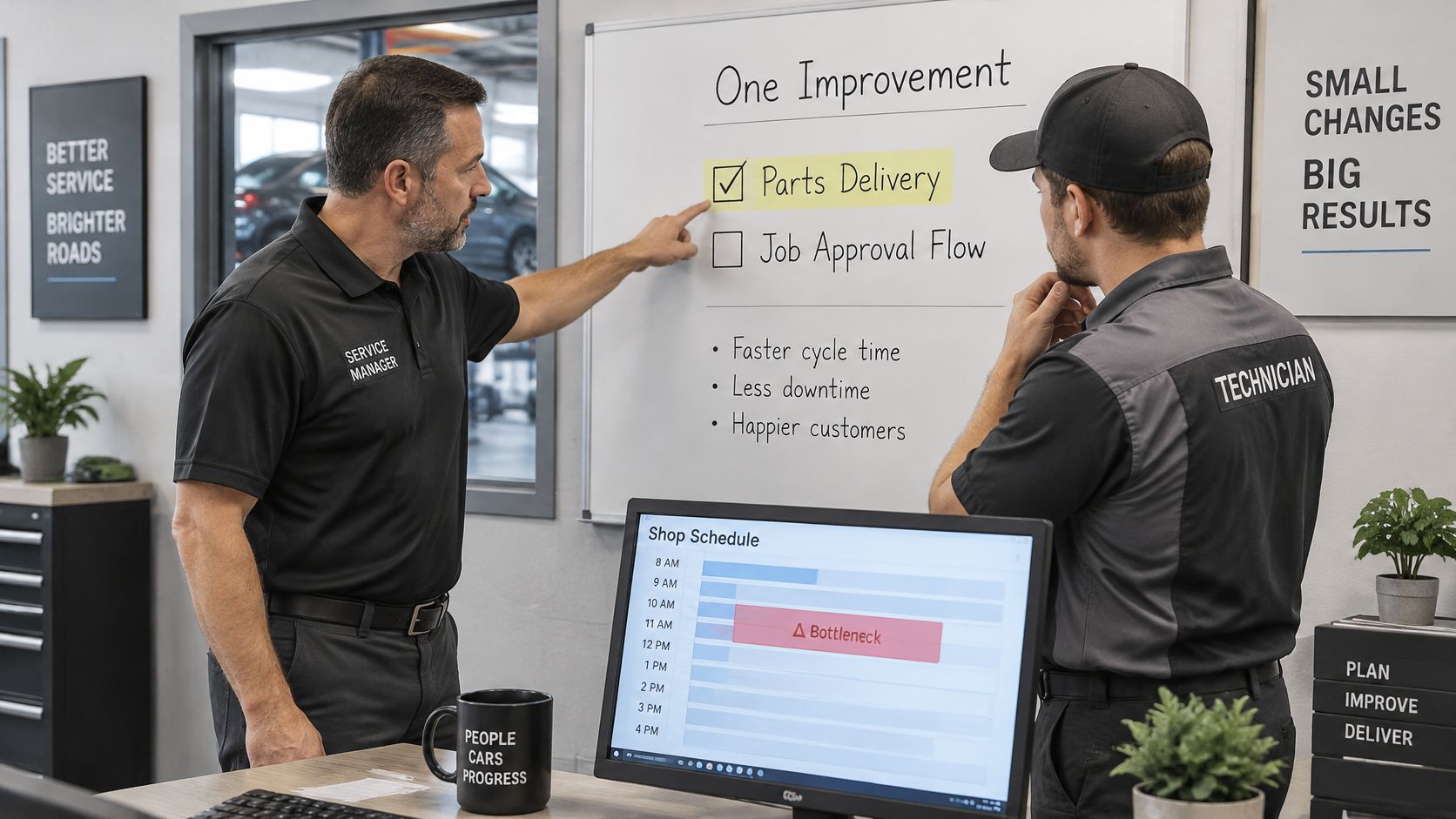
Job readiness comes first. The dispatch queue should distinguish work that can proceed from work still awaiting a decision. A manager can then protect the technician from repeatedly opening a repair order only to discover a missing prerequisite.
Parts staging comes next. Someone should verify the actual contents of the delivery against the repair, not merely mark the order received. The wrong side, missing hardware, or incomplete kit can stop a repair just as effectively as no delivery.
Dispatch needs a single owner. A shared assignment board loses value when advisors, the owner, and technicians all change priorities independently. Exceptions should pass through the person responsible for the whole schedule.
Remote visibility should reduce interruptions. An owner checking progress from a phone needs current job status, not another reason to call the technician. Staff must agree who updates status and what each stage means.
Match the Tool to the Chosen Problem
RedAppy's inventory tracks parts and fluids, deducts them automatically on jobs, and sends low-stock alerts. Shop Portal permissions can allow access to Analytics, Inventory, and Service History, so staff can see the information their responsibilities require.
The company reports a 20% higher average repair order for shops using its platform. That's the company's own performance claim, not a substitute for measuring whether a particular shop completes more worthwhile work without increasing comebacks.
Practical rule: Choose a fix the manager can own, the team can follow, and the owner can measure.
For a 30-day improvement test, the manager should select the bottleneck that cost the most hours last week and record its frequency, waiting time, and effect on promised completion. The same measure should be reviewed throughout the test, alongside repair quality, before another process change is added.
Owners can compare the workflow tools on the platform features page or contact the team about their shop's bottleneck. The useful starting point is a specific problem, such as stalled approvals or incomplete parts kits, rather than a general wish to become more efficient.
RedAppy brings estimates, inspections, inventory, job tracking, and analytics into one shop management platform. Owners and automotive service managers can explore how those tools support clearer assignments and better use of technician time, then discuss the workflow that needs attention first.
Ready to Transform Your Shop?
RedAppy helps auto repair shops create professional digital estimates with photos and videos, send them instantly via text or email, and get customer approvals in seconds. No credit card required to start.