
Automotive Shop Advertising That Books the Bay
Monday starts with two empty bays, a technician waiting for work, and an owner sorting through advertising offers between phone calls. Every seller promises visibility. None explains what the next approved repair will cost to bring through the door.
Automotive shop advertising should earn its place through booked work, not attention. For an owner who also answers the phone, the right plan is small enough to manage and clear enough to connect spending with completed repair orders.
Table of Contents
- Channels That Earn Their Keep
- From a Search to a Signed Repair
- Local Listings and the Review Gate
- Paid Search Math for Real Jobs
- Ads That Prove You Can Do the Work
- Social Posts That Prove and Remind
- Pages, Mailers and Referral Asks
- Where to Spend First
Channels That Earn Their Keep
Where an auto shop should put advertising effort
| Channel | Best job | Cost signal | Judge it by |
|---|---|---|---|
| Google Business Profile and local SEO | Capture near-me demand | Low cash, steady weekly time | Calls, direction requests, bookings |
| Paid search | Immediate service-intent leads | About $4.35 per click and about $30 per lead in | Cost per booked job and gross profit |
| Service pages and landing pages | Turn the click into a booking | A site build, or included with a shop system | Booking rate against the weak-page benchmark |
| Google reviews | Remove the reason to choose someone else | A brief request after each paid invoice | New reviews each quarter and star rating |
| Direct mail coupons | Reach nearby households with one offer | Print and postage inside a real drive radius | Redeemed coupons that become repair orders |
| Radio or outdoor | Name recognition on the drive to work | Flight cost set by the local market | Trackable calls, codes, or online bookings |
| Referral asks | Neighbors and repeat customers | Near-zero cash | Referred jobs and repeat visits |
Decide before you spend: pick one primary channel and one support channel. A shop with a half-finished Google Business Profile should complete it before pricing a billboard. A shop with a credible listing, working service pages, and an open bay has earned the right to test paid search.
The table splits channels that create inquiries from assets that convert them. Reviews and service pages don't replace advertising, but buying traffic without them means paying for introductions the shop can't finish.
Match the channel to the shop's problem
Start with local search. The driver is already looking for help nearby, so the shop's job is to be findable and credible at that moment, not to build awareness across town.
Paid search makes sense when the owner needs demand for a specific service now. At roughly $30 per lead, the math only works if the front counter turns calls into booked jobs and the jobs carry enough gross profit to cover the click.
Direct mail suits one concrete maintenance offer aimed at households inside a real drive radius. Referral asks belong at the counter, in the minute after the customer has seen the work done right. Social posts earn their keep as proof and reminders, not as the main acquisition budget.
Radio isn't automatically wasted money. According to, AM/FM reaches 91% of U.S. adults each month, and 70% of Americans listen while driving. That reach builds name recognition on the commute. What it can't tell you is what one shop will earn, so treat it as a support channel, never the primary one.
Before approving radio or outdoor spending, the owner should require:
- A reachable audience: The coverage should overlap the places customers drive from.
- A recognizable offer: The listener should remember a service or reason to call, not just the shop name.
- A response method: A trackable number, memorable booking destination, or redemption code should identify the campaign.
Spending rule: A channel stays in the plan because it produces useful customer action, not because the salesperson presents an impressive audience total.
Funding every row at once makes the results unreadable. Two channels, judged on booked work, teach an owner more in a quarter than six channels judged on impressions teach in a year.
From a Search to a Signed Repair
Automotive shop advertising works like a service advisor speaking to a driver before the car reaches the bay. It should explain the next step, reduce uncertainty, and give the customer a reason to trust the shop.
Consider a driver whose brakes have started grinding. That person doesn't need a tour of every service the business offers. The immediate questions are whether the shop handles brake problems, when it can inspect the vehicle, and how approval works.
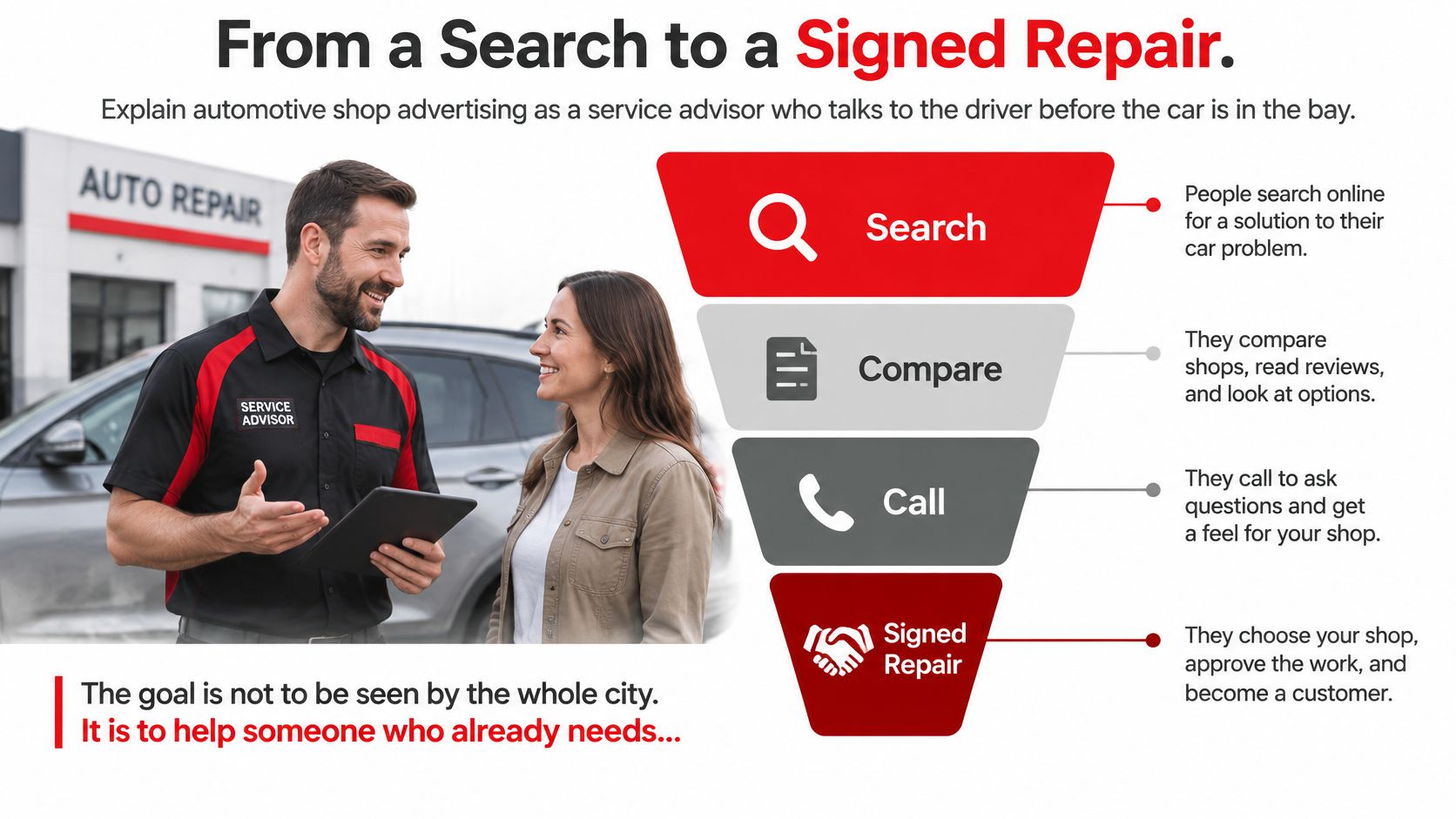
Follow the driver's decision
The path begins with a need. A warning light, noise, or maintenance reminder makes the driver start looking, and the listing or advertisement should name that need plainly.
Next comes comparison. A brake inspection process, a clear explanation of estimates, and evidence of actual workmanship give the driver something more useful than a generic low-price promise.
- Search: The driver identifies a problem and looks for an appropriate service.
- Compare: The shop provides a concrete reason to trust its diagnosis and repair process.
- Call: The customer reaches someone who can explain availability, intake, and next steps.
- Signed repair: The inspection becomes an understandable estimate that the customer can approve.
The advertising promise must survive the phone call. If the ad promotes prompt inspection, the advisor should explain the inspection window rather than imply that every repair will be finished immediately.
Exposure is not a customer.
A booked appointment isn't the finish line either. The driver still has to arrive, understand the recommendation, approve the work, and leave with a reason to return.
Keep a shop-floor scoreboard
The owner should review answered calls, completed booking forms, show rate, average repair order, and returning customers. These measures reveal different problems: missed calls suggest a staffing issue, while appointments without authorizations may point to weak expectations or unclear estimates.
A cheap click that never becomes approved work isn't a bargain. A more expensive inquiry can be worthwhile when it brings a suitable vehicle, a service the shop performs profitably, and a customer who understands the process.
The useful question isn't whether an advertisement looked successful. It's whether the shop helped the driver move from a problem to an informed repair decision.
Local Listings and the Review Gate
Treat local search as the closest thing to a walk-in. Google-related findings summarized by report that 76% of people searching for a business with a near-me query visit a business within the next day, while 88% of smartphone users conducting a local search visit a store.
Those findings cover local businesses broadly, not repair shops alone. For an owner, the practical response is still straightforward: make the essential answers visible before the driver chooses another map pin.
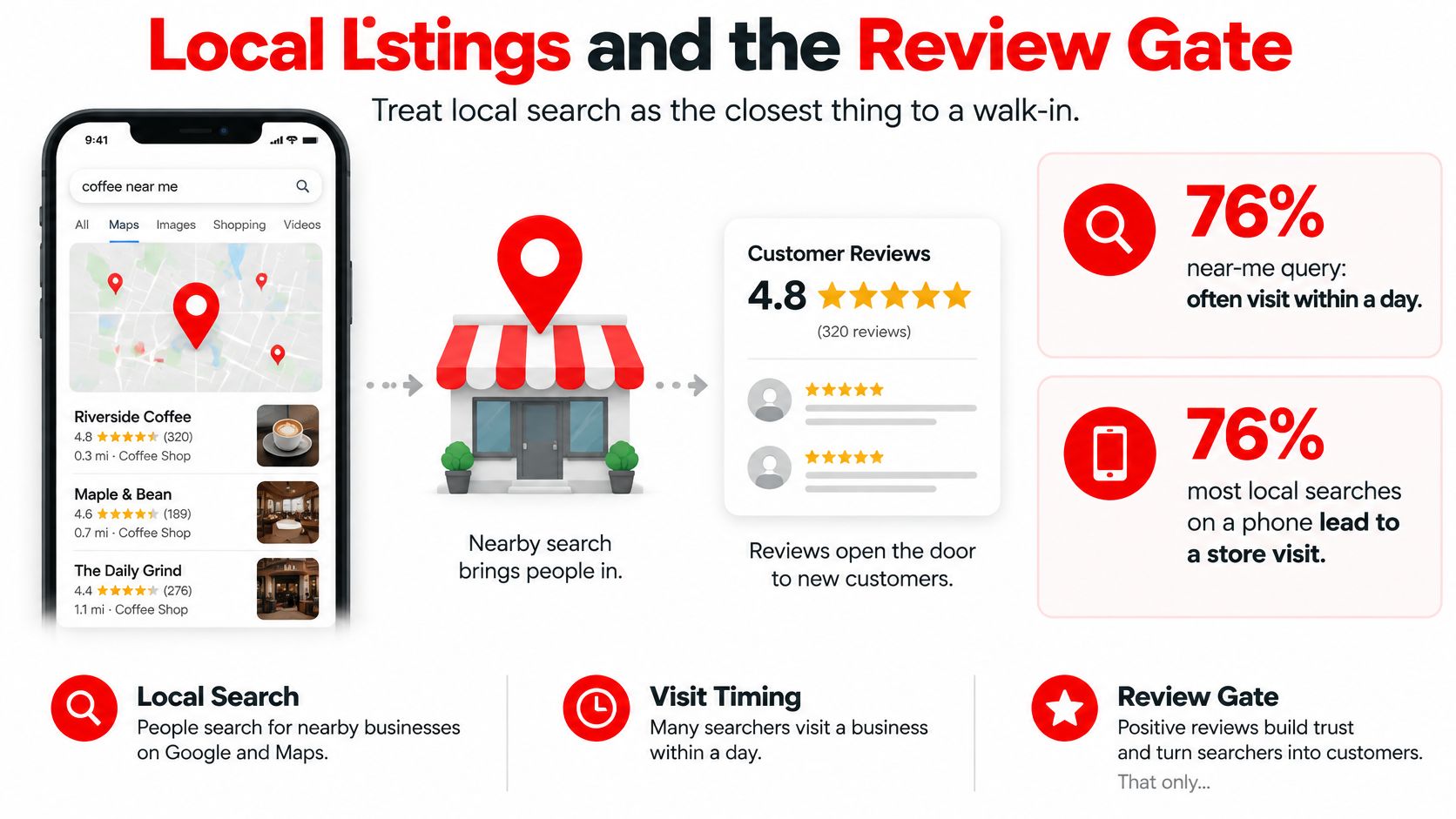
Finish the profile before buying more traffic
A Google Business Profile should accurately describe a working shop, not an idealized version of it. The owner or advisor should check it from a customer's phone.
- Primary category: Choose the category that best matches the shop's core repair work.
- Services: List jobs the team performs, using familiar customer language.
- Location and reach: Keep the address accurate and describe pickup coverage only where it exists.
- Photos: Show the entrance, bays, team, and recognizable shop surroundings.
- Hours and updates: Maintain accurate opening hours and publish a brief, useful weekly update.
- Contact path: Test the phone number and booking destination rather than assuming they work.
For a broader explanation of connecting inquiries with appointments, Wojo Media's guide to provides a useful planning resource. The shop's own records should remain the deciding evidence.
Build current proof without manipulating feedback
An advertisement can't compensate for a profile that gives customers too little independent evidence. In, 47% of consumers would not use a business with fewer than 20 reviews, while 47% of small businesses had fewer than 20 Google reviews.
Age matters as well: state that 74% of consumers only care about reviews written within the last three months. A large historical total shouldn't become an excuse to stop asking.
After payment, send a short text or email asking for honest feedback. Customers who are pleased should have a direct route to Google, while customers with concerns should have an obvious way to reach the shop privately.
Don't buy reviews or make public feedback available only to satisfied customers. Private complaint handling should help resolve problems, not prevent criticism from appearing publicly.
During the weekly profile check, review new feedback, respond professionally, and record review activity beside calls and completed repair orders. Every advertisement should describe services and hours that match the listing.
Paid Search Math for Real Jobs
The following figures appear in Benchmarketing's auto-repair benchmarks: 5.56% click-through rate, $4.35 average cost per click, 15.51% campaign conversion rate, $29.96 acquisition cost, and 5.20% landing-page conversion. They provide planning references, not guaranteed results.
Auto repair paid-search benchmarks and what they imply
| Metric | Benchmark | Shop implication |
|---|---|---|
| Click-through rate | 5.56% | Service-specific wording gives the driver a clear reason to click |
| Average cost per click | $4.35 | About $435 buys 100 clicks before lead quality is considered |
| Conversion rate on the campaign | 15.51% | About 16 leads from those 100 clicks in an illustrative forecast |
| Cost per lead | $29.96 | A planning number, not a promise; city and service mix move it |
| Weak landing-page conversion | 5.20% | The same $435 yields about five leads, near $84 each |
Calculate the cost before adjusting the bid
The forecast above applies the published click cost and conversion benchmarks to an illustrative campaign. At the stronger conversion rate, the resulting lead cost is approximately $27; at the lower rate, the shop pays approximately $84.
Those calculations don't prove that a particular homepage causes poor results. Campaign conversion and landing-page conversion aren't necessarily identical measures, and shops should check how their advertising reports define each action.
The lesson is to inspect the destination before raising the budget. A relevant click can still be wasted when the customer reaches a page with no obvious service details, a broken form, or a phone number that's difficult to tap.
Paid search deserves this attention because the customer has named a need. Brake repair, alternator replacement, check-engine diagnosis, and transmission service each describe a different job and deserve different advertising language.
Build around profitable services
A broad mechanic campaign makes it harder to separate suitable work from irrelevant inquiries. Service-led ad groups give the owner a clearer view of what customers want and what those inquiries become.
- Match the destination: Send brake searches to a brake page with the shop's location, process, proof, and contact options.
- Control geography: Target places from which customers can realistically reach the shop.
- Staff the response: Run call assets when someone can answer, and provide an after-hours booking option.
- Exclude irrelevant intent: Review searches involving employment, training, parts-only purchases, and do-it-yourself instructions.
- Count finished actions: Track connected calls and submitted booking forms, not button taps or form starts alone.
An owner comparing outside management options can use as a reference when asking about service-level campaigns, exclusions, and conversion tracking. Any provider should explain how its reporting connects to the shop's repair orders.
Before increasing the budget: Check whether paid inquiries became appointments, whether those customers arrived, and whether the resulting work produced gross profit.
City, season, competition, and service mix can change the economics. The owner should keep or pause a campaign based on booked jobs and margin, not a benchmark presented as a promise.
Ads That Prove You Can Do the Work
A discounted oil change paired with a generic full-service claim says little about capability. Almost any competitor can publish the same message.
For a driver weighing an independent shop against a dealership, the harder question is whether the technicians can handle that particular vehicle and problem. Specific capability is a stronger message than unsupported confidence.
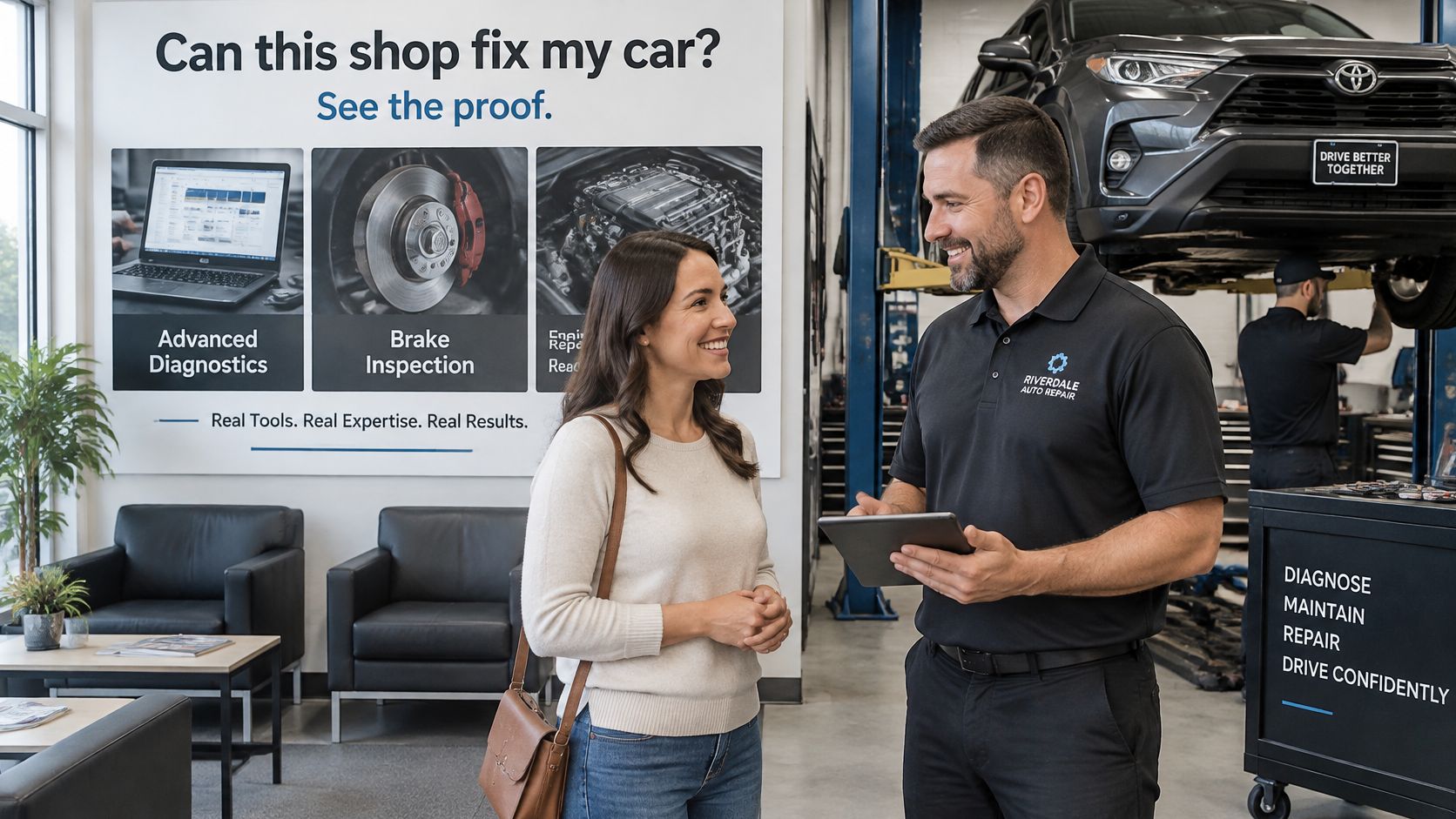
Replace the blanket claim with repair-specific evidence
Cross-market findings published through found that 70% of battery-electric-vehicle owners trust independent aftermarket shops for simple repairs, but only 53% trust them for complex repairs, compared with 73% confidence for complex repairs on conventional vehicles.
A capability advertisement should answer that difference directly. An EV brake and suspension page can identify supported makes, relevant technician training, inspection procedures, and the equipment used for those jobs.
Battery cooling-system diagnosis and post-collision sensor calibration need their own explanations when the shop provides them. High-voltage safety procedures, diagnostic limits, and referral boundaries belong in the message where relevant.
A dealer referral isn't a failure. A shop that clearly identifies unsupported programming or warranty-related work gives the customer a credible boundary instead of an expensive surprise.
Make convenience and proof concrete
Convenience needs operational detail. An advertisement for pickup should describe the coverage area, key handoff, inspection window, approval process, and what happens when parts delay completion.
A commuter may value predictable updates more than a discount. A parent with limited transport may need a firm pickup arrangement. Neither benefits from a broad fast-service promise that the shop can't consistently fulfill.
Useful creative can take different forms:
- Capability ad: A technician explains which brake or suspension work the shop performs on supported electric vehicles.
- Limited convenience offer: A pickup message identifies the eligible area and explains how customers receive estimates.
- Proof ad: An inspection photo accompanies a permission-based customer review and a clear explanation of the diagnosed problem.
For a driver deciding whether to trust an unfamiliar shop, that proof deserves testing against a coupon. It answers what the shop found and how the team communicates, rather than assuming a lower price resolves every concern.
The final rewrite test is simple: if the sentence could sit unchanged on a competitor's sign, it needs more detail. Name the work, show the evidence, and make only promises the service advisor can explain on the phone.
Social Posts That Prove and Remind
Social media deserves a small, steady role in automotive shop advertising. Its job is to show the people, work, and communication a prospective customer can expect.
The owner should keep camera work close to the shop floor. A clear image of completed brake work with a useful explanation is preferable to stock footage that could belong to any garage.
Use a manageable posting routine
A weekly post is a practical starting routine, not a performance guarantee. The subject should come from work the shop already understands.
- Show a repair: Explain the symptom, what inspection revealed, and the approved solution without exposing customer details.
- Answer a question: Explain why a check-engine light requires diagnosis rather than naming a replacement part from the warning alone.
- Offer a seasonal reminder: Connect cooling-system, battery, tire, or AC checks to local conditions and services the shop sells.
- Share customer feedback: Obtain permission before posting an identifiable review screenshot, and favor current experiences.
Posts should direct interested drivers to the relevant service destination. When a platform limits clickable links, the profile destination should make the advertised service easy to find.
Pay for action, not applause
A boosted post should use the same realistic geographic boundaries as the shop's other local advertising. Broad reach offers little value when the audience can't reasonably bring in a vehicle.
Track profile visits, attributable calls, booking inquiries, and resulting jobs. Review them alongside paid-search outcomes rather than treating social engagement as a separate business result.
If a boost attracts views but no useful inquiries after a reasonable test, stop paying for it. The post can remain as proof without receiving more advertising money.
Pages, Mailers and Referral Asks
Once someone responds, the shop has to finish the job the advertisement started. A homepage that compresses every service into a paragraph makes that harder than necessary.
Each real service deserves a page titled in customer language: oil changes, brakes, diagnostics, or AC repair. The page should explain the work without pretending that a driver can diagnose the vehicle from a symptom list.
Give the customer a useful destination
A service page should answer practical questions before asking for contact details. The customer needs to know where the shop is, when it's open, what happens next, and how to request an appointment.
- Service explanation: Describe what an inspection or maintenance visit includes and what requires further diagnosis.
- Visible shop details: Display hours, a map, and a tap-to-call number.
- Booking path: Allow an inquiry outside staffed hours and explain whether the appointment needs confirmation.
- Mobile usability: Test buttons, text size, and form fields on an actual phone.
The driver should be able to complete the task while safely parked, without zooming into a desktop layout. A short form with relevant vehicle and service fields beats a contact box that leaves the advisor guessing.
Give a mailer a specific job
Postal offers still have a place: in, 61% selected postal mail as their preferred way to receive automotive coupons, and automotive repair customers were reported to be 43% more likely to respond to mailbox advertising.
A mailer should carry a focused offer, a clear response path, coverage information, and understandable conditions. Any deadline or restriction should be visible rather than buried in fine print.
The mailing area should reflect actual customer travel patterns. A cheaper household count isn't a bargain if the shop is inconvenient for those recipients.
At payment, the advisor can also invite a satisfied customer to send a neighbor the booking destination. There's no need to wait for a newsletter or build a complicated reward program before making a straightforward referral ask.
Record referred jobs during intake so the owner can distinguish recommendations from assumptions. Whether the customer arrives through a mailer, referral, or profile, the destination should match the promised service rather than end at an unexplained contact form.
Where to Spend First
The first quarter should establish a dependable process before expanding the channel list. The owner needs a sequence that fits around estimates, parts calls, and customers waiting at the counter.
For a hypothetical starting budget, a small shop could allocate $500 to $1,500 a month to paid search after preparing its listing and service pages. A busier shop testing more demand could model $1,500 to $4,000 a month, but those are proposed spending limits, not published market prices or guaranteed requirements.
Put the work in order
- First month: Finish the Google Business Profile, correct hours and service information, publish useful service pages, and establish a consistent review request.
- Second month: Test paid search around selected higher-margin services, with completed forms and calls tracked through to repair orders.
- Third month: Trial a mailbox drop or radio flight with a distinct response code that the front desk records.
The owner should set a review point before each test begins. Spending shouldn't continue indefinitely because a dashboard shows clicks, and a campaign shouldn't expand while nobody can explain which inquiries became profitable work.
Operating priority: Fix missed inquiries and unclear booking paths before paying to send more customers into them.
RedAppy includes a professional branded website that can use the shop's own domain, with a page for each service and a search-ready design intended to help nearby drivers find the business. Customers can book online without calling, and the invoice workflow supports review requests by text or email, with direct Google access for happy customers and a private feedback route for concerns; public-review access shouldn't be withheld from dissatisfied customers.
The owner can examine the website and shop-management features or contact the RedAppy team to discuss the shop's current inquiry and booking process. The practical next step is choosing a service to promote and making sure the shop can capture, answer, and fulfill the resulting demand.
RedAppy connects a branded service website and online booking with the shop's customer and invoice workflow. Visit RedAppy to explore a setup that helps turn automotive shop advertising into appointments the front desk can manage.
Ready to Transform Your Shop?
RedAppy helps auto repair shops create professional digital estimates with photos and videos, send them instantly via text or email, and get customer approvals in seconds. No credit card required to start.