
Automotive Shop Management Software Reviews: The Best Platforms for 2025
Finding the right software can be the difference between a shop that runs smoothly and one that loses hours every week to paperwork, missed follow-ups, and disorganized workflows. These automotive shop management software reviews cut through the noise so you can make a confident decision without testing a dozen platforms yourself.
The auto repair industry is under real pressure. According to the, the U.S. employs over 700,000 automotive service technicians — and the shops supporting them are increasingly expected to deliver fast estimates, digital inspections, and seamless payments. The right platform handles all of that in one place.
This article covers the top shop management tools available in 2025, breaking down what each one does, who it's built for, and where it falls short. Whether you run a single-bay garage or manage multiple locations, you'll find a clear, practical comparison to help you pick the platform that fits the way your shop works.
Table of Contents
- How We Evaluated Automotive Shop Management Software
- Quick Comparison: Top Auto Repair Shop Software at a Glance
- RedAppy: Best All-in-One Platform for Independent and Growing Shops
- Mitchell 1 vs. Alldata: Which Is Better for Repair Data and Shop Management?
- Shop-Ware and Tekmetric: Cloud-Native Options for High-Volume Shops
- Conclusion
- Frequently Asked Questions
How We Evaluated Automotive Shop Management Software
Choosing the right platform comes down to how well it fits your actual workflow — not just its feature list. To keep this guide useful and honest, we evaluated each platform across six core criteria.
Core Features — Does the software cover the full repair cycle? We looked for digital vehicle inspections, estimate creation, invoicing, parts ordering, and payment processing as baseline requirements. Platforms missing key pieces scored lower.
Ease of Use — A tool your techs won't use is a tool that doesn't work. We considered interface design, onboarding time, and how quickly a shop can get up and running without weeks of training.
Pricing Transparency — Hidden fees and per-module pricing are common in this space. We favored platforms with clear, published pricing and flexible terms. According to a 2023 Software Advice survey, 43% of small business software buyers say unexpected costs are their top frustration after purchase.
Integrations — Most shops already use QuickBooks, a parts catalog, or a CRM. We checked how well each platform connects to the tools shops already rely on, including accounting software and supplier networks.
Scalability — A single-bay shop and a five-location operation have different needs. We noted which platforms grow with you and which hit a ceiling.
Customer Support — When something breaks mid-day, response time matters. We factored in support channels (phone, chat, email), availability hours, and user-reported satisfaction.
Shops that switch software mid-year often lose weeks of productivity during the transition — getting the evaluation right the first time is cheaper than fixing a bad decision later.
Who This Guide Is For
This review is built for independent auto repair shops, multi-bay operations, and growing shops looking to replace spreadsheets or outdated desktop software with something more capable. It is also relevant for shop owners considering their first dedicated platform and those comparing legacy tools like Mitchell 1 or Alldata against newer cloud-based alternatives.
Dealerships with complex DMS (Dealer Management System) needs are outside the primary scope here, though some platforms listed do serve that segment. If you're running a high-volume shop looking to scale, the cloud-native options in this guide will be especially relevant.
We did not accept payment from any vendor to influence rankings. Limitations are called out honestly in each review section.
Quick Comparison: Top Auto Repair Shop Software at a Glance
The table below covers the six platforms reviewed in this guide. Use it to quickly match a tool to your shop's size, budget, and priorities.
| Platform | Best For | Key Features | Pricing Model | Free Trial |
|---|---|---|---|---|
| RedAppy | Independent & growing shops | Digital inspections, Kanban board, AI Repair Assistant, parts ordering, branded website | Transparent monthly subscription | Yes |
| Mitchell 1 | Shops needing deep OEM repair data | Manager SE (shop management) + ProDemand (repair info) | Subscription, varies by module | No |
| Alldata | Repair data-first operations | OEM repair database, Manage Online, collision estimating | Subscription per module | No |
| Shop-Ware | High-volume, tech-forward shops | Cloud-native workflow, multi-location, detailed reporting | Per-tech monthly pricing | Limited demo |
| Tekmetric | Busy shops prioritizing analytics | Real-time reporting, digital inspections, CRM | Per-location monthly pricing | Yes |
| QuickBooks | Bookkeeping-focused operations | Invoicing, expense tracking, payroll, tax prep | Tiered monthly subscription | 30-day trial |
A few patterns stand out across the market. RedAppy and Tekmetric lead on workflow automation and ease of setup, making them the strongest starting points for shops that want to modernize fast. Mitchell 1 and Alldata win on the depth of repair data, but both carry steeper learning curves and modular pricing that adds up quickly.
Shops that try to run operations through a bookkeeping tool like QuickBooks alone end up rebuilding the same data in two places — a dedicated shop platform eliminates that duplication.
Shop-Ware and Tekmetric are strong cloud-native options, but they're better suited to shops already running at volume. For single-bay garages or shops in growth mode, the all-in-one approach — where estimates, inspections, invoicing, and parts ordering live in one place — consistently saves more time per week than stitching together separate tools.
RedAppy: Best All-in-One Platform for Independent and Growing Shops
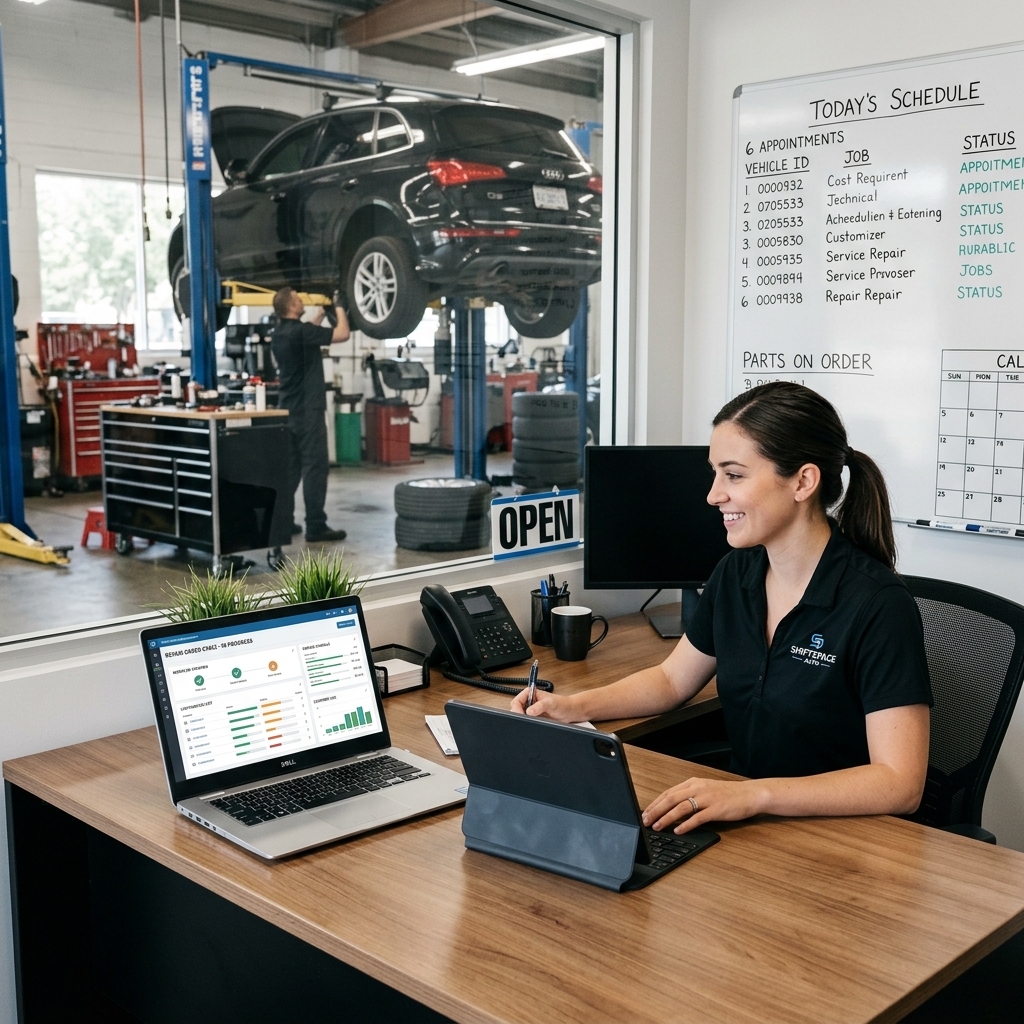
RedAppy is built for the shop owner who wants one platform to handle everything — from the first phone call to the final payment — without stitching together multiple tools.
What RedAppy Does
The platform covers the full repair order lifecycle in a single workflow:
- Digital inspections with photo and video capture, sent directly to customers for faster approvals
- Instant estimates that convert to invoices in one click
- Kanban-style Digital Shop Board that shows every job's status at a glance — from check-in to checkout
- Real-time parts ordering across multiple suppliers with live inventory
- Online payments that eliminate the back-and-forth at the counter
- AI Repair Assistant for labor times, diagnostic guidance, and shop insights on demand
- Vehicle history and customer lookup by name, plate, or VIN
- Team calendar for scheduling and technician management
- Real-time analytics tracking revenue, technician efficiency, average repair order, and repeat business
Every subscription also includes a professional, branded website with contact forms and optional used-car listings — something most competitors charge extra for or don't offer at all.
Who It's For
RedAppy scales from single-bay garages to multi-location operations. In practice, it fits best for:
- Independent shops looking to replace spreadsheets or outdated desktop software
- Growing operations that need visibility into technician performance and parts costs
- Owner-operators who want to reduce admin work without hiring additional staff
RedAppy reports that shops using the platform save 10+ admin hours per week — time recovered from manual estimate writing, phone tag on approvals, and chasing payments.
Photo-rich digital inspections directly increase approved work. Customers who can see the problem are significantly more likely to authorize the repair.
Pricing and Terms
RedAppy uses transparent, month-to-month pricing with no long-term contracts required. This is a meaningful advantage over legacy tools that lock shops into annual commitments. Customization options are available, so shops aren't paying for features they don't use.
For shops exploring pricing in detail, see how RedAppy compares on value per feature.
Honest Limitations
RedAppy is newer to market compared to legacy platforms like Mitchell 1 or Alldata. That means:
- Smaller user community and fewer third-party tutorials compared to tools with a 20-year install base
- OEM repair data is not bundled in — shops that need deep factory repair information may want to pair it with a dedicated data source
- Integrations ecosystem is still growing, though core workflows are fully self-contained
| Feature | RedAppy | Legacy Platforms |
|---|---|---|
| All-in-one workflow | ✅ | Partial |
| Branded website included | ✅ | ❌ |
| AI Repair Assistant | ✅ | Limited |
| Month-to-month terms | ✅ | Often annual |
| Deep OEM repair data | Partial | ✅ |
| Large user community | Growing | Established |
Use case: A two-bay independent shop that's currently juggling a paper estimate pad, a separate invoicing tool, and a basic website would see the most immediate ROI switching to RedAppy. The first-year ROI for shop management software is strongest when a single platform replaces three or more disconnected tools.
Mitchell 1 vs. Alldata: Which Is Better for Repair Data and Shop Management?
Mitchell 1 and Alldata are the two most recognized names in repair information. Both give technicians access to OEM (original equipment manufacturer) data — wiring diagrams, labor times, TSBs (technical service bulletins), and diagnostic procedures. But they approach shop management differently, and the right choice depends on what your shop needs most.
Mitchell 1: Repair Data + Shop Management in One Ecosystem
offers two core products that work together: ProDemand for repair information and Manager SE for shop management. This pairing makes Mitchell 1 one of the few legacy platforms that covers both sides of the operation under one brand.
ProDemand is the repair data engine. It includes OEM procedures, labor times, wiring diagrams, and a SureTrack feature that pulls real-world fixes from millions of actual repair orders. According to Mitchell 1, SureTrack covers over 4.5 billion data points from professional repair shops — making it particularly useful for diagnosing intermittent or hard-to-replicate faults.
Manager SE handles the shop workflow side: estimates, work orders, invoices, parts ordering, and customer history. In practice, the two products integrate reasonably well, but they are licensed separately, which adds to the total cost.
Best use case: A mid-size or established shop that wants deep repair data and a proven shop management system from a single vendor — and doesn't mind paying for both modules.
Honest limitation: Manager SE is a desktop-based system. If you need full cloud access or a mobile-first workflow, this will be a friction point. The interface also feels dated compared to newer cloud platforms.
Alldata: Deep OEM Data With a Lighter Management Layer
is widely considered the gold standard for OEM repair information. It sources data directly from vehicle manufacturers and updates continuously, covering domestic and import vehicles with a depth that's hard to match. According to Alldata, the platform includes repair information for over 95% of vehicles on the road in North America.
Alldata Manage Online is the shop management component — a cloud-based system that handles estimates, invoices, and customer records. It's more modern than Manager SE in terms of accessibility, but it's a thinner platform overall. Features like digital inspections, Kanban boards, and analytics are either limited or absent.
Best use case: A shop where technicians are the priority — specifically, one that needs the most accurate, manufacturer-sourced repair data available. Alldata Manage Online works well for shops that are comfortable pairing it with a separate, more robust management tool.
Honest limitation: Alldata's management layer isn't as feature-rich as dedicated shop management platforms. Shops looking for workflow automation, photo inspections, or detailed business analytics will likely need a second tool.
Head-to-Head: Mitchell 1 vs. Alldata
| Feature | Mitchell 1 | Alldata |
|---|---|---|
| Repair Data Source | OEM + SureTrack real-world fixes | Direct OEM data |
| Shop Management | Manager SE (desktop) | Manage Online (cloud) |
| Digital Inspections | Limited | Limited |
| Labor Times | Yes | Yes |
| Wiring Diagrams | Yes | Yes |
| TSBs & Recalls | Yes | Yes |
| Cloud-Based | Partial (some web tools) | Yes (Manage Online) |
| Pricing Model | Subscription, per module | Subscription, tiered |
| Free Trial | Limited | Limited |
Both platforms excel at repair data — but neither is a strong all-in-one shop management solution on its own.
Where Mitchell 1 wins: The SureTrack real-world fix data gives technicians a practical edge on tricky diagnostics. The Mitchell 1 ecosystem is also well-integrated if you're using both ProDemand and Manager SE together.
Where Alldata wins: Direct OEM sourcing means fewer interpretation layers between the manufacturer's specification and your technician's screen. Alldata Manage Online also edges ahead on accessibility since it's cloud-based.
Pricing: Both platforms operate on subscription models, and both require separate licensing for repair data and shop management. Expect to budget for two products if you want full coverage. Exact pricing isn't publicly listed — you'll need to request a quote from each vendor.
Many shops use Mitchell 1 or Alldata purely for repair data and pair them with a more capable management platform like RedAppy for workflow, invoicing, and analytics. This hybrid approach lets you get the best OEM data without sacrificing the operational tools your front office actually needs.
Shop-Ware and Tekmetric: Cloud-Native Options for High-Volume Shops
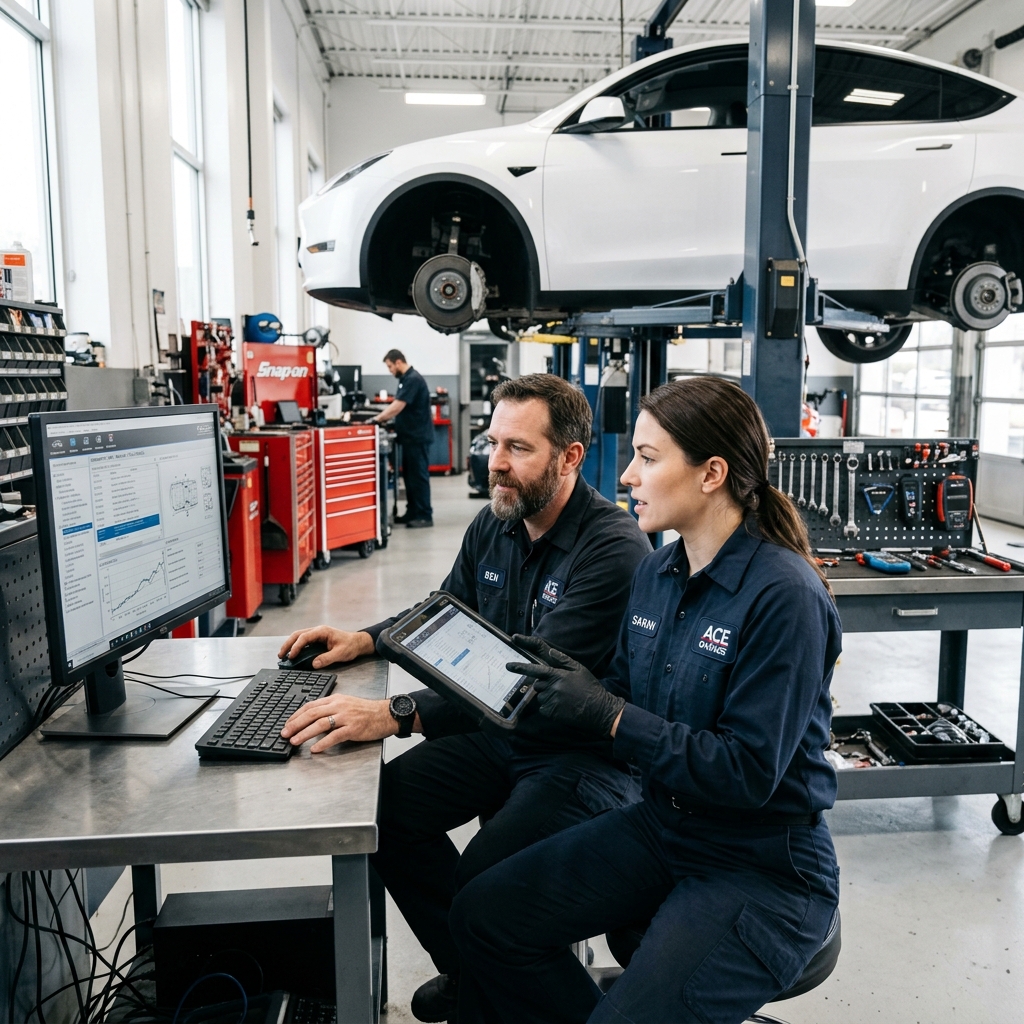
Shop-Ware and Tekmetric are both cloud-native platforms built for shops that handle high ticket volume and want real-time visibility across their operation. They appeal to tech-forward owners who are done with desktop installs and paper-based processes.
Shop-Ware
is a cloud-based shop management system designed around speed and transparency. Its standout feature is a real-time digital workflow that lets customers approve estimates, view inspection photos, and authorize work directly from their phone — without a phone call. According to Shop-Ware, shops using its platform see authorization rates climb because customers can see what's wrong, not just read about it.
Key features:
- Digital inspections with photo and video attachments
- Real-time customer authorization via text or email
- Parts matrix pricing and canned jobs
- Reporting on technician productivity and shop performance
- Multi-location support
Ideal shop size: Mid-size to large operations with 4+ bays that already have some process structure in place.
Pricing: Shop-Ware uses tiered pricing based on the number of users and locations. It's not the cheapest option on the market — from experience, smaller shops often find it harder to justify the cost against simpler platforms.
The customer-facing approval workflow is genuinely well-built, but getting full value from Shop-Ware requires staff who are comfortable with digital tools from day one.
Honest limitation: The onboarding curve is real. Shops transitioning from paper or legacy software will need dedicated time to set up workflows correctly. Customer support quality has received mixed reviews in independent forums.
Tekmetric
positions itself as the shop management platform built by shop owners, for shop owners. It's cloud-based, fast, and focused on giving service advisors a clean interface to build estimates and track jobs without friction. According to Tekmetric's published data, shops on its platform average over $1 million in annual revenue — signaling it's built for busier, higher-output operations.
Key features:
- Drag-and-drop job board for tracking repair status
- Integrated parts ordering from multiple suppliers
- Digital vehicle inspections with customer-facing reports
- Detailed analytics — revenue, ARO (average repair order), technician efficiency
- Two-way texting with customers
- QuickBooks Online integration
Ideal shop size: High-volume independents and small chains looking for a clean, modern workflow tool with strong reporting.
Pricing: Tekmetric offers tiered monthly plans. Pricing is available on request, which can be frustrating when you're trying to compare options quickly.
Tekmetric's reporting suite is among the strongest in this category — if tracking technician performance and ARO trends matters to you, it delivers.
Honest limitation: Tekmetric doesn't include a built-in branded website or used-car listing feature. Shops that want marketing tools alongside operations management will need to combine it with other platforms.
How Shop-Ware and Tekmetric Compare to RedAppy
Both platforms are strong for high-volume, tech-ready shops. But neither bundles in a professional branded website or used-car listings the way RedAppy does. For shops that want an all-in-one solution — operations, marketing, and customer acquisition under one subscription — RedAppy is the closer fit. Shop-Ware and Tekmetric are better suited to shops that already have their marketing handled and want a dedicated, high-performance shop operations tool.
| Feature | Shop-Ware | Tekmetric | RedAppy |
|---|---|---|---|
| Cloud-based | ✅ | ✅ | ✅ |
| Digital inspections | ✅ | ✅ | ✅ |
| Customer authorization | ✅ | ✅ | ✅ |
| AI Repair Assistant | ❌ | ❌ | ✅ |
| Branded website included | ❌ | ❌ | ✅ |
| Used-car listings | ❌ | ❌ | ✅ |
| Multi-location support | ✅ | ✅ | ✅ |
| Transparent public pricing | ❌ | ❌ | ✅ |
Conclusion
Picking the right shop management software comes down to four things: your shop size, your budget, how much you rely on OEM repair data, and whether you want an all-in-one platform or a stack of specialized tools.
Here's a simple framework to guide your decision:
- Single-bay or growing independent shop → RedAppy gives you the most complete out-of-the-box package — inspections, estimates, invoicing, parts ordering, analytics, and a branded website — without a long-term contract or enterprise price tag.
- Shop that needs deep OEM repair data → Mitchell 1 or Alldata are the established choices. Mitchell 1 edges ahead on shop management features; Alldata wins on raw OEM data depth for certain makes.
- High-volume, multi-bay operation → Tekmetric or Shop-Ware are built for throughput. Both handle complex workflows well, though at a higher price point.
- Shops already committed to QuickBooks → Keep it for bookkeeping, but pair it with a dedicated shop platform to handle estimates, inspections, and workflow. RedAppy's native invoicing and payment tracking reduces how much you lean on a separate accounting tool.
The shops that get the best ROI from management software are the ones that pick a platform matching their current workflow — then grow into its advanced features, rather than buying for features they won't use for two years.
If admin time is your biggest pain point, start there. According to RedAppy's reported results, shops save 10+ hours per week just by digitizing inspections, automating estimates, and centralizing parts ordering. That's time that goes back into billable labor or business development.
If repair data accuracy is your constraint — especially for European makes or newer model years — layer in Alldata or Mitchell 1's ProDemand alongside your shop management platform.
No single platform is perfect for every shop. But the wrong tool costs more than the subscription fee — it costs you in missed approvals, admin bottlenecks, and technician downtime. Use this guide to match the platform to the problem you're actually trying to solve.
Ready to see how an all-in-one platform fits your shop? Explore RedAppy's features and pricing or check out our guide to digital vehicle inspections to see how inspection tools drive more approved work.
Frequently Asked Questions
What is the best software for managing an automotive repair shop?
Shop-Ware, Mitchell 1 Manager SE, and Tekmetric consistently rank among the best for managing an automotive repair shop, based on user reviews across platforms like Capterra and G2. Tekmetric is especially popular with modern shops for its cloud-based interface, real-time reporting, and customer communication tools. The "best" option depends on shop size, budget, and whether you prioritize features like inventory management, digital vehicle inspections, or accounting integrations.
What is the best automotive workshop management software?
Mitchell 1 Manager SE and Shop-Ware are widely regarded as top automotive workshop management platforms, offering robust work order management, parts ordering, and customer history tracking. Identifix Shop Manager and AutoFluent are also strong contenders, particularly for multi-location operations. Cloud-based solutions like Tekmetric and Shopmonkey have gained significant traction for their ease of use and mobile accessibility.
Which is better, Mitchell or Alldata?
Mitchell 1 (ProDemand) generally edges out ALLDATA for repair information depth, interface usability, and integrated diagnostic support, according to technician reviews on forums like Garage Gurus and iATN. ALLDATA is often preferred for its OEM-accurate data and straightforward pricing, making it a reliable choice for shops prioritizing factory specifications. Many larger shops subscribe to both, using ALLDATA for OEM documentation and Mitchell 1 for its broader diagnostic and estimating ecosystem.
What is the best bookkeeping software for auto repair shops?
QuickBooks is the most widely used bookkeeping software among auto repair shops, thanks to its robust invoicing, payroll, and tax reporting features. Many shop management platforms like Mitchell 1, Tekmetric, and Shopmonkey offer direct QuickBooks integration, allowing seamless syncing of invoices and expenses. For smaller shops seeking an all-in-one solution, some platforms like AutoLeap include built-in accounting features that reduce the need for separate bookkeeping software.
Ready to Transform Your Shop?
RedAppy helps auto repair shops create professional digital estimates with photos and videos, send them instantly via text or email, and get customer approvals in seconds. No credit card required to start.