
Best Vehicle History Report: Which One Fits Your Shop
A customer is at the counter with a used SUV, and the seller's printout says the history is clean. The advisor has a few minutes before a tech pulls the car in. That sheet is where shops either waste a bay or miss a branded title.
The best vehicle history report is not one product that answers every question. It is the check that matches the job in front of the shop: title and salvage, reported accidents, auction paper, or an open recall. A blank field is not a green light. It means nobody in that database reported an event.
Shops that run intake all day score each field as verified, contradictory, or unknown, then write the inspection that follows on the same sheet the tech will see. The pages below match each shop need to a starting check, show where the records come from, and turn a sample report into a scope the bay can perform.
Table of Contents
- Quick Picks for Each Shop Need
- Where the Data in a Report Comes From
- Accuracy and Coverage Compared Across Report Types
- Reading Verified, Contradictory and Unknown Results
- Matching Report Findings to Inspection Scope
- How to Read and Verify a Sample Report
- Standardize Your Intake Checks Before the Next Car Arrives
Quick Picks for Each Shop Need
No single report wins every shop need, so the choice depends on the question. Start with the row that matches the job, not with the longest feature list.
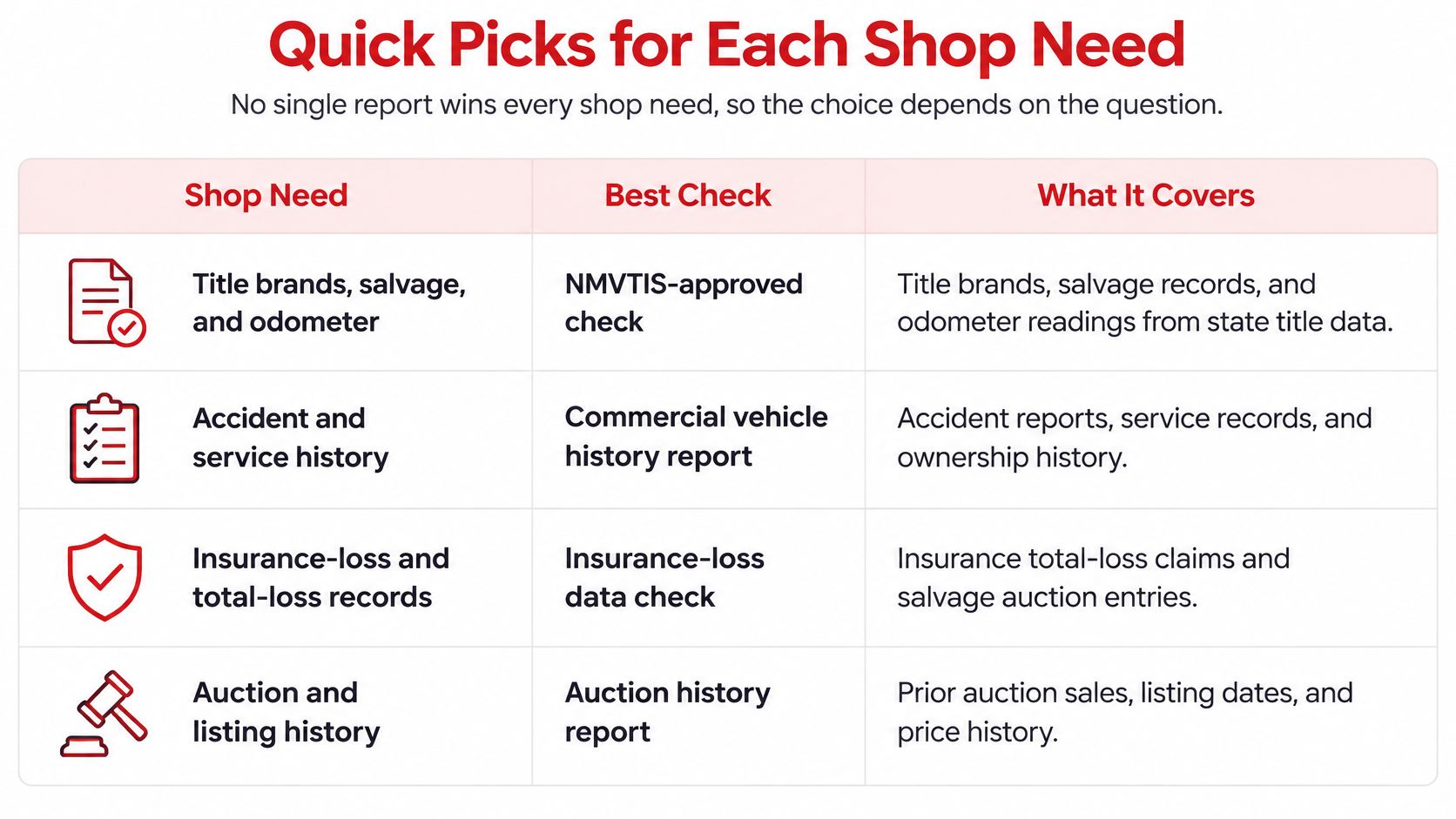
| Shop need | Start with | Why it fits | Main gap |
|---|---|---|---|
| Title and salvage screening at every intake | NMVTIS-approved check | Government-linked title, brand, total-loss and odometer data | Little collision or service detail |
| Accident and repair history for a customer's car | Carfax-style commercial report | Reported accidents, service events and more mileage points | Only shows events that were reported |
| Auction and salvage-auction review | AutoCheck-style commercial report | Auction and salvage-auction records | Only auctions that report to that provider |
| Open safety recall check | NHTSA VIN recall lookup | Free, official, tied to the VIN | Can omit some recalls; recheck periodically |
Title and salvage screening belongs on every intake. An NMVTIS-approved check is the government-linked baseline for brands, salvage, total loss, and odometer readings tied to title events. It will not describe how hard a collision was or which shop fixed the bumper. Next step: if a brand appears, add structural, flood, and airbag checks before anyone prices cosmetic work.
Accident and repair history is the customer's question when they ask whether the car was hit. A Carfax-style commercial report is built for reported accidents, service events, and a longer mileage timeline. The gap is simple. If a shop, insurer, or owner never sent the event, the field stays empty. Next step: match service lines to the customer's invoices.
Auction and salvage-auction review fits cars that passed through a lane. An AutoCheck-style report is the practical start for auction and salvage-auction records. Coverage stops where an auction does not participate. Next step: ask the seller for the auction sheet and compare the sale date with the title date.
Open safety recalls do not belong inside a paid history product. The free NHTSA VIN recall lookup is official and tied to the VIN. It can miss some campaigns, so the shop rechecks before release. Next step: confirm repair status with the manufacturer or a service record, not with the history printout.
The treats a vehicle-history report as an important step in used-vehicle due diligence, and it warns that no report is complete or sufficient by itself. A report may include ownership history, accident information, repair records, salvage status, title information, insurance-loss data, and odometer details. The FTC recommends an NMVTIS-approved provider and the VIN as the vehicle's primary historical identifier, plus an independent inspection because a report may not reveal every mechanical problem or hidden damage. Different companies hold different records. Some non-NMVTIS providers add accident or repair lines, while government-linked title data is the stronger base for title, salvage, and odometer checks. The FTC has also warned about report scams in which a seller pushes an unfamiliar website that may collect payment-card or personal information.
Default rule: Run the NMVTIS-approved check on every intake, add a commercial report when the customer, the title, or the mileage raises a question, and always run the recall lookup on its own.
Note which row matches the job the desk sees most often, and make that the first click.
Where the Data in a Report Comes From
A report is a pile of other people's filings, not a camera that watched the car. NMVTIS, the U.S. National Motor Vehicle Title Information System, consolidates title, brand, odometer, salvage, and insurance-loss information. It holds more than 680 million current title records and more than 1 billion title-history records, and it represents approximately 99% of U.S. motor-vehicle title data, so title-level coverage is broad, as described in the.
Who files the title record
According to the, the system consolidates records from state motor-vehicle titling agencies, automobile recyclers, junk and salvage yards, and insurance carriers. The consumer-facing report is built around five fraud- and theft-related indicators, including the current title and brand history, the latest reported odometer reading, and certain salvage or total-loss determinations by insurers or self-insuring organizations.
A title brand is a state-applied label such as junk, salvage, or flood. NMVTIS keeps brand history applied in different states. Say a flood-branded sedan is retitled two states away in the hope the new title looks ordinary. The centralized brand history still shows the earlier label. That is the point of the government layer. Moving the car does not erase the brand.
What commercial files add
Commercial databases sit on top of that baseline. They add accident, insurance, auction, repair-facility, and mileage events from the businesses that choose to report. A dealer group, a large insurer, or a chain shop may file often. A cash repair at an independent garage may never appear.
A field that looks empty may have no reporter behind it. Treat the source chain as the first reading of any best vehicle history report: who could have filed this line, and did anyone have a reason to.
Accuracy and Coverage Compared Across Report Types
A single accuracy percentage misleads. The useful benchmark is category completeness. Accident and service lines are event-dependent. Privately paid repairs, unreported collisions, smaller insurers, and shops that do not contribute data may all be absent, which is why the treats category coverage, not one score, as the comparison that matters.
NMVTIS has high authority for branded-title and total-loss information and limited mileage breadth. It does not give collision severity, repair documentation, service history, or open-recall status. Commercial providers typically expand mileage timelines and add reported accident or service events. None of them can certify present mechanical condition.
| Record category | NMVTIS-approved check | Commercial report | What to do when it is thin |
|---|---|---|---|
| Title brands (junk, salvage, flood) | Strong, government-linked | Usually included | Confirm the brand history across states |
| Total-loss and salvage events | Strong | Usually included | Treat a mismatch between sources as a conflict |
| Odometer readings over time | Limited to title events | Several readings, if reported | Check the sequence for decreases |
| Reported accidents | Only when a branded title results | Broader, if events were reported | Absence is not proof of no damage |
| Auction records | Limited | Only if that auction reports to the provider | Ask the seller for auction paperwork |
| Service and repair records | Not typical | Only shops that share records | Match against the customer's invoices |
| Open safety recalls | Not covered | Not a guarantee | Run the NHTSA VIN lookup separately |
How a shop compares two pulls
Pull the same VIN from an NMVTIS-approved check and from one commercial report. Score four fields: title integrity, odometer continuity, damage and insurance events, and maintenance evidence. Require a source date and a location on each line. Normalize readings to miles or kilometers, then check whether mileage only moves forward.
A total-loss brand on the NMVTIS-approved check with no accident on the commercial report is a conflict, not a clean car. Any unresolved discrepancy should lower confidence and send the car to a hands-on inspection: scan for diagnostic trouble codes, verify restraint-system deployment history, and inspect structural measuring points. A report with zero accident entries is not a clean-vehicle certification. History reports describe reported events.
A shop that serves one region should test a sample of its own VINs before it picks a default commercial provider. The provider that fills auction lines in one metro may be thin in the next.
Reading Verified, Contradictory and Unknown Results
"Clean history" is the phrase that gets shops in trouble. A report does not grade the car. Each field has one of three states, and the intake sheet should show the state, not a single verdict.
Verified means two or more sources agree. A salvage brand on the NMVTIS-approved check that matches the state title is verified. The brand is real, and the inspection scope changes.
Contradictory means sources or readings conflict. A later odometer reading lower than an earlier one, or a total-loss brand on one source with no matching event on the other, is a contradiction. That field holds the estimate until the customer brings records.
Unknown means no record was found.
No record found means unknown, not clean.
A mileage rollback can sit before the first captured reading, or in a stretch with no systematic reporting. An empty accident field never proves the car is untouched. An unknown field makes the car a physical-inspection case. Shops should not tell a customer the car has a clean history when the report only shows no reported events. Use the coverage comparison to see which categories each source tends to leave blank, and write that state beside the field.
Matching Report Findings to Inspection Scope
Four jobs pull a report for different reasons, and none of them end at the printout.
Independent repair intake on a customer's own car looks for brands and mileage before the shop commits to a large job. A pre-purchase inspection for a buyer, often through a mobile mechanic, looks for conflicts the buyer can take back to the seller. A multi-location chain uses the same four states so one store does not call a car clean while another flags it. Front-desk advisors pull the check at write-up so the finding is on the repair order before the car reaches a lift.
The is the reason the report never closes the inspection. Reports may identify accidents or flood damage but typically do not identify mechanical problems. A clean title history can still hide worn brakes, transmission trouble, or structural defects. The FTC recommends paying an independent mechanic even when a dealer says the vehicle was already inspected or certified.
| Report finding | Inspection to add | Why it matters |
|---|---|---|
| Salvage, junk or total-loss title | Structural measuring points, flood check, airbag and restraint-system scan | Major damage may be hidden behind cosmetic repairs |
| Flood brand or water-exposure history | Carpet, wiring and connector check; module scan for corrosion | Water damage often shows up weeks after the event |
| Odometer decrease or unexplained gap | Module scans, maintenance-record review, wear comparison of pedals, seat and steering wheel | Physical wear can test whether the mileage fits the car |
| Reported accident with no branded title | Frame check, paint-depth readings, wheel alignment | Unbranded repairs leave no title trace |
Why the quiet rows matter
The salvage row is the obvious one. The flood row is the one shops under-scope. Water can look fine at the sale and then corrode connectors weeks later, so carpet, wiring, and a module scan belong on the estimate even when the car starts and drives.
An odometer drop is not solved by arguing with the seller. Module data, invoices, and wear on the pedals, seat, and wheel either support the displayed miles or they don't. An accident with no brand is easy to dismiss because the title looks ordinary. Paint depth, alignment, and frame measurements are what catch a repair that never reached a state brand.
Write the chosen scope on the intake record next to the finding that triggered it. The technician and the customer then see the same reason for the extra time.
How to Read and Verify a Sample Report
The strongest screening is a layered report, not one commercial product. As the lays out, NMVTIS is the baseline for state title brands, salvage and junk designations, total-loss reporting, and odometer readings at title events. It generally does not provide collision severity, repair documentation, service history, or open-recall status. Commercial databases can add accident, insurance, auction, repair-facility, and mileage-event data, and that extra coverage depends on who participates, not on a promise of a complete file.
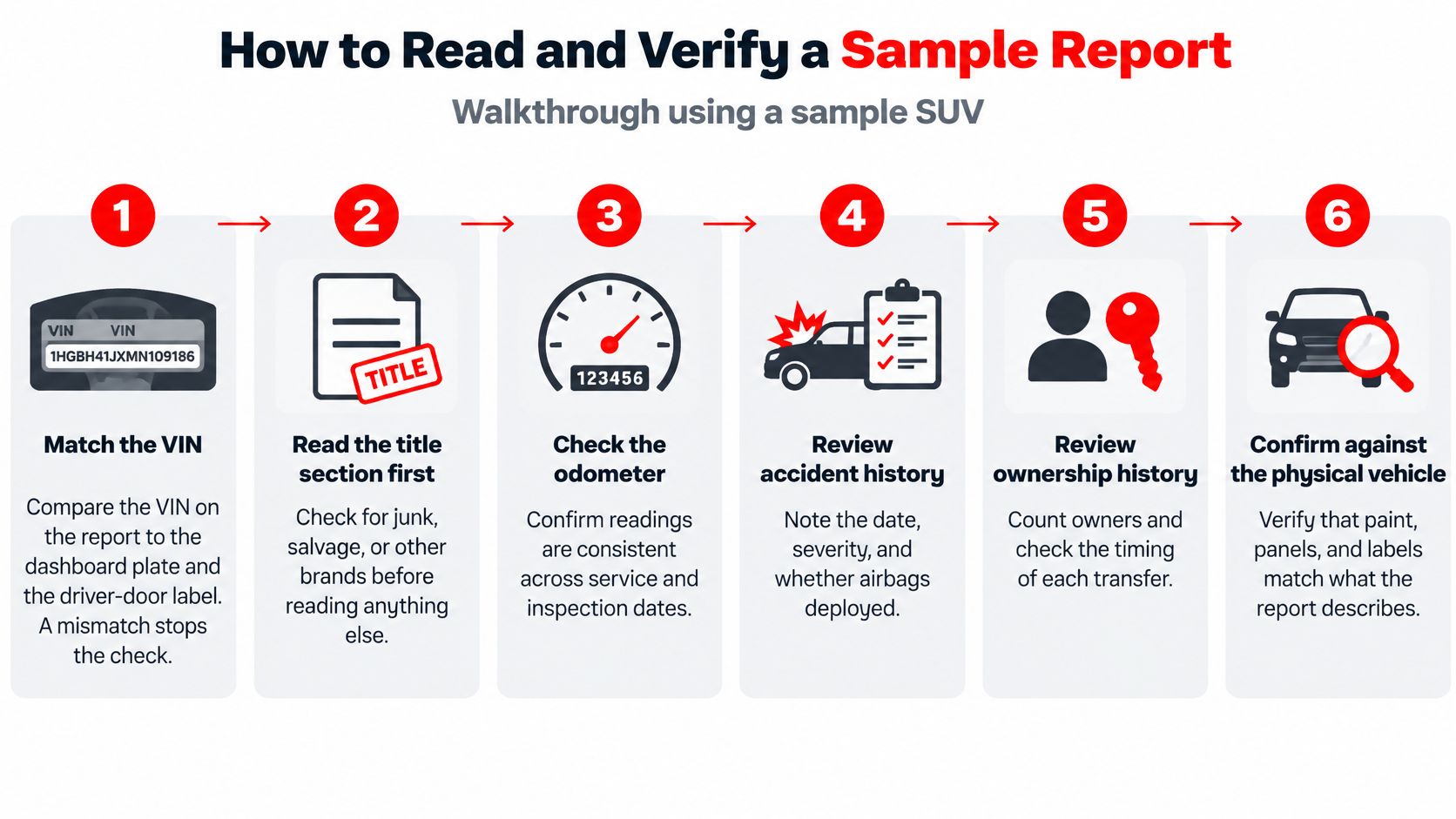
Use one sample SUV and the same eight steps on every car.
Match the VIN. Compare the VIN on the report with the dashboard plate and the driver-door label. Store that VIN on the intake record. A mismatch stops the check. The rest of the file belongs to a different car.
Read the title section first. Look for junk, salvage, flood, or total-loss brands before anything else. On this SUV the NMVTIS-approved check shows no brand. That is verified only against the title in hand, and it does not shrink the later mileage problem. A brand here would add structural, flood, and airbag checks before any estimate.
List every odometer reading by date. Sort them. The sample shows 41,200 miles at an oil change, then 38,900 miles at a later title transfer. That drop is an impossible decrease. Flag it as contradictory. Do not average the two numbers or pick the one that looks nicer.
Note the source and location of each entry. The oil-change line names a shop and a date. The title-transfer line names a state. An entry with no date or no source is weak evidence and should not carry the decision alone.
Read the accident and damage fields as reported events only. The sample's accident field is empty. That means no reported event, not proof of no damage. NMVTIS would show an accident mainly when a brand resulted. The commercial file can be broader and still miss a cash repair.
Compare service entries with the customer's invoices. The oil change at 41,200 miles should appear on an invoice if the customer has one. A long gap with no service line is unknown maintenance, not proof the car was neglected or proof it was cared for.
Run the NHTSA recall lookup separately with the same VIN. Recall records are updated continuously, and some newly announced recalls may not yet have every affected VIN identified. Do not treat the commercial report's recall box as the official result.
Save the report date, each finding, and the inspection scope. This SUV is marked contradictory. The estimate adds a module scan, a maintenance-record review, and a physical wear comparison of pedals, seat, and steering wheel. Title and total-loss flags would have added structural, flood, and airbag checks instead.
Repeat those eight steps at every intake. The best vehicle history report is the one the shop can re-read the same way on the next car.
Standardize Your Intake Checks Before the Next Car Arrives
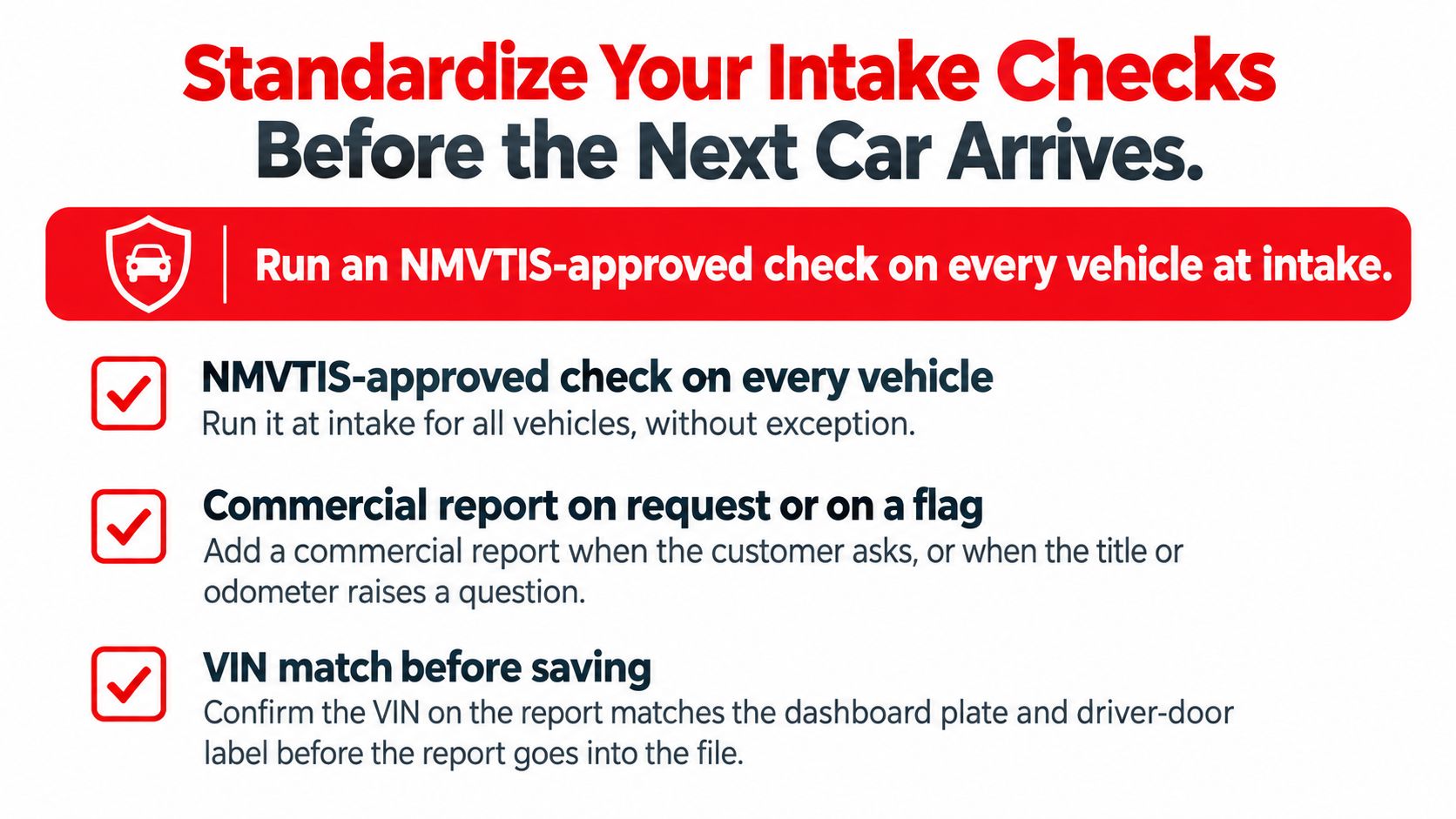
The default is firm. Run an NMVTIS-approved check on every vehicle at intake. Add a commercial report when the customer asks, or when the title or the odometer raises a question. Run the NHTSA VIN recall lookup for every VIN. Paying for a thicker commercial file does not remove the free official check.
The intake line the file should show
- VIN matched: The report VIN equals the dashboard plate and the driver-door label.
- Report date recorded: The file shows when the pull was made, not just that someone ran it.
- State beside each field: Verified, contradictory, or unknown, written out.
- Odometer chronology checked: Readings sorted, decreases flagged.
- Open-recall result noted: The NHTSA result, separate from the paid report.
- Inspection scope set: The extra checks named next to the finding.
- Technician sign-off: The tech confirms the scope was performed or declined in writing.
Why the recall line goes stale
states that its VIN recall lookup can omit recalls already repaired, newly announced recalls whose VINs are not yet identified, recalls older than 15 years, some small-manufacturer campaigns, and international-vehicle recalls. VINs are added continuously, and NHTSA recommends checking periodically. Its SaferCar system can send alerts for newly identified recalls. A car that sits in the bay for weeks should be checked again before release. A paid history report is one layer in that workflow, not a safety certificate.
Commercial reports stay on a trigger, which keeps the per-report spend tied to a real question. Record each provider's current per-report price on the intake sheet and set it next to the cost of a missed branded title or an undisclosed accident on a repair order. There is no universal price that fits every shop.
RedAppy is one way to keep that sheet with the job. Vehicle history and VIN lookup sit alongside digital inspections, photos, and estimates, so the report date and the findings travel with the repair order. The features page shows that workflow, and the contact page is where a shop can set the intake routine to match its bays.
RedAppy keeps vehicle history and VIN lookup on the same repair order as inspections, photos, and estimates, so a contradictory mileage line or an open recall does not get lost between the desk and the bay. Shops can see how that intake flow is built on RedAppy and set the routine before the next car arrives.
Ready to Transform Your Shop?
RedAppy helps auto repair shops create professional digital estimates with photos and videos, send them instantly via text or email, and get customer approvals in seconds. No credit card required to start.