
Vehicle Inspection Checklist: The Complete Guide for Auto Repair Shops and Car Owners
A thorough checklist vehicle inspection is one of the most important tools in automotive safety and shop management — yet it is one of the most inconsistently applied. According to the, vehicle defects and poor maintenance contribute to hundreds of thousands of crashes each year in the United States. Whether you run an auto repair shop or simply want to protect your investment, a structured inspection process reduces risk, builds trust, and catches problems before they become expensive failures.
For shop owners, a standardized inspection checklist does more than identify worn parts — it creates a documented record that protects the business, justifies repair recommendations, and increases approved work orders. For car owners, it provides a clear picture of a vehicle's condition and removes the guesswork from maintenance decisions. Both groups benefit from understanding exactly what gets inspected, why it matters, and how modern digital tools are changing the process.
This guide covers everything you need to know: the core components of a professional vehicle inspection checklist, the difference between inspection types, how digital inspections improve approval rates, and how platforms like RedAppy help shops run faster, more consistent inspections with photo documentation and instant estimates — all from a single workflow.
Table of Contents
- 1. What Is a Vehicle Inspection Checklist?
- 2. What a Full Vehicle Inspection Consists Of
- 3. The Essential Vehicle Inspection Checklist (Point by Point)
- 4. State Vehicle Inspection Requirements: What Can Fail an Inspection
- 5. How Digital Vehicle Inspections Improve Shop Efficiency and Customer Approval Rates
- Conclusion
- Frequently Asked Questions
1. What Is a Vehicle Inspection Checklist?
A vehicle inspection checklist is a structured document used to assess the condition of a vehicle across its key mechanical and safety systems. It guides a technician or inspector through a defined sequence of checks, ensuring no critical component is overlooked. The result is a documented record of the vehicle's condition at a specific point in time.
A checklist transforms an inspection from a subjective walkthrough into a repeatable, defensible process with a clear paper trail.
Checklists serve two primary purposes. First, they protect safety — identifying worn brakes, failing tires, or broken lights before they cause an accident. Second, they protect liability — giving shops, fleet operators, and car buyers a written record of what was inspected, what was found, and what was recommended.
Who Uses Vehicle Inspection Checklists
Several groups rely on these checklists in different contexts:
- Technicians and service advisors use them during routine maintenance visits, multi-point inspections, or pre-delivery checks to document vehicle condition and flag repair needs.
- Fleet managers use standardized checklists to track the condition of dozens or hundreds of vehicles and schedule preventive maintenance before breakdowns occur.
- Car buyers and sellers use pre-purchase inspection checklists — often performed by an independent mechanic — to verify a used vehicle's condition before a transaction is finalized.
- State inspection stations use government-mandated checklists to determine whether a vehicle meets minimum legal safety and emissions standards.
General Maintenance Checklists vs. State-Mandated Safety Inspections
These two types of checklists are related but distinct.
| Feature | General Maintenance Checklist | State-Mandated Safety Inspection |
|---|---|---|
| Purpose | Identify wear, maintenance needs, and upcoming repairs | Confirm vehicle meets legal safety minimums |
| Who requires it | Shop, manufacturer, or fleet policy | State government |
| Pass/fail outcome | No — produces recommendations | Yes — vehicle receives a pass or fail |
| Frequency | Based on mileage or time intervals | Annual or biennial, depending on state |
| Legal consequence | None | Failed vehicles may not be legally operated |
A general maintenance checklist is proactive. It helps a shop catch a belt that is starting to crack or brake pads at 4mm before they become a safety issue. A state inspection checklist is prescriptive — it checks whether specific components meet a defined legal threshold, and failure means the vehicle cannot be registered or legally driven until repairs are made.
According to the, vehicle defects and poor maintenance contribute to a significant share of roadway crashes each year, which is the core rationale for both types of inspection programs.
In practice, a well-designed general inspection checklist often covers the same components as a state inspection — and more. Shops that use comprehensive checklists on every vehicle catch issues early, reduce liability exposure, and give customers the information they need to make informed repair decisions.
2. What a Full Vehicle Inspection Consists Of
A full vehicle inspection covers every major system that affects safety, reliability, and legal roadworthiness. In practice, a complete inspection involves 50 to 100+ individual checkpoints, depending on the vehicle type and the inspection standard being applied.
The table below outlines the standard inspection categories, what technicians examine within each, and why each system matters.
| System | What Is Checked | Why It Matters |
|---|---|---|
| Exterior / Body | Panel condition, corrosion, glass integrity, mirrors | Structural safety; visibility |
| Tires & Wheels | Tread depth, inflation, sidewall damage, lug nuts | Traction, handling, blowout risk |
| Brakes | Pad/shoe thickness, rotor condition, brake lines, fluid | Stopping distance and failure prevention |
| Steering & Suspension | Tie rods, ball joints, shocks, struts, alignment | Vehicle control and tire wear |
| Lights & Electrical | Headlights, taillights, turn signals, hazards, dash warning lights | Visibility and legal compliance |
| Fluids | Engine oil, coolant, transmission, brake, power steering, washer fluid | Component lubrication and cooling |
| Engine & Drivetrain | Belts, hoses, mounts, CV joints, fluid leaks | Mechanical integrity and performance |
| Battery & Charging | Battery voltage, terminals, alternator output | Starting reliability and electrical stability |
| Undercarriage | Frame condition, exhaust system, fuel lines, heat shields | Structural safety; emissions and fire risk |
| Interior / Safety | Seatbelts, airbag warning lights, horn, pedals, HVAC | Occupant protection and driver control |
| Emissions / Exhaust | Catalytic converter, O2 sensors, exhaust leaks, OBD-II codes | Environmental compliance and cabin safety |
Exterior and Body
Technicians inspect all glass surfaces for cracks or chips that could compromise visibility or structural integrity. Mirrors are checked for secure mounting and full adjustability. Body panels are examined for corrosion that could weaken the vehicle's frame over time.
Tires and Wheels
Tire tread depth, inflation pressure, and sidewall condition are assessed on all four corners, including the spare when applicable. Wheel lug nuts are checked for proper torque, and rims are inspected for cracks or bends. Uneven tread wear patterns are noted, as they indicate underlying alignment or suspension issues.
Brakes
Brake pad thickness, rotor surface condition, and brake line integrity are the primary checkpoints. Technicians also measure brake fluid level and check for moisture contamination, which lowers the fluid's boiling point and reduces braking effectiveness. Parking brake function is tested separately.
Steering and Suspension
Steering components — including tie rods, rack and pinion or steering box, and steering linkage — are checked for play and wear. Suspension parts such as ball joints, control arms, shocks, and struts are inspected for leaks, damage, or excessive movement. These components directly influence vehicle handling and tire contact with the road.
Lights and Electrical
Every exterior light is tested for function: low and high beams, taillights, brake lights, reverse lights, turn signals, and hazard flashers. Dashboard warning lights, including the check engine, ABS, and airbag indicators, are documented. Non-functioning lights are among the most common roadside safety violations and inspection fail points.
Fluids
All fluid reservoirs are checked for level and condition. Engine oil color and consistency can reveal contamination or overdue service intervals. Coolant is checked for proper concentration and signs of rust or combustion gas intrusion, which would indicate a head gasket problem.
Engine and Drivetrain
Belts (serpentine, timing where accessible) and hoses are inspected for cracking, fraying, or softening. Engine mounts and transmission mounts are checked for excessive movement. On front-wheel and all-wheel drive vehicles, CV axles and boots are examined for tears and grease loss.
Battery and Charging System
Battery terminals are inspected for corrosion, and voltage is tested under load. Alternator output is verified to confirm the charging system maintains voltage within the 13.5–14.5V range under normal operating conditions. A weak battery or failing alternator can leave a driver stranded without warning.
A vehicle can pass a visual inspection while carrying a battery that will fail within 30 days. Load testing the battery, not just measuring resting voltage, is the only reliable method.
Undercarriage
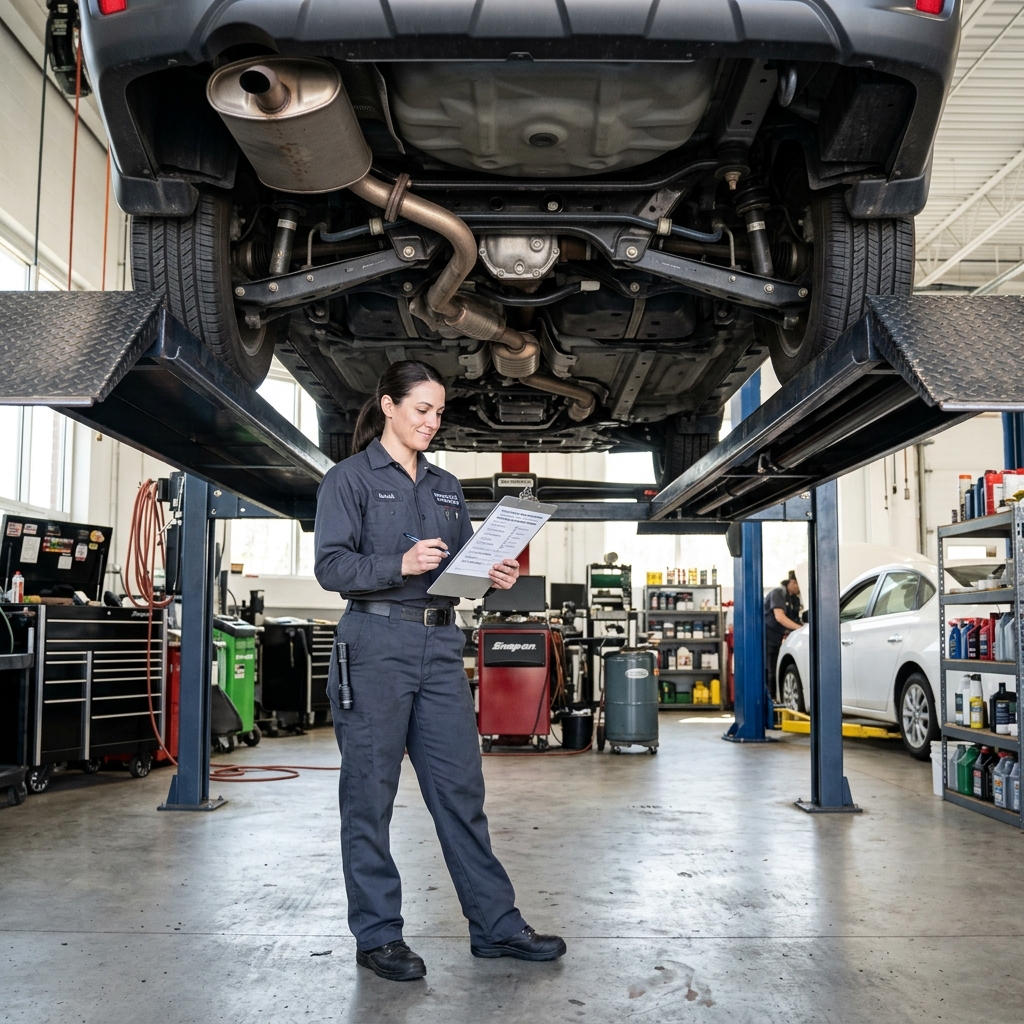
The undercarriage inspection covers the exhaust system from the manifold to the tailpipe, including the catalytic converter and all mounting hangers. Fuel lines, brake lines, and the vehicle frame are checked for corrosion, impact damage, and leaks. This inspection requires a lift and is one area where shop-performed inspections provide significantly more information than a DIY check.
Interior and Safety Equipment
Seatbelts are tested for retraction, latching, and webbing condition. The horn is tested. Pedal condition, floor mats, and windshield wiper function are documented. Any illuminated airbag or supplemental restraint system (SRS) warning light is flagged, as it indicates the passive safety system may not deploy correctly in a collision.
Emissions and Exhaust
In states with emissions testing programs, the vehicle's is scanned for active fault codes. Exhaust leaks upstream of the oxygen sensors can produce false emissions readings and also create a carbon monoxide risk inside the cabin. According to the, OBD-II-based testing now covers most vehicles from 1996 onward in participating state programs.
3. The Essential Vehicle Inspection Checklist (Point by Point)
A thorough vehicle inspection checklist works system by system, covering every component that affects safety, reliability, and roadworthiness. The following checklist reflects industry standards from and common shop practice. Use it as a working reference for technicians and service advisors.
Tires
Tires are the vehicle's only contact with the road, making them the highest-priority inspection item.
- Tread depth: Measure with a tread depth gauge. NHTSA recommends replacing tires at 2/32" of remaining tread — many shops flag tires at 4/32" as a caution.
- Tire pressure: Check cold pressure against the placard on the driver's door jamb, not the maximum listed on the sidewall.
- Condition: Inspect for sidewall cracking, bulges, uneven wear patterns (which indicate alignment or suspension issues), and embedded objects.
- Spare tire: Verify presence, condition, and proper inflation.
Uneven wear across a tire's surface is often the first visible sign of a suspension or alignment problem — not just a tire issue.
Brakes
- Pad thickness: Most manufacturers set the minimum at 2–3mm. Flag pads below 4mm for upcoming replacement.
- Rotor condition: Check for scoring, grooves, heat cracks, or thickness below the manufacturer's minimum discard specification.
- Brake fluid: Inspect level in the reservoir and check color. Fluid that is dark brown or black has absorbed moisture and should be replaced.
- Parking brake: Verify engagement and holding force on an incline.
- Brake lines and hoses: Look for corrosion, cracks, or soft spots that indicate internal deterioration.
Lights and Electrical
- Headlights: Test low beam, high beam, and aim. Cloudy or yellowed lenses reduce effective range by up to 80%, according to AAA research.
- Taillights and brake lights: Confirm all bulbs are operational, including the center high-mount stop light (CHMSL).
- Turn signals: Check front, rear, and side repeaters for correct flash rate (60–120 flashes per minute is standard).
- Reverse lights, hazard lights, and license plate lights: These are commonly missed but required for state inspection in most jurisdictions.
- Dashboard warning lights: Note any active warning indicators — check engine, ABS, SRS (airbag), TPMS, or battery lights.
Fluids
| Fluid | What to Check | Service Interval (General) |
|---|---|---|
| Engine oil | Level, color, consistency | Every 5,000–10,000 miles (synthetic) |
| Coolant | Level, freeze point, pH | Every 2–5 years depending on type |
| Transmission fluid | Level, color, smell | Every 30,000–60,000 miles |
| Power steering fluid | Level, leaks | Inspect annually |
| Brake fluid | Level, moisture content | Every 2 years or per manufacturer |
| Windshield washer fluid | Level | Top off as needed |
Check all fluids cold or at operating temperature as specified by the manufacturer. A low fluid level without an obvious cause signals a leak elsewhere in the system.
Belts and Hoses
- Serpentine belt: Look for cracking, fraying, glazing, or missing ribs. Most manufacturers recommend replacement every 60,000–100,000 miles, but in practice, visual wear often appears earlier.
- Timing belt (if applicable): Confirm replacement history against manufacturer interval — typically 60,000–105,000 miles. A failed timing belt can cause catastrophic engine damage.
- Coolant hoses: Squeeze hoses to check for softness, hardness, or swelling at the ends. Look for weeping around clamps.
- Vacuum and breather hoses: Inspect for cracks or disconnections that cause drivability and emissions problems.
Battery and Charging System
- Battery voltage: A fully charged battery should read 12.6V or higher at rest. Load-test any battery that reads below 12.4V.
- Terminal condition: Check for corrosion buildup, which increases resistance and can cause starting failures.
- Alternator output: Test charging voltage at idle and under load — normal range is 13.5–14.7V.
- Battery age: Most batteries last 3–5 years. Note the manufacture date (usually printed on a sticker on the battery case).
A battery that passes a voltage check can still fail a load test — always perform both steps for an accurate assessment.
Steering and Suspension
- Tie rod ends and ball joints: Check for play or looseness with the wheel lifted. Excessive movement in any joint indicates wear.
- Shock absorbers and struts: Look for oil leakage from the body. Bounce the corner of the vehicle — more than one to two rebounds indicates worn dampers.
- CV axles and boots: Torn boots allow grease to escape and contaminants to enter, leading to rapid joint failure.
- Wheel bearings: Spin each wheel and listen for grinding. Check for side-to-side play with the wheel lifted.
- Steering rack or box: Inspect for fluid leaks and check for excessive free play in the steering wheel.
Exhaust System
- Exhaust pipes and muffler: Inspect for rust-through, holes, or loose hangers. A compromised exhaust can allow carbon monoxide to enter the cabin.
- Catalytic converter: Look for physical damage or heat discoloration. A failing catalytic converter will typically trigger a P0420 or P0430 diagnostic code.
- Exhaust manifold: Check for cracks or leaks where the manifold meets the cylinder head.
Windshield, Wipers, and Glass
- Windshield: Note any cracks longer than 6 inches or chips within the driver's primary line of sight — these are automatic fail criteria in many states.
- Wiper blades: Test for streaking, skipping, or chattering. Replace blades that leave uncleared areas.
- Rear window defroster: Verify that all grid lines are functional.
- Mirrors: Confirm all mirrors are present, intact, and adjustable.
4. State Vehicle Inspection Requirements: What Can Fail an Inspection
State vehicle inspection requirements vary significantly by jurisdiction, but the underlying principle is consistent: a vehicle must meet minimum safety and emissions standards to operate legally on public roads. Failing even one mandatory checkpoint can result in a rejection sticker and a legal obligation to repair the vehicle before it can be registered or driven.
38 states operate mandatory vehicle safety inspection programs, according to the. The remaining states rely on emissions testing, local ordinances, or no mandated inspection at all.
Common Reasons a Vehicle Fails Inspection
Inspectors work from a fixed list of pass/fail criteria. Most failures fall into a handful of categories regardless of the state.
Brakes are the most commonly cited fail category. In Virginia, for example, brake lining thickness must meet the manufacturer's minimum specification. Rotors with excessive scoring or below minimum thickness will also fail. Virginia's official Motor Vehicle Safety Inspection Program requires inspectors to check both disc and drum brake components at every inspection.
Tires fail when tread depth drops below 2/32 of an inch — the federal minimum standard referenced by. Sidewall damage, visible cords, or mismatched tire sizes on the same axle also constitute grounds for rejection.
Lights are a frequent and easily preventable failure point. Any inoperative headlight, taillight, brake light, turn signal, or license plate light is an automatic fail in most states. Aftermarket tinted covers that reduce light output below legal thresholds are also cause for rejection.
Windshields and glazing fail when cracks or chips fall within the driver's primary sight line. Virginia specifies that no crack may pass through the area swept by the wiper blade on the driver's side.
Emissions failures apply in states with active OBD-II testing programs. A vehicle fails if the check engine light is illuminated, if readiness monitors are incomplete, or if tailpipe emissions exceed state thresholds. States such as California enforce stricter hydrocarbon and NOx limits than the federal baseline.
State-by-State Comparison: Inspection Requirements and Common Fail Criteria
| State | Safety Inspection Required | Emissions Testing | Common Fail Points |
|---|---|---|---|
| Virginia | Yes — annual | Yes (certain counties) | Brakes, tires, lights, windshield, horn, steering |
| Texas | Yes — annual | Yes (certain counties) | OBD-II readiness, brake system, lights, tires |
| New York | Yes — annual | Yes (statewide) | Brakes, lights, tires, steering, OBD-II monitors |
| Florida | No safety inspection | Yes (limited areas) | Emissions only; no statewide safety standard |
A vehicle can pass all visible safety checks and still fail solely due to an active diagnostic trouble code or an incomplete emissions readiness monitor — a detail many vehicle owners overlook before arriving at the inspection station.
What Virginia Specifically Requires
Virginia is a useful primary example because it operates one of the more detailed state safety inspection programs in the country. The Virginia Department of Motor Vehicles mandates annual inspections conducted by licensed safety inspection stations. Inspectors check the following systems:
- Brakes: Service and parking brake operation, lining thickness, rotor and drum condition
- Steering and suspension: Excessive play, worn ball joints, tie rod ends, and CV joints
- Lights: All exterior lighting including hazard lights and reverse lights
- Tires: Tread depth, sidewall condition, and proper inflation
- Windshield and mirrors: Cracks, chips, and rearview mirror attachment
- Horn: Must be audible at a minimum distance
- Exhaust system: No leaks forward of the last exhaust control device
- Fuel system: No visible fuel leaks
- Safety belts: All original factory belts must be present and functional
- Wipers: Must clear the windshield effectively
In practice, worn brake pads, failed brake lights, and cracked windshields account for the majority of Virginia rejection stickers issued each year.
The Reinspection Process
When a vehicle fails, the inspector issues a rejection sticker. The vehicle owner then has a defined window — typically 15 to 30 days depending on the state — to repair the failed items and return for reinspection. In Virginia, if repairs are completed at the same station that issued the rejection, only the failed items are re-examined, not the full checklist. If the owner goes to a different station, a complete reinspection is required.
From experience, shops that document failed items clearly — with photographs and written notes — reduce disputes during reinspection and help customers understand exactly what needs to be repaired and why. This documentation practice also protects the shop from liability if a customer declines a repair and later has an incident related to the failed component.
For a detailed breakdown of the individual checkpoints inspectors examine, see the Essential Vehicle Inspection Checklist section above.
5. How Digital Vehicle Inspections Improve Shop Efficiency and Customer Approval Rates
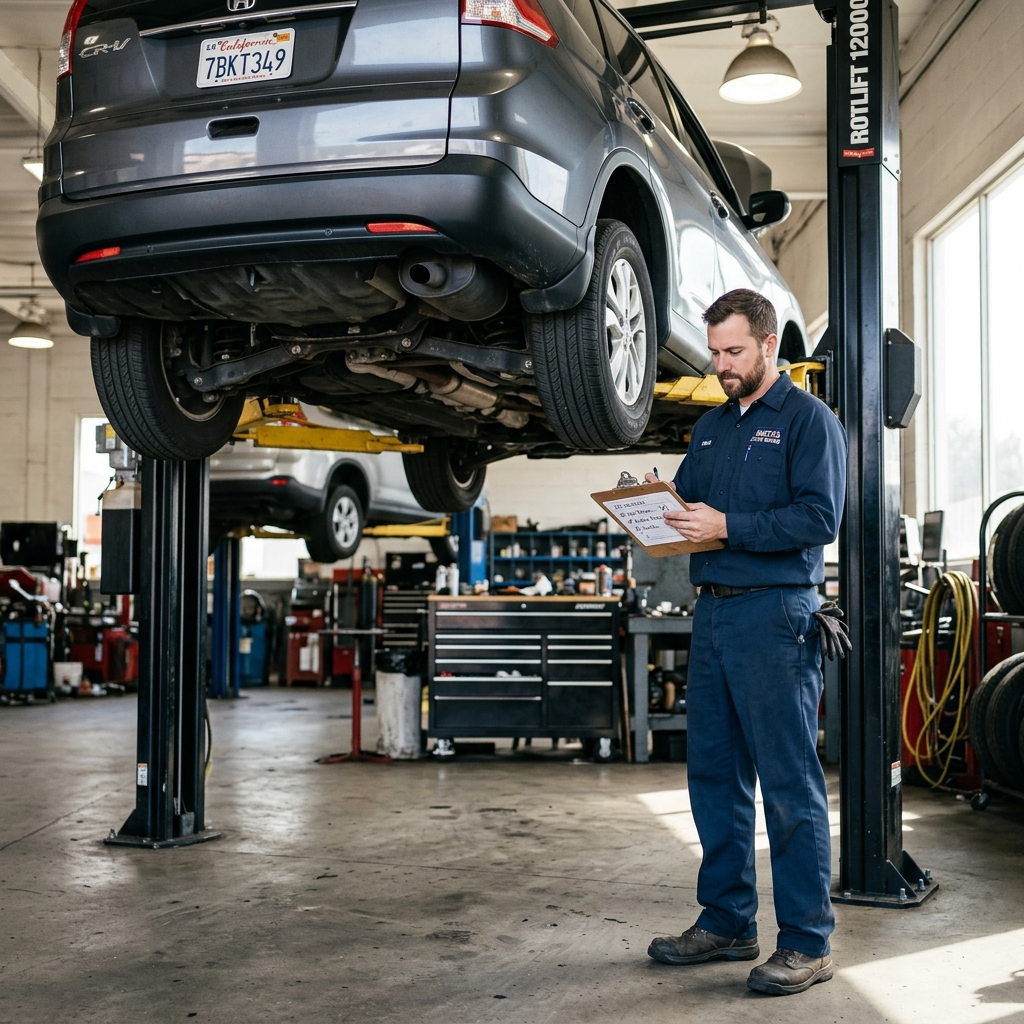
Digital vehicle inspections replace paper checklists with tablet- or smartphone-based tools that capture photos, videos, and technician notes in real time. The result is a shareable, timestamped record that customers can review on their own device before approving any work. This shift from paper to digital is one of the most measurable efficiency gains available to modern auto repair shops.
Why Photo-Rich Inspections Increase Approval Rates
Customers are far more likely to approve recommended repairs when they can see the problem themselves. A written note saying "brake pads worn" carries less weight than a photo showing metal-on-metal contact. According to, shops that adopt digital inspections consistently report higher average repair order (ARO) values — often 20–40% above shops still using paper forms.
Customers who see photographic evidence of a needed repair approve work at significantly higher rates than those who receive only a verbal or written description.
The trust factor compounds over time. A customer who receives a thorough photo inspection on their first visit is more likely to return for future service, because the shop has demonstrated transparency rather than simply asking for trust.
What a Digital Inspection Record Contains
A well-structured digital inspection includes:
- Photos and short videos of worn, damaged, or at-risk components
- Color-coded condition ratings (e.g., green/yellow/red) for each inspection point
- Technician notes tied to specific line items
- Timestamp and vehicle identification (VIN, mileage, date)
- A shareable link or PDF sent directly to the customer via text or email
This record also protects the shop legally. If a customer later disputes whether a condition was identified, the timestamped inspection report is documented evidence.
How Digital Inspections Fit Into the Shop Workflow
The efficiency gain goes beyond customer-facing transparency. In practice, digital inspections reduce back-and-forth between the technician, service advisor, and customer because all information travels through a single connected workflow.
Platforms like RedAppy integrate digital inspections directly with estimate generation, parts ordering, and invoicing. When a technician flags a worn component during inspection, the service advisor can build an estimate from the same platform without re-entering data. That estimate links to the inspection photos, so the customer sees the evidence alongside the price.
RedAppy's Kanban-style Digital Shop Board visualizes every job's status — from check-in through inspection, approval, repair, and checkout — so nothing falls through the cracks between stages. The board updates in real time, giving service advisors an accurate picture of shop capacity without making calls to the bay.
The built-in AI Repair Assistant supports technicians during the inspection itself, providing labor time estimates and diagnostic guidance on demand. This reduces the time spent looking up specifications and helps newer technicians work at a higher level of accuracy.
The Administrative Impact
Paper inspections generate manual work at every handoff: transcribing notes into an estimate, filing the paper form, and following up with the customer by phone. Digital inspections eliminate most of that overhead.
RedAppy reports that shops using the platform save more than 10 admin hours per week by connecting inspections to estimates, invoices, and customer communications in one system. Those recovered hours can be redirected toward additional vehicle throughput or customer service.
| Workflow Step | Paper Inspection | Digital Inspection |
|---|---|---|
| Inspection documentation | Handwritten form | Tablet with photos and notes |
| Customer communication | Phone call or in-person | Text/email with shareable link |
| Estimate creation | Manual re-entry | Auto-populated from inspection data |
| Record storage | Physical file | Cloud-based, searchable by VIN or customer |
| Approval tracking | Verbal or signed paper | Digital timestamp and confirmation |
Limitations to Consider
Digital inspections require upfront investment in devices, software, and technician training. Shops with limited tech adoption may face a transition period before efficiency gains materialize. In practice, the first 30–60 days often involve slower inspection times as technicians adjust to the new process.
Not every customer engages equally with digital reports. Some prefer a direct conversation with a service advisor. The most effective shops use digital inspections as a complement to human communication, not a replacement for it.
For shops evaluating digital inspection tools, the key features to look for are integration with existing shop management software, ease of use on the shop floor, and reliable customer delivery (text and email). A tool that creates additional data entry rather than eliminating it defeats the purpose.
A digital inspection is only as useful as the workflow it connects to — standalone inspection apps that don't link to estimates and invoices add steps rather than remove them.
Conclusion
A consistent vehicle inspection checklist is one of the most reliable tools a shop or vehicle owner has for maintaining safety, meeting legal requirements, and avoiding costly breakdowns.
Throughout this guide, the core principles remain constant regardless of the vehicle, the state, or the shop size:
- Checklists protect people. Systematic inspection catches worn brakes, failing tires, and inoperative lights before they cause accidents.
- Checklists protect shops. Documented inspections create a clear record of what was checked, what was found, and what the customer approved or declined — reducing liability exposure.
- Checklists drive revenue. Shops that inspect consistently and present findings clearly approve more work per repair order.
A missed inspection item is not just a safety risk — it is an undocumented liability that can affect the shop if a related failure occurs after the vehicle leaves the bay.
For car owners, understanding what a full inspection covers puts you in a better position to evaluate shop recommendations, prepare for state-mandated inspections, and make informed decisions on pre-purchase checks or seasonal maintenance.
For shop operators and service advisors, the shift from paper checklists to digital inspection tools represents a measurable improvement in consistency, customer trust, and average repair order value. When every technician follows the same structured process — covering tires, brakes, fluids, lights, belts, steering, and safety systems — fewer items are missed, and findings are easier to communicate.
Modern shop management platforms like RedAppy integrate digital inspections directly into the broader workflow: from the initial vehicle check-in through estimate approval, parts ordering, invoicing, and payment. That end-to-end connection means inspection findings do not get lost between the technician and the service counter. The result is a more efficient shop and a more transparent experience for the customer.
The fundamentals covered here — from the 60-plus checkpoint inspection categories to state fail criteria to recommended inspection frequency — form the foundation of a professional, repeatable inspection process. Whether you run a single-bay garage or a multi-location operation, the discipline of consistent inspection is what separates shops that customers return to from those they do not.
Frequently Asked Questions
What should I include on my vehicle inspection checklist?
A vehicle inspection checklist should cover tires (tread depth and pressure), brakes, lights (headlights, taillights, brake lights, turn signals), fluid levels (oil, coolant, brake fluid, transmission fluid), windshield wipers, battery, belts, hoses, and steering components. Safety systems like seatbelts, airbags, and mirrors should also be included. For commercial vehicles, add cargo securement, horn, and emergency equipment checks.
What should be included in an inspection checklist?
A thorough inspection checklist includes safety-critical items such as brakes, tires, lights, steering, and suspension, along with fluid levels, filters, and belts. It should also cover the vehicle's exterior condition, glass integrity, exhaust system, and emissions components. The specific items vary depending on whether it's a pre-trip, routine maintenance, or state-mandated safety inspection.
What does a full car inspection consist of?
A full car inspection typically covers 30–50+ checkpoints, including the engine, transmission, brakes, tires, suspension, steering, exhaust, fuel system, electrical systems, and all exterior and interior lighting. Technicians also inspect fluids, filters, belts, hoses, and safety features like seatbelts and airbags. Many shops follow a multi-point inspection format that takes 30–60 minutes to complete.
What will fail a car inspection in VA?
In Virginia, a vehicle will fail inspection for issues such as faulty brakes, worn tires (tread depth below 2/32"), non-functioning lights, cracked windshields obstructing the driver's view, excessive exhaust emissions, and inoperable safety equipment like seatbelts or horn. Steering and suspension defects, as well as damaged mirrors, can also result in a failure. Virginia law requires all registered vehicles to pass an annual safety inspection at a licensed inspection station.
Ready to Transform Your Shop?
RedAppy helps auto repair shops create professional digital estimates with photos and videos, send them instantly via text or email, and get customer approvals in seconds. No credit card required to start.