
Customer Acquisition Funnel: Tips for Auto Repair Shops
A shop can look busy all morning and still finish the week wondering where the booked work went. The phones ring, drivers visit the website, and someone asks for an estimate, yet the bays aren't consistently full. Often, the problem isn't a lack of attention. Customers are leaking out between the first search, the first contact, the estimate, and the appointment.
A customer acquisition funnel gives an owner a practical way to find those leaks. It connects marketing activity with what happens at the front desk and in the service bay, so the team can see whether a customer moved from interest to an approved repair, rather than just counting clicks or calls. For broader measurement ideas, the guide to offers useful context that can be adapted to local service businesses.
Table of Contents
- Introduction Why Your Shop Needs a Customer Acquisition Funnel
- What the Customer Acquisition Funnel Means for Auto Repair Shops
- The Four Stages of the Funnel and How to Measure Each One
- Tactics and Messages That Move Drivers Through Each Stage
- Where Most Shops Lose Customers and How RedAppy Fixes Friction
- Real World Examples of the Funnel in Action for Repair Shops
- Putting Your Funnel to Work and Turning Interest Into Booked Jobs
Introduction Why Your Shop Needs a Customer Acquisition Funnel
Consider a typical independent shop. A driver sees a search listing, visits the website, and calls during a busy repair. The advisor promises a callback, but a technician needs more information, another customer is waiting, and the callback slips. The driver contacts another shop. From the owner's viewpoint, marketing generated interest. From the customer's viewpoint, the shop never really entered the buying process.
That gap is the reason a funnel matters. It separates attention from action, then follows the customer through each handoff:
- Awareness: A driver discovers the shop through search, a referral, signage, or a local listing.
- Consideration: The driver checks services, reviews, availability, photos, and explanations.
- Conversion: The driver requests an estimate, approves work, and books a visit.
- Retention: The customer receives a clear experience, pays easily, and returns for future maintenance.
A shop can be strong at one stage and weak at another. A polished Google Business Profile may bring visitors, but a confusing contact form can stop them from becoming leads. A skilled technician may identify needed work, but an estimate without photos or a clear explanation can leave the customer uncertain. A well-performed repair may still fail to create retention if the shop doesn't record vehicle history or follow up appropriately.
Practical rule: More traffic won't repair a broken handoff. The first task is finding the transition where interested drivers stop moving.
The funnel also protects marketing spend. If the website receives attention but few visitors request help, the owner can improve the page and call to action before buying more advertising. If estimates are sent but appointments don't follow, the issue may involve trust, speed, payment options, or scheduling rather than awareness.
This view changes the weekly question from “How can the shop get more leads?” to “Which step is losing the most valuable opportunities?” That question gives owners a manageable starting point and creates a shared language for advisors, technicians, and managers.
What the Customer Acquisition Funnel Means for Auto Repair Shops
A driver may pass your shop, search for help later, compare nearby options, contact your team, approve a repair, and return for maintenance. Each step is a possible leak. Traffic enters at the top, but fewer drivers continue as they gain information and decide whether to trust the shop. The narrowing is normal. It reflects how people make decisions, not a sign the shop is failing to convert.
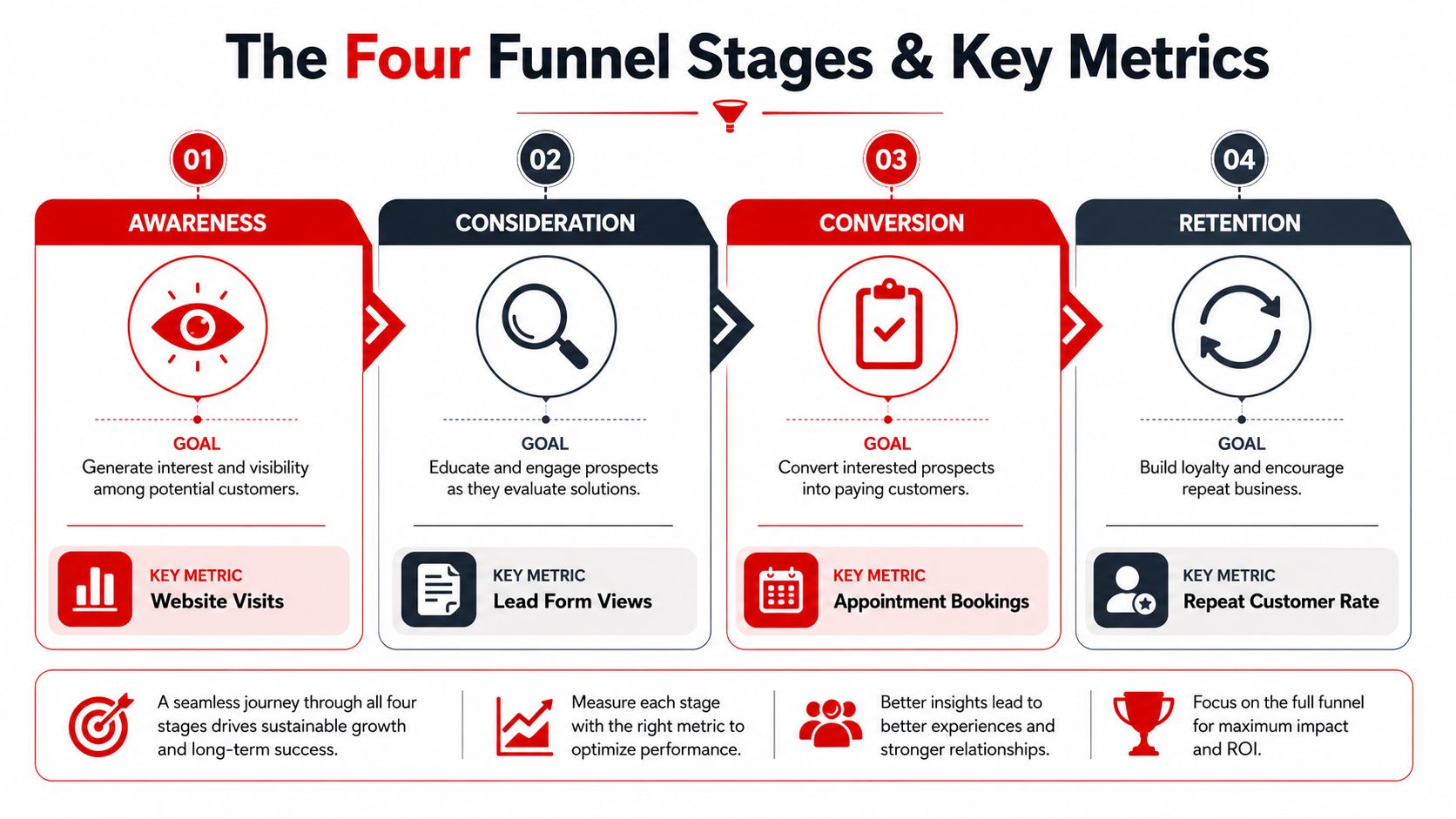
Awareness puts the shop on the driver's map
Awareness begins before a customer is ready to book. A driver may find the shop in local search, see a recommendation in a neighborhood group, or pass the building on the way to work. The shop needs to be recognizable and easy to understand when that moment arrives.
A clear website, accurate service information, useful photos, and a complete business listing answer the first question: “Can this shop handle my problem?” Helpful service pages and visible contact options reduce uncertainty. For independent shops, fast contact matters here because a driver who cannot reach the team may move to another option.
Consideration answers the trust questions
Customers compare more than price during consideration. They look for clear communication, convenient scheduling, careful vehicle handling, inspection evidence, and an explanation of what the technician found. Reviews, technician information, warranty details, and transparent service descriptions support that evaluation.
The next action should be obvious. A driver might request an estimate, ask a question, or select an appointment time. An urgent breakdown and a routine maintenance question should not be forced through an identical path. RedAppy can help the shop connect the right response to each inquiry, reducing the delay between interest and contact.
Conversion turns agreement into a booked repair
Conversion begins when interest becomes scheduled work. The customer responds to the estimate, approves the recommendation, selects a time, and arrives for service. A submitted form alone does not complete the process. The useful outcome is a job on the schedule that the shop can complete profitably.
Retention makes the funnel useful beyond one visit
Retention starts with the service experience. Accurate updates, digital inspection evidence, simple payment, useful vehicle history, and a clear explanation of future recommendations give customers reasons to return. RedAppy can help preserve those follow-up details so the relationship does not end at payment.
Owners seeking more can apply the same principle throughout the funnel. Match each message and action to the customer's stage, then inspect the handoff where drivers stop responding. That leak is usually a more useful place to begin than pursuing more traffic.
The Four Stages of the Funnel and How to Measure Each One
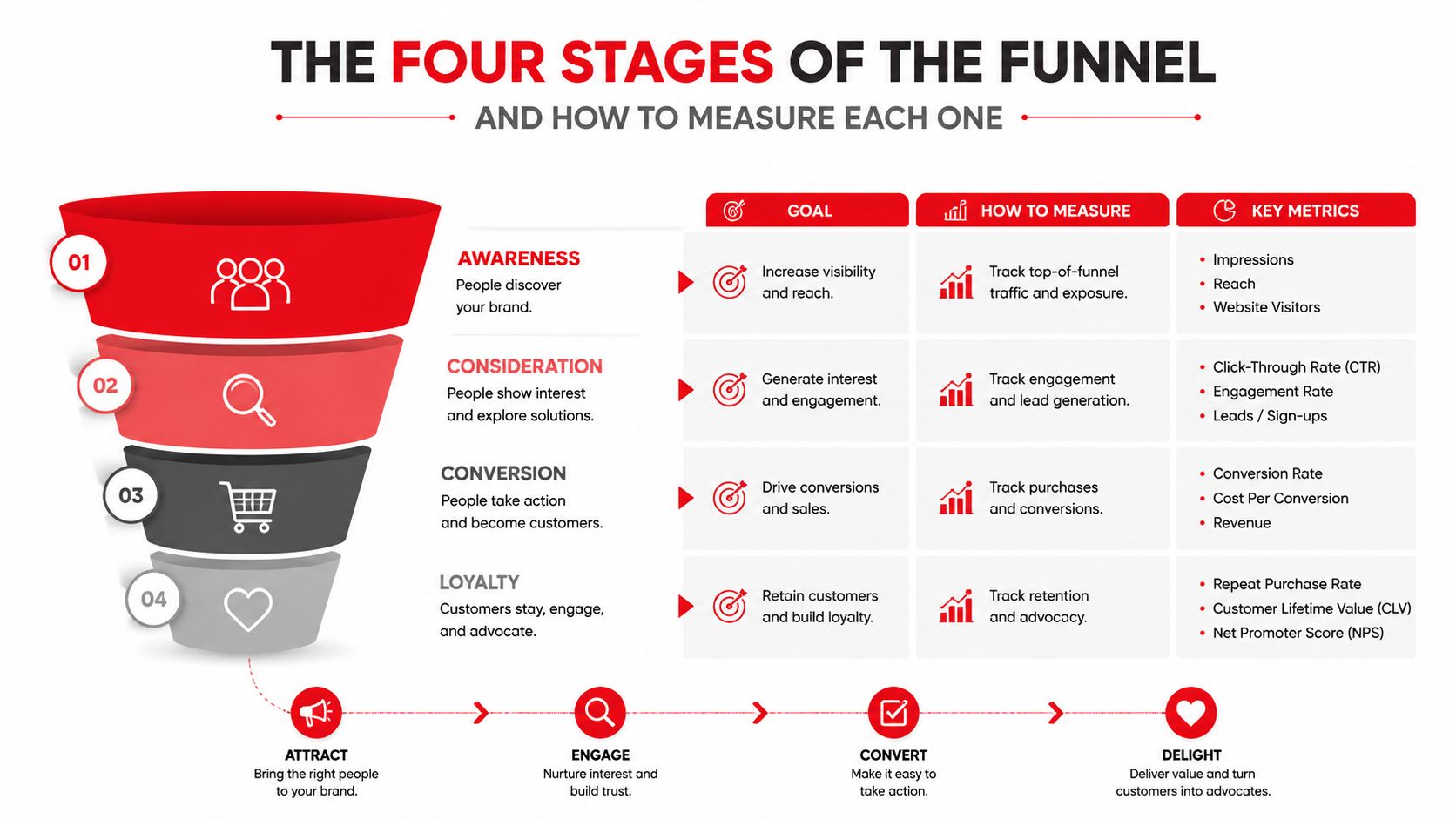
A funnel works like a leak check for an independent shop. It shows where a driver disappears, whether the problem is weak local visibility, slow contact, uncertain inspection evidence, or poor follow-up after the repair. Each stage needs a clear purpose, a signal that shows progress, and a practical measurement method. RedAppy can help connect those signals across the customer path, so owners can fix the largest leak before spending more on traffic.
Awareness
Awareness creates qualified local attention. Useful signals include website visits, calls from new customers, map interactions, referral mentions, and visits to service pages. The useful question is whether those visitors match the vehicles, services, and location the shop can support. Traffic volume alone cannot show that.
Benchmark data provides reference data, but auto repair behavior will not match every B2B market. One summary reports that website visitors commonly convert into leads at roughly 1% to 3%, while overall captured-lead-to-customer conversion is about 2% to 5%. Those figures appear in. Expect meaningful drop-off and measure the local path instead of assuming every visitor should call.
Consideration
Consideration reveals whether a visitor finds enough relevance and trust to take the next step. Track contact-form starts, completed quote requests, calls, appointment-page visits, and engagement with inspection or service pages. Many visitors with few inquiries points to a problem with the page, the offer, or the contact path.
RedAppy can help the shop connect inquiry details with the appropriate response, which makes speed-to-contact easier to review. Record the source when possible. Referral visitors, paid-search visitors, and returning customers may behave differently, and combining them can hide the strongest acquisition path.
Conversion
Conversion is the handoff from qualified interest to scheduled, approved work. Review response time, estimate delivery, estimate approval, appointment booking, show-up rate, and completed repairs. These measures expose issues that a lead count conceals. A shop may receive plenty of inquiries yet book little work because advisors respond slowly or appointment choices are difficult to find.
Benchmark ranges show the value of examining each handoff. Other B2B summaries place lead-to-MQL conversion at 25% to 35%, MQL-to-SQL at 13% to 26%, SQL-to-opportunity at 50% to 62%, and opportunity-to-close at 15% to 30%, as reported by. An auto repair owner can apply the same logic to inquiry, qualified repair need, estimate approval, and booked work.
Retention
Retention shows whether a completed job leads to another useful interaction. Track returning customers, future maintenance appointments, declined-work follow-up, review requests, and referrals. A customer who returns for the next service interval has moved beyond acquisition and become a longer-term business relationship.
A short weekly review can ask four questions:
- Where did new inquiries originate?
- How quickly did the team respond?
- How many estimates became booked work?
- Which completed customers returned or referred someone?
The weakest answer identifies the first repair opportunity. Fixing that transition usually creates more value than adding another report.
Tactics and Messages That Move Drivers Through Each Stage
A driver's question changes as the funnel progresses. At discovery, they ask whether the shop handles their problem. During comparison, they look for evidence and confidence. Once an estimate is ready, they need clear recommendations and an easy way to approve the work. Each leak point needs a message that answers the question in front of the customer.
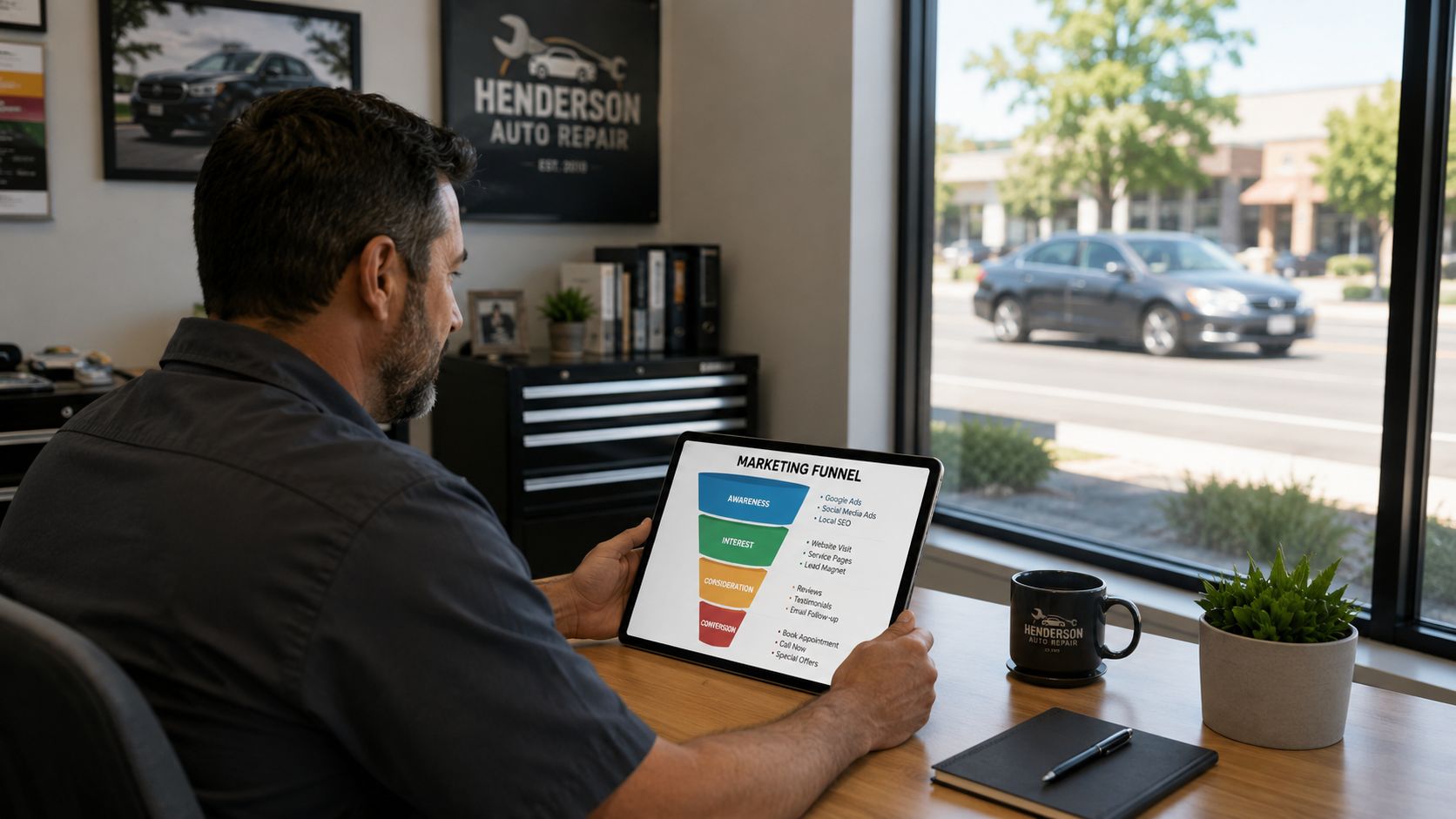
Make local relevance obvious at awareness
A driver searching for help needs to recognize the shop quickly. Build a professional, mobile-ready website around the service area, vehicle types, and common repairs. A headline such as “Brake and maintenance service for drivers in the local area” provides immediate context. Place the phone number, hours, location, and request-help path where visitors can find them without extra searching.
A complete Google Business Profile, consistent service descriptions, community referrals, and useful educational pages can support discovery. For a multi-location operation, each branch needs its own location details, phone routing, hours, and appointment availability. Clear routing prevents a driver from wondering which shop can handle the vehicle.
Show inspection evidence during consideration
A customer comparing shops may hesitate because the technician's findings are invisible from the waiting room. Photo-rich digital inspections, short videos, plain-language explanations, and organized estimates make the recommendation easier to understand. Explain the vehicle's condition, the consequence of waiting, and the next step without depending on technical terms alone.
For a single-location shop, an advisor can send a brief personal explanation with the inspection. A chain can use one inspection format while allowing each location to add relevant notes. In both cases, the evidence supports an informed approval and gives the customer a reason to trust the recommendation.
Remove work from the conversion path
Start with the booking experience on a phone. Ask only for details the team needs to respond, confirm that the request arrived, and show what happens next. Online estimates and one-click payments can reduce back-and-forth. Text and email delivery also give the customer a convenient way to review the recommendation.
Match the call to action to the driver's situation. “Request a diagnostic appointment” fits a warning light. “Schedule your next maintenance visit” fits a routine service reminder. A vague “Learn more” button leaves the driver guessing and adds another decision before contact.
Keep the vehicle relationship active after payment
The final invoice does not have to end the conversation. Provide the completed inspection, explain future recommendations, and make the next visit easy to schedule. A useful vehicle history lets the advisor continue from the previous repair instead of asking the customer to repeat every detail.
Front-desk standard: Every customer should know what was found, what was completed, what can wait, and what action comes next.
Where Most Shops Lose Customers and How RedAppy Fixes Friction
More traffic sounds like the obvious growth answer, but traffic doesn't compensate for a broken response process. One funnel analysis reports a 96% drop from ad click to website, a 98% drop from website to contact, a 53% drop from contact to appointment, and an 80% drop from appointment to sale. Those figures appear in. The exact pattern will vary by shop, but the diagnostic point is powerful: post-click and post-lead friction can outweigh weak awareness.
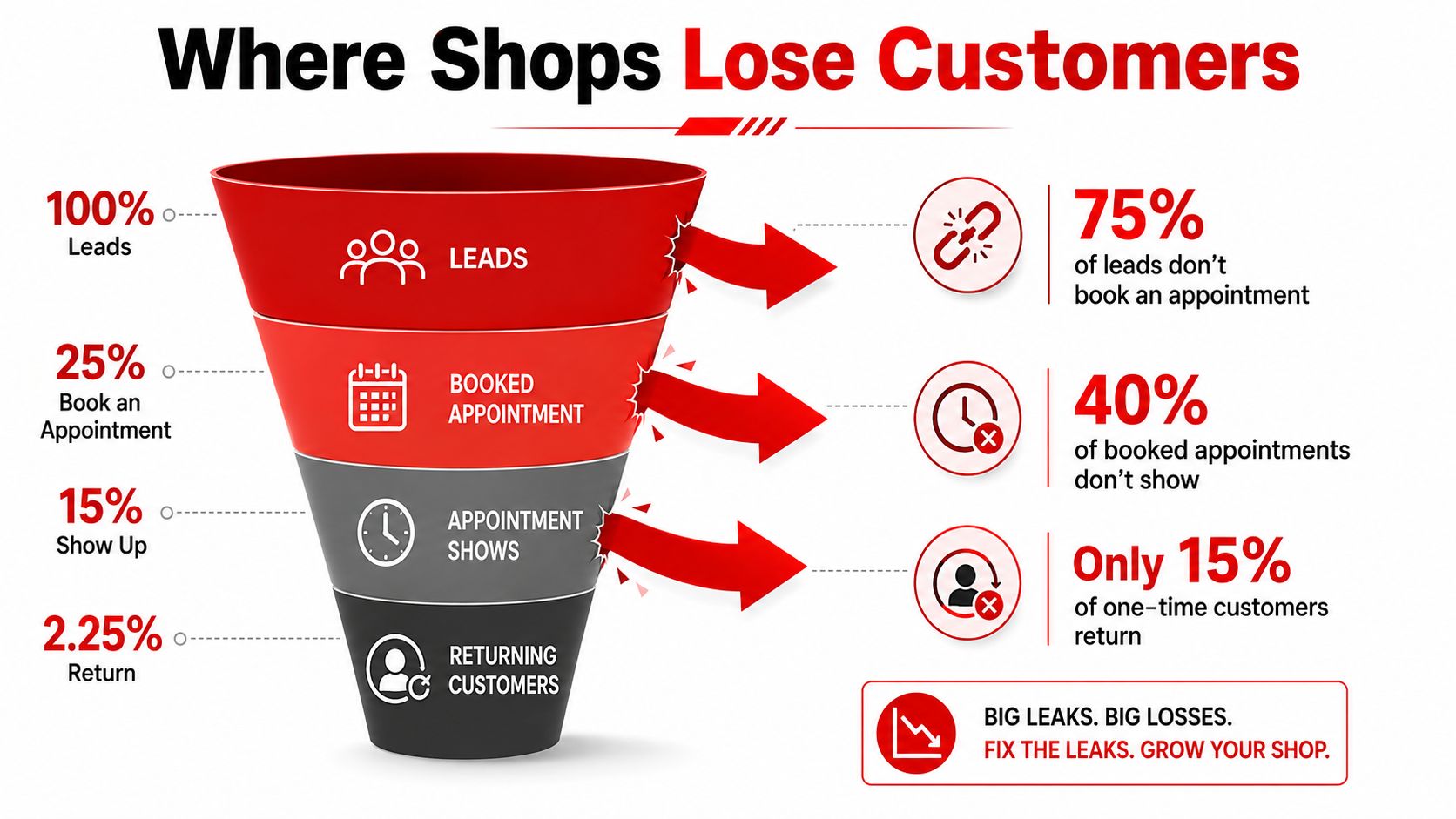
The first leak is often response speed. An independent lead-response analysis reports that inquiries answered in less than five minutes convert at 11.4%, compared with 4.1% for responses taking one to four hours and 0.6% after more than twenty-four hours, an 18.3-times gap between the fastest and slowest groups. The figures are documented in. A shop doesn't need more clicks if its current inquiries wait until the opportunity has cooled.
RedAppy can address several handoffs in one operating workflow. Its branded website includes contact forms for quote requests and appointment inquiries. Digital inspections can include photos and videos, while estimates can be sent by text or email for customer approval. Online payments and one-click invoicing reduce the final administrative step, and the Kanban-style Digital Shop Board gives the team a shared view of jobs from check-in through checkout.
The value lies in connecting the stages. Real-time analytics can help an owner compare inquiries, approvals, completed work, revenue, technician efficiency, average repair order, and repeat business. Customer lookup by name, plate, or VIN and centralized vehicle history can also reduce front-desk delays when a returning driver calls.
A sensible diagnostic order is:
- Response leak: Check whether new inquiries receive a prompt, assigned response.
- Trust leak: Review whether inspections clearly show the condition and recommended repair.
- Booking leak: Test whether approval leads naturally to a time on the calendar.
- Payment leak: Remove unnecessary steps between completed work and payment.
- Retention leak: Record future recommendations and make the next visit easy to arrange.
Real World Examples of the Funnel in Action for Repair Shops
A single-bay independent shop may have strong word-of-mouth but no consistent digital path. Drivers hear the name from friends, search for the shop, and find an outdated page with no clear request form. When the advisor is under a vehicle, messages wait until the end of the day. Customers who do reach the shop receive verbal recommendations, but some struggle to understand why the repair matters.
The owner can repair that journey without changing the shop's identity. A professional website with a direct contact form gives referrals somewhere useful to go. A fast acknowledgment sets expectations, and a photo-rich inspection gives the advisor evidence to share by text. An estimate with a clear approval option turns a conversation into a decision, while vehicle history helps the next visit begin with context rather than repetition.
The improvement is visible in the workflow even before an owner studies a large dashboard. Fewer inquiries sit unassigned, customers can review findings away from the counter, and approved work has a clearer path to the schedule. The shop isn't chasing every driver in the area. It's helping interested drivers continue.
A growing multi-location chain faces a different problem. Each branch may use its own forms, inspection language, follow-up habits, and customer records. A driver who visits one location and calls another can be treated like a new customer, while regional managers struggle to see where inquiries stall.
The chain can standardize the funnel without making every location sound identical. Location pages and routing direct customers to the right branch. Shared inspection and estimate formats create consistent trust signals. Centralized lookup by plate or VIN gives advisors useful history, while a shared board and analytics view expose branch-level bottlenecks.
Repeatable playbook: Give every entry point a clear next action, every inspection a visible explanation, every estimate a simple approval path, and every completed repair a reason to return.
Putting Your Funnel to Work and Turning Interest Into Booked Jobs
A working funnel doesn't require a complete marketing overhaul. It requires a defined path and an honest look at each handoff. The owner can start with a small operating checklist:
- Record how new customers discover the shop.
- Track response time for every inquiry.
- Count estimates sent, approvals received, and appointments booked.
- Identify the transition with the largest loss.
- Fix that transition before adding more traffic.
- Review returning customers and declined work as part of the same system.
The most useful dashboard is the one the team can act on. A manager should be able to see whether an inquiry has an owner, whether the customer received an inspection or estimate, whether approval reached the calendar, and whether the completed job created a future opportunity.
RedAppy brings website forms, digital inspections, estimates, payments, scheduling, vehicle history, shop-board workflow, and analytics into the operational path from first contact to final payment. Shop owners can review the RedAppy features and compare those tools with the leak points already visible in their own process.
RedAppy connects customer acquisition with the work that follows, including branded website forms, photo-rich inspections, digital estimates, online payments, scheduling, and shop-floor visibility. Visit RedAppy to explore the platform or contact the team for a practical conversation about turning more inquiries into approved, booked repairs.
Ready to Transform Your Shop?
RedAppy helps auto repair shops create professional digital estimates with photos and videos, send them instantly via text or email, and get customer approvals in seconds. No credit card required to start.