
Do Auto Shops Do Payment Plans? What to Check First
Yes, many auto shops offer some way to spread out a repair bill, but most do it through a third-party lender or a deposit arrangement rather than an informal plan run by the shop itself. The important question isn't just whether a customer can get approved, but whether the payments will still fit alongside ordinary bills after the car leaves the shop.
What good is an affordable-looking monthly payment if it leaves nothing for groceries, insurance, or the next unexpected expense? For customers, the answer starts with the total repayment cost. For shop owners, it also means understanding who provides the credit, who collects the money, and who handles problems when a repair changes.
Table of Contents
- Whether Auto Shops Offer Payment Plans and What Options Exist
- Why Repair Bills Push Customers Toward Payment Options
- How the Money Moves Between Customer, Lender and Shop
- Test Whether the Payment Fits Your Budget
- Hidden Costs and Disputes in Repair Financing
- How Shops Can Offer Payment Plans Step by Step
- Compare the Shop Offer and Take Action
Whether Auto Shops Offer Payment Plans and What Options Exist
Many auto shops offer payment options, but the arrangement may be financing, a short shop-run agreement, or a deposit followed by payment at pickup.
Payment options for auto repairs at a glance
| Option | Who the Customer Owes | Typical Terms | Main Risk |
|---|---|---|---|
| Shop internal payment plan | The shop | A few short installments set by the shop | Missed payments may delay vehicle release or lead to collections, subject to the agreement and applicable law |
| Third-party installment loan | Finance company | Fixed monthly payments over months at a disclosed APR | Interest and fees can substantially increase the repair's total cost |
| Buy now, pay later | BNPL provider | Short series of installments | Late fees and possible credit checks |
| Deferred-interest promotion | Lender | Promotional interest-free period, with deferred interest if conditions are missed | A missed payoff requirement can trigger a high financing cost |
| Credit card | Card issuer | Repayment at the card's APR | Carrying the balance adds interest; purchase protections depend on the card and transaction |
| Deposit or staged approval | The shop | Part paid upfront, balance at pickup | This isn't ongoing financing, so the customer may still need to postpone work |
Payment timing isn't the same as financing
A deposit reserves funds for the repair but doesn't necessarily let the customer drive away while owing the balance. Staged approval means authorizing separate portions of work, not automatically receiving credit.
Customers comparing outside borrowing can use BadCreditMD's as a starting point for identifying alternatives. The actual lender agreement should still determine the comparison, including charges, payment frequency, and repayment conditions.
The phrase do auto shops do payment plans therefore needs a follow-up question: which kind? A manageable option must fit the customer's budget after the repair is finished, not merely make the estimate easier to approve.
Why Repair Bills Push Customers Toward Payment Options
Repair bills are difficult because the expense and the need for transportation often arrive together. A customer may need the car for work but lack the cash to authorize the repair immediately.
The found that 59% of U.S. adults experienced a major unexpected expense during the previous twelve months; vehicle repair or replacement was the most common category at 30%, compared with 22% for a major house or appliance repair and 21% for a major medical expense. Among respondents who knew their vehicle-related expense amount, the median fell between $1,000 and $1,999.
Why available cash matters
In the same survey, 63% could cover a hypothetical $400 emergency using cash, savings, or a credit card paid off at the next statement; the remaining 37% would need to borrow, sell assets, or use another approach.
A repair bill works like a toll that comes due all at once. A payment arrangement can let the customer cross now and pay in stages, but the toll hasn't disappeared.
Practical distinction: Spreading out a bill changes when the customer pays. It doesn't necessarily reduce what the customer owes.
Consider a driver who needs brake work before returning to a daily commute. Payment options may help that customer authorize necessary work instead of postponing it, provided the repayment terms are workable.
For future repairs, offers a separate preparation resource. Building savings won't solve an immediate breakdown, but it can reduce reliance on financing later.
A service advisor can start with a typical customer's circumstances: essential transportation, ordinary household expenses, and limited spare cash. Can that customer realistically pay the full estimate at once?
How the Money Moves Between Customer, Lender and Shop
Consider a customer who receives an estimate and chooses shop-arranged financing. The repair shop performs the work, but a separate company may provide the money.

Following a repair from estimate to repayment
- The shop provides a written estimate. The customer reviews the proposed work before choosing how to pay.
- The customer selects a payment route. Lender financing requires a separate application and agreement, rather than an informal promise to the service advisor.
- The lender approves the application or another arrangement is agreed. If financing is declined, the shop may discuss a deposit or safely staged work instead.
- The shop receives funds under the provider's settlement terms. Funding timing, merchant charges, and reversal rules should be clear before the shop relies on the approval.
- The customer repays the named creditor. Under third-party financing, that creditor is the lender, not the mechanic.
Industry coverage from describes arrangements that pay shops upfront or within several business days. That doesn't establish a universal funding promise, so each shop should review its own provider agreement.
With a shop-run plan, the shop collects installments and carries the risk of nonpayment itself. Receiving a customer's authorization isn't the same as receiving cleared funds.
Financing and payment processing are different
The explains that APR includes interest and applicable fees, and that the federal Truth in Lending Act requires disclosure of key terms before the borrower becomes legally obligated. Fixed-rate financing keeps the interest rate and scheduled payment unchanged over the loan term.
Processing a card payment is a different money path. With RedAppy, online customer payments go straight to the shop's own Stripe account, and Stripe pays out to the shop's bank. RedAppy never holds the shop's money.
Before offering a lender's product, the shop should confirm who owns collections, who answers account questions, and who handles adjustments. Staff need a clear contact route when a customer's loan balance doesn't match the repair invoice.
Test Whether the Payment Fits Your Budget
A monthly payment needs to fit the household, not just the repair estimate. Approval doesn't establish whether the customer can comfortably cover rent, transportation, food, utilities, and existing debt.
For a hypothetical example, consider a $1,200 repair, a $200 down payment, and six monthly payments. That leaves $1,000 financed, or about $167 per month before interest or fees.
If that same hypothetical household pays $1,400 in rent and $350 on an existing car loan, those obligations plus the repair installment already total about $1,917 per month, before insurance, groceries, utilities, and other expenses. The repair payment can look modest in isolation while leaving the household short overall.
A household affordability check
- Start with the written repair balance. Include approved work and subtract any deposit or confirmed payment from another party.
- Establish the actual installment. Dividing principal by the installment count gives only a baseline. Use the lender's payment schedule to include interest and fees rather than adding the APR percentage to the balance.
- List existing obligations. Include housing, the current vehicle loan, insurance, utilities, other debt, and essential living costs.
- Compare against take-home pay. Use income after tax and leave room for emergencies, irregular expenses, and changes in working hours.
- Reconsider if little remains. Compare another lender, a credit card, or a smaller repair scope that the technician confirms is mechanically and safety-wise appropriate.
Check payment timing as well as amount
A monthly budget can appear balanced while the bank account runs short between paydays. Short installment schedules deserve particular attention because several withdrawals may fall near rent or an existing loan payment.
The customer should place every due payment on a calendar alongside income and essential bills. Automatic payment is convenient only when sufficient funds remain available.
A payment that works only if nothing else goes wrong isn't affordable.
Hidden Costs and Disputes in Repair Financing
An interest-free headline doesn't establish that a repair loan is inexpensive. The agreement determines what happens when a customer pays late, misses a promotional payoff requirement, or needs the repair invoice changed.
The describes certain 90-day interest-free offers that can carry rates as high as 189% APR if promotional conditions aren't satisfied. In a described structure, avoiding deferred interest requires repayment of the entire amount financed plus a $40 fee before the promotional deadline.
Those are specific product examples, not the terms of every repair payment plan. They demonstrate why the promotional label can't replace reading the agreement.
Deferred interest isn't the same as waived interest
With deferred interest, the lender may charge interest associated with the promotional period if the customer fails to satisfy its conditions. A minimum scheduled payment may not be enough to clear the promotional balance in time.
Before signing, the customer should establish:
- The exact payoff deadline. The agreement should make clear when the lender must receive payment.
- Whether interest is deferred or waived. These terms can produce very different outcomes.
- The full promotional payoff amount. Fees may remain payable even when an offer advertises no interest.
- Payment allocation rules. The customer needs to know which balance receives each payment.
- Late or partial payment consequences. A smaller payment may not preserve the promotion.
- The product type. An installment loan, deferred-interest agreement, and lease-to-own arrangement shouldn't be treated as interchangeable.
The highlights concerns involving promotional borrowing, late fees, eligibility, and balances affected by refunds or canceled work. Customers should also establish whether an eligibility check is soft or hard before submitting an application.
A customer who qualifies for credit may still struggle with a short repayment schedule. Rent, insurance, and an existing auto loan remain payable while the repair debt is being cleared.
Repairs can change after financing is arranged
A technician may discover additional damage after disassembly. A customer may cancel work after parts have been ordered, or an insurer may approve less than the repair estimate.
These events affect the repair account and financing account differently. A shop's agreement to issue a refund doesn't prove that the lender has already reduced the customer's balance.
Common payment disputes and how to prevent them
| Dispute | Usual Cause | Prevention |
|---|---|---|
| Refund after a canceled repair | Parts ordered or labor already done | State cancellation and restocking terms on the estimate |
| Supplement after approval | Hidden damage found mid-repair | Get written approval before any added work |
| Payment allocation disagreement | Unclear how payments are applied to the balance | Keep receipts and a full payment history |
| Insurer short-pay | Insurer pays less than the estimate | Confirm the customer's share before arranging financing |
| Balance after a dispute | Customer still owes the lender after a shop dispute | Explain in writing who the customer owes for each part of the bill |
The shop should document the approved repair amount, the financed amount, and any later adjustment. When a refund is due, staff should identify who initiates it, where the funds go, and how the customer can confirm the updated balance.
Customers shouldn't assume that disputing workmanship automatically suspends lender payments. They should obtain written instructions from the creditor about the account while the repair dispute is addressed.
Make the consequences visible before work begins
A plain-language financing disclosure should accompany the estimate. It should show the APR, fees, payoff requirements, and consequences of late or incomplete payment without relying on a verbal explanation alone.
For insurer-covered work, staff should verify the customer's responsibility before arranging financing. Financing an assumed deductible while overlooking another unpaid portion creates an avoidable reconciliation problem.
If the promotional conditions are difficult to meet, the customer should evaluate the offer as a high-cost loan rather than count on the advertised promotion.
How Shops Can Offer Payment Plans Step by Step
A shop needs a repeatable process before staff start presenting payment choices. Consistent paperwork protects the customer's understanding and gives the shop a usable record when balances or approvals are questioned.
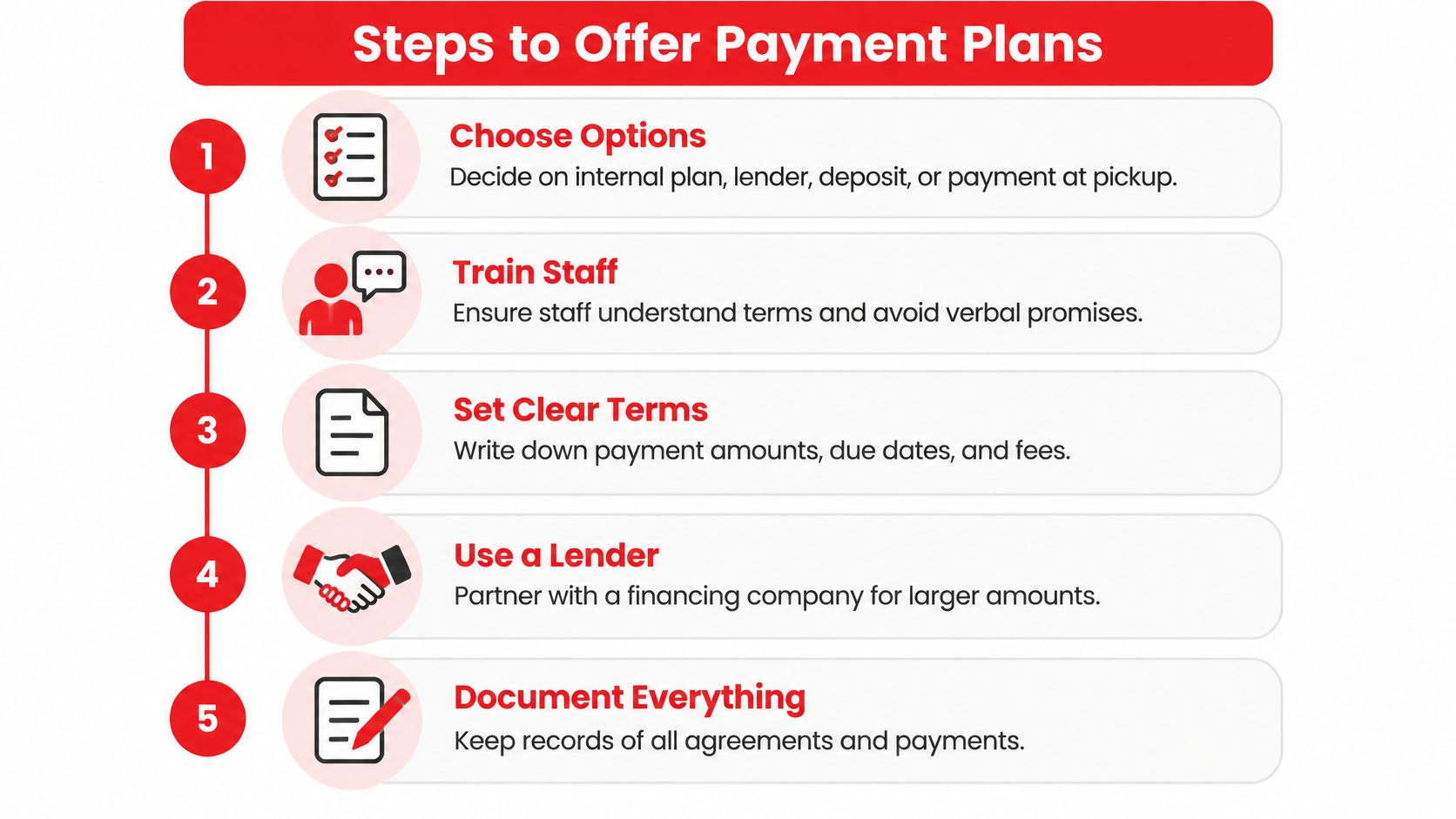
Build the agreement before collecting payments
Decide which options the shop will offer. Establish whether staff can offer an internal plan, lender financing, a deposit, or payment at pickup, and identify who can approve exceptions. This prevents a service advisor from making a verbal promise that the written agreement doesn't support.
Prepare an itemized estimate. List parts and labor separately, include the total, and identify the proposed repair scope. Quoting only a monthly figure prevents the customer from comparing the repair itself with other estimates.
Present the payment terms. Show the APR where applicable, fees, due dates, payoff amount, and late-payment consequences before work starts. Staff shouldn't describe a financed repair as free or substitute a promotional slogan for the actual agreement.
Obtain a recorded approval. In RedAppy's estimate approval process, a customer receives the estimate by SMS or email, opens a link, reviews the labor, parts, and total, and approves it from a phone. A phone conversation without a retained record leaves uncertainty about the authorized scope.
Keep the balance connected to the repair
Record the down payment and every installment. Issue a receipt and apply each payment to the correct invoice so the remaining balance can be reconciled. A separate notebook or informal message thread makes it harder for another employee to answer a billing question accurately.
Send a supplement before adding work. Explain the newly discovered issue, the added cost, and any effect on the payment arrangement, then wait for recorded approval. A customer's original authorization shouldn't be treated as permission for every later repair.
Close with the final payment record. Confirm the shop's balance and provide the customer with the complete payment history. If a lender remains owed, distinguish a settled shop invoice from a fully repaid financing account.
The shop should also decide who reviews unpaid balances and who communicates with the financing provider. Assigning those responsibilities avoids a situation where each employee assumes another person has handled the issue.
Train staff to explain the difference
A service advisor should be able to explain each offered option in a sentence: who receives payment, when payment is due, and whether borrowing costs apply. Staff should also know when to stop and direct a financing question to the lender rather than guess about contractual terms.
A useful final check is whether another employee could reconstruct the agreement from the saved estimate, approvals, invoice, and receipts. If that record is incomplete, the process needs attention before the shop expands its payment options.
Compare the Shop Offer and Take Action
The shop's offer is a starting point, not an obligation. A customer can compare it with a credit card, a personal loan, or borrowing available through a bank or credit union.
The advises avoiding loans above 36% APR and explains that a separately obtained lower-rate loan may be preferable to a difficult-to-complete interest-free promotion. Its guidance also notes that credit cards may offer purchase-related protections that some specialized repair-financing arrangements lack.
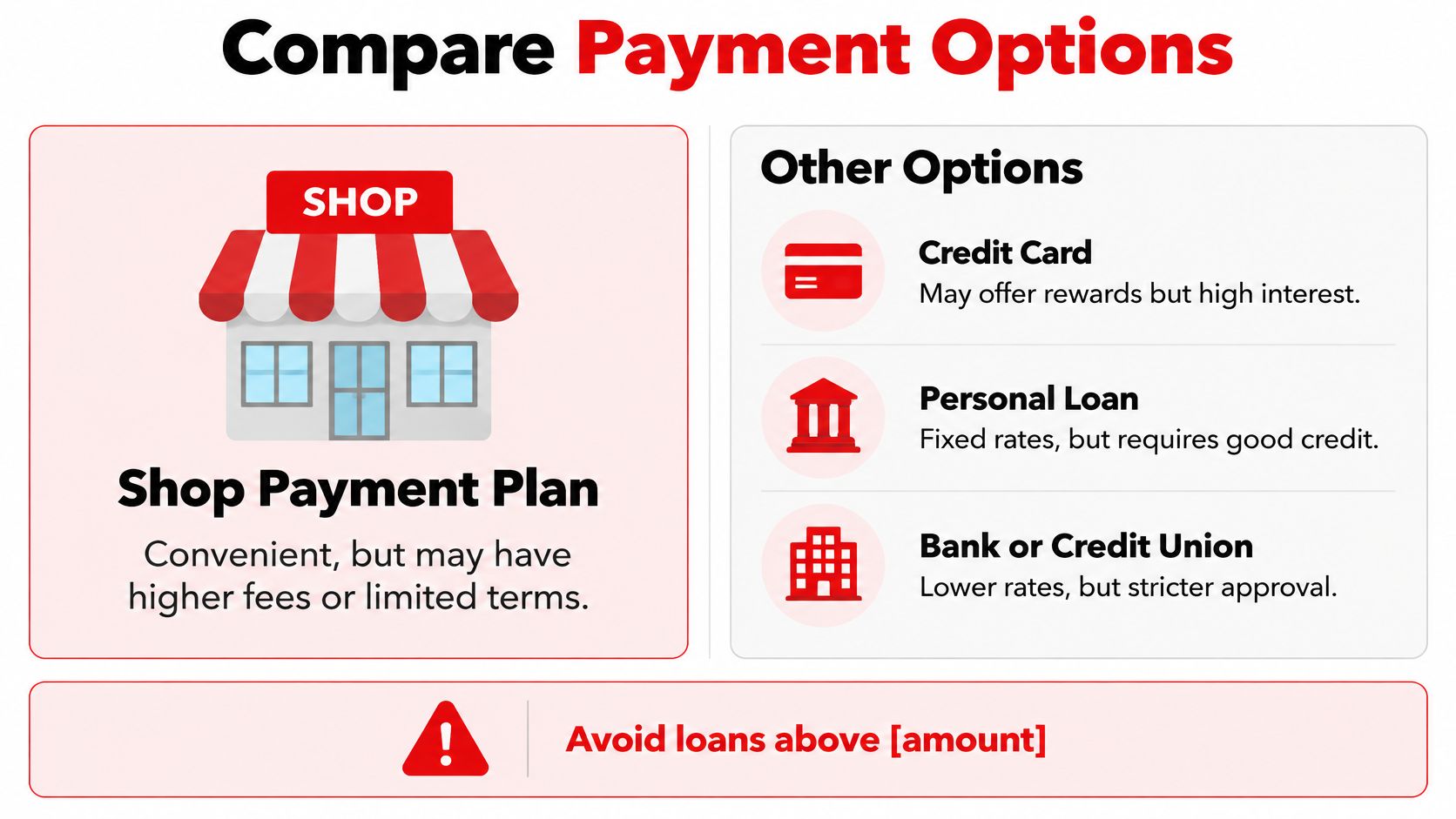
Compare actual offers, not payment labels
A credit card isn't automatically cheaper than shop-linked financing. A personal loan isn't automatically affordable because its payment is fixed, and a bank or credit union offer still needs a full cost review.
Each available agreement should be compared using:
- Repair balance and down payment. Confirm how much work is being purchased and how much borrowing is necessary.
- Installment count and frequency. Compare the entire schedule, including any larger final payment.
- APR and finance charges. Establish the borrowing rate and the money charged for financing.
- Total repayment. Include required payments and fees without counting the same charge twice.
- Late-payment rules. Identify charges and any effect on promotional terms.
- Credit checks. Establish whether checking eligibility or completing the application involves a hard inquiry.
For a hypothetical $1,200 repair with a $200 down payment and six monthly payments, the comparison should add the down payment, all scheduled installments, and any separate required fees. The amount above $1,200 is the price of using that plan rather than paying the repair bill in full.
A lower installment can conceal a longer repayment period. Comparing totals makes that trade-off visible without assuming that the shortest or longest agreement is necessarily the best choice.
Questions for customers and shop owners
Customers should ask whether the shop accepts other payment methods and whether the written estimate separates parts and labor with a clear total. They should retain the estimate, financing agreement, approvals, receipts, and any cancellation or refund correspondence.
For shop owners, RedAppy supports partial payments, including deposits, split payments, and payment plans, and tracks payment history automatically. Payments can be accepted online or recorded as cash, check, card, or financing in one place.
A shop can contact the RedAppy team to discuss how these payment workflows would fit its operation, or review the payment and estimate features before choosing a system. The operational question is whether staff can connect the approved work, collected funds, and remaining balance without creating a separate manual record.
The total cost and payment terms should be confirmed in writing before any repair is authorized.
RedAppy connects estimates, customer approvals, invoices, and partial-payment records so shops can manage repair payment arrangements with clearer documentation. Shop owners can visit RedAppy to explore a workflow that keeps the repair agreement and payment history together.
Ready to Transform Your Shop?
RedAppy helps auto repair shops create professional digital estimates with photos and videos, send them instantly via text or email, and get customer approvals in seconds. No credit card required to start.