
Estimate Form for Auto Repair: Approval Tips
The customer is already standing at the counter, looking at a repair estimate that says too little and costs too much. The service advisor knows the car needs work, but the form on the screen only gives a vague total, a few short descriptions, and no clear reason for the price. That's usually the moment approval gets delayed, because a weak estimate form for auto repair doesn't just miss details, it misses trust.
A strong estimate does the opposite. It shows the vehicle story in a way that makes sense to a skeptical owner, from the problem seen at check-in to the parts, labor, taxes, authorization, and any later changes that come from teardown. The best forms don't feel like paperwork, they feel like proof.
Table of Contents
- Why Most Auto Repair Estimate Forms Fail Customers
- Required Fields Every Estimate Form Must Include
- Structuring Labor Calculations on Your Estimate
- Handling Hidden Damage and Estimate Revisions
- Digital vs Paper Estimate Workflows
- Practical Tips for Winning More Estimate Approvals
Why Most Auto Repair Estimate Forms Fail Customers
A front-desk writer prints an estimate, slides it across the counter, and watches the customer squint at one big number. There's no clear split between parts and labor, no explanation of what was inspected, and no note about what happens if teardown reveals more damage. The customer doesn't hear a plan, they hear a bill.
That's why generic templates fall flat. They capture the basics, but they don't guide the conversation from concern to confidence. A strong form should show what's wrong, what gets repaired, what gets replaced, and why the price exists, not just list a total that feels detached from the vehicle in the bay.

The trust gap starts with vague wording
Customers are rarely objecting to the existence of labor or parts. They're objecting to the feeling that the shop hasn't shown its work. When a form says “repair front end” instead of naming the actual operations, it creates suspicion where clarity should be.
Practical rule: if a customer can't point to a line and understand why it's there, that line will get questioned.
The estimate becomes more persuasive when it breaks the job into recognizable pieces. Itemization helps the customer see that the shop has thought through the repair instead of tossing out a number and hoping for the best. That's also where transparency on parts sourcing matters, because parts condition and selection affect both price and confidence.
A good form doesn't oversell. It makes the decision easier by turning a repair into a readable story. That's why the estimate is often the first sales document in the shop, even though many teams still treat it like a back-office form.
Required Fields Every Estimate Form Must Include
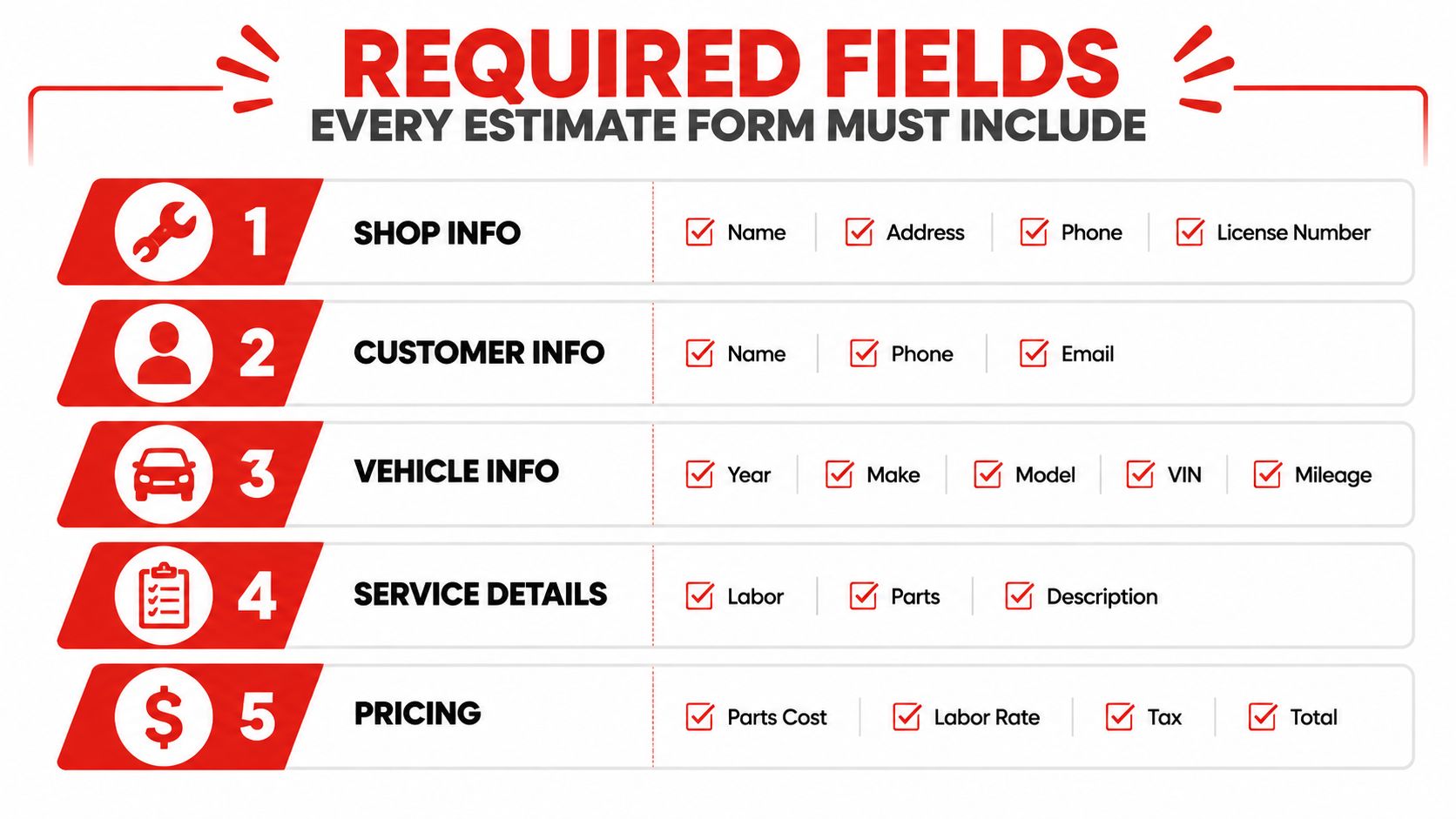
A compliant estimate starts with identity. The shop's name, address, phone number, and the customer's contact details need to be easy to read, because a repair document that can't be tied to the right vehicle and right person causes confusion later. A usable template also captures year, make, model, VIN, license plate, and mileage, since those identifiers anchor the job to the correct car and the correct service history.
Build the form from top to bottom
The next block should cover the repair itself. That means parts listed line by line, including part number, quantity, and price per unit, plus labor descriptions, labor total, and tax details, matching the structure shown in standard template examples from. The same structure appears in a sample repair form that includes estimate number, promised date, delivered date, VIN, odometer, labor description, part number, quantity, unit price, parts total, labor total, and tax rate, which is exactly the level of specificity that prevents arguments later.
Authorization closes the loop. A customer signature block is more than a formality, it documents approval before work proceeds, which is why a compliant auto repair estimate should always include a repair authorization signature. A template guide for repair estimates also shows that the customer's name, contact information, vehicle identifiers, and authorization all belong on the same document, because the estimate is both a pricing sheet and a consent record.
The estimate isn't finished until the customer has a clear place to approve it.
State rules add another layer. Florida requires disclosure of the shop's and customer's names, addresses, phone numbers, the date and time, vehicle identifiers, the proposed completion date, charging method, estimated cost, payment method, guarantee terms, and whether replaced parts may be saved. Michigan requires parts to be identified by condition, such as new OEM, OEM surplus, used, rebuilt, or reconditioned, and it requires the actual dollar amount for shop supplies rather than a percentage. Those details turn a generic form into one that can stand up to a dispute.
For shops also managing payment requests, can help keep the post-approval handoff cleaner, especially when the estimate already spells out what was authorized.
Audit checklist for a working form
- Shop identity: business name, address, phone, and internal estimate number.
- Customer identity: full name, contact details, and a signature line.
- Vehicle data: year, make, model, VIN, license plate, and mileage.
- Repair detail: parts, labor, quantities, part condition, and descriptions.
- Pricing detail: labor total, parts total, tax, fees, and the final authorization total.
Structuring Labor Calculations on Your Estimate
Labor causes the most friction because customers can see a part, but they can't easily see time. The cleanest estimate form for auto repair shows labor as a calculation, not a guess. That means the line item should explain the operation, the estimated hours, and the hourly rate when the shop is billing that way, or a clear flat-rate description when the job is priced differently.
Hourly work and flat-rate work need different presentation
Collision work is often billed by the hour, while some maintenance jobs fit a flat-rate structure, which is why a single universal layout rarely works well. A labor section that treats both models as interchangeable usually confuses the customer and weakens the advisor's explanation. Industry guidance also notes that U.S. auto service technicians had a median wage of $23.88 per hour in 2024 in a widely used template reference, which shows why labor timing and rate selection sit at the center of the form.
| Labor Pricing Structures Compared | Best For | How to Display on Form | Customer Clarity |
|---|---|---|---|
| Hourly repair labor | Collision work, diagnostic-heavy repairs | Operation name, estimated hours, hourly rate, labor total | High when the steps are itemized |
| Flat-rate service labor | Routine maintenance, fixed-scope services | Service name and flat labor amount | High when the scope is narrow |
| Mixed labor with diagnostics | Complex repairs that start with testing | Diagnostic line separate from repair labor | Better than bundling everything into one total |
Diagnostic time should stand apart from repair time whenever the shop charges that way. When the customer sees one line for testing and another for the repair itself, the estimate reads like a plan instead of a padded invoice. That separation also helps when multiple jobs share teardown steps, since overlap can be explained instead of hidden inside a lump sum.
Shop supplies and fee lines need real amounts
Vague percentage-based add-ons weaken trust fast. If the form includes shop supplies or similar charges, the better practice is to list the actual dollar amount, especially in states that require it. That keeps the estimate readable and makes the final bill easier to defend.
A clean labor section does one more thing well. It gives the advisor a straightforward script at the counter, which matters when the customer is deciding whether the car gets fixed now or parked until later.
Handling Hidden Damage and Estimate Revisions
A lot of estimates die after teardown, not before it. The walkaround looked fine, the first estimate seemed complete, then the technician removed the bumper or trim and found damage the eye couldn't see. Basic templates rarely prepare a shop for that moment, even though that's where real disputes begin.
Supplements need their own workflow
California's Bureau of Automotive Repair requires an estimate before repairs, itemization of parts and labor, and documented customer authorization for any estimate details that change. It also says records must be kept for at least three years, which makes the estimate a legally auditable document, not just a quote sheet. That matters because every revision needs a traceable path.
Hidden damage is normal. Missing documentation is what turns it into a problem.
A revision-ready form should leave room for version tracking, whether that's a new estimate number, a change log, or a clear supplement section. Hidden damage should be scoped separately from unrelated damage so the customer can see what was already there and what the teardown uncovered. That distinction protects the shop when an unrelated issue shows up during inspection and someone later tries to fold it into the original repair conversation.
Modern vehicles make this even more important. An industry estimate guide says estimators should include procedures like painting, blending, or ADAS calibrations when applicable, and should also include sublet operations. That's the gap most templates miss, because they still act as if every repair is visible during the first walkaround. In practice, the form needs space for calibration notes, outsourced operations, and labor assumptions that may change after deeper inspection.
A revision-ready sequence keeps the file clean
- Teardown happens first.
- Hidden damage gets photographed and recorded.
- The estimate is updated with new line items.
- The customer authorizes the change.
- Repair work resumes with the supplement attached.
That workflow keeps the shop from rewriting the whole job every time new information appears. It also gives the front desk a clean answer when the customer asks why the total changed after disassembly.
Digital vs Paper Estimate Workflows
Paper still works, but it slows the conversation. A printed estimate has to be reviewed in person, amended by hand, and stored carefully so the changes don't disappear into a file cabinet. Digital estimate tools move faster because photos, line items, and approval requests can travel together instead of separately.
What each format does well
Paper gives some customers comfort because they can sign on the spot and walk away with a physical copy. It also suits shops that still rely on carbonless forms or need a simple backup when internet access is unreliable. The downside is obvious in daily workflow, handwritten corrections are harder to track, and revision history can get messy fast.
Digital workflows handle approval and revision much better. Photos can sit next to the estimate line that explains the damage, which makes the conversation easier for customers who don't speak shop language. Many platforms also connect estimates to invoicing, parts ordering, and the shop board, so the advisor doesn't retype the same job details three times.
| Workflow Choice | Strong Point | Weak Point | Best Use |
|---|---|---|---|
| Paper | Easy to sign and file | Harder to revise cleanly | Smaller counters, simple jobs |
| Digital | Faster approval and cleaner revisions | Needs a system and staff adoption | Busy shops, multi-step repairs |
The ideal setup is often mixed. A shop can keep paper for customers who want it while using digital estimates for photo-rich inspections and faster approvals. The important part is consistency, because compliance doesn't disappear just because the format changed.
For shops that want a single platform instead of stitched-together tools, RedAppy offers digital estimates with photos and videos, plus instant estimates and online approval flow, so the estimate can move into the rest of the job without re-entry.
Practical Tips for Winning More Estimate Approvals
Customers approve work faster when the advisor leads with the vehicle problem, not the total. A safety issue, a drivability issue, or a clear reliability concern gives the estimate context. Once the customer understands the consequence, the price usually lands better.
Make the estimate easy to defend
Photos and inspection notes matter because they show the customer what the shop saw. When a damaged part is visible in a photo, the line item stops feeling arbitrary. If the repair includes OEM versus aftermarket choices, explain the trade-off plainly and keep the wording tied to the actual part on the form.
A useful outside reference on the customer side is, especially when a shop wants to prepare for common objections before they reach the counter. That kind of preparation helps the advisor keep the conversation focused on the repair, not on defending a mystery number.
Small presentation choices change approval rates
- Lead with the concern: open with safety, drivability, or reliability before price.
- Split big jobs into smaller decisions: avoid one intimidating total when the work can be reviewed in logical pieces.
- Use direct descriptions: replace vague phrases with visible operations the customer can picture.
- Follow up without pressure: a declined estimate still needs a clean callback when the timing is better.
The weakest forms bury the important parts under clutter. The strongest ones make it easy for the customer to say yes because the estimate looks organized, honest, and complete.
If the current process still feels manual, RedAppy can centralize digital estimates, photos, customer records, and invoicing in one system, which helps a shop move from first inspection to approval without rebuilding the same information twice. Visit RedAppy to see how a connected estimate workflow can fit the way a real repair counter runs.
Ready to Transform Your Shop?
RedAppy helps auto repair shops create professional digital estimates with photos and videos, send them instantly via text or email, and get customer approvals in seconds. No credit card required to start.