
Handling Difficult Customers in Auto Repair Shops
A customer stands at the counter with the invoice in hand. The repair cost more than expected, the vehicle still has the same warning light, or nobody called to explain that a part was delayed. The customer is angry, the advisor is looking for the right words, and the shop's records may or may not show exactly what was approved.
That moment can feel like a personality clash. Often, it's an operational problem arriving at the front desk: unclear expectations, a changed diagnosis, a missed update, or an approval that's hard to verify. Handling difficult customers starts before the conversation gets heated, with a process that makes the work, cost, timing, and next step clear to everyone.
Table of Contents
- Why Auto Repair Disputes Usually Start Before the Wrench Turns
- Setting Expectations Before the Car Hits the Bay
- De-Escalation Scripts That Work at the Counter
- The Four-Stage Recovery Protocol for Upset Customers
- When to Escalate and How to Protect Your Staff
- Using Digital Inspections and Approvals to Remove Disputes
- Training Drills, Templates, and the Metrics That Tell You It's Working
Why Auto Repair Disputes Usually Start Before the Wrench Turns
A customer who disputes an invoice may not be arguing about the math alone. They may be reacting to a repair that didn't solve the problem, a part that arrived late, or work they don't remember approving. If the advisor starts by defending the technician or repeating the original estimate, the customer can hear evasion instead of an explanation.
J.D. Power's 2025 U.S. Aftermarket Service Index, based on 10,348 vehicle owners, identified repairs that failed to correct the issue and unavailable parts among the leading problems customers encountered. The same index identified keeping customers informed, focusing on their needs, prompt advisor contact, and post-service follow-up among the most influential satisfaction measures. (J.D. Power's U.S. Aftermarket Service Index)
Those are not problems a soothing tone can fix by itself. A respectful conversation matters, but it won't make a delayed part arrive or prove that a customer authorized additional work. The advisor needs to find out whether the dispute is about the outcome, the price, the timing, the communication, or a combination of them.
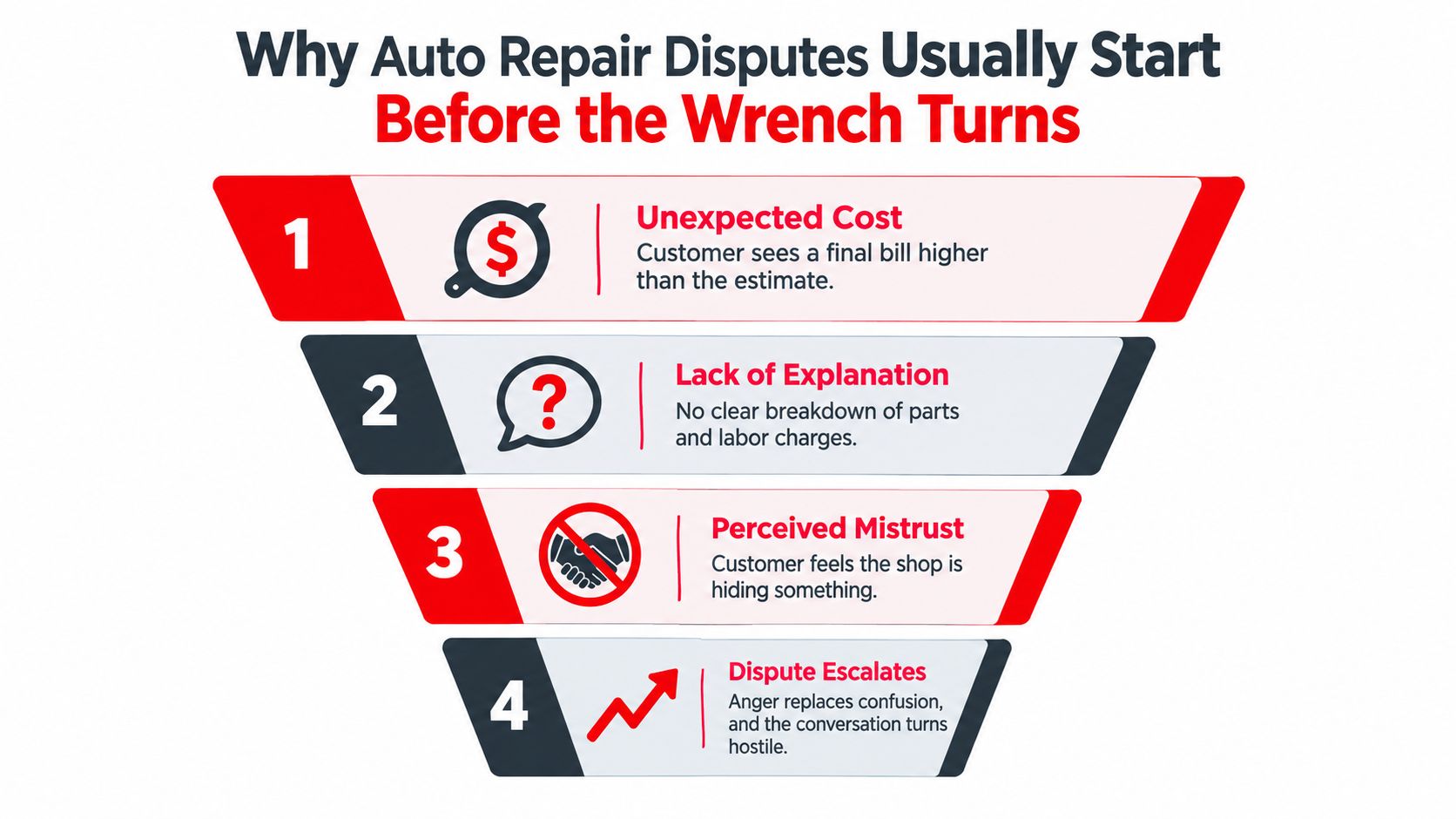
A useful first question is, “What part of this feels most unresolved right now?” Then check the inspection, estimate, approval history, parts status, and promised completion time against the answer. That moves the exchange from accusation to a problem the shop can investigate.
Counter rule: Don't argue about the customer's attitude before you understand the gap between what the shop promised and what the customer experienced.
Setting Expectations Before the Car Hits the Bay
The best time to prevent a counter dispute is before diagnosis begins. At intake, the advisor should establish what the shop will inspect, which diagnostic steps can incur charges, how the customer will be asked to approve more work, and when the next update will arrive.
Authorization needs to be clear and recorded. The Texas Attorney General advises getting written authorization before actions such as towing, inspecting, test-driving, diagnosing, or disassembling a vehicle when those actions may generate estimate-related charges. California's Bureau of Automotive Repair likewise says work shouldn't begin and charges shouldn't accrue before authorization, and requires a revised work order and recorded approval before additional charges are incurred.
A customer arranging an appointment can also review the steps involved in, a useful example of setting expectations before a vehicle arrives.
Confirm symptoms, contact, and timing
Ask the customer to describe the symptom in their own words, including when it happens and whether it's intermittent. Repeat the description back: “So the noise starts during a cold start, then fades as the engine warms up. Is that right?” This gives the technician a usable concern to investigate and gives the customer a chance to correct a misunderstanding.
Name one point of contact and agree on how approval requests will arrive. Avoid promising a firm finish time before the shop knows the diagnostic findings or parts availability. A safer promise is a specific time for the next update, even if the repair plan is still uncertain.
| Situation | Expectation to set | How to document |
|---|---|---|
| Towed-in vehicle | Explain which inspection or diagnostic steps may be chargeable before they begin. | Record the approved actions and charges on the work order. |
| Repeat repair concern | Confirm the unresolved symptom and review the prior repair history before offering a remedy. | Link the new complaint to the prior visit and record findings. |
| Possible parts delay | Explain that timing may change if the part isn't available, and name the next update time. | Log the parts status, customer contact, and revised timing. |
De-Escalation Scripts That Work at the Counter
An upset customer doesn't need a polished speech. They need to see that the advisor is listening, checking the facts, and taking ownership of the next action. A calm tone helps, but the words matter most when they lead to something concrete.
Automotive complaint data points to a gap between what customers wanted and what they said they received: 91% of unhappy customers wanted the vehicle fixed properly, while 28% reported receiving that outcome. 62% wanted a chance to vent, but 4% said they got one; 67% wanted an apology, while 7% reported receiving one.
Start by listening, then restate the complaint
Don't interrupt to explain why the technician did what they did. Let the customer finish, then say: “You brought the car in for the vibration, you still feel it, and you weren't told we'd need to keep it longer. Have I got that right?” Specific restatement gives the customer a chance to correct the record and gives the advisor an actionable issue.
Avoid “That's not what the technician said” or “You must have misunderstood.” Those phrases put the customer on trial before the shop has checked its own records.
Verify before offering a remedy
Say: “I'm going to check the inspection, the approval, and the repair notes before I tell you what we can do.” Then look at the vehicle history, work order, estimate, authorization, parts status, and promised timing. If the record is incomplete, say so plainly and bring in a manager rather than filling the gaps with assumptions.
A discount offered too early can sound like a way to end the conversation without fixing the problem. First establish what happened and what can be done. Then name the next step and when the customer will hear back.

If the discussion becomes loud or personal, offer a private handoff: “Let's move somewhere quieter so we can go through the paperwork together.” The change of setting can reduce the audience effect without dismissing the customer's concern.
The Four-Stage Recovery Protocol for Upset Customers
A complaint needs a repair plan, not just a softer conversation. The recovery should make clear what the shop will do now, what it will change to prevent a repeat, and how both sides will know the problem is resolved.
Listen and restate what the shop must address
First, let the customer explain without interruption. Then restate the concern in operational terms: “The vehicle returned with the same warning light after the repair, and you want us to establish whether the original issue was corrected.” That wording separates what the customer experienced from what the shop still needs to verify.
Separate immediate correction from prevention
The immediate remedy might involve reinspecting the vehicle, correcting workmanship, continuing diagnosis, or explaining why the symptom has another cause. Prevention is different: identify whether the root cause was a diagnostic miss, a communication breakdown, a parts issue, or unclear authorization, then decide what the shop should change.
A study analyzing 428 respondents found that perceived fairness during service recovery was a significant driver of satisfaction. Customers satisfied with the recovery showed significantly higher trust, more positive word-of-mouth, and stronger loyalty than dissatisfied complainants, but the research didn't support a complete recovery paradox: a good response didn't necessarily restore satisfaction to the level customers would have had without the original failure.
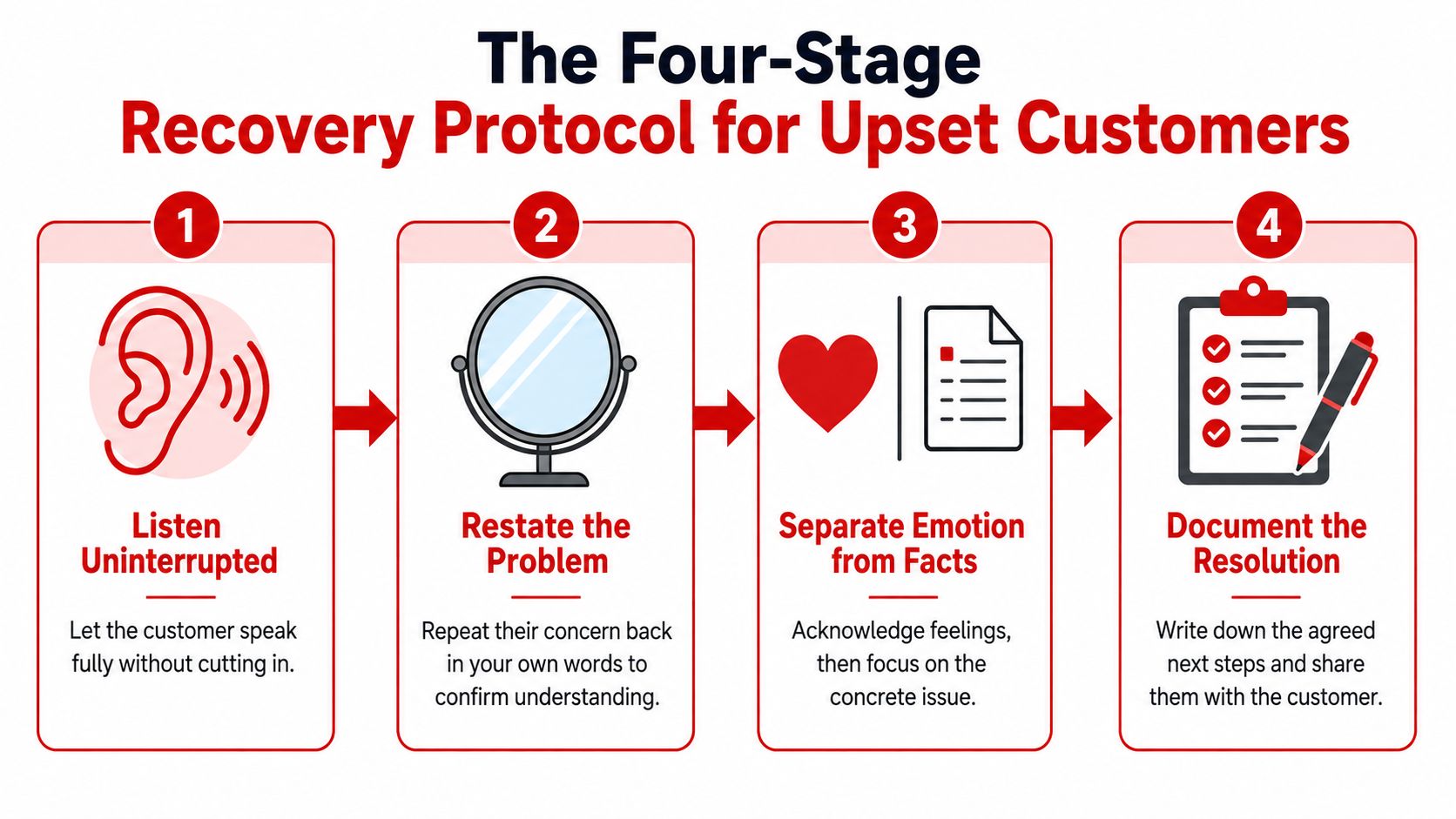
Document the action and close the loop
A dated action plan should identify the owner, the next step, and the condition that counts as resolved. For example: “The service manager will road-test the vehicle and review the prior diagnostic notes. If the warning returns, the shop will continue diagnosis and contact the customer before any added charge or work.”
Close the loop at the time promised, even if the answer is that diagnosis is still underway. A customer can often tolerate uncertainty better than silence, particularly when the shop states what it knows, what it hasn't confirmed, and when the next update will come.
When to Escalate and How to Protect Your Staff
A customer-service policy that protects customers but leaves staff to absorb threats or abuse isn't a complete policy. An advisor who feels unsafe can't focus on explaining an estimate or finding a fair remedy. Protecting employees helps preserve the experienced team members customers rely on for clear information.
A 2025 Perceptyx survey of more than 21,000 public-facing employees found that 53% had recently encountered abusive or unruly customers. Employees who experienced such behavior were 1.9 times more likely to feel unsafe, 2.2 times more likely to say workplace stress affected their physical health, and 81% reported burnout.
The shop should give every employee authority to pause a conversation and call a manager. Staff shouldn't have to decide alone whether a threat is serious enough to act on.
Set thresholds and matching responses
- Frustration: Keep the conversation focused on the vehicle, the evidence, and the next step.
- Profanity: Set a boundary and give a clear warning: “We can work through the repair issue, but the conversation needs to stay respectful.”
- Threats or intimidation: End the interaction and bring in a manager immediately. Don't leave one employee alone to manage a safety risk.
- Discrimination or stalking: Pause or terminate the exchange, involve a manager, and follow the shop's incident and safety procedures.
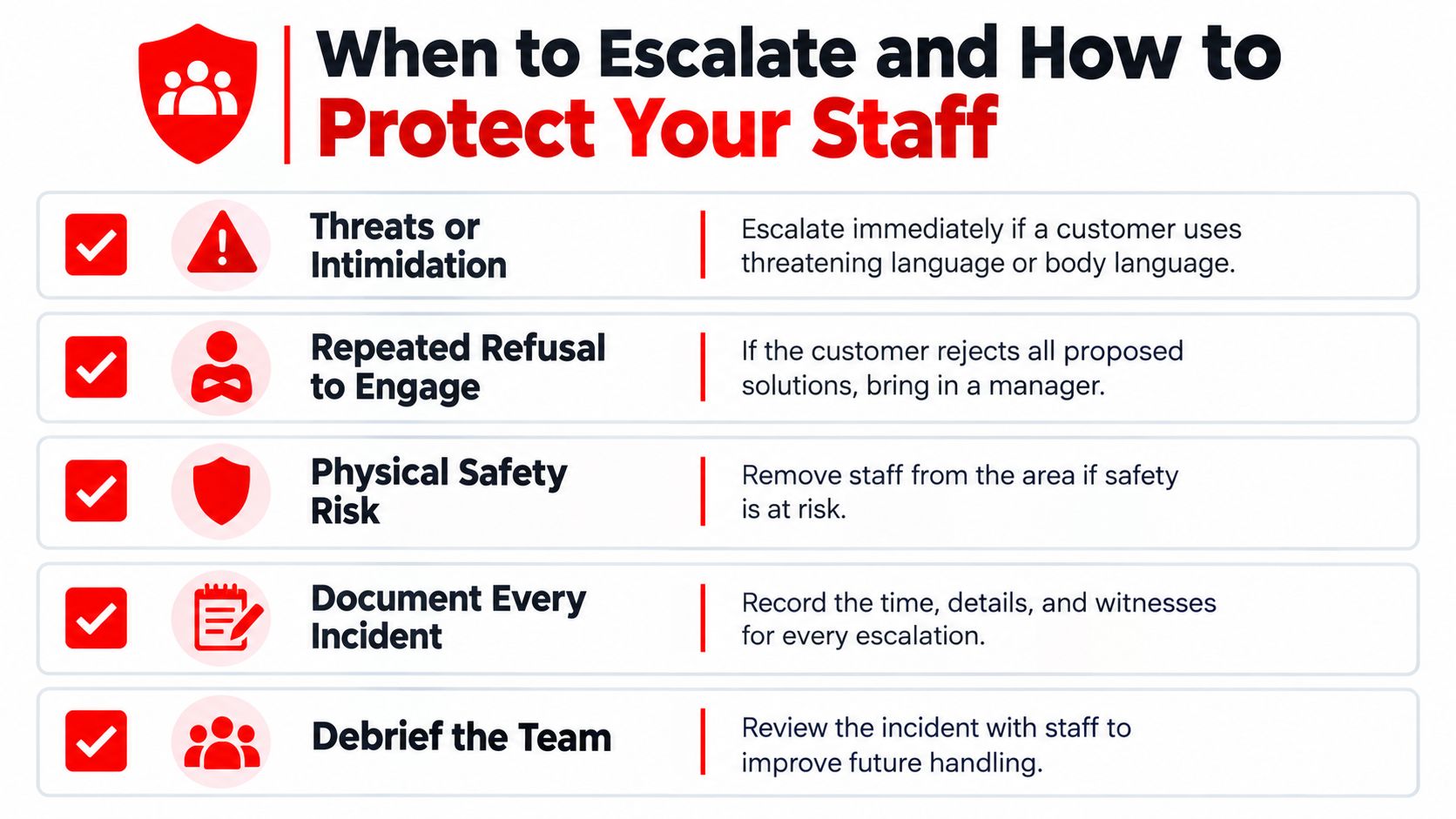
After an incident, record what happened, who was present, and what action staff took. A manager should check in with the employee before expecting them to return immediately to a customer-facing role. The team also needs a clear route to building security or police when a threat creates an immediate safety concern.
Using Digital Inspections and Approvals to Remove Disputes
When a customer says, “Nobody told me that,” the shop needs more than a confident recollection. It needs a record both the advisor and customer can review: inspection photos, an itemized estimate, the approval, any revision, and the messages about parts and timing.
A practical workflow starts with a digital inspection. The technician records the finding and attaches photos or video, the advisor sends the itemized estimate, and the customer approves or declines the work before it proceeds. If the diagnosis changes or a part is delayed, the advisor sends an update and records the revised plan rather than relying on a verbal exchange that may be remembered differently later.
Stop when the scope or cost changes
Several U.S. consumer-protection regimes use an estimate threshold around 10%, though the rule depends on the location and estimate type. Washington generally prohibits charging more than 10% above an itemized estimate without prior approval; Illinois limits overages on an itemized estimate to 10%; New Mexico requires new authorization when repairs exceed the estimate by the greater of 10% or $50.
The safe operating practice is simple: when the projected cost crosses the applicable threshold, stop, issue a revised estimate, and obtain explicit approval before proceeding. The same discipline applies when the repair scope changes, even if the original estimate hasn't been exceeded.
A customer portal can give drivers a place to review repair information and updates without depending on a phone call. A is one example of a customer-facing tool shops can consider as part of that communication workflow.
Automatic discounts aren't a substitute for evidence or authorization. Clear photos, a revised estimate, and a recorded approval can answer the actual dispute. Digital tools such as RedAppy support photo-rich inspections, estimates sent by text or email, customer approvals, and shop workflow records, which can help keep that shared history in one place.
Training Drills, Templates, and the Metrics That Tell You It's Working
A policy only helps when the front desk can use it under pressure. Managers can make the response repeatable by practicing realistic disputes, reviewing the records staff need to check, and measuring whether customers get a clear answer without repeated calls or reopened arguments.
A short monthly drill can use an anonymized complaint from the shop's own history. One employee plays the customer, another handles the conversation, and a manager observes whether the advisor listened, restated the issue accurately, separated the immediate remedy from prevention, and documented the next step. After the role-play, the team should identify which record would have prevented the disagreement from forming.
Ten minutes a month is enough. Advisors who have rehearsed the hard conversations stay calmer when a real one lands at the counter.
Put the response standard in writing
A shop handbook can state the process plainly:
- Intake: Confirm the symptom, possible diagnostic charges, contact method, and next update time.
- Authorization: Record the approved work and obtain renewed approval before proceeding with added charges or a changed scope.
- Escalation: Let staff pause a conversation, require a manager for threats or identity-based abuse, and end interactions that create a safety risk.
- Documentation: Save inspection findings, estimates, approvals, communications, promised timing, and the resolution.
Track whether the process works, not just how many complaints arrive. Useful measures include first-contact resolution, response time, revised approvals, repeat contacts, and complaints that reopen after the shop considers them resolved.
A U.S. government benchmarking report describes leading organizations averaging 85% first-contact resolution and gives examples where average resolution time fell from 55 to 19 days and from 27 to 6 days. Those figures offer context, not an auto repair guarantee; a shop should use them as a reason to measure its own performance. The Consumer Financial Protection Bureau expects companies to respond to complaints within 15 calendar days, select the correct response category, address each concern, and provide relevant supporting documentation. ( and )
For a repair shop, the practical standard is to answer the customer's actual concern, explain what the records show, and state who will do what next. To see how RedAppy brings digital inspections, estimates, approvals, parts updates, and job tracking into one workflow, review RedAppy's features or contact the team to discuss how the tools fit your process.
RedAppy combines digital inspections, estimates, approvals, parts ordering, and job tracking to help shops keep repair decisions and customer updates documented. Visit RedAppy to explore how a shared record can make difficult repair conversations clearer for customers and staff.
Ready to Transform Your Shop?
RedAppy helps auto repair shops create professional digital estimates with photos and videos, send them instantly via text or email, and get customer approvals in seconds. No credit card required to start.