
How to Increase Customer Retention at Your Auto Shop
A customer's third visit in two years sits on Thursday's schedule. Then a text arrives: something came up, they'll call back. They don't. Six weeks later the same car rolls through the quick-lube place across town, and the oil change plus the brake noise they mentioned once get handled in a single trip. Nobody at the shop did anything wrong. The estimate was fair and the work was solid. The shop never gave that customer a reason to come back at a specific time.
That is how most retention is lost in an auto repair business. Not to a cheaper competitor or a better repair, but to a gap: a reminder nobody sent, an update nobody gave, a concern nobody circled back on. Understanding how to increase customer retention starts with accepting that customers rarely churn at the moment of repair. They churn in the empty space after it.
The fix is unglamorous. Repeatable habits at the front desk and in the bay, plus a recovery process for the days those habits fail. Points cards and discount coupons barely touch it, because nobody stays with a shop because of a punch card. They stay because they trust the place and because booking the next visit took ten seconds.
Table of Contents
- Map Each Visit to a Retention Touchpoint
- Follow-Up Messages That Bring Customers Back
- How to Recover Trust After a Bad Visit
- Build a Maintenance Reminder Program Customers Accept
- Front-Desk and Bay Habits That Build Loyalty
- Retention Numbers to Track Each Month
- Start Your Retention Plan This Week
Map Each Visit to a Retention Touchpoint
Most customers don't leave during the repair. They leave in the gaps between repairs, and those gaps are ordinary, fixable and almost never measured.
Continuity of experience is what holds a customer. reported that 54% of owners of vehicles two years old or newer returned to the dealership where they bought the car for service, down from 72% in an earlier edition of the same study. The room left on the table is visible in two more figures: 89% of dealership service customers considered returning, while only 20% of consumers servicing elsewhere considered switching to a dealership. Once a customer has been through the doors, most are open to coming back. What they don't get is a dependable reason to.
The study also found that only 23% of buyers had their first service appointment scheduled for them, and only 25% were introduced to the service department during the purchase. The relationship started and then stopped, because nobody made the next action explicit. Independent shops can copy the lesson without copying the dealership model.
| Stage | Retention action | Timing | Owner |
|---|---|---|---|
| Check-in | Confirm the concern and set expectations for time and cost | Day of visit | Service advisor |
| Estimate | Send a photo-rich inspection and an approval link | Before any work starts | Service advisor |
| Mid-repair | Send a progress update if the job changes or runs late | Same day as the change | Shop manager |
| Pickup | Walk through the invoice and any deferred work | At checkout | Service advisor |
| Post-visit | Send a thank-you message | Within 24 hours | Office staff |
| Seven-day check-in | Ask how the vehicle is running | 7 days after pickup | Office staff |
| Next due | Send a maintenance reminder with the due mileage or date | 2 to 4 weeks before due | Office staff |
Every stage has an owner and a deadline, which is why a missing step makes the next one harder. A customer who never opened the photos in the estimate questions the invoice at pickup. A customer who left without a next-due date has no reason to book when the dashboard light comes on.
Find the weak stage first: ask the team which step they skip most often on a busy Friday, then pull the last ten complaints or callbacks and write down which stage each one came from.
If seven of those ten trace back to pickup, fix pickup this month before adding photo inspections or a loyalty program. Record what changed, and check the same ten-case sample again next month so the team can see whether the gap closed.
Follow-Up Messages That Bring Customers Back
One question at check-in makes every follow-up easier: "Do you want updates by text or email, and how often is too often?" Write the answer into the customer record and honor it. Skipping that question is why so many shops send perfectly good reminders that get ignored or blocked.
Text wins more often than most owners assume. A of 10,348 vehicle owners found that 56% of tire-replacement and quick-oil-change customers preferred text-message work updates. Customers who received updates through their preferred text channel recorded an overall satisfaction score of 854 out of 1,000, which was 34 points above the study average. Same job, same price, better channel.
Pickup thank-you, sent within a day. "Hi [Customer first name], thanks for bringing the [Vehicle] in today. We replaced the front pads and resurfaced the rotors. Your rear pads are at 4mm and will probably need attention within the year. Book whenever you're ready: [link]." It names the car, confirms the work and plants the next job without a sales pitch.
Progress update, sent the moment a job changes. "Hi [Customer first name], the [Vehicle] needs a caliper as well as the pads. The caliper adds $[amount] installed and about [hours] to the job. Do you want us to go ahead, yes or no?" New price, plain reason, one binary question. No ambiguity means no phone tag.
Seven-day check-in, sent exactly seven days after pickup. "Hi [Customer first name], it's been a week since the [Vehicle] was in for brakes. How are they feeling, any noise or a soft pedal?" One question, easy reply, and a comeback gets caught before it becomes a one-star review.
Next-due reminder, sent two to four weeks ahead. "Hi [Customer first name], the [Vehicle] is due for [service] at [mileage]. The manufacturer's schedule calls for it at this interval, and skipping it affects [specific consequence for this car]." Naming the service, the mileage and the reason beats a generic coupon every time.
Timing rule: thank-you within a day, check-in on day seven, and never put a promotion in the same message as a safety notice.
Review requests deserve their own template rather than a line bolted onto an invoice. If the wording is where the shop stalls, this collection of gives ready-made phrasing that gets replies without sounding automated.
How to Recover Trust After a Bad Visit
A brake job comes back three days later with a squeal at low speed. The customer is already drafting the review in the parking lot, and the advisor can hear it in the first sentence of the call. How that call goes decides whether the shop keeps a five-year customer or loses one over a $40 hardware kit.
Losing them is the default outcome when nothing is done. In, 52% of U.S. consumers said they stopped using or buying from a brand because of a bad product or service experience. Most of those people never file a complaint. They just stop coming.
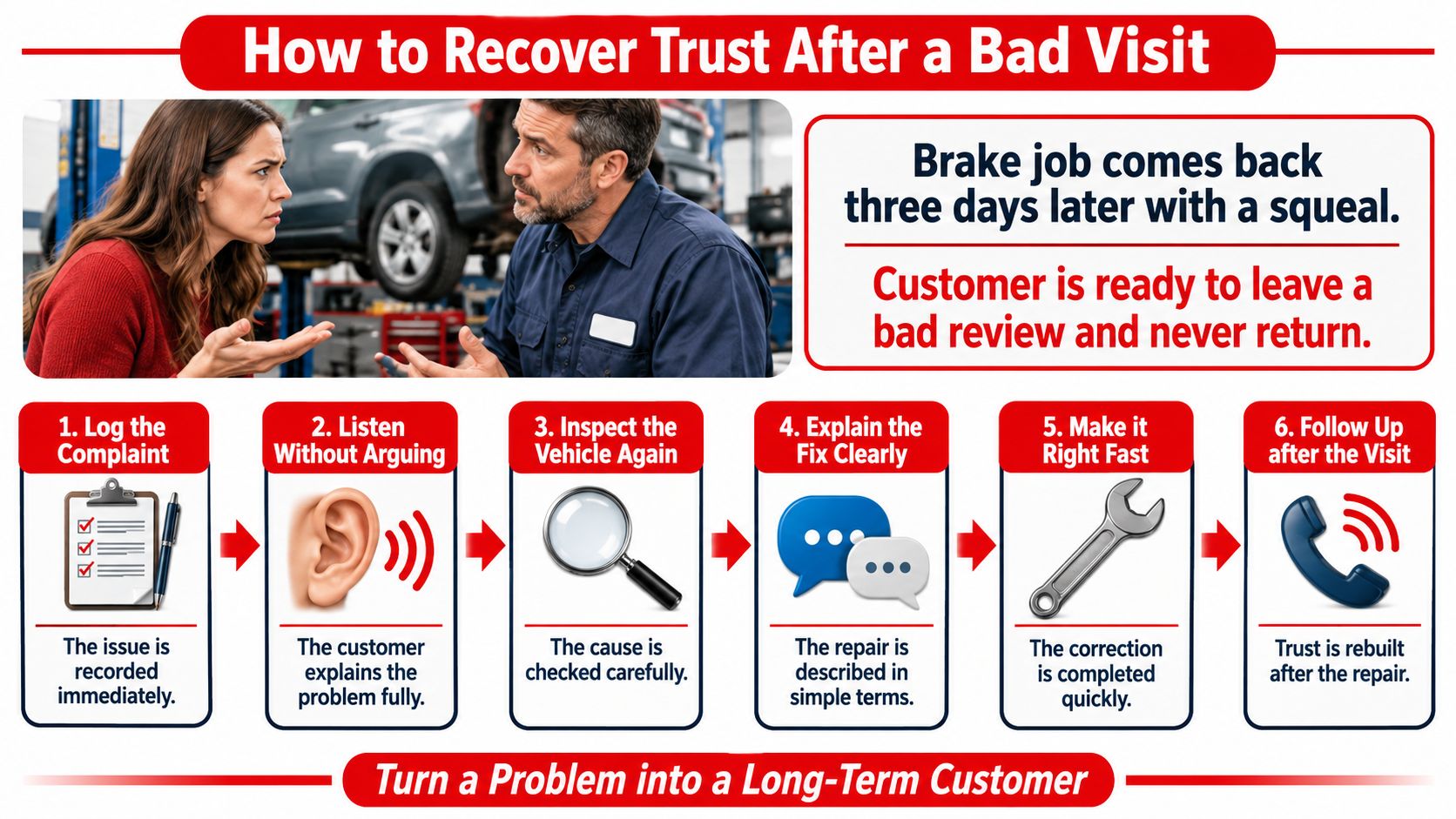
Recovery is a process, not a mood. Six steps cover it.
- Log the case. Vehicle, customer, failure type, technician, date. The common slip is a note on a sticky pad. If the detail isn't in the record, the next advisor makes the customer tell the story twice, and that second telling does more damage than the squeal.
- Acknowledge the same day, by phone if the customer is angry. Speed is the mechanism, not a courtesy. An found that response speed had a statistically significant positive effect on relationship quality (β = 0.27, p < 0.001) and on customer loyalty (β = 0.23, p < 0.001). The common slip is a form email that reads like a ticket number.
- Find the operational cause. A missed torque check, a shim that wasn't inspected, a road test that got skipped on a busy afternoon. The common slip is blaming the part supplier, which tells the customer the shop doesn't control its own work.
- Offer a fair remedy. Rework at no charge, refunded labor, priority scheduling when the bay is full. The most frequent mistake in the whole process is offering a discount before explaining what went wrong. Money before explanation feels like being bought off, and customers remember the feeling longer than they remember the refund.
- Confirm in writing. A short text or email stating the fix is complete, the vehicle was re-checked and who signed off on it. Written confirmation is what the customer shows a spouse or reads again at midnight.
- Record it and read the pattern. Group cases monthly by technician and job type. The common slip is treating each comeback as bad luck, which guarantees the same failure next quarter.
A customer who gets a straight answer and a fast fix often ends up more loyal than one who never had a problem at all, because the first customer has proof of how the shop behaves when things go sideways.
Build a Maintenance Reminder Program Customers Accept
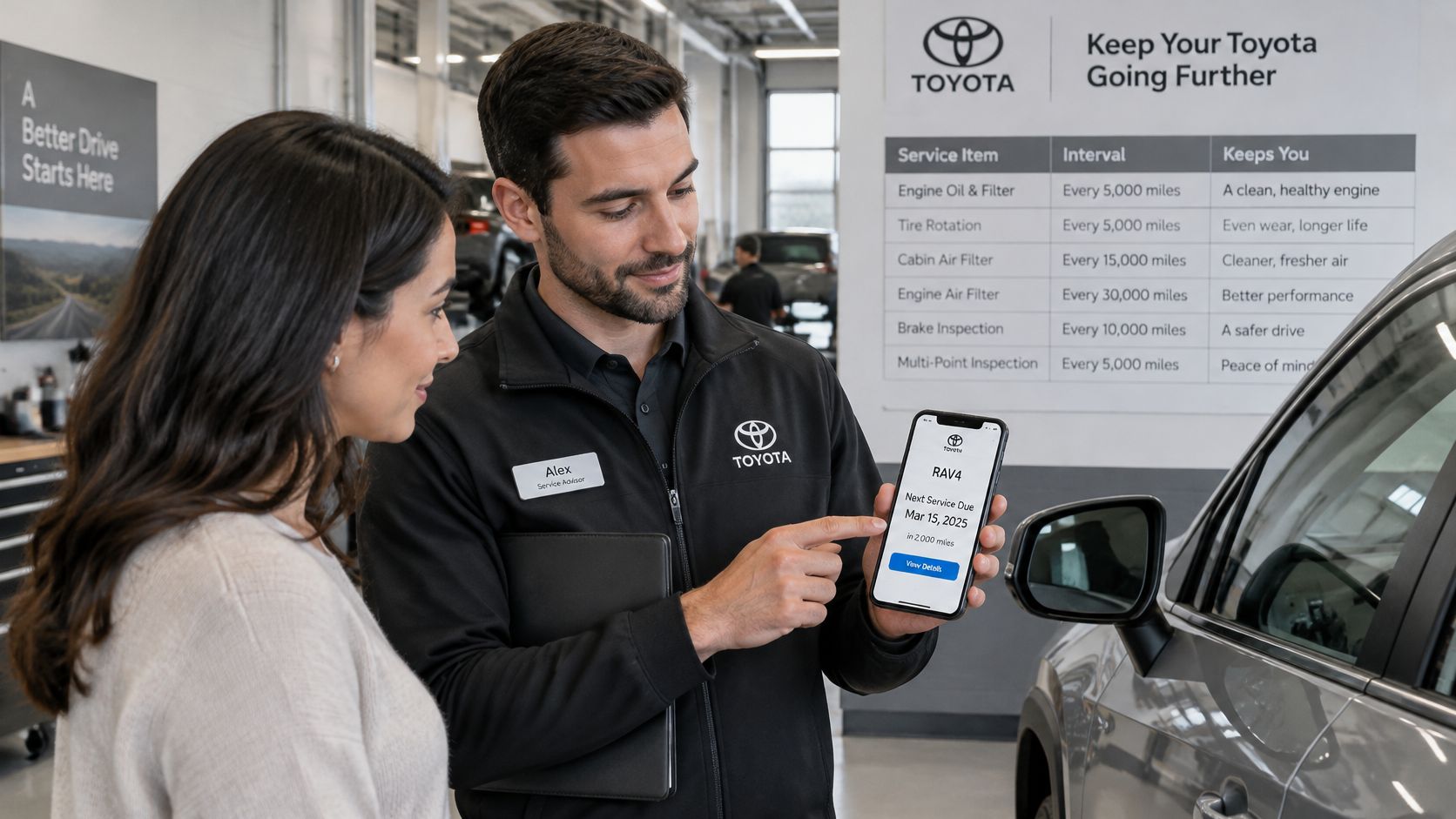
A reminder earns its place only when it arrives before the service is due and names the specific vehicle. Blast a generic "time for service?" text to the whole list and the good customers learn to ignore the shop's number.
Interval knowledge has to sit behind the timing. Most modern engines call for oil changes somewhere between 5,000 and 10,000 miles, depending on the manufacturer's schedule and the oil specification the engine was built for. Tires want rotation well before the tread tells you, brakes need a look at least once a year on a daily driver, cabin filters load up with use, and a battery that's three years old deserves a yearly test before the first cold snap.
| Service | Reminder timing |
|---|---|
| Oil change | 2 weeks before due mileage or date |
| Tire rotation | 1 week before due |
| Brake inspection | 4 weeks before due |
| Cabin air filter | 3 weeks before due |
| Battery test | 4 weeks before the anniversary |
Permission is the part shops skip, and it's the part that decides whether the program works. reports that 88% of consumers want brands to explain how their data is protected, while only 49% feel reassured that companies handle data responsibly. 75% expect transparency when AI is used for recommendations. Applied to a repair shop, that means telling customers plainly why mileage, service history and plate or VIN data are used, and showing the source of a recommendation such as the last inspection or the manufacturer's interval.
Keep safety and selling apart. A brake wear notice and a discounted alignment should never share a message, because bundling them teaches the customer that safety warnings are marketing.
Edge cases break more reminder programs than bad copy does. A sold car needs the vehicle marked inactive and the record linked to a new owner if that person becomes a customer. A shared vehicle needs one primary contact and one reminder, not three. Wrong mileage gets corrected from the odometer photo at check-in, with a one-line apology and no argument. Multiple drivers in one household get one message per vehicle. An opt-out gets honored the same day, with the safety note kept in the file for the next visit.
When the expected interval passes with no booking, send one personal recall that names the vehicle and the overdue service. Then stop. A second and third message turns a lapsed customer into a blocked number.
Front-Desk and Bay Habits That Build Loyalty
Trust beats price at the moment a customer decides where to take the car next. In the, 22% of consumers named "I trust them" as the single leading reason they returned to a dealership for service, ahead of the vehicle deal at 12%, knowledge of service history at 11%, location at 8% and general friendliness at 8%. The same study found 74% of consumers who had returned for service said they were likely to buy their next vehicle from that dealer, against 44% of those who hadn't.
The opposite force is just as strong. A found that service-related problems, including failures, inconvenience and the way a business responds to failure, accounted for about 70% of the stated reasons customers leave, while pricing strategy accounted for 17%. Most churn is operational, not financial.
Habits that build the trust:
- Use the name and the car. "Morning, Dana. The CR-V's ready" lands differently than a ticket number called across the counter.
- Explain every declined item with a photo and a plain reason. Not a sales script, a reason: "the rear pads are at 4mm, here's the photo, they'll be due in about six months."
- Call back at the promised time, even with bad news. A delayed part call at 2pm beats silence until 5pm, every time.
- Write the next due date on the invoice before the customer stands up. It turns a goodbye into a plan.
- Send the technician out for two sentences at pickup on complex jobs. Nobody explains a repair better than the person who did it.
One training habit pays off faster than any of them. Once a week, run a five-minute role-play of a comeback call, with one person playing the upset customer. Ask the team what they'd say and, more usefully, what they'd avoid. These habits cost almost nothing, and they make recovery possible, because a customer who trusts the shop will give it a chance to fix a problem instead of disappearing.
Retention Numbers to Track Each Month
The most common measurement mistake is counting new customers as retained customers. That single error lets a shop report healthy growth while its actual base erodes, because new volume covers the churn.
The standard customer retention rate strips new customers out. Take customers at period end, subtract everyone acquired during the period, divide by customers at period start. lays out that formula and the surrounding metrics, and the exclusion of new customers is the whole point of it.
| Metric | How to calculate | How to read it |
|---|---|---|
| Customer retention rate | (customers at period end minus new customers) divided by customers at period start | Rising is better; check it monthly |
| 30, 90 and 180-day repeat rate | Share of customers who return within each window after their last visit | Compare cohorts, not the whole base |
| First-time-fix rate | Repairs completed correctly without a callback, divided by total repairs | A drop points to a process or technician issue |
| Callback resolution time | Hours from the customer's complaint to a confirmed fix | Shorter is better; track the median |
| Estimate-to-invoice variance | Difference between the approved estimate and the final invoice | Near zero means trust is intact |
Average repair order belongs next to those five, since a small lift on returning customers usually beats a big percentage gain on first-timers. So does days since last invoice, which is the earliest warning a shop gets.
Cohorts turn the numbers into decisions. Group customers by last visit date, vehicle age or repair category, and the picture sharpens: a reminder change that lifts repeat visits among three-year-old SUVs may do nothing for fleet trucks. Run the same cohorts every month, one page, five numbers, no new dashboard software required.
Watch completed repair visits and margin, not message clicks. Open rates can climb while actual visits fall, and a reminder nobody acts on is just noise with a good subject line.
Start Your Retention Plan This Week
Three actions, all doable before the next Monday.
Pick one stage and fix only that one. Take the stage where the last ten complaints clustered and rebuild that single step. Adding a second initiative before the first one works is how retention projects die.
Run the thank-you and the seven-day check-in on every completed job. Copy the templates, set the day-seven follow-up as a task at checkout, and let it run for a month before judging it.
Log every complaint as a recovery case with a named owner and a promised resolution time. Six lines in a shared record tell you more about your operation than any customer survey.
RedAppy supports the mechanics of that plan. Every text goes out from the shop's own number and stays attached to the customer's record, so any advisor can pick up a thread without making the customer repeat themselves. Review requests can go out by text or email from the paid invoice, sending happy customers straight to Google while unhappy ones fill in a private form first, and shops using the platform see a 30% increase in repeat customers. The features page shows how the Digital Shop Board, vehicle history and analytics fit together, and the contact page is where to talk through setup for a specific shop.
Thirty days from now, pull the same five metrics for the same cohorts and compare. That gap, not the number of messages sent, tells you whether the plan is working.
Retention in an auto shop comes down to trust earned in small, repeatable moments and repaired quickly when something goes wrong. RedAppy puts digital inspections, estimates with e-signature approval, texts from the shop's own number and retention analytics in one place, so the follow-up happens on schedule instead of when someone remembers. Visit RedAppy to see how it fits the way your shop already works.
Ready to Transform Your Shop?
RedAppy helps auto repair shops create professional digital estimates with photos and videos, send them instantly via text or email, and get customer approvals in seconds. No credit card required to start.