
How to Write a Work Order: A Step-by-Step Template
A car leaves the shop after a front brake job, and the customer calls back insisting the rear brakes were never approved. The ticket says "brakes." There's a total, a signature nobody can read, and no mileage anywhere on the page. Nobody can prove what was agreed, so the shop absorbs the difference and the technician takes the blame for a paperwork gap.
That isn't a filing problem. It's an authorization problem, and it surfaces the moment a work order has to stand in for a conversation nobody wrote down. A work order is the proof of what the customer approved, what the technician found, and what was performed. Build it that way and the disputes, the warranty arguments, and the repeat diagnoses mostly stop happening.
Table of Contents
- Fields Every Work Order Needs Before Work Starts
- How to Write a Work Order Step by Step
- Turning Vague Notes Into Precise Work Order Lines
- Approval Limits, Signatures and Record Keeping
- Handling Diagnostic Work and Revised Estimates
- Build Your Work Order Template Today
Fields Every Work Order Needs Before Work Starts
A work order is an authorization and execution record, not a note on a ticket. Anyone who opens it weeks later, whether a warranty clerk, a technician chasing a comeback or a customer with a question, should see what was asked for, what was approved, what was performed and when the job closed. The treats the document exactly that way. It requires a work-control system to receive, classify, identify, estimate, approve, schedule, track, account for, analyze and report work from initiation through completion, with a unique identifier so a job can be followed through planning, approval, execution and historical documentation. It also expects tasks, labor by trade, materials, equipment, safety requirements and priority on the record. A repair shop's version of that list is shorter, not looser.
| Field | What to record | Example |
|---|---|---|
| Customer and contact | Name, phone, email and preferred approval method | Text approval to the number on file |
| Vehicle identity | Year, make, model, plate and VIN | Plate and VIN checked against the registration |
| Mileage | Odometer reading before the car is moved | 86,412 at check-in |
| Customer complaint | Symptom in the customer's own words, with conditions | Grinding when braking below 20 mph |
| Inspection findings | What was measured, observed or photographed | Front pads at 2 mm, rotor scored |
| Authorized work | Repairs the customer approved | Replace front pads and resurface rotors |
| Recommended work | Declined or deferred items kept separate | Rear shocks, declined |
| Parts | Part number, quantity and new, rebuilt or used status | Brake pad set, quantity 1, new |
| Labor | Labor operation and hours | Front pad replacement and rotor resurfacing, 1.7 hours |
| Estimate and approval | Total and how and when the customer approved | $486.20 total, approved by text reply before the car entered the bay |
| Technician and status | Assigned technician, current status and completion details | Technician initials, status Completed |
Two fields carry more weight than the rest. The mileage ties the visit to the vehicle's history, and its absence is the first gap anyone spots when a warranty claim or a chargeback lands on the desk. The single repair-order number keeps every revision, supplement and invoice attached to the same car, so a second visit doesn't start from a blank page. Both belong on the first screen, not the last.
The brake job test: a complaint of grinding below 20 mph, findings of front pads at 2 mm and a scored rotor, and approved work of pad replacement plus rotor resurfacing is a complete record. "Customer wants brakes checked" is not.
Consistency matters as much as completeness. If one advisor writes the complaint as a paragraph and another types four words, the shop's reports stop comparing like with like and the history becomes unsearchable. Every service history record should carry the mileage, the technician who worked on it and a summary of the work, so the next person reading it gets a usable account rather than a name and a total. Shops that take a high volume of phone traffic often pair this structure with a to capture the complaint accurately at the first call, before the car ever reaches the bay.
Save that table and use it as the checklist for the next write-up. If a row is still blank when the keys change hands, the record isn't finished.
How to Write a Work Order Step by Step
The sequence below is what holds up when a job gets complicated. It's four moves in the graphic and nine in practice, and skipping any of them is how a total ends up on the page before the parts lines do.
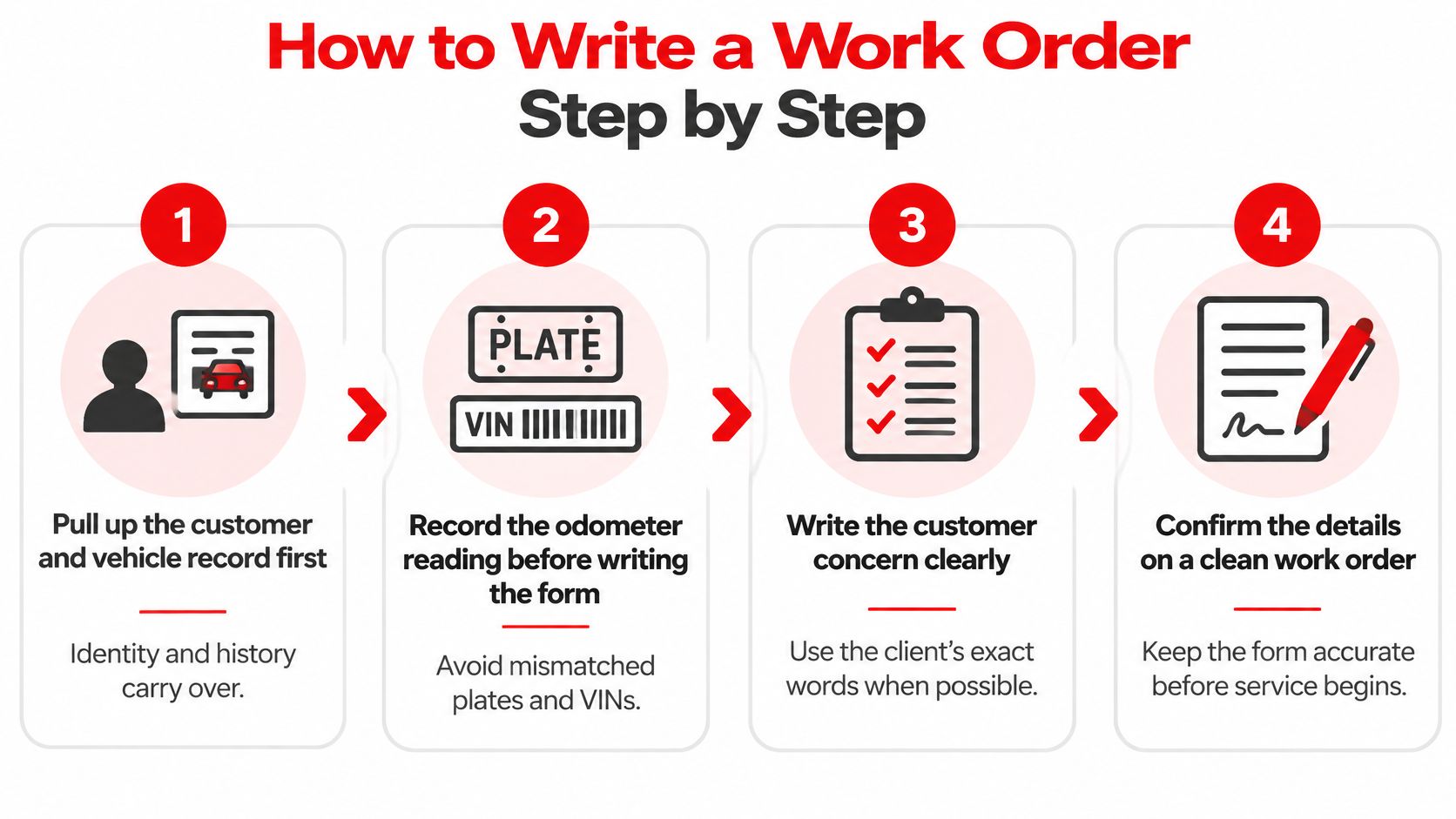
- Pull up the customer and vehicle record first. On RedAppy's Estimates or Invoices list, Find Customer opens matching customers and vehicles with New Estimate and New Invoice buttons, which start a write-up with the customer and vehicle already filled in. Retyped details are exactly where plate and VIN mismatches start.
- Record the odometer before the car moves. A reading taken from memory at closing time is a guess. Missed mileage is the most common gap when a warranty question arrives.
- Write the complaint in the customer's words, with conditions. "Grinding when braking below 20 mph, worse when cold" tells a technician where to start. "Brakes bad" tells them to guess.
- Record findings as measurements, photos or codes. Pads at 2 mm, a scored rotor, four timestamped photos and a stored fault code can be verified by a stranger. A conclusion can't.
- Split authorized work from recommended work. Declined items sit on their own line with a reason. Blended lines are how an approved total grows.
- Add each part with a number and condition, each labor operation with hours. New, rebuilt or used changes the price and the guarantee. A part number lets the next technician order the same part.
- Send the estimate and capture the approval. A RedAppy customer receives the estimate by SMS or email, opens a link, reviews the labor, parts and total, and approves it from their phone. A recorded approval is the difference between a repair and an argument.
- Assign the technician and keep the status honest. A job marked "in progress" that's waiting on a part skews every schedule in the shop.
- Close with completion details. Note the final test, what was done and the closing status. The close-out is the only part of the record future decisions can be built on.
What the estimate itself must show
An itemized estimate separates parts from labor instead of presenting one combined total. sets out what a written estimate carries: customer name, address and telephone number, the estimate's date and time, vehicle year, make, model, odometer reading and license tag, the customer's problem or request, labor charges based on a flat rate or hourly rate, estimated repair charges, shop supply or hazardous waste charges, estimate fees and their basis, intended payment method, an alternate authorization contact and the parts-and-service guarantee terms.
For repairs costing more than $150, Florida requires the customer to be offered a choice: request a written estimate, receive notice when costs exceed a specified amount, or decline a written estimate entirely, signed and dated by the customer. That signed choice is the clearest proof a shop can hold of what the customer expected.
Turning Vague Notes Into Precise Work Order Lines
"Fix brakes" is the line that ends up in front of a mediator. It can't be priced, verified or defended, because it names neither the symptom nor the measurement nor the parts. A precise line runs a chain: the customer complaint, the verification method, the measured result, the repair decision, then a post-repair check that proves the fix. Washington's automotive-repair statute,, pushes in the same direction by requiring written estimates above its threshold to carry facility and customer information, vehicle identifiers, the odometer reading and the reported problem, and invoices that describe services and identify supplied parts and part numbers where available.
| Vague note | Precise version | Why it helps |
|---|---|---|
| Check car | Scan for codes and record each code with its freeze-frame data | Shows what was tested and what it returned |
| Fix brakes | Replace front pads and resurface both front rotors, with part numbers on the line | Makes the scope and parts checkable |
| Noise | Grinding on hard braking below 20 mph, reproduced on road test | Lets the next technician reproduce the complaint |
| Intermittent no start | Battery load test at 12.4 V, voltage drop measured at the starter circuit, crank time recorded, ten start cycles logged after repair | Ties the decision to measured results and a post-repair test |
| Oil leak | Dampness at rear main seal, no drip on the floor, confirmed with UV dye | Separates a leak from a stain and supports the repair scope |
Every line also needs the technician's identity, the time, the parts supplier and part number, whether the part is new, rebuilt or used, and the labor basis in hours or a standardized operation. Declined recommendations go somewhere separate from authorized work, never folded in.
Four failures cause most of the damage. Starting unauthorized work. Commingling declined and approved operations in one block. Omitting mileage or part identity. Closing a job without a post-repair test. Each one is cheap to prevent at the point of writing and expensive to defend later.
The test for any line: could a technician who wasn't there read it and reproduce the job without walking over to ask the advisor what was meant?
A final advisor review catches what the bay missed. Reconcile estimate against actuals, record any additional authorization, attach the inspection photos and hand the customer a complete copy.
Approval Limits, Signatures and Record Keeping
A printed approval limit turns a dispute about memory into a check against a number. Set the shop rule, print it on every estimate, and treat any move past it as a new authorization, not a courtesy call.
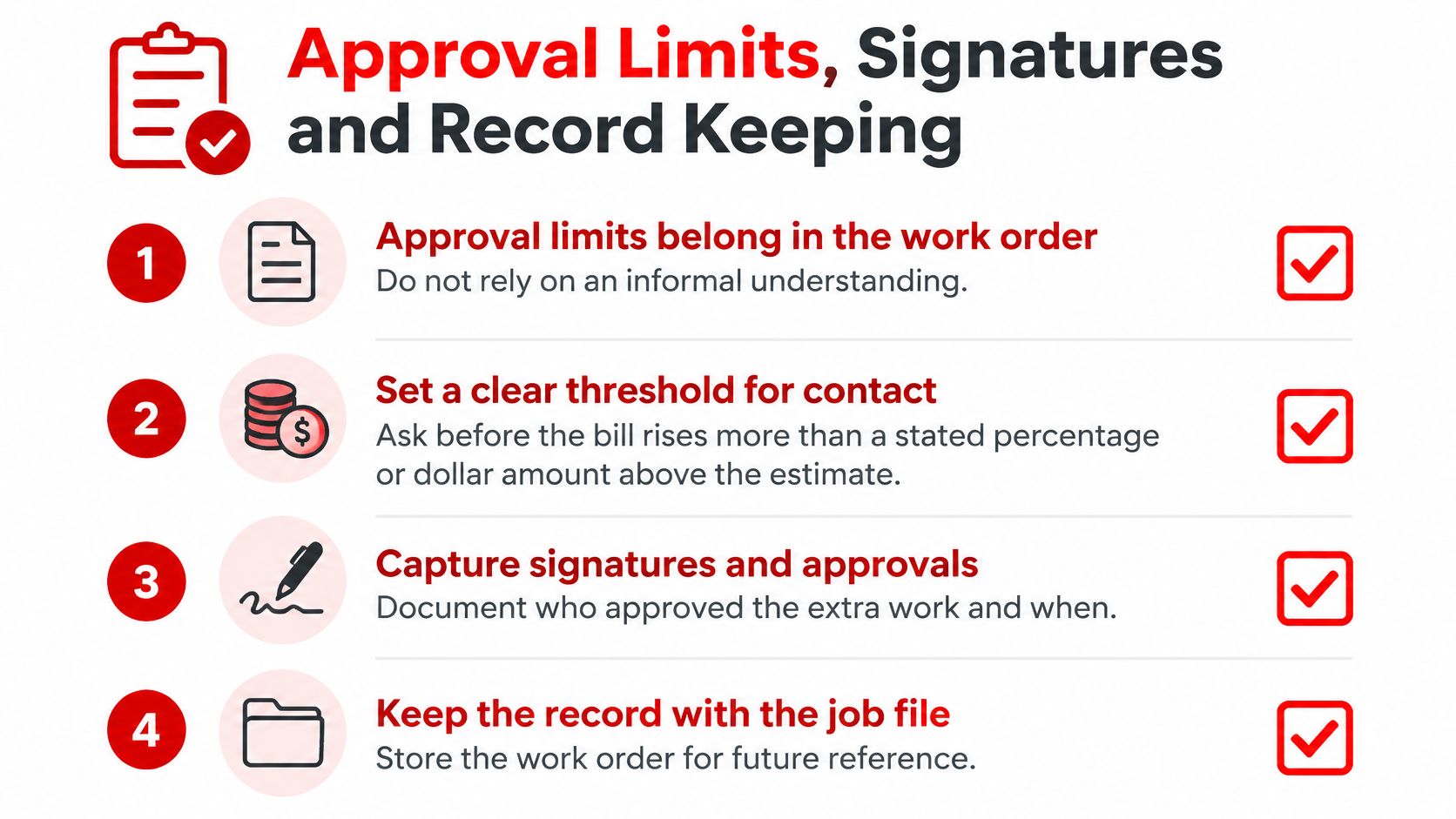
Take an estimate of $400 with a stated 10 percent limit. Anything above $440 needs fresh approval, and that approval has to name the added parts, added labor, revised total, who gave it and how. “Customer said go ahead” with no name, time or method is a hole in the file.
Why the shop must set its own threshold
State rules do not line up, so the safest number is the one the shop writes down. The says a customer must authorize repairs exceeding the estimated pre-sales-tax total by more than 10 percent. The Florida motor vehicle repair guidance draws a different line: approval before repair cost is exceeded by more than $10 or 10 percent, whichever is greater. The requires customer approval before the repair method or parts change on an authorized, itemized work order, with the authorization recorded. A shop near a border, or one that has never checked its rule, should print its own limit and apply it even when local law would allow more.
Keep the proof in three places. Method: write text, e-signature, recorded line or in-person initials on both the work order and the invoice. Evidence at the moment: when approval rests on something found, attach the photo or test result to the revision before the call is logged. One number: revisions, supplements and declined items stay under the original repair-order number so the record reads as one job.
Signoff checklist before release: one repair-order number stays open until the car leaves, every overrun is tied to a named approval and method, photos or test results sit with the revision they justify, and the customer copy matches the authorization trail.
The expensive miss is the informal yes. A waiting-room approval for two extra diagnostic hours feels handled, nobody logs it, and the invoice lands on a total the customer does not recognize. The work order is the proof of what was approved; if the approval is not in it, the extra work is hard to defend and usually gets discounted.
Handling Diagnostic Work and Revised Estimates
Most writing advice assumes the repair is known before the work order is created. Plenty of jobs don't work that way. An intermittent fault, a noise that only appears cold, a transmission that might need a teardown: pricing these in advance means guessing, and a guess written into a work order becomes a promise the shop can't keep. The honest structure is two documents, not one stretched one.

Stage one is an authorization to find out
The first work order authorizes diagnosis, not a repair. It states the diagnostic fee, a spending cap, what access the shop may use (road test, trim removal, disassembly) and the point where testing stops and the customer gets a call. That last item matters most. Without a stop point, a diagnostic cap turns into a number nobody agreed to.
Stage two is a revised estimate tied to findings
Say an intermittent electrical fault comes in. Stage one authorizes a scan and a wiring test up to the cap. The findings show a chafed harness at a connector. The revised estimate then lists the harness section, the connector, the labor hours and the new total, and it goes out for approval before the repair begins.
Teardown-dependent work follows the same shape with a harder gate. California's Bureau of Automotive Repair defines a work order as a document containing the customer's requested repairs, the estimate for that specific job, the customer's authorization and the vehicle's odometer reading, and requires recorded authorization before additional repairs. Where external transmission adjustments fail to correct a problem and a full teardown is needed, the shop verifies that removal and disassembly are necessary and prepares a revised work order describing every additional part and labor operation with the total revised cost. The same rule requires records to be kept for at least 3 years and made available for inspection during normal business hours, which is another reason to keep every revision under one repair-order number.
Two writing habits make the two-stage approach work. The original complaint stays in its own field, untouched, while the technical diagnosis goes in a separate one, so the record shows how understanding changed without rewriting history. Declined recommendations are logged with the reason and the time they were declined. RedAppy's multi-point inspections can include photos of what's found, and the results can be sent to the customer so they can approve the work, which keeps the revised estimate anchored to evidence rather than to a description.
More detail isn't automatically safer. A firm repair promise made before diagnosis is less accurate than a record that separates confirmed symptoms, test procedures, possible causes and conditional repairs.
Build Your Work Order Template Today
Everything above fits into one reusable template with five blocks.
| Block | Fields to fill | Sample entry |
|---|---|---|
| Header | Repair-order number, customer contact, vehicle identity and odometer | RO 4127, text approval number on file, 2016 sedan, plate and VIN verified, 86,412 miles |
| Complaint and findings | Customer's words, conditions, measurements and photo references | Grinding below 20 mph; front pads 2 mm; 4 timestamped photos |
| Authorized work | Approved operations with labor hours | Replace front pads, resurface both front rotors, 1.7 hours |
| Recommended work | Declined or deferred items with reason and time | Rear shocks, declined by text reply |
| Parts and labor | Part number, quantity, new, rebuilt or used, and supplier | Brake pad set from supplier invoice, quantity 1, new |
| Approval and completion | Total, approval method, approval limit, technician, status and closing test | $486.20, e-signature approval, 10 percent limit, technician M.R., Completed, road test passed |
Run it on the next three jobs and note which block gets skipped most often. That block is the one to tighten, because the field nobody fills is the field that goes missing when a claim arrives.
A shop management system holds the whole structure in one place. Estimates go out by text or email and come back approved with an e-signature, and the Service Timeline lists every invoice and estimate for a vehicle, newest first, with status, date, technician and the jobs done. Shops that want the template built into their own workflow can request a walkthrough, and the estimate, approval and timeline tools show how the blocks connect.
One rule outlasts every template: if a line can't be checked by someone who wasn't in the bay, rewrite it before the car leaves.
RedAppy gives auto repair shops one place to build the estimate, capture the customer's approval from their phone, and keep every revision attached to the same vehicle history, so the record that protects the shop is created while the car is still on the lift. Its digital inspections, estimate approvals and Service Timeline turn the five blocks above into a workflow rather than a form to remember. Visit RedAppy to see how a work order that holds up later starts with the write-up you do today.
Ready to Transform Your Shop?
RedAppy helps auto repair shops create professional digital estimates with photos and videos, send them instantly via text or email, and get customer approvals in seconds. No credit card required to start.