
Hybrid Vehicle Maintenance Guide for Shops and Owners
A hybrid arrives with a warning light, a customer expecting a quick answer, and a bay already full of gasoline work. The oil looks familiar, the brakes look familiar, and then someone spots orange cabling and realizes the usual routine isn't enough. That's where hybrid vehicle maintenance goes wrong in busy shops. It's not a harder oil change. It's dual-system work on an engine and a high-voltage system that share one vehicle, one estimate, and one customer conversation. Shops that handle it well don't guess faster. They isolate safely, record evidence first, and quote only what testing has confirmed.
Table of Contents
- Hybrid Maintenance Intervals at a Glance
- How to Isolate a Hybrid Before Any Hands-On Work
- Tooling and Parts for Hybrid Work
- Preventive Inspection Checklist for Hybrid Shops
- Diagnosing Hybrid Warnings and Building the Estimate
- Cooling and Brake Service Done Right
- Set Up Your Shop Workflow Before the Next Hybrid Arrives
Hybrid Maintenance Intervals at a Glance
Start with a schedule that fits the vehicle in the bay, not a generic interval copied from a gasoline car. Pull the owner's manual schedule for that model, mark the items that are model-specific, and record every reading so the next visit has a comparison point.
| Service item | Typical interval | What to check |
|---|---|---|
| Engine oil and filter | By the owner's manual, often 5,000 to 10,000 miles | Leaks, oil level, filter condition |
| Brake fluid | Every 2 to 3 years | Moisture level and fluid color |
| Hybrid coolant | Per the model's maintenance schedule | Reservoir level, freeze protection, correct coolant type |
| Tire rotation and alignment | Every 5,000 to 7,500 miles | Wear pattern and alignment |
| 12-volt battery | Test at every visit, usually replaced in 3 to 5 years | Cranking voltage and terminals |
| High-voltage battery health | Baseline at first visit, compare each year | State of charge and temperature spread |
| Battery and cabin air filters | Inspect every visit | Clogging and airflow |
Which Rows Move Between Models
Oil intervals, coolant schedules, and filter access change by manufacturer and by how the vehicle is driven. A hybrid used for short trips may run its engine in brief bursts, while a highway commuter puts steadier heat into the same fluids. Brake fluid also follows time, not pad wear, because moisture lowers its boiling point even when pads look thick.
The cost claim needs the same care. In, second-generation hybrid buses recorded total maintenance costs per mile 39% lower than first-generation hybrids and 42% lower than compressed-natural-gas buses. A separate Department of Energy evaluation of UPS diesel-hybrid delivery vans found propulsion-related maintenance costs for the hybrid group were 77% higher than for conventional vans. Neither result is a retail-car promise. Generation, duty cycle, and system maturity change the answer, which is why a blanket savings percentage misleads customers.
Practical rule: Sell the schedule that can be documented for that VIN, not a savings story borrowed from a different vehicle class.
Fleet operators tracking many powertrains across depots face the same record-keeping problem at scale, and shops advising those customers can as a reference for how service data gets organized. For a single shop, the simpler version works. Record interval, mileage, fluid condition, battery readings, and filter condition at every visit, then compare trends instead of reacting to age alone.
How to Isolate a Hybrid Before Any Hands-On Work
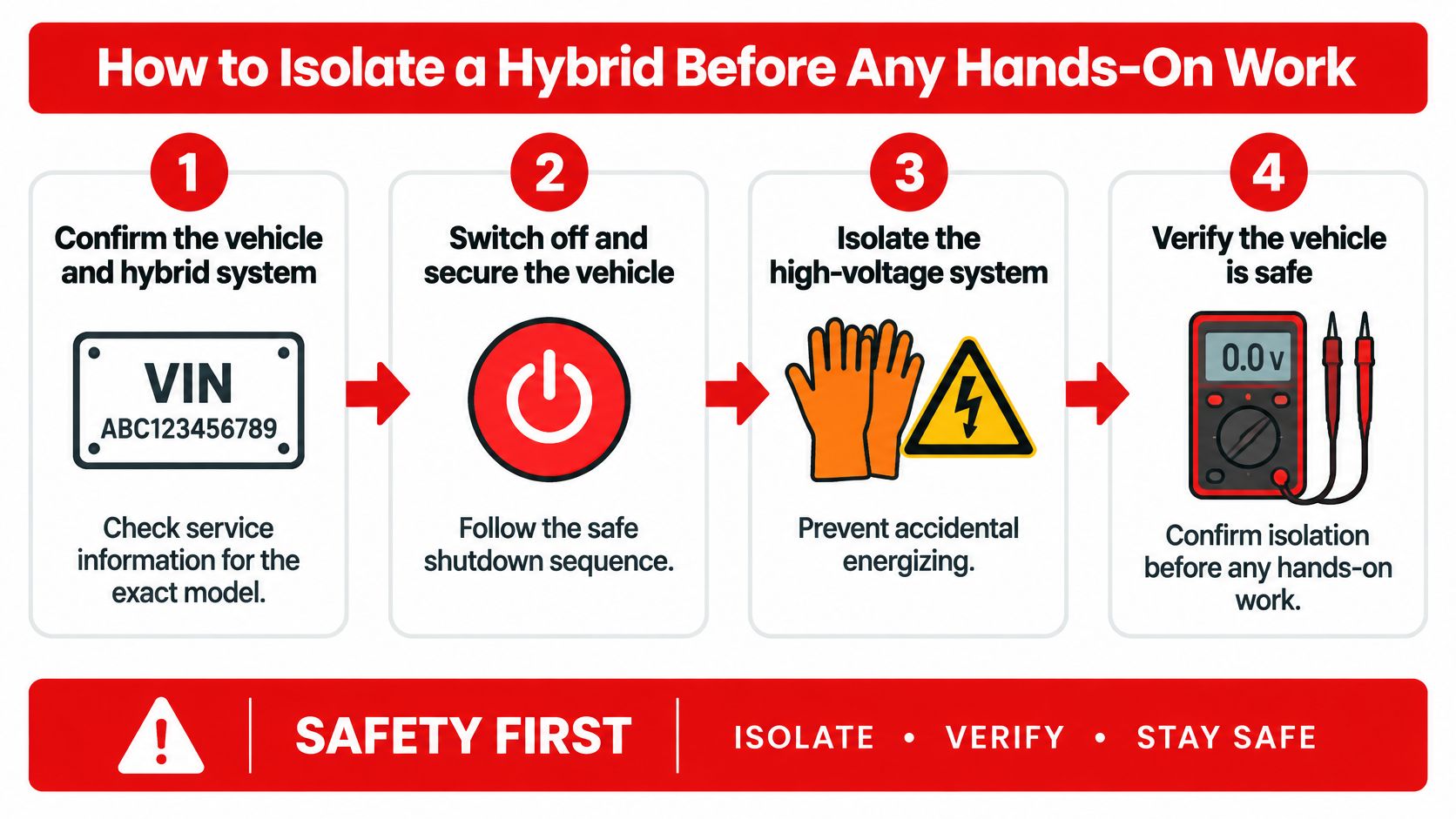
Isolation comes before diagnosis, and diagnosis comes before parts removal. A skipped step doesn't save time if a capacitor still holds charge or another technician reactivates the vehicle mid-job.
The Safe Sequence
- Confirm the vehicle and hybrid system: Match the VIN or plate to manufacturer service information for the exact model. Hybrid architecture, disconnect location, and discharge procedure differ between platforms, and guessing from a similar model creates risk.
- Switch the vehicle off: Remove the key or move the fob away from the vehicle and confirm the READY indicator is not illuminated. A silent hybrid can still be ready to move or energize systems.
- Secure against reactivation: Apply the parking brake and tag the vehicle so nobody restarts it. The tag protects the technician under the vehicle from a well-meaning coworker at the front counter.
- Disconnect and wait: Disconnect the high-voltage battery following the manufacturer procedure. instructs technicians to wait 15 minutes before beginning work after that disconnect. Stored energy needs time to fall, and the clock starts only after isolation.
- Use rated protective equipment: Wear Class 0 rubber insulating gloves inspected for pinholes, cracks, tears, or splits, plus protective eyewear. Ordinary latex or neoprene shop gloves aren't thick enough to protect against high-voltage shock.
- Prove the circuit is safe: Test the specified circuit with a properly rated digital voltmeter and confirm exposed orange cables have fallen to a safe residual voltage before contact. An absent warning lamp proves nothing about stored charge.
- Record the isolation: Write down the isolation time, meter used, measured voltage, vehicle state, and diagnostic codes retrieved. Documentation turns a safety habit into evidence another technician can trust.
The reason for the discipline is plain. states that some hybrid circuits can reach 650 V and warns that incorrect handling can cause fatal electric shock, severe burns, or explosions. The 12-volt battery isn't the only electrical risk, and it isn't even the serious one. Treating both systems as one low-voltage job is the mistake that puts people in hospital.
No meter reading, no contact. A hybrid that cannot be proven safe doesn't get touched.
When to Stop and Escalate
A flood-damaged or crash-damaged hybrid follows a different rule. It doesn't get jump-started, pushed into a normal bay for exploratory disassembly, or handed to the nearest available technician. It gets isolated, kept clear of standing water and other vehicles, and assessed by a qualified specialist with a documented safety evaluation. Damage can compromise insulation, shielding, and battery enclosures in ways a visual walk-around won't reveal. Refusing that job in-house isn't lost revenue. It's the correct professional call, and the referral should be recorded in writing for the customer.
Tooling and Parts for Hybrid Work
A hybrid bay needs its safety kit checked before a vehicle arrives, not assembled while the car sits on the lift. The order matters because each item supports the next step of the job.
Safety Kit
- Class 0 rubber insulating gloves: Inspected for pinholes, cracks, and tears before each use, stored away from sharp tools and solvents.
- Protective eyewear: Worn for every high-voltage task, including testing that feels routine.
- Insulated tools: Used where the procedure calls for work near exposed high-voltage connections.
- Properly rated digital voltmeter: Used only on the circuit the repair procedure specifies, with leads and category rating matched to hybrid work.
- Tags and lockout supplies: Kept at the bay so securing a vehicle never waits on a trip to the office.
Ordinary latex or neoprene gloves don't belong on that list as protection. They keep hands clean, nothing more, and confusing cleanliness with insulation is a dangerous shortcut.
Consumables and Sourcing
Consumables need the same precision. Shops should stock or order the factory-specified hybrid coolant for the models serviced most often, along with deionized, distilled, or soft water for any dilution the procedure allows. Brake fluid should match the grade the manufacturer lists, and cabin plus battery-cooling intake filters should be treated as regular inspection items rather than special orders. A replacement 12-volt battery must match the vehicle's specification, including venting and terminal layout where the design requires it.
Recording every part and fluid on the work order keeps job costs matched to what was installed. That record also protects the shop months later, when a customer questions which coolant went into which reservoir. RedAppy inventory tracks parts and fluids, deducts them automatically on jobs, and sends low-stock alerts, which suits consumables that disappear between hybrid jobs.
Before ordering any high-voltage component, technicians should confirm OEM part numbers against current service information and record the source of the part. A superseded number or an undocumented salvage component creates warranty and safety arguments later. Cheap sourcing on power electronics rarely stays cheap.
Preventive Inspection Checklist for Hybrid Shops
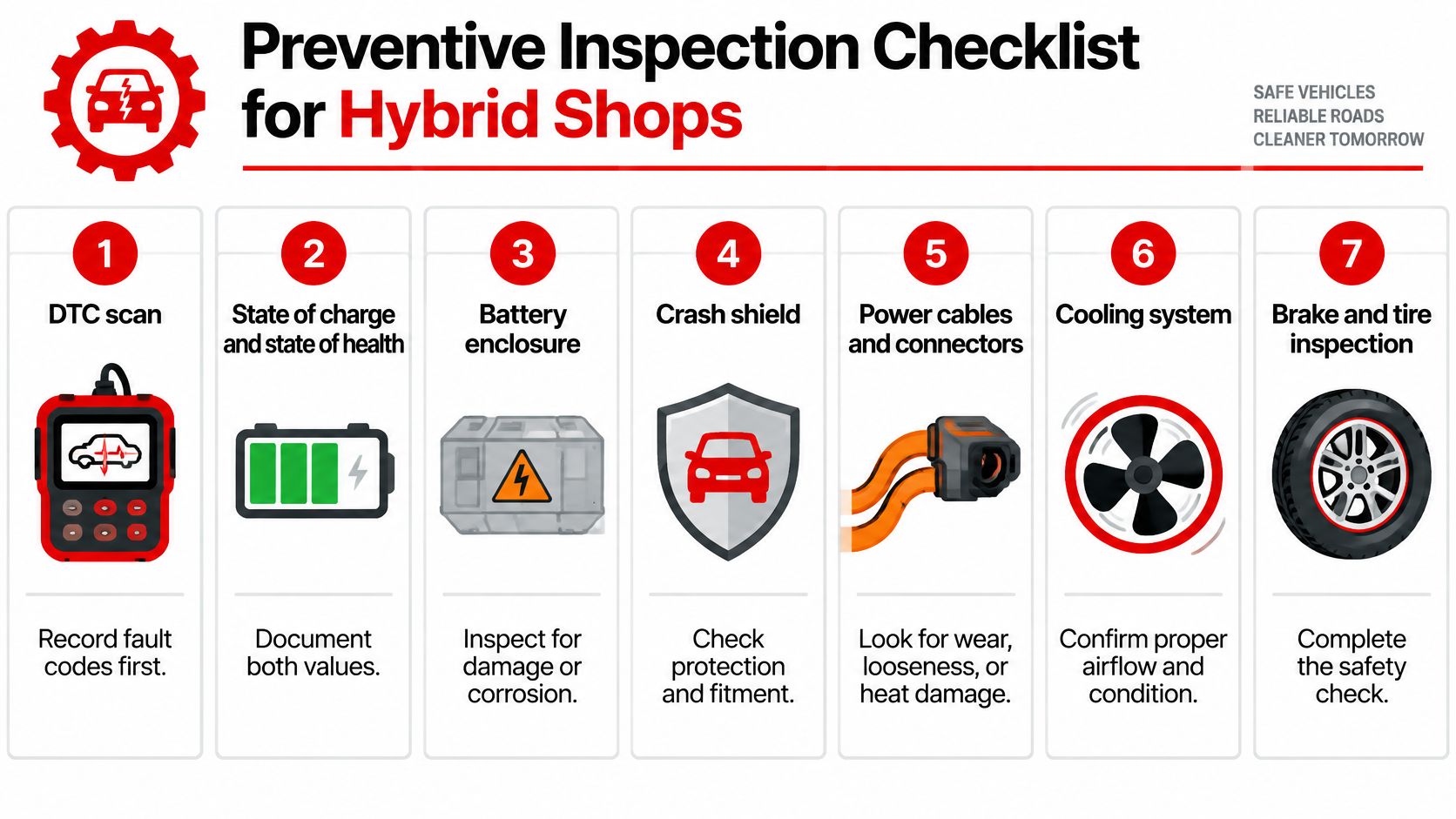
A useful inspection follows the order a technician works, from electronic evidence to physical condition. Jumping straight to oil and brakes skips the systems that decide whether the hybrid side is healthy.
Start With Scan Data and the Battery Enclosure
The first step is a full DTC scan, saved before any codes get cleared. Next, the technician records traction-battery state of charge and state of health as baseline readings. Those two numbers mean little alone and a great deal when compared across visits.
Physical inspection follows. recommends inspecting the battery enclosure, crash shield, power-management electronics, wiring, and cooling circuit for damage or leaks. That same checklist notes that hair and other contaminants can reduce heat-exchanger and fan efficiency, and one fleet evaluation it draws on reported annual traction-battery failure rates of 4.8% for first-generation hybrid buses in year one while a second-generation group recorded 0% during its evaluation year. Those are fleet figures, not passenger-car rates, but they make the point clearly. Diagnosis has to be vehicle-specific.
Cooling, Low Voltage, and Running Gear
Cooling fans, heat exchangers, hoses, and connections get checked for dust, hair, and debris that can choke airflow. Coolant chemistry and freeze protection get verified, not guessed from color. Then the 12-volt battery and control-system voltage get tested, because a weak low-voltage supply creates hybrid warnings that send shops chasing the wrong system.
The remaining checks cover transmission or power-split fluid, brake-fluid condition, brake-line integrity, regenerative-brake operation, and friction-brake wear. HVAC performance and tire alignment close the list. Poor alignment and underinflated tires cost fuel economy on a vehicle the customer bought for efficiency, so those findings belong on the report with measurements attached.
A single fault code is a starting point for testing. It is not a purchase order for a traction battery.
Why the Baseline Decides the Conversation
A repeat visit showing a falling state-of-health reading, a widening temperature spread, or repeated cooling codes is evidence. One code on one visit is a question. Shops that replace traction batteries on code alone will eventually replace a healthy pack and leave the actual fault for the customer to address.
The practical finish is simple. Photograph each inspected item, save the readings to the vehicle's record, and complete that documentation before the customer sees any estimate. Photos of a clogged cooling intake or corroded 12-volt terminal end arguments that verbal descriptions start. The estimate then describes confirmed condition, not suspicion dressed up as certainty.
Diagnosing Hybrid Warnings and Building the Estimate
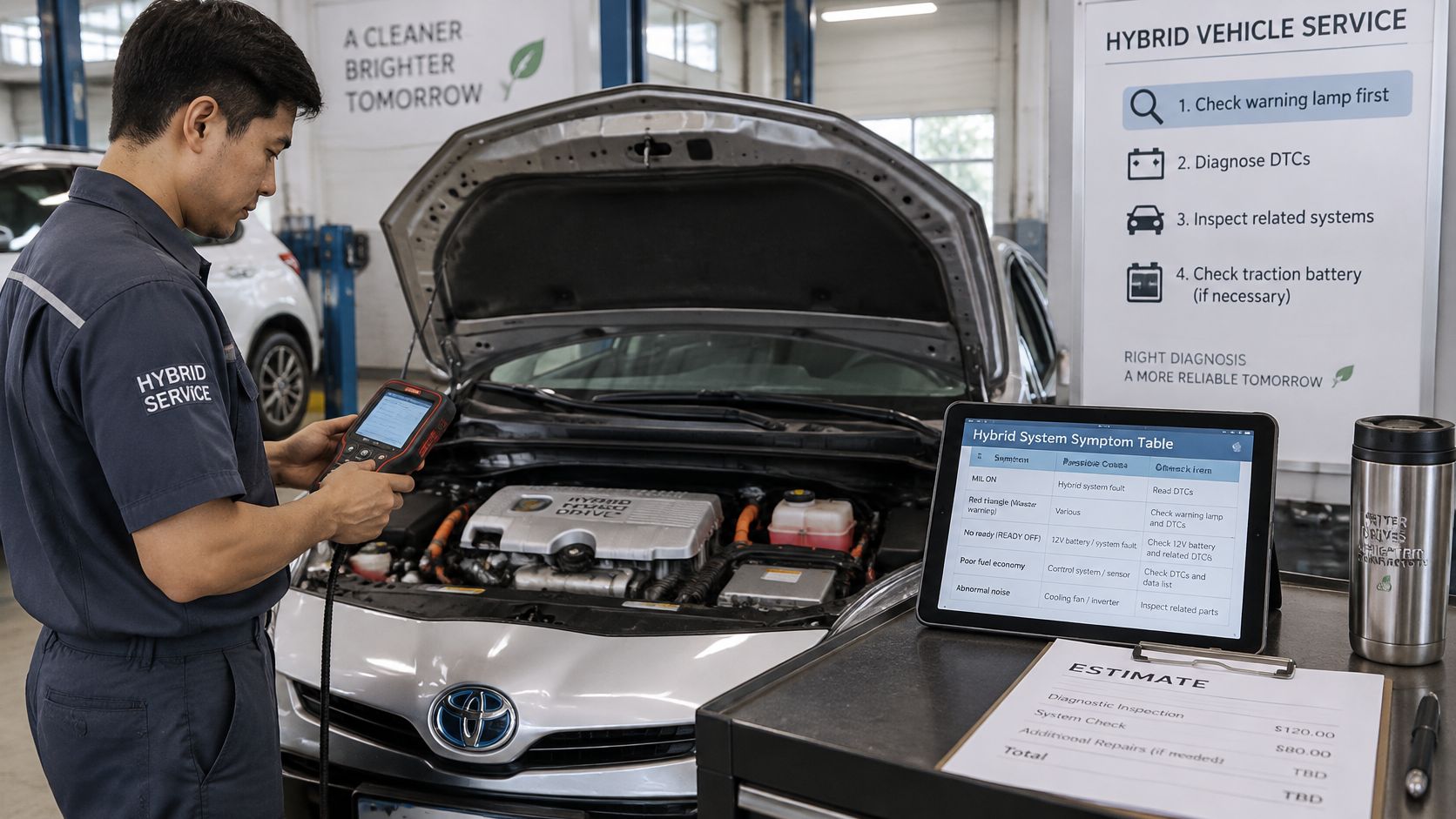
Most hybrid warnings don't point straight at the traction battery, no matter what the customer has read online. The symptom table below gives advisors and technicians a shared starting point before anyone mentions major parts.
| Symptom | Likely cause | First check |
|---|---|---|
| Hybrid warning lamp while the high-voltage battery tests healthy | 12-volt battery, cooling fan or sensor fault | Test the 12-volt battery and scan for codes |
| Reduced power on a hot day | Clogged battery cooling intake or failing fan | Inspect and clean the intake, check fan operation |
| Low state of charge after normal driving | Cell imbalance or charging fault | Compare module voltages and read history |
| No start or odd warnings after water exposure | High-voltage damage | Isolate the vehicle and refer to a specialist |
Narrowing Tests Before Any Big Quote
Each symptom has a cheap test that narrows the field. A warning lamp with a healthy pack sends the technician to the 12-volt battery first, since low control voltage corrupts module behavior across the vehicle. Heat-related power loss sends attention to the cooling intake and fan, where pet hair and dust are common, unglamorous culprits. Low charge after normal driving calls for module-voltage comparison and a history read, looking for imbalance patterns rather than a single low reading.
Temperature spread across the pack matters as much as voltage. One hot section beside cooler neighbors points toward airflow or a failing module, and those two causes carry very different prices. History data shows whether the fault is new, recurring, or slowly worsening, which changes whether monitoring is responsible or reckless.
The cost of guessing wrong is steep. puts a hybrid battery at about $5,000, while an inverter assembly may reach $8,000. At those numbers, an hour of testing isn't an upsell. It's the cheapest line on the invoice.
Label Every Finding Three Ways
Estimates stay honest when each finding carries one of three labels: confirmed, suspected, or ruled out. A confirmed fault has test evidence attached, such as a failed 12-volt load test or a measured module imbalance. A suspected fault has symptoms pointing toward it but still needs deeper testing the customer hasn't approved yet. A ruled-out item tells the customer what was checked and cleared, which builds trust and stops repeat questions.
Shops should hold the diagnostic line until the customer agrees to it, approve routine work separately, and record referred specialist work in writing. Mixing all three into one lump sum guarantees a dispute when the suspected item turns out innocent.
Build the Estimate in Separate Lines
A defensible hybrid estimate separates scan and diagnosis time, isolation and safety verification, cooling-system service, high-voltage testing, and 12-volt testing. Each line describes work performed, so the customer sees why hybrid labor differs from a gasoline equivalent.
There's hard context for that difference. found hybrids averaged nearly $470 more in parts costs, more than $200 in additional labor costs, and 1.1 extra labor hours per repair than conventional vehicles. A gasoline labor guide will underquote hybrid work, and the shop absorbs the gap.
With evidence in hand, the advisor can compare OEM replacement, a remanufactured pack, module-level repair where it's safe and supportable, or continued monitoring with a scheduled recheck. Warranty status belongs in that conversation before any option gets priced. The right answer depends on remaining capacity, vehicle value, and how long the customer plans to keep the car, not on which option carries the best margin.
Cooling and Brake Service Done Right
Coolant and brakes are two separate jobs on a hybrid, and treating either one casually creates expensive comebacks. The mixing ratio table belongs at the top because technicians reach for it mid-job.
| Ambient temperature | Antifreeze to water ratio |
|---|---|
| 5°F (-15°C) | 35:65 |
| -13°F (-25°C) | 40:60 |
| -31°F (-35°C) | 50:50 |
Two Cooling Circuits, Two Reservoirs
Hybrids can run a separate cooling circuit for the inverter and high-voltage electronics alongside the engine circuit. Before service, the technician confirms which reservoir is being serviced and uses the specified coolant for that circuit. Topping off the wrong tank with the wrong fluid is a self-inflicted fault.
identifies coolant as a scheduled maintenance item, specifies deionized, distilled, or soft water when adding coolant, and warns against mixing hard water with factory-filled coolant. The ratios in the table come from that same documentation. Coolant, in other words, isn't a tank to top off and forget. It's a scheduled service with a recipe.
Shops should also check pump operation, hose condition, and temperature data during cooling service. A weak pump or trapped air pocket can mimic an electronics fault, sending diagnosis toward an inverter that was only ever overheating. Verifying flow before condemning electronics saves both parties money.
Brakes That Wear Slowly Still Age
Regenerative braking reduces friction-brake wear, so pads may last far longer than on a comparable gasoline car. That longevity hides a different set of problems. Rotors corrode, pads stick in brackets, caliper slides dry out, and brake fluid absorbs moisture on its own schedule regardless of pad thickness.
Brake lines and fluid condition therefore get checked at each visit, even when pads look nearly new. A technician should also confirm the friction brakes apply evenly, since regenerative braking can't cover every stop. Emergency braking and low-speed final stops still depend on hardware that may sit unused for long stretches.
When pads look new but the customer reports a soft pedal, check fluid and lines before blaming the regenerative system.
The work order should close the loop. Record the reservoir serviced, coolant type, mixing ratio used, freeze-protection result, and brake-fluid test outcome. Those five details take under a minute to write and settle most questions at the next visit. They also give the next technician a starting point instead of a mystery.
Set Up Your Shop Workflow Before the Next Hybrid Arrives
The workflow works best when inspection, estimate, and invoice share one record instead of living on paper, a scanner, and someone's memory. Digital vehicle inspections can include photos and videos, so customers see the clogged intake or worn component directly. Past multi-point inspection results can be reviewed to track vehicle condition over time, which turns the baseline readings from earlier visits into a trend an advisor can show. Each vehicle card shows the number of services, total spent, last visit date, and last recorded mileage, and vehicle history stays searchable by name, plate, or VIN.

Getting the job right the first time carries real weight. found 12% of vehicle repairs were not completed correctly on the first visit. Saved readings and inspection photos cut directly into that comeback risk.
The finishing task is a one-page checklist covering safety steps, inspection items, and interval reminders for every hybrid that enters the shop. Shops formalizing that checklist into a repeatable give every technician the same sequence instead of personal variations. Hybrid vehicle maintenance then becomes a standard service line rather than a special event. To talk through a setup, shops can contact RedAppy or review the RedAppy features first.
RedAppy gives independent shops digital inspections with photos, searchable vehicle history, and estimates that carry parts and labor in one record, which fits hybrid jobs that depend on documented evidence. Shops ready to turn baselines, isolation records, and confirmed faults into cleaner approvals can visit RedAppy and set up a workflow built for dual-system work.
Ready to Transform Your Shop?
RedAppy helps auto repair shops create professional digital estimates with photos and videos, send them instantly via text or email, and get customer approvals in seconds. No credit card required to start.